Hillary Frey

Best nonfiction of 2006

Forget the political treatises. This year, the nonfiction books that captivated us most told stories: Of food, of family, of secrets.

Political books — from Frank Rich’s media critique,“The Greatest Story Ever Sold,” to Lawrence Wright’s 9/11 investigation, “The Looming Tower” — stole much of the spotlight on nonfiction this year. But the books that captivated us most in 2006 told stories: of family, of food, of a double life. We promise they’ll entertain you — and surprise you, too.

“Sweet and Low: A Family Story” by Rich Cohen

Cohen’s maternal grandfather, a former short-order cook, invented the sugar packet and Sweet ‘n’ Low, the artificial sweetener that made him a millionaire. Cohen’s mother was disinherited by her own mother, and his Uncle “Marvelous” Marvin, who took over the company, got into trouble with the FBI — a little thing they call tax evasion and criminal conspiracy. Then there’s Aunt Gladys, who hasn’t stepped out of the family home in Midwood, Queens since the Nixon administration, yet still manages to pull all the strings. With this book, Cohen aims to nail down what really happened in his clan’s highly mythologized saga. His digressions on the history of, say, Brooklyn or sugar or the Walburg banking dynasty, might strike some as padding, but he describes it all with an economical, pugnacious wit that never falters. The heart of the book, though, is a long, complicated and darkly funny family feud encompassing intrigues, sabotage and widely divergent stories about what really happened and when, and of course, who it can all be blamed on.

Read an interview with the author and an excerpt | Read a review | Buy this book

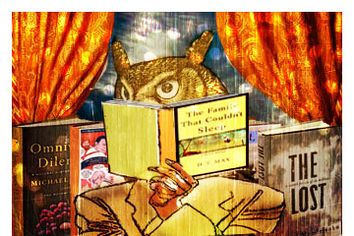
“The Family that Couldn’t Sleep: A Medical Mystery” by D.T. Max

A tiny protein that works in mysterious ways is the villain at the center of this elegantly spun tale of the quest to find out what elusive agent lies behind Mad Cow disease, scrapie and the brain disorder that has caused the descendants of one16th-century Venetian doctor to die of terminal sleeplessness. The story glides effortlessly from a canalside palazzo to Scottish sheep farms to the depths of the New Guinean jungles, where the members of a cannibal tribe succumbed to a plague called “the “laughing death.” Spotlight-hogging doctors battle, backstab and misbehave but eventually the culprits — christened “prions” by one media-savvy researcher — are identified. And, man, are they scary: unkillable by most conventional antibiotic and antiviral tactics — mostly because they aren’t even alive to begin with. Max writes so lucidly you hardly notice how much you’re learning, and the book’s suspenseful narrative never flags. This is science writing at its best.

Read an interview with the author and an excerpt | Buy this book

“The Lost: A Search for Six of the Six Million” by Daniel Mendelsohn

When Daniel Mendelsohn was a boy, he would walk into family gatherings and find that the mere sight of him would move his older relatives to tears. “Oh, he looks just like Shmiel!,” they would cry, in Yiddish. All Mendelsohn knew of Shmiel was that he, the oldest brother of his grandfather, had been killed, along with this wife and four daughters, by Nazis during the war. That crumb of information was tantalizing enough to inspire long-lasting curiosity  and, as its subtitle makes plain — “The Lost” is Mendelsohn’s attempt to find out who these relatives were, and what exactly happened to them. After traveling thousands of miles, visiting the Ukraine, Israel and any place else where someone might have known someone else who knew his uncle, Mendelsohn discovers that the truth of what happened to his relatives was quite a bit more complicated — and surprising — than anyone had known. The story is gripping, but along the way “The Lost” reveals itself to be so much more than a Holocaust family memoir: it’s also a page-turning mystery, a lesson on how history is written and a work of religious scholarship. This is a book that you start and think: I have never read a book like this one before.

Read an interview with the author | Read an excerpt | Buy this book

“James Tiptree Jr.: The Double Life of Alice B. Sheldon” by Julie Phillips

Alice Sheldon had many selves. As a child in the 1920s, she went on safari through Africa with her socialite parents. She could fly planes and shoot guns. During World War II, she worked for military intelligence and after it, for the CIA. She was a clinical psychologist, and published a short story in the New Yorker. But her most daring and successful adventure in self-creation was posing for several years as a man, the innovative science fiction writer James Tiptree, Jr., who carried on many intense correspondences with such authors as Ursula K. Le Guin and Phillip K. Dick, until her real name and gender were discovered by tenacious fans. Everyone who knew “Tiptree” was flabbergasted to learn “he” was really a woman, but whether anyone really knew Sheldon — even her husband of decades, with whom she died in a suicide pact — is the question Julie Phillips pursues in this astute, sensitive and always fascinating biography. The life was remarkable, and so is the telling of it.

Read an interview with the author and an excerpt | Read a review | Buy this book

“The Omnivore’s Dilemma” by Michael Pollan

If most food writing seems like an covert form of narcissism, Pollan explodes the genre out of its navel-gazing constraints and offers a rare, expansive view of what and how we eat. Inexhaustibly inventive and imaginative, Pollan jazzes up what could have been a dreary jeremiad about the “industrial food chain” by inviting us to view the modern American diet as the triumph of a formerly obscure South American grass that has manipulated humanity into making it one of the most successful plants on earth: King Corn — it’s in nearly every processed food. He highlights an obscure scientist without whose great invention — the synthesis of nitrogen fertilizer — billions of people could not have been born (or at least, not have been fed), and he explains just how much oil goes into “making” one conventionally raised steer (about a barrel). There’s an observation to blow your mind on nearly every page of “The Omnivore’s Dilemma” — the sections on “industrial organic” farming and an entirely foraged meal are also revelatory — about this most basic of human needs.

Read an interview with the author | Read an excerpt | Buy this book

Best fiction of 2006

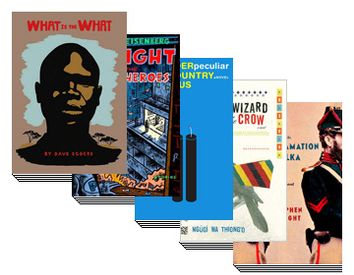
This year, stories from five extraordinary writers about Africa, 9/11's aftermath and the Civil War captivated us the most.

Africa, race and 21st century global paranoia are the prevailing themes in our favorite books this year — less a reflection of the immediate moment than of the way ideas and events slowly make their way through the imaginations of talented writers and emerge, transfigured, long after the headlines have turned yellow. Literature, as Ezra Pound put it, is news that stays news. We expect that people will be reading these books for many, many years to come.

“What Is the What” by Dave Eggers

The unusual provenance of this novel — Eggers has written it in the first-person voice of a real man, Valentino Achak Deng, and all of the events in the story are true, although not all of them happened to Deng — is complicated. The result is sublime simplicity, the ego-less conveyance by Eggers of Deng’s plain-spoken, gentle, world-weary but never hopeless voice. One of the Lost Boys of Sudan, Deng saw his village destroyed by Arab militiamen as a little boy and fled alone into a chaotic landscape before joining a troupe of similarly dispossessed boys on an epic journey on foot to a refugee camp in Ethiopia. Hunger, thirst, lions, crocodiles and soldiers on both sides of Sudan’s civil war harried all of them and killed some. Deng finally made it to the promised land of America, but we know from the start that it proved to be no paradise. The novel’s framing device — Deng imagines telling his life story to thieves who beat and bind him while robbing his house and to the jaded officials who deal with the crime’s aftermath — is inspired; instead of making him pitiful, this silent appeal emphasizes Deng’s remarkable, ineradicable dignity.

Read an interview with the author | Read an excerpt | Buy this book

“Twilight of the Superheroes” by Deborah Eisenberg

Deborah Eisenberg’s short stories seem ready-made for this age of overcommitment. In just a few deceptively straightforward pages you get all the depth, breadth and nuance that other writers require whole novels to build. The stories in this newest collection are all tinged to one degree or another by 9/11, but the attacks don’t feature as significantly as the depredations of age, psychiatric fragility and that chronic weakness of Eisenberg characters, self-doubt. (Tellingly, the one story here that makes 9/11 its main focus — the title story, unfortunately — is the only disappointment.) What lifts Eisenberg’s work above the usual fiction in this mode is her uncanny ability, shared only with Alice Munro, to conjure an entire multifarious life in the span of a few incidents. This gives her stories an unusual suspense; you’re always waiting for the moment when the spell takes its effect and a human being materializes right before your very eyes.

Read an excerpt | Read a review | Buy this book

“A Disorder Peculiar to the Country” by Ken Kalfus

It makes perfect sense that the best novel about 9/11 — a collective memory by now encrusted in a layer of pieties — would be a biting satire. Kalfus chronicles the awful divorce of New Yorkers Joyce and Marshall; things have gotten so acrimonious that when each one suspects the other has died in the tragedy, they both secretly rejoice. Don’t mistake this for a book about how 9/11 affected our personal lives, though. Instead, it’s for every nice middle-class American who pleads astonishment at the malice and savagery of the attacks. Kalfus shows us that the far-off national conflicts we find so baffling and complicated actually work a lot like a really bad divorce — both are furious clashes between people who can’t get along but who also can’t escape each other. And let’s face it: Most of us know a lot more about divorce than we do about the Middle East. The novel’s story — rich with betrayals and outrageous antics and a couple of expertly drawn and miserable kids — never staggers under its thematic load. It remains always razor sharp, true to life, light on its feet and sneakily tragic.

Read an interview with the author and an excerpt | Read a review | Buy this book

“Wizard of the Crow” by Ngugi Wa Thiong’o

Novels about African dictatorships are supposed to be dour and educational, the literary equivalent of Brussels sprouts — good for you if not especially tasty. The great Kenyan novelist Ngugi Wa Thiong’o capsizes that formula with “Wizard of the Crow,” an outrageously entertaining, madcap political farce set in the fictional nation of Aburiria, whose despot is known only as The Ruler and has been running things for as long as anyone can remember. When the book’s educated but destitute hero, fleeing a police constable, tries to throw the cop off his trail with a sign boasting of the awesome powers of the Wizard of the Crow, he inadvertently sets himself up as the sorcerer du jour. Soon, he’s mixed up in the affairs of scheming government ministers, fatuous businessmen, a ruthless political climber and an elusive band of rebels. The novel is full of disguises, mistaken identities, tall tales, slapstick, hairs-breadth escapes and double-crosses. Ngugi’s political satire is deep enough to apply to Midwestern regional marketing managers in addition to strutting West African tyrants — aren’t all tyrants the same, after all? — because its real subject is human folly in all its many, hilarious and heartbreaking forms.

Read an interview with the author and an excerpt | Read a review | Buy this book

“Amalgamation Polka” by Stephen Wright

This is not your grandfather’s Civil War novel, but who would expect that from Stephen Wright, that rare combination of literary wild man and flawless prose stylist? A Candide-like figure named Liberty Fish — child of a renegade Southern belle and the Yankee abolitionist she eloped with — joins the Union army and wends his way back to his maternal grandfather’s plantation. Along the way, he meets all sorts of people — pirates, soldiers, preachers and con men — most of them driven half (or all the way) mad by their inability to make the American dream of freedom and the American reality of race add up to anything plausible. At the end of his journey he finds the heart of the nightmare in its ultimate, florid, night-blooming manifestation: his demented grandfather, Asa, trying to create — avant Norman Mailer — a white negro. This novel is a plummet down the black rabbit hole of American utopianism, with the brakes off and the seat belts removed, and it’s one hell of a ride.

Read an excerpt | Read a review | Buy this book

- – - – - – - – - – - -

What was your favorite book of 2006? E-mail us a few sentences about it at bestbooks@salon.com before Thursday and we’ll publish your picks at the end of the week.

Continue Reading Close

Best debuts of 2006

The creator of a wisecracking high-school sleuth and a moving graphic memoirist wowed us this year with outstanding first books.

The fixation on first books often seems misplaced. (And we’ve fudged the distinction a little ourselves, since our choice for best nonfiction debut has been writing a fiction comic strip for years.) Still, there’s nothing like spotting talent in its first white-hot bolt from the gate, which is definitely the case with our fiction selection. The best thing about both of these writers is that we expect them to be moving and delighting us for decades to come.

Fiction:

“Special Topics in Calamity Physics” by Marisha Pessl

This year, from the sea of debut literary novels, Marisha Pessl’s “Special Topics in Calamity Physics” emerged with all the noise its title portends. A sprawling, ambitious and hilarious coming-of-age story, “Calamity Physics” is narrated by 16-year-old Blue van Meer, a prodigious and precocious young woman who rattles off references to books and movies with the speed of a Gilmore Girl and wins us over with the ever-gimlet eye she casts on school, boys and the confused adults that surround her. “Special Topics” follows Blue through her senior year as the new kid at a private school, where she’s swept up with a group of glamorous odd-duck students in the thrall of an eccentric and charismatic film teacher. There’s teen stuff (romances, jealousy); grown-up stuff (a terrific send-up of the academy); and mystery stuff (murder, secret societies), all of which combined make for a thrilling ride. But Pessl dazzles most at the end, when she weaves every silken thread in her book together for a surprise ending that marks her not only as a clever entertainer, but a genuine, and talented, new novelist.

Read an interview with the author and an excerpt | Read a review | Buy this book

Nonfiction:

“Fun Home” by Alison Bechdel

Alison Bechdel calls her graphic memoir a “family tragicomic,” though the story in a lesser artist’s hands would probably have come out simply sad. The book is an investigation of her own childhood, spent in the ornate Victorian house her father obsessively restored and maintained, and the way her understanding of that childhood was overturned after she came out to her parents at 19. The return whammy, delivered by her mom, was that her father had a lifelong history of affairs with men, including some of the teenage boys in the small Pennsylvania town where their family had lived for generations. A few weeks later, her father was killed in a highway accident that Bechdel believes was a form of suicide. Bechdel’s years of drawing a serial comic strip (the divine “Dykes to Watch Out For”) have honed her ability to convey oceans of feeling in a single image, and the feelings are never simple; “Fun Home” shimmers with regret, compassion, annoyance, frustration, pity and love — usually all at the same time and never without a pervasive, deeply literary irony about the near-impossible task of staying true to yourself, and to the people who made you who you are.

Read an interview with the author and an excerpt | Read a review | Buy this book

- – - – - – - – - – - -

What was your favorite book of 2006? E-mail us a few sentences about it at bestbooks@salon.com before Thursday and we’ll publish your picks at the end of the week.

Continue Reading Close

Salon Book Awards

Our five-day book extravaganza kicks off with Erica Jong, Malcolm Gladwell, Curtis Sittenfeld and some of our other favorite authors weighing in on the best reads of 2006.

For most of Salon’s existence, we’ve come to you in December bearing a list of our favorite fiction and nonfiction books of the year. We’ll do that this year, too, but this time around things are going to be a little different. Instead of one big day devoted to celebrating our favorite titles, there will be five. That’s right, a whole week of books, starting today.

Why? Well, it’s clear that you love to read about books. Some of the most popular Salon stories of 2006 have been reviews of new books (see Andrew O’Hehir’s examination of Nora Vincent’s gender-bending memoir “Self-Made Man” and Laura Miller’s take on Laura Kipnis’ provocative tract “The Female Thing”) or interviews with authors (see Steve Paulson’s conversations with Richard Dawkins and Karen Armstrong). Douglas Wolk’s monthly column on graphic novels always draws a crowd (especially his piece on Alan Moore’s racy “Lost Girls”), and the Literary Guide to the World has brought book lovers from all over the globe to Salon.

To kick things off, we’ve asked a selection of Salon’s favorite writers to tell us about their favorite books of the year. Contributors include Booker-prize winner John Banville, best-selling New Yorker writer Malcolm Gladwell, “In Her Shoes” author Jennifer Weiner and feminist icon Erica Jong. Tuesday, we’ll reveal our favorite fiction and nonfiction debuts of the year. Wednesday will bring a list of our top five fiction books; Thursday our five favorite nonfiction titles. Along the way, we’ll also offer interviews with the authors of our chosen winners as well as excerpts to help you better select your end-of-the-year reading. And on Friday, we’ll publish your picks for 2006; just e-mail us, by Wednesday, a few sentences about the best book you read this year at bestbooks@salon.com.

So, welcome to the Salon Book Awards. And happy reading!

- – - – - – - – - – - -

Steve Almond, author of “Candyfreak”

I reviewed a lot of books this past year and the best (by far) was Peter Orner’s “The Second Coming of Mavala Shikongo.” The novel documents the restless daily routines of the staff at a primary school in a forgotten corner of Namibia, but it is properly understood as a series of meditations — brief, lyric chapters that celebrate the small moments in which life resides. It is a book unlike any I have ever read, a miraculous feat of empathy that manages to unearth — in the unlikeliest of locales — the infinite possibilities of the human heart. If it were up to me, Orner would have won both the Pulitzer and the National Book Award. The novel is that astonishing. At the very least, he has joined the first rank of American writers.

Jonathan Ames, author of “I Love You More Than You Know”

My two favorite books written in this calendar year are Stephen Elliott’s “My Girlfriend Comes to the City and Beats Me Up” and Philip Kerr’s “The One From the Other.” Elliott’s collection of short stories is the rawest, most exciting depiction of beautifully perverse human sexuality that I have come across since I first read, 20 years ago, “The Queen Is Dead” chapter in Hubert Selby’s “Last Exit to Brooklyn.” Elliott has incredible balls to write such a book, though in his case his balls must have been pinched and tormented by vicious clamps, which probably would help any writer, come to think of it.

Kerr’s book is his spectacular follow-up to his extraordinarily brilliant “Berlin Noir” trilogy. Kerr is the only bona fide heir to Raymond Chandler that I have ever come across; his German private detective Bernie Gunther would have been respected by Philip Marlowe and the two of them would have enjoyed sitting down at a bar and talking. One of the things that is so amazing about Kerr’s four Bernie Gunther novels, to me, is that while the books are ostensibly hard-boiled mysteries, they gave me a glimpse into the incomprehensible horrors of the Second World War and the Holocaust in much the same way D.M. Thomas’ “The White Hotel” and Spiegelman’s “Maus” once did. For me they are all works of art that for a moment enabled me to grasp the unimaginable, before my mind clouded over and returned to the safety of the quotidian.

Stephen Amidon, author of “Human Capital”

Although I’m not entirely convinced that George Pelecanos’ moody thriller “The Night Gardener” was the best book I read all year, he certainly is by far the best author I discovered in 2006. A lot of writers talk the talk about transcending genre fiction — Pelecanos walks the walk. Whether writing about the past or the present day, his crime stories manage to evoke the mean streets of Washington, D.C., with a perfect blend of humor, excitement and humanity. Start with his unforgettable “Hard Revolution,” which introduces his private investigator Derek Strange during the 1968 riots, and then sit back and enjoy the ride.

Shalom Auslander, author of “Beware of God”

I’m no fan of gods, religious or otherwise, and while it’s true that Spinoza had a god, it was Reason, and that’s a hell of a lot better than most. Reason never told anyone to suicide bomb a pizzeria or firebomb an abortion clinic; nobody stands outside AIDS clinics holding up placards that read “Reason Hates Fags.” In “Betraying Spinoza,” Rebecca Goldstein pulls off the neat trick of both imagining the tremendous personal toll Spinoza paid for the crime of thinking for himself, while inspiring the reader to nevertheless do the same.

John Banville, author of ‘The Sea”

I’m becoming a little embarrassed at my enthusiasm for Richard Ford’s novel “The Lay of the Land,” but it does seem to me the finest piece of fiction out of America in a long time. Its two predecessors in the Frank Bascombe trilogy, “The Sportswriter” and “Independence Day,” are marvelous works, but this new volume is remarkably fluid and accommodating in an almost Proustian way — and it’s laugh-out-loud funny, too.

David Bezmozgis, author of “Natasha: And Other Stories”

My favorite book of the year was “A Writer at War: Vasily Grossman With the Red Army 1941-1945,” edited and translated by Antony Beevor and Luba Vinogradova. This is the WWII equivalent of Isaac Babel’s “Red Cavalry” war diaries. A novelist and correspondent for the Red Army newspaper Krasnaya Zvezda, Grossman, like Babel, captured the experience of war with poetry, sympathy and precision.

“A chicken belonging to headquarters staff is taking a walk between earth dugouts, with ink on its wings.”

His impressions are often moving, frequently wry, but always frank.

“I came across the following phrase in a leading [Front newspaper] article: ‘The much-battered enemy continued his cowardly advance.’”

Grossman kept such diaries at his peril. Had they fallen into the hands of the NKVD, he could have been shot. Fortunately, they survived and have been wisely and thoroughly edited and translated by Beevor and Vinogradova. More than a testament to a great talent, Grossman’s diaries are also, in the editors’ words, “by far the best eyewitness account of the terrible Eastern Front.”

Tom Bissell, author of “God Lives in St. Petersburg”

For those citizens who have dutifully made their way through every Iraq war book while waiting for some final lightning bolt of explication, 2006 brought forth the best book on the conflict yet. Rory Stewart’s “The Prince of the Marshes” is not the most widely researched Iraq war book, nor the most newsworthy, nor even the most “inside” account, but it singularly (and fairly) demonstrates, better than any book I have read to this date, why the invasion and occupation of Iraq was doomed from the start. This was not my belief when I began the book, and now it would be hard to imagine an account that could win me back to my former one. Stewart, who had a small, brave and quixotic role in Iraq’s occupation, has written what is possibly the closest we can come to T. E. Lawrence’s “Seven Pillars of Wisdom” in a post-colonial, seen-it-all world.

William Boyd, author of “Restless”

Richard Dawkins’ “The God Delusion” was a bracing blast of secular common sense, even to this devout atheist. In a world where the mumbo jumbo surrounding competing supernatural beings is growing deafening, this cool, trenchant advocation of strictly rational argument was wonderfully beguiling.

I relished Gore Vidal’s “Point to Point” navigation not least because there can be few authors whose tone of voice is so established and instantly recognizable. Tremendous, sagacious arguments, at once world-weary and fiercely provocative and partisan. The Gore Vidal story moves on to 2006: a fascinating sequel to the fascinating “Palimpsest.”

Peter Carey’s “Theft” shows what a fine novelist he is even when his ambition is somewhat scaled down. Vibrant, vital prose, super characterization and a brilliant ear for the idiosyncratic voice. Not bad satire, either  the flimflam world of modern art takes a deserved battering.

Rich Cohen, author of “Sweet and Low”

If by favorite book you mean a book you read and read again, and underline, and read to friends, and keep going back to, and find yourself thinking about, or maybe you find yourself thinking about non-book-related things in a new way and realize it is because of this book, I would have to say my favorite of 2006 is “Consider the Lobster” by David Foster Wallace. It’s a book of essays about, among other things, the Porn Industry Oscars, Tracy Austin, Dostoevski, a lobster festival in Maine, a John Updike book, which Wallace trashes (here is half a typical sentence: “Beside distracting us with worries about whether Updike might be injured or ill…”), every one of which snaps like a flag on a sharp autumn day. Because the guy is funny, never boring, super-smart, and has that all-important quality for a reporter/writer — he is never scared to make an absolute ass of himself.

Geoff Dyer, author of “The Ongoing Moment” and “Out of Sheer Rage”

Cormac McCarthy’s last, “No Country for Old Men,” was no book for grown-ups. The relentless violence was quite infantile. His writing had always displayed this tendency but since the silliness was now given free rein one feared the decline might prove terminal. “The Road,” though, was an amazing return to form and an extension of his already considerable imaginative powers. As bleak and ashen as anything in Beckett but with immense narrative drive as well. I have never appreciated the comfort and abundance of my sofa and home as intensely as I did while immersed in this vision of utter devastation.

Jennifer Egan, author of “The Keep” and “Look at Me”

I’m not generally a big fan of futuristic deathscapes, and my first reaction to Cormac McCarthy’s monochromatic “The Road” was a fairly acute wish to read just about anything else. But after a chapter or two, McCarthy’s sheer inventiveness had pulled me in; the devastated earth is richly imagined and gorgeously rendered, and the plight of the novel’s protagonist father and son is urgently involving. Readers of “The Road” reap the benefits of McCarthy’s many years of experience — very few writers could have pulled off the post-apocalyptic world he describes with such authority — coupled with his willingness, even at this late point in his career, to make a leap; there’s a pathos to this novel so intense it risks melodrama. The result, for me, was the first book in a long time that I actually dreamed about.

Stephen Elliott, author of “My Girlfriend Comes to the City and Beats Me Up”

My absolute favorite book of the year hands down is Peter Orner’s “The Second Coming of Mavala Shikongo.” It’s this incredibly poetic yet minimalist story set in Namibia after revolution. I should point out that I know Peter but that’s not why I loved the book. In fact, I was dreading reading it the way I always do when someone I know publishes something. But this was surprising. It’s not just the best book I read this year, it’s one of my five favorite novels of all time.

One other book worth mentioning is “Indecent” by Sarah Katherine Lewis from Seal Press. This book is not getting any attention and it’s not on anyone’s radar. It’s a paperback original from a small press. It’s a nonfiction book about Sarah’s 10 years in the adult industry. It’s very graphic, honest and funny. It’s also full of anger and unsparing and totally unique. It’ll be a shame if it just gets brushed aside as another tell-all memoir.

Nell Freudenberger, author of “The Dissident”

What I love about David Mitchell’s “Black Swan Green” is the mixture of fantasy and the everyday, a blend that feels especially appropriate to the novel’s 13-year-old narrator. Mitchell gets that moment between childhood and adolescence — when your father’s office can suddenly transform itself into Bluebeard’s chamber — probably because he, like the best fiction writers, hasn’t lost that amphibious imaginative power himself.

Malcolm Gladwell, author of “Blink”

My favorite book of the year was Michael Lewis’ “The Blind Side,” his story about a young football player from the slums of Memphis, Tenn., who is adopted by a wealthy, white, evangelical family. Lewis has a made a habit of writing about sports recently — first baseball in “Moneyball” and now American football in “The Blind Side.” But as was the case with “Moneyball,” sports is really only a subtext for a much more meaningful examination of discrimination and class and race. I wept at the end of “The Blind Side,” which I have not done at the end of a work of nonfiction for a very long time.

Erica Jong, author of “Fear of Flying” and “Seducing the Demon: Writing for My Life”

For me the best book of the year was “The Mission Song” by John le Carré — a novelist I admire immensely.

Reviewers tend to think of le Carré as a Cold War novelist — because of the immense success of his novels of that era. But in truth, le Carré has grown and matured and now takes chances no other novelist takes.

In “The Mission Song,” he invents an Anglo-African of mixed race (and many languages) who is an interpreter. Through his metier, le Carré’s hero gets mixed up in the Machiavellian African politics of the Congo, leaves his wife, finds the woman of his life, pays dearly for his attempt to save the country of his youth from double-dealing warlords, and comes to represent the African-European of the 21st century.

Most white novelists would not dare to get inside the head of a black man. Le Carré not only dares, but succeeds with humor, empathy and a political canniness that goes far beyond stereotypes. He addresses the Christianization of tribal Africa, the colonialist hangover, the idealism of young Africans, the hypocrisy of the British press and the British upper classes, what it means today to “pass”– both in Britain and in Africa — and why the survivors are almost always the biggest dissemblers and hypocrites.

Every issue of today is here: class warfare, race, torture, immigration, language. But “The Mission Song” is also a tender love story, a fast-paced thriller, and a story with as many brilliant minor characters as major. Like another favorite of mine, “The Constant Gardner,” it “gets” the centrality of Africa to our world today.

Just as le Carré defined the Cold War, he defines Africa — with heart and love, and with a ragingly readable adventure tale.

Ken Kalfus, author of “A Disorder Peculiar to the Country”

“The People’s Act of Love,” by the British writer James Meek, is a philosophical thriller that revolves around a little-known incident of the Soviet Civil War: the mutinous seizure of the Trans-Siberian Railway by a legion of Czech soldiers sent to fight the Bolsheviks. In a Siberian railway village, where a Czech detachment encounters a sect of Christian castrates and a hardened revolutionary who has escaped from prison, the central conflict, thrummingly relevant today, is between those who renounce the compromises of earthly pleasure and those who live imperfectly, complicit with evil and pain. Foretelling post-Bolshevik agonies and those of our own century, the revolutionary declares, “I’m here on earth to destroy everything which doesn’t resemble Paradise.”

“Solovyovo: The Story of Memory in a Russian Village,” by Margaret Paxson, is about life in the north of Russia, written by an American anthropologist who lived there off and on for several years. It’s a distant, primitive place, and her hosts lived without running water but with color television. Her emphasis is “social memory,” and how it gets transmitted through the generations. Central to Russian society is the concept of “svoi,” “my own,” which usually defines the household, khozainstvo, in relation to the village or the village in relation to neighboring ones, but in the time of WWII extended to the entire nation, ruled by the nation-khozain, Stalin. Svoi is the mechanism that enables the villagers to cooperate in a virtually cashless community, doing each other the favors necessary for survival while respecting the boundaries of each household. National and world events barely create a ripple. Stalin’s times were good and bad, what Paxson describes as a “a symphony of dark and light.” The villagers recall, “How we lived better then! How we were joyous! One wrong word and they could take you away in the middle of the night. We lived in friendship and generosity.”

Greil Marcus, author “The Shape of Things to Come”

Well … “The Shape of Things to Come,” actually. But also Dana Spiotta’s “Eat the Document.” Times long past begin to crumble, decades later, leaving people who purposefully stranded themselves decades before forced to rejoin the world. While a teenage Beach Boys fan tries to figure out who his mother is.

Claire Messud, author of “The Emperor’s Children”

I think I’d have to pick “Suite Française,” by Irène Némirovsky. I didn’t know the full story behind it until after I’d read it — I only knew that she’d been killed in the Holocaust — and while that made the book still more remarkable, I was glad to have been able to revel in her storytelling, her precise observations, her psychological acuity, without knowing the full tragedy of her curtailed life. The two existing sections of her novel enabled me, for the first time, fully to imagine what it was like to live in France under the occupation, and the ways in which collaboration came about. Occasionally, the first section is rather broad in its satire, though always effective, and darkly very funny; but the second section, set in a rural village, is an unqualified gem. I only wish she had been able to write the remaining sections that she envisaged, and sketched out in her notes. “Suite Française” is a significant literary work, and a rare reminder of the enduring importance of art, even in the darkest hours.

Neal Pollack, author of “Alternadad”

It may not have been the best read all year, and it certainly wasn’t the most subtle, but the 2006 book that stuck to my gut most strongly was “The Ruins,” by Scott Smith. “The Ruins” represents the apogee of a strange contemporary genre: Clueless American tourists meet a horrific fate in an unknown land that they don’t understand. Smith takes this particular horror trope much further than movies like “Turistas,” or even “Hostel”; he preys on our fears of the unknown at nearly Lovecraftian depths. It’s a must-read for haters of backpackers, or lovers of kudzu.

Will Self, author of ‘The Book of Dave”

Patrick Cockburn’s “The Occupation” is a magnificent book, essential reading for anyone stateside who really wants to understand the hideous quagmire of the U.S./British invasion of Iraq. Cockburn, a veteran Middle East correspondent, has been fearless in getting out on the ground in Iraq. His front-line reporting is unrivaled, his analysis lucid and compelling, his conclusions deeply unpalatable. He knows his stuff, having already written the definitive account of the aftermath to the 1990 Gulf War, and has covered this latest conflict for the London Independent newspaper and the London Review of Books.

Jim Shepard, author of “Project X”

Mine would probably be Cormac McCarthy’s “The Road”: I found it unsettling and moving and beautiful in its portrait of human connection pared down to the bone. It read like a personal meditation on mortality projected out to include the entire human race.

Curtis Sittenfeld, author of “Prep” and “The Man of My Dreams”

One of my favorite books of this year is “But Enough About Me: A Jersey Girl’s Unlikely Adventures Among the Absurdly Famous” by Jancee Dunn. Dunn worked for years as a reporter for Rolling Stone and MTV, and she alternates between chapters giving an insider’s perspective on what it’s like to interview Madonna or Brad Pitt and chapters about her own weird, funny New Jersey family. A book like this could easily be a smorgasbord of name-dropping, but Dunn is completely self-effacing and honest about her own dorkiness. I suspect this book will especially strike a chord if you’ve ever been a reporter, had a sister (or two) or shared in our national celebrity fixation — her descriptions of all three ring hilariously true. I should note here that I “blurbed” this book, and while blurbs are rightfully regarded with suspicion (often meaning the blurber and the blurbee once worked/slept/got their MFAs together), I’ve actually never met Dunn; I endorsed her book for the sole reason that I thought it was great.

Jennifer Weiner, author of “In Her Shoes”

For me, 2006 marked the lamentable triumph of style over substance. Designated PYT Marisha Pessl’s much-hyped debut came tap-dancing in, all bells and whistles (and footnotes, and illustrations). There may have been a strong brew underneath, but I couldn’t get through the froth. Cormac McCarthy’s bleaker-than-bleak, darker-than-dark “The Road” could have been a contender, save for its distracting stylistic gimmicks. (Did the nuclear blast that eradicated the world’s population take all of the world’s apostrophes with it, too?)

I’ll pick two winners: Ken Kalfus’ “A Disorder Peculiar to the Country,” in which a pair of narcissistic New Yorkers have their divorce interrupted by 9/11. Hilarity ensues. And for those who crave a big, sprawling, old-fashioned, romantic tale over the too-cool-for-school po-mo tricks of perspective or punctuation, Stephen King’s “Lisey’s Story” was a completely ravishing meditation on the thin skin between reality and nightmare, and the mysteries of writing, and of marriage.

Continue Reading Close

L is for lame

How "The L Word" lost its intoxicating boundary pushing.

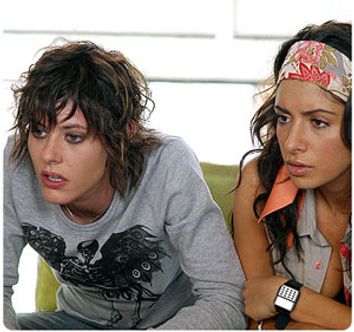
When “The L Word” premiered on Showtime two and a half years ago, I was intensely curious about it — all those gorgeous women, and all of them in that mesmerizing city of cars, canyons and hot tubs — Los Angeles! But I was too nervous to admit my excitement to anyone else, let alone watch it in company. I guess I was a little too curious, and slightly ashamed of how eager I — a straight girl in New York — was to drink in Jennifer Beals, Mia Kirshner and, my god, the outrageously sexy Katherine Moennig, making out (and doing so very much more) with other women.

However, thanks to the multiple airtimes — and my roommate’s bedtime of 10:30 — I could sneak watching it on my own, free of embarrassment. Eventually, as I was able to own up to my love for “The L Word,” I discovered — perhaps unsurprisingly to the rest of the general population — that all women with access to Showtime were obsessed with this show. Gay, straight, very straight — it didn’t matter. Everyone had someone to crush on — Moennig’s womanizing, androgynous Shane; Leisha Hailey’s too-cute, and very bisexual, Alice; and, in that first season, Karina Lombard’s Euro-trash femme fatale Marina. Jenny (Kirshner) was that women so many of us wondered if we were: straight, until we met the right (or very, very wrong) woman.

But now… I am back to being ashamed of my “L Word” love, but for a different reason. What started as an ambitious, artful series aiming to push the envelope of cultural acceptability has devolved into a nighttime soap opera so tedious it makes the later years of “Melrose Place” seem like the first season of “The OC.” Too many references? Let me put it this way: “The L Word” has become trash. Not just regular trash like “E!” or “90210″ reruns, but bad, bad trash — the kind so pungent and sticky that just being near it makes you feel yucky.

In an effort to push its characters — and boundaries — all over the place, the show’s writers have betrayed all of what once made it good. Shane, the intoxicating whore, became monogamous; instead of fighting off girls, she fights with just one, her girlfriend Carmen (Sarah Shahi). (No matter how hot Carmen is, watching them argue is boring.) Jenny? With her need to turn her partner Max (Daniela Sea) — a sweet pre-op FTM transsexual — into a statement, she’s overpoliticized the show. Speaking of… what’s up with the Gloria Steinem cameos? And what about killing off Dana (Erin Daniels)? It wasn’t enough to give her breast cancer, they had to make her die, within the span of a few episodes, and then have her two ex-girlfriends hook up to stifle their mutual grief.

No longer a brave exploration of smart, successful, driven women who have sex with other women, “The L Word” is just another Sunday-night drama full of desperate women who happen to be lesbians instead of housewives.

See the other shows we hate to watch

Continue Reading Close

What is the Literary Guide to the World?

Looking for the best novel about Zimbabwe? Or just want to take a virtual trip to Martha's Vineyard? On this literary journey, everything is first-class.

A few years ago, I went to Delhi to visit a friend. On the long flight to India, I worked my way through the American magazines I was bringing as a gift, and Ian McEwan’s “Enduring Love” (very good airplane reading). Once I had settled in my friend’s white-tiled apartment in the quaint Nizamuddin district, I wanted to take in something that seemed better suited to my destination. Not a travel guide — those I had already read and dog-eared. Rather, a book that could thrill and educate me all at once, a book that would enhance my visit rather than distract me from it.

My friend handed me a beat-up paperback edition of “City of Djinns: A Year in Delhi” by the British writer William Dalrymple. The taxiwallahs, the shrines, the Khan market immediately came to life in a whole different way. Dalrymple, whose book I toted all over Delhi, became my traveling companion — pointing out the sites, teaching me Delhi’s complicated and storied history, cracking jokes that were much funnier in India than at home. Dalrymple, even more than Mr. Vijay, who ran our very necessary car service, showed me the city. His book was indispensable — and a delight.

After that trip, I started thinking: Wouldn’t it be cool if there was a travel guide devoted not to restaurants, hotels and museums, but to the literature of a place? Yes, it would. So here it is: Salon’s Literary Guide to the World. It’s a grand name, to be sure, but one that suits. From Turkey to Togo, D.C. to L.A., Rio to Russia and beyond, the Guide promises to recommend the best books — fiction, history, memoir or otherwise — to take with you on your travels. And if there’s a place that you’ve always dreamed of seeing, but won’t visit in the foreseeable future, the Literary Guide will point you to the books that offer the best virtual tours around.

Our writers know their stuff: The first group of eight includes Booker Prize-winning Irish novelist John Banville on his homeland; New York Times bestselling author Alexandra Fuller on her childhood home of Zimbabwe (formerly Rhodesia); frequent Salon contributor — and once-Togo resident — Matt Steinglass on the small West African nation he used to call home; and the lauded young novelist Tony D’Souza on Havana, where he had a very good time.

Throughout the summer, the Literary Guide will feature two new locations a week; in autumn we’ll continue with one a week. There’s much to look forward to, including pieces from National Book Award winner William Vollmann (Norway), Salon favorite Garrison Keillor (Minnesota) and “Divine Secrets of the Ya-Ya Sisterhood” author Rebecca Wells (Louisiana). We’ll take you as far as Papua New Guinea and South Africa, but we’ve also got the books to read if you’re staying closer to home — in Martha’s Vineyard, say, or the Jersey Shore. And you can make your own suggestions, too. We hope you’ll use Salon’s letters feature to comment on our writers’ choices, and to make some suggestions of your own.

Welcome to the Literary Guide to the World — we hope you have a great trip!

Continue Reading Close

Page 1 of 9 in Hillary Frey

www.salon.com/writer/hillary_frey/index.html