J.B. Orenstein

Rack ‘em up

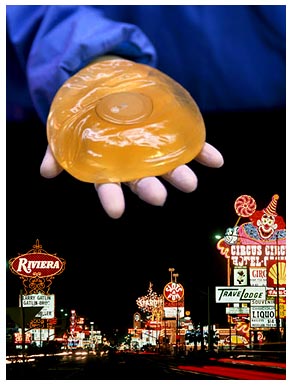
She looked great with small breasts, I told my plastic surgeon buddy as he pumped up his patient's implants. Hey, it's Vegas, he said -- there's no such thing as too big.

  • more
    • All Share Services

Rack 'em up

“I want big.”

The first three words out of John Minoli’s patients never vary. And Dr. Minoli, a Las Vegas plastic surgeon, doesn’t expect otherwise. His clientele want one thing and one thing only: Big. Bigger. Biggest possible.

I took time off from my pediatric E.R. job to visit my old medical school roommate last March. John spent years in clinics in Los Angeles and New York polishing his innate surgical skills and artistry; now he had a nice, private practice group in the golden desert. While watching Sheena Easton belt out her catalog at a cozy spot in the Hilton he invited me to visit his outpatient surgi-center to watch him operate the next day. Thus, I found myself at the brilliant — but, for a tourist in Vegas, odd — desert hour of 7:30 a.m., hustling through a remote corner of town. By the time I arrived, Frank Sinatra was crooning in the background and John had halfway dissected his first breast of the day. (Both women operated on have given permission to have their surgery described in this story.)

“Sinatra? C’mon!” I protested.

“Welcome to Vegas, pal,” he told me, the first of many times to come. “This girl’s got bad ptosis — her breasts droop,” he explained, nodding over his shoulder to a laptop displaying an image of the patient’s deflated breasts. “But watch a few minutes and see what happens.”

The face of the woman lying on the gurney was concealed by a surgical drape, exposing only her torso’s upper half, washed in a brown, drying betadine and a line of purple marker outlining the mammary border. Her face had similarly been cut from the photo behind us. She seemed to have a raw smile under her right nipple: lips of yellow and red fatty tissue bordered by a white, fibrous rim of tissue. Mary, the nurse opposite from John, held the edges apart with pencil-sized skin retractors, while John’s fingers and instruments cleared a path through the fat to the shelf marked by the pectoral muscle below and bosom proper above. He uttered a small “tsk” and the anesthesiologist popped his head up.

“She’s a bleeder,” John said, zapping the blood vessel with a Bovie, a knife that electrically cauterizes small veins or arteries. An acrid smell of burnt flesh rose up along with the white plume from inside the surgical wound. “Twenty-five years old and five pregnancies. All that back and forth on her tissues wiped out a lot of the suspensory ligaments and created a lot of overgrown blood vessels.” He chattered on about how she was really a bubbly gal, great personality. Sweet kids.

John and I roomed together for three years during med school. His hair has thinned (a little) and gone gray (a little more than mine) over the years, but his eyes still twinkle and gleam. John’s conspicuously sunny character came straight from a big heart, and we all had pegged him for a family practitioner, or possibly an oncologist where such instincts prove most valuable. He surprised his friends and classmates by steering toward a specialty notable for gilded charms and a callow clientele, but seeing him at work, it became clear that his love for patients and primary dedication to good care hadn’t faded or been traded away en route.

John nodded to Mary, who passed over an empty IV bag with a tube sticking out at one end. “The sizer.”

John slid the folded plastic bag into the hole he had just made and connected the tube to a 2-ounce (or 60 cc) syringe. He pumped once, and the breast gently rippled as the bag unfolded. With the second hit, the markered, browned and blood-stained bosom sprang to life. A third hit, six ounces filling the bag now. Another valley burgeoned with the fourth. He went a fifth time and now the breast bordered on the grotesque.

He was ready for a sixth push on the syringe and I envisioned exploded blood and bosom flesh splattering the walls. “John!” I protested, “she was fine at three!”

“She wanted big,” he reminded me. “This is Vegas.”

“They go for medium in the Midwest,” Mary said, “but around here you can’t make them too big.”

“When I see them post-op, the only complaint I ever hear is that I didn’t make them big enough,” John said. I shook my head in disbelief. He delivered the sixth barrel and her chest resembled nothing so much as a beach ball lying by a blanket on the sand. “Just wait a little. It’ll actually turn out pretty nice,” he assured me. He used saline implants rather than silicone because it gave better results: fewer ridges or pits and a more natural look over the long run.

“Natural?” I said.

He laughed and elbowed me in the ribs. “You’ll see. Artist at work.”

Opening up and sizing the next breast took another 30 minutes. But then, upon breathing the same 12 ounces into the second breast and watching it bloom, despite the muddied skin discoloration, skewed purple lines and yawning gashes below the areolas, the skill of his conjury revealed itself.

The hanging sacs, those limp rags in the picture on the laptop, had transformed into a pair of hooters.

John’s partner Steve Miller stepped in to see how things were going. The day before, they discussed the intricacies of the multiply-pregnant, deflated breast and how best to return its youth and sprite. Looking over the handiwork of his partner, Steve nodded in appreciation and offered a word of advice. “Dig her out on the right a little.”

“Ah. Hmm.”

John stepped around to her right, snugged his fingers between skin and balloon and burrowed up toward her armpit. I could see the silhouette of his fingers crawling up inside the breast tissue like a fat caterpillar. I must have made an alarmed face: “There’s almost no limit to how much the skin stretches,” he explained. When John was finished digging, he smushed the implant upwards and stepped back again.

Steve and John stared and nodded without saying a word — John with arms folded, Steve rubbing his chin.

“Mary — squeeze them, please,” John said. Mary went over to the girl in the controlled coma and very delicately pushed the breasts together to form a deep décolletage.

The surgeons watched coolly for a second, then John walked up and slid a pinky into the left breast. The right side had pillowed into a graceful arc, but the left had the faintest dimple, which he pooched out in a moment.

“Mary, squeeze again, please.”

A perfect cleavage.

“OK?” she asked. <P"OK," they agreed in unison.

Mary reached over onto the instrument tray and picked up a towel, dipped it in saline and washed the chest clean.

John had sculpted a flawless pair of knockers, round and bursting in the full glory of rejuvenation. He deflated the air-filled bags and the breasts collapsed back into their original formlessness. In less than three minutes, he had the sizers out and the permanent implants in place, which he filled with precisely recorded volumes of saline. In another five minutes he had both incisions sewn closed so as to be almost invisible. The patient recovered from anesthesia and was discharged before I could see her face.

- – - – - – - – - – - -

The next girl and I exchanged some small talk before her surgery. John worked over her chest with his purple marker, outlining where his fingers should and should not roam in search of the perfect cavity.

Since she was smaller and firmer than the first patient, with delicate, almost indistinct nipples, I asked John — a few minutes later in the operating room when the patient was under — if he ever turned down patients on aesthetic grounds. “She’s really pretty in a small,” I said. I looked down again at her supine form. “It’s a good look for her.”

John picked up his Bovie again and went back to his patient. “And it is Vegas.” Then he went on about how she, too, was a bubbly gal with a great personality. The sweet kids, the works.

“She’ll have a lot more personality now,” I answered lamely.

Mary gave me an irritated look, the kind a mom might give to a particularly dense teenage son. “Or maybe a better paycheck or bigger tips. Or a rich Texas boyfriend. These things pay for themselves pretty quickly.”

The surgeons don’t do too badly, either. I told John about surgeon friends in the East, especially the OB-GYN guys, getting squeezed between slow, stingy payments from insurance companies for services performed and the crushing hikes in malpractice premiums. He confessed that while the cash-’n'-go nature of his work made it easy to keep doing these simple procedures day in and day out, he missed the more interesting, complex reconstructive cases he used to do at teaching hospitals. “I know it sounds like crying all the way to the bank, but there’s just not that much delicate work to do out here.” (One year later John has, in fact, remodeled his practice to attract a broader set of reconstructive procedures.)

An hour later, after both balloons were inserted, filled, balanced and molded just so, I again had to salute John’s handiwork.

“Alright, already,” I conceded. “Now she’s a knockout! But she was still great as an ‘A.’”

Mary slathered antibiotic ointment over her fresh scars. “You try getting by with tiny boobs in this town,” she said. She proceeded to wrap the newly puffy bonbons in a wide bandage. When she was done, her patient looked like she was wearing a tight tank-top. John and his partner talked complications, short- and long-term, as they pulled off the sterile outfits. Infection and post-op bleeding are rare, easily managed problems in the first few days after surgery. For some women, unhappiness with the results are tied to body image and life dissatisfaction, issues which are inextricably linked to the motives that brought them to a plastic surgeon in the first place. Both surgeons acknowledged the inevitable fact that one day a discontented patient was going to take them to court, and nothing but the unscientific, unquantifiable measure of “happiness” was going to be at stake.

The woman woke up from her sleep and, still loopy and disoriented, instinctively reached for her dressing. She started to tug at the wrapping in order to get a look. “Aaaaa-aaam I dunnn? Am I dunnnnn?” She managed to hook a thumb into the top and pulled downward.

Then she emitted an excited but low, guttural chuckle.

An epidemic of fear hits the E.R.

All it takes are a couple of news reports and a few spores of panic to contaminate the sick bay.

  • more
    • All Share Services

Friday was a bad day in the E.R. Even before the creepy, ominous news came from New York — and later Nevada — about more anthrax, our hospital, a 700-bed megacenter, was full beyond capacity. There were more than a dozen patients in the E.R. “boarding” as inpatients, waiting for intensive-care beds. As recently as two years ago, that was unheard of, particularly on a nice balmy day in October.

But the president had spoken to the nation about the FBI’s broad terrorism warning the night before, and while the speech and the overcrowding may have been entirely unrelated events, the coincidence was depressing. And as one last terrible portent, the waiting-to-be-seen boxes were full. Patients who had registered three or more hours ago were still waiting to be seen.

My first patient, an Asian woman in her 40s, had a measles-like rash, a high fever and a bad headache. There was no earthly reason for me to suspect smallpox. The rash was wrong. The natural progression of the disease didn’t fit. Below her left shoulder, there was even a smallpox vaccine scar. But still, my stomach flipped and never settled down.

I called for the infectious disease specialist. “Sure does look like measles,” he agreed.

“Why the hell does a grown woman have measles?”

“Happens.”

Yeah, it happens, and there was, of course, nothing suspicious about it. Unless an hour later, the number of anthrax cases happens to double.

A resident physician checked out CNN on the Web from a computer in the treatment area, and saw the first report of the NBC anthrax case. She had just spoken with a friend who “knows things” at the Pentagon (in Washington everyone has a friend who “knows things” at the Pentagon) who had told her that “stuff” was already happening on both coasts.

My infectious disease consultant and I traded glances. A suspicious infection or not? Simultaneously we said, as casually as humanly possible, “Let’s get some labs.” “And a chest X-ray,” he added. Smallpox leaves no traces on a chest film, but plague and anthrax do, as do a smattering of other bioterror agents.

As word of the New York anthrax cases filtered through the E.R. and the waiting room, patients started making their way to me. It was clear they all had seen “Special Report: America Panics Again.” Few patients were brave enough to actually ask if their symptoms were something uglier than first suspected, but the look was in every face.

Some days in the E.R. we see nothing but car wrecks and work accidents, but on other days, we are deluged with the new virus hitting town and this was one of those days. Every patient’s complaint seemed to begin with “fever and ”

The E.R. doc who heads the hospital’s disaster committee, and has been on double or triple duty since Sept. 11, came in ashen-faced. “The Public Health Department’s sending us a ‘rule out anthrax.’”

As we spoke, the hospital was setting up a procedure with the state epidemiologist to swab noses and send appropriate cultures for the foreseeable future. Our nursing coordinator tacked on every desk daffodil-yellow signs, emblazoned with a big, bold 800 number for the Public Health Department. The number to call to report any “suspicious” infection.

At 3 or so in the afternoon, by which time every infection was suspicious, a lawyer in his 30s came in with the worst story of the day. A healthy, active guy, he had been fighting a cold for the past two weeks. His doc had put him on an antibiotic a few days back and he had actually begun to improve for the first day or two. But that day, Friday, he woke up weak.

A medical student presented the case to me, so at first I didn’t believe a word of it. When he reported that the patient’s forearms and calves were weaker than his upper arms and legs, he had my full, undivided attention.

Guillain-Barré syndrome? Or was it botulism?

I had already turned to the Johns Hopkins bioterrorism Web page once that morning to look up the pictures of cutaneous anthrax and smallpox rashes to make sure my first lady didn’t have them. I turned back again to read up on botulism. I had visited the page several times already since Sept. 11, but clearly, I hadn’t retained much. Maybe I hadn’t wanted to.

Stomach lurching, and dark bands tunneling my vision — at this point I was having a full-blown panic attack — I read the page twice: My patient had absolutely no botulism symptoms. Botulism descends — from paralysis of the mouth, eyes and upper respiratory tract to the rest of the body. Guillain-Barré syndrome ascends, from fingers and toes up to the arms, and then to the respiratory musculature. And typically, it does so following a two-week period of mildly viral symptoms.

I called a neurologist who confirmed my opinion and I called back the infectious disease specialist who had been called to answer similar questions at another E.R. No, this guy didn’t have botulism, just like the first lady didn’t have smallpox.

Meanwhile, media teams descended and pulled docs out of the E.R. to give “reaction” to the news from New York. Patients continued registering at the front desk with sniffles and aches. Spores in envelopes continued to turn up across the country. A guy stuffed powder into a vent onboard an airplane at Dulles, just a few miles away. Flu won’t even begin to enter the picture for another six weeks or so.

The disaster chief looked a little less ashen by the end of the day, and beds had opened up a little. Then we heard about the spores in Nevada. A normally unshakable guy, even the chief was getting rattled.

I started chanting what has become my new mantra, a British-ism straight out of the Royal Air Force that came from a Pentagon friend who knows things. “Steady the buffs, old man,” I told myself, “steady the buffs.”

Continue Reading Close

A matter of life in death

It begins with carnage and never really ends.

  • more
    • All Share Services

A matter of life in death

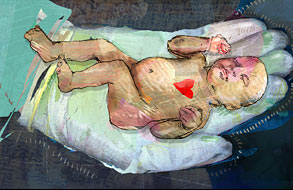
A piercing shriek cut suddenly short, a car flipping sidelong against its natural direction. For an odd, hanging moment, nothing else happened. The sky overhead buzzed as a helicopter changed directions. On the ground, asphalt sparked in an infinity of rising dust and fallen glass crystals around a dusty brown car; a palette of reds splattered and dotted the windshield, and then began to drip.

The car tumbled to a halt in a precarious stance on the passenger side, all four tires airborne, after one-and-a-half turns on the highway. The truck had recoiled back into the mouth of the crossing. The next 30 seconds or so following the helicopter’s departure were still. Police records indicate several calls registered to 911 nearly simultaneously.

That’s how it ends or that’s how it begins.

The intersection, at Route 1 and Rippon Boulevard, was long familiar to 911 operators. Route 1, three lanes in each direction on a slight elevation, bends gently to the south and east. Rippon Boulevard enters blindly. Route 1 traffic is hidden by a 20- or 30-foot hill at the intersection, a mound of dirt and tall reedy grasses. A left turn is a grope until the middle of a lane in which cars stream by at 50 miles per hour. It’s a setup. A meat grinder.

The nearest rescue squad, three blocks south, can get there in under a minute. The first vehicles arrived as the second round of calls lit up the 911 switchboard and they knew, before they even got there, that it was going to be a bad one.

The paramedics were ready for anywhere up to four or five occupants. The statistics of vehicle occupancy dictated that chances were good there would be a single victim, the odds on two a lot lower but possible. Three or more would have been a rare stroke of bad luck. As they shot out of their truck and scrambled over to the driver’s side of the smashed car, a single occupant — and a horrible surprise — awaited them. It was instantly apparent. The lady’s huge belly was moving.

First-responder protocols include perhaps one paragraph on the pregnant trauma victim: A) It is a rare situation, and B) get her the hell to the hospital as fast as humanly possible. The woman’s body would take a minimum of five to 10 minutes to extricate from the wreckage. It was already so busted up they might only have attempted to find a pulse to confirm the fact of instant death, but with a living patient trapped inside their dead patient, they had to get her to the hospital no matter what.

A medic crawled in through the back seat to support the woman’s head and stabilize her neck with a rigid-foam collar; a second medic broke through the windshield and produced a face mask and oxygen bag. Then, still at a crazy angle inside the vehicle, they attempted an awkward, ineffective CPR in earnest, one pushing in and falling back off her chest, the other blowing in oxygen from the bag and mask. The ambulance driver radioed for more help.

No one noticed that somewhere along the line the baby had stopped moving.

“Line one, Jul.”

The call greeted me as I began my E.R. shift at 4 p.m. “They’re working on what looks to be a near-term pregnant woman MVA out on Route 1. No vital signs, ground crew called for air backup. No ETA yet, they’re still getting her out of the car.”

OK.

I turned around to look at the patient board, scan the nursing station. A reflexive move, a dodge. Okaaay. “No vitals because they haven’t gotten to her yet, or no vitals?”

“No vitals.” As in dead.

“All right.” I paused again, because this raised a million questions. “I’ll get NICU (the Neonatal Intensive Care Unit) down here. Do they know?”

“Not yet.”

I hung up. Lynn, the charge nurse, hovered over me with her hands on her hips. “What’s coming in?” She skipped a grimace and went for a poker face when she heard the details. “Coming by air?”

“Called for ‘em. Still getting her out of the car. We’ve got some time.”

The message from Comm (communications) was clear: Mom was gone but if everything broke right there might be a chance to salvage the baby. Such rescues were rare, but not unheard of. They’d have to be here in 10 minutes max in order to give the baby a chance. Possibly the mother, too, if, for some reason, the pre-hospital info was wrong or overblown. So, in practical terms, the call meant we had to get the NICU, specialists in newborns and preemies, down to the E.R. in a hurry.

Activating a trauma team is as easy as pushing a button. The E.R. at Fairfax Hospital, in the suburbs of Northern Virginia, is a Level 1 trauma center, a place where miracles can — and are expected to — take place. But the rescue about to unfold was going to push our limits.

Comm called again almost immediately with an update. “Air crew’s there. ETA 15,” she said and disconnected. We had 15 minutes to get ready.

Kathy Kelly, the other E.R. doc who had been alerted to the coming trauma code, was on the phone when I found her. Her exasperated look, a too-calm “No, I need you now,” signaled that the party on the other end wasn’t cooperating. Her clipped tone, the “now” of her request, was the unique prerogative of the E.R. doc: When we call for help, we need help. Kathy set the receiver down and stared at it for a second before looking up at me. “That was OB. They’ll try to make it.”

“Try?”

“Do or do not,” she said, in fair imitation of Yoda. “There is no try.”

“So what’s the scene here?” I asked.

In medical school, one of the fostering-nurturing things students are told ad nauseam is that there is no such thing as a stupid question. In the real world of medicine, 90 percent of questions are stupid, including the one I’d just asked. The “scene” was the New York subway, the F train at rush hour, and it was about to get substantially worse.

Lynn suddenly appeared from the mouth of the trauma room, dictating strategy and ready positions. With a double trauma on the way and every bed already occupied, her whip was already cracking. “Kathy. I’m moving the last two traumas out to the hall. Julian, the baby will go into Room 2 once he or she’s out.”

Because obstetric trauma occurs so rarely, neither obstetrics nor neonatology staff are used to the stop-drop-and-run drill that E.R. and trauma docs take for granted. A few obstetric and neonatal emergencies demand instantaneous care, but for the most part, their docs rarely need to go running to find them. When the neonatologist, Dr. Huntington, returned my page she, too, sounded busy, and her tone left me less than completely reassured that anyone would show up to help.

I had performed resuscitation on critically ill newborns and preemies during my pediatrics residency years before, but I had gotten a little rusty, and hoped the skills would come back to me. A lot of life hung on the results. I didn’t need the NICU so much, but I prayed for them to arrive. I doubted any E.R. doc had ever done a crash cesarean section. A trauma surgeon, yes, probably, because trauma surgeons are accustomed to emergency surgery, but even then it might not be smooth.

An inescapable fact of medicine, unfailing as a law of nature, dictates that the more practiced a surgeon is at a procedure, the better the ultimate outcome. I had no idea at the time, really, how fast a crash C-section could be performed — two minutes? three? — but I knew that an obstetrics resident performed them far more often than a general surgeon.

Given the situation, doing it in two minutes was infinitely preferable to doing it in four minutes. And given, too, the grim fact that the mother, already dead in the field, had no realistic chance of resuscitation whatsoever, the only point of this whole exercise would be to immediately remove the baby in the remote to unlikely chance it had not already suffered irreversible brain damage.

All trauma patients, upon arrival in the E.R., are given a name, Alpha through Zulu. All receive the surname Doe. The woman headed our way was Sierra Doe; her baby, if she made it, Tango Doe. Once the helicopter bearing Sierra Doe landed on the roof of the E.R., it would take less than 60 seconds for the team to bring her down from the landing pad and into the trauma bay.

The only job I absolutely had to do was to check that we had a functioning warmer for the baby and a neonatal resuscitation kit ready. Residency training had ground into me that checking one’s own resuscitation box was like packing your own parachute — only the life at stake was not mine, but a newborn baby’s. I had five or six whole minutes to get ready. An eternity.

Matt Minoli, the senior trauma surgery resident, had already been in the E.R. all day. He had just left to tend to a crashing patient in the Surgical ICU, leaving Prabhu, his junior resident, sewing up the head of the last trauma patient, who had arrived 20 or so minutes earlier.

Matt responded loudly to the page, “Fuckin’ motherfucker. They’re thinning the fucking herd out there today.”

“OB’s not here yet, and they sound busy,” Lynn informed him on his return. “Ever done a stat section?” she asked.

“I’ve done C-sections once or twice,” he said, folding his arms.

“Well, here’s your chance to do another one,” she said.

He rubbed his chin, eyes sliding to the trauma room, where his junior resident was still sewing the scalp laceration. He patted his pockets, found a surgical stapler. “Prabhu!” he called out. “Catch!” The silvery packet sailed across the E.R. Prabhu’s puzzled look turned to a nod of understanding. The head wound was closed in an instant.

The Comm nurse had an update from the flight crew. Sierra still had no pulse, even with CPR. There was a “downtime” of 15-plus minutes, which meant she’d been pulseless — dead — at least that long. There was a lot of blood.

The only one listening besides the secretary, several patients and their families was Donna Rotondo, our social worker.

When a trauma patient arrives, one critical team member waits in the background, eyes and ears alert, arms folded, hands idle: the social worker. He or she watches from a corner, picking up bits and pieces of information, awaiting the family’s arrival. Social workers routinely embrace the family’s misery and loss, standing by through the ordeal and interpreting the goings on. Depending on the gravity of the situation, they offer condolences, tempered pessimism or reassurance, accompanied by advice on whom to call for emotional support.

“You knew this was coming in, didn’t you?” the Comm nurse asked.

Donna shook her head no, her face registering alarm.

Donna’s task was to find the husband and arrange for him to get over here if the 911 rescuers had not dispatched police to do that already. Maybe the woman’s wallet would help someone from the ambulance crew find the guy. If not, Donna would make first contact. This delicate art requires her to prepare him for a brutal shock without telling him the worst of it. After all, none of us knew yet what was coming our way.

Donna is the person you want in the room at the moment your life is shattered. The daily, close contact with vulnerable and confused people facing their most primal fears is not for the faint of heart. The trauma code could last a matter of minutes at most. Intense, hairy as it might be, it would blow over quickly enough. Everything afterward, preparing the father to cope with the hours, days, months, years ahead, fell on her shoulders.

With Donna dispatched, the Comm nurse repeated her update. Sierra Doe had taken the full impact of the oncoming car. There was a subtext: In the science of crashes — and car wrecks are meticulously referred to as crashes, not accidents — somebody is always at fault. When a car runs a light, the driver of that car risks being crunched under the force of an accelerating vehicle, the caving door just inches away from his or her body. The innocent driver is at least a hood’s length way from impact. By the harsh logic of vehicular crash statistics, our girl may have run the red.

We didn’t want to believe it. Pre-hospital information is sometimes sketchy, inaccurate or just plain wrong. (Subsequent accident reconstruction investigators later did, in fact, find otherwise.) But news distracted us.

That’s when we heard it. The helicopter carrying Sierra Doe chopped into our thoughts and at that moment, despite all the commotion, not one true specialist who could help her in a meaningful way was present.

The baby box was under the warmer and everything seemed to be ready: tubes for the airway, I.V. catheters, pre-filled medication syringes. My thoughts were racing so fast at that moment I was only half-aware of what I was checking. I didn’t want to miss the action in the next room. At first, I nervously registered a couple of syringes, a bunch of tubes. I forced a deep breath, then focused on each item one by one. Each medication syringe appeared to be properly labeled, none expired or outdated, all the correct tube sizes. Very few items are needed to rescue even the most gravely ill newborn.

Kathy, Matt, Prabhu and select nurses began to rip open sterile packs containing turquoise blue surgical gowns, matching booties, masks and caps. An obstetrics cart had been wheeled in and Matt headed there first. He was soon joined by two women I did not recognize, both skinny and blond, neither one in trauma garb, who had followed us in without our being aware of their arrival.

The obstetrics team — finally.

Their belated arrival added to the crackling air of anticipation. Our patient was being unloaded from the helicopter, rolled into the elevator. In another moment, she would emerge into the corridor a few yards away. NICU was still AWOL.

Matt and the obstetrician reviewed their strategy. The trauma surgeons were to be at Sierra’s head and chest as the OB team, at the belly, sliced and grabbed. “Who’s going to take the baby?”

“Me.”

The surgeons whirled around and seemed to see me for the first time.

Prabhu, lacing and unlacing his fingers, looked across an empty stretcher to Matt. “She won’t make it,” he said. “Right?”

“Bet she will,” Matt said.

“A beer,” the junior rejoined.

“You’re on.”

“Prabhu,” Kathy said softly from immediately behind his shoulder, “don’t bet on patients. Don’t bet on death.”

A few students and residents had been trying to squeeze into the room so as not to miss out on the rare experience. Lynn, assuming the role of recording nurse, shooed them out one by one, from a podium at the back of the room. Each time a swish of a body came through the door, all eyes turned in anticipation, followed by grumbling at the inconsiderate idiots breaking their attention, stretching their nerves.

Lynn, getting exasperated, yelled out into the E.R. for someone to keep everyone else out of the room and then pulled the door closed. The trauma record, a massive, three-page document, unscrolled in front of her.

The door opened again, and Lynn countered with a lunge of her own. “I told you to keep out!” she snapped.

A dark-blue-sleeved arm, bearing the insignia of the AirCare rescue team, forced her arm backward. Sierra Doe, the guest of honor, had arrived.

The 15 or so sea blue bodies packing the room — doctors, nurses, techs — distinguishable only by their eyes, parted for the stretcher and paramedics. As if choreographed, a gap opened around the trauma bed, and the phalanx of dark blue rescuers marched in with Sierra Doe.

My first glimpse was of a small mass — a swath of skin, a tangle of hair and a plastic tube. The head and face. Next came a huge mass, a thunderhead — her gravid belly. Dried and not yet dried blood covered her face, her hair, every inch of her flesh, the middle part of the dark blue flight suits surrounding her. It permeated the fabric of her dress. The torso of one of the paramedics rhythmically pumped up and down on her chest as the effort at cardiopulmonary resuscitation continued.

Fifteen bodies closed in on Sierra Doe as swiftly as they parted. Exhale, inhale. A pair of heavy-duty scissors hacked through the remains of her blue jeans up to her blood-soaked maternity top. The bloody rags were pulled aside.

Simultaneously, the chief flight paramedic stepped back and gave his report, his the only voice in the room for the moment. Standing just beyond the patient’s head, he described the scene we all knew by heart: T-bone collision, high speed in an intersection. Driver-side car door into her side.

Matt and Prabhu were on opposite sides of her chest, talking in voices loud enough to be heard over the paramedic. Matt apparently didn’t like what he saw and called, “Thoracotomy tray!” The paramedic performing CPR was waved off by Matt, who intended to slice open her chest and explore for heart wounds — the first swirl of chaos in the otherwise orderly proceedings.

The obstetrics surgeon had not said a word. Standing immediately in front of me, next to the enormous belly, she started her procedure. My eyes snapped from Sierra Doe’s chest to her belly; the mental sequence of neonatal resuscitation stopped running abruptly. In another two minutes, maybe three, I would have the baby.

“Probably 25 minutes realistically,” blared the voice of the flight medic over the din. Dead for 25 minutes. An eternity. What are we all doing here? In just that flick of an eye upward, I missed half of the cesarean.

Epidermis.

Dermis.

Subcutaneous fat.

Linea alba.

A scalpel raced through them, a single horizontal slice. A brown-black mass appeared through the incision; the obstetric resident’s assistant’s hands shoved back the ecchymotic flesh, further exposing the darkened uterus.

Lynn barked irritably from her podium: “Tell me what you’re doing, people.” A nurse holding a bag of blood spiked it with an infusion set, called out to the nurse closest to the body to open up. At the nod, she squeezed the bag with all her might, and a cord of red — transfusion No. 1 — began snaking its way into Sierra Doe’s broken body.

Fascia sheath.

Myometrium.

Amnion.

The OB resident deftly flicked the scalpel handle around in her hand and passed it off to her assistant. Then, equally swiftly, she produced a fine pair of scissors, poked the point of the blade through the uterine fundus and guided the scissors down vertically from umbilicus to pubis. A slice first this way, then that. Thirty seconds, tops. She reached into the black waters and brought out a baby.

It’s a girl.

No wail, no cry, just a purple slippery form.

“Time of delivery 4:13,” she called loudly, and the room froze momentarily.

In a final display of dexterity, the OB resident’s hands again appeared, this time at the improbable reed dangling beneath the baby. She clamped the umbilical cord once, moved up an inch and flicked the second clamp down, closing it on the cord. She cut the cord a moment after the second clamp was on, and Tango Doe was free.

I had been standing just behind the OB doc, stepping in closer as the startlingly brief cesarean unfolded. As she wheeled around, holding aloft the newborn girl, I raised my arms to receive her. Before I could lay gloved hands on her, Dr. Huntington, the NICU herself, darted in, grabbed the baby and fled.

A single, graceful arc traced her journey from mother’s dark womb to isolette landing pad. I saw the baby’s assessment had already started: A pair of the NICU doc’s fingers fixed at the base of the umbilicus, feeling for a pulse.

The infant flopped down limply, and it was clear, without a nod or grunt from Huntington, there could be no pulse, no heart rate, as — at the tender age of 15 seconds old, 20 — no cry, no respiration. Same deeply saturated grape hue as mom. Lifeless, stillborn. Dr. Huntington had brought along just one nurse and they began their work: an endotracheal tube down the throat to breathe, a long I.V. catheter placed through the umbilical cord. Reflexively, my fingers were on the baby’s chest, performing rapid compressions.

The nurse applied monitor pads, connected I.V. fluids, accepted medications from me. The quiet of Trauma Bay 2, punctuated by brief, staccato comments and replies, was a stark contrast to the rising din in the next room. They must have found something.

Sierra Doe, epicenter of the frenzy, lay paralytically still. Her color was an ashy purple, ashy from the rivers of blood drained through her many injuries, purple because the little blood left in her body had been depleted of all its oxygen. Her short brunet hair was matted in blood. The thin rim of her dilated pupils was too small to register a color.

Her arms were extended at both sides, the better to receive blood and fluids, the better to expose her flanks for various and sundry crash surgical procedures. The rest of her features were vague and distorted by the circumstances of her death: her face swollen and cut up, her body similarly disfigured and opened in unnatural ways.

But she inched closer back to life each moment. Matt found several fractured ribs and a gaping chest wound, perhaps sheared by glass, perhaps from the door itself crunching under the impact. Like the OB doc a few moments ago, he made a hasty slashing incision to explore. If the worst of her injuries was only a lacerated heart muscle, he would know the moment he held it in his hands. Fixable. The brain and its starvation for oxygen — screw it. Never believe the worst until you see it for yourself.

With one hand inside her chest, Matt used the other to shove away the medic doing CPR. Sierra Doe’s chest relaxed, allowing Matt’s fingers to crawl deeper into her thorax. Maybe there was a chance for a good resuscitation after all.

The second unit of blood arrived, then almost as quickly began to leak through the sieve of her wounds. Prabhu spiked a needle into the right side of her chest and was greeted immediately by a rush of air and a stream of blood, and the right lung reexpanded. A step closer.

It was with the third unit of blood, the third of eight eventually muscled in, that the miracle occurred. Matt’s fingers, caressing the woman’s heart, failed to identify a tear, and for a moment his spirits fell. The woman would not be tricked from death by something as easy as a lacerated heart.

As his fingers withdrew, he perhaps tickled a fiber, a sensitive spot. Something. Kathy’s eyes, still darting briskly, flicked up to the monitor above.

A beat. A pause. Another. Another.

“Is there a pulse with that?” Kathy asked, her voice rising through the din.

And there was. As the heart resumed its ceaseless motion — contract, relax, contract, relax — the pallor of Sierra’s face transformed from purple to pink, from ghostly death to flickering life, from a gargoyle into a pretty, young mommy.

“God must not have wanted her,” Lynn said, tears pouring forth from her eyes.

Everyone in the room froze as Richard stepped in. The only movement was the flare of a white bedsheet as it was hastily thrown over Sierra Doe’s gutted abdomen and thorax. The nurses, docs and techs met his eyes with a blank stare. We had assembled for the sole purpose of giving this man a chance to be with his wife and baby, but no one seemed to know what to do with him once he got there.

Kathy sensed her cue and approached him, softly, telling him about the broken ribs, the internal bleeding. She pointed to chest tubes. He nodded, possibly understanding, possibly following what she was saying. The sheet covering his wife’s belly was turning red as Kathy pointed to it; the surgeons needed to get her to the O.R. right away to explore for other injuries, like a lacerated liver or spleen. Again a nod. He looked around nervously. A rainbow of reds splashed seemingly everywhere, on towels thrown to the floor, smearing the sea blue surgical gowns and hanging from the last two transfusion bags into the body of his wife. Too much blood. No baby.

We don’t know yet if any head injuries have been sustained, Kathy continued. There’s no obvious sign of head injury, and the tube coming from her mouth is for breathing. Once more, a nod.

Then she handed him off to me.

He engaged my eyes first. He was so young.

“Here. Come with me,” I said, guiding him by his shoulders through the cubicle between the two trauma rooms.

The view in Trauma Bay 2 presented a far more antiseptic picture: Here was a small baby, swaddled in blankets, in the arms of a nurse. We arrived just as Dr. Huntington and her nurse were preparing to take the baby to their unit. They didn’t know the father had shown up.

I told him, “It’s a girl” as the nurse handed her over, placed her in his arms. “Oh … a girl …” he cried. “A girl …”

He carried her stiffly, like any new father, afraid he might break her. It all looked so normal.

The long-dormant memory reawakened, the reflex of how to talk a new dad through a disastrous delivery that may — will — have lifelong consequences. I told him that his baby had revived as soon as we started to work on her, that her ultimate prognosis would be known better once some testing could be done in the NICU. “Prognosis” is a portentous, scary enough word, and I left it at that. He hadn’t heard me, wasn’t even listening.

“Her name is Elizabeth,” he whispered, his eyes brimming. My eyes welled, too. “That’s a beautiful name,” I said. “She’s a beautiful baby girl.”

“Liebchen and I picked the name just a week ago.”

Dr. Huntington explained that she was there to take the baby to the NICU in the mobile warmer just behind him. As he gave away his baby, he lapsed once again into a series of nods and “uh-huhs.” The nurse placed Elizabeth in the isolette. I took the father by the shoulder and guided him back to his wife.

The collected surgeons, nurses and techs were chafing to get to the O.R., to get out of that room, finally. It seemed like an eternity since Sierra Doe had first rolled in, and the minute it took Richard to meet his daughter had been an excruciating pause. Matt and Prabhu were busting to get to the O.R., a home turf of sorts, and be done with the ghastly nightmare. But they would be forced to endure it for another moment, as Richard took a step to his wife, and bent down to her ear.

“I’ve just been in to see our daughter,” he said, choking on the word “daughter.” “Elizabeth. She’s beautiful. Just like you.”

Then he kissed her, lingering for a long moment, tears working their way down his face. “She loves her mommy. She told me to tell you.”

And then it happened. Her eyelids twitched. Blinked. It was the last movement Liebchen ever made, and even now I think it was because she had heard him. In the darkening, closing paths and circuits of her brain, I am convinced she knew, just before she died, that she had given birth, was a mommy, and that her daughter was making her father so damn proud that she could finally let go.

No one else saw it besides Richard and me. I asked, and no one believes me. It hardly matters. She blinked. She acknowledged her husband’s love and the birth of their daughter.

Richard stood up, ready to go, helpless and malleable once more. But halfway out of the room, he turned back to face us: a vast crowd, anonymous behind identical gowns, masks and caps. He stopped and addressed the sea of eyes. “Thank you. All.” He stuttered, trying to think of something else to add. “I mean, just thank you. All of you.”

The door shut softly behind him. Sierra Doe’s blink, her baby’s flickering survival, the stunning synchronicity of these unexpected events for the benefit of a husband and father — it felt like perfection, like the apex of lifesaving, even with death, two deaths, around the corner. We had resuscitated battered humans before, but never with such graceful timing, never for such brief and rich reward.

As if a switch had been thrown, the team revived and broke into action, this time to disband. Someone kicked the brake from under the stretcher, releasing the wheels, and in another second the sea blue and blood-spattered phalanx escorted Sierra Doe to the O.R. A half-minute later, Dr. Huntington and her nurse rolled the isolette bearing Tango Doe silently away to the NICU. Both trauma rooms stood empty except for one or two housekeeping crew cleaning up.

Kathy and I exchanged glances, a few words, and we started to part company, too. The X-ray tech was hustling back toward us with a film’s ugly truths and a confused, wondering look on her face. Everyone’s gone, and she had something vital to share. “O.R.,” I said.

“Look, though.”

I held the black-gray film up to the light. “Yeah, OK.” The head was attached only by skin and muscle, above a severed spine. Depending on where you stand, that’s how it ends or that’s how it begins all over again.

Liebchen, once known as Sierra Doe, died at 9:46 p.m. She was taken to the operating room from the trauma bay, where a quick exploration of her abdomen turned up surprisingly little damage. The X-ray tech jogged in with the film revealing the fatal separation between head and neck. Matt studied it as he worked his fingers on her intestine. He sighed, shrugged and instructed Prabhu and another junior resident to begin closing.

“See that?” he said. “Atlanto-occipital distraction.”

The existing records fail to document how many times Richard held Elizabeth in his arms before she died the day after the accident. They are maddeningly dry with regard to her final moments: “The infant was removed from the ventilator and within six minutes there was no heart rate. The infant made no respiratory efforts off the ventilator. Thus the heart stopped.”

But I know what goes on.

The nurse takes the baby’s isolette to a quiet room, picks a fresh blanket from the warmer and sits the father in a comfortable rocker. She disconnects the monitors first — the alarms going off would be a cruel distraction — and then she caps off whatever I.V.s are running. This makes it a simpler matter to wrap the baby to make her look pretty and normal, and only then does she hand the baby over to the dad.

In a minute the nurse stops the ventilator. She breaks the connection between breathing tube and machine, and the baby’s color fades, pink to ashy to deeply cyanotic, and the mingled sounds of crying and grief might fill the room. And then sometime later they will fade, too.

Almost to the day, four years later, Richard remarried. And almost to the day, two years after that, he held a baby girl in his arms once again, healthy, pink, kicking and crying. Which was the greatest act of faith? Getting married again? Crying for joy upon learning his wife was pregnant? Or something as subtle as watching her drive off to work one more time?

If asked, I’ll tell you the most beautiful thing I can think of is this: At night, Richard puts his baby, Serena, to bed in the crib Liebchen’s father made for another baby in another house in another life. Richard sings his daughter to sleep and sometime later on he’ll check on her once more.

Continue Reading Close

Physicians’ Desk Reference, 55th edition

Why doesn't anyone know that Elvis' favorite book, the Physicians' Desk Reference, is written by drug companies?

  • more
    • All Share Services

Physicians' Desk Reference, 55th edition

It was, some say, Elvis’ favorite book. Judging from the stacks of copies at Borders and Barnes & Noble, it’s a lot of other people’s fave as well. The book, the Physicians’ Desk Reference, or PDR — the 55th edition of which has just become available — is huge, dwarfing all other medical volumes on the shelf. It’s blue. The cover’s textured for that authoritative feel. But it’s not what you think — that is, if you think it presents the fruits of herculean, independent drug research, you’re wrong. There is such a book, only nobody buys it (more on that later).

What the PDR does offer readers, in deadeningly dry prose, is the manufacturer’s information packet for every drug licensed by the U.S. Food and Drug Administration. The drugs are listed in a nested alphabetical style: by pharmaceutical company and then by name, from Abbott Laboratories’ Abbokinase, a clot-busting drug (available to institutions for about $2,300 a pop, but cost is just one of the urgently important items the PDR doesn’t deliver), to Zeneca’s Renagel, trade name for sevelamer hydrochloride.

Each drug citation contains, in rigid sequence, information the drug company provides by law to the FDA. The PDR says so, in the foreword no one reads. Buried on Page 2 is a precise description of the volume’s purpose: to be an “exact copy of the product’s FDA-approved labeling.” The publisher’s sole function is “compilation, organization and distribution of this information.” Sweet gig, especially since people buy it thinking they’re getting so much more.

Here’s what you get for 80 bucks: First, in each listing are “indications,” those uses for which the drug has been OK’d by the FDA. The book cannot, by virtue of the rules of the game, list all the conditions that a drug might be useful for, known as a drug’s “off-label” prescription. But regardless of its “indications,” there’s no restriction on how a doctor may prescribe a particular drug, so if you’re using the PDR to look up whether the antibiotic you shelled out $90 for actually works, lotsa luck. The answer ain’t there. Which doesn’t mean the drug won’t work; it just means the manufacturer is the wrong guy to ask.

The second section describes “contra-indications,” those conditions that might get worse if you take the drug. For instance, look up propranolol, a blood pressure drug that causes air tubes in the lungs to constrict; you’ll find it shouldn’t be used by asthmatics. Makes sense — asthma is a condition characterized by overzealous air tubes that constrict more than they should. But the PDR cannot resolve such questions as whether a physician who prescribes meds to the asthmatic hypertensive in his or her practice is screwing the patient or the patient is being screwed by his or her collective maladies.

Moseying on down, one comes to “adverse reactions.” Ah. Perhaps something useful, finally. An answer to the nagging question “Does that funny (itch/heartburn/flaking) I just developed have anything to do with the drug I’m taking?” Let’s look. Suppose you’re taking Anzemet and you’re feeling a bit constipated. By cracky, there it is among the adverse reactions. Cause, effect. The only problem is, you’ll have to flip through dozens of drugs to come up with a medicine that doesn’t list constipation as a side effect. There’s a good reason for that: During pre-release testing trials the manufacturer gets information on every symptom experienced by every patient, mild to severe. That data is passed along in full to the FDA, and shoveled straight into the package insert. Thus every drug in the PDR lists constipation, flatulence, rash and thrombocytopenia as adverse reactions.

There’s more. Gads and heaps and slabs more. But by now you may have realized that little in the PDR is useful or helpful information. It’s just a bloated, biased bog of data. Facts required by law, delivered in boilerplate language artfully constructed for the sole purpose of limiting liability claims. It’s hard to imagine a less useful source of information.

I suspect the vast majority of those who place their faith in the PDR look on it as a sort of Consumer Reports for drugs and are completely unaware of its true nature. It has been around since the 1940s, after all, and every physician gets one free at the beginning of each year. Generations of people have seen the book in doctors’ offices and assumed that it was the hands-down reference of choice. Sublime, invisible marketing.

Unbiased information on every licensed drug available in the U.S. can be had in book form. For less than half the price of the PDR, you can get the Complete Drug Reference, compiled by the staff of the U.S. Pharmacopeia and published by Consumer Reports Books. You may not have heard of the Pharmacopeia — it’s an independent, nonprofit organization that sets official standards for drugs for the FDA. This is what you want if what you really want is to look up the relevant facts about any current drug. Like the PDR, its rigid structure (uses, warnings, drug interactions) makes the data accessible.

Both books have lots of pictures of pills, so you can identify which of Grandma’s meds left over from her Christmas visit have just gone into Junior’s mouth.

The value of the Complete Drug Reference lies in its objectivity. You still can’t find out how much you’d have to lay out for a month’s supply, but you can find out what you can or cannot eat while taking the drug. The book is written for you, the consumer, not hospitals, government officials or malpractice attorneys.

Continue Reading Close

Fighting for treatment

These days, having cancer isn't enough to get you into the hospital -- you have to really be sick.

  • more
    • All Share Services

Fighting for treatment

Could anything be worse than coming to see the doctor about a sore throat and finding out that what you have is not a sore throat at all but an aggressive, malignant tumor?

Yes.

What’s worse, far worse, is finding out that you have a malignant tumor and not being admitted to the hospital then and there because the doctor is unwilling to play the elaborate intake game — leaving you on your own to negotiate the Kafkaesque system to arrange diagnosis and treatment. Because even if you have a deadly cancer and great insurance coverage, the doctor must provide an airtight excuse to slip you in past the bean counters and case reviewers. Otherwise you can waste a couple of your last precious few months trying to force your way through a healthcare labyrinth that is blind and deaf to your suffering.

On a recent and relatively calm night in the emergency room, I picked up the chart of a 55-year-old woman complaining of a sore throat. According to the triage nurse’s notes, the patient had just finished a course of the antibiotic Biaxin, but her throat remained swollen, which suggested a viral infection or a resistant strep.

I entered the examining room to find a diminutive Asian woman — probably Cambodian, judging from her 14-letter, five-syllable last name — accompanied by a slender daughter and the girl’s boyfriend. I ran through a few perfunctory questions. The patient answered in broken English, with an occasional assist from the kids: Fever? Cough? Trouble breathing? No, no, no.

Smoker? No.

Open wide.

Most adults don’t open their mouths properly. They bunch their tongue up toward the palate, blocking the view of the tonsils, and this woman was no exception. Even before I reached for my tongue depressor, I noticed a bulge where the woman’s left tonsil should have been. My interest ticked up a notch: a possible peritonsillar abscess. Sometimes a strep infection can escape the antibiotic assault and grow into a pocket of pus in the lymph tissue behind the tonsil, creating a potential hazard to breathing.

The abscess can be drained easily enough with a sharp needle jab, as long as care is taken not to puncture the internal carotid artery, millimeters away. A tiny mistake can result in massive bleeding and a howlingly disastrous surgical emergency. This is the kind of fun procedure that ER doctors salivate over: a quick fix, an element of danger, topped off by the patient’s admiration and heartfelt gratitude.

But as I positioned my stick and coaxed her tongue away from the roof of the mouth for a better look, I saw, instead, an angry red mass the size of a golf ball hovering over her larynx. No abscess, a tumor: Nothing else occurred to me. As I pulled back, trying to compose my face, I brought my hands up to feel the sides of her neck. There it was again on the left, just inside and underneath her jaw.

I launched into a new string of questions. You don’t smoke? No, you told me that already. Fever? No, you answered that, too.

Have you had TB? The daughter and boyfriend looked at each other, then at the woman. She smiled, uncomprehending. Huh? TB? A quick huddle with the kids: didn’t think so. I kept probing along her neck from the center of the bulk to the margins. The ball felt firm as wood.

Do you do a lot of gardening? Work as a florist? No.

Damn. She’d just ruled out a diagnosis of sporotrichosis, a definite long shot but the last soothingly benign explanation. I leaned back, sadly regarding her deferential smile.

How long have you noted the swelling? Two weeks.

No more than that? Are you sure? No, just two weeks.

Bad answer: This monster was growing rapidly.

No trouble breathing in all that time? No, none.

I knew what I had to do next: call an ear, nose and throat specialist. I hesitated because, well, they can be trying. After taking an hour or so to respond to a page, they usually want to know just one thing: Is the air passageway obstructed? If not, send ‘em to the office in the morning. If yes, intubate and admit to ICU and they’ll see the patient the next day. The most common reason for an ER call is uncontrollable nosebleeding — a messy, unpleasant affair. So from the ENT doctor’s point of view, the ER calls with nothing but trouble.

Worse still, I had on my hands an uninsured patient who might need surgery. There’s no overemphasizing the callousness of modern medicine when it comes to patients with no money and no resources, and I feared I’d have to discharge this woman with little more than an empty promise that someone else would see her in a day or two.

Why empty? Because on-call doctors are pros at rigging the game against uninsured patients. Here’s how it works: Hospitals receiving Medicare and Medicaid are legally bound to treat all patients — insured or not — who turn up at the door. To fulfill this obligation, the hospital enters into an elaborate bargain with specialists. The facility grants them lucrative admitting and operating room privileges; in exchange, the physicians agree to be on call occasionally and treat patients who appear during that shift no matter what their financial circumstances.

On their call day, they have to take all comers, most of whom are uninsured or on Medicaid, which generally pays less than private insurance plans. If the patient needs surgery or immediate treatment, the doctors have to rush to the hospital. If the problem is manageable on an outpatient basis, the specialist is supposed to grant them at least one office visit. But patients discharged with just a name for follow-up often end up right back in the ER in a day or two, unable to make an appointment in anything less than weeks or months. Even fully insured patients can be given the runaround, but their chances of gaining a physician’s sympathy are better.

Young doctors just out of residency training happily grab lots of call days for a couple of years so they can establish a reputation with the physician community and build a valuable referral base. In time, the referrals for insured patients pile up, superseding their interest in hits from the ER. That’s when they get a little testy about what they see as our ‘dumping’ patients on them.

One of the first things I do upon starting a shift is scan the call list to see who’s on: the good, the bad or the ugly. The ENT doctor on call this particular night was an unknown entity. I recognized his name, but I had never called him before. He returned his page quickly — an unexpected but positive omen — and asked, as I knew he would, about her airway.

Please understand: I am willing to lie. It may be in a patient’s best interest for me to paint a bleaker picture simply to facilitate admission to the hospital or, at a minimum, to lure the on-call doctor in to make an evaluation. Although this woman was breathing comfortably, the easiest way to force the ENT doctor’s hand would have been to report that her trachea was in imminent danger of obstruction. The downside of presenting a false clinical picture is that when they come in they’ll think I was either lying or stupid — and they’ll remember it the next time I have to call. So I use this tactic sparingly.

Since this ENT guy had responded so promptly and sounded concerned, I decided to tell the truth. I said she was breathing fine but that the mass was huge and had erupted in a mere two weeks. He mulled it over for a moment. Then he asked me her name and performed the doctor’s version of racial profiling. “Southeast Asian?” he said. “High incidence of oropharyngeal carcinomas in that population.”

Uh, oh. No way out.

“So you want me to send her to your office tomorrow?”

This was a defeatist’s question. Fifteen years ago, during my training, it would have been unconscionable for me, or anyone, to toss a patient back into the street with a diagnosis, or even a suspicion, of cancer. But now compassion — the system’s not mine — competed fiercely with the bottom line.

Once again, the ENT surgeon paused and considered my question. “If her airway’s not obstructed … Well, let’s get as much of the pre-op studies done now as we can, though, and see what we’ve got. Is that OK?”

It was more than OK: He was obviously going to look after her very carefully. After running down a list of baseline labs to order, he gave specific instructions to get a CAT scan of her neck area.

I returned to the patient and her family and admitted that while I didn’t know what the mass was, it could be something bad. A specialist was already involved and might be in tonight, tomorrow at the latest. I couldn’t tell her anything more until after the scan. I spoke slowly and accompanied my speech with a lowered gaze, a lot of sighs and meaningful eye contact: The classic shorthand way to convey that it was bad-news-with-worse-coming.

They met me sigh for sigh, lowered gaze with lowered gaze. They understood. The woman again offered me that lovely smile.

An hour later, I found the ENT doctor and radiologist in the CAT scan suite, film hanging on the light-box. They were standing before the mosaic of black and gray images, silent in the way that only means careful calculating, weighing, studying: sarcoma or lymphoma? high grade or low? pushing up against normal structures or chewing them up?

“How bad?” I asked.

They turned to me, startled at the interruption. “Oh, hi,” the ENT guy said, shaking my hand and introducing himself. He pointed out what looked ominous on all the images: an unnaturally round black-gray sphere. If he had to guess, he’d put lymphoma at the top of the list, an undifferentiated sarcoma next, perhaps thyroid carcinoma third. Bad, worse, terrible. TB would have been nice, under the circumstances. He sighed deeply. “But it’s not TB.”

He’d give her maybe six months. He said it as if he knew for sure.

As we walked back to the ER, I asked about the surgical options. “I could take it out, but these bleed like stink,” he said. “It’s better to do a small needle-biopsy to get a tissue sample and then let chemo shrink it down. I’d really hate to operate on it. Her airway’s OK, right?” I told him again it was. “Yeah, you only go in after these if she’s going to obstruct.”

Meaning if it’s going to choke her before it kills her.

I didn’t accompany him into the room and didn’t ask afterward what he’d told them. I simply thanked him. It was reassuring to know that someone with cancer and no money could still get admitted to the hospital right away. He smiled and shrugged. “You know,” he said, “I think you were wrong about that airway. It is compromised. She’s retracting a little.” He shot me a significant look as he said this.

“What? No, she’s …” I paused. “Oh, yeah. That’s right. She was working a little hard to breathe, wasn’t she?”

The utilization reviewer would never allow the hospitalization otherwise. The ENT doctor would be counseled about a ‘bad’ admit and he’d have to watch himself a bit more carefully in the future. So, yes: She had respiratory distress.

A day later, back in the ER, I scanned the on-call roster at the start my shift. The same ENT guy was listed. I asked the secretary to put in a page. Again, he answered promptly. I was really beginning to like this guy.

Any news?

The needle biopsy had been performed that morning, he told me. Lymphoma, as he had guessed. Aggressive, invasive, ugly. Probably six months, like he’d thought. He was lining her up for chemo to shrink it so it wouldn’t compromise her airway. However long she lasted, and whether she died at home or at the hospital, we both knew it would be a nasty death.

“When it’s my turn,” he said, “just give me a six-pack and a fishing rod.”

Continue Reading Close

Broken arrow

It's rare, but men can fracture their most private part.

  • more
    • All Share Services

Broken arrow

Warning: The content of this article deals with a painful male condition that just might prove too graphic for many readers. You are cautioned to proceed at your own risk.

Jennifer Gardner, a resident in pediatrics at Georgetown University, comes across as pretty tough. A tall, blond drink of water, Gardner’s hometown of Haddonfield, N.J., is a place where she thought she had seen it all. But on this hot summer day, when she came across the case of Rod Johnson, she realized she hadn’t. (No, it’s not his real name.)

Rod had an interesting, almost unique complaint. Gardner charged in without once looking at the front sheet to see what his predicament was. “What’s your problem?” she asked.

“I got a problem.” He paused.

“Why don’t you tell me your problem.”

“I’ll tell you the problem.” He paused again. “You know … um, how you, uh … wake up sometimes with an, er … an erection?”

“No, I don’t know. I never woke up with an erection.”

Rod had to spell it out for her. “Yeah, well sometimes you wake up with a bo — a hard-on.”

“Go on.”

“Well, here’s where it gets complicated. My alarm clock went off, and I already had this hard-on on. Then I, like, lunged over to turn off the alarm. It got caught.”

“Caught?”

“Well, not caught, more like yanked.”

“Yanked?”

“Hard. It got yanked hard.”

Gardner remained poker-faced. They hadn’t taught this in medical school. “Go on.”

“Then my balls got all swollen and turned blue. You know.”

“No, I don’t know,” she shot back, probably a little too quickly. “Girl, remember?”

“Well, that’s my problem, Doc. They didn’t know what to do for me at the Urgi center.”

“The Urge center?”

“No, ‘Urgi.’ Urgent care. So what’s my problem? Did I do something to it?”

It was like a game of high-stakes poker, as they stared each other down. She finally darted her eyes to his Joe Boxers. “Lemme see ‘em.”

A few minutes later, she was relaying the story for me. As the attending doc, I hear about all the cases. Lucky for Rod I was familiar with his delicate little problem.

“There are 206 bones in the body,” I told Gardner. “This isn’t a bone, but it breaks like one.”

“Are you saying that the penis can break?” I made deep eye contact. “You got it, kiddo.” She ran out of the room, only to return moments later, when I explained in such terms that there would be no room for confusion. “Rod’s got a fractured penis. A gimp biscuit. Nailed nail. His wand ain’t casting spells,” I said.

To learn more about Rod’s peculiar condition, we did an online search on MEDLINEplus, the National Library of Medicine’s Web site, where even the most obscure medical literature is archived. The term ‘fractured penis’ yielded no fewer than 133 references, most in the past 10 years, but going as far back as 1965 to a case report from the Philippines. Undoubtedly, this has been a scourge of mankind for time immemorial, but the Web library only goes back so far.

There were reports from every corner of the globe: Spain, Qatar, Russia, Bulgaria, China. One hundred and seventy-two cases from Kermanshah, Iran, where the practice of “taghaandan” (to click or snap when forcibly pushing the erect penis down to achieve detumescence) was common. A penile refracture from Parel, India. Penile fracture and testicular rupture in Cleveland. (Lord have mercy on his soul.) A case of the dreaded Mondor’s disease mimicking penile fracture in Karachi, Pakistan. And finally, the French described in 1994 a ‘False Step in Coitus.’ This lucky Pierre, according to the report, “recovered normal erectile function which was only lost at the moment of the accident.”

Next, Gardner and I called a urologist, Simon Chung. Turns out the fractured penis is one of his interests. Although he has done extensive research on the subject, he’d treated only one case seven years ago, which also happened to be my first case. That one was a little more typical.

Officer Flagstaff (not his real name, either) was a county cop, 6-foot-5, 220 pounds of muscle. He and his girlfriend had been having a very hot and heavy date one night, until things went terribly wrong. When he had pulled back and come out all the way, he tried to sail clear back into harbor. But he missed. He had rammed into a part of her other than the bulls-eye. He felt and heard a ‘pop’ (so did she) and looked down to see an exploded penis — all swollen, bent and blue. A bruise of pooled blood gathered in the scrotum.

As Chung told us that night, a fracture usually happens during vigorous activity and often with the woman on top. It needs to be repaired surgically, since a dime-size, star-shaped hole in the fibrous shell, known as the corpora cavernosa, is the actual injury. It won’t heal well on its own, and if there’s a prolonged delay before getting to surgery, impotence and abnormal curvature can result.

One of the Medline articles, a report from Alabama, had mulled over the implications of a delayed repair. I talked to Chung about this. One of the reasons that someone might have a delayed fix, he says, is because a lot of docs don’t even know the condition exists. “It’s easy enough to recognize,” he went on, a statement Gardner and I both had to agree with, “but if you’ve never heard of it before, you might not know that it has to go to a urologist pretty quickly.”

“When can he have sex again?” Gardner asked.

“Four to six weeks.”

Ouch.

“Yeah,” Chung sympathized. “And no masturbating, either.”

I could tell that I was going to have to break the news to the guy about this myself. I had never realized the gravity of the situation before.

We went back to Rod. We laid out the facts for him, as Chung had dictated. “So I don’t need a cast?”

Gardner seemed to choke back a burst of laughter. No cast. It’s not really a bone.

“Is there a support network?” Gardner’s choke was a lot more audible and I tried hard to force down a smile.

“Seems unlikely,” I said. “It’s not that common, and you’ll be better in a hurry. You can ask Dr. Chung, however.”

“What about the blue balls?” Gardner asked.

“That’s the blood that escaped from the shaft when the cavernosa blew. It’s just pooled blood. No big deal.” To Rod I said: “Go to a pool. Maybe the shrinkage will help.”

He nodded in agreement. “Yeah, that oughta do it.”

“Shrinkage?” Gardner asked.

I could tell: It was gonna be a long night.

Continue Reading Close

Page 1 of 2 in J.B. Orenstein