John Knefel

Occupy defends the Volcker Rule

Radical protesters are reborn as policy analysts; they tell the SEC to curb Wall Street speculators

Occupy the SEC's radical message

As the Occupy the SEC march made its way past the Goldman Sachs building in New York City on Monday night I looked up from the near-constant tweeting I do at these events just in time to see a man in a top-shelf suit rush past us holding a bottle of champagne. I imagined him looking at the 100-plus crowd of activists disrupting the walk to his luxury mid-size, pouting indignantly, “You’re gonna do this to a guy in a $4,000 suit? Come on!”

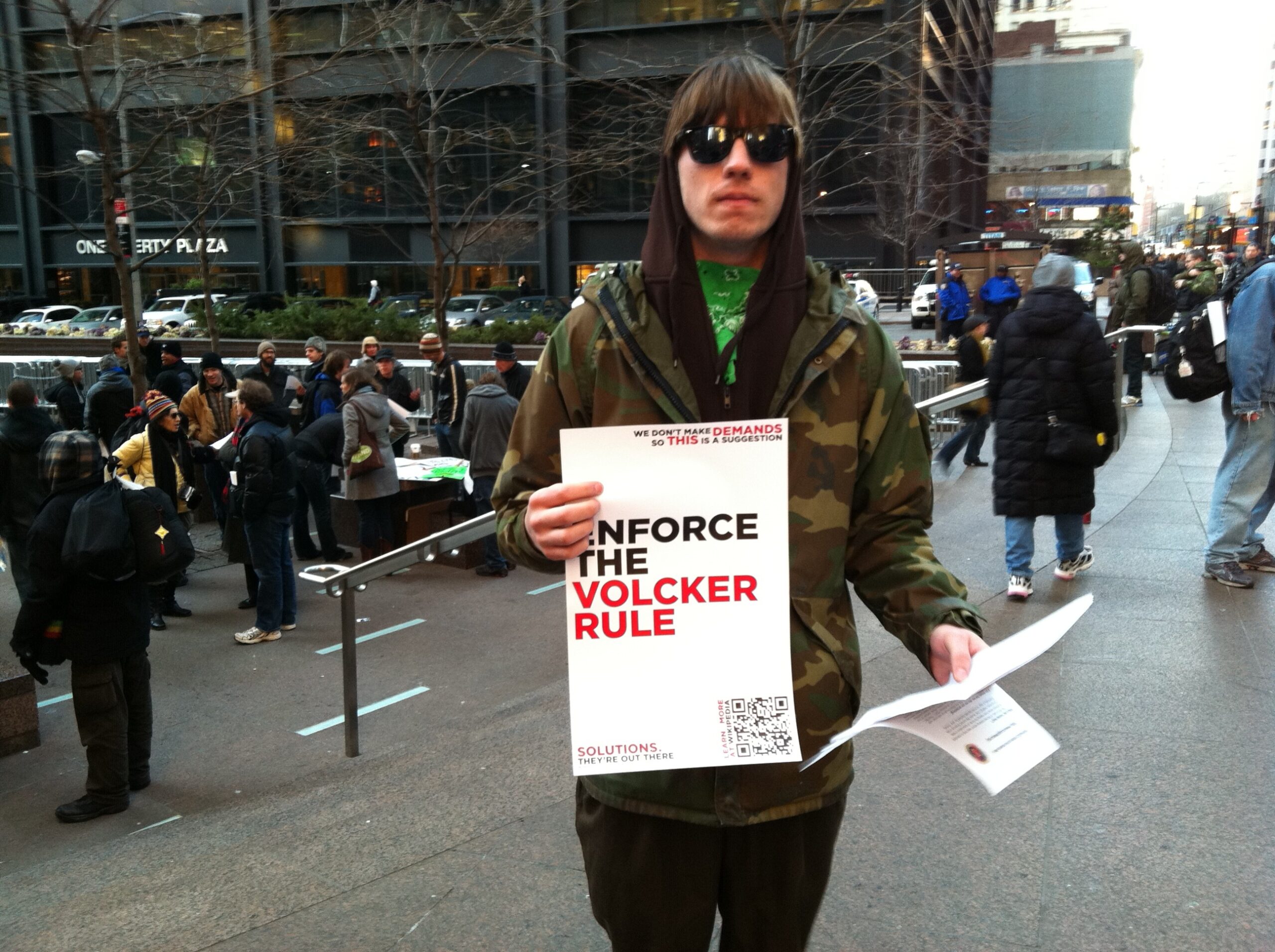
Occupy the SEC held the march to celebrate the release of its 325-page comment letter to the SEC calling for it to strengthen – and then, more important, enforce – the Volcker Rule, which will go into effect on July 21, 2012. According to Aaron Bornstein, who helped organize the march, Occupy the SEC’s comment is about twice the size of the next longest letter, drafted by the Securities Industry and Financial Markets Association, a financial interest lobbying group.

The working group’s detailed policy position gives lie to the common claim that the Occupy Wall Street movement is “well intentioned but misinformed.” It shows there’s room in the movement both for policy wonks and those chanting “anti-capitalista.”

The group was aimed to bolster one of the key reforms to emerge since the 2008 crash. The Volcker Rule (named after former Federal Reserve Board Chairman Paul Volcker)  is a subsection of the Dodd-Frank act, passed in 2010. Its purpose is to curb risky speculative trading by Wall Street investment firms. The regulations are set to be  finalized in mid-July. Until then well-paid lobbyists will do everything they can to create new loopholes that will enable the banks to engage in high-risk, high-reward speculation. Occupy the SEC seeks to block them.

“The main takeaway is the bank lobby is not the only player when it comes to influencing the regulators. There’s another side, and we’re trying to take that side,” said Akshat Tewary, an attorney, who helped draft the letter.

The SEC  is now bound to some combination of its initial draft and the comments it receives, explained Alexis Goldstein, who quit her Wall Street job last year. “They can’t add new stuff out of thin air; it has to come from comments. We’ve basically said the opposite of what the banks have said, from what I can tell so far.”

The action marks an unusual development for both the Occupy Wall Street movement and  the SEC. Unlike the Environmental Protection Agency, which gets comments from both industry and environmentalists, the SEC usually only hears from industry. The movement is bolstering the regulators, not bad-mouthing them. While the Occupy movement is often characterized by its disruptive street protests, it also includes a faction willing to dedicate untold hours of detailed policy analysis urging the SEC to do its job. That’s a more full understanding of what the movement calls “diversity of tactics.”

It’s hard to argue with Occupy the SEC’s recommendations. The Volcker Rule currently has an exemption for “repos,” which, Akshat tells me, is “basically a way to get funding at a very high leverage and very quickly.” Alexis describes repos like a pawn shop transaction. You sell your watch to the pawn shop for cash, but you plan on buying it back.

“So it’s technically a sale, but it’s treated as a way to finance things. Banks do this all the time, to finance things. And that would be fine if they were using Treasuries [i.e., U.S. Treasury bonds,  the definition of a safe bet], but they’re using these crappy assets. So they sell them, then they buy them back, and it’s all really short-term trading that happens with them. When people start to think the assets are bad they demand more collateral, and then other people hear that they’re in trouble so they start to demand more collateral and it becomes this death spiral.”

Repos are one of the reasons Lehman Brothers fell as swiftly as it did in 2008, and Occupy the SEC thinks that exempting them from the Volcker rule is a “terrible” idea.

They also want illiquid, over-the-counter financial products – like mortgage-backed securities – to be forbidden. As Alexis Goldstein puts it, “There’s a clause that says any high-risk asset shouldn’t be allowed by the rule, and we think over-the-counter illiquid assets are high risk.” The millions of Americans still suffering the effects of the Great Recession that began with the 2008 Wall Street crash  are likely to agree.

In addition to its attempt to directly influence the SEC, the group hopes to wage a broad educational campaign to teach the public about the financial industry. Occupy Wall Street has already successfully jammed early-stage class consciousness into the American zeitgeist. Occupy the SEC is hoping to build on that.

As one SEC occupier told me before the march, “One of the most exciting, surreal things about Occupy Wall Street so far is I have this sign that says, ‘Bring Back the Glass-Steagall Act,’ and if I just hold that on the subway, or on Broadway, you see people walking up to me every day, every single day I do it, someone walks up to me and says, ‘Yeah man, the Glass-Steagall Act.’ That would have been unthinkable four or five months ago.”

Creeping authoritarianism on Capitol Hill

What we can learn from one congressman's convoluted defense of the NDAA

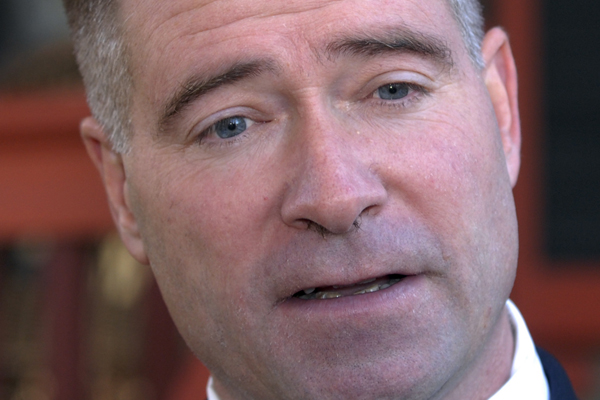
Rep. Chris Gibson (Credit: AP/Hans Pennink)

On the day Occupy Congress came to Washington, I tagged along with seven Bard College students who went to talk to their representative, first-term Republican Chris Gibson from the 20th Congressional District of New York.  Listening to Gibson defend his vote for the National Defense Authorization Act (NDAA), which President Obama signed on New Year’s Eve and which allows for the indefinite detention of American citizens, I had a rare glimpse into the contemporary authoritarian mind-set in all its banality. It illustrated how the slow erosion of civil liberties manifests itself in the halls of power in Washington.

Gibson is a retired Army colonel, and it shows. From the Airborne division name plate on his desk, to the photographs of camouflaged soldiers that adorn his walls, to the “Beat Navy” button on his desk, his military background is on display. He spoke about serving in the military to defend American’s rights – rights that he claims to take very seriously. To his credit, Gibson joined 26 other House Republicans in voting against the extension of the Patriot Act in February 2011. But his written record, and his NDAA vote, indicate he is a politician more concerned with waging war than preserving liberty.

He believes “the West” faces an existential threat from al-Qaida. On Page 4 of his book ”Securing the State,” published in 2008,  he wrote:

The US is engaged in a difficult struggle against a determined enemy who publicly declares his strategic aim the establishment of a caliphate in the Middle East and the ultimate destruction of the West.

Since then, Gibson has publicly said that Congress should “declare war on al-Qaeda,” which “could re-focus the nation and provide the political consensus necessary to consolidate and restructure the Federal government to win this war” [emphasis mine]. Those quotes are from an Op-Ed that argues the federal government, particularly the national security apparatus, is bloated and uncoordinated. He believes that a Joint Special Operations Command-style military is a better paradigm than the one envisioned by Donald Rumsfeld. President Obama also favors a JSOC model for foreign intervention.

When one of the Bard students asked about the NDAA, Gibson was well prepared. He removed three documents from his bag: a copy of Section 1021 of the bill, Obama’s signing statement, and an on-the-congressional-record conversation between two congressmen declaring the writ of habeas corpus was unaffected by anything in the NDAA.

Gibson rested his defense of his claim that the NDAA doesn’t significantly alter U.S. citizens’ civil liberties on Section 1021(e), which states, “Nothing in this section shall be construed to affect existing law or authorities relating to the detention of United States citizens, lawful resident aliens of the United States, or any other persons who are captured or arrested in the United States” [emphasis mine].

This section has already received substantial scrutiny online, which I won’t restate here, but sitting in Gibson’s office, he did his best to present this passage as proof-positive that all this anti-NDAA activism was much ado about nothing. He repeated it several times for us: “‘Nothing in this section shall be construed to affect existing law.’ It’s right there in the bill, this doesn’t change anything.”

“But I think critics would say ‘existing law’ is part of the problem,” I interjected. I cited the assassination of U.S. citizen Anwar al-Awlaki as the most troubling example of existing law, and that a case like Hamdi – which eventually ruled that the law required Hamdi to be granted habeas rights – is overshadowed by the president’s decision on al-Awlaki. If the president claims the power to assassinate a U.S. citizen without due process and in complete secrecy, then he also has the power to indefinitely detain citizens.

“I have to concede the point on al-Awlaki,” Gibson responded. He went on to say the al-Awlaki situation wasn’t handled well. He said there should have been some sort of judicial overview, something like a public defender, which could be selected by a group like the ACLU, to offer a defense in cases like this. Gibson believes al-Awlaki was engaged in war against the United States, but he readily admitted that that wasn’t enough; the government needs to prove those kinds of accusations.

And that, as they say, is the rub. After spending 15 minutes defending the NDAA, offering argument after argument about how it doesn’t change anything about citizens’ rights, how it doesn’t erode our liberties, he abandoned the point. When faced with the most egregious example of unconstitutional behavior by the executive branch – deprivation of life without due process – this staunch defender of the NDAA is forced to concede the point. What kind of logical pretzel must Gibson’s mind be twisted into? How can one cite “existing law” as the anchor of that section of the bill — as the language that prevents the executive from overreaching its power — and then, when faced with abhorrent existing law, simply concede the point? An argument that flimsy would not do well in a high school debate tournament. In the context of the U.S. Congress, it’s what passes for nuance.

This is how civil liberties get eroded: not by landslides, but by glaciers. Inch by inch. Those who claim to believe in liberty sacrifice it for the illusion of security, all the while holding themselves up as staunch defenders of the American Way. To whatever extent Gibson believes his own rhetoric about the importance of the Bill of Rights, his actions tell a different story, a story of illusion trumping logic and fact.

The greatest threat to America is the steady drip of, “I’ll concede that point,” but, after all, you’re citing a fringe example from which we can’t extrapolate. We are a Free Country, and no bill or act or presidential decree can take that away. Those who find comfort in that line of reasoning – and Gibson has plenty of company in both parties – are, whether they know it or not, acting as authoritarians. They must confront their own complacency and reverse course if they wish to actually defend civil liberties, instead of just claiming they do.

Continue Reading Close

My 37 hours with the NYPD

Why it is important for occupiers to see the inside of the prison-industrial complex

Your correspondent on the job(Credit: Stephanie Keith)

“You got press credentials?”

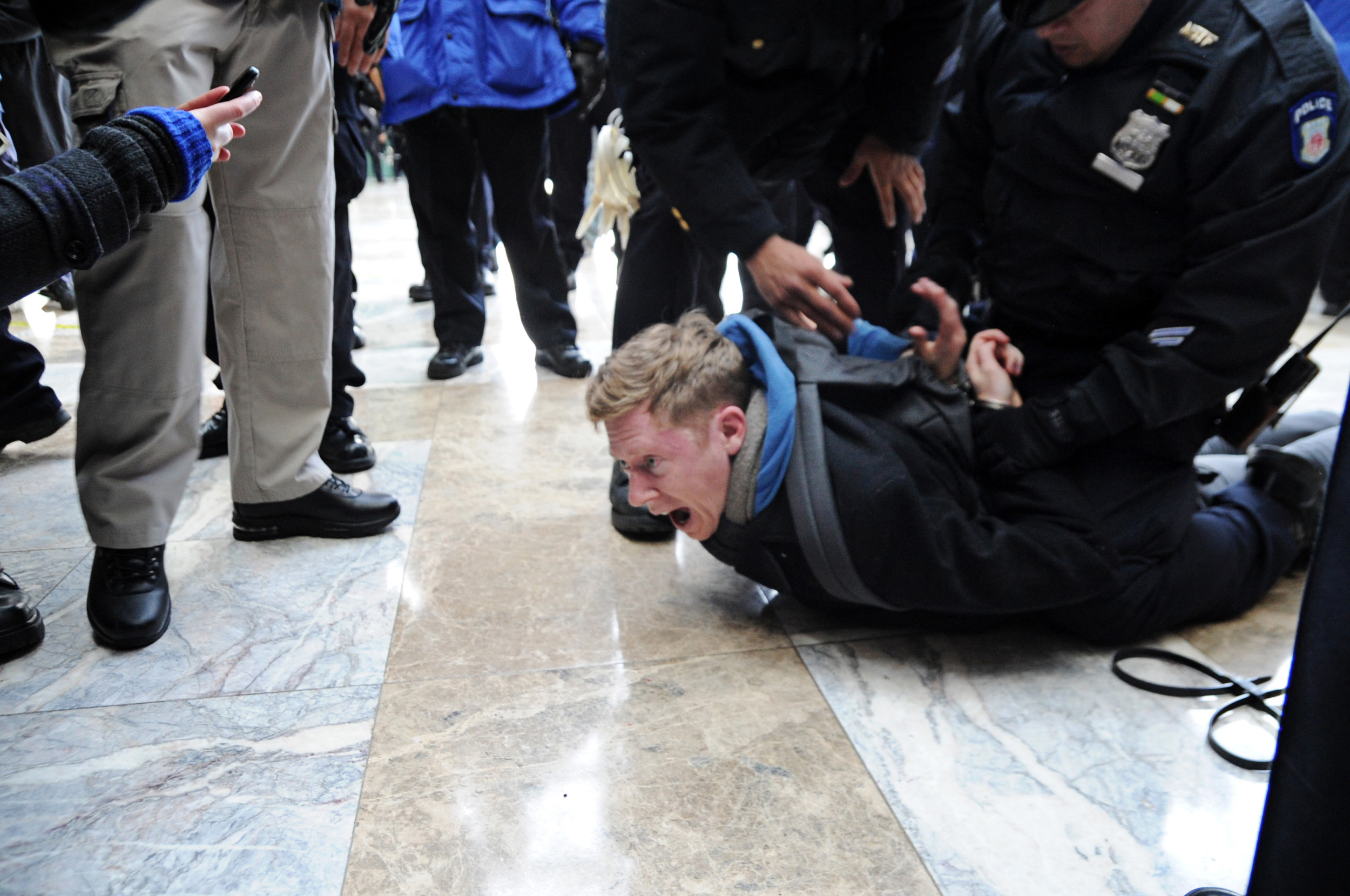
I barely had time to say no to the mustachioed White Shirt before he grabbed my forearm and threw me to the ground. As he brought me down I transferred my smartphone – which I had been using to document the NYPD’s aggressive arrests following the impromptu celebration in the Winter Garden on Dec. 12 – to my left hand and then my pocket. The website Boing Boing posted a very dramatic photograph of me holding my glasses while police pile on top of me. I’ve been covering Occupy Wall Street as an independent journalist for its entirety as a radio show host, for Salon, and on the ground.

My arresting officer soon moved me to a chair at the far end of the lobby, just in front of the giant bay windows that line that side of the building. I was the 12th person arrested so far. There would be five more that morning before the cops were done – 10 men, seven women. Next to me sat a woman named Sarah, a drummer for the phenomenal protest marching band the Rude Mechanical Orchestra. Plastic zip ties – a longtime favorite tool for so-called riot police – held her wrists behind her back. Sarah still had her bass drum strapped to her chest, though, giving her a somewhat comical appearance. One could imagine charges against her reading: conspiracy to start a dance party. That type of absurd application of authority would become common over the next 37 hours as my fellow arrestees and I would wait for our arraignment.

The perp walk from the atrium to the paddy wagon wasn’t so bad. There were around 100 supporters standing by in solidarity clapping, taking photos and yelling, “Whose tweets? Our tweets.” Of the 10 guys I was in the wagon with, eight of us had either been tweeting, livestreaming or had cameras. None of us had official NYPD press credentials. On the ride to the station I was able to reach into my pocket and slide my phone into my hand to shoot off some last-minute tweets, Charles took some photos, and Paul, who was sitting next to me, fired up his livestream again. When we got to the 7th Precinct none of the cops standing guard paid much attention to us, until one of their bosses came up and told them that someone at One Police Plaza was watching the paddy wagon feed, and they weren’t too happy about it. After that we put everything away, but Elizabeth, another member of the OWS media team, continued to film from outside.

They brought us inside and sat us in chairs against the wall in a large meeting area with a podium on one side. I was the last arrestee to be processed, just short of five hours after I had been handcuffed.  The police would continue this blistering pace for the next day and a half, using every excuse or procedure possible to slow our processing down. Once the sergeant on duty removed my plastic cuffs – which dig into your skin, often cause tingling or loss of feeling, and for me caused soreness, though nothing extreme – and confiscated my backpack and personal belongings, they sent me to the holding cells in the back of the precinct.

One cell in the tiny hallway held the seven women, next to that was a bathroom with a door that didn’t close, and after that was a cell that held the nine other men. Our cell was roughly 7 feet by 8 feet, and for the entire time we were held there were between 10 and 12 men inside. We were kept there from early Monday afternoon to 3 a.m Tuesday. I was not allowed to make a phone call until roughly 1 Monday night, about 14 hours after my arrest.

Getting to know Diablo

A man whom I’ll refer to as Diablo – a pseudonym based on a pseudonym – was with us most of the time we were there. He was being held on drug charges, but he claimed to be the victim of a setup. Diablo is a 28-year-old man from the neighborhood around the 7th Precinct, grew up in the projects near the Williamsburg Bridge, and had been involved in various petty crime operations since he was a teenager. According to him he had many, many priors, but none of them had resulted in felony charges.

As the 11 of us sat there, he told us that he was trying to get a gig as a security guard and work his way up to a position at an independent armored car firm, like Dunbar. If he got a felony charge, though, that would essentially end that potential career path. He said that we was a really talented basketball player when he was younger – his position was shooting guard – until he got wrapped up in the drug game, as he said. He also likes doing yoga and said he would love to be a personal trainer someday. So we sat there and talked about him, and about Occupy Wall Street, and then a cop came in and handed him a few sheets of paper that said he was going to be charged with a felony.

He was upset, clearly, but his initial reaction was something closer to resignation than anger. He said that he had “had a good run,” and if he had to do a city beat – which refers to spending time in Rikers, as opposed to being sent upstate – that wouldn’t be so bad. He needed a vacation, needed to get sober, stop smoking weed, exercise more. At one point he said, “I’m not going to pretend like I didn’t see this coming. What I was doing was illegal.” He jokingly asked if OWS could send a working group up to visit him at Rikers. Some of the organizers I was with said yeah, we’ll do jail visits.

One of the highlights of the whole thing for me was when the OWS women in the next cell started singing “Lean on Me,” and after a few bars the men joined in. When we finished Diablo said, “Man, this is some straight up movie shit right here.” An occupier named Guy looked at Diablo – who was facing six months in real prison and was surrounded by 17 protesters – and said, “This must be pretty weird.” Diablo responded, “No, definitely, this is real weird.”

Around 3 a.m. the cops were finally ready to move us to Central Booking. We lined up outside our cell standing in five sets of pairs, all facing the same direction. The cops then shackled us together like you would a chain gain, except instead of the full hands and feet we were only bound with one hand. So if you were in the front pair standing on the right, your left hand was attached to your partner’s, and vice versa, and each pair was linked together by maybe two feet of chain. We were marched through the precinct’s lobby – where Elizabeth the livestreamer slept in a chair, waiting for us – and into a new paddy wagon. We marched up the stair and into the holding area in complete darkness. When we were all inside an outwardly confident though obviously deeply insecure officer named Pete Volaric shut the doors behind us, leaving us in complete darkness.

The ride to Central Booking was stop and go although it was 3:30 a.m., and with each slam on the brakes we lurched forward as one awkward organism. Our handcuffs weren’t double locked, which means that with every motion, every yank, the rings got tighter.  When we got to Central Booking a different cop opened the latch and said, “Jesus, Voleric, you didn’t even turn on the light?” That cop switched it on as we made our way out of the paddy wagon. Standing in an open air pen inside the perimeter of Central Booking, shivering from the cold, Justin – a high-profile occupier – offhandedly remarked, “This is some real Soviet shit.”

The next two hours in many ways distilled the absurdism of our entire detainment. The 10 of us were forced to wind our way around tight hallways and down staircases all shackled together. One member of our group, Al, is an older man who had trouble walking quickly, especially since his belt had been taken, and as a result we moved at a pallbearer’s pace. The officers shuffled us from station to station, each time stopping us outside the room we had to go in to release us from our group cuffs one at a time. As a result, a series of processing procedures that could have taken 30 minutes total was dragged out for about two hours. I can’t be certain, but I think we finally arrived at our new cell in the tombs at around 5 a.m.

We spent the next 15 or so hours there. At lunchtime when we lined up in the hallway we saw Diablo in the next group cell over. It was like seeing an old friend. He asked how we were doing, we said fine. We asked how he was doing, he said fine. Someone in one of the other group cells behind us said, “No, no, that’s the Occupy Wall Street guys.” A few arrestees said keep up the good work. Later in the day we called some allies and recorded a phone interview describing our experience. Jeff, a member of the press team, and Lorenzo and Nick, members of the livestream group, set up the interview and sent it out to the Internet. I spoke with a friend of mine named Joe who helped me alert people about our situation.

We want your retina

When we were finally brought to the final holding area for our arraignment we were informed that if we refused to submit to a retina scan we would likely be held overnight. The retina scan is a voluntary procedure that all 10 of us had already denied earlier that day. According to our lawyers from the National Lawyers Guild – who are heroes – the lieutenant on duty and the judge said that if we continued to refuse the scans we wouldn’t get out that night. With only a few exceptions due to personal commitments, we all stood in solidarity and refused to submit to the procedure. This was around 11 p.m. on Tuesday, roughly 36 hours after our arrest. Several of the women arrested and a majority of the men were going to spend another night in prison to protest the ever expanding security state. In many ways, this final hurdle was the most egregious encroachment on our liberties. The retinal scan is a voluntary procedure, but if you don’t submit to it, you will be punished.

One final thought after these illuminating 37 hours. The story of Occupy Wall Street is impossible to tell removed from the story of the prison industrial complex. What makes OWS necessary is a story of a failing educational system. It’s a story of privatized prisons. It’s a story of predatory lenders, lack of affordable housing, and a complete absence of jobs in the most marginalized communities, who are often black or brown. It’s a story of a so-called drug war meant to imprison black and brown youth as a means of generating profits for the 1 percent. The NYPD have shown they will arrest accredited and unaccredited journalists alike. Official credentials don’t work as a protection.

That said, journalists – like activists – shouldn’t be afraid of going to jail. If and when we do get arrested it is not an inconvenience, or something that we shouldn’t be subjected to. It’s a chance to refocus our outrage, a chance to tell the most important stories, a chance to bear witness to the horrors of our criminal justice system. I don’t think the NYPD will ever offer me official credentials, but I won’t be asking them for any. Our right to observe and document police misconduct is not contingent on the approval of the authorities. And if the police think that intimidation is going to stop this movement, they should know better by now.

Continue Reading Close

Last night at the Zuccotti barricades

A first-person account of pepper spray, rugby cops and "collective viciousness"

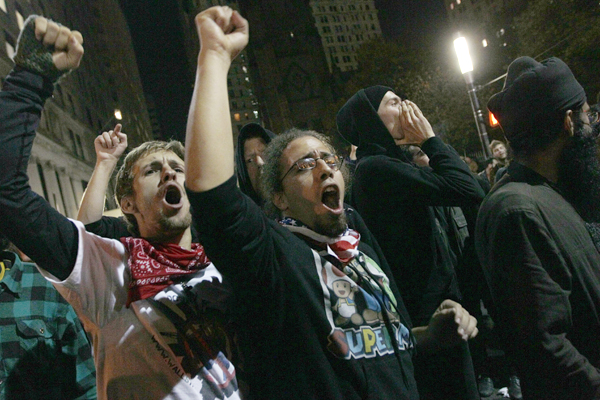
Occupy Wall Street demonstrators chant slogans at a police barricade near t Zuccotti Park early Tuesday (Credit: AP/Mary Altaffer)

Just after 1 a.m. Tuesday Occupy Wall Street sent out an emergency text message that read: URGENT. Hundreds of police mobilizing around Zuccotti. Eviction in progress.

I hopped on my bike and rode over to see what was happening. Biking there turned out to be a lucky accident; when I arrived I saw on Twitter that the Manhattan-bound side of the Brooklyn Bridge had been shut down and some subway lines weren’t running downtown.

I tried to get as close to Liberty Square as possible, but the NYPD had erected a buffer zone of two or more blocks completely around the park. The resulting media blackout was well-documented this morning, and I couldn’t see any of what was actually going on as the police moved in.

The police began forcibly moving protesters gathered around the barricades north on Broadway with their batons held out, parallel to the ground. At one point about 30 people sat down on the sidewalk outside the Payless store as an act of civil disobedience. The police issued a dispersal order but didn’t move in, and the situation seemed to calm down temporarily.

Shortly after, however, the police formed a line and once again began using their batons to shove the mass of protesters backward, toward Cortland Street. At this point the police became aggressive, rushing into the crowd to grab protesters and using pepper spray. The crowd began moving north more quickly at this point, though police continued to arrest activists standing on the sidewalk attempting to obey their orders.

A video I took on my cellphone and posted to Twitter shows police then formed a gauntlet to remove the protesters who were still on Broadway. They stood in two short parallel lines and flung protesters in the general direction they were instructing us to go, an action that resulted in many people tripping over each other, which was followed by police using their batons to clear those who were attempting to witness the arrests.

It was around this time that those gathering in Foley Square began marching. On this march I witnessed several egregious examples of police misconduct. Compared with the Occupy Oakland solidarity march from earlier this month – which followed a similar route – the police behavior was far more aggressive and provocative. Two women were arrested while they were marching on the sidewalk a few feet in front of the rest of the march, seemingly unprovoked. There were several instances of police rushing through marchers like deranged rugby players, possibly in an attempt to arrest a specific person on the other side of the group.

A medic I spoke with estimated that between 30 and 40 people had been pepper-sprayed just around the kitchen area alone. I was hit with a baton on the leg and pepper-sprayed simultaneously after briefly stepping off the sidewalk, and although neither did significant damage I can confirm that both of those things are very unpleasant, and also make it difficult to document police abuse. It’s hard to shoot video when you’re temporarily blind.

Shortly after my incident I walked into the street to get a video of an aggressive arrest when a cop brandished her baton at me and hurled expletives, yelling, “Get the fuck back on the sidewalk. Get the fuck back on the sidewalk.”

The march got as far north as Broadway and Great Jones, after which it turned south, eventually winding through the narrows of the financial district to its ultimate destination of Broadway and Pine, where a large group had already congregated. The situation there was mostly calm, although a friend of mine was arrested and I was recently told that he suffered a concussion during his arrest.

This morning showed that Mayor Bloomberg and Commissioner Kelly are not trying to win a P.R. war or demonstrate restraint. I’ve for the most part defended the NYPD over the past two months. This morning, though, they had a collective viciousness that I haven’t found to be present on a large scale before. This tactic, however, will backfire. If recent history is any guide, we can expect Thursday’s planned actions to attract even more participants than they would have otherwise.


Continue Reading Close
www.salon.com/writer/john_knefel/index.html