Kate Moses

From household saint to social pariah

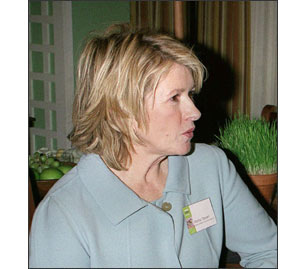
In Sunday's New York Times Magazine, Martha Stewart let it slip that the real reason she's leaving Westport, Conn., is because she's lonely.

  • more
    • All Share Services

From household saint to social pariah

In the Feb. 21-28 issue of the New Yorker, Joan Didion made some incisive observations about the enigmatic allure of Martha Stewart. “The promise she makes her readers and viewers,” Didion wrote, “is that know-how in the house will translate to can-do outside of it … The ‘cultural meaning’ of Martha Stewart’s success, in other words, lies deep in the success itself.”

It’s hard to argue with Didion’s point — to a point: The Polish girl from Nutley, N.J., who started a part-time catering business in her house, is now the famous scion of a staggeringly successful, publicly owned multimedia corporation bearing her name. She’s running an empire on four hours of sleep a night, has numerous tastefully appointed residences and she’s got all of those tag-sale treasures that you and I will never have.

But what are we to make of Stewart’s unwitting confession of interpersonal failure in last Sunday’s New York Times Magazine?

An essay titled “Martha Stewart Leaving” appeared under Stewart’s byline in the Times’ theme issue on American suburbia. The piece was ostensibly the author’s apologia regarding her decision to move away from Westport, Conn., her home base for almost 30 years.

Yet with the astonishing lack of insight that is familiar to regular readers of Martha Stewart Living magazine, Stewart made it apparent, if not exactly clear, that the real reason she’s giving up on Westport is because she’s lonely there. Her revelations of her neighbors’ cold-blooded rejections and her increased obsession with her pets don’t jibe with the idea that Stewart’s “know-how” in her Turkey Hill estate has translated to “can-do” in the community outside of it.

In short, Stewart needs friends.

Casting out from her unintentionally illuminating, purposely nostalgic “Remembering” column, which appears monthly on the back page of Martha Stewart Living, Stewart wrote in the Times about the changing face of suburbia, in particular, Westport. The Times editors capture it thus in their concise, subtly ironic subhead: “The reason Westport no longer works for Stewart: Small-town life just isn’t what it used to be.”

Stewart then outlines the way Westport was vs. the way it is now, a difference she boils down to two primary assessments: one, that the town is no longer full of hospitable folks, and two, that its local regulations have not proven to be helpful to the entrepreneurial projects of its best-known resident. Stewart details how her favorite local businesses have disappeared, how her “extremely critical” neighbors have created “an increasingly unfriendly neighborhood atmosphere,” how her acrimonious divorce divided her social circle and left her lacking in companionship, how her married daughter doesn’t want to visit “with the atmosphere in Westport so changed.”

It’s surprising to hear that “friendliness” actually matters that much to Stewart, for whom people have always seemed such an afterthought. Stewart’s meal-centered “reunions” with various friends and acquaintances that are featured in the monthly magazine always seem stiff and staged, as if “An Iowa Picnic” or “A Luncheon in Harlem” are the only ways to capture Stewart in commerce with someone not within her employ.

It’s equally surprising that nowhere in her essay does Stewart take note of how significantly she — not just her town or her marital status or “things” — has changed since she made Westport her home.

Instead, Stewart tells us how she’s managed to cope with “the warning signs” that her community was turning its back on her. She’s redecorated her house and “carefully edited” her furnishings. She’s enlarged her gardens. She’s tried to offer fresh eggs and garden produce to her endless stream of new neighbors, only to be rebuffed (“once with a slammed door”). She’s ultimately given in to creature comforts — in addition to her chow chow dogs and her eight cats, she’s now breeding chinchillas.

Yet despite how much she loves her pets and the oft-cited Turkey Hill estate, despite her “bold attempts” to keep up her own social traditions, nobody’s inviting her to dinner and she feels isolated. The vision this information evokes in the mind’s eye is rather creepy: Stewart is just another lonely loser in suburbia, a shut-in surrounded by landscaping and material comforts and litter boxes, someone who is draped with shedding, long-haired animals and reduced to watching “The Sopranos” by herself every Sunday night.

This is, quite frankly, more than I wanted to know about our Martha. Don’t get me wrong. There’s a certain mean-spirited pleasure I get out of scanning the “Remembering” column for dirt every month. Unlike the front-of-the-book “Letter from Martha,” which is constrained by editorial necessity to hollow-souled flag-waving for the month’s features and an occasional mortified mea culpa for some transgression in the previous issue (no flour in the recipe for Easter Egg Cake!), Stewart’s regular “Remembering” essay is clearly the Good Thing queen’s sacred opportunity to flex her literary muscles on a wistful subject of her choosing.

She’s written about undertaking a third major garden, making marshmallows and sending her young daughter to camp. The current issue’s “Remembering” glorifies the good old days when Stewart’s mother used to spend every Monday slaving over the laundry for a family of eight in the steamy basement of their house in Nutley.

Utterly devoid of even a whiff of irony, these missives are frequently peppered with weird and unintended revelations about the inner Stewart, whose earnest reminiscences and forthright, if prosaic, storytelling are the scrim through which we are witness to her thorough lack of self-awareness.

There are so many classic examples of Stewart’s obliviousness regarding her own psychology that it’s hard to narrow down the field of favorites. In her latest “theme” issue, the just-released “Martha Stewart Baby,” which outlines the many ways a baby can be utilized as a decor statement, Stewart remembers that her labor with Alexis lasted — yes! — exactly one efficient hour!

Another all-time great was Stewart’s 1998 column on Alexis’ summer camps. Before spending the summer correcting the spelling in 6-year-old Alexis’ homesick letters, Stewart basked in the maternal glory of choosing a camp based on the aesthetics of the grounds (a long dirt road paved with crushed garnet fragments, “a lodge that resembled a Shaker meeting hall”).

And then there are the references to “When Andy and I were first married …” Any Stewart follower knows that her marriage ended in a bitter divorce a decade ago, and her ex — who went so far as to take out a restraining order against her — is now married to Stewart’s youthful former assistant. It’s nothing less than bizarre, then, to note the frequency with which Stewart’s rosy-toned essays linger on some fondly remembered aspect of married life with Andy.

Frankly, it’s fun to have such a regular dose of imprudent psychological obtuseness from the woman who has been impressively shrewd in building a lucrative empire wrung solely from her personal “vision.” Precisely because of that empire, I’ve often wondered why someone doesn’t pull the plug on “Remembering” before she really embarrasses herself. I’ve also wondered if “Remembering” is a title that her wincing editorial staff uses as shorthand for “Remember, it’s her magazine.”

The thing to remember about “Remembering,” though, is that within the context of “Martha Stewart Living,” Stewart’s indiscretions are fairly safe. She’s in Switzerland, so to speak. Which is not to say that those of us who buy her magazine or watch her show or covet the rubberized linen shower curtain in the “Martha By Mail” catalog actually like Stewart, that we’re on her side. The relationship between Martha and the Martha’d is far more complex than that, as we all know.

“Even her troubles and strivings are part of the message,” notes Didion, “not detrimental but integral to the brand.” Ours is a codependency; we may sneer in derision at Stewart’s infuriatingly elaborate and expensive projects one minute, then stare covetously at her animals fashioned out of homemade mohair pompoms the next.

By virtue of our complicity in being even the slightest bit interested in Martha Stewart, we become members of Stewart’s unique 12-step world. When we read “Remembering,” it’s the equivalent of sitting in a squalid parish basement drinking watery coffee and listening to the boring, woebegone life story of some balding guy with a compulsive thigh-jiggle and an ugly sweat suit. You don’t laugh; you don’t point. Once you’ve walked in the door and sat down, you’ve joined the community. You may roll your eyes privately, but you don’t rat Stewart out.

The editors at the Times magazine, however, let Stewart rat herself out. What would pass for a hiccup of personality in Martha Stewart Living suddenly looms pathetic and cringe-inducing within the far more symbolically “public” pages of the New York Times.

It’s no crime and no shame to admit you’re lonely and that nobody in your town wants to be friends with you — but it’s pitiful to admit it to a circulation of 1.7 million readers without realizing what you’ve done.

Over the years, Stewart has elicited a whole kaleidoscope of emotions from me: fascination, envy, material desire, determination, frustration, boredom. Until now, I never felt sorry for her. And what I really don’t want is to turn my Martha fantasies toward social intervention for the CEO of Martha Stewart Living Omnimedia — imagining some sort of dinner round robin (“Sally, you call her up for Monday; I’ll invite her over for Wednesday; maybe we can get Stan to take her out for pizza on Friday”), or convincing her to give up the chinchillas.

I want my Martha fantasies for me. Lord knows I’ll need the time if I’m ever to get any of my Martha projects off the ground. I want her to replace the veil she’s dropped, to keep her revelations behind the merciful curtain of Martha Stewart Living, where such intimacies belong, and where they can be marveled at or shrugged off, as desired. I’m in agreement here with Didion: “The dreams and fears into which Martha Stewart taps are not of ‘feminine’ domesticity but of female power, of the woman who sits down at the table with the men and, still in her apron, walks away with the chips.”

Stewart has indeed proven herself to be, in her inimitable way, a model of contemporary female power (if a model with feet of clay), and for that reason I have to bemusedly offer my admiration and, in a way, my loyalty. I do hope she moves out of Westport and makes more friends, and I hope she can stop herself at eight cats, which should help. I also hope she learns to play her cards, when she next goes to the “outside,” a little closer to her chest.

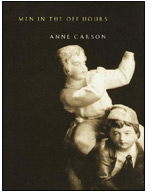
“Men in the Off Hours” by Anne Carson

The poet's breathtaking fourth collection takes in the picnic of sex and love and death that time spreads in its wake.

  • more
    • All Share Services

Anne Carson, the Canadian poet who has been called “a philosopher of heartbreak,” drops a clue to the preoccupation of her fourth collection of verse, “Men in the Off Hours,” in a poem titled “New Rule.” Here, as elsewhere, she refreshes a couple of lines from one of her earlier books:

Not enough spin on it, said my true love

When he left in our fifth year.

In her 1995 collection “Glass, Irony and God,” Carson wrote:

Not enough spin on it,

he said of our five years of love.

There and in “Plainwater” (also published in 1995) — which opened with a poem called “What Is Life Without Aphrodite?” — as well as in her 1998 novel in verse, “Autobiography of Red,” the emphasis was on the erotics of human interaction, the “love” that ends that couplet. In her new collection, though, the brilliantly inventive Carson has tipped her scale toward the secondary element in that earlier reflection on eros: Much of the book is a sui generis meditation on time. But it’s impossible for Carson to divorce herself completely from a thematic territory she has previously made so startlingly new, and so “Men in the Off Hours” encompasses all of that picnic that time spreads behind itself: life and sex and love and death.


It’s appropriate that Carson should allow her mind to rest on the notion of time — subjective, linear, collapsing, cinematic — for she is a classicist with a rare ability to invigorate figures and themes otherwise relegated to the dustbin of history. Her opening gambit is a prose essay that throws together Thucydides, the historian of the Peloponnesian War, and Virginia Woolf, who “stays in her own time” as she records the beginnings of World War I in her essay “The Mark on the Wall.” “How people tell time,” Carson observes, “is an intimate and local fact about them.”

Later in the book, she revisits Thucydides and Woolf in the sequence “TV Men,” wherein Thucydides is the director to Woolf’s actor/narrator, who questions her character’s motivation and delivery on the set of a documentary version of (of course) “The Peloponnesian War.” In another wildly imaginative juxtaposition, Carson pins gritty narrative illuminations of the paintings of Edward Hopper to the epiphanic “Confessions of Saint Augustine.” This droll poetic sequence, titled “Hopper: Confessions,” begins with a quotation from the artist: “I hope it does not tell an obvious anecdote for none is intended.”

Carson further illuminates her investigation of time in “Essay on What I Think About Most,” in which she breaks open the Aristotelian theory of metaphor (something “that causes the mind to experience itself/in the act of making a mistake”) as if it were a loaf of bread. This gift for surprise — the ability to fling together the strangest ideas, phrases and words and make them resonant and memorable — is at the center of Carson’s genius:

There is something you should know.

And the right way to know it

Is by a cherrying of your mind …

The way to know it

Is not by staring hard.

But keep chiselled

keep Praguing the eye …

In another poem, she writes:

Our lives

Were fragile, the wind

Could dash them away.

Carson, like Sylvia Plath, has the Dickensonian ability to make words, in their simple particularity, astonishing.

In this sense, her poetry can be contrasted with the masterworks of John James Audubon, the premier American ornithological artist and the subject of one of the most traditionally structured yet most biting poems in the collection. Audubon, Carson notes, created a new method of painting he called “drawn from nature,” meaning that he depicted birds after he’d shot them, stuffed them and wired them in realistic poses in his studio: “You can look at these true shapes all day and not see the bird,” she notes coolly.

You can, however, see the resuscitated Lazarus as Carson evokes him in his “Shooting Script” section of “TV Men,” one of the most breathtaking passages of poetry to appear in years — a perfect illustration of Ezra Pound’s dictum “Make it new.” Perhaps only the frescoes of Giotto have done a better job than Carson’s poem of bringing Lazarus back to life:

And so

shifted forward into solidity —

although he pulls against it and groans to turn away —

Lazarus locks on

with a whistling sound behind him

as panels slide shut

and his soul congeals on his back in chrysolite drops

which almost at once evaporate.

Lazarus

(someone is calling his name) — his name!

And at the name (which he knew)

not just a roar of darkness

the whole skeletal freight

of him

took pressure,

crushing him backward into the rut where he lay

like a damp

petal

under a pile of furniture.

Fresh and surprising, too, are the 12 sections of “TV Men: Tolstoy,” in which Carson runs her perceptive finger over the surface of the novelist’s crystalline imagination and his benighted marriage (48 years of hell after a newlywed’s fateful mistake). Carson captures Count Leo Tolstoy and his miserable wife as another odd couple strangely united. For the count, she offers a set direction:

His bedroom on a March morning as cool as pearls, close-up on rustling,

coats or shawls.

For the mostly misunderstood countess:

Her alone at a midnight table in the zala, leaning over the manuscript with

her shortsighted eyes, shadow of her bent arm huge on the wall.

Woolf makes a final appearance at the end of the book, when Carson at last reveals what drew her attention so ineluctably toward a contemplation of time: Her mother died, and suddenly “night comes earlier — gathering like a garment.” Woolf’s diaries stood on Carson’s desk after the funeral, and she looked to the books for comfort despite their having led Woolf ultimately “to the River Ouse” — that is, to her suicide. And yet, the poet declares, “strong pleasure rises from every sentence.” It’s easy to make the same judgment of Anne Carson.

Continue Reading Close

Witness for the persecution

Croatian novelist and journalist Slavenka Drakulic tells a story of breathtaking brutality. We interview her about her new novel and her experiences.

  • more
    • All Share Services

Witness for the persecution

For most Westerners, who have the luxury of rhetorical objectivity while pondering the benign creep of tiny tanks across a television screen, the word “war” has been sanitized, denuded of the visceral horror and fear it is meant to evoke. It’s a word that’s been used too often and in too distant a context. It’s a concept that no longer holds its edge.

According to Croatian novelist and journalist Slavenka Drakulic, the word war “has recently become tamed and domesticated in our vocabulary like a domestic animal, almost a pet.” So it goes without saying that one simply cannot grasp the possibility of war entering one’s daily life on a mild Sunday afternoon, say, while drinking Cabernet and eating pasta for lunch with a friend.

But war entered Drakulic’s life in just such an inconceivable way in the fall of 1991: She held her fork poised halfway between her plate and her mouth as low-flying MIGs suddenly roared over her apartment building in Zagreb.

The Western world’s reaction to the outbreak of war in the Balkans in the 1990s betrayed this lack of understanding of war as much as it betrayed a yawning gap in sensitivity to the fearful citizens of the Balkan nations, most of whom, despite the oft-repeated myths of their “ancient legacy of hatred and bloodshed,” were simply stunned by the presence of war in their own villages and neighborhoods.

One doesn’t live one’s daily life by the myths of ancient legacies; one lives by wondering, as does Drakulic’s schoolteacher narrator in “S., A Novel About the Balkans,” how one will manage to grade the progress of schoolchildren whose parents are fleeing the area. War, when it comes, comes as a shock, whether or not you’ve been born into a bloody legacy.

In her novel about the Balkan war, Drakulic makes S.’s initiation into the daily life of war as mind-bogglingly surreal as her own had been: S. is so taken aback by the sudden appearance of the young Serbian soldier who has just kicked in her apartment door that she invites him to sit down for coffee and then joins him, benumbed, at the table.

What follows for S. is a nightmare of monumental proportions — after being rounded up with all of the other Bosnian Muslim villagers in the town, S. watches as soldiers lead the village’s men away and listens, together with the other women and children, as gunshots ring out from a distance. The women are then taken to a warehouse where they are robbed, imprisoned, forced to sleep en masse on the bare concrete floor, to defecate as a group in an open field and to watch, again in silent helplessness, as their young girls are led away by guards. S., too, is soon led away to the “women’s room,” where the youngest and most attractive women are sequestered so that they can be repeatedly raped, beaten and tortured at the whim of Serbian soldiers.

The real nightmare, though, is that the character of S. is the only fictional element in Drakulic’s novel. Everything that happens to S., all that she experiences and witnesses — from her months in the women’s room to the horrible realization that she’s become pregnant, from observing another rape victim calmly smothering her newborn with a pillow to hearing that guards are forcing Muslim fathers to rape their own sons or be shot — comes from interviews with women who were victims of acts of breathtaking cruelty and racial hatred.

“War is merely a general term,” thinks S. from the Serbian prison camp, “a collective noun for so many individual stories.” Drakulic’s “S.” is the true story of the women who learned the real, unspeakable meaning of war in the Balkans.

Drakulic has been observing and recording the everyday experience of life — politicized, random, gruesome, hauntingly enigmatic — in her part of the world with acuity and insight throughout her career as a respected writer and journalist. Her concern for the lives of women is long-standing: She is a founding member of the first network of Eastern European women’s groups and has served on the advisory board for Ms. magazine.

In addition to the major European newspapers for which she writes regularly (Italy’s La Stampa, Germany’s Frankfurter Allgemeine Zeitung, Sweden’s Dagens Nyheter), Drakulic is now a contributing writer to the Nation. She’s the author of “The Balkan Express: Fragments From the Other Side of the War” and “Cafe Europa: Life After Communism.” “S.” is her third novel. Mothers Who Think spoke with her about “S.” and the terrible legacy of the Balkan war on the same day that the New York Times reported on the dismal conditions for women and children now swamping the Chechen refugee camps.

How did you come to be involved in documenting the war in the Balkans, and in particular, the experience of women during the war?

I was just there. I was born in Croatia — Yugoslavia — and all my life lived there. So, when the war started, it was my natural reaction — the reaction of a journalist and a writer to articulate events. These events, or the war, were so terrifying and changed people around me so much, that I felt compelled to describe that in order to try to understand what war does to people … to myself as well. And I am a woman. So I decided that these were the stories I wanted to tell. The war stories are about destruction and battles and number of killed and heroism, rarely about a woman or women.

You set out to write a nonfiction account of the “women’s rooms,” the experience of rape in the prison camps, but then chose the genre of fiction and created a fictional “everywoman” instead to tell this story. How did that decision come about? Were the Muslim cultural stigma of rape or the desire to protect the identity of the victims factors in your decision?

Rape is an incredibly strong cultural stigma in the patriarchal Muslim culture. And of course the identity of victims should be protected, but these concerns weren’t my real problem.

In 1992 I wanted to do a book of documents, of witness accounts of the victims of rape, with my introduction. That was my original idea. But the more witnessing I heard or read, the less I was convinced that they would work for the reader of such a book. The way stories were told — they were similar, repetitive and very … poor, limited somehow. So the effect was not one of identification, but of boredom.

In short, I realized that the terrible human drama was not fully present in the witness accounts. And I wanted people to listen, not to simply skip it. The only solution was to tell the story of a fictional woman, and through her all these stories.

What was the post-war experience of women who were defiled in the camps? How were they treated by their families and communities?

This is hard to say. There is no systematic evidence. Generally, the women do not talk about rape; they try to hide it. There are very few of them who come out in public and use their names. But there is a lot of anonymous witnessing.

Just recently one such book of witnessing accounts was published by CID, the Center for Investigation and Documentation of Bosnia and Herzegovina. Witnesses’ identity was protected, of course. But what is distressing is that those women, or men, who were camp inmates do not have even the minimum of legal rights or means of recourse. By publishing that book they are trying to fight for their rights.

Is the experience of S. a typical experience? How much of what happened to her and what she observed — being moved to the women’s room, being beaten and tortured, becoming pregnant, observing other women killing their babies or committing suicide — comes from factual or anecdotal evidence collected during your research?

My character, S., is fictional, but everything that happens to her is true. Every detail comes from someone’s witnessing. Unfortunately. And how typical? Well, that is hard to say. I read that 80 percent of the imprisoned women were raped in the camps. There were about 600 camps with over 200,000 prisoners, of which 38,000 died or were killed. But what can you say about statistics, if for example one women was raped over a hundred times? Statistics don’t take this kind of fact into account.

Could you describe the nature of the research you did with the Center for War Crimes? How many women did you interview, and were most Muslim? How comfortable did they feel telling their stories?

Well, my research went on through years …

I first met some of these women in the late autumn of 1992 in refugee camps in Zagreb and Karlovac. They were mostly Bosnians, Muslims, but some were Croats as well. Then I dropped the whole idea, as I described. Then I read more witnessing, books, talked to more women … It was a long and painful process for me. For them, well, it was difficult to get stories out of them. They were very, very uncomfortable talking about it.

Later in my process as a writer I read a number of books on the psychology of victims and understood why they do not want to, and cannot, talk. No victim of any kind of trauma can speak. When they can begin to articulate their trauma, it means that they are recovering. I understood, then, why the witnessing of these women had seemed so reduced and repetitious.

Are there any other statistics regarding the experience of women in the camps? Does anyone know how many were tortured or killed? How common were the women’s rooms?

Several independent international commissions established that the number of raped women is 20,000 to 60,000. The Bosnian Ministry of Interior is declaring 50,000. Now, this is just an approximation, it serves as orientation. But in reality, it is very difficult to establish the exact number, because during the war and after it is difficult to compile any kind of statistics.

In order for any of these numbers to make sense, how many people were killed or how many children wounded, you need to have all of the relevant demographic parameters. And with refugees, that is nearly impossible. But it is fair to say that women’s rooms were a mass practice. More than that, women’s rooms were a systematic practice, an integral part of ethnic cleansing. It means that this method was used to scare a population off of the specific territory. There were many women’s rooms.

What has happened to the “rape babies”? Is S.’s experience of giving her baby up for adoption a typical one? Are some of those babies being raised by their mothers? What is the social status of those children?

In your book, a character recalls being told by the soldiers raping her “that she would give birth to their Serbian child and that they would force all of these Muslim women to give birth to Serbian children. Where are those soldiers now? If children are born, they will be born to these women and they, not their unknown fathers, will decide their fate.”

Not much is known about the babies, though there were probably hundreds to thousands. They have been protected from the very beginning. I heard that most have been given up for adoption. There are only a few examples of women who kept those children. However, their status is presumably not different from other children’s, since no one knows that they were conceived by rape.

What is the agenda of the Center for War Crimes for these women, beyond documentation?

There is none.

What are the lives of the women like now? I’m reminded of what S. thinks as she’s readying to leave the Zagreb refugee camp: “Wherever they wind up, all these people will reek of the past.”

Last year I attended the weekly meetings of a psychotherapist and about 50 such women. They are refugees in Berlin. They are trying hard to survive, to go on. It is an immense, everyday struggle. To me, an outsider, it looked as if they live two parallel lives: one on the surface, in the present, and the other, the invisible one, in the past. If they manage to live a little bit more in the present, it is already a success.

Do you think, as Varlam Shalamov says in the quote you use to open the novel, that “a human being survives by his ability to forget”? What does that say about our chances, as members of the human race, of escaping more horrors like the Balkan wars?

We all like to believe that we are good, that human beings are essentially good and that it is possible to escape horrors. But I am not so sure. I think we are both, good and bad, and it is only an illusion that we know ourselves and that we can predict how we are going to behave in an extreme situation like a war. We don’t know, we can’t guarantee for ourselves and I think this is the terrible lesson that war teaches you. On the other hand, if we can’t forget horrors that happened to us, we cannot continue to live. I believe Shalamov. He knew what he was saying, he was a prisoner in Kolima, the worst Siberian camp …

When you made the decision to fictionalize this story, did you feel any concern about the possibility that fictionalizing these unspeakable crimes could further distance us from them and from the women who were victims? Or that creating one “everywoman” could render the real victims more faceless — rob them of their stories, when our inclination as readers and news-watchers is to want as much distance as possible?

No, I did not. On the contrary, I realized that the only way for readers to identify with such suffering was to fictionalize a character, although not a story. Simply, there was no one woman who could tell her story in such detail, psychological and emotional. Victimized women can’t do that. It means that either their stories will stay in the domain of witnessing and thus remain inaccessible to the public or that the public will have to wait another 10, 20 or more years until one of the victims decides to write her memoir. But then she also has to be very talented. I am sure that will happen. In the meantime, I decided to write a novel.

Continue Reading Close

Everyday genius

Joanna Scott's visionary new novel tells the story of an orphan torn between black and white grandparents.

  • more
    • All Share Services

Everyday genius

Can you pity a writer who’s won a MacArthur fellowship, the coveted, so-called genius award that bestows both confirmation of one’s bona fide egghead status and a financial package opulent enough to keep the genius juices flowing for a handful of years? The annual list of fellows makes for satisfyingly grandiose fantasies, but people also expect the award to be given to writers whose work is incomprehensible and dull.

This would be a wholly inaccurate assumption in the case of novelist Joanna Scott, former MacArthur fellow as well as Pulitzer Prize and PEN-Faulkner award nominee; the lofty critical affirmations of the literary establishment have little to do with the actual experience of reading one of her books. Scott is undeniably smart, but it’s not her learned brain that rises full and glowing as Humpty Dumpty out of her fiction; it is instead her startlingly perceptive, fecund and appealing imagination that is the biggest thing about Scott.

In all of her six books, each wildly different from the others, Scott has a lapidary’s instinct: She turns each story over as she would a raw gem, revealing its underside, magnifying every possible angle. Her multifaceted fictions gleam with real-world precision, so detailed that whatever universe she composes — a 19th century slave ship, a rural estate in 1920s New York, artist Egon Schiele’s fin-de-siecle Vienna, the interior landscape of a 4-year-old boy, a blind beekeeper’s orchard — appears solidly dimensional in the mind of the reader, quickened by a powerful narrative force.

But it isn’t just Scott’s settings that are believable. She’s a double threat: a writer who has the breadth of imagination to detail even the most minute sensory qualities of her fictional setups, and who also specializes in shaping and dissecting characters who come across as quirkily and mysteriously human. Human behavior, with all its vagaries, its shadows and light, is her project, and her characters, no matter how peculiar or obsessed, are drawn with a compassionate and relentless curiosity. Scott writes of her beekeeper, the protagonist in a story from the 1994 collection “Various Antidotes”: “With remarkable accuracy he could imagine the experiences of others … he comprehended these in rich particularity. Perhaps empathy rather than imagination would better describe this skill.” The same is true of Scott.

Scott’s preoccupation with the spiritual development of individuals has grown more evident with each of her books. Her first novel, “Fading, My Parmacheene Belle,” chronicles a furious flight by two haunted souls, one a 15-year-old runaway, the other an old fisherman whose ranting, book-long soliloquy is his tortured reconciliation to widowhood after 53 years of puzzling married life. The gruesome, wind-stalled journey of the slave ship in “The Closest Possible Union,” Scott’s second book, is also a metaphor for the moral journey of the novel’s young narrator, a 14-year-old who is both the captain’s apprentice and the son of the ship’s owner.

In the prismatic “Arrogance,” a fictionalized life of the Austrian expressionist painter Schiele, Scott creates a fragmentary structure informed by the artist’s tormented self-portraits and scandalous career, thereby shaping a meditation on artistic genius, psychic struggle and societal imprisonment. The widely praised “Various Antidotes,” arguably Scott’s best-known work, explores the theme of scientific passion from the perspectives of characters whose obsessions drive them to grim extremes — ranging from Charlotte Corday, who stabbed the French revolutionary Jean-Paul Marat in his bathtub, to the Dutch inventor of an early microscope, who kisses his daughter “not like a father should kiss a daughter but like the devil kisses” in order to steal a tear and test his new invention.

In “The Manikin,” Scott gave full rein to her natural gift for the strange and eccentric. A full-blown Gothic mystery, “The Manikin” is set in a rich taxidermist’s gloomy, isolated mansion where each of the stranded characters is symbolically trapped in time, their lives as suspended as those of the stuffed creatures that line the halls. What links this novel to her latest, the newly published “Make Believe,” and what sets both books apart from her earlier inventions, is a sustained authorial voice.

The novel opens with Bo, a 3-year-old boy and the pivot about whom the plot of “Make Believe” turns, hanging upside down from his seat belt following the car accident that has just killed his teenage mother, Jenny. Bo is now an orphan — his gifted, teenage father, Kamon Gilbert, was shot and left to die on a sidewalk, a random act of violence that occurred two months before Bo’s birth. After emergency surgery for a damaged spleen, Bo goes home with Kamon’s parents, Erma and Sam Gilbert.

Bereaved over the death of their son but content to raise their grandson, who has been in their daily care since Jenny started a job, Erma and Sam see it as pure and simple chance when an ordinary day closes with food on the table and their family’s good company instead of ending with tragedy. Similarly, Bo’s parents had attributed to the randomness of chance — it was neither good nor bad — the fact that Jenny was white and Kamon black.

Jenny’s stepfather, Eddie, however, saw Jenny’s pregnancy and her black boyfriend as evidence of her intrinsic corruption and drove her out of the house where she grew up. It is when Jenny’s passive mother, Marge, receives a huge bill for Bo’s emergency surgery, a bill for the care of a grandchild she has never bothered to meet, that Scott’s plot begins to take its full shape. The story’s linchpin is Eddie, whose inflexible belief in his moral superiority — and greedy desire for a spiritual test of his righteousness, conveniently dangling before him in the guise of a medical malpractice suit on behalf of Bo — stirs him to press for the custody of a child for whom he has previously shown complete scorn.

Rather than the skittish, untrustworthy narrators or limited viewpoints of her earlier works, in “Make Believe,” as in “The Manikin,” we experience Scott’s entire imagined vista through her own omniscient eyes. The scope of the world is described from the bottom of an ice-covered lake in midwinter — its shifting light, its iron-colored water gelatinous with cold. It is also described from the viewpoint of Kamon, as he lies bleeding on a sidewalk after being fatally shot, his dying, stream-of-consciousness moments growing equally more hallucinatory, essential and dimmed as they tick past. And it is seen from the vantage of a monumental discovery in the consciousness of Bo as he first savors the “bitter pleasure of pity.” Sent to his room in punishment for a misdeed, “he cried just thinking about himself crying, a sorry sight that would evoke, in memory, enough self-pity to sustain him for a lifetime.”

For a writer focused on the illumination of the subjective, imperfect, mystifying human journey, choosing a small child as a protagonist can be an exciting challenge, a method by which to expand and contract the boundaries of how a story can unwrap itself. It can also be a dangerous gamble capable of stalling a novel with an unplayable hand. Scott has played it safe by teaming her unveiling of Bo’s inner landscape with the points of view of his parents and grandparents, thus creating a palette of personality and perspective from which to choose when coloring in the details of her narrative.

Bo’s fantastic, partial and instinctive understanding of his world is at once wholly innocent of and stimulated by the desires of the many adults who steer his fate — and whose individual worldviews are likewise shaped by fantasy, partiality, bitter experience and instinctively camouflaged motivations. In Bo’s estimation, Eddie, the stranger with whom he finds himself inexplicably living, “always looked like he wanted to be doing something different from whatever he was doing.” When he catches a glimpse of his dead mother’s face in grandmother Marge, Bo suddenly thinks himself “the victim of some terrible lie, having long ago been told a story about the whereabouts of his real mama and for all this time believing it to be the complete, undeniable truth.”

Bo’s are the simple and often poignant truths of childhood. After the car accident, the hospital personnel conclude that Bo’s shock at his mother’s death has made him mute. In fact, Bo is sticking strictly to his mother’s rule — Never talk to strangers! — for fear that his mother will be so angry she’ll never return if he does speak. Scott reveals her sensitive instinct for childhood wisdom throughout her handling of Bo’s character: His sense of himself in the world is both inflated and confused. He has a child’s uncanny radar for friends and enemies, for appropriate adaptation and for self-inflicted harm. Bo reminds us, also, that our perception of time’s unfolding evolves so noticeably as we age and yet never really changes: A toy sheriff’s star is lost and “There is only now, luckless empty now.” Moments later a toy is found, and Bo is jubilant, his good fortune returned, “his head pounding with the colorful blur of the here and now.”

Scott captures each of the novel’s primary characters with equal precision and subtlety. She trusts in her own sensitive meter for human perversity and mood shift to further inform their personalities — a trick often hard to pull off in fiction without confusing readers about the “true” nature of the players. Benumbed Marge, for instance, who has spent decades allowing Eddie to dictate her every decision and thought, finds secret pleasure in accusing her upstanding husband of sleazy behavior and watching him spin furiously with indignation, even after she recognizes that he is innocent of that particular brand of wrongdoing. Kamon is finely drawn as a talented, responsible man-child packed with all of the conflicting emotions and urges of late adolescence: arrogance, amazement, sloppiness — reciting lines from Shakespeare one minute and smugly taking advantage of his cousin’s stupidity and laziness the next. Then there’s Eddie: Well, Eddie is the kind of person who gives humorless, Bible-thumping stepfathers a bad name.

Yet with all of its vividness and flashes of insight, “Make Believe” has some serious problems, all of which can be traced to rickety plotting and the attempt to mask it. Because Scott chose not to include the custody hearing in the book, Bo’s removal from the Gilberts hangs on a book the widowed judge read: “The novel irritated him, and his irritation made possible an irritating acceptance of the significance of matrilineage.”

That seems believable in itself, since it’s not hard to imagine that a family court judge’s decision could be swayed by such unconscious forces. But considered alongside the novel’s other crudely outlined coincidences — a cousin just happens to have been arrested for drug possession on the Gilberts’ front lawn making their home seem an unsavory environment for a child; the haziness of the medical malpractice situation itself; and the hospital informants who appear without warning to grease the wheels of litigation — Bo’s appearance in the home of Marge and Eddie ends up feeling forced.

And what of the Gilberts? Bo’s paternal grandparents are passionate enough about Bo that they make an abortive attempt to flee with him, and yet they seem to never take a legal stand by asking to raise their adored grandson; instead, they relinquish him without so much as a peep. Scott drops hints that their passivity is based on a conviction that the white grandparents will invariably win any courtroom struggle, but race is such a nonissue in this novel (except, perhaps, to Eddie) that the hinting itself feels disingenuous. Disingenuous, too, is the feel of some of the dialogue. Scott is typically dead-on in creating voices for her characters, but here the dialogue often feels stilted, forced or coy: Even the characters don’t seem to believe what they’re given to say.

With “Make Believe,” it seems almost as if Scott has stretched for herself too small a canvas; you can feel her (in her long, evocative lists of free-floating daily awareness, or in her focused monographs on the minutiae of costume, food and habit) breaking out of the story at its edges.

With these reservations noted, the sheer force of Scott’s storytelling impulse coupled with the depth of her characters sustains her novel, and her readers, to its conclusion. In a fateful moment late in the story, when Bo has escaped out onto the disintegrating ice of the lake and a devastated Marge flees her complacency and her husband in order to save the little boy, her plaintive, sincere plea to Bo to “please believe me” reverberates in the heart of the reader. “Please believe me” — it carries with it all of the desire, disappointment, hope and hopelessness that flood our own unanswerable prayers. It reminds us that this is still a Joanna Scott novel. We feel then, at the book’s ending, a bit like Bo — happy to be there, though vaguely confused. While it is not her strongest book, with “Make Believe” Scott still convinces her readers that they could do a lot worse than to spend a few hours inside her mind. She can and does make you believe.

Continue Reading Close

Why they never told us

First novelist Rahna Reiko Rizzuto talks about the silence surrounding the Japanese internment camps, being "stealth Japanese" and writing herself into two children.

  • more
    • All Share Services

In 1992, Rahna Reiko Rizzuto took a trip with a busload of Japanese internment camp survivors — including her mother — to the brown, blowing Colorado prairie and the site of what had been Amachi, one of 10 “relocation centers” where tens of thousands of innocent Japanese-American citizens and their families were imprisoned during World War II after being stripped of their homes, their businesses, their property and their civil rights. Seven years later, Rizzuto has published the debut novel that took seed on that trip despite the barren landscape: “Why She Left Us” is a haunting collage of conflicting accounts and fragmented memories, the story of three generations of a Japanese-American family indelibly marked by the war, the camps and their own heedless mistakes.

Standing at the center of “Why She Left Us” is Emiko Okada, the only daughter of an immigrant Japanese sharecropper and his picture-bride wife who are eking out a meager living in Southern California. From the time she is sent away at 12 to work as a maid, Emi becomes an enigma to her family, most pointedly when she returns home just after the bombing of Pearl Harbor — unmarried, pregnant and having already given up an earlier child, a baby boy named Eric, for a adoption. Though family pride compels Emi’s mother to retrieve her grandson from his adoptive family, she cannot force Emi to become Eric’s mother any more than she can control the historic events unfolding beyond their house.

Four members of the Okada family — Emi’s mother Kaori, son Eric, daughter Mariko and brother Jack — alternately narrate Rizzuto’s novel, moving back and forth in time and space, from the converted horse stalls at the Santa Anita racetrack where the Okadas and many others were assembled before being bussed to the hastily constructed camps, to a two-room sharecroppers’ shack in 1925, where Kaori gives birth on the floor, unassisted but for a frightened 4-year-old girl; from the muddy mountains of Italy in 1944, where Jack is fighting with the 442nd Battalion, the all-Japanese-American unit assembled from young men willing to fight for their country while their families remained behind barbed wire at the camps, to contemporary Hawaii, where the now-grown Mariko is struggling to piece together her shreds of memory into a family story she’s not sure she wants to hear. Through it all, Rizzuto’s spare, precise language acts in concert with the patchwork of fateful decisions, misremembered details, family apocrypha and painful truths, creating a poignant portrait of a family caught in a parallel universe of shame, pride and the longing to belong.

Why did Emi Okada choose between her children, leaving behind a little boy who would spend his childhood waiting for her return and taking with her a little girl whose only protection against the guilt of being chosen was to forget her past? Rahna Reiko Rizzuto doesn’t answer that question in her interview by phone with Salon Mothers Who Think, but she does talk about the internment’s legacy of forgetfulness, how delving into the intricate power structures of family has affected her choices as a parent of young children and the responsibilities, desired or not, that come with writing about race.

Tell us about your mother’s story.

My mother’s story is a big blank. She was born just before the evacuation in 1942, and with her entire family was sent first to the Santa Anita racetrack and then interned at the Amachi camp. But she doesn’t remember — she left the internment camps when she was about 5 and she spoke only Japanese until she was about 6 and then her family moved to Hawaii and that was the end of it for her. It was locked out of her mind so effectively that one day when she was in high school they were talking about the Japanese internment and she came running home to her mother and said, “Hey Mom, did you know that people were interned during the war?”

So that’s where it started for me, both the internment and the silence around the internment, because I too didn’t know growing up. The first time that I heard of it was also in high school, but it was actually through my grandmother. A teacher of U.S. history found out that my grandmother had come for a visit and invited her to the class. My grandmother came and told the story of the evacuation. She said the family had a piano — I think it was a player piano — and they were given a week to sell everything they couldn’t carry. A guy offered them the full amount they were asking for the piano, but when he came to pick it up the day they were to leave, he only gave them $5 for it, which they took, because what else could they do? I played with that story a little bit and gave it to the family in the book.

Looking back on it now, the odd thing is that when I learned about the internment as a teenager, I didn’t grab it even then. I was quite a minor celebrity in school shortly after my grandmother’s appearance but somehow there was something in my mind that said, “Yes, but it didn’t happen to me and I’m not Japanese.” It wasn’t really until my mother applied for the redress in the 1980s, 10 years later, that it came up in our family again. My mother called one day and said, “We’re going to Amachi. Do you want to come?” And I said, “Yes.”

You’re playing with that idea of revisionist memory and selective memory in the novel, too. Have you ever talked to your mother about why she didn’t tell you earlier in your childhood about the camps?

No, but in her case, I think, it’s because she still doesn’t know very much about it. For years, most camp internees didn’t talk about it, maybe because it’s too painful, maybe because they feel, “Well, it’s in the past. We did our best and now we have moved on.” One of the things that was so interesting for me when I went to the camp was that this silence was also physical. Everything is gone. There’s a graveyard. There are a couple of concrete foundations. There’s a monument that’s been defaced. The place itself is a big silence as far as what you can see but it was the first time that I heard people talk about their experience, and the way that they talked about it was so strange. There was a table of older ladies sitting and talking about an old Issei, or immigrant, woman who would put a bag over her head when she went to the bathroom in the public latrine, which I used in the book. I think the reason that it finally hit home to me was that I was so outraged by the idea that this poor woman had to put a bag over her head to get some privacy and these women were laughing. You know, it was just another thing: “Oh gee, I hadn’t remembered that until now, but oh yeah …” However they have processed it, for a lot of these people, it’s simply gone.

I talked to several sets of sisters. In one particular set, the first sister I spoke with told me about terrible things that happened to their family that she had never spoken about before and had never told even her children about. Her father almost died and her sister had been separated from the family; her sister’s husband was taken away in the sweep. Right after Pearl Harbor there were these “sweeps” where the FBI took the leaders of the community, the Buddhist ministers, the Japanese language teachers. They were jailed for longer than everyone was interned, in much worse conditions for no supportable reason. It was a heartbreaking, heartbreaking story. And then I spoke to her sister and her sister told me about the church groups and teaching bonsai and making macrami and it was — you know, as if they were not even related. It was fascinating and definitely this is where the book came from, but it does make you think, “Well, is it healthy to remember so selectively?” And maybe it is. I mean, maybe picking up and moving on is sometimes all you can do.

In “Rabbit in the Moon,” Emiko Omori’s recent documentary on the experience of remembering the camps, the filmmaker made the observation that part of the “silencing” of the camp internees may come from their hesitation at comparing themselves and their experience to that of the Nazi concentration camp victims. In fact, she mentions that the term “concentration camp” was replaced by “internment camp” once the Holocaust became common knowledge. I think what she said was, “What happened to us was bad but in comparison maybe it wasn’t bad enough.” Did you ever come up against that idea either while interviewing people or in the writing of the book itself?

One of my sources was my great-uncle. At one point in my transcripts I came across this quote from him: “The war was the best thing that happened to the Japanese-Americans.” For a long time that was my working title for the book because, again, it’s one of those things that’s impossible to wrap your head around. But his point was that before the war the Japanese were completely ghettoized. They were discriminated against to the point that they couldn’t marry a white person, become citizens, even use the same swimming pools as Caucasians. And bad as the internment was, after it, the Japanese were spread all over the country, they had proven themselves in a very difficult way, and suddenly, they had a chance. So I didn’t come across “it wasn’t bad enough,” but I did come across this weird “it was good.”

The novel unfolds in fragments, stories told by four different narrators, all members of the same family but different generations. Their stories intersect at points but you’re playing with four different sets of reality. You chose not to use Emi, the one daughter in the Okada family, as a narrator — yet it is her two mysterious pregnancies that really set this novel’s story in full motion. Did you want to give her a voice, to tell her side of the story?

I very much did not want to give her a voice, partly because I don’t believe there is a single answer. Does the story begin in the first chapter when Emi leaves her little boy behind and goes to Hawaii, or does it begin when she leaves her family in the first place to clean houses as a 12-year-old, or do you begin with the actions that sent her away from the family and gave her no support system? Where is the single decision? And I don’t think there is one.

Another one of the themes that plays itself out fatefully in the book is the impact of a parent’s actions on how children’s lives are shaped. Because as readers we get to follow the reverberation of those acts across several generations, we get a more clarified view than normal of how Kaori and Matsuo Okada’s choices affected, first, their own three children, and then their grandchildren. As a mother, do you think about how the decisions you are making today are shaping your children in such indelible ways?

When I started this book I was not a mother and I was a woman who didn’t want to be a mother. I was afraid of children, because I thought of them as so terribly needy. I had this recurring nightmare that I had a child who was screaming for peanut butter, and it was a Sunday night at the end of a long week. I’d have this child who’s screaming for peanut butter and it would be too late to get peanut butter and I just wanted to throw myself out a window or maybe throw the child out the window! And I think, without intending to and without ever doing it in a conscious way, this book was a way for me to exorcise my demons and to explore what women have to give up for their children — and what they shouldn’t necessarily have to give up for their children and how their actions can influence their children. And in a way, I wrote myself into two children.

Did you write the two — very graphic — birth scenes in the book before or after you’d had your kids?

Before.

Before? Really? Did you go back and revise or did you feel that the scenes still felt true after you’d had the babies?

I didn’t revise them. I had a friend who’d had a child and who had read the birth scenes before I was even pregnant. She said, “Oh my God, I can’t believe that you got it so perfectly.” So I believed her and went with that.

The book was finished before my first child was born; I did actually do a little bit of revision between the two children but not with the idea of incorporating all these new things that I had learned. Those will go into other books. I would imagine that you could spend your life, if you were a writer, revising your first work to reflect where you are at that moment.

And is “Why She Left Us” the story you originally set out to write?

When I started to listen to the stories of the camps, I was planning to write about the internment and to find out what I didn’t know. But what I found was that the internment was, at the same time, too much and not enough and I couldn’t do it in a way that would be representative. The way that I hit on the Okada family, though, was that I wanted to create a personal situation that paralleled the internment in a way: You have this moment of upheaval and shame on a national level — what if you create a different event, a moment of upheaval and shame in a family, and let them react to that?

There’s a moment in the book when Mariko is thinking about confiding in her grown daughter all that she knows and doesn’t know about her family history. What do you think about the limitations about what you can or should share with your children? Especially in terms of a situation like the one in “Why She Left Us,” which brings into play not just individual family members and their culpability but the culpability of the whole culture that your children are being raised in.

I don’t know — I think whatever my answer is will change as my kids grow. I feel it’s important to be as honest with your kids as you can and to share as much as you can and maybe that’s partly from coming out of a family where people didn’t share very much.

Do you worry about your kids experiencing racial prejudice?

Not for being Asian. They’re both blond at the moment.

I know what you mean. This summer I took my children to the Smithsonian, which has an exhibit called “Japanese-Americans and the Constitution.” It documents in graphic detail the genesis of Executive Order 9066, which set the internment in motion, and everything that happened after — complete with racist quotes from senators and a re-created boarded-up storefront with the order tacked up.

My son was only 5 when we went to his grandfather’s camp reunion, so the whole story had washed right by him then. But this summer, a 10-year-old in the Smithsonian, he read a sign that said anyone who had even 1/16 Japanese ancestry was going to an internment camp. He was horrified. “I would go. I would have had to go.” My blond, blue-eyed son. That brought home the whole story of it and who he is in such a vivid way, in a way that it’s never been brought up before. And I, too — I think if someone asked me, I would say no, I don’t worry about my kids experiencing racism or being the subjects of it.

You definitely and particularly, when you’re blond and blue-eyed, become kind of a “stealth” Japanese. You hear what people say. I’ve been on the subway and heard people say really nasty, racist things. So we’re bringing up our sons to know that they are Japanese and Chinese and they will hear those kinds of things. But I’m actually more concerned about making sure that they are not racist themselves, that they are very well aware of their heritage and that they make sure to treat people with equal respect.

Are you expecting to be called upon as the newest voice of the Japanese-American experience?

Well, I’m dreading it actually, and I’m not quite sure what I’m going to say about that.

One of the things that I keep expecting to be asked is, “Who are you to write about these people?” or “Do you think that white people can write about Japanese-American people?” People tend to be a little confrontational; there has been a school of thought that writers should be writing within their own experiences. And one of the things that I think when I pose those questions to myself is, “Well, then, if I need to represent, who am I going to represent? I’m only half-Japanese. And if I can’t write about Japanese people do I get to write about white people? Can I only write about hapa Haole girls growing up in Hawaii?

On the other hand, I could get the opposite. I could get people who hit me for not making my Japanese-American characters model minorities, or for not giving a very standard scenario — where the government did a terrible thing to these helpless, innocent victims, but they struggled and overcame adversity. In fact, my characters are not models. They are very human, and some of their actions are unforgivable.

Certainly there’s cause for controversy in the way the Okadas reacted to Emi when she returned to the family unmarried and pregnant. I’m thinking of the dinner scene when the older brother, Will, beats a hugely pregnant Emi almost to death in the kitchen. I wonder what reaction you’re going to get for portraying family violence —

And there will be people who say, “How could you do this when the greater evil was outside of the family?” But it was important to me to create characters who were people before the internment, and after it, and not simply frozen in time as “internees.”

Were you playing with the idea of “the wisdom of the elders” by making Kaori one of the narrators? It’s clear to readers that she narrates her side of the story from a space between life and death. The usual idea is that the elders are wise and all-knowing, and you look to them for guidance; clearly this is a woman who has made huge mistakes and carries enormous loads of guilt. So what were you doing with her in making her speak from beyond the grave?

I was giving her a chance to see what her life was really like. I was playing with the notion that the characters who are alive are still blind. By making Kaori dead, it allows her to see but it puts her in a position where she can’t make amends.

Which is perhaps a lot more like real life.

Yes. I think the reason a lot of us want the neat, tidy stories is that there isn’t a catharsis for us in real life. We don’t sit with our mothers and say, “Oh my God. You mean you loved me all along?” It just doesn’t happen.

Continue Reading Close

Happy birthday, Miss Welty

America's greatest living short story writer turns 90.

  • more
    • All Share Services

It’s the end of summer at the beginning of the century, the dark
middle of the night on a street and in a house just like the one where
Eudora Welty grew up in Jackson, Miss., and a little girl named Josie
has been roused from her bed, dressed in the wrong coat and escorted by her
parents to a safe room during a tornado. As the storm passes eerily over
and her smaller brother yells in his sleep, Josie floats through her
dream-life childhood, effortlessly conjuring visions of the season now
passing — toy tattoos of flower baskets and Athenian ruins transferred
onto her arms and legs, live June bugs on threads, the fascinating
golden-haired teenage neighbor, Cornella, in her high-heeled shoes. The
morning after the storm, Josie finds a wet scrap of paper outside — a torn
bit of ardent love letter with Cornella’s name scribbled on it, which Josie
hides in her “most secret place”: Oh my darling I have waited so
long …
“For the first time in her life,” wrote Welty in
“The Winds,” a short story published in 1941, “she thought, might the same wonders never
come again?”

This realization — that one door opening might mean another one
closing forever — might stand as a metaphor for Eudora Welty’s entire
career. When she wrote “The Winds,” Welty was 32, and had just sold her
first book. Around the same time she confided to her friend and mentor,
Katherine Anne Porter, that she was still a virgin. “And you always will
be,” Porter replied.

Porter may have been right. That door may never have opened for
Eudora Welty the woman. But whether it did or not, another door — one that
leads into a strange and beautiful imaginative world — opened for Eudora
Welty the writer.

Today, April 13, 1999, is Eudora Welty’s 90th birthday. In some
minds the question of America’s greatest living short story writer’s
virginity is still worth wondering about, made all the more tantalizing by
Welty’s famed, lifelong silence on the details of her private life. It’s
not just prurient interest that drives curiosity about Eudora Welty (though
in this age of confession prurience is hard to escape). How, one might ask,
could an unmarried, childless woman who spent her entire life living in the
home of her parents, who acknowledges having lived “a sheltered life,” have
known so much about life? That she did is undeniable. Many qualities have
gained Welty her exemplary standing in American fiction — her perfect
pitch for Southern dialect and culture; her comic, satirical extravagance;
her range of tone and form; her experimentation with folklore and myth –
but it is her exploration of the gift and burden of aloneness, what Welty
has termed the “human mystery,” that keeps her work so vital. Yet Welty is
herself, deliberately, something of a human mystery.

“I’d rather you didn’t talk to her” was Welty’s ladylike directive
to her friends and colleagues, according to Ann Waldron, author of the one
and only biography of Welty (“Eudora, A Writer’s Life,” Doubleday),
released this year. It’s not that Welty has had nothing to say about her
life — she has, in fact, said plenty, submitting graciously to countless
interviews over the years and publishing her own bestselling memoir of her
early life, “One Writer’s Beginnings,” in 1984. One of the oft-repeated
stories about Welty as a child is that she would appear in the room when
her mother’s friends would come to the house to visit, commanding them,
“Now, talk.” Though she remembers riding her bicycle around the
rotunda of the state Capitol in the city where she has spent
virtually her entire life, Welty has said that she sometimes felt like an
outsider in the South, an observer whose ancestral home did not burn during
Sherman’s March — her West Virginian mother and Ohioan father, both
schoolteachers, settled in Jackson as newlyweds. It’s well known that Welty
traces her aspiration to be a writer to her brief stint as a reporter for
the WPA during the Depression, which gave her the opportunity to travel all
over Mississippi for the first time, interviewing and photographing people
of all social classes in their everyday lives.

Welty is even on record about her conflicting feelings of guilt and
loyalty toward her mother, with whom she lived for 57 years. In
her memoir, Welty recalled her mother’s puzzlement over Welty fighting with
her younger brothers — “I don’t understand where you children get
it,” Chestina Welty had said. “I never lose my temper. I just get hurt.”
“But that was it,” Eudora wrote. “A child has no greater burden to bear
than a mother who ‘just gets hurt.’” She transformed her sorrow over the
deaths of both parents into her last novel, “The Optimist’s Daughter,”
which won the Pulitzer Prize in 1973. But Welty has always carefully
steered interviewers away from questions about her marital status, family
affairs and sexuality, insisting politely that certain subjects are simply
private. (Asked by one questioner why she never married, she replied, “I
wasn’t brought up to answer questions like that. And I don’t think you
were, either.”)

Welty’s biographer, however, suffers from no such scruples. Waldron
is endlessly fascinated by the nature of Welty’s relationship with her “adored”
friend John Robinson, to whom Welty dedicated the novel “Delta Wedding” and
who was perhaps the only man with whom she may have had a romantic
attachment, though he is known to have been homosexual. Waldron also
suggests — without offering any evidence — that Welty’s devoted
friendship with sexually predatory writer Elizabeth Bowen may have been
more than platonic. But the most tiresome and offensive of Waldron’s
speculations is her insinuation that despite her infectiously charming
personality, it was Welty’s “ugliness” — which Waldron greatly
exaggerates, if photographs can be trusted — that prevented her from
attracting a romantic partner. No doubt this type of personal intrusion is
exactly what Welty hoped to protect herself from by discouraging
biographers.

Flawed, unfounded or silly as many of Waldron’s personal analyses
of Welty may be (for example, there are several catalogs of the details of
minor social events that end meaningfully, “but Eudora didn’t attend”),
hers is the only work to gather so much of the vast trove of secondary
sources — letters, interviews and various other papers — together in one
volume, and for this reason alone it is indispensable for students of
Welty. It is worthwhile to consider, for instance, Welty’s comment about
“hurt” mothers and her own guilt within a broadened context of
information: Waldron notes that several of Welty’s early, unpublished
stories deal with protagonists trying to escape from powerful mothers; that
Chestina Welty had breast surgery for a malignant tumor on the night before
young Eudora’s piano recital but didn’t tell her daughter for fear she
“wouldn’t do herself justice”; that Welty’s love of travel led to her
mother’s cutting comment shortly before her death, “I’ll be right back –
when you die, those words ought to be engraved on your lips — ‘I’ll be
right back.’”

In fact, Welty’s experience of the world was anything but
parochial. From her early 20s onward Welty made innumerable trips
east, especially to New York, where she was an avid theatergoer and struck
up enthusiastic friendships with writers and editors, even working at the
New York Times Book Review for a spell. She also lived for a few months in
San Francisco (one of the stories in “The Golden Apples” is a veritable
walking tour of the city and describes her daily streetcar ride to the
beach) and traveled in Europe, the inspiration for many of the stories in
“The Bride of the Innisfallen.”

But if travel opened Welty’s mind, her true subject was always her
inner landscape. Welty would not have earned her status in the American
canon if she had merely invented traveling salesmen or provincial
beauticians or old black grandmothers or little girls dreaming through
storms. What distinguishes her fiction is the way she parts a curtain for
her characters — often observers, outsiders, travelers like herself –
allowing them fleeting glimpses of some truth they’ll never be able to hold
onto. In one of many eloquent soliloquies delivered by a Welty character,
an adolescent camper on the cusp of adulthood in the story “Moon Lake”
thinks of how pears begin to turn brown as they are eaten: “It’s not the
flowers that are fleeting,” she thinks, “it’s the fruits — it’s the time
when things are ready that they don’t stay.”

Welty’s legendary powers of observation — undoubtedly honed during
her travels, camera in hand, for the WPA — were obvious from her first
book, “A Curtain of Green and Other Stories.” In this strange and affecting
collection, Welty laid virtually all of her stylistic and thematic cards on
the table: her knife-edged ability to render place, her fascination with
journeys, her virtuosity with metaphor and description and her
characteristic plot, a meandering, nonlinear story that resolves itself –
or doesn’t — in ways wholly impossible to anticipate. The effect is that
of entering an elevator in which a fateful conversation is already taking
place — and your only choice is to get off at your own floor. Most of
Welty’s best-known stories, including “Why I Live at the P.O.,” come from
this book, which also displays how acutely she understood the stilted
mysteries of relationships between men and women. “Women?” the
then-admittedly virginal Welty wrote in “Death of a Traveling Salesman,”
“He could only remember little rooms within little rooms, like a nest of
Chinese paper boxes, and if he thought of one woman he saw the worn
loneliness that the furniture of that room seemed built of.”

There is nothing of the prudish old maid, nothing innocent, about
Welty’s fiction. Not only does she not flinch at the most vivid of sexual
situations, she exhibits an almost frightening insight into the nuances of
sexual conduct and married life. In “Sir Rabbit,” a young wife is raped in
the woods by a Pan-like character with whose twin boys she once literally
rolled in the hay. Another young wife, reuniting with her husband after a
year’s separation, “slid in her hand and seized hold of him right at the
root.” In “Music From Spain,” a year after a beloved child’s death a
husband slaps his stunned wife across the breakfast table, “without the
least idea why he did it.” And in a fantastically pagan, archetypal scene
in the novel “Losing Battles,” a bride is forced to the ground by her
assembled female relatives, who cram her mouth and smear her wedding dress
with watermelon.

“The Optimist’s Daughter” is the most overtly autobiographical of
her books. Written in response to the recent deaths of her mother and
younger brother, the book’s protagonist is Laurel McKelva Hand, an artist
nursing a complicated, long-buried grief. Laurel has returned to her family
home to be with her father during his eye surgery, but he dies while
convalescing in a New Orleans hospital, leaving Laurel to contend with his
selfish, oblivious second wife, her mother’s wretched death years before
and her widowhood — Laurel’s young husband was killed shortly after their
marriage during World War II. As the novel opens, Laurel remarks that “some
things don’t bear going into”; by book’s end, after her father’s funeral
and an inescapable pull back into memory, Laurel has removed herself from
the category of “those who never know the meaning of what has happened to
them.”

Welty seems to have used “The Optimist’s Daughter” to discover for
herself the meaning of what had happened in her own life. Laurel’s mother,
Becky McKelva, is clearly based on Chestina Welty: Like Chestina, Becky
missed the West Virginia mountains where she grew up with a widowed mother
and five banjo-playing, storytelling brothers. At 15, Chestina had
taken her father, whose appendix had ruptured, by river raft and then train
to Baltimore, where he died; Becky makes the same terrible journey. “Your
mother died a crazy!” Laurel’s stupid stepmother taunts, and Laurel is
forced to think back on her mother’s angry suffering, described in terms
not dissimilar to Chestina Welty’s final years, during which Eudora was
completely occupied by the needs of her family. Laurel’s father’s optimism
– a reference to his determined desire for his wife’s torments to turn out
all right, an unrealistic hope that only caused her mother more frustration
and that Laurel cannot easily forgive — is clarified further in “One
Writer’s Beginnings,” in which Welty recalls her mother labeling her
father “an optimist” with a sigh. “You’re a good deal of a pessimist,
sweetheart,” Welty’s father replied.

Looking back over her parents’ “blunders,” Laurel is ultimately
freed by disturbing the “old perfection” of the past, despite the losses
and regrets that rise to the surface. And yet, knowing how closely linked
the emotions, if not the fictionalized events, in this book are to Welty’s
own life, it’s hard to ignore the autobiographical sting of its most
sorrowful moment: when Laurel dreams up her dead husband, “wild with the
craving for his unlived life,” crying out, “I wanted it!” “I tell my
innermost secrets through my fiction. It’s all there,” Welty stated in a
late interview. How can one not imagine her, then, weeping like Laurel
McKelva Hand “for what happened to life,” the voice of her lost love rising
with the wind in the night and becoming a roar?

Back in 1943, when what Welty wanted most was to succeed as a
writer, she got a fan letter. She had just published her third book, “The
Wide Net,” in which many of the characters are somehow isolated, cut off
from the world; most of the reviews were disheartening, calling her work
“puzzling” and “obscure.” But a letter came that assured Welty that “You
are doing fine. You are doing all right …” It was signed “Faulkner.”

Forty years later, Eudora Welty gave a speech honoring the memory
of her fellow Mississippian, whose work she once characterized as “twice as
true as life” and whom she admired more than any other writer. “Faulkner sees
with the eyes of the artist and can make us see what is here and at the
same time through it to the truth about it, the human truth,” Welty said.
The same could be said of her own work, though her famous modesty would
never allow her to say it. Eudora Welty sees with the eyes of an artist,
but her vision has always been that of a woman who has lived.

Continue Reading Close

Page 2 of 6 in Kate Moses