Kenneth Rapoza

The lies I tell to keep Santa real

It's not long before my girls are jaded middle schoolers. Can't I let them believe in magic a little longer?

Christmas 2010 might be the last year my 9-year-old daughter believes in Santa Claus. That’ll pressure the 6-year-old into disbelief, too, meaning our nuclear family will pass a phase in our own particular holiday culture that I’m not ready for yet. Next year is the year of middle school sarcasm and wanting $400 presents that everyone knows are made by techies at Apple and not toymakers employed by St. Nicholas.

“Daddy, I’m looking at all of my fairy dolls and they all say ‘Made in China’ on them,” says an inquisitive 6-year old, holding a Silvermist doll from Disney Fairies. The oldest doesn’t pay too much attention, even though the doll was given to her by Santa last year. Instead, she glances up from a blank piece of paper while hunched over a box of colored pencils on the living room floor. She is writing her annual day-after-Thanksgiving letter to Santa Claus. We’ve been doing this since she was 3. Looking at her, I think that this is the last time we will share this moment as parent and child.

“How should I start the letter different this year, Daddy?” she asks. We send letters to the Santa Claus Main Post Office in the Arctic Circle in Lapland, Finland. A real place. We even got letters back from them two years ago.

That tradition began after my daughter, at 5, discovered in school that the North Pole had no land mass and didn’t support life, except for an occasional polar bear in the winter months. I pointed out that Lapland was a hot spot for actual Santa activity and told her that the North Pole was just one of many Santa stories: not real. It was a nice recovery, but year after year, it’s getting harder to trick her.

What she doesn’t get is the logistics. How can Santa deliver toys around the world in one night? It’s not one night. It’s two because of world time zones and dates, plus the story that Santa flies through the sky on reindeer is just a story. Years ago, he delivered toys in his hometown by sled, pulled by reindeer. But Santa has a big staff now. The Santas you see, including those in the fake beards who are trying to dress like Santa, represent Santa in other cities and towns and — upon receiving your letters to Santa — fill in your wish list with small presents that Santa makes. This is reality, dear. Santa may not be as magical as you think. But don’t ruin those stories for others, I say. She’s cool with it.

I remember the day that magic died for me. I was on what children’s book character Junie B. Jones calls the “stupid, smelly bus” in fourth grade and was told by a friend that there was no Santa and that if I still believed, I was a baby. I asked my mother before I stepped into the house. She told me the truth, standing outside one fall day on our cement front steps. I seemed to radically go from a kid who believed in Santa to a boy on playgrounds learning about sex and smoking. I want to postpone that for my girls. I want to keep them age-appropriate, making friendship bracelets, being innocent in a culture that pushes them out of childhood too fast.

And so, I am our family’s one-man Santa-belief crisis control team. I acted this way in my youth, too: If you were going to end up even remotely saddened about this leap into tweenager years of disbelief, it had to be for a good cause.

After the letter to Santa, my oldest daughter and I head to Toys R Us with my brother and his daughter Julia. It’ll be the first time that my oldest will go out shopping for her sister and choose the gift that she will give her. In the car, the girls, both in fourth grade, sing Madonna’s Christmas carol for the über-rich, “Santa Baby,” and talk incessantly.

“What I really want is to be a millionaire,” my oldest says.

“Why?” my brother asks.

“So I can buy a mansion for my entire family to live in.”

“Me, too. I want to be a millionaire, too,” says Julia. “That’d be awesome. Think of the Christmas presents we could buy!” she says, and I can feel the eyes bugging out of her head.

“Christmas is not about getting presents,” I say.

“How do you plan on becoming a millionaire, anyway?” my brother asks.

“I’m going to become a nail stylist so I can paint people’s nails,” my oldest says.

In Toys R Us, the girls go through the aisles. They like everything, but are not greedy. They never say they want this or that. “Jingle Bell Rock” comes on and they start dancing, being girly. My brother picks up a Pop the Pig game and my oldest looks at it: an obese pig you feed supersize hamburgers.

“Hey, Daddy. This is made in China, too!” She actually says this.

“So? Everything I’m wearing is, like, made in China” says Julia. “I got this vest for Christmas from Santa. Made in China.”

“Santa gives clothes, Daddy?” my daughter asks. I told her Santa only delivers toys, and not many. Mom and Dad and your uncle buy the rest.

One year I almost lost it. The Santas went haywire. She was 4. Her grandparents on both sides of the family bought her so many gifts marked “Santa” that it took her an embarrassing two days to open them. I made sure that never happened again, because if there is one thing my Currier & Ives Massachusetts Christmas heart can’t take is maniacal children ripping open Christmas gift after gift to the point where each one becomes more meaningless than the next.

In the store, I am lost in a Snoopy snow globe when my daughter asks, “Why does Santa make everything in China anyway?”

I guess the good news is, she’s inquisitive. And one day, she’ll learn about the global economy, and labor markets and how life is not about getting everything you want. Life can be very hard, even sad. But for now, she is just a happy girl at Christmas. And so, like the Grinch thinking up a lie to Cindy Lou Who as she catches him stealing her Christmas tree, I say, “Santa doesn’t make every toy in the world. He contracts different toy companies, like Hasbro, who makes toys for him and he places orders at their factories that have relocated to China.” It seems to be complicated enough to satisfy her. We head home with a box of Calico Critters for her sister. One is enough.

Now we are decorating our tree. The youngest loads one part of the tree with every ornament she can get a hook on. I stare into a small snow globe ornament I find from my childhood and shake it up, but it doesn’t work anymore. So I have to use my imagination to make it the winter wonderland it once was when I was small. It’s my hope that, because this holiday has always been special to me, it will always be special to them. And when my oldest finally asks me for a yes or no answer on Santa, I’ll tell her the “truth,” of course. When St. Nicholas, the original Santa Claus, passed on, people around the world took his place. Where there was once one, there are now many. And when she is older, she can join the pack.

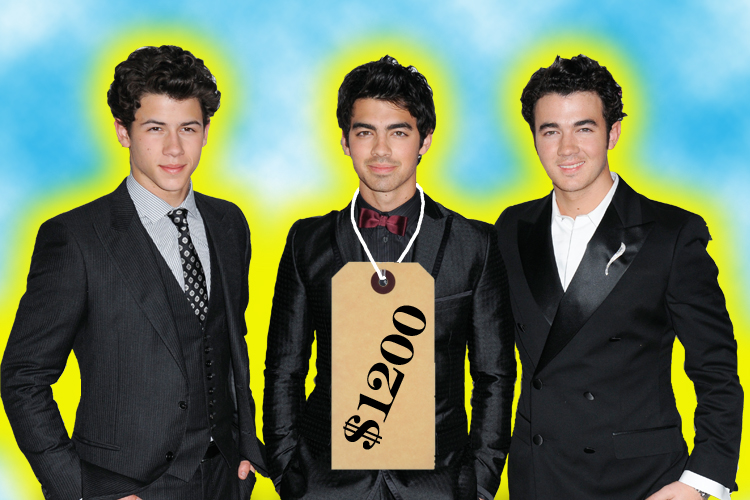
Help, I need to buy $1,200 Jonas Brothers tickets

It's ridiculous, it's insane, but is it really so wrong to want your kids to be VIPs?

My 9-year-old daughter’s best friend Sierra has VIP passes to see the Jonas Brothers this summer. It’s a big blowout at the Comcast Center in Massachusetts in August — the Jonas Brothers, Demi Lovato and the cast of “Camp Rock.” What better way to end their summer than with a bang like that?

I can’t name one Jonas Brothers song, but I know most of the lyrics to Demi Lovato’s songs and so does my 5-year-old, who sings in her car seat with a fake microphone to and from kindergarten every day. Sometimes she makes up lyrics. I swear Demi Lovato does not have any songs about fishing, but my 5-year-old seems to think she does.

One day, while listening to the theme song to “Sonny With a Chance” — the typical Disneyesque song about young dreams of celebrity stardom all coming true with a wink, a smile and a positive attitude — the idea seizes me: I am going to buy VIP passes to the freaking Jonas Brothers. They deserve this. If Sierra can go, then my kids can go, too. My daughters are going to get their pictures taken with Nick and Joe Jonas and Demi, who will undoubtedly discover them as the young, talented beauties they are.

Just before dinnertime with the extended family, I scour Ticketmaster and other concert ticket sites and there they are, the gleaming golden Jonas Brothers tickets. In the boys’ photograph it appears they have halos glowing behind them; behold the angels of teen fame and wealth, the American dream for today’s youth. Comcast seats 19,000, according to its owners, Live Nation. But less than half of those seats are covered. The rest are in an open pavilion, or a sprawling lawn. I look for sections 1, 2 and 3 in the amphitheater. Seats for four. VIP. (The tickets say nothing about having your picture taken with the performers, but as a reporter I will figure out a way to make that happen.) The price?

“That’s awesome!” says my oldest. Then, “Wait, is that a lot?”

“It’s more than a lot. It’s ridiculously a lot,” says my wife, a Brazilian woman whom I will now refer to as the Master of No. “We are obviously not paying $1,200 per ticket to go see the Jonas Brothers.”

And she’s right, of course. There is no way I can afford that. The bill for all four of us would come out to more than I have ever earned in a month. But there is another option.

“They also have cheaper VIP seats on the lawn for around $350 outside,” I say. “I won’t go. Just you and the kids will go. Imagine if we had that kind of money,” I say, looking at my mom with the vague hope she might chip in. “I’d do it. That’d be something to remember.”

“But Daddy, what if it rains? I don’t want to see Demi singing in the rain,” says my youngest.

Her mom reminds her, “No.” Not as in “No, it is not going to rain,” but “No, you’re not going to see the Jonas Brothers.”

My oldest is mildly disappointed. She’s a good kid. None of that, “Aw, but Sierra and Olivia are going!” Sulk. Pout. Get sent to her room. That doesn’t happen.

“Nice going,” my brother says. “You got them all pumped up for Jonas, and you can’t deliver.”

That night, over electric margaritas from the house bar, I try to reason with the Master of No, but she isn’t having any of it.

No, I don’t want to listen to our youngest complain about how loud it is all night long for $1,200.

No, our children don’t need to see girls screaming like maniacs over teenage boys.

No, we don’t have that kind of money.

No, we’re not going to turn our girls into teenagers before they’re 10.

“What if I found cheaper seats?”

No answer. That means I had a chance.

I really wanted those VIP tickets to the Jonas Brothers, though. I probably wanted to go more than my children did. When I was a child, my parents never did anything remotely cool like that for me. All parents want to do more for their children than their parents did for them. It’s a way of showing our parents we are better than they are, and in showing them that we are better and more successful than they ever imagined, we assume in our childlike minds that we can finally win their approval and love.

More than that, this pursuit made me feel like a kid again, with my whole life ahead of me and all the possibilities that youth brings. I can picture myself there, air drumming Lovato’s “Here We Go Again” just to see my 9-year-old roll her eyes.

My first concert was for Bon Jovi’s “Slippery When Wet.” I was 18. But there were no concerts for children when I was growing up. That’s because advertisers hadn’t yet discovered the tween and pre-tween market yet. That didn’t start until the late ’80s, when every toy had a storyline you could witness on VHS tape, or watch on Saturday morning. Things like “Masters of the Universe,” “My Little Pony.” Combine that with the boy-band boom of the ’90s and you have an unbeatable combination. Disney is a master at this, and Nickelodeon is getting better. Its “iCarly” star Miranda Cosgrove is plastered all over Times Square with her new CD release. Pre-tweens are a whole other animal now and my daughters are in the cross hairs. They’ve got style, they’ve got flair, they wear colorful rubber Silly Bandz. They dream of having their own show on the Internet, just like iCarly.

Honestly, though, my children are down to earth. It’s me who’s bad, stuck in the iron grip of the tween marketing squeeze. A thousand bucks to go see the Jonas Brothers for an hour? Wow. Capitalism sucks.

I try my pitch to my wife the next day, downgrading from VIP seats to regular tickets. My argument: Just as we raced to Disney World for lunch and dinner with the princesses when the girls were in their princess phase in 2006, we should do this now. When they really are concert-going age, they’re not going to want anything to do with us, and we probably won’t want to see Lil Wayne anyway.

“You know, I saw that Selena Gomez was in concert and she is just $25,” my wife says of the “Wizards of Waverly Place” star.

“Where is she playing?” I ask.

“Some fair in Ohio,” my wife says.

Poor Selena. I imagine her self-conscious teenage ego is semi-devastated by the fact that her colleagues are fetching five times that at sexier venues. “Well, we’re not going to Ohio to see a concert,” I say.

“It would probably come out cheaper than VIP seats at the Jonas Brothers,” she says. I calculate: $300 round trip ticket to Cleveland from Boston per person, another $150 for a hotel. Dammit, the Master of No is right! It would be cheaper.

In my frustration, I tell her, “You’re too negative. You criticize me too much and tell me what to do! Stop criticizing and telling me what to do already.” We pull into a garden shop near our house. I park crooked. She keeps quiet.

Over time, my wife starts to come around. I think I sold her with the princess phase bit. Plus, I found cheaper tickets for around $70 each. With taxes and all, a night out with the Jonas Brothers and Demi Lovato will come out to around $500. It irks me to think that these guys, who are at least 20 years younger than me, are getting rich off this. I start to steam at the injustice a bit, then I try to walk out the “in” door. It doesn’t open. I notice my wife is already in the parking lot, because she walked out the exit.

“Why didn’t you tell me I was walking out the wrong door?” I ask her.

She shoots me a look.

The Master of No might come around yet on Jonas. We’ll see. And even if my kids aren’t VIPs at the concert, they will be in my house, which is where it really matters to a child.

Meanwhile, my wife shows me some more colorful rubber SillyBandz she bought. She has cheaper taste than me and is easily entertained. These things are just little elephants and giraffe-shaped rubber bands. The kids love them. Better yet, they cost $2.

Kenneth Rapoza was a frequent contributor to Salon back in the late 1990s. He recently worked as a foreign correspondent for Dow Jones and the Wall Street Journal and is still looking for VIP seats to Jonas, or at least backstage passes for his daughters. 

Continue Reading Close

The 9/11 lawsuits

A small but growing group of people who lost loved ones in the terror attacks are giving up federal compensation to sue airlines, airport security firms and the FAA.

Waiving federal payments of as much as $1.85 million, 10 people who lost their loved ones in the Sept. 11 terrorist attacks have sued several U.S. airlines and airport security firms, charging that they are responsible for their relatives’ deaths. More lawsuits, including ones against the Federal Aviation Administration (FAA), are expected in the wake of recent revelations that U.S. officials had received warnings about imminent terrorist attacks, and failed to properly investigate two alleged terrorists.

“We have over 30 clients right now who will probably go the way of a lawsuit,” said Mary Schiavo, aviation attorney at Baum, Hedlund, Aristei, Guilford & Schiavo in California, and former inspector general of the U.S. Department of Transportation, who is handling nine of the 10 individual cases. “Thanks to these incredible disclosures by the White House and whistleblowers, it just keeps getting easier. These hijackings were foreseeable, unlike what we were initially told.”

Named in the suits are American Airlines, United Airlines and two airport security firms, Huntleigh USA Corp. and Argenbright Security Inc. Schiavo’s firm is also preparing suits against the FAA.

The Nolan Law Group in Chicago filed the first wrongful death case against the airlines in December and is currently waiting for approval to file five more.

Neither Nolan nor Baum, Hedlund have set figures for damages sought. But Lorna Brett, public affairs official at Nolan, said, “Seven figures is not unusual, whether the case gets settled or sees a jury.”

The families say they are bringing the lawsuits to get to the bottom of the intelligence and security failures that led to Sept. 11. They say that money isn’t the issue, although some of them also claim that the Victims’ Compensation Fund set up by the Department of Justice pays much less than advertised.

To bring the suits, the plaintiffs had to start by opting out of the fund, which was created on Sept. 22 and offers as much as $1.85 million to families afflicted by Sept. 11 tragedies. Those who choose the fund waive their rights to bring lawsuits against American firms and government agencies. (Foreign nationals may still be sued by those who have accepted money from the fund.) Of the 2,823 people eligible for the fund, more than 500 have chosen to accept payments, according to the Department of Justice.

“I thought I’d go for the fund at first. I was thankful for it,” said Julie Sweeney, 29, whose husband, Brian, died aboard United Airlines flight 175 out of Logan International Airport in Boston. “But the more I learned about it, the more angry I became. I think it is there to tempt people to move on with their lives, tax free, so they won’t ever sue. I call it a government buyout. It screamed ‘coverup.’” Sweeney, from Massachusetts, filed her suit on March 6 after spending time researching airport security on the Internet and meeting with Schiavo.

Lance Koutny, also of Massachusetts, says he believes his mother-in-law had too much insurance to allow his family to qualify for even the $250,000 the fund claims is its minimum payout. (The fund’s payouts can be adjusted based on financial criteria like insurance.) “I don’t believe that we qualify for money from the fund,” he says. Koutney’s wife, Maria, lost her 53-year-old mother, Marie Pappalardo, on United flight 175. “Marie had significant life and travel insurance. My wife doesn’t care about the money. She wants to know what happened on Sept 11.” Koutny contacted Schiavo and filed suit against the airline in January.

Both law firms say they recommend that families with immediate financial needs accept the U.S. payment.

The first stage of the legal process — the collecting of evidence — has already begun. During a conference call in late April, presiding Judge Alvin K. Hellerstein of the Southern District Court in Manhattan told Donald J. Nolan, aviation attorney at the Nolan Law Group, he could proceed with discovery, a legal term for requesting information such as interoffice memos and subpoenas. Nolan filed discovery requests with United Airlines. Among the information sought was the following:

All ticketing, baggage and other travel documents related to Marwan Al-Shehhi, Fayez Ahmed, Hamza Alghamdi, Ahmed Alghamdi and Mohald Alshehri, the hijackers aboard United flight 175; a complete passenger list; the FAA-approved Air Carrier Security Plan for Logan International; any and all security directives received by the airlines from Jan 1, 2001, to Sept 11, 2001; information about liability insurance policy; and records of aircraft security inspections.

On May 3, the airline’s law firms, Quirk and Bakalor and Mayer, Brown, Rowe & Maw, replied to Judge Hellerstein that the request involved “sensitive security information” and that only the newly formed Transportation Security Administration (TSA), which took over some airport security issues as of Feb. 17, could release it. It asked the court to obtain the views of the TSA before going forward with discovery.

“They are claiming secrecy,” said Nolan. “They say they did everything the FAA told them to do with regards to security. But these secrets can’t be the basis for withholding evidence from us.”

“My guess is that the TSA is going to sit with the judge and say this is top secret information and then it will be up to the judge to decide,” said Lorna Brett, public affairs official at Nolan. “If the judge disagrees with them, we get our discovery and it becomes part of the court record. If the judge agrees it is sensitive information and can’t be handed over, then we have to file a motion against that call. Let’s put it this way, this is going to be a long battle.”

The airlines have denied that they were negligent and said they did what the FAA told them to do. Calls to their lawyers were not returned.

“I want answers. The answers go way beyond the airlines,” said Ellen Mariani of New Hampshire, a Nolan client who lost her husband, Louis Neil Mariani, on United flight 175. “You can’t keep covering this up. What did the FAA tell United?”

According to a number of FAA “Red Team” field officers, the staff personnel responsible for covert inspection of airport security, the FAA was ignoring warnings left and right. “The FAA could have easily taken measures to secure airports, given what they knew about lax security in some of the major hubs across the country, and they did nothing,” said Steve Elson, a Red Team agent from 1992 to 1995 and security inspector at Houston International Airport until February 1999. “The same thing goes with the FBI. No one listened to the field agents. I call that wanton criminal negligence.”

The FAA, various government agencies and Congress were warned about the potential for suicide hijackings numerous times in the past few years.

In 1993, the Pentagon commissioned a report called “Terror 2000″ by Marvin Cetron, president of Forecasting International, a think tank in Virginia. It was sent to the State Department, the FBI, the FAA and the Pentagon. “Anybody who was anybody was involved in that report — the CIA, the KGB, the [Israeli] Mossad — and we briefed the Pentagon and told them that a suicide hijacker could easily slam into the Pentagon,” Cetron said. “They were interested, but not convinced.”

On Sept. 12, 1994, a small private plane owned by Frank Eugene Corder crashed into a White House wall.

Also in 1998, Dale Watson of the FBI’s International Terrorism Section of the National Security Division reported to two congressional committees about terrorists in the U.S. He talked about “Operation Bojinka,” a terrorist plot to plant bombs on “numerous U.S. air carriers in a simultaneous operation.” This was the second time they had heard about Bojinka; the first time was in 1995. To this day, cargo is considered a very small security operation for the FAA. But Watson said in his statement that the FBI was better equipped to deal with international terrorism, given the lessons learned from the first World Trade Center bombing in 1993.

In 1999, a report to the FAA by the Library of Congress warned that al-Qaida operatives could hijack a commercial airliner.

In April 2001, Boston’s Fox News Channel 25 reported on Logan’s security woes. Brian Sullivan, a risk-management specialist for the FAA in Boston, said he sent copies to Sen. John Kerry, D-Mass., on May 7, adding that “multiple aircraft could be taken down by determined terrorists.”

From January 2001 to August 2001, the FAA sent out warnings to the airlines but, according to Sullivan, who left the agency during this period, did not instruct the airlines to act. “When the FAA says that they have had no specifics about terrorist threats, they are lying bastards,” said Sullivan. “These are legitimate threats that could have been carried out because of the vulnerability of the system. We made the FAA aware of this — we did everything we could. When I saw that the planes that hit the towers came out of Boston I wanted to throw up.”

Whether the above warnings and events, combined with the 9/11 terrorist attacks, add up to actionable negligence is a difficult question. (The law firms are concentrating on the airlines and the FAA because it is extremely difficult to sue other branches of the federal government, such as the FBI.) The unprecedented nature of the 9/11 attacks might seem to make the litigants’ task harder, since the defendants can argue that they could not have been expected to anticipate or take action against hijackings carried out by groups of men who then crashed the planes. But the principle of using private litigation to seek redress for negligence is well established. “The airlines assume the duty to monitor and screen passengers, and if they didn’t do that properly and it leads to damages, then that’s when they are legally negligent,” said Mark J. Conlin, an attorney at Conlin Maloney & Miller in Spokane, Wash. Conlin is handling a case against American Airlines flight 587, which exploded en route to the Dominican Republic on Nov. 12, 2001.

Only 25 percent of aviation crash cases eventually see a jury, Conlin attests.

The airlines and their security companies are responsible for passenger safety once they pass the security scanners. The FAA is only responsible for supplying the airlines with security warnings and recommendations according to its regulations, which are mostly confidential.

“The negligence of the airlines was clear from the get-go,” said Schiavo. “But if they received specific warnings from the FAA and did nothing about it, then we go right off the simple negligence charts and into egregious negligence, which is knowing the vulnerability and the threat and doing nothing.”

But Red Team whistleblowers, past and present, say that the airlines are not the only culprits. Senior FAA managers who knew about the security failures from field agents did little, if anything, to improve airport security, they say. And according to Sullivan, several high-ranking officials on whose watch 9/11 took place were promoted, including William J. Gripper Jr., formerly in charge of New England airport security for the FAA, and Mary Carol Turano, former FAA manager of the Boston Civil Aviation Security Field Office at Logan.

“Here are the chief architects of the federal insecurity at Logan and instead of holding them accountable, they get moved up a notch,” Sullivan said. In tests at Logan, Sullivan reported that on more than one occasion he was able to get through the metal detection systems with knives hidden in money pouches. When a security inspector waved the wand over his clothes, they found his belt to be responsible for the metal detection and waved him to the boarding area.

Despite the evidence suggesting FAA shortcomings, successfully suing the agency will not be easy. The government cannot be sued based on policy decisions. So if field inspections never warranted a policy change, then the FAA cannot be held accountable. But if the FAA was aware of airport or airline security lapses and failed to inform the offenders of the problems, it would be liable.

“These ‘gotcha’ reports are wonderful evidence because the FAA is responsible to file a warning with the airlines,” said Schiavo. “If these security violations were not passed on to the airlines, the FAA is negligent. That is what we are looking for right now.”

Stephen Gale, a professor at the University of Pennsylvania and counterterrorism expert, doesn’t think the airlines could reasonably have been expected to prevent 9-11, considering the fundamentally flawed system they’re operating in. In 1998, Gale helped the General Accounting Office with a report on airline security and later briefed FAA managers about suicide hijackers. “The FAA’s response to me was that you can’t protect yourself from a meteorite,” Gale said. “These lawsuits want to find a culprit, but no single airline could have protected against Sept. 11. The system is full of holes to this day. If you want a secure system, we’d have to start by looking at the best model out there, El-Al of Israel, and I don’t think airlines would want to put up with that. Our system is enormous and we can’t have airlines going around profiling people, but that’s what El-Al does at times and there’s no hijackings.”

Sen. Kerry, a member of the subcommittee on international operations and terrorism and former member of the Senate Intelligence Committee, says that information overload and cumbersome bureaucracies could have been the reason the federal agencies were unable to connect the dots. “Could turf battles and arcane inner-agency adherence to protocol have caused information to be lost in the bureaucracy? Definitely. Could simple, honest and understandable mistakes have caused valuable intelligence to be overlooked? Absolutely.”

Even if the agencies responsible for airport security and counterterrorism intelligence had utilized the information provided by their field agents, Kerry said, it is hard to say whether the terrorists’ plot could have been prevented. “We don’t know. And there are people obsessed with secrecy who are preventing us from knowing and learning,” he said. (It was unclear whether Kerry was referring to the airlines, the FAA, federal intelligence agencies, the Bush administration or all of the above.) “We have no information on which to make our best judgments today.”

On June 11, family survivors of Sept. 11 will rally in Washington to call for an official investigation of what led to that fateful day. Sens. Joseph Leiberman, D-Conn., and John McCain, R-Ariz., proposed a bill on Dec. 20 to investigate the security and intelligence failures leading up to the 21st century’s Day of Infamy. “An independent commission makes sense,” said plaintiff Mariani. “Especially for people who chose to go into the fund. They’ll get some answers.”

Skeptics doubt much information will come even from an independent commission inquiry. Proponents of an independent commission expect that the discoveries won’t lead to the hanging of any one person or agency, but are likely to create policy changes within the FAA, FBI and possibly other bodies of government. Whether or not a commission sees the light of day, claimants still want to take their case to trial.

“I’m in this case for the long haul,” said Catherine Stefani of California, who lost her daughter Nicole on United flight 93. “I don’t want to settle this out of court. I want answers. I want to know how these guys got through security with box cutters. I want to know about the people involved in the Venice, Fla., flight school,” she said of the school attended by Mohammed Atta. Stefani is traveling to Hawaii for Independence Day. Half seriously, she said that she would feel safer on the island than on the mainland during the Fourth of July.

“My daughter would not have flown that day if she heard warnings like we’re hearing now,” she said.

Continue Reading Close

Banned in Boston?

A rumor that the city's housing authority targeted shamrocks as hate symbols just wouldn't die in embattled Southie.

It all started, as ethnic misunderstandings have been known to do, with diversity training.

Late last summer, the Boston Housing Authority gathered residents and staff at a voluntary diversity meeting, where the talk turned to the power of ethnic symbols. Someone suggested that shamrocks, the Hallmark-approved symbol of Irish pride, might be perceived negatively by the non-Irish living in Boston’s housing projects. Soon afterward, trans-Atlantic hell broke loose.

A column in the South Boston Tribune reported that local residents who’d attended the workshop were “insulted” by the notion that shamrocks could be hate symbols, and alleged the BHA was telling residents to take down shamrocks displayed on their apartment door and windows. Columnist John Ciccone called the diversity training “another way of saying brainwashing.” Readers began debating the supposed shamrock ban in letters to the editor.

The notion that the shamrock, which is believed to have been used by St. Patrick to explain the mystery of the Holy Trinity, could be banned in Boston had local Irish-Americans seeing red, not green.

Soon it was international news. The Irish Echo, the nation’s largest Irish-American newspaper, reported that the BHA was asking residents to remove shamrocks from their property. Lydia Agro, a spokeswoman for the Boston Housing Authority, did not deny the story, saying that residents were told to avoid public displays of any “bias indicators.”

In Dublin, the Sunday Tribune headlined the story “Outrage as shamrock is seen as ‘hate symbol.’” Agro was quoted again: “We want people to talk about what they may be doing that is causing an effect that they did not intend and not to display symbols people might consider to be bias indicators on the outsides of their buildings.” The Boston Globe and Boston Herald followed with stories a week later.

Arguably the Irish capital of North America, South Boston had been plastered with shamrock symbols, from planters to shutters to basketball courts, for decades. There are three low-income housing projects in Southie: Old Colony, West Broadway and the Mary Ellen McCormack Developments. Traditionally home to poor Irish-American families, today they are only one-third white and most of those are elderly women of Irish descent.

For more than six months, BHA has been in damage control.

“To me, this whole thing started out as a rumor. This is the story that just won’t quit,” said a frustrated Agro recently. She claims she was misquoted by reporters.

Sandy Henriquez, BHA administrator, quickly pounded out letters to residents and Boston city officials. She wrote: “The BHA has no oral or written policy banning shamrocks nor has it given any of its residents any directive not to use shamrocks or other ethnic symbols such as the Puerto Rican flag.” She said that no one at the BHA training session ever stated that the shamrock was the equivalent of a hate symbol. She wrote to the thousands of residents in South Boston’s projects that banning shamrocks “is totally and completely false and has been fueled by very biased and incorrect reports.”

But still, all these months later, the rumors persist. And it gets weirder. A South Boston Tribune editor told me the paper never ran a story about banning shamrocks, even though it was widely read and produced a ton of reader mail. And the columnist who wrote it, John Ciccone, did not return telephone calls about the controversy.

So how did the rumor start? And who’s telling the truth? This Rashomon tale is typical of South Boston, a notoriously insular and self-protective neighborhood that’s still reeling from its clash with the federal government over forced busing almost three decades ago.

South Boston is still infamous for its bitter opposition to a school integration plan in the 1970s. Race riots broke out following Judge Arthur Garrity’s decision to bus local kids to other schools, while black students were bused into Southie. As with so many social engineering strategies, this one fell on the backs of the black and white working class. The poverty level is high in South Boston, and in recent years the neighborhood has struggled with a tragic epidemic of youth suicide that parents and professionals are at a loss to explain.

This is the turbulent South Boston that elite Irish in the city would like to forget exists. And longtime Southie residents want to make sure they can’t forget. Government intrusion is fought viciously here, so the rumor of a shamrock ban fell on particularly fertile soil.

Jeanne McDonald used to work for the BHA and lives in the McCormack Development. She leads its tenant task force and is one of the neighborhood’s most active volunteers. Southie has been her home since birth. “This story [of the shamrock ban] goes back at least a couple of years. I have been hearing rumors that the BHA was going to consider banning shamrocks,” she said. “I never heard anyone inside BHA say this, but I told them that if they even attempt it people would plaster this place with shamrocks.”

According to McDonald, the rumor mill started churning way back in the ’80s, when the government began integrating South Boston’s housing projects. Black families complained they were being passed over for residency in South Boston. The BHA entered talks with the U.S. Department of Housing and Urban Development and the NAACP. No lawsuit was filed — the BHA settled out of court — but as minorities started moving in, some locals became convinced that the government’s goal was to fill the projects with minorities and oust the Irish-Americans.

As Irish descendants started moving out, and new people started moving in, the BHA suddenly started talking about “symbols” and diversity, McDonald said, and shamrocks seemed at risk.

“We didn’t want the city government telling us how to integrate. We were doing well. We still are,” she said. “Cultural symbols are going to represent the majority, whether it’s Puerto Rican or Irish. And it’s always been Irish, until now. But the ones who remain are not going to take down their shamrocks, not ever.”

Today South Boston is also being invaded by the better off, not just the minority poor. Its real estate is hot, with a commanding view of the Boston skyline. It’s a 10-minute train ride from downtown, a haven for moderate-income white folks who are being priced out of other neighborhoods.

Bill McGonagle, the deputy administrator of BHA, whose grandparents emigrated from County Donegal, Ireland, grew up in the Southie projects and still lives in the neighborhood. “It will never be an intention to ban shamrocks on our property,” he said. “To me the shamrock is a symbol of cultural pride. It’s also a religious symbol.”

But the tension won’t go away. Too many of Boston’s race conflicts just happen to break out here. More recently the shamrock controversy has been edged out of the news by a wrangle over a South Boston bar that occasionally decorates with an “African jungle” motif, complete with monkeys. Owner Tom English says it’s to make the bar feel warm in the winter. But in February his patrons began joking that it’s a celebration of Black History Month.

So now officials from the Boston Licensing Board, the NAACP, the Anti-Defamation League and the Massachusetts Coalition Against Discrimination are looking into the bar’s decor as a possible hate crime. English is understandably upset. English, who talks with the help of a medical device that replaces his voice box, says he decorates his bar in various motifs year round. Yet he’s probably headed to court to defend his decorating decisions.

But the news isn’t all bad from Southie. An energized McDonald wants to change the neighborhood’s image once and for all, especially in the housing developments. “There are good people here. They get a bad rap. We want to accentuate the positive in all of us.”

Continue Reading Close

Will big business gobble up Ben and Jerry's?

A protest movement tries to make sure that Cherry Garcia is never owned by Nestli.

Ben & Jerry’s Homemade Inc., the Vermont ice cream company with a social conscience, is having a hard time doing well while doing good. So with the company’s stock price sagging, multinational ice-cream manufacturers are trying to scoop up the struggling firm.

On Dec. 2 the company announced that it had received acquisition offers from four firms: Unilever NV, Nestli, Diageo of Britain (makers of arch rival Häagen-Dazs) and Italy’s Roncadin. Ben and Jerry’s stock climbed 8 points on the news.

A grassroots movement against the proposed sale, however, formed quickly after the announcement, and it’s clear that many Vermonters don’t want to see Ben & Jerry’s sold.

On Monday afternoon, about 100 demonstrators gathered in Burlington, handing over ice cream lids with the words “Don’t Sell Us Out” to the company’s board of directors. Vermont government officials, well aware of Ben & Jerry’s large tourist draw and economic boon to local farmers, said that they were “very concerned” about the possibility of an acquisition by a multinational.

“This company has really come to symbolize Vermont to the country and to the world,” Vermont Gov. Howard Dean told Reuters. “It would be a shame if it were sucked into the corporate homogenization that’s taking over the planet.”

Ben & Jerry’s surged to popularity in part on the marketing of its socially responsible, countercultural approach to business. It named ice cream after ’60s icons like Jerry Garcia and Wavy Gravy, and recruited a CEO through an essay contest. It is probably the only company that holds its annual shareholders meeting at a live outdoor concert, where investors can step up to the microphone and give opinions and advice on the company’s future.

The executive director of Vermont’s Public Interest Research Group (VPIRG), Dave Rapaport, said the company has a business model that proves companies can be successful and care about local communities. “We want a local economy. It’s been historically a local economy in this state but the entry of a lot of large corporations coming in here is dominating the characteristics that make Vermont unique,” Rapaport said.

Vermont could very well suffer from a Ben & Jerry buyout. State officials fear it will result in hundreds of lost jobs. Plus, Ben & Jerry’s buys all its milk from Vermont dairy farmers, and it pays more than most premium ice cream manufacturers. The company also donates 7.5 percent of its pre-tax earnings to Vermont charities.

Do-gooders like the company for other reasons. Ben & Jerry’s won’t buy milk, for instance, from dairy farmers who inject rBGH, the infamous Bovine Growth Hormone produced by agribusiness giant, Monsanto. The company makes its brownies in a New York factory that only employs “disenfranchised people,” according to VPIRG, who’ve been out of work, recently off welfare or just out of prison. And in San Francisco Ben and Jerry’s teamed up with a local job training agency to hire at-risk teenagers to work in its local stores and its 3-Com Park franchise.

And yet Ben & Jerry’s is a public company whose stock is traded on NASDAQ, and lately it seems that the firm’s brand of benign capitalism isn’t yielding the return its investors expect.

Public companies are required by law to consider all reasonable offers put before them by outside competitors. The four successful corporations are offering nearly double the share-price value, so the board of directors must take the offer to the shareholders.

Founders Ben Cohen and Jerry Greenfield, along with a shareholder named Jeff Furman, hold 47 percent of the voting shares and are opposed to a buy out. On Monday, Cohen told Vermont public radio that he wants to keep the company local. But they are facing pressure from other shareholders, who want to take the money and run, nearly doubling their investment.

Meanwhile, in Massachusetts, an aggressive 23-year-old named Garret LoPorto created a Web site last week to convince Ben & Jerry’s fans to buy shares in the company, and write to the board of directors. The site has over 700 posts urging Cohen and Greenfield not to sell. LoPorto said he bought some shares this week, but not enough to cover the $225 million being bid for the coveted brand name.

“When I heard about this I thought it was totally against everything Ben Cohen says he is. It doesn’t seem like selling his business to a global corporation is something he’d go for,” said LoPorto. “It’s totally contrary to what Ben & Jerry’s is.”

Visitors to the Save Ben & Jerry’s site are asked to sign a petition against what he calls the “liquidation” of the 21-year-old-company.

Joseph Henry, a shareholder from Iowa, said if globalization gobbles up Ben & Jerry’s, he’ll stop buying the brand. Henry works for Iowans for Sensible Priorities in Des Moines, where he has had opportunities to talk about socially responsible capitalism with Ben Cohen. “Why is Ben & Jerry’s so famous? People are turned on by what they do. Their success is driven by people who care about society and there are a lot of people out there who connect with companies like this,” he said.

“As a shareholder I say no to any sale. I’ve seem small industry get bought out by large competitors here in Iowa. They soon move the plants out of state,” said Henry. “I want the company to stay as it is.” But Henry, with 100 shares of Ben & Jerry’s stock, doesn’t have voting rights.

Joan Johnson of Philadelphia writes on the Save Ben & Jerry’s Web site: “Please don’t let a truly unique institution become just a cog in some monolithic wheel. Let’s continue to have Cherry Garcia and social conscience together in one entity!”

Continue Reading Close

Militia U.

Vermont's Norwich University continues to make Indonesians into soldiers, despite a suspension of military cooperation between the two countries.

Human rights activists claim the presence of 11 Indonesian students at a central Vermont military college flies in the face of the recently enacted U.S. policy that forbids U.S.-Indonesian military cooperation and training.

Due to the violence in East Timor after its vote for independence from Indonesia, President Clinton made the ruling in September. But unless the government intervenes in the business of the private 1,000-student military college, the students will finish their four-year course of studies at the 1,000-student college and return to Indonesia for a compulsory 10-year military stint. They list their address in Jakarta as the headquarters of Kopassus, the army’s elite forces alleged by Human Rights Watch to have committed the most atrocious of acts against the East Timorese.

All U.S. training of Indonesian soldiers has been curtailed at public military schools. But Norwich’s private status — like any private school, it needn’t follow the rules of state universities — means that so far it has been exempt from the U.S. policy.

Founded by West Point superintendent Capt. Alden Partridge in 1819, Norwich is the only private military school in the country. Though it receives no government funds, ROTC instructors — active duty military officers selected and paid by the Pentagon — teach many of the classes.

“The Pentagon said we’re in compliance with the law. So did the White House,” said Thomas Greene, spokesman for Norwich University in a recent interview.

How is it that the United States is at once suspending military relations with Indonesia — a nation that only yesterday, amid chaos, voted for its next president — and continuing to allow the training of Indonesian soldiers for its elite forces?

It all pivots on the current status of the future warriors: The Indonesian students are not yet technically soldiers. Chosen from high school to attend Norwich by the Indonesian government, the 13 students (in addition to the 11 from Kopassus, two others without known links to Indonesia’s elite forces attend the school) still qualify as ordinary citizens. With money from its military, the Indonesian Embassy in Washington foots the $20,000-per-student bill. But while only half of their U.S. classmates will enter the military professionally, all the students from Indonesia must serve their 10 years in its army.

Pentagon spokesman Lt. Commander Anthony Cooper has said that all Indonesian military students in Department of Defense (DOD) schools have been asked to leave: “There were some Indonesian military officials that had to return home once the decision was made — a few graduated from a Naval post-graduate school in Monterey just before the suspension,” he explained. According to Cooper, DOD schools do not train officers for combat. Instead they offer courses in human and civil rights, disaster relief and professional career training such as public affairs.

But for some, the current severing of relations has not gone far enough — especially since the Pentagon can lift the suspension at any time. To rectify what they see as an overly lax policy, Sens. Russell Feingold, D-Wis., Jesse Helms, R-N.C., and Patrick Leahy, D-Vt., introduced legislature in early October that would suspend U.S.-Indonesian military cooperation across the board. The new bill encompasses all military programs — from private training at Norwich to non-DOD programs like the FBI and CIA. Under this bill, the suspension would be lifted only after the army leaves Timor and returns some 300,000 refugees to their homelands.

“The Senate bill has strong bipartisan support,” said Lynn Fredriksson of the East Timor Action Network. “We believe this will affect ROTC instruction at Norwich.”

Leahy, who has been a staunch supporter of East Timor’s independence, recently helped the private military academy secure funds for a new armory to be built on campus. “I have the highest respect for Norwich University,” he said, “but I do not support direct or indirect assistance or benefits to the Indonesian army.”

The U.S. government’s tolerance of this sort of training may be due to ignorance. “Congress has not been aware of these relationships,” testified activist Allan Nairn recently before Congress. “Norwich is just one example,” he said. Nairn claims the CIA and FBI engage in similarly low-profile training activities. “The executive branch knows about Norwich,” he added.

One State Department employee with ties to Indonesia said he knew nothing about Norwich University’s links to Kopassus. He asked to remain anonymous, saying he wanted to minimize the State Department’s involvement in the matter.

Norwich’s Greene insists that a private school ought to have the freedom to determine its own admissions policy. “It’s a question of whether colleges can make decisions for themselves,” he said. “[The 11 students are] guilty by association. As far as I can tell, the students here are very supportive of the Indonesians.” Norwich president Richard Schneider, speaking on WBUR, Boston’s public radio station, said the school was teaching the students combat training, military ethics and human-rights issues, and hoped this would stop them from taking part in any future violence in East Timor.

Yet some critics consider the notion that the U.S. military can teach foreign students to become ethical soldiers preposterous. “There’s a wide belief that if you could expose these cadets to U.S. freedom and education, you’re going to transform them into a respectable army,” said Human Rights Watch’s Sidney Jones. “We’re just not seeing this happen.”

Jones maintains that U.S. military schools regularly produce graduates who go on to commit documented human-rights abuses. On the other hand, none of the Norwich graduates who served in East Timor during the Aug. 30 election for independence — there were at least four — has been linked to the atrocities.

The history of Norwich’s relationship with Indonesia is short. In 1997 former Kopassus officers Gen. Zacky Makarim and Gen. A.M. Hendropriyono met with university officials at the Vermont campus. President Schneider has told the Boston Globe that he did not know the generals’ backgrounds at the time of the meeting. Makarim is the man accused of heading 13 of the militias responsible for massacres in East Timor. “Hendro” has been nicknamed “The Butcher of Lampung” according to Human Rights Watch.

The Norwich connection with Indonesian high officials goes beyond that 1997 meeting on campus, however. “The Defense Intelligence Agency facilitated the setting up of the Norwich training program with Indonesia,” Nairn said. “Colonel John Haseman [U.S. attachi in Jakarta until 1994] now serves as advisor to the Kopassus-based students studying at Norwich.”

Meanwhile, it appears that President Clinton has no beef with the Indonesian students. If the Senate bill passes, its sponsors would have to add a clause that includes ROTC as military-to-military cooperation. As it stands, the Pentagon’s curious ties to Indonesia’s military remain.

Greene said the college has no intention of fighting Congress or offending East Timor. “Our position is that we’ll do whatever the federal government tells us to do. If they tell us to send them home, we’ll do it. Otherwise, they’ve been model students.”

Continue Reading Close

Page 1 of 2 in Kenneth Rapoza