Laura Morgan Green

Salon’s guide to Nobel winner Doris Lessing

Novelist, memoirist, activist, fantasist -- this entry from "The Salon.com Reader's Guide to Contemporary Authors" takes you on a guided tour of the celebrated writer's long literary career.

  • more
    • All Share Services

Salon's guide to Nobel winner Doris Lessing

Lessing, Doris

1919-

b. Kermanshah, Persia (now Iran)

For over half a century, Doris Lessing has turned her prolific pen to just about every prose form — fiction, autobiography, essays, drama. Yet all of her writing stems from the impulse to lay bare the grid of class, race, and gender relations that governs her middle-class characters’ lives. Lessing brings the microscopic intensity of George Eliot and the combative sexual consciousness of D.H. Lawrence to bear on English culture, whether the context is the provincially hierarchical “settler” society of Southern Rhodesia in “A Proper Marriage” or the beleaguered bohemia of “free women” in “The Golden Notebook.” Lessing’s reputation as one of the most important novelists of the post-World War II period rests firmly on her contribution to the grand tradition of English social realism. Yet Lessing herself once dismissed George Eliot, to whom she is so often compared, as “good as far as she goes”; she prefers to claim the more cosmopolitan influence of Tolstoy and Balzac.

Indeed, this apparently most British of writers was thirty years old before she set foot in England or published her first novel. Her upbringing on a farm in Southern Rhodesia (now Zimbabwe) acquainted her more thoroughly with the isolation and racial exploitation of white colonial culture than with an imperial literary heritage. Her formal schooling ended at age fourteen, and in “Under My Skin,” the first volume of her autobiography, Lessing notes with pride the real accomplishments of her youth: the ability to “set a hen, look after chickens and rabbits, worm dogs and cats, pan for gold, take samples from reefs, cook, sew, use the milk separator and churn butter, go down a mine shaft in a bucket, make cream cheese and ginger beer … drive the car, shoot pigeons and guineafowl for the pot, [and] preserve eggs.” By the time she left for London in 1949, she had augmented these accomplishments with two divorces, three children, the obloquy of Communist party membership and anti-apartheid agitation, and the unpublished draft of her first novel.

Colonial race relations, political activism, and the burdens of women have remained her central concerns. Her first novel, “The Grass Is Singing,” about a farmer’s wife drawn into a doomed affair with an African worker, approaches its material from a distance. Lessing infuses a simple plot with the intensity of Greek tragedy: She portrays the wife’s murder by the African, Moses, as the inevitable outcome of male violence and female passivity fostered by white settler culture. Lessing depicts the white experience of colonial Africa more urgently and directly in her five-novel Children of Violence sequence (1953-1969), in which she embeds the sexual, political, and intellectual development of her protagonist, Martha Quest, in a detailed evocation of the communist and progressive political and intellectual life of Rhodesia and London in the 1950s and 1960s.

Anna Wulf, the novelist heroine of Lessing’s most celebrated work, “The Golden Notebook,” continues Martha’s quest: political activism, sexual experimentation, maternity, female friendship, and authorship all feed into her struggle for authentic, integrated selfhood. The declarative simplicity of the novel’s opening line –”The two women were alone in the London flat”– belies its explosive effect on several generations of women intellectuals struggling to reconcile the life of the mind, the imperatives of the body, and the gender roles they inherited from the 1950s. But as Lessing herself insists, “The Golden Notebook” achieved innovations beyond its contribution to what she dismissively terms “the sex war.” The novel combines omniscient observation, Anna’s own musings in four different journals, and sections from Anna’s novel manuscript. These interwoven narratives capture both an individual consciousness and a particular cultural moment with something of the multilayered depth of James Joyce’s “Ulysses.” Public events shape private histories in Lessing’s novels, often violently. In “The Good Terrorist,” for example, middle-class Alice Mellings keeps house for a pseudo-communist cadre until a too-successful bombing destroys her illusion of control. In the chilling “The Fifth Child,” terror emerges from the bosom of the family, when Harriet Lovatt gives birth to the sociopathic Ben, the embodiment of a disaffected savagery that, Lessing suggests, will inherit the urban future. Lessing anatomizes a less dramatic, but perhaps more pervasive, anguish in “The Diary of a Good Neighbor,” “If the Old Could …” and “Love, Again,” in which women whose familial and productive relationships have passed away confront the isolation of aging.

Lessing’s scary genius lies in her ability to bring her readers face-to-face with an unadorned reflection of some of our more depressing, but all too human, features. At the same time, her realism has always coexisted with a tendency toward mysticism. Her novels of the 1970s compellingly combine a surface of social and geographic detail with journeys into an inner space that Lessing described, in “The Real Thing,” as “so much more intelligent than the slow, lumbering, daylike self.” In the haunting “Memoirs of a Survivor,” for example, worlds separated by time and space interpenetrate through the vision of the unnamed female narrator, enabling her to save herself and her companions from extinction. But when Lessing leaves humanity entirely behind, as she does in the science fiction sequence Canopus in Argus: Archives (1979-1983), her depictions of warring galactic empires lack the individuality and emotional insight she brings to earthly society. In the novel “Mara and Dann,” she returns once again to the theme of earthly apocalypse, with human, if visionary, protagonists.

In “Under My Skin,” Lessing describes her long-ago attempts to explain to her young children her departure from their lives: “[I told them] I was going to change this ugly world, they would live in a beautiful world where there would be no race hatred, injustice, and so forth … One day they would thank me for [leaving] … I was absolutely sincere. There isn’t much to be said for sincerity, in itself.” It is typical of Lessing to emphasize the limits of good intentions, even her own. Yet in doing so, she paradoxically underlines her dedication to a more rigorous sincerity, a vision as stripped of illusion as her art can make it.

FICTION: “The Grass Is Singing” (1950), “This Was the Old Chief’s Country” (stories, 1952), “Martha Quest” (Children of Violence series, 1952), “A Proper Marriage” (Children of Violence series, 1954), “Five: Short Novels” (1955), “Retreat to Innocence” (1956), “The Habit of Loving” (stories, 1958), “A Ripple From the Storm” (Children of Violence series, 1958), “The Golden Notebook” (1962), “A Man and Two Women” (stories, 1963), “African Stories” (1964), “Landlocked” (Children of Violence series, 1966), “The Four-Gated City” (Children of Violence series, 1969), “Briefing for a Descent Into Hell” (1971), “The Temptation of Jack Orkney and Other Stories” ([republished as Volume 1 of Collected Stories, 1978] 1972), “The Summer Before the Dark” (1973), “The Memoirs of a Survivor” (1975), “To Room Nineteen” (Volume 2 of Collected Stories, 1978), “The Diaries of Jane Somers” ([including "The Diary of a Good Neighbor" (1983) and "If the Old Could…" (1984), originally published under the pseudonym Jane Somers], 1984), “The Good Terrorist” (1985), “The Fifth Child” (1988), “The Real Thing: Stories and Sketches” (1992), “Canopus in Argos: Archives” ([contains "Colonized Planet V, Shikasta" (1979), "The Marriage Between Zones Three, Four, and Five" (1980), "The Sirian Experiments: The Report of Ambien II, of the Five" (1981), "The Making of the Representative for Planet 8" (1982), "Documents Relating to the Sentimental Agents in the Volyen Empire" (1983)], 1992), “Playing the Game: Graphic Novel” (1993), “Winter in July” (stories, 1993), “Love, Again” (1996), “Mara and Dann” (1999), “The Sweetest Dream” (2002)

NONFICTION: “Going Home” (1957), “In Pursuit of the English” (1961), “Particularly Cats” (1967), “A Small Personal Voice: Essays, Reviews, Interviews” (1975), “Prisons We Choose to Live Inside” (1987), “The Wind Blows Away Our Words” (1987), “African Laughter: Four Visits to Zimbabwe” (1992), “Under My Skin” (Volume 1 of “My Autobiography, 1949-1962,” 1994) “Walking in the Shade” (Volume 3 of “My Autobiography, 1949-1962,” 1997)

“Angelhead” by Greg Bottoms

A memoirist tells the harrowing story of his teenage brother's decline into the unthinkable horror of schizophrenia -- but is that enough?

  • more
    • All Share Services

“Angelhead” is Greg Bottoms’ account of his older brother Michael’s descent into acute paranoid schizophrenia during adolescence and young adulthood. Over the course of the narrative, before finally winding up in the psychiatric ward of a prison facility, Michael will suffer hallucinations, become homeless, be raped on more than one occasion, confess to one murder, try several times to kill members of his family and attempt suicide twice. In his delusional state, Michael believes that God is speaking to him, but God offers no redemption.

I am not giving anything away here, since Bottoms offers this catastrophic list barely two pages into his narrative — fair warning that neither suspense nor hope drives the story. Bottoms’ narrative belongs to the unsparing rather than the sentimental genre of trauma memoirs. Michael’s family cannot cope with his increasing violence and delusions, and no heroic teachers or doctors or mental health professionals step in to save him or even offer effective advice. When he is finally locked away, the reader’s primary emotion — like that of his family — is relief.

Michael’s juggernaut of decline takes place against a background of middle-class suburbia, rendered here as a sinkhole of hidden disaffection. In a community of carefully mowed lawns, lovingly washed cars and high school football games, Bottoms’ mother fields phone calls “from school, from neighbors, from the parents of girls her 14-year-old may have slept with.” Bottoms himself seeks escape in pot, pills, alcohol and the more anomic forms of youth culture before he is even in his teens. The entire family sleeps with their bedroom doors locked against Michael’s ranting insomnia and increasing rage.

Bottoms’ prose is matter-of-fact, and he renders the infectious ugliness of Michael’s condition in graphic detail. Yet if “Angelhead” is harrowing, it never becomes deeply affecting. The jacket identifies the book as a memoir — Bottoms calls it “creative nonfiction” — but it is a memoir in the 19th rather than the 20th century sense of the word: the author’s remembrances of another person. That person is not someone most of us would choose to spend time with; Bottoms himself devoted years to forgetting he had such a brother. However tragically or unjustly, Michael is both defined and cut off from us by his disease. Bottoms cannot get fully inside his head, and we cannot learn anything from him.

Unfortunately, we get no closer to the people in the book — particularly Bottoms’ parents — at whose greater complexity Bottoms occasionally hints, and whose very ordinariness gives them greater potential to move us. Proud of their own escape from the lower middle class, Bottoms’ parents work constantly “to keep on top of their barely confinable debt,” leaving their troubled children largely alone. Determined not to admit to the crumbling of their dream, they ignore Michael’s decline to the point certainly of delusion and perhaps of outright negligence. Yet they are clearly well-intentioned people, overmastered by an unthinkable horror against which they must struggle without effective outside intervention. Bottoms describes them strikingly as “a team in crisis. They weren’t so much a couple as two people pitted against an unconquerable foe, stuck with their family and their lives.”

Such moments of sharp observation brighten “Angelhead,” a competently written book that tells the story it means to tell lucidly and without anger. But it’s hard to imagine what effect Bottoms wants his account to have on the reader. Himself a desperately voracious reader in college, Bottoms says, “I started to believe — and I still believe — that I could somehow save myself with a story, and even though I couldn’t save anyone else, I could try to understand them, attempt to grant them at least that, and perhaps it is in this, this attempt to understand, that a person is truly saved.” Michael is unlikely ever to be cognizant of his brother’s attempt at understanding, but perhaps Bottoms hopes that others in extremity will find some terrible affirmation in seeing their own hell, or one similar to theirs, put into words.

In an author’s note, Bottoms writes that he has aimed to “capture the experience of schizophrenia.” In fact, “Angelhead” suffers from a belief abroad in literary culture that the truth of a story is its own justification, that to “capture an experience” is a good end in itself. The idea is wrong on both counts: A story need not be true to be valuable; conversely, not every accurately evoked experience conveys a valuable truth. Michael’s interior remains impenetrable, his exterior repellent. It is Michael’s parents, in the glimpses we get of their unheroic desires and their moral ambiguity, who come closest in this narrative to attaining the status of fully realized literary characters, rather than descriptive efforts. And for that reason it is their tragedy, rather than Michael’s tortures, that is likely to affect and remain with the reader.

Continue Reading Close

“As Seen on TV: Provocations” by Lucy Grealy

The author of "Autobiography of a Face" returns with essays on sex, religion and celebrity.

  • more
    • All Share Services

The title essay in Lucy Grealy’s collection “As Seen on TV: Provocations” begins casually: “So, for reasons that will become obvious, I’ve changed a few identifying details in the following anecdote.” The anecdote concerns Grealy’s appearance on a daytime talk show whose topic is triumph over “horrendous physical suffering.” Grealy is invited to surprise a guest, a man who was kidnapped, tortured and almost buried alive, who found comfort during his recovery in “Autobiography of a Face,” Grealy’s mordant memoir of her own experience with a disfiguring cancer of the jaw. The essay ends with a surprise twist to Grealy’s encounter with the guest, and with Grealy’s thoughts about people’s fascination with celebrity and disability.

With its informal tone and its attempt to link a personal experience to larger social meanings, “As Seen on TV” is characteristic of the collection. As in “Autobiography of a Face,” what is most admirable in this collection is Grealy’s refusal to pretend that suffering is always ennobling. For example, she is frank about her own capacity for mean-spiritedness. In an essay called “My God,” about the petty comforts as well as the transcendence offered by religion, she confesses to being at one time “jealous of a woman who had cervical cancer; I thought she got to have all the ‘benefits’ of a hard experience but didn’t have to suffer any permanent visible scars.” We’ve all had this sort of self-serving response to the suffering of others, but we are not all so disarmingly willing to admit it.

Grealy is at her most insightful, in fact, in continuing to map the territory that she began exploring in “Autobiography of a Face”: both the intimate and the public impact of pain and disfigurement; the difficulties — highlighted by her experiences, but shared to some extent by most of us — of growing into self-acceptance under the ruthless scrutiny of a spectacle-oriented, hypersexual commodity culture. She is astute about the perversity of the ways in which the media packages suffering. She wonders why, for example, when she appears on Oprah Winfrey’s show, the guests are “four women, all of whom have been through actual horrendous suffering, having to sit centered around this guy (and he was sitting there, like the king, in the center) just because he’s an expert, which he is only because he wrote a self-help book.”

A good question — but the language in which she chooses to ask it highlights an exasperating feature of the collection: Grealy’s strident informality is frequently indistinguishable from sloppiness. The breathless sentence structure and the playground diction (“actual horrendous suffering,” “just because”) get old very quickly. It doesn’t help that Grealy claims to be accomplishing a stylistic intervention in the reader’s intellectual development. She declares proudly that she is being “relentlessly vernacular … which makes this essay the embodiment of exactly what I was taught not to write in high school.” Although “you might think it’s a good idea to write a formal essay and sound smart … what’s also happening is that you’re being taught the value of neat, containable ideas, which is a total sham” because “the truly interesting (and radical) ideas are usually rather sloppy and run-on.”

This specious opposition between formal but empty and sloppy but “truly interesting” puts Grealy squarely in a long, if not particularly proud, tradition of American anti-intellectualism — the same tradition that leads many citizens to be turned off by Al Gore because he “sounds smart” and has committed to paper some carefully worked out ideas. But as Grealy would, I’m sure, concede, it does not follow that because George W. Bush frequently fails to sound smart, he is the “truly interesting (and radical)” candidate.

Unfortunately, it also does not follow that because Grealy writes colloquially and sometimes chooses dopey questions over conclusions (“What if a species is to an individual what our sense of self is to our own cells?”) her insights are interesting or radical. The book’s subtitle, “Provocations,” positions Grealy as a gadfly, a deflater of pretensions, but her targets are frequently easy — the culture of celebrity, the fashion industry, the rhetoric of the religious right. Her revelations are hardly shocking: that clothing with an originally rebellious or practical purpose, such as motorcycle boots or jodhpurs, may be appropriated as fashion by people who do not ride motorcycles or horses (“Fool in Boots”); that “beauty is only an easy label for a complex set of emotions (feelings of safety and grace and well-being)” (“Nerve”); that the tango as danced in 20th century New York is more about salesmanship than about passion” (“What It Takes”).

In her preface, Grealy confesses that “most of my magazine pieces get killed because I get carried away and then can’t bring myself to neuter the results.” If the first part of this sentence seems disarmingly frank, the second suggests at best a lack of self-scrutiny, at worst a refusal to listen. Perhaps what her readers might ask of Grealy is not that she “neuter” her intimate, often witty voice, but that she respect her readers’ intelligence, as well as her own, by not confusing the personal with the self-indulgent, or sloppiness with subversion. There is nothing wrong with sounding, as well as being, smart.

Continue Reading Close

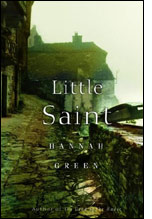
“Little Saint” by Hannah Green

On the trail of a French martyr beheaded by her father for embracing Christianity.

  • more
    • All Share Services

Hannah Green, who died in 1996, published in her lifetime a single, acclaimed novel, “The Dead of the House” (1972; reissued 1996) — a celebration, in language at once exalted and rueful, of an Ohio Protestant childhood in the middle of the century and of the power of family to connect us to history. Two other novels drawing on her family memories were put aside, unfinished, after Green, visiting the village of Conques in southern France in the 1970s with her husband, encountered the legend of St. Foy, a fourth century Christian child-martyr.

St. Foy “came as a gift” writes Green, who returned to Conques for months at a time over the next couple of decades, believing that “in some way without my knowing or preparing, I had been coming toward her my life long.” The result of Green’s lifelong journey is “Little Saint” — a book almost impossible to describe, and not easy to absorb: a love letter to the saint and to the villagers of Conques who still keep her faith.

St. Foy was only 13 years old when her father denounced her to the Roman proconsul Dacien because she refused to forswear her then-forbidden Christian faith and make a sacrifice to the goddess Diana. She was tortured, beheaded and buried at Agen; five centuries later, her remains were brought — an almost certain theft, which church historians, early practitioners of spin, refer to as the “furtive translation” — to the Benedictine abbey at Conques. There, she came to rest in a bejeweled golden statue, a likeness 3 feet high, and was worshipped both for the miracles of healing and intercession she performed and for the beautiful craftsmanship of her reliquary.

Even this incomplete summary of St. Foy’s legend is not easily gleaned from “Little Saint,” which is composed of lyrical re-creations of St. Foy’s martyrdom, long quotations and translations from historical sources and stories about the saint told by the local people: by Phre Andri, the scholarly Benedictine monk whose job it is to guard and display St. Foy and other precious relics; by nonagenarian Madame Benoit, whose memory “goes back further than her ninety-one years, straight back through her mother and her grandmother and her great grandmother”; and by local artist Jean Sigalat, survivor of a tragic love affair, who, understanding Green’s plan to “bring present-day Conques … to life,” eagerly shares “details, glimpses, illuminations, apergus, confidences,” as well as the number of times (between 634 and 744) that the bells of Conques will ring every single day.

These villagers not only contribute to Green’s reconstruction of St. Foy but become characters in their own right, their stories twining around hers as we meet them in the narrative’s present (a single June day in 1979). These intertwined stories often enrich each other, illustrating one of Green’s primary themes: the continuing presence of the past, the communion between the living and the dead. St. Foy’s betrayal by her father and her own refusal to betray her faith, for example, reverberate in the villagers’ long memories of resistance and complicity during the German occupation. Sometimes, however, Green’s layered narrative is merely confusing, and among the clamor of personalities, we come to know none well.

Certainly, we receive little insight into Green’s own history or motivations as she embraces, without apparent hesitation, the cult of St. Foy. At one point, the granddaughter of one of the villagers asks Green whether she believes in St. Foy’s miracles — a reasonable question, since Green recounts without comment many miracles (healing the sick, releasing the imprisoned, etc.) that are difficult for the average 20th century reader to credit. But Green, rather than taking this opportunity to address the challenges of faith, simply omits her answer to the question.

Occasionally, Green’s unanalyzed presumption that the reader understands and shares her reverence for the tradition she describes can become an affront — as when she confides that “the face of Mary, the faces of the angels, once you have seen them, make you gasp.” As it happens, being neither Catholic nor, indeed, a believer, I’m pretty certain of my ability to look on any number of Marys and angels without gasping. And Green’s occasionally overwrought apostrophes to the saint — “Golden spark, little saint, come down through time, you who through the ages stayed steadfast and survived … hear my prayers, O my saint” — do little to move me toward an understanding of her modern-day pilgrimage.

Nevertheless, even a skeptical reader can be drawn into the spiral of time, memory and survival that Green creates. “I found that there were stories that sprang from Sainte Foy and were spun around her like the gold filigree, the beading and the gemstones around her crown,” Green writes, and at moments, her remaking of these stories itself has the delicate strength of filigree and the radiance of a jewel.

Continue Reading Close

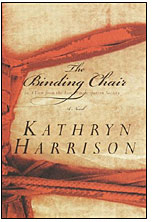
“The Binding Chair” by Kathryn Harrison

Is the author's latest abused-woman fantasy -- this one set in China and France in the early decades of the 20th century -- revelatory or pornographic?

  • more
    • All Share Services

The bodies of Kathryn Harrison’s heroines are well-marked maps of abuse, illness and self-destruction. Her previous novels, “Thicker than Water,” “Exposure” and “Poison,” as well as her eyebrow-raising memoir of father-daughter incest, “The Kiss,” detail among them the physical and emotional effects of sexual child abuse, incest, rape, torture, poisoning, bulimia, breast cancer, diabetes, self-mutilation and amphetamine addiction. It’s no wonder that the women in these books often feel, as Ann Rogers does in “Exposure,” that they would like “to be empty, go away, disappear somehow.” But a stubborn belief in the possibilities of love and ecstasy — Harrison’s heroines have a lot of pleasurable, as well as abusive, sex — lights them through the tunnel of victimization. For the reader who doesn’t share Harrison’s fascination with physical extremity, though, the journey can seem less sensuous or revelatory than furtively pornographic.

Her new novel, “The Binding Chair,” allows Harrison to add to her repertoire of physical cruelty the (discontinued) upper-class Chinese ritual of binding women’s feet. Set in Shanghai and France, “The Binding Chair” tells the intertwined stories of two women: May, the daughter in a well-to-do Chinese family growing up in the last decades of the 19th century, and Alice, an English girl born in the first decade of the 20th. When May is 5 years old, her grandmother “sits her on a red chair decorated with characters for obedience, prosperity and longevity” and binds her feet — a literally bone-breaking and flesh-annihilating process that Harrison describes in loving detail.

From this inauspicious beginning, May’s situation worsens. Married to an abusive silk merchant at the age of 14, she runs away and supports herself in a Shanghai brothel, where she forswears everything Chinese and waits for a Western “benefactor.” After seven years, he arrives in the person of a gentle, unemployable Englishman who belongs to a society dedicated to eradicating the custom of foot binding. He promptly becomes erotically obsessed with May’s tiny feet, he marries her and brings her home to the Shanghai household he shares with his sister, his banker brother-in-law and his two nieces. The Chinese prostitute May thus becomes Mrs. Arthur Cohen, aunt to the strong-willed, rebellious Alice Benjamin.

Alice’s story, intercut with May’s in chronologically overlapping sections, begins in 1913, when she is packed off, at the age of 12, to school in England, to remove her from May’s exotic influence. Traveling across the continent with her mother, sister and governess on the trans-Siberian railway, Alice demonstrates her own propensity for flight, impulsively disembarking with a melancholy Russian army captain. Brought back and delivered to her English school, she promptly involves a teacher in a minor scandal, develops scarlet fever and is rescued by May — who has also been packed off to Europe (to break her of an opium habit) and who, carried about the streets of London in a litter by two Chinese servants, creates her own disturbance.

On returning home to Shanghai, Alice smokes opium and dallies with a local boy, while her father gets rich as a war profiteer, her mother develops an obsession with cleanliness and influenza devastates the city. After a series of reverses, May and Alice find themselves on the French Riviera, where, in the present (1927) of the novel’s opening, Alice has an affair with a Russian refugee and May insists on learning to swim.

“The Binding Chair” is Harrison’s second historical novel. (“Poison” is set in 17th century Spain under — what else? — the Inquisition.) But although Chinese resistance to Western imperialism, the Russian Revolution and World War I are all there in the background, history for Harrison is less about politics and ideology than it is about sensory detail. Setting much of the story in Shanghai — then China’s foremost port city and a center for European exploitation and trade — allows her to assemble a canvas of subplots, scenes and minor characters to which no summary can do justice, including May’s life in the brothel, a particularly grisly village execution, a lisping English governess whose poorly fitting dentures and eidetic recall of numbers contribute to the Cohen family’s fortunes, and a number of dead and missing children. The Shanghai scenes in particular are vividly drawn; the narrative becomes less entertaining once the setting shifts to France. May’s dark secret, revealed close to the end, is neither particularly surprising nor original.

“The Binding Chair” is certainly an entertaining novel. Harrison writes graceful and richly descriptive prose that only occasionally becomes annoying in its portentousness. (“May was five when her grandmother devoted herself to May’s feet, and to her future.”) It’s too bad, however, that — like Amy Tan’s “The Kitchen God’s Wife” — “The Binding Chair” achieves its “exotic” effects by gleefully representing pre-20th century Chinese culture as uniformly cruel and backward, without internal logic and without dissent. And while some readers may find Harrison’s matter-of-fact descriptions of the body in extremis revelatory — even, at times, erotic — they strike me as evidence of a sentimental attachment to fantasies of martyrdom masking itself as unflinching realism. I can’t shake the unpleasant feeling that Harrison takes a certain pleasure in inflicting tortures on her characters and forcing her readers to watch.

Continue Reading Close

The way we clean now

Is "Home Comforts," the new bestseller on housecleaning, an essential reference work or a scary sign of anti-feminist backlash?

  • more
    • All Share Services

The way we clean now

On a dreary winter evening, I love to curl up with a juicy domestic tome. Not a glossy photographic guide to some exasperating household art like flower arranging or a chemical-heavy treatise on furniture refinishing. I like big, housewifely volumes that tell you how to can your own preserves and starch a shirt.

I have no intention of doing either of those things myself as long as supermarkets and dry cleaners are around. But I might easily want a recipe for apple pie or a method for removing the blob of red wax from my dining room table (without removing the varnish too, as a household-hintless friend of mine did). Or I might just want to contemplate the vast, humbling but oddly comforting care, thrift and ingenuity that have been expended for centuries on the daily upkeep of life — mostly by women, laboring for love, money or survival.

While bookstores abound in cookery classics — the recently revised “Joy of Cooking,” for example — good household help is always hard to find. In fact, reading about housework can be much duller than doing it. I once, for example, had to copy-edit a book called “How to Remove Spots and Stains,” an experience from which I developed a rule of my own: Dry-clean it or throw it out. At the other end of the comprehensiveness spectrum, Oxford University Press is shortly to reissue the 19th century English classic “Mrs. Beeton’s Book of Household Management.” But while I can’t wait to browse this behemoth (the 1880 edition in Yale’s library runs to 1,296 pages), I suspect that it won’t offer much practical help with daily life in the 21st century.

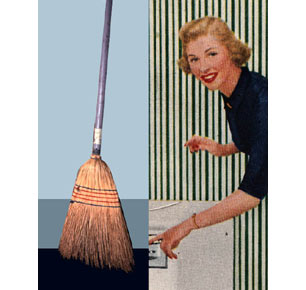
The fact is, housekeeping has an image problem. It’s essentially a backstage production, more noticeable in its lapses (the pink-tinged bathroom tile, the sticky kitchen floor) than in its successes (the measure of which, in my apartment, is getting up from the couch without looking as though you’re modeling the latest trend in fur — cat). Its equipment is low-tech — brooms, mops, sponges — and it lacks the glamour of related activities, like decorating and entertaining, that involve acquisition and display.

Because of a fusion of trends, most of them originating in California — Alice Waters, sun-dried tomatoes, Williams-Sonoma — the daily necessity known as cooking got repackaged in the 1980s as “cuisine.” But despite Miele vacuum cleaners, Restoration Hardware and the hysterical home craft of Martha Stewart, actual housecleaning — the unglamorous, interminable battle with dirt and disorder — has never quite made it as a yuppie pastime. Just compare the sleek look and layout of dicor magazines (Better Homes and Gardens, Metropolitan Home) or culinary magazines (Food & Wine, Saveur) with the print-heavy dowdiness of homemaking magazines (Good Housekeeping, the Ladies’ Home Journal).

The one book of housekeeping hints I do own bears a revealing title: “The I Hate to Housekeep Book.” How reassuring author Peg Bracken’s humorous resistance must have seemed in 1962, at the end of the domesticity-mad 1950s: The housewife should not feel obliged to iron her husband’s handkerchiefs, darn the family’s socks, scrub their collars, polish the furniture. One heretical lady of her acquaintance even goes so far as not waxing her kitchen floor, although Bracken stops short of recommending such neglect. Bracken, in fact, didn’t hate housework nearly as much as Betty Friedan, who just a year later (in “The Feminine Mystique”) declared that it was driving women mad. Abandoning the Mop & Glo no longer seemed nearly revolutionary enough, and the market for homemaking hints has been slow ever since.

Now a sometime lawyer and philosophy professor and her editor at Scribner have gambled that the time has come for a housekeeping revival, purged of its association with the old-fashioned housewife. They appear to be on to something. Cheryl Mendelson’s 800-page-plus “Home Comforts” has shipped 160,000 copies since November and held on as an amazon.com Hot 100 and a barnesandnoble.com Top 100 seller, as well as a Book-of-the-Month Club alternate selection — a breakout performance for a book whose 72 chapters include “Sanitizing the Laundry” and “Vacuuming, Sweeping, and Dusting.”

Is “Home Comforts,” as Katha Pollitt charged in the Jan. 24 issue of the Nation, an example of anti-feminist backlash designed to inspire guilt in women who regard housekeeping as a chore rather than, as Mendelson’s subtitle has it, an “art” and a “science”? Is it, like the Miracle bra, a turn-of-the-century repackaging of midcentury femininity? Or, with its coverage of abstruse topics such as “Legal Protections Against Governmental Intrusions on Your Privacy”; its illustrated descriptions, addressed to the novice, of how to sew on a button, set a table and iron a shirt; and its determined gender neutrality (the book features housework but no housewives), is it a much-needed resource for the modern home?

Actually, it’s both. Two books compete for dominance in “Home Comforts.” One draws on the least appealing traditions of home economics: prissy moralizing and scary science. The other is a contemporary compendium of information that’s useful, curious or entertaining — material for several weeks’ worth of dreary winter nights.

In home-economics mode, Mendelson strives for breezy pragmatism, but a nostalgia for domestic dedication leaks through. Sheets needn’t be ironed, she concedes — but how good they feel when they are! She can’t resist telling us that the best way to clean bare floors is on hands and knees, although she realizes that her reader is unlikely to adopt this position. Delicate line drawings (by Harry Bates) illustrate the proper way to fold underwear, lay a formal place setting, hang laundry on an outdoor line and accomplish a number of other tasks most readers are likely to perform according to common sense or not at all. In this mode, too, Mendelson’s didacticism occasionally runs right away with her. I can’t imagine even a novice reader requiring the information that “milk in coffee or tea renders the drink less bitter; sugar makes it sweet.”

More annoying, though, is Mendelson’s insistence on the moral significance of housework, which in her first chapter she extols as offering “the increasingly rare freedom to engage in worthwhile, unalienated, honorable work.” Now, I enjoy my few hours of Sunday afternoon cleaning. Sparkling tile often gives me as much satisfaction as a shapely paragraph. I feel the same smug superiority to people who never clean their own floors that subway-riding New Yorkers feel to their taxi-dependent friends: the superiority of real folk — in there, getting our hands dirty — to the effete, white-gloved bourgeoisie.

But like most smug attitudes, this one won’t stand scrutiny. The fact is, I clean at whim, with only my own comfort to consult: If deadlines press, then the tile just won’t sparkle this week. If I were housekeeping under duress, if someone else were judging my domestic performance, if children or spouses or housemates were undoing my efforts as fast as I made them, I doubt I’d find the work so soothing.

Indeed, if housekeeping is so fulfilling, you have to wonder why men have historically unloaded it on women, while women have leapt at every opportunity to pay or coerce their less fortunate sisters to do it for them. Mendelson’s cheerleading (Look! Housekeeping requires intelligence! Intuition! Skill!) rather closely resembles the arguments used at the turn of the 19th century to discourage women from leaving their homes to work or to vote. Yes, a clean home is nicer and healthier than a dirty or untidy one, but not if keeping it that way means being trapped in it.

Mendelson’s hawkish position in the Great American Microbe Wars is also tiresome. Perhaps it’s her training as a lawyer, but the kitchen as she describes it in a chapter on “Safe Food” is less the warm center of the home than a scene of potential negligent homicide. According to Mendelson, my small but (I’d always thought) friendly kitchen is really a battleground for toxoplasmosis, E. coli and salmonella — to name only the most familiar suspects. These microbes multiply in my rare (or even medium) steaks, raw (or even lightly steamed) shellfish, poached eggs and unwashed fruit. (Mendelson’s anti-microbial frenzy, by the way, does have the full support of the U.S. Department of Agriculture, on whose killjoy expertise she draws copiously.)

When I reach for my sponge to wash away these contaminants, I merely worsen matters by sending rampaging armies of microbes across counters and cutting boards. Indeed, the sponge itself, which Mendelson appears to regard as a weapon of germ warfare, quivers with so many microorganisms it’s amazing it doesn’t jump right out of my hand. With my careless kitchen habits and my taste for the rare and the raw, I should by all rights be dead by now, or at least a little fluish. Being unaccountably healthy, however, I’ll take my chances and probably continue to swipe at the floor with the sink sponge and wipe my hands on the dish towel.

To be honest, though, I did, after reading Mendelson, go out and purchase 10 new kitchen towels, five (green) for dishes and five (blue) for hands; rearrange several kitchen cupboards; and polish the copper pot that sits (uselessly) on top of the fridge. I like to think I did these things out of inspiration, not guilt. Piles of fresh towels and shiny pots are nice to have around the house. It’s not that I don’t understand Mendelson’s pleasure in cleanliness and order. I just wouldn’t elevate it to a principle.

If, however, you take both the philosophizing and the fear of germs with a pinch of salt, another “Home Comforts” emerges: a reference book full of exhaustively researched, clearly presented information. As a home economist, Mendelson is an autocrat — the word “must” occurs frequently. But the great thing about reference works is that they are essentially democratic. You don’t have to read them in any particular order, and you can ignore what you don’t need. I may never look at the kitchen chapter again, but the 200-page section titled “Cloth” fascinated me for days. I’ve learned what Tencel is, how wool keeps you warm and why I needn’t covet the expensive, lustrous, high-thread-count sheets featured in bedding catalogs (they don’t wear well and they’re harder to care for).

And even though I’ll probably keep shoving too many clothes in at once and pulling them out wrinkled, I love the drawing — carefully stippled, shaded and labeled — of a “properly loaded clothes dryer.” In fact, the whole “Laundering” chapter is promising; perhaps it will explain the differences among all those products on the detergent shelf: brighteners, whiteners, washing soda, bleach, bluing  The chapter on the home office (a topic neither Beeton nor Bracken includes) may offer some way out of my present ergonomic distress, and as for the section on the organization of records — well, I can use all the help I can get.

The fact is, while I don’t have the time or the inclination for domestic perfection myself — and I certainly wouldn’t recommend it to anyone as a goal in life — I don’t mind having the instructions for it on hand.

Continue Reading Close

Page 1 of 2 in Laura Morgan Green