Martha Nichols

Can video games spark my son’s imagination?

I want my boy to develop his own inner life. Maybe I should accept that reading isn't the only way to do it

  • more
    • All Share Services

Can video games spark my son's imagination?iStockphoto/hawridger

On a recent Sunday morning, I found my son asleep on our big purple couch, his latest Bionicle inches from his nose. He’d clearly been staring at it before he dozed off. 


What was he imagining about that fierce, reticulated monster? Did he picture himself doing battle, another armored warrior? Was he contemplating the way the parts fit together?

I have no clue. But when my 8-year-old son creates his very own inner world, a place of solace and inspiration, I know he’s developing a crucial life skill. As a writer, I believe this to my bones. I don’t know any other way to be.


Yet here’s where I question my own biases. My son is also at an age when he parrots the teenagers he knows or sees in exaggerated form in cartoons. He wants an iPhone and an iPod. He wants a GameBoy. He wants to immerse himself in computer games.


All these high-tech toys would put him in his own world, too, a world in which it’s easy to avoid the scrutiny of parents. But is this so different from the imaginary worlds inspired by books and daydreaming? Those take you out of adult range, too.


My guy is not getting a PDA or other Internet-connected gizmo in the near future, but I do wonder if I’m wrong to distinguish between their supposed evils and whatever he’s imagining when he reads or draws.


This is not just a question about how parents spark kids’ imaginations. It’s about how much we’re willing to let our children spark themselves.

I’m not immune from wanting to understand when my child is furious or unhappily silent. Yet I’m also a firm believer in private daydreaming. If he sits staring into space — even if he complains “I’m bored!” — I don’t feel it’s my duty to entertain him or to script his imaginary play. 


My father introduced me to a love of books through his daydreaming example. When he brought me along to the Holmes Used Bookstore in downtown Oakland, Calif., decades ago, I still remember the dusty landings, the tepid light struggling through cobwebbed windows, and my father’s head bent over whatever title he’d pulled from the shelves.

He’d be lost in his own world. Yet we’d be companions, too, on parallel journeys through different books. We’d wander through those crammed stacks, my dad letting me buy a title of my own choosing every time.


I didn’t like all the ones he suggested. My son doesn’t like all my childhood favorites, either. The only way I recently cajoled him into listening to me read “The Adventures of Tom Sawyer,” for instance, was by convincing him that it would help him go to sleep.

He’d had a rough night after watching a scary movie and kept waking up. Finally, at 2 a.m., I settled down with him and started reading “Tom Sawyer” out loud. Within a few pages, he was snoring.


It’s become something of a family joke, the soporific quality of Tom. Yet, my son has become less sleepy, more intrigued by Twain’s colorful dialogue and just what in the world the boring pastor was talking about in church. When Tom loses a front tooth — just as my son did last week — my boy’s eyes got wide on hearing that Aunt Polly yanked Tom’s out.


Suddenly, he was sparked by that small connection between his own experience and that of a fictional character more than a century ago. I couldn’t have predicted his tooth would fall out just as we reached that scene. But whatever inspires him, it’s that spark in his eye that makes me glad, that makes me think I’m doing my job as a mom.


Does one create the same rich and nuanced language of self with a video game? My knee-jerk answer is no. But my son has already fallen headlong into comic books and cartooning. If I really believe in the power of imagination, then don’t I need to trust him to daydream his own way?  

Yes. I think I do.

Martha Nichols is the Editor-in-Chief of the online literary magazine Talking Writing.

Adoption fearmongers take over

As the mom of an international adoptee, I'm saddened by the Russian adoption story -- and outraged by the coverage

  • more
    • All Share Services

Adoption fearmongers take overA swing set is seen in the backyard of Torry Hansen and Nancy Hansen's shared backyard in Shelbyville, Tenn. on Friday, April 9, 2010. Russia has threatened to suspend all child adoptions by U.S. families after a 7-year-old boy adopted by a woman from Tennessee was sent alone on a one-way flight back to Moscow with a note saying he was violent and had severe psychological problems. Artyom Savelyev was put on a plane by his adopted grandmother, Nancy Hansen. (AP Photo/Josh Anderson)(Credit: AP)

When I first saw the pictures of 7-year-old Artyom Savelyev — who is close to my son’s age — in Moscow, after his adoptive grandmother put him on a flight from Washington, D.C., by himself, I wondered what the hell is wrong with us.

Who is “us”? That’s the question. American adoptive parents? Not most of us, by any stretch. The American adoption agency involved, which has now had its license suspended by the Russian education ministry? Again, that’s painting with a broad brush. The Russian orphanage in which by some reports the boy was mistreated? Who knows?

I wanted to blame somebody, though, as did the many commenters on news stories and blogs about Artyom’s fate this past weekend. Adoptive mother Torry Hansen and grandmother Nancy were right at hand, courtesy of the AP. Here are a few comments about the story from Lisa Belkin’s Motherlode blog:

“This is totally unconscionable and irresponsible.”

“This woman’s (I cannot say ‘mother’s,’ for she doesn’t deserve such a title) behaviour is despicable.”

“This article made me cry. It takes the patience and endurance of Mother Theresa to deal with special needs children. Where did this woman not understand the commitment to a young, troubled child that she adopted into her family?”

If you haven’t heard the story yet, last week, Nancy Hansen decided to fly Artyom (called Justin by his adoptive family) back to Russia because his violent behavior had become too much for them. According to one of the AP stories, his grandmother “chronicled a list of problems: hitting, screaming and spitting at his mother and threatening to kill family members.”

Back in Russia, he was accompanied by a note from adoptive mother Torry Hansen, who is a registered nurse: “This child is mentally unstable. He is violent and has severe psychopathic issues … I was lied to and misled by the Russian Orphanage workers and director regarding his mental stability and other issues … After giving my best to this child, I am sorry to say that for the safety of my family, friends, and myself, I no longer wish to parent this child.”

As of Friday, Russian foreign minister Sergey Lavrov was threatening to suspend all U.S. adoptions, calling this “the last straw.”

Grandmother Nancy says she had no idea she was setting off an international incident. She did tell an AP reporter, “The intent of my daughter was to have a family and the intent of my whole family was to love that child.”

I hate stories like this, in which a child becomes abandoned over and over again, unwanted by anyone. I hate what this does to me as an adoptive parent of a son born in Vietnam, of the doubts I start to feel about whether I had any right to everything that my family means.

I’m also waiting for more facts. The problem, as usual, is that a media storm has managed to make the situation even murkier, spreading an array of misinformation about international adoption, attachment disorders, and what constitutes “normal.”

Shocking headlines like “Boy from Russia said ‘he’d torch our home‘” and “Grandmother: Boy terrified adoptive kin” keep the focus on extreme behavior. Here’s the blurb that introduces the AP report in the Seattle Times: “Torry Hansen was so eager to become a mother that she adopted an older child from a foreign country, two factors that scare off many prospective parents. Her fear came later.”

A distorted look at “the inside story of adoptions that go horribly wrong” aired on ABC’s “Nightline” Friday, including videos taken by parents of children having “meltdowns.” (Click here for the accompanying article.)

This prompted developmental psychologist Jean Mercer to debunk some myths in a Psychology Today blog. She rightly castigates “Nightline” for running home videos without questioning the parents’ interpretations. In one case, shortly after a pair of Russian sisters had been adopted, the older sister wanders around her American home in tears, clutching a blanket, and crawling under furniture. As Mercer notes,

“[T]he parents seem to have regarded it as such bizarre and unacceptable behavior that it needed to be recorded because no outsider would believe it.

“But what do we actually see in this video of a child who has been in the adoptive home for about a week? Let me just inquire how similar it might be to your own behavior, if you had been taken by very large people who spoke a different language, put on an airplane with little comprehensible explanation, and taken far away to a new house, new food, new ways of doing things? Would you be grateful?”

Meanwhile, it’s important to keep the numbers in perspective. According to the U.S. State Department, there have been about 15,000 U.S.-Russia adoptions in the past five years. I’ve heard that in the last 15 years, it’s about 50,000. As many adoption experts have noted, most of these don’t go “horribly wrong.”

Whether Artyom is really psychopathic and violent is unclear. Even if it were true, shoving him onto an airplane is at the very least an act of ignorant desperation. Giving him an American name when he was already 6 years old indicates a lack of awareness and empathy. The Hansens — not to mention those parents supplying videos of their children for “Nightline” — appear to have little understanding of what it means to suddenly land in another culture.

Yet something much larger is at play than the actions of two unfit adoptive family members. Based on the official outrage of Russia — following the travesty of American missionaries trying to hustle Haitian “orphans” out of that country after the recent earthquake — the practice of international adoption is once again under fire.

There are lots of ethical reasons why it should be. In Haiti, a number of the children involved still had biological parents. In many other developing countries, from Vietnam to Ethiopia, there’s always been the risk of money paid for babies to finance a less than savory adoption industry.

Yet there’s the flip side, too, and you see it in Russia and Haiti: social welfare systems that simply are ill-equipped and far too under-funded to support the rolls of abandoned children. What you see is poverty and its brutal impact on society’s most vulnerable — children who receive little or no adult care.

Let me say it again: You see poverty, on a global scale, ramped up by the churn of developing economies. The Harvard University Project on Global Working Families, research that surveyed 55,000 people in a variety of countries and is detailed in Jody Heymann’s book “Forgotten Families,” makes clear that many children have no one to take care of them. Here’s a quote from my own 2007 review of Heymann’s book in “Women’s Review of Books“:

“Of the working parents interviewed, nineteen percent in Vietnam left their children alone or in the care of an unpaid child; 27 percent did so in Mexico; and a whopping 48 percent did in Botswana, which has almost no publicly funded child care.”

Even the reference in a USA Today story about Artyom — “United Airlines allows unaccompanied children as young as five years old on direct flights. Children age eight and above can catch connecting flights, as well” — chills me.

So maybe we should blame global capitalism and every one of us (that “us”) who participates. Maybe it’s not just the Hansens of Shelbyville, Tenn. Maybe we should blame general ignorance about international adoption — for example, the various media commentators ranting about the numbers on the rise when in fact they’ve been in steep decline since 2004.

Our son was a baby when we adopted him from Vietnam, from an orphanage in which he seemed very well-treated by affectionate staff. He is now a happy and healthy little boy. I say this not to vaunt my own skills as a parent but to add that even my son, who remembers nothing of the orphanage — an orphanage that was far from a horror show — has occasional meltdowns. When he was just a little younger than Artyom, he would cry uncontrollably when I left him at school. My son still sucks his thumb, though he’s working on it.

Loss experienced by young children can be profound and impossible to process rationally. The fact that my mother was hospitalized when I was 6 still sits in my soul. Sometimes I believe my own loss has helped me to understand my son’s; other times, I think that all humans walk alone.

In my adoptive family, some days we walk in the light. We are together, we are whole. But have we really become a world in which so many children have no safe homes?

Apparently so. At this moment, all I can do is hug my boy close.

This post also appeared in the blog Adopt-a-tude

Continue Reading Close

Shyamalan’s weak defense of “Airbender” racism

The director spins his whitewashed film as a triumph of cultural diversity. Here's why he's wrong

  • more
    • All Share Services

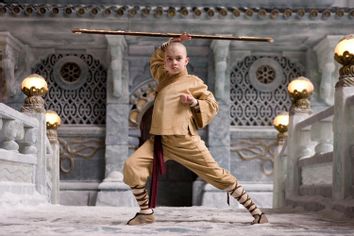
Shyamalan's weak defense of Noah Ringer in "The Last Airbender."

Poor M. Night Shyamalan. Apparently he’s been caught off guard by the protests over white actors playing many of the lead roles in his movie “The Last Airbender.” It’s ironic, he told UGO movie blog writer Jordan Hoffman:

[I]t is the most culturally diverse tent-pole movie ever made. And I’m proud of it. It’s part of what drew me to the material, to see the faces of our whole world in this new world. And only time will assuage everyone and give them peace. Maybe [the protestors] didn’t see the faces that they wanted to see but, overall, it is more than they could have expected. We’re in the tent and it looks like the U.N. in there.

Last week, Shyamalan sat down for a breakfast interview with several film bloggers, journalists, and what Hoffman calls “three stoked webmasters from Airbender fan sites” in a love fest for the movie and its auteur. The live-action film, based on a Nickelodeon cartoon series, opens July 2.

There’s plenty of room in the public forum for a sophisticated analysis of race and culture. Many writers have noted that race is a social construction, not a biological absolute, and to reduce all debates about difference to skin color is to miss everything else that influences the way others perceive us.

The problem comes when invocations of “culture” or “cultural diversity” — the new watchwords — end up erasing racial and cultural inequality. In this case, the casting practics of Hollywood, that maker of dreams, are on display.

It is ironic. There’s no better illustration of the global melting pot than the anime-inspired Airbender franchise. The original series was created by two white Americans (Mike DiMartino and Bryan Konietzko), who cite Asian martial arts and Hayao Miyazaki as influences. Most of the cartooning was done in Korea. Now an Indian American is at the movie helm.

But as an update of “We Are the World,” Shyamalan’s vision begs the question of why white actors are playing three key roles. This includes Aang, the main character for which the movie is named.

Shyamalan’s critics are not interested in the usual Hollywood multicultural mix—all those extras and bad guys who could be pulled from Los Angeles jury pools. Blogs like Racialicious are full of responses to him “spouting a load of BS,” in the words of one commenter:

I don’t see how anyone who has ever taken the time to step outside of their own cultural box can look at [the Airbender cartoons] and see ‘white’. The series is filled with cultural markers that are blatantly Asian in depiction, so when people go on about Aang being white (or even Sokka and Katara, who are obviously browner than everyone else…), I really have to question whether they’ve ever stepped outside or are they just so used to white appropriation that they see everyone as white…

We haven’t reached post-racial nirvana yet. We may have a biracial president who identifies as African American, but a casual perusal of tea party websites should convince anyone that racism is not dead.

While Shyamalan says anime is racially “ambiguous” — it is indeed a cartoon realm in which characters often have big blue “power” eyes and pale skin — many fans would argue right back that these characters are culturally Asian (and, more specifically, East Asian). Back in 2005, the “Airbender” creators said in Animation Insider that they “wanted to base [their mythos] in Asian rather than European background.”

I’ve written before about my own disappointment over “Airbender” heroes like Katara and Sokka getting white makeovers. My young son, a Vietnamese adoptee, deeply identifies with these cartoon characters.

What makes this all so complicated is that cultural affiliation is many-layered, even if you aren’t an international adoptee. For example, there’s Vietnamese culture (and the subcultures and dialects of Vietnam). There’s mainstream American culture. And there’s pan-Asian-American culture, which is marked by physical appearance more than a set of beliefs. That’s just for starters.

Regardless, I know my son wants to be the hero in his favorite stories. Of course those fictional heroes don’t always have to be Asian, though these days, they often are. He didn’t like being stuck in the role of Yoda, as he was when playing “Star Wars” with white friends in kindergarten.

This should not be a big leap for Shyamalan. Women professionals from Laura Bush to Sonia Sotomayor have cited the importance of Nancy Drew as a role model. In fact, the “Airbender” cartoons are popular with many progressive moms because of the strong female characters.

So imagine you’re an Asian American boy (your background may be Vietnamese or Chinese or Korean or Japanese, but the American part matters, too). On TV, you see a slang-talking teenage hero named Sokka with a black top-knot of hair and brown skin. Sokka throws a boomerang in battle, tells bad jokes, and gets to kiss the moon goddess. You see yourself.

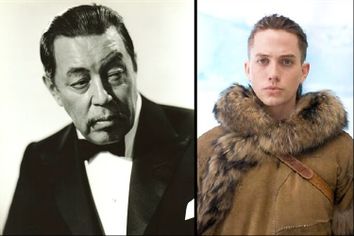
In the movie, Sokka is played by Jackson Rathbone in an Eskimo parka.

I’m trying to give Shyamalan the benefit of the doubt. His “Last Airbender” does include at least one Indian actor in a lead role: Dev Patel as Prince Zuko (although this casting change came after the protests started). In some of the other online pieces spun from his breakfast interview, the director reflects at length about decisions he made in creating the various nations in this fantasy world. Shyamalan seems to have thought hard about why racial mixing, for example, might make sense in a culture of nomads like the Air Nation.

But his explanation, quoted by Hoffman of UGO, of why he’s changed the pronunciation of character names from that of the original cartoons comes off as a defensive slap against his critics:

Now this is, for me, because, at the end of the day a South Indian guy directed the movie. It’s a personal thing. So ‘Aang’ is not [like Tang] but ‘Aang’ [like Tong.] It’s ‘Ang Lee.’ See, my first name is Manoj [as Man-oh-j] and everyone mispronounced it in school and butchered it as ‘Man-ahhj.’ So, this is coming from a specific place, from a multicultural appreciation.

He’s the auteur, all right. He doesn’t want to be roped into a boring paint-by-numbers franchise in which he’s beholden to fans. I can see the pickle he’s in, and his “multicultural appreciation” may pay off. But changing the pronunciation of names from a long-running TV show seems benighted. It’s like focusing on your own little tree in a huge forest.

Fans have a culture, too. So why isn’t there room for them in M. Night’s “tent-pole movie,” especially when their protests say a lot about our own changing but very real world?

Continue Reading Close

Sweet Zeus! Where are the good Greek films?

Classic mythology offers the most dramatic stories ever. Why are Hollywood's attempts to re-create them so lousy?

  • more
    • All Share Services

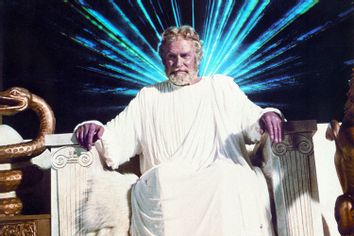
Sweet Zeus! Where are the good Greek films?Laurence Olivier as Zeus in the 1981 version of "Clash of the Titans."

Watching the trailer for “Clash of the Titans,” I know as surely as the Oracle of Delphi that this movie will be foul. A remake of the 1981 film — fantasy classic to some, pure hokum to others — it will swoop upon us April 2.

Here’s what I wonder: Why has no halfway decent director made a film about the Greek gods and their attendant nymphs and heroes? I don’t mean contemporary retellings like “Percy Jackson & the Olympians: The Lightning Thief.” I mean a movie that re-creates the Greek gods on their own terms.

Think about what James Cameron or Peter Jackson could do with this material — the original stuff from Hesiod and Ovid and Apollodorus, which is so much better than toga-clad extras and grunts fighting giant scorpions.

TV spots for the 2010 “Clash of the Titans” played endlessly during the Vancouver Olympics. In one, Liam Neeson as Zeus cries “Embrace your birthright, Perseus!” in tones stinking of Stilton. The following clip is like a low-rent “Gladiator” jammed with rock ‘n’ roll:

Liam-as-Zeus intones, “Release the Kraken!” Never mind that the sea monster is an escapee from Scandinavia and the “Pirates of the Caribbean” franchise.

I don’t give a hoot about the purity of sources in fantasy or science fiction. The Greek gods have been ripped off by so many writers they’re very far from Homer’s time. I also know I’m not the audience for this movie, but as a longtime fan of Greek myths, I could have been, and that’s what frustrates me.

In fact, the 1981 “Clash of the Titans” still has some spark despite the outdated (and goofy) special effects. But as the basis for the 2010 remake it’s a poor substitute for the myth of Perseus. It’s like copying a copy of a cartoon.

The 1981 movie is basically the Hollywood gold standard for Greek gods, with Laurence Olivier as Zeus chewing the fake columns on Olympus. As in the Greek myths, the sniping goddesses give off the most heat, especially Claire Bloom and Maggie Smith. When the head of a statue crashes to the ground — then becomes animated with Dame Maggie spitting curses at hapless human worshippers — it was almost worth watching this again on Netflix.

Almost. There are a few good moments from the actual myth. The three blind witches, for instance, who share a single eye and have a taste for human flesh (complete with a squirming hand in a cauldron) manage to upstage Medusa.

But the story of Perseus is such a rehash that the witches might as well have sucked out his marrow. It feels like anti-myth. Perseus is played by Harry Hamlin in a disco ‘do — remember him? — handsome, vacuous, idiotic. And it’s not enough that the deformed creature Calibos is a Hollywood invention; his lopped-off hand is replaced with what looks like a deadly salad fork.

Then there’s the mechanical owl sent to Perseus by the goddess Athena, a riff on R2-D2, down to the chirps and clicks it “speaks” to Perseus. Even in 1981, this was tacky.

The 2010 “Clash of the Titans” will have amazing special effects (in 3-D) and get rid of some of the Velveeta offenses of its predecessor (not a high bar, granted). The synopsis on the Warner Bros. Web site makes clear that the plot has changed, including a clash between Zeus and Hades (Ralph Fiennes).

Both the 1981 and 2010 movies mash up references from a bunch of Greek myths, but that’s OK. The original myths themselves were retold and remixed wherever people listened to them, and the story of Perseus isn’t any more real than Tolkien’s fantasy world in “The Lord of the Rings.”

What I do question are plot swerves that kill the mythic dimension or reproduce the dustiest clichés. Many of the changes Peter Jackson and his fellow scriptwriters made to the “Lord of the Rings” trilogy, for example, addressed poor writing and anachronisms in the Tolkien saga, especially regarding female characters. Ang Lee’s “Crouching Tiger, Hidden Dragon,” drawn from the flying ninjas of kung-fu movies, also plays with gender roles.

Yet in “Clash of the Titans,” Danaë, Perseus’ mother, is cut from the story once Perseus is of age. In the opening of the 1981 version, we see her clutching the babe as they’re stuck in a box and shoved out to sea by her nasty father. Protected by Zeus — who impregnated Danaë in a golden shower of light (yes, that’s in the myth) — the mother and half-god son land on a peaceful island.

There’s one shot of a bare-breasted Danaë nursing her baby, followed by a cut to naked Mom and little boy ambling along the seashore. Again, think 1970s. Then Perseus goes on his adventures, and Danaë disappears.

But in the Perseus myth, Danaë is a key player. Once Perseus is grown, the king of the island tries to force her to marry him. Danaë refuses. After rescuing his love Andromeda from a sea monster, Perseus returns to save his mother. He pulls out the Medusa’s head and turns the king and his courtiers to stone.

As for Andromeda and her vain mother Cassiopeia, they hail from Ethiopia in the myth, but you won’t see women of color in those roles (or, to be fair, in any images of Andromeda by Renaissance and classical painters). Given Zoe Saldana’s turn in “Avatar” and her sultry take on Lt. Uhura in “Star Trek,” just consider what a little imagination or a few moments on Wikipedia (type in “Andromeda princess”) could have brought to this project.

Maybe the goddess of wisdom is still whispering in my dreams, but I’m offering Athena’s protests here. I’m remembering how much I loved the Perseus story when I first read it in Edith Hamilton’s “Mythology.” I still see my fifth-grade self lying on the green Indian-print bedspread in my bedroom, thinking, Go, Danaë! Go, Athena! (And, why not?) Go, Medusa!

This morning, I got out Hamilton’s popular retelling of the Greek myths, originally published in 1942, and came across this description of Perseus:

“He went to Delphi, but all the priestess would say was to bid him seek the land where men eat not Demeter’s golden grain, but only acorns. So he went to Dodona, in the land of oak trees, where the talking oaks were which declared Zeus’s will and where the Selli lived who made their bread from acorns.”

Talking oaks are cool. Hamilton also describes the god Hermes as “radiant” in a winged hat and sandals. It’s not a stretch to Jude Law. And what about Athena, who “guided his hand” when Perseus killed Medusa?

Note to Hollywood: You can’t make this stuff up. So try reading those who did. 

Continue Reading Close

The death of the library book

Cambridge has a gleaming new main building, but something's missing -- and closing local branches won't help

  • more
    • All Share Services

The death of the library bookThe new addition to the Cambridge Public Library

This post originally appeared on Athena’s Head, Martha’s Nichols’s blog on Open Salon.

I’m amazed at what I get for free in public libraries. Books, big tottering stacks of books, but there’s also computer access and, in the last few years, free Wi-Fi. When my son was younger, we went to story hours and singalongs.

Libraries are one of the great loves of my life. That’s why a hearing last week about the Boston Public Library’s proposal to close some neighborhood branches has me on edge. And several months after the opening of the new main library in Cambridge, I find myself asking an unexpected question.

What’s the purpose of libraries — really? To be a community gathering place? To promote lifelong learning? To help users navigate the information flow? To store print documents for the historical record, as Nicholson Baker argues they should (and aren’t) in “Double Fold: Libraries and the Assault on Paper”?

Libraries can serve all these functions. But what they mean to us as physical spaces is changing, and the information-science vision has now been enshrined at Cambridge Main.

When I visited the new building recently, I saw people; I saw open shelves and attractively displayed books. But few people were reading those books, and I saw way too much unused space, the kind of emptiness beloved by architects.

From the third floor, I stared down at a slim man in a chair. He had a laptop on his knees; ear-buds dangled against his black-sweatered chest. Behind him sat more glowing screens on Ikea-like desks.

The laptop users perched on the second floor in a glassed-in bay. I was up in the children’s room — no longer a room but a vast acreage at the top of the building — sitting in a chair that looked as if it was hewn from an exotic log.

Of course I’m only one observer, floating through on a weekday afternoon. The new main branch opened just last November. Its systems have yet to be tested, and it will evolve over time, with plenty of community backtalk.

But the building, a glass box that’s attached to the old Victorian-era gothic fancy, also reflects new ideas about information and who gets access to information. It has none of the old clutter, and for me, that’s a problem.

Architecture Week, not surprisingly, calls it “stunning”:

“The older building’s Richardsonian Romanesque style is all about ponderous granite and brownstone and circular geometry—arches, cylinders, and cones. The glass addition goes in the opposite direction aesthetically: it is light, transparent, crisp, and orthogonal.”

Yes, it’s an orgasmic spread from Architectural Digest. It’s a po-mo watering hole, complete with dark pink walls and stairways. But I wonder who this design is supposed to attract. If you’re not middle-class, college-educated, and adorned with an iPhone or laptop — or, more to the funding point, a potential donor — I have my doubts about how inviting this is.

I also question all the open space in the entrance area. I question the unspoken belief that the books are a design element, like potted plants. When the building first opened last fall, the glowing review in the Boston Globe noted that library director Susan Flannery “wanted to create a ‘hybrid’ that would mix the qualities of a library and a retail bookstore.”

A retail bookstore? With all its emphasis on market share? I feel the cold hand of commerce squeezing my lefty heart.

In a town of bookish big mouths, revamping the main library was political and emotional; a 20-year resident of Cambridge, I remember it well. Local press has since been enthusiastic. But although the old building needed lots of fixing, I’m now reevaluating my own opinion of whether the city should have spent $91 million on this architectural marvel.

If nothing else, the hearing about the Boston libraries, as reported in the Globe and other papers, makes clear that such decisions involve triage. It also hints at attitudes about what kind of information “sells.” If you’ve got money for new facilities, do you focus on storing print documents (as Nicholson Baker would promote) or build the equivalent of a Barnes & Noble? If you don’t have money, what matters? Computers? Children’s activities? New or old books?

The angry voices at the hearing weren’t asking for new buildings or computers. They just wanted the old branches to stay open. “It’s outrageous that it has come to this,” the Globe quoted one Dorchester resident at the packed hearing, who accused Mayor Tom Menino of chucking libraries “as a 21st-century anachronism, something that can be replaced by Yahoo and Google.”

The president of the Boston Public Library, as well as the library board chair, argued that there weren’t enough computers or staff to go around. But one active member of a threatened library branch asked if the decision really was just about money: “Even if a miracle happened and you got your $3.6 million, would you still be looking to close branches?”

Library administrators noted that an infusion of money would help, but they didn’t deny that they still might consolidate services and staff.

Meanwhile, protests continue. As Globe columnist Renee Loth notes, the library “is threatening to become the site of a classic Boston brawl, with neighborhoods [pitted] against one another clamoring over a shrinking pie.” This past Saturday, adults and children staged a “read-in” at one branch.

In Cambridge, after watching the laptop users, I walked down the pink stone stairway to the nonfiction stacks. I found “Double Fold” and settled into a Danish-modern reading chair. OK. I loved my view of rooftops and clouds through the windows. I liked the whisper-clicks of keyboards all around me. I’m the target audience. But if I’d wanted to, I could have ordered “Double Fold” by logging on to the library network at home. I didn’t need to be there — but then that brings up questions about why anybody needs to be in a library.

I continued down to the ground floor with its “cafe” and alcove of vending machines. The round metal tables were thronged by chattering high school students from Cambridge Rindge and Latin next door.

I followed the signs back to the old building. (The new building is called “Glass,” the old “Stone.”) One of the reading rooms with its WPA murals is still open to the public. Its built-in shelves are stocked with large-print books. The intended demographic is obvious, although few people occupied these tables.

The restored murals illustrate the history of printing, beginning with the ancient Egyptians and Chinese, then shifting to “1422-1491: William Caxton, the First English Printer” to Benjamin Franklin and Gutenberg. I thought about what a 21st-century panel might depict. Rows of computers? Shuttered newsrooms? Words vaporizing?

Yet the movement of so much text into cyberspace doesn’t necessarily amount to empty space — and that’s the irony. Like the laptop users upstairs, I now find most of the rich clutter I love online rather than in a building like this.

Outside again, I walked in the drizzle over to the old Stone entrance, which has been glassed-in as a small conference room. A decade ago, this entryway was packed with community boards and messy stacks of fliers. In Glass, I only saw one notice board, and that was up in the children’s room. Even that had none of the willy-nilly announcements for yoga classes and baby sitters.

I miss the overflowing shelves of the old children’s room, the closer confines that provided more intimacy with the librarians. I’m nostalgic, I admit, strapped to my own memories. I started bringing my son to old Stone when he was a toddler. I didn’t care if the kids and moms and nannies were relegated to the basement. We’d sit on that fusty rug with ragged stuffed animals, and at his height, in every direction, he’d see books. He’d grab them and scatter them, as quickly as he now hops sites with Google.

Regardless of what administrators say, the current library aesthetic isn’t just about practicality. The new building encourages no creative scattering. It may be a library scientist’s dream of control, but it’s not mine. How different it would be if that glass box were crammed with books. From the park outside, we’d see far more than emptiness. And maybe we’d come to believe in a vision of information that’s not constantly threatening to overwhelm us.

Continue Reading Close

Haitian adoptions: Why race matters

The mainstream media celebrates "white saviors" but avoids a necessary discussion about transracial parenting

  • more
    • All Share Services

Haitian adoptions: Why race matters

On Saturday, the Boston Globe ran a beautiful, provocative, complicated photo above the fold on the front page. A dark-skinned girl with a purple headband and a huge grin hugs a white woman with strawberry-blond hair.

They’re sitting on an oriental rug that’s covering a hardwood floor. The caption: “Wislandie, an 8-year-old orphan from Haiti, is right at home with adoptive mother Beth Wescott of North Andover.”

I love this picture. I’m an adoptive mom myself, so it’s a relief after all the mug shots of misguided missionaries trying to smuggle children out of Haiti. In the video that accompanies the online version of the story, “A New Home for Wislandie,” adoptive mom Beth gently rocks a little girl who is lively and mischievous but also clearly in need of comfort.

Yet the Globe’s photo spread, video and story by Maria Sacchetti — “Joy, Frustration Brought Home” — raise big questions for me, too, because of all that isn’t said or shown. This front-page feature, more than all the press about those criminally ignorant Baptists, exemplifies the cognitive dissonance that’s part of transracial adoption.

Why is the white-savior storyline so entrenched? And why is it so hard for the “objective” journalistic voice to talk about race?

The racial difference of Haitian adoptees and their adoptive parents isn’t mentioned once in this story. Perhaps the photo and video are supposed to lay that issue on the table — and they do — but the story frame is the usual one of dedicated church members (Wislandie’s adoptive father is a pastor) visiting Haitian children in a Christian orphanage in Port-au-Prince.

To be fair to Wislandie’s new parents and the orphanage (the Marion Austin Christian School) and this story, “about 10 Boston-area churches regularly send mission groups to help at the school,” Sacchetti writes, and the connection prospective adoptive parents have formed with children apparently often goes back to when they were toddlers. Many of the prospective adoptees are in their teens.

Before the earthquake, some adoptions were already in process; according to the article, a few, like Wislandie’s, have been successfully completed. But other potential adoptive parents and adoptees wait, mired in even more bureaucratic red tape, as conditions for the orphanage children worsen. (In this same issue of the Globe, the story above Sacchetti’s, after the jump inside, is headlined “Haiti Wants Refugees Back in Ravaged Areas.”)

As Massachusetts state Rep. Barry Finegold asks: “These children are never going to have families in Haiti, so why not try to bring them into loving families in Massachusetts?”

Yes, why not? The rhetorical question rings true in the most immediate way for longtime orphans. Seventeen-year-old Auguste Joseph wants to join his frustrated adoptive parents in Ashby, Mass. Like other kids in the orphanage wearing Red Sox T-shirts, Auguste is quoted as saying, “I’m dying to go … I’ve been waiting for a long time.”

But for many of us in the international adoption community — adoptees, adoptive parents, birth parents and adoption workers — this question is far from simple. After “why not?” I also wonder, “what next?”

There are hints of the dissonance to come in an evocative description at the end of the Globe feature: Wislandie is now wearing pink Crocs and has a bedroom of her own. “It is not an easy transition,” Sacchetti writes; the girl’s adoptive parents “look alternately joyful and exhausted.”

Most haunting: “Even though she has so much now, Wislandie insists on dividing every snack or sandwich, to give away half to her mother, father, or sister.”

The story then closes with her adoptive mom insisting, rightly, that her daughter isn’t the only one who has lucked out.

Yet this is really just the prologue. The rest of the real story, which varies with every transracial adoptee and his or her particular family circumstances, is full of complications of race and culture and loss that apparently can’t be accommodated in a mainstream news feature.

Here’s where I have to ask: Why not? Why can’t a daily paper like the Boston Globe, in a metropolitan area that includes a large Haitian immigrant population, tell this story as more than one white family’s joy and the frustration of other waiting white families?

At least one caller to a Jan. 20 NPR show, “Where Will All the Haitian Orphans Go,?” raised issues of cultural and homeland loss. These were treated seriously by Tom DiFilipo, CEO of the Joint Council on International Children’s Services, the guest on this edition of “Talk of the Nation.”

Other sources, such as ColorLines’ blog RaceWire, have grappled with the racial question of whites adopting Haitian orphans. And as one topic on the Haitian Internet Newsletter, “Haiti’s Orphans, What Are We Going to Do About It?,” puts it:

Let me ask you a question: Do you really think that the rest of the world will just fly to Haiti and take all these Haitian kids into new homes somewhere outside of Haiti so they can live happily ever after?

The orphan children of Haiti are Haiti’s problem and now is the time to start talking about how we’re going to deal with it.

This is our country, these are our kids …

Discussions about race and culture and international adoption are all over the Internet and in various blog and editorial forums, even in mainstream press outlets. But you wouldn’t know it from this Globe feature about Wislandie.

Interestingly, a number of the online comments to the story have been negative, pointing out snidely that there are American black kids waiting for adoption, too. That kind of knee-jerk response flips too far in the other direction, but it’s obvious that readers and video-watchers are reacting immediately to the racial difference.

You could argue that daily news features are really people stories. Americans adopting orphans from countries like Haiti or Vietnam (as in my own family) can surely be heartwarming. I would argue, however, that journalists make decisions all the time about whom to focus on and what main idea to follow.

Simplifying the emotional storyline by focusing on getting home to America has political and social implications. It seems to deny that differences of race and culture matter. And I don’t think daily news is off the hook for promulgating musty stereotypes, letting anonymous online commenters criticize a story subject or go out on a limb rather than reporting on what this white mother, for example, thinks about parenting a black child.

Of course Wislandie is happy to be free of the current devastation in Port-au-Prince, where many families huddle under nothing but bedsheet tents as the rainy season approaches.

Yet what will she think of her homeland as she gets older? Will she make connections with the local Haitian community in Boston and Cambridge? Will she keep speaking French and Creole? Will she realize that Haiti has a rich history and literature, a complicated history, that  is not just defined by poverty and disaster?

That is the international adoptive parenting journey. It is very possible that Wislandie’s adoptive mom and dad will help her along the way. In the video, Beth holds the girl close and talks realistically about adjustment challenges and the scene in Haiti.

But not until I read more mainstream stories that dig into white adoptive parents talking about race, and not until I hear more about the links that can be forged between adoptees and the Haitian American community, will I believe that the discussion about international adoption has moved beyond saving those poor lucky kids from a place better left behind in the rubble.

Continue Reading Close

Page 1 of 2 in Martha Nichols