Marty Beckerman

Tales of a groomzilla

I'm part of a new generation of men happy to share the duties of wedding planning. And frankly, I'm losing my mind

  • more
    • All Share Services

Tales of a groomzilla (Credit: picturepartners via Shutterstock)

“This photographer has zero talent,” I told my fiancée as we examined the sample wedding album. “I could take better photos with an iPhone jammed up my rectum.”

OK, I’ll admit it: I have become a groomzilla, the increasingly common (and dreaded) masculine version of a micromanaging bride. Oh, I don’t care about the flowers and table linens; I have no requirements of the cake beyond chocolate of some kind. But I’m an equal partner in our wedding day, much like 80 percent of other modern grooms, if Bridal Guide magazine is to be believed. And as the date swiftly approaches, I’m starting to melt down.

“What do you want for dinner tonight, honey?” my fiancée asked earlier today.

“DINNER?” I howled through my teeth-bleaching Crest Whitestrips. “Protein powder, just like we had for breakfast.”

Hey, I just want to look good on the most photographed day of my life. I’m in the best physical health since college — thanks to daily cardio/resistance/starvation — and the worst mental health.

It wasn’t supposed to happen this way. “Just tell me where to show up in a tux,” I said at the beginning of this process. “You can handle the rest.”

Ha. Ha. Hee. Ho. Heh. Ha. Hee. Hee. Ho. Heh. Ha. Hee.

I thought I was being generous when I replied “whatever you want” to my fiancée’s every question. I wanted her to be happy with every decision, but my agreeableness made it sound like I didn’t care. So I decided to show how much I care. Now I’m frantic over every detail from the guest list to which family members can sit at the same table without brawling. (Yes, we’re inviting Irish people.)

My father doesn’t understand this panic and seems to think I’m a total sissy for letting the pressure get to me. In his day, men had no major responsibilities between the proposal and the wedding. Perhaps this is because cohabitation was so rare back then; it’s impossible for modern guys to escape the madness unless we leave our apartments for the bar around the corner … and we dread the beer calories too much.

We’re left with a single option: giving a crap. And when men care about something — whether it’s sports, politics or discovering new foods to pair with bacon — we give it our full attention.

“When you tell a buddy that you’re scouting reception venues this weekend, you’re less likely to get openly mocked,” says Jeff Wilser of the groom advice site The Plunge. “It’s less about shifting gender norms and more about cold, hard cash. The groom might not give a damn about ice sculptures, but if he sees that the ice costs $1,000, suddenly he pays attention.”

But in this arena men are completely out of our league; the frequent bickering over inconsequentialities — for example, ice sculptures — makes you a worse person and a worse partner at exactly the wrong time. An argument over which hors d’oeuvres to serve at the cocktail hour somehow becomes an existential referendum on your lifelong compatibility.

“They say if you can make it through the wedding planning, you can make it through anything, right?” I recently asked my fiancée’s uncle, quoting the cliché.

“Right.” He nodded. “That’s what I thought until my divorce.”

A couple planning a wedding is like a country going to war: You tell yourself it will be quick, affordable and painless — a cakewalk, a slam dunk — but soon your treasury is exhausted, you can’t keep the peace between rival tribes, and you suffer from unprecedented domestic polarization. (Also: It becomes a half-century commitment.)

We assumed it would be so low-key. You find a venue, a caterer, a DJ or band, a dress, a tuxedo, and maybe some flowers. That’s it, yes? How could this possibly take more than a couple weekends of searching, max? Other couples who claim to go through hell planning their weddings are just being melodramatic or unrealistic, right? We won’t give our friends letter grades and proceed to cull them; we won’t agonize over finding a band that isn’t goateed, toupéed, ponytailed, corpulent and otherwise depressing.

Ha. Ha. Hee. Ho. Heh. Ha. Hee. Hee. Ho. Heh. Ha. Hee.

Last year a friend of mine drove to Vegas with his girlfriend on a whim and found the nearest Elvis impersonator to officiate. At the time I thought he was nuts — why wouldn’t you want your family and friends to share the moment? — and I told him so.

“Go ahead and scoff,” he said, “but your big, fancy ceremony will get very expensive, very tense, very fast. You’ll fight with each other, with your parents, with her parents … I have no regrets.”

Now I wish that I could pay a mutton-chopped dude in a rhinestone jumpsuit his $300 honorarium. This has been the most difficult 12 months of our eight-year relationship; neither of us likes the person we’ve become during this process. With a mere couple of weeks left before we tie the knot — dealing with the inevitable last-minute crises such as RSVP changes and rings that don’t quite fit — we’re knotted up, losing our cool for no good reason. She’ll cry because I don’t care which set of plates goes on our registry (because I am a man), and then I’ll spend the next day muttering passive-aggressive, petty insults about her estrogen levels (because I am a man).

“It’s so gray outside,” she observed yesterday. “Summer’s definitely over.”

“Yeah, life is hell, huh?” I snapped, reading way too much into a comment about the weather. Because everything is magnified through the prism of F-O-R-E-V-E-R.

You’re born, you get married, and you die; the second is extra significant because you don’t get to plan No. 1 or No. 3 (unless you kill yourself, an increasingly attractive option). You can get so worried about the future that you manage to jeopardize it, but a wedding should never ruin a marriage. Sure, it’s the ultimate rite of passage, mythologized in our psyches all the way back to the Disney movies that we absorbed as children, so it brings out the crazy from everyone within its orbit. With men helping orchestrate the festivities in unprecedented numbers, more and more couples will find themselves at the breaking point … and beyond.

But we won’t let this happen. Not to us. Not now. All of the financial overload, family drama and other hassles won’t matter in the long run. All that matters is we’re taking this leap of faith together for a reason, even when the universe seems to exist for the sole purpose of crushing our bond. So whenever I begin to freak out — whether it’s a legitimate reason, or because we have only 18 centerpieces for 19 tables — I’m going to remember why I asked her to spend her life with me.

Because I can be myself around her. Because we can still learn new stories about each other’s childhood. Because she introduced me to “Star Trek.” Because we have so many inside jokes, and we don’t even remember when the punch lines originated. Because she makes me feel young, and I’m not even 30 yet. Because I can’t enjoy dancing with anyone else besides her, preferably in our pajamas. Because we’ve already stayed with each other for better and for worse…

And for better.

How to drink, the Hemingway way

The self-destructive drinker knew what he liked when it came to alcohol. Here are some of his hard-learned tips

  • more
    • All Share Services

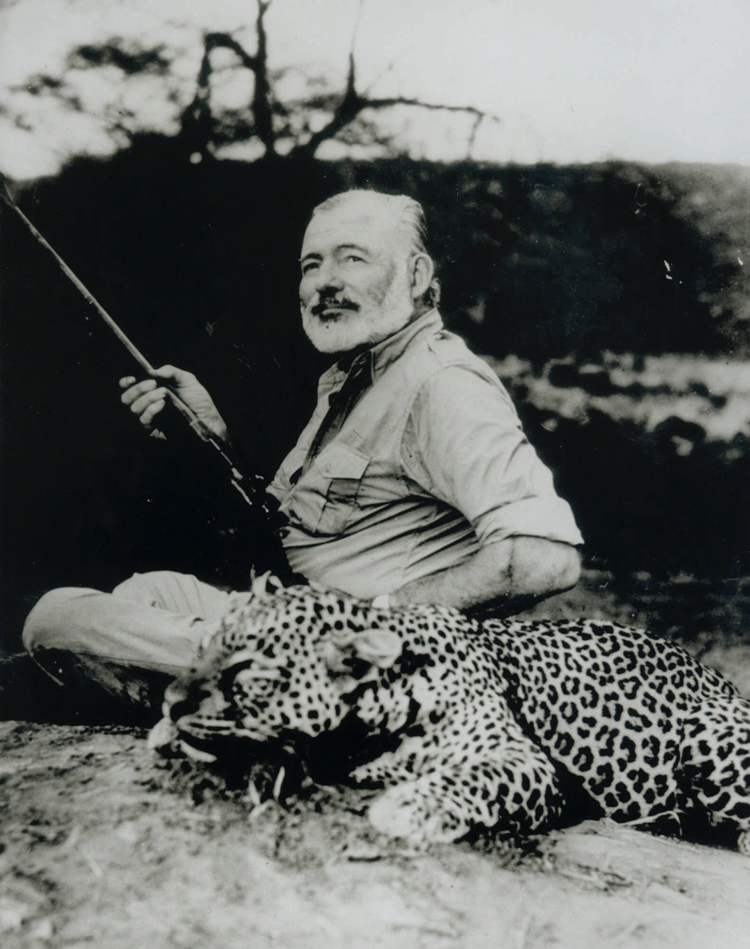
How to drink, the Hemingway wayErnest Hemingway poses with a dead leopard in 1953, part of an exhibit of Hemingway photos to celebrate his 100th birthday on display at Washington's National Portrait Gallery through Nov. 7, 1999. Hemingway, who killed himself three weeks before his 61st birthday, would have been 100 on July 21. (AP Photo/National Portrait Gallery, Earl Theisen)(Credit: Earl Theisen)

In this age of Mike’s Hard Lemonade, Smirnoff Ice, Bacardi Breezers (flavors include pineapple, watermelon, mango, coconut, raspberry, blueberry, and probably estrogen), and other alco-pops marketed to prepubescent girls, it’s easy to wonder: why should I drink throat-burning hard liquor when I can instead sip five-proof carbonated fruit juice? Or: why should I put hair on my balls when I’m just going to manscape them anyway?

BECAUSE THAT’S WHAT MEN DO … THAT’S WHAT MEN HAVE ALWAYS DONE.

But didn’t Hemingway love daiquiris? you ask. Didn’t Hemingway invent the mojito? Yes, Hemingway loved and invented lots of things — such as freedom and gravity — but only Richard Nixon could go to Red China. We must painstakingly follow his example (Hemingway’s, not Nixon’s) which means earning sufficient masculine credibility to experiment with unmanly pursuits, and thereby make them manly.

Amateurs, unlike aficionados, can’t afford to break the rules, because (as Hemingway told the Paris Review) “what amateurs call a style is usually only the unavoidable awkwardnesses in first trying.” You may consume a piña colada garnished with maraschino cherries and caramelized strawberries only after surviving trench warfare, the Running of the Bulls, two African safaris, four wives, and thousands upon thousands of piña coladas.

Men don’t get loaded for the vitamin C. We get loaded because we have demons. We are dark, broody, and mysterious; we possess inexplicable desires and tempestuous temperaments. We can dull our torment with liquid intoxicants — as the amputee endures his wretched condition with morphine — but we cannot erase our misery. Nor would we want to do so, because “to suffer like a man” (like Santiago in “The Old Man and the Sea”) makes us men.

Alcohol isn’t about expressing this torment. The whole point is burying it deeper, which is why nobody likes a sad drunk. But some inconsiderate people — specifically, people with vaginas — cannot help themselves; they have an ounce of schnapps and then weep about their latest breakup (with yet another soul mate) or their backstabbing girl friends (those bitches) or their dead pet (more like toy) or their horrible daddy (the molester).

Whining is for women; whiskey is for men. The only shoulder a man cries on is marinated beef chuck, and the only tears he cries are tears of joy. “You don’t want to mix emotions up with a wine,” Papa implored in “The Sun Also Rises.” “You lose the taste.”

The only time Hemingway cried over alcohol: When Congress made it illegal during Prohibition. But he pulled himself together, as a man does always, and traveled to Paris, as a man does seldom. There Papa committed to a life of glorious, full-throttle chemical dependence alongside “The Great Gatsby” author F. Scott Fitzgerald, who said, “First you take a drink, then the drink takes a drink, then the drink takes you.” In Fitzgerald’s case, the drink took ten thousand drinks and then left him dead in the gutter.

During this time Hemingway composed “The Sun Also Rises,” a novel about self-loathing, castrated Jake Barnes, who impresses women with his massive booze consumption, since he can’t impress them with a massive anything else. (Original title: “The Junk Never Rises.”) The book’s characters drank more than a hundred and fifty types of alcohol on nearly eight hundred occasions, just like their creator before lunch. A decade and a half later, at the ripe old age of forty, Hemingway — who wrote what he knew — suffered from kidney and liver problems, hypertension, cramps, diabetes, insomnia, bloody urine, and (worst of all) erectile dysfunction. Life penis imitates art penis.

Doctors begged him to cut back from his average of three bottles per day. Hemingway agreed to compromise, reducing his intake to a detox diet of absinthe, whiskey, vodka, wine, gin, tequila, champagne, and beer for breakfast, according to numerous biographies. (You haven’t tasted Cinnamon Toast Crunch until you’ve doused it with Guinness Extra Stout.) Papa even refused to shower, revealed his friend A.E. Hotchner in the memoir “Papa Hemingway,” instead demanding “alcohol sponge-baths.”

These physical and psychological maladies suggest that imbibing is a bad thing — with negative consequences — but Hemingway told us in “The Sun Also Rises”: “It seemed out of place to think of consequences during the fiesta.” Alcohol takes years off your life, but he told us in “A Farewell to Arms,” it “always makes you happy,” like a well-marbled steak drenched with blood and butter. (And with bourbon.)

Anything worth doing is more worth doing blitzed …

  • Hunting

A man works up quite a thirst while massacring ferocious beasts such as lions, tigers, and chipmunks with his personal arsenal of firearms and traps and machetes and blowtorches. On safari Hemingway often “drank a whiskey … to take the edge off so I would not be nervous” (“Green Hills of Africa”) and got “too drunk to shoot straight.” Like Dick Cheney, he probably scared away more hunting partners than wives.

  • Fishing

This strategy was less successful on his boat, the Pilar, when — drunkenly trying to kill a shark—he accidentally shot himself in both legs. (As opposed to purposefully in the face.)

Nevertheless, Hemingway advised, “you ought to taste [beer] on a hot day when you have worked a big marlin fast because there were sharks after him.” But you ought to use liquor, not beer, to sterilize that gaping wound.

  • War

In WWI Hemingway always kept a bottle hidden under his bed for comfort. And when the Allies retook Paris during WWII, Papa’s first priority was “liberating” the bar at the Hôtel Ritz. He miraculously even convinced starstruck U.S. Navy officers to stock the Pilar with bazookas, grenades, and machine guns to hunt Nazi submarines.

But the clandestine missions of Captain Hemingway devolved into combat-free “fishing trips” during which “grenades were hurled into the sea in drunken sport,” as biographer Kenneth Lynn documented. His third wife left him because of this behavior, despite his epic defense: “Honey, drinking is war.” Ironically, divorce court was the most vicious war zone of all.

  • Health

You could pay a doctor to diagnose and treat your disorders, but alcohol “cures everything” (“For Whom the Bell Tolls”), especially alcoholism’s withdrawal symptoms. Besides, a physician will order you to cut your consumption and take fancy-schmancy medicine instead. The greedy bastard just wants to make you dependent on his potions, unlike the benevolent angels of the adult beverage industry. “You’re not supposed to drink,” Hemingway scoffed in “True at First Light,” “but I always did and I’m still here.”

Until he wasn’t.

  • Fatherhood

What kind of papa was Papa? According to Lynn, the kind who once told his puking ten-year-old son, “I’ll fix you a Bloody Mary — you’ve just got a hangover.” But is triple-distilled vodka really unhealthier than McDonald’s Happy Meals, which millions of deadbeat parents shovel down their morbidly obese tykes’ gullets? Alas, vodka does not come with a collectible gizmo, unless a transplanted liver qualifies as a disposable plaything.

  • Gluttony

Unlike his prepubescent son, Hemingway rarely experienced hangovers, because “any man who drinks a great deal needs to eat.” (“True at First Light”) Load up on heavy carbohydrates: pizza, pasta, and “pretzels for … the good way they made the beer taste.” (“A Farewell to Arms”) Another good source of carbohydrates: beer.

  • Watching Sports

Puritanical scolds object to “the obvious moral wrongness of the bullfight, just as people could refuse to drink wine which they might enjoy …” (“Death in the Afternoon”) But two wrongs obviously make a right. Whenever in Spain, Hemingway got loaded and hit the arenas, where heckling was tolerated because (“Death in the Afternoon” again) “bulls pay little attention to a drunk.”

  • Interacting with Society

Men love solitude. We don’t need conversation when a “bottle of wine was good company” and “[i]t was pleasant to be … drinking alone.” (“The Sun Also Rises”) An isolated cabin in the forest is the perfect home for us.

Unfortunately humans are social animals. We must communicate if we don’t wish to go utterly off-the-rails insane. Alcohol can help with this tedious chore: martinis will make you “feel civilized” (“A Farewell to Arms”) and will make the people you hate seem tolerable, because “[a]n intelligent man is sometimes forced to be drunk to spend time with fools.” (Hotchner’s “The Good Life According to Hemingway”)

Hell isn’t other people; it’s other people when you’re sober.

Booze improves every aspect of life, but it’s going to cost you. If you piss away your fortune — likely for a professional novelist instead of, say, an employed person — find a wealthy woman (like Papa’s first wife) to serve as your benefactor. Naturally you’ll need to convince her that you’re worth more in social status than she’s worth in money, and you’ll also need to convince her that you’re not a “boozer and whorehound” (“A Farewell to Arms”) who achieves “nightly alcoholic triumph.” (“The Short Stories”)

This means lying to your sugar mama, but if you feel guilty for deceiving a female — or if you feel guilty for anything — you are definitely not drinking enough.

“To drink is nothing,” Hemingway proclaimed in “For Whom the Bell Tolls.” “It is to be drunk that is important.”

This article is excerpted with permission from “The Heming Way”

Marty Beckerman has written for Esquire, Playboy, Salon, Discover, Gawker, AOL, the Daily Beast, and every other worthwhile publication of our time. His literary masterpieces include “Generation S.L.U.T.” (MTV Books / Simon & Schuster) and “Dumbocracy: Adventures with the Loony Left, the Rabid Right, and Other American Idiots” (The Disinformation Company).

Continue Reading Close

Hi, I’m Marty, and I’m a recovering Republican

I was a feminazi-hating, liberal-bashing loudmouth who tried to befriend Bill O'Reilly. Man, I was such a douche

  • more
    • All Share Services

Hi, I'm Marty, and I'm a recovering Republican

Every day I wake up with the same thought: “I used to be such a goddamned idiot.”

I am a former Republican. And I wasn’t merely the libertarian, live-and-let-live, fun-at-parties kind of conservative whose primary concern is balancing the budget; I was a spiteful, narrow-minded, fire-breathing paranoid lunatic who questioned the patriotism and morality of my liberal fellow citizens. Recognizing the error of my ways has done wonders for my mental health but left me with constant, unremitting remorse; I really want to go back in time and kick my own ass.

Surely I am not alone: Earlier this year independents sympathized with Democrats two-to-one over Republicans, whereas they were evenly split five years ago; a slim majority of young voters voted for Sen. John Kerry in 2004, but nearly 70 percent chose Barack Obama in 2008, the widest margin in electoral history. Traditionally people shift rightward as their bank accounts expand and their flesh wrinkles, but my generation is seemingly the first to move leftward with age.

Actually, I was a passionate liberal when I entered college in September 2001, and I initially resisted the GOP’s post-9/11 fury and propaganda. I decried the suspension of habeas corpus and the 2003 Iraq invasion and feared for our country when dissent was equated with treason in the popular imagination. And then a few things happened:

• A handful of my friends joined the College Republicans. As our drunken nights accumulated — with Fox News always in the background and a stack of vitriolic books cracked open — I found myself questioning my assumptions. Craving the acceptance of my peers like any other insecure college kid, I gradually accepted their self-reinforcing groupthink, slowly but surely inching toward the Dark Side.

• A handful of my fellow campus left-wingers appeared to excessively sympathize with right-wing Islamists, rationalizing the violence of suicide bombers, for example, but refusing to criticize (on multicultural grounds) heinous civil rights abuses across the globe. The starry-eyed George W. Bush acolytes who called for the expansion-by-explosion of worldwide freedom — despite opposing countless domestic liberties — seemed righteous in comparison.

• A handful of my professors injected their utopian and hypersensitive politics into the classroom, calling for a “socialist revolution” and grading me poorly for using “heteronormative” language. Rebelling against their authority, as they had rebelled against conservative professorial authority in their student days, felt as natural as doing a keg stand at a fraternity party.

• A super liberal girlfriend dumped me, sparking my testosterone-fueled bitterness toward everything that reminded me of her, such as left-wing politics and basically all human females.

Very few people in their late teens and early twenties seek justice in moderation. The hormone-soaked college years are a time of extremes, our changing identities often defined by dissent-quashing affiliations, leaving us to later cringe at our frenzied “Goldfish Liberation phase,” “Castrate the Phallusocracy phase,” “Noam Chomsky phase” or “Ayn Rand phase.” (Yes, I spent a summer vacation trying to finish reading “Atlas Shrugged,” ultimately throwing in the towel around page 75,000.)

Much like our previous chief executive, I should have seen the danger of sealing myself in an echo chamber to prevent contamination from outside viewpoints; I began only hanging out with conservative true believers, only reading conservative books, only getting my news from conservative media outlets. In order to avoid journalistic “left-wing bias,” I embraced right-wing bias, foolishly confusing sensationalist entertainment with debate and truth-telling. Outrage became my drug of choice.

There was no single moment when I transformed into an unhinged, raving authoritarian; propaganda works in repetition — in accumulation — and worldviews rarely change overnight. However, as your skepticism weakens, a new understanding of history develops. Whereas Liberal Me viewed America improving over time with the progression of civil rights and sexual liberation, Conservative Me viewed history as an unfolding catastrophe: In my mind, “socialist” handouts threatened our laissez-faire way of life, as if public roads/schools/libraries were no different than Stalin’s gulags, and hedonistic decadence — facilitated and encouraged by scheming left-wing nihilists — threatened individual self-control. I mistakenly came to believe that America had not progressed toward justice but fallen from grace.

I railed in conversation and on my website against “freedom-hating hippies,” “activist judges who overturn the will of the people,” “pro-abortion feminazis,” “Marxist Democrats,” “elitist, so-called intellectuals,” “greedy welfare queens,” “environmental whack jobs” and other perceived bogeymen. I lost sight of grayscale and instead saw the world in black and white; I labeled Terri Schiavo’s husband a money-hungry murderer for pulling the plug on his comatose wife, lumped all Palestinians together with the few terrorists among their population, uttered racial/sexual/ethnic slurs with a little too much enthusiasm for simple prurience and approvingly repeated Michael Savage’s book title “Liberalism Is a Mental Disorder.” I even argued that women belong in the home, not the workplace! (Now a self-employed author, I cook dinner for my girlfriend nightly and perform household chores — groceries, laundry, dishes — when she heads to the office. Truly I am a domestic goddess.)

My sudden transformation mystified my friends and family, many of whom tried to talk sense into me when they didn’t outright disown me. Even my conservative father said I was going overboard. For example: wondering if my 90-year-old grandmother was a Commie for cashing her Social Security checks. In order to heed your inner Joe McCarthy, you must first squelch your inner conscience.

Strangest of all, I developed a finger-wagging puritan bent, which made absolutely no sense for a 20-year-old guy who was getting laid and intoxicated on a steady basis. I blamed “the anti-family Left” for encouraging couples to divorce and youngsters to fornicate, as if liberals were all conspiring together to destroy the traditional family, as if liberal states do not have lower rates of divorce and teen pregnancy than their conservative counterparts. My hypocrisy is mystifying in retrospect — why would I bash sexual liberation while having sloppy drunken unmarried sex whenever possible? — but perhaps conservative politicians such as John Ensign, Mark Sanford, David Vitter, Larry Craig and Newt Gingrich can explain.

You might imagine my moralizing stemmed from our cultural anxiety about sexuality, but it actually came from a longstanding need to position myself as superior to others; I got off on presenting my fellow millennials as pleasure-seeking, unthinking/unfeeling animals while my life had Truth and Meaning. It was incredibly self-righteous and self-congratulatory, and it was only about 50 percent accurate.

None of this would haunt me so deeply if I did not have a national platform to air my histrionic, uninformed opinions. However, I was uncommonly lucky for my age. In 2004 MTV/Pocket Books published my book “Generation S.L.U.T.,” which described the anonymous hook-up culture among contemporary American youth and unleashed a storm of publicity. Although I am proud of the book’s emotional nakedness (apart from its amateurish didacticism), the book’s promotion is another story: In Salon, the New York Times, and countless other interviews (newspaper, radio, TV, blogs) I blamed the psychological turbulence of modern teenagers — from wrist-cutting to school shootings — on the 1960s feminist revolution. I sounded like a bitter middle-aged man; I even flattered the ultimate bitter middle-aged man, Bill O’Reilly, whom I asked to “be my friend” during a Fox News Channel appearance. (O’Reilly appeared confused by the request. For the record: I am friends with every Irish person, minus the nondrinkers, who do not exist.)

I completely understand why conservatives-turned-liberals such as Arianna Huffington and David Brock and liberals-turned-conservatives such as P.J. O’Rourke and David Horowitz spend decades walking back their youthful ramblings. When millions upon millions of people remember you for something that you no longer represent — if you think they remember you anyway, which they probably do not — the shame is unbearable, the desire for a time machine pathological. The temptation is to become an extremist in the opposite direction — LOOK how much I’ve changed, everybody! — which is hardly an act of maturity. The dilemma remains: You have evolved, yet the perception of you remains stuck in a misguided past. (At a recent literary event someone asked me, “Aren’t you the guy who thinks women shouldn’t have sex?” I’m misanthropic, yes, but willing to concede that humanity should probably reproduce.)

However, I might have never recovered from my right-wing fever if not for the controversy I caused. Readers sent me hate mail following a Salon interview with Rebecca Traister, in which I bashed feminism and articulated such thoughts as: “Men don’t see women as clean and pure but as a means to an end, a nice little fuck-hole.” One Salon reader even threatened my physical safety.

But middle-aged liberal psychologist Steve Edgell took another approach: calmly and gently talking me back to earth. Over the course of many e-mails and phone conversations, Dr. Edgell — who had been an Ayn Rand junkie at my age — explained the reasons for his own political evolution and guided me through the myriad inconsistencies of my rabid philosophy. Just as I was beginning to understand how unbalanced I had become, Edgell died of a heart attack. He did not live to see me completely return to planet Earth but must have known he had planted the seeds of doubt. I never met the man, and I don’t necessarily agree with everything he believed, but I owe him my sanity. (He was an atheist, but I hope he is looking down from the cosmic void with amused satisfaction.)

Just as morphing into an extremist took a couple years, un-becoming an extremist happened over time. One by one I saw the flaws in conservative orthodoxy: attempting to fight terrorism with torture, which only aided our enemies’ propaganda efforts and thus created more terrorists; seeking to liberalize the Muslim world while curtailing rights for gay people at home; criticizing public schools for lackluster results and therefore cutting funds further; disdaining the weak while never analyzing why they are weak; always seeing the effect but never the cause, which on a mass scale perpetuates the effect.

The 2008 financial crash further proved to me the necessity of an economic safety net within the market system; tying health insurance to employment suddenly made no sense, for example, when millions of people lost their jobs due to conditions beyond their control. Capitalism with a few safety pads — or a condom, I suppose, since the recession has fucked us all — is a far cry from a Marxian worker’s paradise.

I am not an extreme leftist by any means — I still dream of swimming in a vault of gold coins like Scrooge McDuck, I would die to protect the First Amendment from censorial progressive overreach (the same goes for theocratic conservative overreach), and I would consider voting for moderate Republicans if any still existed — but I’ve learned to see the big picture. It doesn’t matter whether you are liberal or conservative, but it’s dangerous to always think with exclamation points instead of question marks. Your stance on any particular issue is far less important than whether your worldview is a product of inquiry or incuriosity, whether you feel more comfortable questioning the crowd or blindly marching with it. No ideology has a monopoly on reality — including my rediscovered left-wing politics.

No longer drunk on jingoism and bloodlust, I feel like a German in 1946, wondering what the hell happened to me, what the hell I supported when I harbored no doubt that we should “nuke ‘em all” and measured people by standards other than their character. The years pass, but I cannot reconcile my former and present selves; in my early 20s I made the worst mistake of my life –injecting poison into a world that desperately needed the antidote — and while it’s impossible to undo that error, perhaps my penance is remembering and therefore not repeating it. Just as Dr. Edgell steered me back to the shores of lucidity, I can encourage mellowness in others — no matter their cause — and discourage the inevitable craziness that resentment and overgeneralization breed.

Paul of Tarsus, the most famous convert in history, commented long ago: “Even though I was once … a persecutor and a violent man, I was shown mercy because I acted in ignorance and unbelief.” I don’t know if anyone, deity or human, will show mercy on me, but I will try to have mercy on myself, and — even if I continue to fail — maybe that’s enough.


Continue Reading Close