Michael Humphrey
Stuck in a well: A short cultural history
From Kathy Fiscus to Baby Jessica, the drama of someone trapped underground has long fed news and entertainment
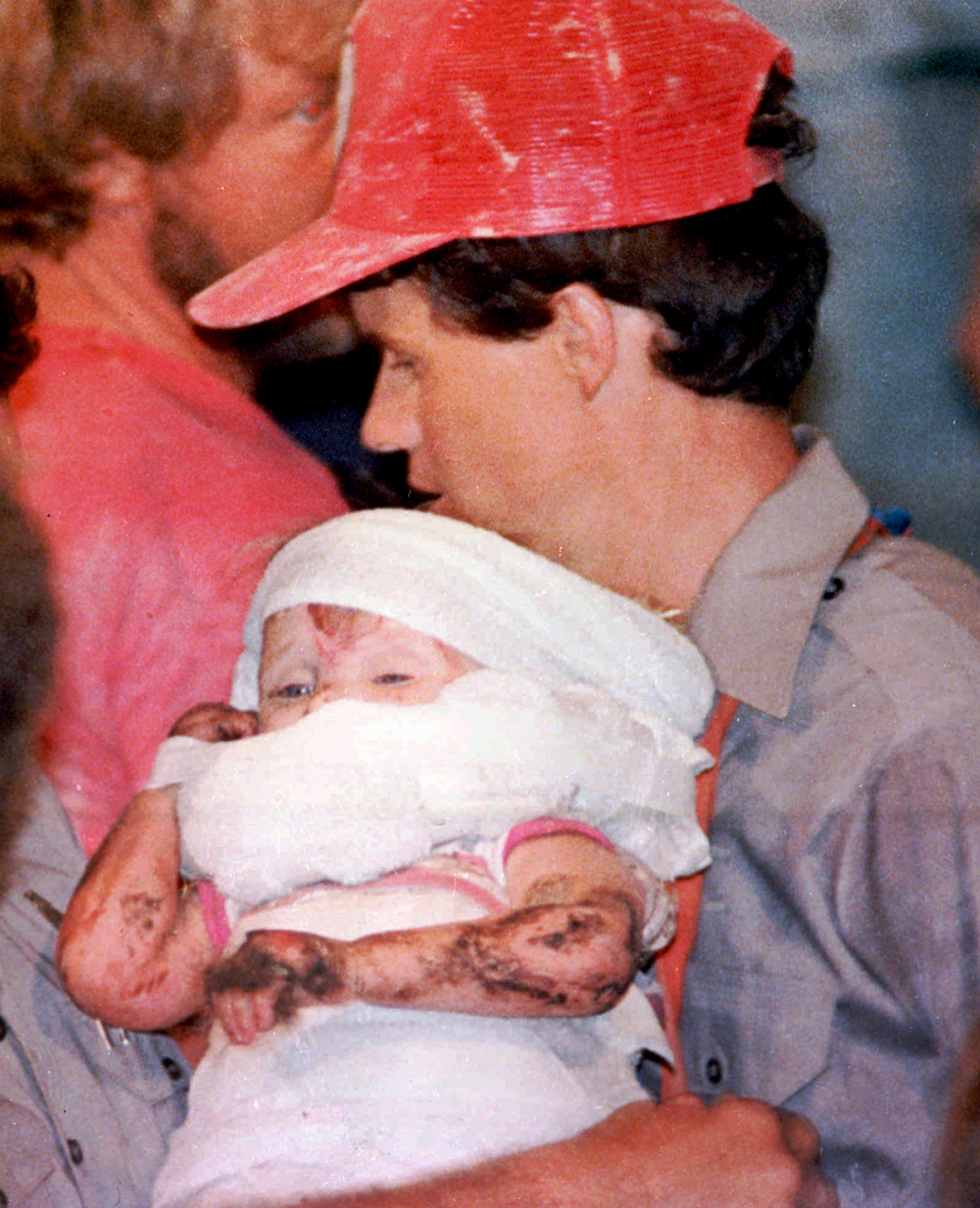
Rescue worker carries 18-month-old Jessica McClure Oct.16,1987, shortly after she was rescued from an abandoned water well at Midland,Texas. Now that the dramatic, round-the-clock rescue of 33 Chilean miners has finally come to a close, it’s worth asking: “Why do we love a story about people in holes?” Call it the “Timmy in a Well trope” — in news, as in entertainment, we are riveted by people stuck underground.
“I suppose there are mythic elements at work here,” says author Melissa Fay Greene, who wrote “Last Man Out: The Story of the Springhill Mine Disaster.” “These are men who learned something about the beyond. They have literally been buried alive.”
There is something uniquely modern about it, too. The first television news event to captivate all of America in real time was about Kathy Fiscus, who fell into an abandoned water well. Stan Chambers of KTLA in Los Angeles covered the story for 27 hours until a doctor was lowered into the well to find her dead from suffocation.
The story inspired not only media coverage as we know it, but also a song by Kentucky folk singer Jimmie Osborne, in a song called “The Death of Little Kathy Fiscus” (“On April the 8th, the year ’49, there claimed a little child, so pure and so kind / Kathy they called her, met her doom that day / I know it was God that called her away”) …
… and films such as Billy Wilder’s “Ace in the Hole” and Woody Allen’s “Radio Days.”
All of these stories, real and fictional, ended badly. “Ace in the Hole” replaced the little girl with a man trapped in a cave. He dies. “Radio Days” is more faithful to its inspiration — a little girl falls into a well and the movie switches between the scene and a family following the news on the radio. She dies, too. The 1958 Springhill Mine Disaster in Nova Scotia, which Greene says was the first television event where live coverage captivated not just one country but the entire world, had a somewhat better ending. A hundred of the 174 miners were eventually rescued. It also inspired music, this time by Pete Seeger.
Another kind of media phenomenon — cable television news — found its stride when Jessica McClure, aka Baby Jessica, fell into an eight-inch wide well casing in 1987. With the clock constantly ticking on her life, CNN kept the images and chatter coming as workers spent 58 hours extracting the child, this time with a happy ending. This inspired an example from the quintessential 1980s cultural format, the TV movie “Everybody’s Baby: The Rescue of Jessica McClure.”
But the mythic elements of these stories begin with the media coverage.
“What really happened may never be understood outside of the mine,” Greene says. “Chances are we journalists aren’t going to get it right. The real stories are so damn subtle, and private and obscure and individual that 33 true stories could be told.”
And certainly will be. But who will write the song?
“Where Good Ideas Come From”: Epiphanies are overrated
Steven Johnson explains the real science of innovation -- and how some companies, like Google, are mastering it
Where do brilliant ideas come from? When reporters ask Tim Berners-Lee about the moment he conceived of the World Wide Web, he can’t answer. He hasn’t forgotten, it just never happened. The idea percolated in his mind for nearly a decade, based on a desire to organize massive amounts of data shared between connected computers. He needed ideas of others to buzz around him and he needed an image that would make his idea understandable. His “stack” of information became a “mesh” before eventually becoming a “web.” The cliché did not hold true: His moment of insight, as it turns out, wasn’t the result of a single flashbulb going off in his brain.
Continue Reading CloseGreat moments in publishing: Celebs turned novelists
Snooki is just the latest in a legacy that includes Naomi Campbell and Lynne Cheney, and we have the excerpts
FILE - In this June 23, 2010 file photo, television personality Nicole "Snooki" Polizzi attends the premiere of "Grown Ups" at the Ziegfeld Theatre in New York. (AP Photo/Evan Agostini, file)(Credit: AP) News that “Jersey Shore” star Snooki will soon join the literati came packed with excitement, especially her own. “I’m pumped,” she said in announcing “A Shore Thing,” the tentative title of her romance novel, due out early next year. But it’s not the first first-pumping a celebrity has given to the world of letters. Any public figure can write a memoir, but it takes a special daring to jump into the realm of fiction. Here are 10 of the most memorable attempts.
Continue Reading Close“My Lie”: Why I falsely accused my father
For years, Meredith Maran believed her dad molested her. She talks about "recovered memory," and finding the truth
Meredith Maran More than 20 years ago, Meredith Maran falsely accused her father of molestation. That she came to believe such a thing was possible reveals what can happen when personal turmoil meets a powerful social movement. In her book “My Lie: A True Story of False Memory” (the introduction of which is excerpted on Salon), Maran recounts the 1980s feminist-inspired campaign to expose molestation, which hit feverish levels in 1988 with the book ‘The Courage to Heal.” As an early reporter on the story, Maran observed family therapy sessions, interviewed molesters and steeped herself in cases where abuse clearly took place. Meanwhile, she divorced her husband and fell in love with a woman who was also an incest survivor. Maran began having nightmares about her own molestation and soon what had been a contentious relationship with her father turned into accusations of unspeakable crimes. Eventually, she came to realize the truth. She was the person who had done wrong.
Continue Reading Close“Ah-Choo!”: What you didn’t know about the common cold
Why are some people more susceptible? Does any cure work? An author explains the latest, fascinating discoveries
The common cold makes fools of us. It’s not just the runny nose and Daffy Duck speech; it’s our naiveté about preventing, alleviating and curing the mess. Despite spending millions of dollars on preventions such as Airborne and immunity enhancers and endlessly washing our hands, we humans are still constantly undone by the minuscule menace. On average, we catch between 100 and 200 colds in our lifetime, and in the coming weeks, as the weather cools off, it will likely reduce millions to heaps of mucous and lethargy.
Continue Reading ClosePage 2 of 2 in Michael Humphrey