Nedra Pickler

Holder Gives Legal Defense For Al-Awlaki Killing

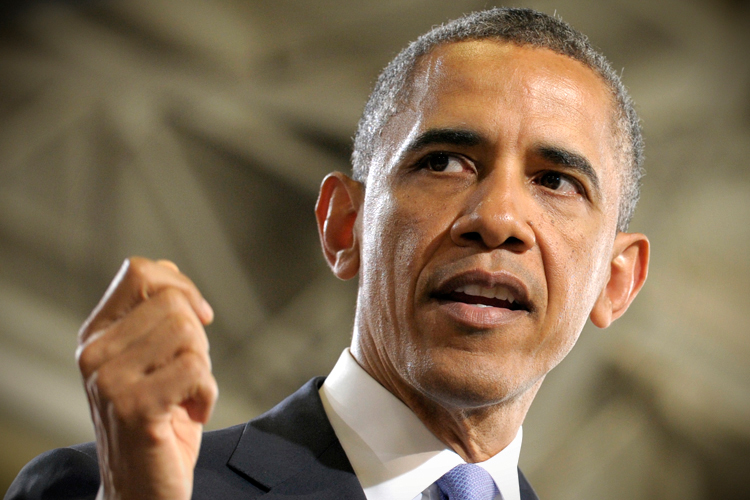
Attorney General Eric Holder speaks at the Northwestern University law school, Monday, March 5, 2012 in Chicago. Holder said Monday that the decision to kill a U.S. citizen living abroad who poses a terrorist threat "is among the gravest that government leaders can face," but justified lethal action as legal and sometimes necessary in the war on terror. (AP Photo/Brian Kersey)(Credit: AP)

WASHINGTON (AP) — Attorney General Eric Holder said Monday that the decision to kill a U.S. citizen living abroad who poses a terrorist threat “is among the gravest that government leaders can face,” but justified lethal action as legal and sometimes necessary in the war on terror.

Holder’s comments broke the administration’s silence on the legal justifications for its decision to kill American-born al-Qaida operative Anwar al-Awlaki five months ago in Yemen. In a speech at Northwestern University law school in Chicago, he described al-Awlaki as concocting plans to kill Americans but he never explicitly acknowledged the administration responded by targeting the cleric for death.

Instead the attorney general outlined a three-part test for determining when a targeted killing against a U.S. citizen is legal. He said the government must determine after careful review that the citizen poses an imminent threat of violent attack against the U.S., capture is not feasible and the killing would be consistent with laws of war.

The Obama administration has refused to release the Justice Department legal opinion on al-Awlaki’s killing under the Freedom of Information Act and is in court opposing efforts to have it made public.

Responding to criticism from civil libertarians, Holder flatly rejected the suggestion that the Constitution’s due process protections require the president to get permission from a federal court before taking lethal action.

“The unfortunate reality is that our nation will likely continue to face terrorist threats that at times originate with our own citizens,” Holder told a packed Thorne Auditorium, where all 700 seats were filled with law students, who were taking notes on their laptops, were joined by Chicago-based federal prosecutors and other observers.

“When such individuals take up arms against this country and join al-Qaida in plotting attacks designed to kill their fellow Americans there may be only one realistic and appropriate response,” the attorney general continued. “We must take steps to stop them in full accordance with the Constitution. In this hour of danger, we simply cannot afford to wait until deadly plans are carried out — and we will not.”

Al-Awlaki’s killing in a joint CIA-U.S. military drone strike on a convoy in Yemen sparked a public debate over whether the president should have the authority to kill an American without a conviction and despite an executive order banning assassinations — which Holder called a “loaded term” that doesn’t apply in this case. Until now the Obama administration has said very little about it publicly as administration officials have debated how much to reveal in response to the criticism.

The day that al-Awlaki was killed, President Barack Obama said his death was “a major blow to al-Qaida’s most active operational affiliate” and “another significant milestone in the broader effort to defeat al-Qaida.” But he did not acknowledge publicly that the United States was responsible for the drone attack, which was confirmed by counterterrorism officials.

Al-Awlaki was a cleric who was born in New Mexico and once preached at an Islamic center in Falls Church, Va. His sermons in English are posted all over the Internet and his name has been associated with several attempted terrorist attacks. The Justice Department has said that a Nigerian man who tried to blow up an international flight on Christmas 2009 told FBI agents that his mission was approved after a three-day visit with al-Awlaki.

Obama administration officials told The Associated Press that Obama approved al-Awlaki’s killing in April 2010, when he became the first American placed on the CIA “kill or capture” list.

“Any decision to use lethal force against a United States citizen — even one intent on murdering Americans and who has become an operational leader of al-Qaida in a foreign land — is among the gravest that government leaders can face,” Holder said. “The American people can be — and deserve to be — assured that actions taken in their defense are consistent with their values and their laws.”

Al-Awlaki’s father sued to try to stop the government from killing his son, arguing he had to be afforded the constitutional right to due process. But U.S. District Judge John Bates in Washington refused to intervene in al-Awlaki’s case because he said the courts do not have the authority to review the president’s military decisions.

Holder pointed out that decision in his speech. “The Constitution guarantees due process, not judicial process,” Holder said.

At least three recently filed lawsuits have sought to force the Obama administration to publicly release its legal justification for the attack, contained in a secret Justice Department memo. The Associated Press also filed a FOIA request for the memo, which was denied. The AP has appealed.

Hina Shamsi with the American Civil Liberties Union, one of the groups suing for the memo, said if Holder can discuss the targeted killing program publicly, the memo should be released and its position defended in court.

“Few things are as dangerous to American liberty as the proposition that the government should be able to kill citizens anywhere in the world on the basis of legal standards and evidence that are never submitted to a court, either before or after the fact,” Shamsi said. “Anyone willing to trust President Obama with the power to secretly declare an American citizen an enemy of the state and order his extrajudicial killing should ask whether they would be willing to trust the next president with that dangerous power.”

University of Notre Dame international law expert Mary Ellen O’Connell also said the memo should be released to reveal more about the administration’s position.

“From what we know so far, the memo is highly reminiscent of the torture memos written during the Bush administration, in which irrelevant U.S. cases and statutes are cited in order to give the CIA a green light,” she said. “The relevant international law does not permit targeted killing far from battle zones.”

Holder said it’s “not a novel concept” to target enemy leaders for death, pointing out such attacks were made against al-Qaida’s chief Osama bin Laden and during World War II, including shooting down an aircraft specifically because it was carrying Japanese Admiral Isoroku Yamamoto, leader of the attack on Pearl Harbor. He said Congress has given the president authorization to use lethal methods under a resolution passed a week after the Sept. 11 terrorist attacks that authorizes the use of all necessary force to prevent any future acts of international terrorism against the United States. He said that authority was not limited to battlefields in Afghanistan, because the nation faces a threat of terrorism from “a stateless enemy, prone to shifting operations from country to country.”

“It is preferable to capture suspected terrorists where feasible — among other reasons, so that we can gather valuable intelligence from them,” Holder said. “But we must also recognize that there are instances where our government has the clear authority — and, I would argue, the responsibility — to defend the United States through the appropriate and lawful use of lethal force.”

Holder said that doesn’t mean the administration can use military force whenever it wants and that it must respect other nations’ sovereignty before acting alone on their soil. “But the use of force in foreign territory would be consistent with these international legal principles if conducted, for example, with the consent of the nation involved or after a determination that the nation is unable or unwilling to deal effectively with a threat to the United States.”

___

Associated Press writer Michael Tarm in Chicago contributed to this report.

Judge Rejects Denial Of FOIA Request In Young Case

WASHINGTON (AP) — A federal judge on Tuesday rejected the Justice Department’s refusal to turn over records of its criminal investigation into Rep. Don Young’s handling of a Florida highway project, including its decision not to charge the congressman.

The department had denied a government watchdog group’s Freedom of Information Act request on grounds that it was protecting the veteran Alaska Republican’s privacy rights. But U.S. District Judge Gladys Kessler ruled Tuesday that public interest in the case outweighs Young’s privacy rights.

Congress asked the Justice Department in 2008 to investigate Young’s role in securing a $10 million earmark to widen a Florida highway. The project would have benefited a developer who helped raise money for Young. The congressman was re-elected to a 20th term in 2010 after revealing that the department was not going to charge him.

“It is difficult to understand how there could not be a substantial public interest in disclosure of documents regarding the manner in which DoJ (Department of Justice) handled high-profile allegations of public corruption about an elected official,” Kessler wrote. “Clearly, the American public has a right to know about the manner in which its representatives are conducting themselves and whether the government agency responsible for investigating and, if warranted, prosecuting those representatives for alleged illegal conduct is doing its job.”

Young’s office declined to comment on the ruling. The Justice Department did not immediately respond to a request for comment.

The watchdog group Citizens for Responsibility and Ethics in Washington submitted its FOIA request a year ago seeking all records related to the Young investigation that are not covered by grand jury secrecy, including the department’s decision not to file charges.

“No government official should be above the law,” CREW Executive Director Melanie Sloan said in a statement applauding Kessler’s ruling. “Why has Rep. Young been allowed to avoid consequences for his actions? That is what CREW is trying to learn.”

The department’s agencies declined to search for any requested documents, and instead flatly denied the request on grounds that any release of documents would violate the Privacy Act. But Kessler said Young has “minimal” private interest considering that the investigation was not secret and that he publicly announced that the department was not going to charge him.

“The public interest in releasing this information is very strong,” Kessler wrote in her 16-page opinion. “The public needs to know how DoJ carried out its statutory duties to investigate allegations of bribery and corruption of members of Congress. That is the purpose of FOIA.”

She gave the Justice Department 60 days to turn over the documents related to CREW’s request or specifically describe the documents it has and why each should be withheld so that she can make a final decision on what must be turned over.

Continue Reading Close

Judge Rejects Denial Of FOIA Request In Young Case

WASHINGTON (AP) — A federal judge is rejecting the Justice Department’s refusal to turn over records of its criminal investigation into Rep. Don Young’s handling of a Florida highway project, including its decision not to charge the congressman.

The department had denied a government watchdog group’s Freedom of Information Act request in order to protect the Alaska Republican’s privacy rights. But U.S. District Judge Gladys Kessler ruled Tuesday that public interest in the case outweighs Young’s privacy rights.

Congress asked the Justice Department in 2008 to investigate Young’s role in securing a $10 million earmark to widen a Florida highway. The project would have benefited a developer who helped raise money for Young.

Young was re-elected to a 20th term in 2010 after revealing that the department was not going to charge him.

Judge Rejects Denial Of FOIA Request In Young Case

WASHINGTON (AP) — A federal judge is rejecting the Justice Department’s refusal to turn over records of its criminal investigation into Rep. Don Young’s handling of a Florida highway project, including its decision not to charge the congressman.

The department had denied a government watchdog group’s Freedom of Information Act request in order to protect the Alaska Republican’s privacy rights. But U.S. District Judge Gladys Kessler ruled Tuesday that public interest in the case outweighs Young’s privacy rights.

Congress asked the Justice Department in 2008 to investigate Young’s role in securing a $10 million earmark to widen a Florida highway. The project would have benefited a developer who helped raise money for Young.

Young was re-elected to a 20th term in 2010 after revealing that the department was not going to charge him.

US Argues It Is Immune From STD Experiment Lawsuit

WASHINGTON (AP) — The Obama administration argued Monday that Guatemalans unknowingly exposed to sexually transmitted diseases by U.S. researchers in the 1940s cannot sue the United States, no matter how shameful and unethical the studies were.

In its first response to a lawsuit filed on behalf of the experiment’s subjects, the Justice Department late Monday said sovereign immunity protects federal health officials from litigation stemming from the study. The experiment conducted in the 1940s exposed Guatemalan prostitutes, prisoners, mental patients and soldiers with STDs to test the effects of penicillin. The studies were conducted without the test subjects’ consent.

President Barack Obama, Secretary of State Hillary Rodham Clinton and Health and Human Services Secretary Kathleen Sebelius all have apologized for the research, hidden for decades until a Wellesley College medical historian uncovered the records in 2009.

The Justice Department filing Monday said the studies were “a deeply troubling chapter in our nation’s history.”

“As a result of these unethical studies, a terrible wrong has occurred. The United States is committed to taking appropriate steps to address that wrong,” the filing said, without elaborating on what steps might be planned. But the government attorneys argued, “This lawsuit is not the proper vehicle — and this court is not the proper forum — through which the consequences of this shameful conduct may be resolved.”

The government says the Federal Tort Claims Act protects the United States from lawsuits based on injuries suffered in a foreign country, even if the acts that caused the harm were planned in the United States.

Attorneys for the Guatemalans said the immunity assertion contradicts the apologies made by Obama and his advisers. They also said failure to accept responsibility for the human rights abuses violates the international prohibition against nonconsensual human medical experimentation that the United States and other nations renounced during the Nuremberg trials following World War II.

“We will continue to vigorously fight for the rights of the Guatemalans wronged in this matter to obtain a remedy for the harms done by U.S. officials,” plaintiffs’ attorney Terrence Collingsworth said in a statement in response to the filing. “But we remain open to the United States deciding to do the right thing, consistent with long-established human rights law and basic morality.”

Guatemalan President Alvaro Colom said he wants the U.S. government to compensate six survivors who have been identified. But the lawsuit also seeks compensation for heirs of all the victims who have died, some who have experienced their own health problems possibly linked to their parents’ exposure, with the amount to be determined by a jury. Attorneys representing the Guatemalans first asked the Obama administration to set up an out-of-court claims process similar to those established in the Gulf of Mexico oil spill and the 9/11 terror attacks, but they got no response and filed the suit.

Guatemalan officials said last month that they have found 2,082 people were involved in the experiments conducted from 1946-1948 to infect subjects with syphilis, gonorrhea or chancroid. U.S. officials put the figure at 1,308 subjects.

The STD study was designed to test the effects of penicillin, then a relatively new drug. Among the goals of the research, funded by the predecessor of the National Institutes of Health, was to see how well differing dosages of penicillin worked against different venereal diseases.

An American team persuaded officials at prisons and mental institutions to cooperate by giving them other equipment and supplies such as refrigerators and difficult-to-get medications for malaria and epilepsy. Sometimes, individual subjects were paid with cigarettes and, in the case of prisoners, infected prostitutes were used to expose them to the disease.

The U.S. has been involved in numerous other infamous medical studies on human subjects. The most notorious was the Tuskegee syphilis research on 600 black men in Alabama who were studied without being offered any treatment. The physician involved in that study, Dr. John Cutler, directed the Guatemalan research.

Continue Reading Close

U.S. ties Iran to plot to assassinate Saudi diplomat

The Justice Department says elements of Iranian government planned to kill Saudi ambassador on U.S. soil

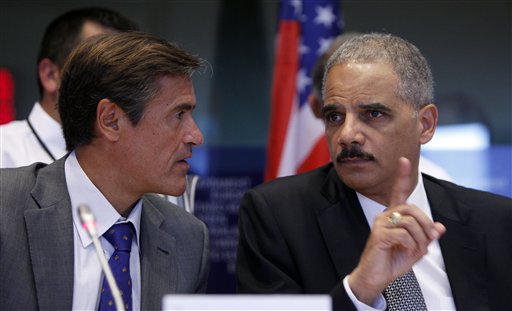
Spanish MEP Juan Fernandez Aguilar, left, looks on as United States Attorney General Eric Holder, right, speaks during a session at the European Parliament in Brussels on Tuesday, Sept. 20, 2011. (Credit: AP/Virginia Mayo)

WASHINGTON (AP) — The Justice Department on Tuesday accused elements of the Iranian government of being involved in a plot to assassinate the Saudi ambassador to the United States, and Attorney General Eric Holder said the U.S. would hold Iran accountable.

Two people, including a member of Iran’s special operations unit known as the Quds Force, were charged in New York federal court. Holder said the bomb plot was a flagrant violation of U.S. and international law.

“We will not let other countries use our soil as their battleground,” Preet Bharara, the U.S. attorney in Manhattan, said at a press conference in Washington with Holder and FBI Director Robert Mueller.

Manssor Arbabsiar, a 56-year-old U.S. citizen who also holds an Iranian passport, was charged along with Gholam Shakuri, whom authorities said was a Quds Force member.

FBI Director Robert Mueller says many lives could have been lost in the plot to kill the ambassador with bombs in the U.S.

Holder said the U.S. government would be taking unspecified action against the Iranian government as early as Tuesday afternoon. Asked whether the plot was blessed by the top echelons of the Iranian government, Holder said the Justice Department was not making that accusation.

Continue Reading Close

Page 1 of 2 in Nedra Pickler

www.salon.com/writer/nedra_pickler/index.html