Nelle Engoron

“Mad Men’s” evil twins

In an episode filled with doubles, Don shows his brilliance -- and Betty returns with a nefarious plan

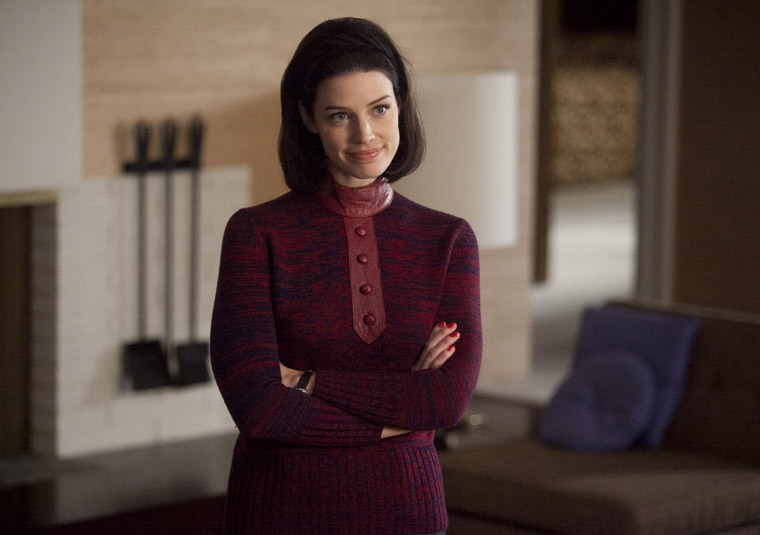
Jessica Pare in "Mad Men"
Nelle Engoron recaps "Mad Men" every week on Salon. She is the author of "Mad Men Unmasked: Decoding Season 4."

“I don’t like going in with two ideas – it’s weak.”

A strange statement coming from a man with a dual identity and often hidden motives, but then “Dark Shadows,” the latest “Mad Men” episode, is rife with competitive doubles, if not actual evil twins. (Just like in a soap opera, wink wink.) Don and Ginsberg have dueling SnoBall campaigns, Peggy reminds Roger she’s supposed to be his secret sharer rather than that schlemiel Ginsberg, Megan struggles to be friends with both Sally and Don, Henry’s torn between two candidates he’s worked for, and everyone seems to have at least two wives – even if Pete’s second one belongs to another man. Unlike the SnoBall fight with Ginsberg that he rigs, Don wins the wife competition fair and square by having three, even if one was in name only. As Betty tells Sally when she works on her family tree, “They only care about the names anyway.”

So does a prospective new client, Max Rosenberg, who’s impressed that WASPy Roger Sterling has a wife named Siegel. He wonders if she’s related to someone he knows, leading his wife to gently remind him that they’re not related to every other Rosenberg, without adding the electrifying reason that’s a good thing. As Roger puts it to the client, they wants SCDP to sell Manischewitz to “a different kind of people” – after all, groups of people are different from each other, aren’t they? (North Carolina sure thinks so.) Even Jews are further subdivided by Roger into “Fiddler on the Roof” cast or audience members, a coded way of describing how assimilated they are.

“Different” is the polite code that Roger uses with the client, but with his man Ginsberg, he straight-talks about selling the product to “normal people – like me.” (Isn’t it great that we’re long past white males defining “normal” as being just like them?) Cultural ventriloquist Roger secretly uses a Jewish copywriter to produce an ad campaign to sell a traditionally Jewish wine to gentiles, before adding what Bert calls his “finesse” to it. That’s code for privileged WASP sheen, as when Roger talks boats with Max’s thoroughly assimilated son, who’s moved up from his father’s steerage class to Roger’s yacht class.

Roger’s double-talk extends to that “Semitic wife” of his who Bert’s unaware has already been circumcised from Roger’s marital staff, telling her that while on LSD she promised to help him any way she could. Jane one-ups Roger’s lie by double-talking her way into a second apartment, complaining that the old one has too many memories (and mothers-in-law) attached to it. “I feel like I can’t start a new life until I start a new life,” she argues, giving Betty some competition for self-actualizing platitudes – or bad soap opera dialogue. (It’s hard to tell the difference at times – unlike how easy it is to tell the difference between people — at least if you’re Roger.)

Jane shares with Betty an inability to take responsibility for her own acts, blaming Roger for ruining her new digs by digging her a bit too much after the client dinner, even though she starts to stop him before going ahead with their little housewarming. “Now this is no different than the last place,” Jane pouts about the apartment she’d considered “perfect” up to that moment, cluelessly conflating her emotional state with the situation she finds herself in.

If only she’d join Betty at that fount of philosophical wisdom, Weight Watchers, she’d have all the answers. Gleaning not only diet plans but life lessons from the weekly meetings, Betty uses them to complain about how very hard her life is and how proud she is of not overeating in response. Turning inside out the facilitator’s pre-Thanksgiving advice to not overeat but instead “fill ourselves with our children, our homes, our husbands, our health, our happiness,” Betty stuffs that old bird Henry with her newfound wisdom. “It’s so easy to blame our problems on others, but really we’re in charge of ourselves,” she advises primly after he complains that he “bet on the wrong horse and jumped ship for nothing” in leaving Nelson Rockefeller for John Lindsay, since Lindsay (unlike everyone else in this episode) is choosing not to compete.

In marrying, both Henry and Betty have bet on the wrong horse, and each is coping with it in their own way – Henry by secretly feeding himself what he misses in the dark shadows of the night, and Betty by embracing a strict diet while helping herself to a heaping plate of revenge. Her transparent attempt to turn Sally against Don and Megan fails only because women know what games their gender plays. Having seen Megan partly undressed through a window, Megan in turn sees through Betty, physically holding Don back from the angry call that would have made Betty smile as much as that loving spoonful of stuffing she savors. Having chided Megan with “Who’s the child here?” when she says she was trying to respect Sally’s wishes, Don quickly realizes that he’s the one who’s reacted childishly and apologizes – showing once again how he’s changing, in large part because he has a wife who’s leading him in a new direction.

Unfortunately, this maturity isn’t duplicated at the office, where he competes with the far younger Ginsberg to prove whose SnoBalls are bigger. But there’s never really any contest between the juvenile Ginsberg, who channels the child’s desire to throw a snowball in authority’s face (including the “pig,” which will soon be code for the cop in his ad), versus the manly Don, who channels the devil himself to chuckle, “This could change everything.”

Like Jane, Don wants a new life, and after trying to change everything at home, he now senses that he needs to do so at work, especially after having looked at the portfolio of the year’s ads that Joan presents and realizing he has nothing to contribute to it except his anti-tobacco letter from a year before. “We’re still suffering for it, might as well get something out of it,” he decides, an approach that Ginsberg would probably joke is his people’s motto and that could double as self-help advice for Betty and Jane.

Goaded by this lack of product and the sight of Ginsberg’s name on so many ads, Don feels inspired to create for the first time since he married Megan, and riffs his way into a devilishly good campaign that he sells “the hell out of” to the client. “Even me,” are the words Don puts into the thirsty devil’s mouth as he devours a SnoBall – a sentiment echoed by Ginsberg, who’s amazed that even Don can come up with something that good after not writing an ad for so long.

But Ginsberg’s grudging admiration turns to mere grudge when he finds out that Don ruthlessly edited him out of the friendly and fair competition he believed they were having. Apparently he needs the same disillusioning speech that Roger gives Peggy after she says he only cares about himself and he retorts that she’s just the same because, “That’s the way it is, it’s every man for himself.” Roger’s masculine phrasing was the norm at the time but nevertheless underlines Peggy’s objection to the idea that choosing Ginsberg for Manischewitz was a no-brainer. “I’m sick of hearing people think that way. I’m not an airplane either. I can write for anything.”

While Ginsberg makes a joke about Roger assuming he’s Jewish, Peggy’s genuinely angry at being categorized, having felt the impact of that thinking in negative ways (being denied accounts or having to work hidden in the background) while so far Ginsberg has benefited from being Jewish while also getting “non-denominational” work due to being male. Having earlier declared that he needed a penis working on Mohawk, Roger apparently doesn’t care if it’s circumcised — just as Jane points out that he’s suddenly OK with letting people know he married a Jewish woman. Here the show accurately portrays the fact that religious and even racial barriers often dropped before ones that kept women from competing equally with men in business and other pursuits.

The result is that the women are left to compete with each other, as both Betty and Sally do with Megan (and Megan does with her acting friend, Julia). Betty’s visibly jealous of Megan’s relationship with her children, as well as envious of Megan’s youthful beauty and Don’s love for her, which is underscored by a romantic note he’s scrawled on the back of Bobby’s drawing. In revealing Don’s first platonic marriage, Betty hopes to poison several wells – making Sally angry at both Don and Megan for hiding the truth, and casting Megan as merely the latest in a string of wives and therefore unimportant. (We can only assume Betty sees herself as different since she alone gave Don children, as when she explains to Sally that on the family tree Henry and Megan “get a branch off of us because we’re your parents,” showing the primacy of blood relationships to her, with everyone else mere appendages.)

Competing with Don for Megan’s love, Sally argues that she was friends with her first, and scowlingly demanding that Megan not betray her secrets to Don. Both Megan and Don tell Sally she’s just a little girl, but she only objects to Don categorizing her this way, leading him to disclose the hard truth that “you should realize your mother doesn’t care about hurting you, she just wants to hurt us.” Earlier Megan had taught Sally the actor’s trick of creating tears by keeping your “eyes wide open and think(ing) about something that makes you sad.” But Sally chooses to keep her eyes open to the truth while not getting sad but even. Proving she deserved the A+ she got for working on her family tree, Sally goes right to the root of the problem, axing Betty’s attempt at revenge by telling her that everyone had a love fest sharing the merry wives of Whitman.

Not so merry is Pete, who’d love to share the wife of his train buddy, and who sucks up to a New York Times reporter only to find the flattering profile he’d expected about “hip” agencies has omitted SCDP and turned into a “bullshit piece on the usual assholes” in which the writer “compares them to philosophers.” One man’s philosopher is another man’s asshole, of course, as the shelves of self-help books can attest — and those two identities also tend to shift as the times and fashions change. (As the out-of touch Bert shows when he tries to correct Pete’s use of “hip” to “hep.”)

Pete himself is the designated asshole of SCDP, and both Bert and Roger compete with him by secretly wooing Manischewitz, for reasons that Roger explains to Ginsberg in dark shadowy terms indeed: “When a man hates another man very, very much sometimes he wants to know something is his even if in the end he has to give it up.”

Where things end up is precisely the question in any story, of course. As Ginsberg says when he sees the Pop Art painting in Roger’s office, “I like the connect the dots. What does it end up being?”  What each character on “Mad Men” will end up being – enlightened or disillusioned, successful or defeated, happy or bitter – remains undefined, the dots waiting to be connected once they realize they have the power to do so. Each seems to be stumbling along unaware, from Ginsberg not realizing what the poem he’s quoting from means, to Don believing that competing with Ginsberg doesn’t matter to him, to Roger not understanding why he feels the need to take everything for himself, to Betty who’s grateful for what she has only to the extent that she can feel superior to others.

Like Don, they each need to find a light bulb to dispel the dark shadows and see both themselves and other people better – how we each are different, and how we are all the same.

“Mad Men’s” generation gap

As Megan makes a surprising choice, Don is confronted with changing '60s culture -- and Pete's spiral continues

Pete Campbell (Vincent Kartheiser) on "Mad Men"
Nelle Engoron recaps "Mad Men" every week on Salon. She is the author of "Mad Men Unmasked: Decoding Season 4."

Something strange occurred somewhere in the middle of the 1960s. People began doing what they felt like doing, rather than what was expected of them.

Of course, rebels and freethinkers had always done this, but they were rare and often paid a price for their actions, even losing their lives. Now ordinary people began adopting the mantra, “If it feels good, do it.” Personal satisfaction, rather than duty, increasingly became the driver behind people’s choices. And they didn’t pay a price, unless you count the anger and jealousy evoked in those who weren’t courageous enough to do the same. Nearly 200 years after America was founded on a right to the “pursuit of happiness,” Americans began to claim that right. And they’ve never looked back.

“There are no second acts in American life,” F. Scott Fitzgerald famously declared, without living long enough to see the constant self-reinvention of our age. In “Lady Lazarus,” the latest episode of “Mad Men,” Megan chooses to re-make her life, simply because her career isn’t making her happy. Even with her recent success, and the discovery that she’s able to “do everything,” (as Don declared in a tone of awe), she finds advertising so boring that leaving it is akin to raising herself from the dead.

A stunned Don and Roger commiserate that they never got the chance to pursue their dreams – not that they can bring any to mind. As Depression-baby Don sums up, “I was raised in the ’30s; my dream was indoor plumbing.” Don’s a man who has literally succeeded beyond his wildest dreams, while Roger has merely followed the path his father laid out for him (if not the one Mona’s father did in trying to ensure fidelity).

Trying to keep her from throwing her career away, Don tells Megan it took him years to reach the level of mastery she has, not understanding that he’s only underscoring the reason for her decision: Advertising plays so naturally to her talents that there’s no challenge in it for her, and she’s been hit hard by the reality that Stan speaks of, when you see that all your hard work literally only amounts to a hill of beans. Don explains that the reward will come when she sees her work up on the sides of buildings, but she dreams of seeing her own name, not the client’s, up on a theater marquee. Surely making a name for yourself is something Don should understand?

But it’s not just the older generation who marvels as Megan’s decision. Showing how quickly things are changing, the only slightly older Peggy feels resentful that Megan is throwing away the same success she’s had to work so hard for. While Don chooses to play the supportive husband to his wife’s face (proving he’s as good an actor as she is, and not just when selling dessert toppings), he and Peggy have the marital spat that he avoids with Megan, after pretending to be a married couple eating fake whipped cream. Belying his soothing words to Megan, Don blames Peggy for her departure, regurgitating Megan’s previously stated disgust at the cynicism of her co-workers while ignoring the fact that he can be the coldest whip of them all. Who exactly are his employees emulating in their workplace behavior, if not their leader Don?

While the Draper kitchen is a place of harmony where a barefoot but deliberately not pregnant Megan cooks Don a loving meal that burns him when he tries to swallow it, Peggy and Don engage in their own version of the Nixon-Krushchev kitchen debate after their failed marital simulation. While she muffed the lines that Don refused to rehearse with her because he’s said them so many times before (with so many women, we might add), Peggy is still accurate in arguing that “I did everything right and I’m still getting it from you.” We can imagine Betty making that same point.

But Don is also striving to do everything right this time, painfully stretching himself to make Megan happy so she won’t turn into either Betty or her own mother, and looking almost tearfully happy when she tells him that he’s everything she’d hoped he would be. Don earns another Tony by returning the compliment, even though it’s clear that Megan is both more and less than he’d hoped – not the naïve young girl he first met, but a strong-willed woman with dreams of her own despite his efforts to subsume her into his.

Don thinks he’s been wonderfully open-minded to not only “allow” Megan a career after marriage, but help her succeed, and no doubt further congratulates himself for feeling proud rather than threatened by her being a natural at what he had to work to become. To have her say that he’s done everything right and it’s still not enough for her is almost more than Don can bear, a feeling symbolized by his getting the shaft at the office, as an elevator to nowhere opens before him.

Gawping into the abyss, Don faces the same nothingness that had Pete weeping not long ago. But Pete was mourning a lack of male respect while Don’s rapidly-shifting feelings bring to mind the saying that no man feels good about himself unless a woman approves of him. Having lost Megan’s loving presence at work, which stroked his ego as much as any other organ, Don may be boarding an express elevator to failure unless he can rediscover that thrill of success he was trying to sell her on.

Meanwhile, our seemingly doomed to rest-in-Pete has another intimation of mortality, as his train-buddy Howard tries to sell him life insurance. Suggesting that SCDP is the beneficiary of his company-issued policy, he warns that everything Pete has will “(stop) short the minute they put you in the ground.” Just as work consumed the lives of American men in that era, leaving them wondering like Howard where the hell their kids are, even their deaths were given over to their companies.

Howard counts himself a good husband because he’s provided financially for his wife Beth (“Gilmore Girls’” Alexis Bledel) both now and after his death, which he says is all that matters to her. And it’s hard to believe she would want more from the callous Howard, who’s putting his own Cool Whip topping on a strawberry blonde in the city. Having been commuter-trained in the art of suburban infidelity by Howard, Pete makes himself the beneficiary of Beth’s neglected affections, but with her ego assuaged by a quick romp, Beth brushes Pete off.

Taking a page from the traditional playbook, both in her role of suburban wife and mother and her well-rehearsed toying with Pete, Beth continues the push me-pull you game that ignited Pete’s libido in the first place, drawing steamy hearts behind her husband’s back and showing why she’s been getting attention from men her whole life. But then how could a man resist a beautiful woman who literally sees the world reflected in his eyes, even if (as so many felt at that time) it’s a troubled planet, “tiny and unprotected, and surrounded by darkness.”

Stung by rejection, Pete rants to Harry that women “do anything they want ….Turn it off and on when they feel like it, while we’re … waiting at attention. This isn’t the way it’s supposed to be.” Pete’s complaint is one men have made about women for much of human history, as is evidenced by Harry’s resigned answer of “They just do” when Pete asks why women get to decide what’s going to happen. But Pete’s also channeling a complaint that the older generation began making about the younger, the very one that goes unspoken by Don and Roger, as they choose to support Megan’s dreams, at least in theory.

More typically, members of their generation angrily questioned the right of younger people to “do anything they want,” a luxury not afforded to those who came of age during the Depression and World War II. (As he never tires of pointing out, even pampered rich kid Roger risked his life fighting in WWII.) They fought to protect democracy for future generations, but when those generations took them up on the offer by democratically helping themselves to whatever was on offer, it didn’t go over very well. The reason we fought, they said, was so that you could be exactly like us. But copying the old model is precisely what this generation didn’t want.

After all, Cool Whip isn’t whipped cream, and Peggy isn’t Megan, and Megan isn’t Betty, and Pete’s eyes don’t really contain the whole world. (Hell, they don’t even encompass another person’s desires.) Peggy ponders work that Megan says she created exactly as dictated, saying “they’re exactly as they’re supposed to be, but they’re not it. Or maybe they are.”

This elusive gap between what’s desired and what actually exists is a theme running throughout the show, often signified by an attempt to duplicate something desirable, only to have it fail the ineffable test of authenticity. In the Season 3 episode, “The Arrangements,”the agency worked on a cola ad that imitated an Ann-Margret number from “Bye, Bye, Birdie.” But as Harry put it after the client rejected the result, “It looks right, it sounds right, it smells right, but something’s not right. What is it?” while Roger offered the obvious answer, “It’s not Ann-Margret.”

This time around, Chevalier Blanc men’s cologne wants a rip-off of the Beatles’ film, “A Hard Day’s Night,” even if they’re surprised to hear the Beatles won’t provide the music. No problem, the SCDPers reassure them, since every pop group is trying to imitate them. But even though he tells the client that they know what the Beatles sound like, it turns out that Don can’t tell the difference between them and a song from his youth. “When did music become so important?” he demands of Megan, who argues that it always has been, seemingly unaware of the vast difference between growing up desperately poor on a farm during the Depression and her cosmopolitan upbringing in the era of early rock and roll.

Music will be important to every generation from now on, but the primacy of pop culture is alien to Don, who’s previously admitted going mostly to the theater for business, so he couldn’t really enjoy it. Megan hasn’t been enjoying the theater lately, either, but because it makes her envious of those involved in it. For Don, art is simply part of business, a means to success, but for Megan, art is part of life, one that she wants to make her business. While would-be artists like Megan have always sought careers that fulfilled their creative desires, the belief that work should be enjoyable rather than just materially rewarding is yet another searing truth that Don is having trouble swallowing. “Sweetheart, sometimes we don’t get to choose where our talents lie,” he says to her patronizingly as if he can talk her out of this silly acting idea. But in her gently persistent way that wears him down every time, Megan disabuses him of the notion that she’s going to go along with what he thinks is best for her.

In fact, it’s Megan who knows what Don needs, just as she’s his living link to what’s hip and current in the culture. “Just taste it,” she entices him during the mock commercial they act out, after Cosgrove urges them to “do the bit.” But while Don can bite down on what Megan’s offering when they’re playing the heightened happy version of themselves (which Cosgrove terms a “twist” on the stupid husband and pushy wife cliché, because they seem to really like each other), in reality he can’t take in what she’s offering.

Reminding him that he’s complained he “doesn’t know what’s going on,” she tries to enlighten him with the latest Beatles’ record, the groundbreaking “Revolver,” instructing him to begin with the last song, “Tomorrow Never Knows.” But either the psychedelic music (which implicitly urges the listener to turn on) or the spiritually-oriented lyrics (which explicitly tell the listener to turn off their mind) are too much for Don, who turns off the stereo and retreats, old-fashioned drink in hand.

“It is not dying,” the Beatles try to reassure, although then again, “It is not living.”  Roger’s generation was told to come home every night, and Howard thinks that spending one night a week with his wife keeps things “in balance,” but now Megan is the one who goes off at night, even if she’s no longer lying to Don about the reason. As women seek their own satisfaction, many men will feel left behind, forced to face the music alone. Lady Lazarus may be rising, but as in the Sylvia Plath poem of that name, she’s eating men like air – or so they feel.

Continue Reading Close

Don Draper loses his touch

At an awards ceremony celebrating his accomplishments, he learns that some things are not what they seem

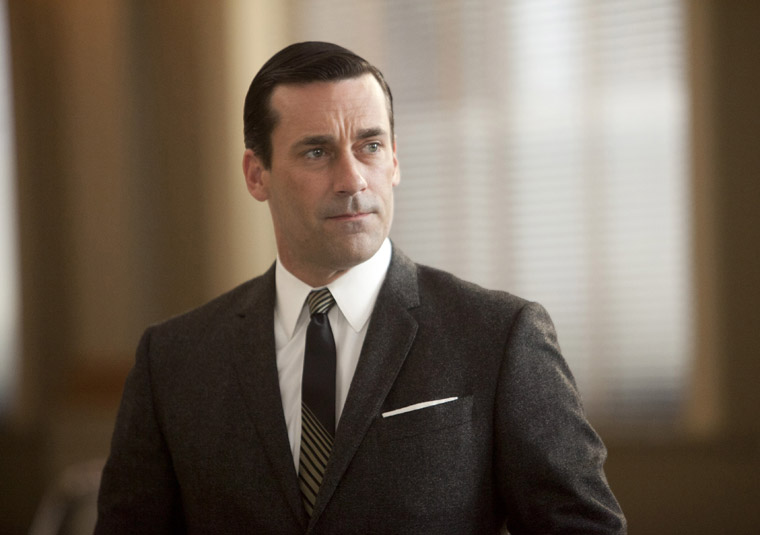
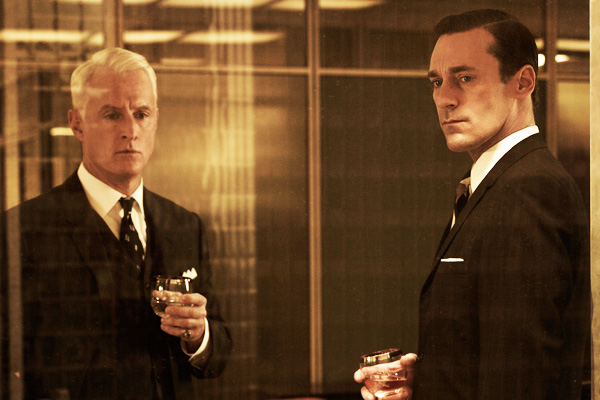
Jon Hamm in "Mad Men"
Nelle Engoron recaps "Mad Men" every week on Salon. She is the author of "Mad Men Unmasked: Decoding Season 4."

Last night “At the Codfish Ball,” our mad men and women learned that life isn’t a party just because you’ve dressed yourself up, and losing can sometimes appear disguised behind a mask of winning. Fortunately, to borrow Cosgrove’s term, there’s also the possibility of a “double secret reverse,” in which you get what makes you happy even if it’s not what you expected – or what others think is right.

In this fish tale, the genders are moving up and down like parallel elevators in the Time-Life building, the workplace that consumes so much of their lives they barely can escape it for a meal that doesn’t involve business – and in this episode, not even for that. But this show is about time and life – the time in these characters’ lives, and the times they’re living in. Unfortunately for them, few seem to be having the time of their lives.

After her failure to impersonate Don, Peggy’s off the Heinz account, but seems in good spirits when Stan and Ginsberg treat her like one of the boys. She rolls with the sexual banter about how she’s got a way with the equipment on the Playtex account, as well as Ginsberg’s criticism that she’s a “traditionalist in the bosom arena” (something that will be challenged in this episode), defending her opinion about selling youthful, sexy bras to older women.

Having to elicit male support for her ideas isn’t a good sign for our Pegs, and neither is the fact that after her bean blowout, she’s being marginalized to female products (Topaz pantyhose, Playtex, Pond’s cold cream, etc.). Given that we now live in a time when tweeners dress like prostitutes, Ginsberg may look prescient in arguing they should be selling adult bras to young girls, while Stan grumps that her opinion shouldn’t count more just because she’s a “boob-carrying consumer” (as opposed to a consuming boob like him). But in fact, bras will soon be even less popular with young women than beans, so I award Peggy the winner’s cup in this round.

Megan is the real heroine of the hour, having had a beanstorm while feeding Don’s kids spaghetti, which her mother also did to comfort her. Realizing that “some things never change” between parents and children (not only a slogan but an idea well-proven by interactions with her visiting parents), she envisions a historical beanline stretching back to caveman days and rocketing all the way to a family’s meal on the moon (where in just three years astronauts will in fact be eating consumer products like Tang). Despite being on the verge of dumping SCDP – a fact that Megan intuits and confirms with some wife-to-wife talk in the ladies’ room – the client Raymond loves the idea as soon as he hears it, proclaiming, “It’s the future; it’s all I ever wanted.” Of course, he admits this only after his wife all but pokes him in the ribs to get him to acknowledge that emotion Peggy had scolded him for not admitting to before.

To his credit, Don’s ecstatic at Megan’s adroitness in both creating the campaign and figuring out on the fly how to pitch it, feeding Don cues that allow him to let rip with one of his classic Don Draper spiels, during which he gives Megan credit only for the space scene. “You’re good at all of it,” he marvels afterward in the taxi, as if basking in his own reflected image, finally having found someone who (unlike Peggy) can play the role of a female Don Draper.

But, in fact, Megan’s playing a different and very traditional role, that of the woman behind the powerful man, not just letting Don take all the glory, but deliberately engineering each situation so that he’ll get the attention, and modestly deflecting credit from her co-workers for what Peggy rightly terms a “home run” (which also happens to be what Don wants from her immediately afterward). Expressing a classic female fear, she’s concerned that Stan and Ginsberg will hate her for changing their campaign (the kind of worry that we never see cross any of the men’s minds), and is relieved when the banished Peggy not only congratulates her, but also urges her to enjoy what she’s accomplished.

Yet Peggy’s words contain an implicit warning against future career satisfaction, telling Megan to “savor” her victory because “this is as good as this job gets.” Megan’s father, Emile, is similarly worried that Megan has started “at the end,” achieving wealth and success by marrying Don rather than working for it. Speaking to her in English because he says she’s changed (into – quel horreur! – an American), he suggests that she’s given up her own dreams to mold herself to Don’s, an argument that seems to hit home since Megan silences him with, “Not tonight.”

Emile’s own dreams are shattered when he’s rejected by the one publisher that had agreed to consider his manuscript. Taunted by his wife, Marie, who pointedly observes about Sally and Don that “every daughter should get to see her father as a success,” he shows that things never do change by accusing Marie of being just like her own mother and covering him in shit. Despite her Heinz slogan, that particular family tradition seems to be stopping with Megan, who is not only covering Don in glory, but covering up for the fact that he’s not having good ideas anymore. Even worse, the normally razor-sharp Don can’t even recognize them, forcing Megan to play connect-the-dots in translating spaghetti to beans, and all but kick him under the table to get him pitching at the client dinner.

Megan’s father may be right that she’s skipped over all the intermediate steps to the end, but as Don acknowledges, she’s doing so by displaying every skill required to succeed. No longer the pupil to Don’s master, she instead schools her husband, who admits his inclination was to yell at the client rather than persuade him (behavior we’ve seen in the past with anyone who dares reject Don’s genius). In a masterful display of classic feminine wiles, Megan gently overrides Don’s terrible slogan for Heinz with her own, modeling the ego-flattering behavior that he then repeats with the client, letting Ray take full credit for the idea of using the same actors for every historical period in the commercial. (Another image of how patterns repeat throughout generations as well as in human beings in general.)

As Peggy said in the season premiere, this hardly seems like the Don Draper we know, but that episode also revealed that Megan dominates Don in a way that sexually enthralls him. In this episode, their improvised pitch-as-casual-dialogue serves as a kind of public foreplay, and he finds her mastery of the process so powerfully erotic that they have to return to the office to make love, sealing the melding of their personal and business partnerships.

It’s an open question if Megan will remain content with “topping from below” (as disempowered people have always had to do) or whether with women gaining power, she’ll soon take the more straightforward route, even if it caused Peggy to crash and burn – or does the same to her marriage. That velvet glove Megan uses on Don would also be fantastically successful with clients, even without Don as her wingman.

Wings are another theme of this episode, as several characters try theirs, with varied success. With Megan’s assistance, Sally rocks a minidress, makeup and boots for walking, provoking from Don the response I expected to hear from Betty, as he tells her she’s not leaving the house dressed that way. Don at least says he’s happy his daughter will soon be wearing more grown-up attire, even if he deems she’s not quite ready for it yet. In contrast, Emile’s otherwise immaculate English mysteriously slips on Freud when he warns Don that “no matter what, one day your little girl will spread her legs and fly away.”

His own daughter has done just that, of course, marrying a man he dislikes and distrusts because “his manners are studied” – a strange comment from a man who studies things for a living. But then Emile’s also a Marxist who can’t understand why Don doesn’t let the doorman carry the luggage, and a man who dresses well and enjoys an apartment that he nevertheless criticizes as “exquisitely decadent,” because (as his wife observes) it puts his eyes and his politics in conflict.

Eyes and politics are increasingly in conflict in America, as the battle between traditional concerns about “appearances” clashes with the youthful push for social change and a more natural way of being. Roger’s ex-wife, Mona, says she refuses to let a “bunch of dirty teenagers” make her feel guilty, but Roger, still riding the magic carpet of post-LSD openness, has been having bouts of post-hallucinogenic self-awareness. (Not to worry – he’ll probably get over it soon.)

He interprets his 1919 World Series hallucination to symbolize his entire life, in which he cheated his way into success by being born into wealth and privilege. Determined to show he can actually work for a living (a fact he trumpets to Don and Megan as a great accomplishment after trying it one morning), he schemes to use the American Cancer Society dinner at which Don’s being given an award as a chance to gain clients. Envisioning it as a gold mine that they’re being lowered into, Roger himself appears to be rising (in more ways than one) but is as unaware that the work he’s doing may be fruitless as he is that the insights he gained on acid are commonplace knowledge to less self-absorbed people.

Watching him pursue clients right and left, a flirtatious Marie says he’s so full of life and ambition that he’s like a “little boy,” and sadly this seems true. He recruits his maternal ex-wife to rustle up intel for him and enlists 12-year-old Sally as his pretend date, instructing her to bolster his ego by saying “Go get’em, Tiger,” and – the coup de grace — sneaks off to have sex with the wife of a man who is his guest. Perhaps he should have listened more closely to the rest of Marie’s “Je regrette quelques choses” speech, when she says one day she realized she’d made too many mistakes. Instead he cheerfully responds that he’s decided never to stop trying, an approach that without true enlightenment will yield not progress, but merely a repetition of his own brand of mistakes.

Having rightfully mocked Roger for not knowing that people are focused on their own concerns rather than his, Don has his own mind-blowing moment at his familiar temple of self-enlightenment: a bar. Chatting at the American Cancer Society party with Ken’s father-in-law, Ed Baxter, an executive at Dow Corning, the company that brought better death through napalm, Don is shocked, shocked to find out that that he’s as popular with clients these days as the Viet Cong would be. While Roger had predicted that Don would be like the bride at an Italian wedding, with people lining up to give him envelopes of money, Don’s instead pink-slipped by Ed, who wonders why he hasn’t gotten out of the ad business. The award he’s been given might as well be a death certificate, because no one wants to do business with a man who betrayed his client the way Don did Lucky Strike. “They’ll bury your desk with awards, but they’ll never work with you after that letter,” he calmly informs the shell-shocked Don. “How could they trust you after the way you bit the hand?”

Not just the hand that fed the agency, but the hand that holds the cigarette we might assume, as SCDP’s former lucky strike turns into a match that could burn down the house.  A point subtly made when we see the familiar image from the credits of Don’s hand with a cigarette echoed by a drunk and sleeping Marie. Following her mother into the bedroom as if she’s done this a thousand times before, Megan removes the smoking weapon from her hand and puts it out, just as she rescues Don in this episode.

Their partnership is paralleled by another couple, as Abe asks Peggy to live together. Having initially thought he was breaking up with her, only to be counseled by the ever-wise Joan that men take you to dinner for good news like marriage proposals, Peggy is momentarily fazed before agreeing, her ironic “I do” in answer to a question about dinner, rather than a vow that she’s seemed quite ambivalent about taking. But just as she has to have backup for her creative ideas, she turns to the now marriage-hardened Joan for approval, which is granted after some initial shock at shacking up, granting that at least Peggy has a man who really wants to be with her. Anticipating a song (“My Old Man”) that Joni Mitchell will write a few years later, Peggy argues that she and Abe don’t need no paper from the city hall to stay tied and true, a sentiment that was still fairly radical for a woman of her time, but which will be quite popular before long.

This decision is soundly rejected by Peggy’s very traditional Catholic mother, who literally takes the cake by saying she’d rather her daughter had lied to her than revealed the truth of what she’s doing. That repossessed cake is one that she described as “very delicate,” telling Peggy she would be the one to take it out of the box, just as she deems when and how Peggy should share herself with a man. Saying Abe will leave her when he’s ready to marry, she offers Peggy mere crumbs, suggesting that cliché of single womanhood: a series of cats to keep her company until she runs out of lives.

In congratulating Megan, Peggy said that seeing her victory was like “getting to experience my first time again,” as if the act of mentoring someone else to success had made her a born-again virgin. Becoming a successful professional woman has in some ways restored Peggy, not just from the trauma of giving up her child, but from an upbringing that counts the “sin of pride” as seriously as that of fornication. But to her mother, she’s still damaged goods, just as Don is to the clients he seeks to woo. And just as Peggy’s mother worries that Abe is “using her for practice” for his future life, it’s possible that Megan is similarly using Don.

Meanwhile, Sally practices being a woman, including in her play date with Roger, but is disappointed that the hotel ballroom has no staircase or prince. She may tell the waiter she’s done with her Shirley Temple, but she’s not ready to leave childhood behind, hastening to remind Glen that she’s not his girlfriend right after getting a glimpse of adult sexuality with Roger and Marie. Like Peggy’s mother, she finds the city “dirty,” an appropriate response for a girl of her age and innocence, if not for a middle-aged woman.

At the end of the episode, five people sit side-by-side in silence, sunk into their own thoughts about what they are facing at this time in their lives, and completely unaware of the others around them in similar pain. Perhaps if they’d joined the Heinz clients at that new Edward Albee play, they’d have a sense of what life requires, namely “A Delicate Balance.”

Some things never change.

Continue Reading Close

“Mad Men” on drugs

Roger takes the leap into LSD, while Peggy and Don dramatically discover their own dependencies

Jon Hamm in "Mad Men"
Nelle Engoron recaps "Mad Men" every week on Salon. She is the author of "Mad Men Unmasked: Decoding Season 4."

As long as we’re being totally real with each other, I have a confession to make: I’ve never taken LSD. But I did work at a Hojo’s for three summers in high school, and the particular shades of orange and turquoise the company used for its décor and uniforms is forever burned into my brain. I’ve been seeing those colors all season on “Mad Men” and feeling a bad acid flashback to the long hot days I spent in a polyester uniform serving up “tendersweet fried clams” and sticky bowls of ice cream. But I kept shaking off the feeling that those colors represented anything significant. Like others who’ve picked up on subtle symbols and made predictions about the show, I should have realized that this was a sign something big was going to happen in a Hojo’s.

Wait, let’s go back a minute. Because that’s what happens in the latest “Mad Men” episode, “Far Away Places.” People go back a minute or a day or two, and they race forward in time as well. The parallel storylines of a day in the life (when a man blew his mind out in his car) of Peggy, Roger, and Don are supposed to remind us of how time can get all wonky when you’re under the influence of a drug, as all three are during this episode. Peggy goes with her familiars, alcohol and marijuana, Roger takes the leap into LSD, and Don drowns himself in the new drug he’s addicted to called Megan. (I’d say “love” but it looks more like possessive dependence to me.)

Actually, there’s another substance they’re all sampling and it’s called honesty. It didn’t become a widespread drug of choice until the 1970s, but these are trendsetters we’re following, so they’re ahead of the curve. Instead of puking up martinis as we used to see them do, the characters are starting to spill their feelings with equal force, and with some of the same messy consequences. This week Peggy, Roger, and Megan each find out that other people can’t always handle the truth, even when they’re entitled to it.

In a time when the famous tweet their most personal thoughts and ordinary people blog about their sex lives and both rush to appear on embarrassing reality TV shows, it can be hard to believe that until very recent human history, people considered it sinful, vulgar or simply inappropriate to talk about what they really felt or thought. The shift from hiding one’s true self to revealing it to your intimates to broadcasting it to the world is one of the biggest changes in human culture that’s ever occurred, and “Mad Men” has been exquisitely illustrative of the moment when this change began.

Abe starts off the honesty binge in this episode by accusing Peggy of the typically male sin of compartmentalizing, saying she puts him in a drawer and then pulls him out when she needs him. Pulling it out of a drawer when she needs it is exactly what she’s desperately trying to do with her “good luck” box of violet candy from Don, but she finds it only to lose her real lucky charm, Don, who leaves her in the lurch to play hooky with Megan. Abe’s promise of a brucha (blessing) is angrily transformed into a wish that she have a bad day, a curse that comes to pass with her truth-telling to the Heinz clients. After they reject her Blazing Saddles with Boomers bean campaign, Peggy tries to impersonate the missing Don by telling them she knows better than they do. But as every woman painfully realizes at some point, behaving like a man at work doesn’t, well, work.

After she accuses the client, Ray, of ignoring the feelings that the “Home is Where the Heinz Is” campaign has engendered in him, he says that’s precisely the trouble – the campaign must be sentimental and old-fashioned if it appeals to an old fart like him. Stop writing down what I say and figure out what I want, he scolds her, placing Peggy in the classic female bind of desperately trying to please a man even if it means doing the opposite of what he says. Ken suggests that Peggy’s passionate feelings show how powerful the campaign is, but all the client can see is young woman who’s told off her Daddy. Seeing which way the wind is breaking, Ken then lets loose with the words every woman hates to hear and tells Peggy she’s being overly sensitive. (Remember, Pegs, when they garrote you, it’s only business, not personal.)

Criticizing the client for having no response other than, “I don’t like it,” she tries to put the right words in his mouth, just as he’s suggested she do. “It’s young and beautiful,” she argues, “You have to run with it.” But in fact, he doesn’t, and Peggy’s the one who’s run off the account.

As an ex-Catholic, Peggy knows that she wasn’t “Born Free” but watching Elsa’s story play out onscreen, she can’t help but empathize with the young and sheltered lioness trying to survive in a hostile environment. “She’s not going to make it out there on her own,” a stoned Peggy moans to the strange guy she’s met at the movies. “Aren’t you worried?” she asks, trying to find common ground, but he responds with the assuredness of male privilege that everything will turn out all right.

That’s a different answer than we would get from Don, who after having been called “Superman” in the last episode, now spends his time in a phone booth unable to transform himself into the hero he once was, either to his wife or to his business partners. He instead ends up re-enacting the African movie that Abe wanted to see, “Naked Prey,” in which humans are hunted like animals.

Ordering Megan to join him on a business trip, he fails to recognize her desire to be part of the “team” at work, seeing only the society of two that he’s constructed in his possessive fantasy. Megan’s also seeing double, as she’s whipsawed between the twin roles of employee and wife at Don’s whim, as well as torn between her ambition and that female “desire to please” that Stan congratulates Peggy for lacking. In Don’s fantasy, Megan has no desires of her own, not even when it comes to dessert, and he gets his just ones when she uses the truth she knows about him and throws not a drink but his dead mother in his face.

Having angrily refused to “Yes, Master” him like Jeannie, she’s deserted by Don, but rather than waiting for him to come back and rescue her like he expects a woman to do, she strikes out on her own. At first frantic and worried, Don is furious rather than relieved when he finds her safely at home, chasing and catching her (the Naked Prey of his dreams) before showing his emotional dependency by kneeling at her feet and revealing he was terrified that he’d lost her. A mute Megan merely nods to acknowledge the power she has over him.

It’s precisely this power that the old lion Bert has roused himself from slumber to rebuke Don for. Telling him a client’s walked out because Don left a “little girl (Peggy) running everything,” he accuses Don of having been on “love leave” and neglecting work to his – and the company’s – peril. When Don tells him it’s none of his business, Bert reminds him of whose name comes before his on the sign, and when Don claims he only needs “more bodies,” Bert makes it clear that it’s not the body but the head (of the department) that’s required. Already immersed in a do-over of married life, and never one to balance home and business well, it’s an open question whether Don can fulfill the command that Bert’s scribbled all over his work.

With Don down, it’s only natural that Sterling would rise, but who knew an expanded mind would give him lift? Last season I suggested that Roger might somehow embrace the progress of the 1960s while avoiding the embarrassment of becoming the old guy in love beads, but I wouldn’t have guessed he’d be the first of our merry pranksters to drop acid. (My money was on Peggy.)

Having been talked into it by Jane, who doesn’t want to face the truth alone, Roger’s the one who has the breakthrough, but only in discovering the chemical version of no-fault divorce. “I imagined screaming, fighting and lawyers,” he marvels, “But we were able to be there together in the truth, like you wanted.” Insecure Jane has a temporary truth blackout and recovers from it only to show she hasn’t changed at all, telling Roger it’s going to be an expensive divorce. “I know,” he says with the calm of a man who’s not only been down that rabbit hole before, but has seen the truth that’s made him free – of an unhappy marriage.

Having conjured as his psychedelic guru not Jesus or any other deity but Don, and fixating on details such as what color his hair is and why the Stoli bottle is singing in Russian, Roger doesn’t seem enlightened but merely on a more interesting high than usual. Like Tony Soprano, he’s too inflexible to be transformed by a mere hallucinogen, but his cheerfulness suggests he’s shrugged off the sour Roger and will join Bert in reasserting his dominance at the firm.

With this episode’s tilt of the seesaw back to the older generation from the flailing youngsters, we’re reminded that while the 1960s saw a cultural shift towards youth, like a drunk, no historical change walks a straight line. For all the claims that Don and others have made that the “kids” increasingly hold the cards, the real truth (if we’re telling it) is that older white guys like Bert and Roger never truly lost power, even if they began to hide behind the scenes while fresh young faces took the public glory.

A plaintive story that Ginsberg tells Peggy illuminates this point. Revealing he was born in a concentration camp, he frames the seemingly impossible event as a fable in which he’s a Martian (perhaps soon to be our favorite one) sent not to conquer Earth but merely to live there as a displaced person, unable to find any others of his kind. With his mother dead (just like Don’s), he’s located in an orphanage by his supposed father, who sends “one communication – a simple order: Stay where you are.”

Such is the message that elders have always sent to their children, putting them in their place and ordering them to stay there. But these traditions are unraveling faster than Peggy and Don’s careers, leaving the older generation to wonder at these alien creatures they’ve given birth to, who seem to come from a far away place. They may not want to conquer the world yet, but just wait until they find others of their kind — as in Peggy’s pitch, when the kids arrive at the campfire alone, but feel included when they gather in a circle, safe from whatever’s out there in the dark.

Sitting in the darkness of her apartment, Peggy turns to Abe for solace of her own, not after she fails at work, but after hearing Ginsberg’s story, which she requires his insight to make sense of. “You need me now,” Abe says without rancor, to which she replies softly, “I always need you.” By agreeing to come and comfort her, he proves his earlier assertion that he’s not like most men, who would leave rather than play the traditionally female role of nurturer while she pursues her career.

“Is there a cure for neurosis?” one of the LSD party guests asks a shrink who’s argued that discovering the truth of why you behave a certain way doesn’t do the trick. “Love works,” comes the answer from another guest. Real love, it might be added, which doesn’t require the other person to change for you and acknowledges when the most loving thing may be to part peacefully.

Abe and Peggy demonstrate the first, and Roger the second, while the damaged Don can’t understand that real love isn’t trading the separateness he had with Betty for the merging of identities he seeks with Megan. Don fantasizes longingly about a never-ending vacation in which Megan is still the eager young woman who fulfilled every desire he had, from the sexual to the maternal, but Megan has shattered that fantasy by asserting desires of her own. Rejecting Don’s possessive, angry love, she explains that, “Every time we fight, it diminishes us a little bit.”

In doing so, she’s implicitly asking him to grow rather than to shrink, to become a bigger and better person than he’s ever been before. For that he will require something stronger than any drug: The realization that the truth about himself is neither good nor bad, but merely relative. Like Ginsberg, his origins are improbable and full of tragedy, but running from them is what has made him miserable. It’s only by accepting that far away place where he began that he will finally find a home in the present, whether the Heinz is there or not.

Continue Reading Close

“Mad Men”: Pete’s spiral of doom

The Mad Man becomes even more insufferable, dejected and delusional. Are we being prepared for his death?

Vincent Kartheiser in "Mad Men"
Nelle Engoron recaps "Mad Men" every week on Salon. She is the author of "Mad Men Unmasked: Decoding Season 4."

No, Roger, you’re not the only one who wanted to see it.

Many “Mad Men” fans were no doubt just as eager as the staff of SCDP to see someone finally smack Pete’s smug little face. Rarely a sympathetic figure, Pete’s been made increasingly insufferable this season, whining about getting no love from his colleagues while doing everything possible to make them despise him.

In the latest episode, “Signal 30,” he childishly belittles Lane for landing a new client, Jaguar, and initially refuses to help him close the deal even after Don points out that adding automobiles to planes will raise the struggling agency’s stature.

Perhaps the value of cars is lost on the immature Pete because he’s only now learning to drive, and is more focused on getting into the car’s back seat with a young female classmate in his driver’s ed class. Made to watch the warning film “Signal 30” (police code for an extreme emergency), which shows footage of teenagers’ bodies mangled by car crashes, the girl, Jenny, feels appropriately queasy but Pete laughs and seems unaffected by the “mayhem.” Frustrated by her rejection of him in favor of a teenager appropriately nicknamed “Handsome,” Pete uses the excuse of client entertainment to indulge himself in a look-alike prostitute. Warned that it won’t be easy to please him, she quickly figures out that it requires kneeling on all fours and calling him, “My king.” While Lane may be overstating the case by calling him a “monster” and a “grimy little pimp,” his actions in the episode are questionable enough to draw a lecture from Don about how he should appreciate and not screw around on his wife. And when Don Draper lectures you about fidelity, you should know that you’re in trouble.

Pete may turn out to be everything we’ve always feared he is – including marked for death – given all the talk of guns, Don’s drawing of a noose, and those bloody accident scenes, but if he’s going to be pushing up daisies soon at least he believes “God’s all over the garden.” When Don warns him that you don’t get a second chance at what he has, Pete responds with a mocking, “I have everything,” and ends the episode weeping and declaring that he has nothing. If Roger’s the privileged guy who thinks he’s hit a triple, Pete’s the guy who was born on third base and thinks he’s sitting in the bleachers, utterly unable to appreciate his loving and spunky wife (who has won over even the socially resistant Don) or “take credit” for his adorable baby (but then again, there was another baby he couldn’t do that with, either, through no fault of his own).

Paralleling the slick deception of advertising, “Mad Men” has always been about the difference between appearance and reality – between what people seem to be and what they really are, as dramatized by the initial MacGuffin of Don’s secret identity. But the truth is that all human beings are mysterious, even to those people they’re most intimate with – and even to themselves. In “Signal 30,” we begin with a film prologue explaining that what viewers are about to see isn’t a slick Hollywood production but grisly reality. The horror we see in the episode is the tragedy of a young man who can’t appreciate the gift of life, and a lucky one at that. In the optimistic reframing of Ken’s Pete-inspired short story, “everything ordinary has become too beautiful to bear” for the protagonist, but in fact, we see that for Pete, everything ordinary has become too disappointing. Like his teenage classmate, he feels that “things seem so random all of a sudden” (rather than that his own poor choices are creating the fate he bemoans) and that time is “speeding up” (just like a car heading for a crash).

Pete’s spiral into a depressive and perhaps even suicidal state is the negative space that defines the hidden reality of the other characters. While Pete is less than he seems – unhappy despite having “everything,” not as strong as the prostitute flatteringly says he is, unable to win a fight or even fix a faucet like a man is supposed to do – other characters are revealed to be even more than they’ve seemed in the past.

While Don is still the series’ “Superman” the women joke about (when he whips off his shirt to fix the faucet) – tickling the client’s fancy with his idea to sell Jaguars as a literal wet dream for men, and such catnip to women that, as Roger jokes, he even does better than the others at a whorehouse — he also shows how much he’s changed by staying faithful to his wife and getting all “broody” upon seeing Trudy and Pete’s baby. Having joked that Saturday night in the suburbs makes you want to blow your brains out (another hint that Pete’s not long for this world), Don spurns the idealization of “country life” that the others indulge in, defining it as shitty by recalling only the horse manure and outhouses. Telling Megan that when he opens his eyes, he wants to see skyscrapers, he makes it clear that he’s found his true home in the city, which offers not only stimulation but a pleasing anonymity that makes him feel safe. While Megan pointedly teases him about lacking friends (other than his accountant), and the other characters spiral around him like eager satellites orbiting a planet, Don seems content to be a society of two, wanting to be alone with his new wife as much as he wanted to be away from Betty, and forcefully telling Pete that he wouldn’t have thrown away what he had if he’d met Megan first (as Pete did Trudy). Literally loosening what Pete has tightened too much by fixing the faucet that “blew in (Trudy’s) face,” the formerly angry and now relaxed Don controls what we increasingly see bursting out of Pete.

With Don and Pete squared off in different corners of the marital arena, a surprising referee appears. Last season I called Roger a potential Zen master when he showed glimmers of wisdom, but his recent sour attitude left me unprepared for the shift in this episode, as he takes his reduced status in stride, holds his temper, and dispenses not nastiness but the old Roger witticisms (abetted by a guardian angel-like Bert hanging over his shoulder). He actually seems to relish his new role as “Professor Emeritus of Accounts,” coaching Lane in the art of forming a “conspiracy” with the client by finding common ground in shared misfortune, which will lead to finding out everything you want to know.

Trying to put this plan into action, Lane fails miserably when his happy client doesn’t “have a complaint in the world” — although it will turn out he has one about Lane, who didn’t get Lesson No. 2 from Roger, “How to Please the Client With a Trip to the Whorehouse.” As Lane says about his client’s good fortune, “Well, that’s too bad, isn’t it?” And too bad is what the other boys are when they take over entertaining the client, losing the account when a hooker literally gums up the works.

Which leads to our little replay of the American Revolution, this time with the Brits coming out triumphant over the Yanks. “Good day to be an Englishman,” as Lane says earlier in the episode when England beats another old adversary, Germany, in the World Cup, temporarily putting on hold that “messy divorce from Great Britain” he’s been having. Lane’s triumph is short-lived, however, as he misreads Joan’s sympathy and tries to plant his flag, only to have her make it clear that she’s not ready to be conquered. “There is no end to my humiliation today,” he moans, a strange complaint from a man who’s just won a fight, but it follows asking her what he does that’s of importance, showing that Pete struck the harder blow by questioning his relevance to the firm. “Something essential,” Joan soothes, before reassuring him that being different from the other men in the office is a good thing.

That’s something she might do well to tell Ken Cosgrove, another example of someone who isn’t quite what they seem. Jovial Ken gives every appearance of being a lightweight, but while the other men are busy being johns, he’s turning himself into a John – Cheever, that is, or maybe Updike. Having openly published in the past (and drawn Pete’s jealousy as a result), he’s gone Don Draper by assuming a pseudonym, Ben Hargrove, to hide his moonlighting as a successful writer of sci-fi/fantasy stories. When Peggy discovers his secret, we also discover one they share: a “pact” to leave the agency together if the opportunity arises.

Having admitted to Peggy that he makes time for writing by cutting client dinners down to drinks, he’s outed by his proud wife at Pete and Trudy’s dinner party, leaving sneaky Pete to squeal to Roger. In another nod to dual identity, Roger scolds Ken for being “you by day, and Edgar Allan Poe by night,” saying he already has both a day and a night job at SCDP, and that his attentions can’t be “divided.” It’s an ironic statement from a man who makes a sport of being unfaithful to his wives, and followed by the unintentionally self-revealing assertion that “when this job is good, it satisfies every need. Believe me, I remember.”

But what we remember is that Ken has previously talked about the limited importance and satisfaction of business, and that he rejects the belief of Roger’s generation that success at work is the be-all and end-all for men. He tells Peggy that “Ben Hargrove is dead” and he’s “through with all that fantasy stuff” but this is merely a literal truth, when the reality is that he’s adopted a new pseudonym under which he’s writing realistic stories in the Cheever/Updike mold. Perhaps familiar with Roger’s tactic of using a client’s unhappiness for gain, Cosgrove takes Pete’s misery and turns it into literature, thereby transforming reality into art – a rebuke to advertising, which turns reality into artifice. Pete may not be long for this world, but I suspect Ken is not long for the world of advertising, even if that book contract doesn’t come through.

In order to maintain that “shred of privacy” he tells Peggy he craves, Ken hides his intelligence and his talent. Letting others see him as less than he really is gives Ken more power and freedom; by contrast, trying to be more than he is exposes Pete to ridicule and rejection. Having overestimated his importance at work (while denigrating others such as Roger and Lane), he thinks a teenage girl will find him attractive, only to be mistaken for a teacher. After being too afraid to fight war hero Roger, he apparently takes in the prostitute’s flattery about his strength and takes on Lane, who proves to be more of a fighter than anyone expected. Having been badly licked, he is humiliated a second time by weeping in front of Don, who has no answer when Pete says he thought they were friends.

“You have to pay both ways,” the cab driver tells Pete when he hears his destination is the suburbs, to which Pete responds, “I’m aware of that.” No matter which way you choose to live your life, there is a cost – to yourself, and to others. The mass murder of University of Texas students by Charles Whitman is attributed to a brain tumor, and then compared to Ken’s sci-fi story of a robot who has no power to decide anything, but only knows how to turn a bolt, and in doing so, kills thousands. Despite his words to the cab driver, Pete seems to subscribe to this mechanistic view of human behavior, leaving him no agency to change his life for the better.

At the end of this stylishly directed (by John Slattery) episode, the writer Ken imagines his fictional Pete hearing Beethoven on the “miniature orchestra” of his hi-fi and reflecting on the pathos of Beethoven composing his ninth symphony while deaf and heartbroken, with Death biding his time in the doorway. But the real Pete sits in a different kind of hell, listening not to glorious music but to the whir of a film projector spewing images of death while the endless drip of banal mortality echoes in his ears – a noise that Trudy agrees “goes all day” but which, unlike Pete, she doesn’t hear.

Ask not for whom the faucet drips, Pete Campbell – it drips for thee.

Continue Reading Close

A most disturbing “Mad Men”

Recap: In a nightmarish episode, a woman from Don's past returns -- and Joan discovers a big secret

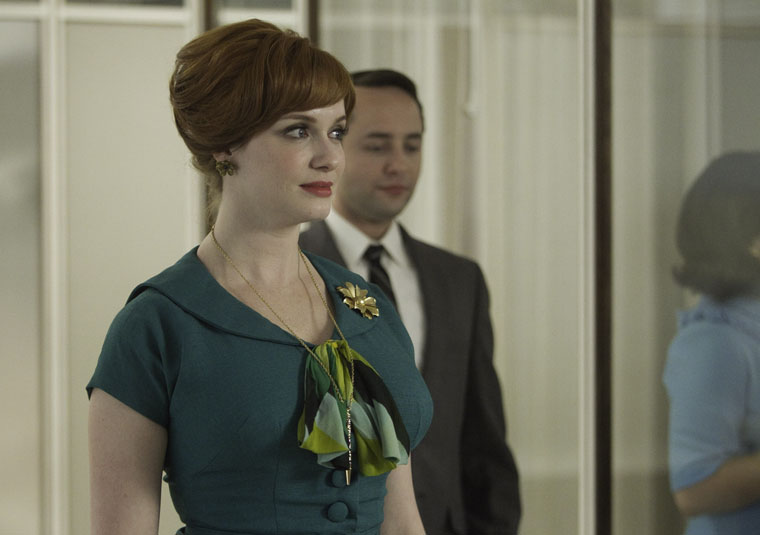
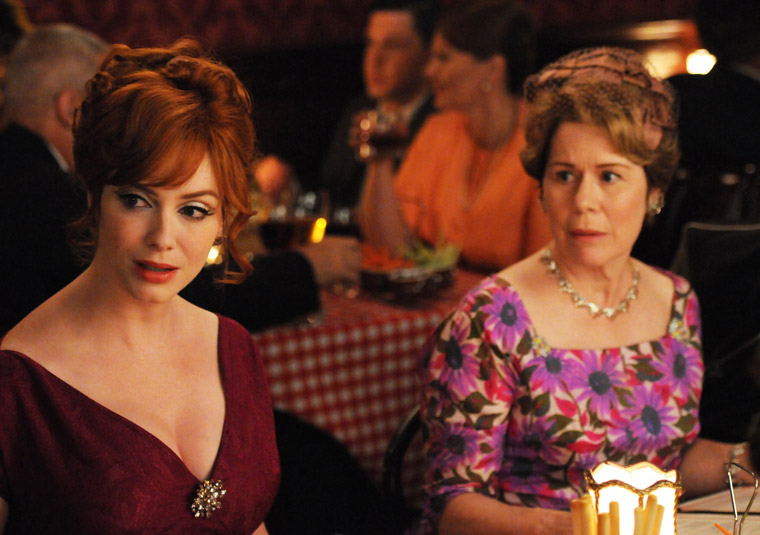
Joan (Christina Hendricks) in a scene from last night's "Mad Men"
Nelle Engoron recaps "Mad Men" every week on Salon. She is the author of "Mad Men Unmasked: Decoding Season 4."

I once read about a research study that surveyed men’s and women’s worst fears about the opposite gender. What the majority of men feared most was that a woman would laugh at or humiliate them. What women feared most was that a man would kill them.

Research into abusers and killers suggests a strong link between those two fears, with violence often triggered by feelings of humiliation and powerlessness. Both genders see the power to destroy as resting in the other’s hands – those hands that you may want to hold, or hands that may want to hold you, either lovingly or violently.

All of these fears are portrayed in “Mystery Date,” which may rank as the most disturbing episode ever of “Mad Men.” The dark side of the fairy tale of American life and of American marriage has been a constant theme of the series, and in this spooky house of an episode, various characters play Sleeping Beauty, only to wake up safely back in the brighter world (at least we hope that Sally will, once that Seconal wears off).

Our nightmare in shining amour, Don, feels his happy second marriage threatened by the specter of his past when he and Megan run into Andrea, a plaything from the Betty years. Andrea calls Don her “bad penny,” but she’s the one who keeps turning up in a sick Don’s fever dream. As if put under a spell, Don thinks that Andrea’s pursuing him, turning up at his apartment and refusing to leave even when he says she’ll wish she’d jumped off the balcony if his wife catches her (thus displacing his violent feelings onto a woman, one who took the male role earlier when she was “embarrassed” at Don’s “careless appetite” for sex). In a symbolic return of the repressed – those dark desires he’s tried to turn away from – Don’s nightmare Andrea both seduces and threatens him until he must strangle her and push her dead body under his marital bed, leaving only a red high heel behind, as if she’s a bloody Cinderella.

Don may be a psychic killer rather than a psycho killer, but this glimpse of his hostility toward women feels real, especially given the anger and rough treatment we’ve seen in the past (toward Bobbie Barrett and Betty). Yet in Don’s view, it’s women’s anger that’s to be feared – Megan’s about both his past and possible future infidelity – as well as the humiliating taunt that he places in Andrea’s mouth, about how sick he is (and not in a viral way). “Think you’ll be safe over there by yourself,” Don joke-taunts Megan when she backs away from his coughing. Being by himself  – alone with his often-repellent feelings and memories – is clearly something Don fears.

The real woman under the bed is not dead, but the lone survivor of the horrific nursing student murders committed by Richard Speck in Chicago, an event that fills both headlines and heads throughout this episode, just as it did in real life. (Like Sally, I read about those killings as a child and felt so afraid I could barely sleep for weeks. I didn’t actually crawl under something to sleep like she does, but I often thought about it.) In the mid- to late 1960s, killers became truly serial, a recurring nightmare of American life. That slaughter of eight student nurses was followed by other horrific murders that were sensationalized by the media, creating a morbid fascination with the grisly details and making Americans feel that crazy killers were lurking around every corner. Worst of all, these killers were no longer professional criminals, but the “quiet guy next door” types — neighbors who were revealed to have a secret homicidal life (a transformation suggested by Stan jokingly putting the pantyhose over his head like a criminal).

As with Don’s dream, victimhood keeps getting displaced in the episode. Ginsberg, who’d earlier been the only one to find the crime scene photos “disgusting,” nevertheless pitches the footwear clients a campaign that puts the consumer in the self-justifying serial killer’s shoes: First with the chilling slogan, “You’ll never tell, they’ll never be able to,” and then with the elaborate Cinderella fantasy he spins in which the girl is “wounded prey” who falls for the killer because he’s so handsome, and who “knows she’s not safe but doesn’t care” because “in the end, she wants to be caught.” The client loves the idea, not because he can admit it plays into some male fantasy, but because he thinks Ginsberg’s gotten into a woman’s head and is reflecting how they really feel (Ginsberg at least has the grace to say he really doesn’t understand women). The simultaneously self-deprecating and self-congratulatory “Ginzo” would be as pleased to find out he’s the author of Don’s nightmare as he is about winning over the client, though he narrowly escapes being fired. This doubly lucky guy is labeled a victim, first when Don threatens to “or else” him if he doesn’t stop shooting his mouth off, and later by Stan, who jokes about Don having “scattered his ashes.”

Similarly, Pauline explains Speck’s homicidal acts to a bewildered Sally by saying that the nurses “stirr(ed) his desire” (for rape and murder) with their short skirts, conjuring a scene in which they opened the door to a “handsome man” (in reality, Speck was quite ugly) and were too naive to realize what was happening and save themselves. As in a fairy tale, only one escapes death, because of a secret hiding place, but Pauline imagines that she’ll never be able to speak again, as if rendered mute by a spell. As Ginzo says to Don in the pre-pitch meeting, it’s all about “a woman and her secrets, the things she’ll never tell,” or perhaps the things that no one wants to hear. Pauline similarly tells Sally it’s time for her to start acting like an adult, and recounts a story about Pauline’s abusive father striking her “for nothing” and saying this warning was “valuable advice” that made her a better person. Three cheers for Sally for fighting this nightmare grandmother with, “I know you don’t think so, but I’m a good person.” This episode makes clear that the messages that girls and women are getting are still as poisonous as Snow White’s apple.

In a lighter vein, another sleeping beauty, Roger Sterling, finds out that he’s taken a $410 nap. Having snoozed through business as usual, he’s lying down in his dark office when interrupted by that pesky dwarf, Pete, who reminds him of the need for a campaign for Mohawk on Monday. Roger’s nightmare of being proven useless by Pete becomes Peggy’s dream come true when she extracts $10 for the work and $400 for the lie, proving a saying popular in the years ahead: that it’s not the crime but the coverup that costs you. Working late, Peggy finds out that the office is indeed haunted, but only by Dawn who (like so many fabled children) can’t get safely home.

This launches Peggy’s fairy tale, in which she and Dawn have a drunken girlfriend-y sleepover in which she’s the open-minded liberal and liberator who tells Dawn they have to stick together because they’re both the first of their kind in the office. She wants so much to see Dawn as being like her that she’s clearly disappointed when she doesn’t want to be a copywriter. Peggy shows her own fear by asking if she acts too much like a man, and when Dawn allows that she probably has to in order to succeed, she admits that she doesn’t know if she wants to play that role. Before going off to sleep, Peggy eyes the proverbial bag of gold she’s leaving on the coffee table in front of Dawn, clearly having to fight her own racist thinking. She’s rewarded for her trust with a thank-you note from a woman who must rise at the crack of her own name, and doesn’t even check that her treasure is intact.

But the real triumph of the episode belongs to Joan, who makes a dream come true for “Mad Men” fans by getting rid of her nightmare of a husband, saying he’s never been a “good man,” even before they were married and that he knows what she means by that. Even if he doesn’t, we do, which makes her mother’s description of Greg’s re-entry as “finding a little hole in his life, and sticking his elbow in until he can walk all the way in” horrifyingly appropriate.

There may be no bologna in Vietnam, but there is in the weasel-y Greg, who lets Joan think the Army has extended his tour and answers her anger about that with, “Nobody lied to anybody – it’s more complicated than that – it’s war.” And indeed, this is a war between the sexes. When the truth comes out, Joan relieves herself of military duty, rejecting Greg’s orders to be an obedient wife, before taking one last shot at his ego by saying she’s happy to surrender the job of stroking it to the Army.

Even before the breakup, Joan is wary, telling Greg she doesn’t want to know if he’s seen or done terrible things in Vietnam, and if he has to tell her about it, he certainly shouldn’t hold her hand while he does it. She rightly suspects the linking of intimacy and violence, especially at this man’s hands. While Greg’s right that she “slept a long time” in their relationship, her response that she “barely slept at all” sums up her changed state this season. The beauty who can’t sleep, Joan’s wakefulness signals a shift to clear-eyed action. When Greg issues his version of the “or else” threat, she responds by jerking her arm out of his grasp for the last time and saying, “That’s it.” At the end of the episode, she’s still wide awake, contemplating her future while her mother and baby slumber.

“I better not see you again,” Don says to the phantom Andrea. But nightmares and dreams aren’t so easily banished, and the hold that people have on us, whether loving or abusive, can never be shaken off entirely. As Don explains to Megan, our past is going to show up now and then. But these encounters are survivable, if we don’t let them get the best of us. The real mystery date is the one we’ll have some day with death, which we fear will arrive like a terrifying stranger, but which, if we’re lucky, we will welcome like a friend.

Continue Reading Close

Page 1 of 3 in Nelle Engoron

www.salon.com/writer/nelle_engoron/index.html