P. Smith

In the first plane to land after Flight 587

We came down in view of two crash sites and surrounded by thousands of ghosts.

  • more
    • All Share Services

In the first plane to land after Flight 587

Schiphol Airport in the Netherlands, world-renowned for security and convenience, features an unguarded observation deck and a bicycle path that follows the contours of the runways and taxiways. The airport’s railway station lies along the north-south line linking Amsterdam with Rotterdam, Antwerp, Brussels, and beyond. The station sits not at some outlying transfer point, but within the terminal building itself, a 30-second escalator ride from the ticket counters and arrival halls.

Yesterday, at 10 in the morning, I was clearing immigration at Schiphol. There were no long lines, no soldiers, no ransacking of carry-ons — just the smooth and orderly flow of passengers through no fewer than three security checkpoints in an atmosphere of cool, confident, European efficiency. Three times I passed through a metal detector — my luggage was pulled quickly beneath an X-ray machine while the magnetic strip of my passport was swiped for verification. Down below, I knew, suitcases were being sniffed, X-rayed and pressurized. Nobody asked about nail clippers, files, or scissors. Total elapsed time from check-in desk to departure concourse? About six minutes.

At the departure gate, I assured an anxious traveler that all was safe and secure. “I feel safer flying from Europe than I would from Chicago or St. Louis,” I told him. Next to me on the Boeing 767 sat a young Kuwaiti businessman.

An hour prior to landing at Kennedy Airport in New York, the captain made an announcement. I knew it was something important because the graying commander spoke not in a disconnected drawl from the cockpit, but while standing at the forward bulkhead, the P.A. phone in his hand, eye-to-eye with the passengers.

“I’m afraid I have some unfortunate news,” he announced. My initial thought was, “Not again.” On the chaotic morning of Sept. 11, I had been airborne as well, deadheading from Boston’s Logan Airport, my plane eventually diverted to Charleston, S.C. From an aisle seat I had looked through the window and watched American Flight 11 roar down Logan’s Runway 09.

Holding out his hand in a gesture of reassurance, the captain went on to explain there had been some kind of crash near JFK, and our flight would be redirected to Hartford, Conn. The result of this turned the business class cabin into a hive of anxious conjecture. People whispered, assumed the worst, left their coffee untouched.

Descending in the airspace around Hartford, we suddenly lurched skyward again and were informed that New York had reopened and was accepting traffic. We headed south across Long Island Sound and made our approach to Runway 31L, necks craning, passengers peering across from aisle seats to search out a crash site. And there it was, though I don’t think most people saw it: a distant mist of gray smoke, like a tiny, isolated fog bank against the clear blue afternoon.

The plane had gone down in the Belle Harbor section of Rockaway, a skinny stretch of neighborhood merely a few blocks wide, not unlike the Florida intercoastal. On one side of Rockaway is the open Atlantic, on the other is the huge marshy basin known as Jamaica Bay. The islands of this bay comprise a wildlife refuge and something called the Gateway National Recreation Area, at the northeast corner of which rest the runways of Kennedy Airport. As a pilot based at JFK, I once saw a pelican resting in the grass along a taxiway.

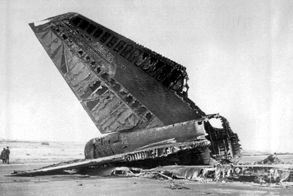
In 10 years of commercial flying I have never seen a crash site before. Now, without even the need to shift my gaze, I could see two of them: the smoldering wreckage of the American A300, and in a straight line to the west, 15 miles away, the vacated chunk of sky that was once the World Trade Center.

It would be unwise, at this point, to offer up theories as to what caused Flight 587 to go down. Suffice to say, in even a best-case scenario, it was an accident of uncannily bad timing, if indeed there is a good time for 270 people to die violently. Was it a bombing, a fulfillment of this author’s worst fears and suspicions after Sept. 11? Or was it the failure of machinery, the occasional and inevitable result of the tossing of our fates to the gods of luck and technology?

Shit happens, I suppose, which is a cavalier way of saying that yes, sometimes a $70 million flying machine can indeed break to pieces and fall to earth, even when we can least afford it. “Engine failure,” is a media propagated buzzword that many people associate with disaster, and the engines of Flight 587, huge turbofans manufactured by General Electric, are receiving their share of attention.

Commercial jets are built and certified with engine failures in mind. Should an engine cease to operate, even at the most critical moment of a flight (those few seconds at takeoff when gravity is at last, and strainingly, defied), the aircraft will continue upward with little more than a shudder. But airplanes are not necessarily designed to withstand uncontained disintegration of their power plants, when molten shrapnel is flung at near supersonic speed into fuel tanks, control cables, and even the cabin.

Just ask Capt. Al Haynes, surviving commander of the United DC-10 that crashed in Sioux City, Iowa, in 1989, his control systems rendered useless thanks to an engine that became a giant fragmentation grenade, bleeding the aircraft of its vital hydraulics.

That is, for now, the running theory. But the most experienced pilot in the world can offer no more than this kind of hunch. We’ll wait, perhaps quite nervously, until the black and orange boxes give up their secrets.

I’m thinking of this as I stand curbside after finally clearing customs and emerging into the cold daylight. Our aircraft was the first to land after the crash, touching down at about 2 p.m., an Aeroflot 767 coming in just behind us. Above me looms the enormous oval rooftop of what was once the Pan Am Worldport and is now renamed, in an almost sacrilegious ignominy, Terminal 3. This was where the Beatles made their infamous “bigger than Jesus” declaration, and where dignitaries and movie stars once boarded smoky old 707s bound for every conceivable latitude and longitude.

This is an airport of mystique, a place designed a half-century ago when the airline biz was still rife with delusions of eternal glamour. Its terminals, laid out in a great circle, were called “jewels in a necklace.” You can check out architect Eero Saarinen’s iconic — and now filthy — TWA terminal, a listing on the Register of Historic Places. Over at American, you can even see the world’s largest stained glass window. In the seventh grade I made a trip here, a sort of junior pilot’s pilgrimage in which, without my parents’ knowledge, binoculars in hand, I spent the day at the Worldport’s rooftop parking lot, Shangri-La for a 13-year-old airplane nut.

What I discover here is something I’d never expect to find at Kennedy Airport in a hundred years, and if we’re lucky, I’ll never find again: Instead of the normal, 100-decibel whirlpool of cars, buses and humanity, there is almost total silence. No vehicles, no noise, no people. Not even a taxi. I can hear my own footsteps echoing off the overhanging concrete. It is so deserted that a Port Authority cop will actually have to call a cab so I can make my journey across Queens to catch the shuttle from LaGuardia.

And as my yellow taxi rides northward away from the complex of terminals and hangars, the gray pall from Rockaway no longer visible, I’m thinking too about the many ghosts of this place. I think of Pan Am 103. TWA 800. EgyptAir 990. Swissair 111. Eastern 66. Avianca 52. KAL 007. The Air France Concorde. And even the great granddaddy of them all, the Pan Am 747 that crashed on the island of Tenerife in 1977 as part of the worst aviation accident in history. And now this.

Acts of willful sabotage, acts of God. Bombs, suicides, simple mistakes. Whatever the causes, all of these high-profile accidents, and others, involved flights that originated from, or were en route to, John F. Kennedy International Airport. And with that in mind, maybe suspicions and investigations are not, after all, the order of the day. We can put aside the specter of terrorism for a minute, and instead acknowledge the thousands of souls whose fate was intertwined with this enormous swath of asphalt, glass, and aluminum flying machines at the far end of the world’s greatest city.

Search for bombs, not nail clippers

A commercial pilot says that security checks are laughably misdirected

  • more
    • All Share Services

Search for bombs, not nail clippers

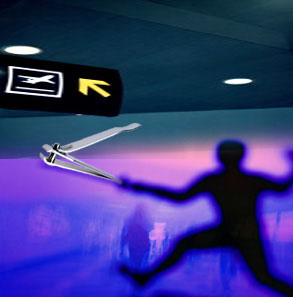
At a major international airport recently, an airline pilot in full uniform, en route to fly a planeload of passengers to a major city in the Northeast, had a small pair of scissors confiscated from his toiletries bag. When the pilot asked a U.S. marshal what purpose was served by taking a pair of rounded-end Fiskars from the very person responsible for flying an airliner, the marshal shrugged and answered, “That’s what they want us to do.”

Whether this pilot intended to hijack himself with scissors is, if it can even be suggested with a straight face, a long-shot suspicion at best, but reason and clear thinking aren’t a high priority on the concourses these days. At LaGuardia airport more than a week after the Sept. 11 attacks, not a single pay phone was in working order. “For security,” nodded a policeman. If there’s a relationship between pay phones and security, the Gotham cop had no particular insight. “It’s a new world,” was his only explanation. In another episode, a U.S. Customs officer reportedly was relieved of his box cutter, a tool he uses to inspect bales and packages, but was allowed to pass with his 9 mm pistol strapped in its holster.

Since Sept. 11, thanks in part to the Federal Aviation Administration’s new zero-tolerance policy toward the carriage of sharp objects, airport security in the United States has spiraled into a scene of near-absurdity. Passengers are subjected to two-hour check-in times while senior citizens have their carry-on luggage combed for nail files. Silverware is banned from restaurants, and there’s talk of removing mirrors from airplane lavatories, lest one is smashed and the plane commandeered by a terrorist wielding a pointed shard.

In addition to the madness at the X-ray machines, airlines also have instituted gate-side luggage checks, in which randomly chosen passengers are paged just prior to boarding, and must lay out their carry-ons for inspection by staff wearing rubber gloves. Random to the point of senseless: a roll call of selectees during one recent departure included a mother with two small children, a middle-aged businesswoman and an off-duty airline employee deadheading to work. If these individuals were the result of some behind-the-scenes profiling, dare we suggest some parameters need to be reset?

Meanwhile, to suddenly deem all sharp objects potential instruments of terror is not only incredibly time consuming, but sets the ultimately impossible goal of keeping any and every “weapon” out of the cabin of an airliner. All the determination in the world, replete with the most juvenile and ridiculous regulation, will not out-duel the ingenuity of even a half-determined sneak.

From pencils to flammable liquids hidden in shampoo bottles, there is, when it comes right down to it, virtually no way to prevent somebody from fashioning a dangerous device if he or she truly desires to. We should know this, yet time and time again we’ve heard the unwavering support of inconvenienced passengers as they languish in check-in lines or have their bags eviscerated by underpaid security guards. “I don’t care how long it takes,” goes the mantra of the delayed flier. “If it makes flying safer, I’m all for it.”

But what if it doesn’t? Should we really care if a passenger in Row 15 has a Swiss Army knife in his backpack? We should realize that a follow-up terrorist attack involving the airlines would not, in all likelihood, be another kamikaze-style hijacking. And in the wake of last month’s destruction, it’s almost inconceivable that a plane full of passengers and crew, unless they too happen to be suicidal fanatics, could ever again be overtaken by boxcutters and knives. No, our resolve belongs elsewhere, and our resources would be much better spent combating another, far more likely threat. Which brings us to a frightening truth. As we obsess over forks, corkscrews and hobby knives, and slowly turn our airports into scrap metal depositories, the greatest danger of all has rarely been discussed: explosives and bombs.

Most of us remember Pan Am 103, a New York-bound Boeing 747 named “Clipper Maid of the Seas,” blown up by Libyan terrorists over Lockerbie, Scotland, three days before Christmas in 1988. A small amount of Czech-made explosives, hidden inside a Toshiba radio, brought down the 300-ton aircraft and took the lives of 269 people, most of them Americans. Following this disaster, several measures were put in place to enhance safety aboard international flights.

The most familiar of these, at least to seasoned travelers, is positive luggage/passenger matching, whereby a person’s bag may not make the journey without the passenger who owns it. This may not be the most comprehensive insurance against someone on a suicide mission, but it’s worth noting that the Lockerbie terrorists did not die over Scotland in the flaming plunge of Pan Am 103. They were safely on the ground in Valetta, Malta, the island from which they’d sent along the explosive-laden luggage aboard a connecting flight. The deadly suitcase, sans its owners, made its way to Frankfurt, and then to London, where it was “interlined,” to use industry parlance, onto Flight 103.

Another post-Lockerbie innovation, used at certain European airports, involves the placement of checked luggage in pressurized chambers that simulate the climb and descent of flight, detonating any barometrically triggered bombs before they’re loaded into the holds of aircraft.

Most important, however, and with farthest-reaching potential, has been the development of highly sophisticated explosive-screening machines. Yet for reasons both political and economic, relatively few of these devices are in use at U.S. airports. The precise number, in fact, along with their exact whereabouts, is a guarded secret. But considering the hysteria and discipline at the metal detectors these days, it is downright tough to stomach a recent estimate that only about 5 percent of all checked luggage in the United States was undergoing any kind of high-tech explosives screening. This, during a virtual lockdown of the nation’s airports.

Since the destruction of the World Trade Center, the focus of security has been inordinately “above deck,” scrutinizing our pockets and carry-ons. We are forbidden to walk aboard with scissors, but the bags down below may or may not have been examined for explosives. (And, for good measure, the passenger/luggage match rules described above are still not applicable to domestic flights.)

The airlines, once reluctant to pursue such technology on a large scale for fears of delays and cost, know a bombing — or multiple bombings — could be a deadly slash to the jugular of the nation’s already precarious economy, bringing ruin to their industry by paralyzing an already nervous populace. Behind the scenes they now are working to institute new, more extensive procedures, the details of which are wisely (or for lack of scope) kept confidential.

But the airlines, government and FAA cannot act fast enough, and need to have effective anti-explosive technology and procedures in place at every U.S. airport, as well as all foreign airports from which flights depart for U.S. destinations, as quickly as possible. Prior to recent events, FAA’s goal for establishing a comprehensive detection network was the year 2017. That is, if you need help with the math, more than 15 years from now.

Advanced screening equipment costs as much as $1 million per unit, and several hundred, even thousands, of these would be needed to adequately equip more than 400 commercial airports across the country and beyond. Remember that the security of our airports is only as strong as the system’s weakest, most vulnerable point. Passengers connecting in New York, Chicago or Boston may have boarded commuter flights at Appleton, Wis., Scranton, Pa., or Presque Isle, Maine. (Just as Mohammad Atta and the hijackers of American flight 11 cleared security not at Boston’s Logan, but in Portland, Maine.) But we haggle over the cost at our own peril.

We cannot afford another postmortem frenzy over deficient security measures, not to mention the shame and embarrassment over how, possibly, we could have missed this one. Regardless of how it’s paid for, we must soon be assured of an extensive and effective system. The billions of dollars required are a mere fraction of what we stand to lose.

Continue Reading Close

Page 2 of 2 in P. Smith