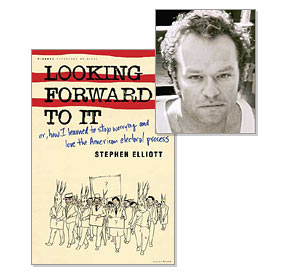
Stephen Elliott
Gimme shelter
Trying to force authorities to open an Air Force base as a shelter, Jesse Jackson and other black leaders picked up 150 evacuees at the squalid New Orleans Airport and headed into the night.
The New Orleans Airport sits on the north side of the city, removed from the bulk of the disaster that struck nearly a week ago when Hurricane Katrina battered the buildings, smashing through the levees and flooding the town. The highway leading into the airport is deserted, open only to official vehicles. The giant concrete overpasses are surreal empty loops, though nothing compared to the images inside the city itself.
I arrive at the airport Saturday afternoon with a convoy of three air-conditioned buses, two SUVs, and a state police escort. I’m with U.S. Rep. Maxine Waters, her husband, Ambassador Sydney Williams, chair of the Louisiana Black Caucus Cedric Richmond, the Rev. Jesse Jackson, and State Sen. Cleo Fields. Cleo Fields has a plan to bring people to England Air Force Base, a decommissioned base in Alexandria, La., four hours northwest of New Orleans. The idea is to show up with hundreds of disaster victims and force the federal government to open the empty buildings. They did not receive permission from anyone to take the evacuees there. On Saturday a U.S. Army spokesman said bases, including England, were being considering as shelters.
When we left the Office of Emergency Management in Baton Rouge, Sen. Fields responded to harsh questioning from a television crew. The reporter wanted to know if they had working sanitation facilities at the base, and healthcare.
“These people are living beneath a highway,” he responded incredulously. “It’s been six days. Do they have healthcare now? Do they have beds now? People are dying, not from the storm. People are dying because they are being left to die.” The reporter wasn’t impressed. She wanted to know what would happen if they couldn’t get in the base. “Worst case scenario: They’ll sleep on the buses. It’ll be the best night they’ve had in a week.”
On the way to the airport we see six buses full of people, pulled over at the side of the road. We pass about 150 buses sitting empty on the opposite side of the highway. We see many other buses, also empty, driving in both directions. “You’d think they were full if you were taking pictures from a helicopter,” a cameraman says. “All those empty buses moving around.”
Around the airport the neighborhood is mostly empty, the stores closed. Many buildings were heavily damaged by the storm but not affected by the water that has submerged most of New Orleans.
Approaching the airport there are large groups of people sitting on the lawns in front. The airport looks like something out of a science fiction novel. Thousands of people are waiting outside the terminals next to an enormous pile of refuse. A large force of Guardsmen and police keep the peace. They patrol with automatic rifles at their waists, watch wearily from the roofs of sand-colored military transports. It’s 90 degrees and the air reeks.
The people outside of the airport mostly arrived in the morning. Shuttled in from the Convention Center, the Superdome and the highways — the causeway over Lake Pontchartrain and the I-10. Thousands of victims were waiting in the three spots. Less than a day ago there were reports of 4,000 people who were living beneath the highway, in the shade of the overpass. Most of these people have been stranded since Sunday in subhuman conditions. But the conditions now are no better. There is trash everywhere and people stand nervously in line, afraid to lose their place, hoping to get inside the airport where there is at least air-conditioning. Nobody has showered in a week.
“We were at the Convention Center five days,” Charlotte Bradley tells me. “There was feces everywhere. Young girls were being raped. One night the lights went out. People were dying. People died in wheelchairs and they just put a sheet over them.” With Charlotte is her blind sister and autistic son.
Also with Charlotte is her friend David Tousant, Sr., whose son is also autistic. “First we were on the bridge,” he says. “I saw the waters rising and bodies appearing from the water. We were there two days when they came and got us and took us to the Convention Center. Then this morning they brought us here.”
Thousands more people are inside the airport. There’s a giant triage facility, like a big sloppy hospital. Seriously wounded and sick individuals lie on rows of dark green stretchers on the floor, some of them strapped into their stretchers. An old man sits on one stretcher in the middle of the floor, away from the others, a yellow band tied around his wrist. He’s not wearing shoes and his pants are rolled over his knees. A doctor kneels next to him, asks him if he knows where he is.
A line of elderly women in wheelchairs sit nearby, their only possessions strapped in small bags to the chairs’ handles. Each stares patiently ahead.
In the other part of the airport people are waiting in lines to be flown out or for buses to take them away. Nobody knows where they are being taken to or when. Time has nearly ceased to matter. Some people have bags; many others have nothing. Some just wander aimlessly. Families sit in corners, tribes that have formed since the disaster. A man in a blue shirt lies on a cardboard box next to the closed doors of the Body Shop, with its absurd signs behind the glass — blemish cream, two for $10.
The people inside the airport are the lucky ones. They have air-conditioning and bathrooms. They don’t want to go outside where the others are. They might not be allowed back in.
We fill the three buses quickly with the people waiting outside. Priority is given to women and children and elderly people as well as families. We take 150 people. Nobody asks where the buses are headed. Nobody cares. And I begin to worry. Permission has not been given to transport these people to the Air Force base. I worry that these victims are being used as fodder for a political agenda. I wonder where they would have been taken if the Black Caucus had not shown up with their own buses. Somewhere better? But then I think at what point do you just go? I wouldn’t wish that airport on anyone. I console myself with Sen. Fields’ comments earlier: Even if these people sleep on the buses it will be better than their last six nights.
The bus I’m on is dark and I keep my misgivings to myself as we travel through Louisiana late at night. There’s a DVD playing on the small screens. Someone says they had forgotten what a television looked like. The movie is “Rain Man.” When that’s done the driver puts in “Bad Company,” starring Christopher Rock and Anthony Hopkins. It’s not a very good movie.
A man named Charlie Armstrong and his family are sitting behind me. Charlie spent 20 years in the Army, went overseas six times, served in the first Gulf War where he was based six months in Saudi Arabia. “My best friend died over there,” he says. “I didn’t re-enlist after that. I missed out on Afghanistan.” Instead he went to work with his father and brother, doing construction.
Charlie and his family were stuck in a house through the storm. “The first floor was under water,” he says. “The roof was mostly gone. We were on the second floor getting rained on. They were dropping us food and water through the roof. The storm came right through that roof. I sure am glad to be out of there.”
The senator, Jesse Jackson, and the congresswoman are all riding in a car ahead of the buses. I don’t know if they received word that they would not be able to use the Air Force base, or if they decided to change plans because of the lateness of the hour, but we go to a shelter in Alexandria instead.
When we arrive, police surround the buses and refuse to let anyone off.
“They’re treating us like prisoners,” Charlie’s aunt says.
“You will absolutely not get off this bus,” an officer says. When Jesse Jackson gets out of the front car he’s immediately accosted by a shelter resident.
“You can’t bring those types of people here,” the man shouts. “Those are rapists and looters.”
“Now hold on,” Jesse says.
“Get the hell out of here,” the man says. The police guard the buses but make no move to stop the man, who seems like he might attack the reverend. “It’s not a race thing,” the man continues. “My wife is half-black.” He points to a pregnant woman standing nearby. “We don’t want your kind. This is a good place.”
The people on the bus are not allowed off. Apparently the shelter is 85 percent full and has only 20 open beds.
Fields says that someone called ahead to the shelter and was told it was all right to go there. But the leader of the Red Cross at the shelter vehemently denies that anyone called her. Jesse Jackson grumbles that they were set up.
People at the first shelter tell them that there is another shelter with space nearby. The convoy leaves the first shelter, driving five minutes across town.
It’s past midnight now. At the second shelter things go much better. We’re greeted by Police Chief Jay Barber, a kind man with a strong resemblance to Terry Bradshaw. Whoever the officers were at the first shelter, they apparently didn’t work for Barber. Barber’s men wear blue. The officers at the first shelter wore green. “I’ve got room for 150,” he says, about the number of people on the buses. The shelter is clean and well lit. There are large televisions, food, air-conditioning, cots, showers and a separate play area for the children. The people are taken in small groups. Each is disinfected for sanitary reasons. Bags are searched for weapons. “We had an incident a few days ago,” Barber says.
I ask the Rev. Jackson what happened at the first shelter on the other side of town. “When people act like children,” he says, “you have to act like an adult.”
“We’ve been waiting for folks for two days,” Barber tells me. “We’ve been expecting people. I’ve been taking walk-ins.”
I can’t believe what he’s saying. These people were lying in shit two days ago. We passed hundreds of empty buses on the way to the airport. How could a well-staffed, clean, secure, working shelter with 150 open beds in Louisiana sit half full for two days while people are being turned away at the Astrodome in Houston and bussed to Utah?
Leanne Murphy, the CEO of the Central Louisiana chapter of the Red Cross, is on hand. “We’re going to do everything we can for these people,” she tells me. “We’re so glad they’re here.”
“What if 300 more show up?” I ask her.
“We’re going to find a place for them,” she says.
The people at the shelter are genuinely decent, particularly Chief Barber. It makes it hard to understand what happened at the first shelter. A woman getting off the bus wraps herself around Jackson. She can’t stop crying. “Thank you so much,” she says, burying her face in the reverend’s shoulder. “I’ve been in the Superdome since Sunday. You have no idea what it was like. Nobody wanted to help us.” I wonder if it’s relevant to point out that she is white. Most of the people on the buses aren’t.
With operations well underway at the shelter I leave with the reverend and the politicians for nearby England Air Force Base. It’s nearly 1 in the morning and I’ve been sleeping the last three days in my rental car, living off potato chips, peanuts and candy bars, but I’m not particularly tired. The people on those buses were so happy to get there.
We’re greeted at the base by Bridgette Brown, vice chairman of the Airport Board. She tells us, “Today the board voted unanimously to accept people from New Orleans.” She thinks it will cost $1.6 million to the community. I wonder where the federal government is in all of this. I also wonder whether the board would have moved to open the facility if it had not been for the Black Caucus’s intervention.
Brown takes us on a tour of the facilities. There are four buildings with 480 double rooms capable of medium-term housing for 960 residents. The electricity and water work. The buildings clearly haven’t been used for a while and need a cleaning but don’t seem terrible. Compared to the airport they don’t even need a cleaning.
“We should have this place ready in two days,” she says. “We could have had it ready earlier but not everybody was in agreement.”
“How many acres do you have here?” Sen. Fields asks.
“Three thousand.”
“That’s a lot of tents,” he replies.
The Rev. Jackson gives me his take on the situation. “We used to have a war on poverty,” he says. “We need that here. Most of these shelters are temporary but it’s going to be a long time until people can return home. We need housing that’s appropriate, longer term like these unused military bases.”
“You use these buses to take people to Utah, you’re taking that bus out of commission,” Sen. Fields tells me. But lack of buses is not the problem. There are unused buses — I saw 150 of them on the road — and unused buildings. There are people living in conditions that would be unacceptable in the Third World.
Jesse Jackson shows me a letter from Hugo Chavez, president of Venezuela, offering planeloads of aid, soldiers and firefighters, and thousands of barrels of petroleum. “We turned him down,” he says.
At 5 in the morning we arrive back in Baton Rouge. I shake hands with Sen. Fields and hug Rep. Waters. I drive off with Ken Hooks, a lawyer and a friend of the senator. There are no hotel rooms available in Baton Rouge. A policeman in front of the Marriott tells us there’s no hotel rooms for 90 miles in any direction. Ken lets me into his office east of the city, gives me a pillow, and I fall asleep on the rug.
Above: The Rev. Jesse Jackson and Rep. Maxine Waters, D-Calif., meet with evacuees at New Orleans Airport on Saturday, Sept. 3.
“I want to keep living here, but I can’t”
Along the Gulf Coast, the devastation is complete, with Biloxi casinos just stones along the shore. In Jackson, refugees wait for their next move.
It’s only at the Gulf that one gets a full sense of Katrina’s devastation. The Gulf of Mississippi is destroyed. As far as one can see in any direction the beach is filled with wreckage, twisted docks, trucks turned over, trailers impaled on cement barriers. The parking lot at the Copa Casino in Gulfport is broken in pieces, littered with beams long as houses, tires, glass and odd fabric straps. Steel pylons wrenched from the concrete, which is cracked like plaster.
Casinos in Mississippi are not allowed to be land based, so the casinos are actually boats. The six-story Copa is a barge as large as a city block. It sits unmoored 300 feet from its dock. Several holes have been ripped in the side of the Copa. The slot machines sit in rows next to the opening, tops covered in black plastic bags. Split wires lay across the floor and dangle from the roof. The nearby Grand Casino has also been lifted from the sea and thrown ashore. Bricks lie peeled from the face of the adjoining hotel.
Continue Reading Close“They’ve got to open the base”
Louisiana black leaders, along with Maxine Waters and Jesse Jackson, want to take Katrina victims to a shuttered Air Force base instead of shelters. And I'm going with them.
I got on a bus with California Rep. Maxine Waters Saturday afternoon, not sure where we were going, just knowing we were headed to New Orleans to pick up Hurricane Katrina victims. Even as television news is showing pictures of people being rescued by military helicopters and chartered buses, local and national black leaders are seething at the mismanaged evacuation, as well as the haphazard way even the rescued people are being handled. So they’ve come up with their own plan: to load the remaining residents on buses they’ve chartered and bring them to England Air Force Base, a shuttered military installation in Alexandria, La.
Continue Reading CloseDarkness falls in Florida
From the author of the grimly hilarious campaign memoir "Looking Forward to It," a final, post-election chapter you won't find in his book.
I was in the voting equipment center in Broward County, Fla., on the night of the election. The streets were blocked off and they were counting votes in the back room of the building. Brenda Snipes and the other election officials were sitting behind a large oak table and occasionally arguing over a challenged ballot. There were 30 to 40 journalists and politicos watching a black-and-white screen as the numbers from the county slowly trickled in. The Democrats took 65 percent of the county, which is about what everybody expected. But only 60 percent of the county turned out to vote. People had been hoping for 70 or 75 percent.
Continue Reading Close“I love you, man”
An excerpt from Stephen Elliott's hilarious new book, "Looking Forward to It: Or How I Learned to Stop Worrying and Love the American Electoral Process."
I run into John Edwards’ press secretary, Jennifer Palmieri, in the basement of Holloway Hall at the University of New Hampshire just before the debate is about to start. Outside it’s cold as hell, but there’s a snack tray set up here with coffee and brownies. “You’re with GQ,” she says.
“I’m with Harper’s now,” I reply. (1)
“It’s down to Dean, Clark, and Edwards,” she tells me, and I feel like we’re picking up an old conversation, except last time we met Clark wasn’t in the race, and maybe he still isn’t. I’m going to need to meet the general soon, figure out where he’s really at. The Washington Post has a quote from him talking to a counter woman at a Dunkin’ Donuts — “Do you make your donuts here?” “No.” “So how do they get here?” I talk with Jennifer for a while and at some point she narrows her eyes on me, like she’s suddenly seen deep into my soul. “You’re smarter than you look,” she says, and I realize that before this election is over she will tell me lies and I will repeat them, because she is strong and I am weak, and now that she’s found me out I won’t have much of a chance against her.
Continue Reading CloseSwimming with the online card sharks
In the world of virtual Texas hold 'em, the money is real and so is the addiction.
“Italians come to ruin most generally in three ways, women, gambling, and farming. My family chose the slowest one.”
– Pope John XXIII
I have a poker table that dominates my studio apartment in a seedy neighborhood in San Francisco. I have clay chips that were given to me as a present last Christmas. The difference between the clay chips, which go for $10 a pack, and the cheap Walgreens plastic numbers is palpable.
I grew up playing spades in state homes for wayward youth. In college I won the dorm euchre championship (we cheated, but that’s how you play euchre). My compulsive card playing reflected disastrously on my college transcripts. My friend Louie got me into blackjack laying around our squat in Chicago’s notorious Cabrini Green while the men rolled dice on the sidewalk out front. I lost my last $600 the first time I played poker in West Yellowstone on the way to see my girlfriend in Seattle. Our relationship never recovered.
Continue Reading ClosePage 2 of 2 in Stephen Elliott