Susan McCarthy

Hollywood’s long history of animal cruelty

"Luck's" horse injury-related cancellation shows how far the film industry has come in treating non-human stars

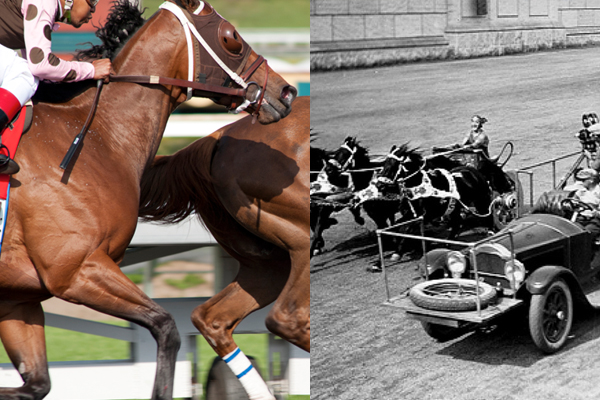
Stills from "Luck" and "Ben-Hur"

When HBO’s “Luck” was canceled after a third horse died during production, it was natural to ask what was going on. Were animals being abused? Were people being careless?

The truth was nothing was that simple or savage. Apparently the horses were being treated well, with greater care than actual working racehorses. The third horse was reportedly in good health and high spirits the day it died. It was in such spirits that it reared up as horses sometimes do. This time it fell over backward, and landed on its head. Just an accident. All you can blame is the fragile frame of the thoroughbred horse, which was created for racing.

But that didn’t keep the show from being canceled – or critics from speaking out. Even before the third horse death, PETA charged that “two dead horses in a handful of episodes exemplify the dark side of using animals in television, movies, and ads.” Like all filming in the U.S., “Luck” was shot under supervision of the American Humane Association’s Film & TV Unit, the people who certify that “No animal was harmed in the making” of a film or TV show. (That’s a statement about animal welfare, not animal rights. If you don’t think animals should be filmed for entertainment at all, you’re not going to like AHA. Founded in 1877, it also promotes the welfare of children.)

Moreover, this latest incident shows just how much the treatment of animals has changed in Hollywood since the motion picture industry began.

The early days were rough. Take Thomas Edison’s elephant electrocution as a starting point. Topsy, like the producers of “Luck,” was charged with causing three deaths. The third was a cruel trainer who tried to feed her a lighted cigarette. Naturally, she killed him. Edison electrocuted Topsy with alternating current to show how dangerous it was, part of his feud with Nicola Tesla, and released “Electrocuting an Elephant” (1903). This seems unfair and crass to most people today, but the idea was to find the most merciful way to kill Topsy.

Beginning in the 1920s the motion-picture industry boomed, developing new genres as it went. In those days you could do almost anything to an animal (or an actor, for that matter). As many as 100 horses died in the making of the 1926 version of “Ben Hur.” Early Hollywood was an anarchic world, with upstart production companies launching grandiose projects on every side. Filmmakers did whatever struck them as a great idea.

With the advent of sound in 1927 profits took off. The studio system arose, concentrating filmmaking in a handful of dictatorially efficient corporations employing thousands and turning out movies at a tremendous rate. Animal actors were part of the process. Dramas, comedies, adventure stories, musicals, biographies – all would use animals, but the genre that used the most was the western.

The popularity of westerns was particularly hard on horses. Westerns were a staple in ’20s and ’30s Hollywood, and then boomed in the 1940s. In the early days, people were more familiar with horses, more attuned to the dangers of a runaway team, or the dangers of a horse and rider falling. Directors showed lots of falls. They used pitfalls, or tripwires to make horses fall, and there were also some stunt horses, who would fall at a signal. Trained horses jumped through windows or through flames. They leapt over wagons. They rampaged through saloons. All this was at the regular cost of injury or death.

Sometimes individual horses became known, and they were protected because of their fame, and because the actors loved them. Western star William S. Hart had a famous pinto, Fritz. Beautifully trained, Fritz would fall on command, lie down to act as a shield in a gunfight, even play scenes with a monkey. “Singer Jim McKee” (1924) had a scene in which Hart rode Fritz off a cliff into a gorge, but the actor didn’t want to risk Fritz, or a stunt horse, so a fake Fritz was constructed. Hart was filmed galloping to the edge on Fritz, at which point, on cue, the horse did a fall to one side. Then he was led away and replaced by the fake Fritz, held up with wire. When the wires were cut, the two toppled into the gorge. Hart was “badly shaken” by the fall, wrote Petrine Day Mitchum in “Hollywood Hoofbeats,” but once edited, the footage of falling man and “horse” was chillingly spectacular – so much so that the Motion Picture Producers and Distributors Organization, aka the Hays Office, called Hart in to explain why he had been so cruel to Fritz.

Fritz was one of the exceptions to the rule. Most Hollywood horses were less famous, less recognizable, and often disposable. In 1939 two horses were killed in the filming of “Northwest Mounted Police” and two more in “Jesse James.” The horses in “Jesse James” were wearing movie blinkers with eyes painted on them. Unable to see, the horses had no idea they were running off a 75-foot cliff over white water until it was too late. The footage was impressive, the stuntman was well-paid, and the horses were dead.

This was the single biggest turning point in the history of Hollywood’s treatment of animals. Word about the deaths got out and there was a tremendous furor. In reaction to the outcry, the Hays Office worked with the AHA to write guidelines for animal performances. Starting in 1940, the AHA was granted access to sets. The Hays Office, well known for prissy extremes such as insisting that marital bedrooms feature twin beds and that Betty Boop dress more modestly, also banned apparent animal cruelty. Films were submitted to the office before release to get a certificate of approval and often changes were demanded before a certificate was issued.

In 1968 the Hays Code was dumped, mostly because it was ridiculous. Now you could have actors curse. You could ridicule the clergy. Married couples could be shown in the same bed. It was good news for the movies, but not for animal welfare. The end of the Hays Code contributed to the rise of the New Hollywood, a golden age of moviemaking. Younger filmmakers were creating realistic and daring movies, with more subtlety and less dependence on formula, contributing to a cinematic renaissance and a move toward realism and location shooting — and, sadly, more problems with animals.

“Through the final days of the ’60s and then into the ’70s, it was bleak. We were banned from film sets. There was a push for a gritty realism in those days in filmmaking. And they didn’t like to be told they could or could not do something with animals,” says Karen Rosa, vice-president of the AHA’s Film & TV Unit. She calls those “the dark days.” Because the AHA wasn’t on set, they couldn’t prove that two mules were killed on the Spanish set of “Patton” (1970), in a scene in which Gen.Patton shoots two mules blocking a bridge, but throughout the 1970s, the AHA’s list of “unacceptable” movies cites a litany of “animals killed for entertainment,” “horses wire tripped,” “mistreatment of animals,” and “live snake sliced into pieces.”

Gritty realism produced two of the most notorious animal welfare abuses in Hollywood history: In “Apocalypse Now” (1979), a real water buffalo was slaughtered with a machete (though it has been claimed that the buffalo was going to be slaughtered in this manner anyhow), and although the movie got great reviews, it caused a lot of upset. Before it was released in the U.K., the RSPCA protested that it violated the Cinematograph (Animals) Act.

“Heaven’s Gate” (1980), the notorious flop, came out a year later — such an expensive failure that it put United Artists out of business. It wasn’t a good gig for animal actors, either. Chickens died in staged cockfights. A horse was killed in an explosion. Horses were killed or injured in a battle scene. Other horses were allegedly bled to provide gore for humans to be smeared with. It was also claimed that cattle were killed and gutted so their innards could double for those of human actors. The AHA, which hadn’t been allowed on the set, led a boycott of the film, with picket lines. The boycott was taken up across the U.S. by local humane groups — and this time there were no voices sticking up for the artistic merit of the film.

Once again public anger led to sweeping changes. The Hays Code didn’t return, but AHA monitors came back on sets through a contract with the Screen Actors Guild (SAG) and Association of Motion Picture and Television Producers (AMPTP) and the “No animals were harmed …” disclaimer came into being. Importantly, these inspectors gained significant independence from the industry itself. The AHA Film & TV Unit isn’t paid by the individual producers of film and TV shows, but gets most of its budget from a yearly grant from the Industry Advancement and Cooperative Fund (IACF).

In 1988 the AHA published a set of guidelines for film and TV production. Since then, they say, the incidence of accidents, illnesses and deaths of animals on sets has sharply declined, although there are still occasional violators, especially when filming takes place overseas (some of Werner Herzog’s films, which often include scenes of simulated animal cruelty, have aroused suspicions). Before production even begins, the AHA reviews scripts, looking for potential problem situations, and advises the producers on how to handle the animal action they plan. The disclaimer has become a part of popular culture. Frequently mocked, it has probably also created a widespread awareness of animal welfare as a significant issue. (But see YouTube for counter-examples. No, I’m not going to give URLs.)

AHA’s guidelines evolve, sometimes in the light of new research, sometimes in the light of experience. “There was a time when we allowed tranquilization for the sake of entertainment, as long as it was done by a licensed veterinarian, as long as the the veterinarian stayed present,” says Rosa. But on a film shoot in the late ’90s a bird was tranquilized on a set. “It was very warm … and the bird didn’t make it. We just said, you know what? No.” The guidelines were changed.

There have always been people in Hollywood who care about animals and want to see them treated well. Now they know they can call in the AHA. On the set of “Horse Whisperer” (1998), a distressed crew member collared the AHA monitor. A horse with a bloody wound, she reported. In the corral! Nobody even seems to care! They went to the corral. There stood a horse with a bloody wound. And on the far side of the corral were four similar-looking horses. Each had an identical bloody wound, all superb examples of prosthetics.

Animal actors today have it cushy compared to the early days of Hollywood. AHA doesn’t have to look out for tripwires or pitfalls. “We want to make sure that they’re not stressed, and they’re well rested,” says Rosa. “I read these articles about horse racing and they’re talking about levels of drugs in the horses’ systems. We wouldn’t let the horse run even three-eighths of a mile for filming with drugs in its system.”

After the second horse died during “Luck’s” shooting, the AHA increased its precautions. They insisted that a second, independent vet do health checks on the horses on the days they were to perform. They demanded X-rays of the horses’ bones to check for unsuspected weaknesses. They asked Rick Arthur, a veterinarian and director of the California Racing Board, to review their protocols. “I thought they were actually very good precautions,” he said. “They were greater than those ordinarily found on the racetrack, and they were greater than those on any filming previously.” But horses are prone to do silly things, he says. Like rearing up and falling over backward.

Spinning an elephant thrill kill

With GoDaddy boycotts underway, CEO Bob Parsons' virtuous excuse for shooting an elephant prompts cries of bull

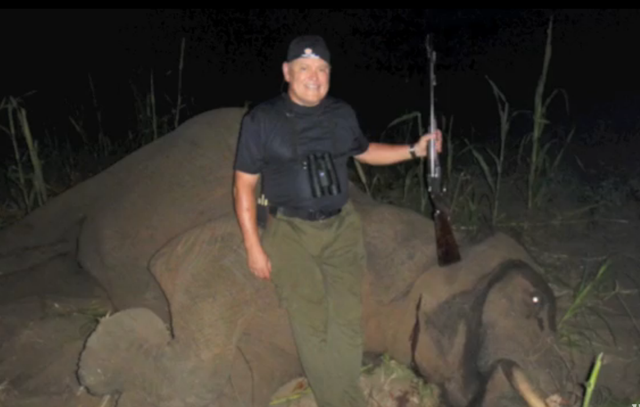
Idiotic mistake or brilliant publicity move? GoDaddy CEO Bob Parsons recently posted a video of himself killing an elephant in a sorghum field in Zimbabwe. Many were appalled. Others called it a P.R. disaster. Boycotts are underway.

But PR Daily called it a successful stunt: “This story will be dead by Sunday, and GoDaddy will have won tons of coverage.” And Parsons derided critics as uncomprehending or hypocritical. He refused to take down the video, and promised to post one next year, when he plans to shoot another elephant.

However, in the last few days, the initial, more sensational video has been quietly replaced with an edited version. In this one, a trampled sorghum field in Zimbabwe is shown. Destitute villagers, the video claims, need help protecting their crop. A nighttime scene follows as “the team” stakes out the field awaiting a nocturnal elephant raid. Shots ring out. A daylight scene shows Zimbabweans in GoDaddy caps crowding around a dead elephant to divide the meat.

(Taken out of the first video: Captions to the nighttime scene that read “Bob Parsons fires first” and “Bob Parsons fires again,” images of Bob Parsons posing with the dead elephant. Also cut: AC/DC’s “Hell’s Bells” playing over the scene of people cutting up the elephant.)

Cue Parsons, playing savior. “These people have literally nothing and when an elephant is killed it’s a big event for them, they are going to be able to eat some protein. This is no different than you or I eating beef,” Parsons told myFoxPhoenix. “All these people that are complaining that this shouldn’t happen, that these people who are starving to death otherwise shouldn’t eat these elephants, you probably see them driving through at McDonald’s or cutting a steak.”

But eating elephant really is different from eating beef. For one thing, it’s unsustainable on a basic ecological level. Elephants take too long to grow up and reproduce too slowly to work as a human food source. Animals that are successfully raised for food grow fast and reproduce early. (That’s why chicken is cheaper than beef and there is no giant-tortoise ranching industry.)

So, about that hypocrisy? Parsons claims he shoots elephants to save people. “If you had the choice to take a few elephants or to let people starve,” Parsons propounded to Mashable, “what choice would you make?” Asserting that we must choose between humans and elephants is, of course, a false argument. There’s a more stripped-down form that goes, “If it comes to a choice between a wild animal and my child, I know which I’m picking,” and excuses the extermination of all wolves, mountain lions, rattlesnakes, etc. By viewing our relationship to animals as a series of false choices — elephants or starving villagers? wolf or toddler? eagle or fuzzy bunny? — this philosophy justifies wholesale destruction.

They ask him to shoot the elephants, Parsons says. Sure, farmers everywhere hate crop-eaters, whether they are elephants, deer or blackbirds. Fishermen hate seals, cattle ranchers hate wolves, and quail farmers hate hawks. There’s a genuine land-use problem. More and more land is being occupied by farming villages. Elephants are losing land to people, and people are losing crops to voracious elephants. In Parsons’ formulation the answer is to shoot a few elephants and the rest magically run “into the forest” and don’t come back. There are other answers, but they’re less simple, and they don’t yield a Great White Hunter photograph of yourself with your boot on a dead elephant.

CNN’s Piers Morgan asked billionaire Parsons why he didn’t, instead, give money to the poverty-stricken Zimbabweans if all he wanted to do was help. “I don’t know that one has to do anything with the other,” replied Parsons.

A lot of people are mad at Parsons because they love elephants. Elephants are charming to watch. The more you learn about them, the deeper the charm goes. They are intelligent, life-long learners. They have long memories to go with their long lives. They have complex emotions and social relationships.

That’s true even of male elephants — though Parsons asserts that they’re all relatively interchangeable. Parsons says that his killing of a bull “has no effect on the elephant social structure (as it is matriarchal) as well as the herd size. The reason is another bull quickly steps up and breeds in place of the bull taken.”

Ah, the worthless male, sperm donor, all-you-need-is-one, theory. That’s not what elephant experts say. Scientists and researchers working in Africa argue (as in a February 2005 essay in Nature) that older male elephants are critical to the social development of younger males, specifically in keeping young bulls from becoming hyper-aggressive and attacking elephants and other species, such as rhinoceroses. In groups of violent young males (orphaned in elephant culling operations) who were killing rhinos and other elephants, the re-introduction of older males stopped the killing sprees.

So, back to the hypocrisy, the other reason people are mad at Parsons. It’s as if Parsons doesn’t know much about elephants. (Some who saw the original video have even cast doubts about whether he knows the real sex of the elephant.) Or as if he prefers to hold an outlook that lets him shoot “huge” trophy elephants — and do it to help the poor. Maybe someone will buy that. Others are apt to believe that Parsons shoots elephants for fun and to look tough. And on top of that, he wants gratitude from African villagers and admiration from the hometown crowd.

Idiotic mistake or brilliant P.R. stunt? Even if Parsons’ video posting turns out to be a canny publicity move, and doesn’t maim GoDaddy’s bottom line, I’m going with idiotic mistake.

Continue Reading Close

Tigers don’t belong in zoos

But where can the big cats go? The deadly mauling in San Francisco underscores the paradox of zoos today.

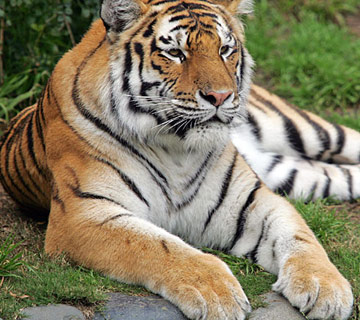
It doesn’t matter whether Tatiana, the tiger who attacked three people and killed one at the San Francisco Zoo on Christmas Day, was being teased or taunted. It doesn’t matter because zoo animals shouldn’t be able to escape from their enclosures no matter how rude people are to them. It also doesn’t matter because even if the young men were doing nothing, or were making gestures of homage and respect, Tatiana had years of reasons to be in a bad mood.

Tigers are among zoo visitors’ favorite animals. They’re also one reason many people hate zoos. Saddened by the picture of misery presented by the tiger who repetitively paces back and forth, back and forth, some people never go back.

“Tigers simply don’t belong in the zoo,” says Adam Roberts, senior vice president of the animal advocacy organization Born Free USA. “Tigers don’t belong on concrete, tigers don’t belong behind bars, and frankly, tigers don’t belong near people.”

Life in a zoo isn’t necessarily oppressive for all animals. Most animals didn’t evolve to explore as much space as tigers. But tigers in most zoos are like people spending their lives locked in an empty living room. They are confined to tiny spaces, with nothing to do. Life is intensely boring, year after year. Some animal observers say zoo life may also be stressful. Tigers, who like to lurk, skulk and hide, are on display, with groups of strangers staring at them. Freedom is absent, and so are choice and control.

The San Francisco Zoo is among the many older U.S. zoos saddled with the physical legacy of tiny, inhumane cells. Instead of replacing them all, zoos build a gorilla habitat here, a giraffe palace there, while other animals languish in the old cages. In the past decade, San Francisco Zoo has sought to shed its infamy. In 2002, it unveiled the Lemur Forest, a delight to behold, with five species of lemurs trooping over a large island and clambering through tall trees and climbing structures. In 2004, it opened the expansive African Savanna, where visitors walk along an pathway, observing giraffes, zebras and oryx rambling through open grounds. And it used the rescue of two young grizzly bears from Montana to help raise funds for a new bear exhibit bigger than all its previous bear grottoes combined.

Yet the grotto in which Tatiana and the zoo’s three other Siberian tigers lived was barely upgraded from 1940, when the zoo’s grottoes were built as part of the Works Project Administration. It was small, dull and, as we now know, not completely tiger-proof. In December 2006, Tatiana mauled and nearly tore off the arm of keeper Lori Komejan inside the feeding cages. As the San Francisco Chronicle reported, the state’s workplace safety agency, Cal/OSHA, blamed the zoo, citing defects that the zoo knew about but hadn’t fixed, and imposed an $18,000 penalty.

Whatever problems one zoo may have, conservationists argue that keeping tigers in zoos is a means to preserve a species in terrible danger. After all, wild tigers are losing ground fast. Assaulted by poaching and loss of habitat, populations are sinking. A hundred years ago there were probably 100,000 tigers. Now there are about 3,000.

Today, zoos are active in breeding programs to preserve tigers. Under the Species Survival Plan, only about 20 tiger breedings a year take place, planned to maximize genetic diversity. “The whole philosophy that I have lived by is that tigers in zoos are a genetic insurance policy,” says Ron Tilson, the director of conservation at the Minnesota Zoo and a respected tiger expert who directs the Species Survival Plan at accredited U.S. zoos. “There are the same number of Amur [Siberian] tigers in captivity as in the wild, and there’s greater genetic diversity in captive tigers.” If a virus like distemper or feline leukemia devastated the wild population, he adds, it could be rebuilt from the genes of captive tigers.

Even Peter Knights, executive director of the conservation organization WildAid, which strives to preserve threatened animals, including tigers, worldwide, acknowledges that zoos are valuable. “Zoos play a positive role in sensitizing people to conservation,” he says. “Tigers are in an ambassadorial role. The actual experience of seeing a physical animal is nothing like seeing it on a TV screen.”

Knights, however, is skeptical about ever reintroducing tigers, even if it could be done in a large protected area. Predation isn’t an easy trade to pick up, and wild cubs stay with their mothers for two years learning how it’s done, being supported while they learn. “We haven’t worked out how to reintroduce tigers into the wild yet,” he says. At the same time, various projects with other big cats suggest that while the first generation will starve if they’re not provisioned by humans, the second generation does fine. But it’s true: tigers can’t be reintroduced now. It’s not safe for them out there.

Roberts of Born Free USA has no patience with the defense of zoos, either for their genetic storage programs or their ambassador roles. “The tiger is a perfect example of the way that zoos are missing the point about conservation,” he says. Money spent on zoo tigers should be spent on protecting habitat for wild tigers. “There’s an expenditure of millions if not tens of millions of dollars on captive tigers. If we really want tigers and not just a shell of the beast we call the tiger, the real emphasis needs to be first and foremost in the field.”

Currently, despite the best efforts of groups like Born Free USA and WildAid, the outlook for tigers in the wild remains dim. The only place where wild tigers are doing well is eastern Siberia, which is also the only tiger habitat sparsely inhabited by people. “Everywhere else, everything is failing,” says Tilson. “It doesn’t matter how much money there is. It doesn’t matter how good the recovery team is. It comes down to: Is there a will from the government to put resources into it, to create laws, and to enforce those laws? For a real failure, go look at India.” There, prosecutions for poaching don’t stick; the Sariska Tiger Preserve has had every single tiger killed; and the Tribal Rights Bill now in Parliament would allow hundreds of thousands of people and their cattle to live in national parks.

The ideal situation for tigers would be the protection their wild habitat. Until that comes to pass, zoos will continue to serve a purpose for helping to preserve the species. But the new safety barriers the San Francisco Zoo has installed on its tiger enclosures shouldn’t be where we stop. We should also look seriously at how to make tigers happy. So why don’t we do some happiness research?

Setting aside the solipsistic notion that we can never know what’s in the heart of another, there are in fact multiple ways of getting at what tigers like. We could put on white coats and measure corticosteroids, stress hormones. We could find out if it’s true that active tigers live longer. We could then design zoo habitats better. After all, we should treat our captives well and intelligently. If they must be in prison, why can’t it be one of those country club prisons we keep hearing about?

There are encouraging signs in that direction. In recent years, zoos have constructed new tiger exhibits with big enclosures and greenery. There’s usually a pond, maybe even a waterfall. Zoos have also signed on to the concept of “enrichment.” They’re giving animals things to play with, things to destroy, things to take apart in search of snacks.

In the Bronx Zoo, keepers spray odd scents like cinnamon or musk around the enclosure to make things more interesting for the cats. At the Minnesota Zoo, tigers get a fake carcass. It’s a fake moose stuffed with meat, and the tigers have to wrestle with a long strip of rawhide to get to the meat. “The tigers really love this,” says Tilson.

In fact, Tilson assures me that zoo tigers are content. Of visitors saddened by the sight of zoo tigers, he says, “It may be a look of boredom they’re picking up on, but [the tigers] are not unhappy.” They live longer than wild tigers. They’re well-fed and safe from enemies. Tilson thinks all zoo tigers should have enrichment programs. He speaks well of the tigers-and-water shows at a few facilities, including an aquarium in Denver and an unaccredited wildlife theme park in Arizona. “As long as it’s done safely, it’s good for the animals,” he says.

Zookeepers also tell us that tigers are cats, happy just to eat and sleep. But zookeepers so badly want their tigers to be happy that they may not be the best judges.

Elizabeth Marshall Thomas, author of “The Tribe of Tiger,” argues that circus tigers are happier than zoo tigers because their lives are active and interesting. She cites an observation of Tilson’s from when the Minnesota Zoo was doing endocrine studies on tigers. The tigers were in small cages in a laboratory, and had blood samples taken several times a week — and they looked great. They were relaxed and bright-eyed, and their corticosteroid levels were far below those of the tigers on display. Apparently they liked being able to observe the activity in the lab, and they liked the regular, friendly interaction with the researchers.

If the horrible incident at the San Francisco Zoo makes people pay attention to conditions for tigers in zoos, maybe some good will come from it. It’s the least we can do for the tigers while our species continues to eat up their native homes.

Continue Reading Close

Move over, Dr. Phil!

Dr. Tatiana mostly offers advice on banana slug penis problems and sponge louse jealousy, but we can all gain from her sexual wisdom.

They’re fighting ever more fiercely for the chance to advise us on our sex lives. Dr. Laura, Dr. Ruth, Dr. Phil, Dr. Oprah, sensitive Dr. Masoch and hard-liner Dr. Sade (not to mention the tireless Dr. Spam) — they seem to be everywhere in recent months. They’re on television, the radio, the covers of women’s and men’s magazines. Surely the need for sexual advice and the desire to learn what sexual advice others require are not endless? Who will be left when the market shakes out? I believe it may turn out to be the sexual advisor who combines two popular genres into one blockbuster feature. Hint: Animal Planet.

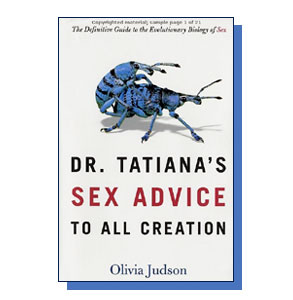
In the chatty, opinionated guise of Dr. Tatiana, Olivia Judson brilliantly combines the ever-popular genre of the advice column with that of Sick Nature Facts. The combination is strikingly successful. As Dear Abby never has, Dr. Tatiana confronts the etiquette issues involved in depraved cannibal incest, for example, and uses them to illuminate biological insights into the nature of life on earth.

A typical section of Judson’s book, “Dr. Tatiana’s Sex Advice to All Creation,” will begin with a letter from a troubled or inquiring life-form and will go on to explore issues raised by that creature’s situation. She examines an instructive variety of dilemmas. I am particularly fond of a letter from “Hoodwinked in the Gulf of California,” one of life’s winners who nevertheless feels as if he’s slowly going mad: “I’m a sponge louse, and I recently won a battle for a sponge cavity that is home to a large harem of beautiful girls. But I’m starting to suspect that some of the girls are not what they seem: several look like men dressed as women. Am I being paranoid?”

Then there’s “Anxious in Amboseli,” an elephant with whom many will identify, who concludes his plaint: “I’m obsessed with sex. Night after night I have erotic dreams, and the sight of a beautiful cow sends me into a frenzy. Worst of all, my penis has turned green. Am I ill?”

Dr. Tatiana is able to reassure Anxious that his situation is perfectly normal, which is in fact her response to many worried beings. Her explanations of various bizarre evolutionary successes are clear and compact. My only complaint would be that I want to read even more letters from correspondents like “Neglected Househusband in Tamil Nadu” (a bronze-winged jacana) or “Group Sexists in Santa Catalina” (sea hares).

Dr. Tatiana often takes quite a folksy tone. (Surely this is fair to say when she addresses readers as “Folks”) Although I have read vast numbers of books on biology for popular audiences, I believe this is the first time I have encountered the term “rumpy-pumpy.” (In reference to the love life of Australian seaweed flies, as you might have guessed.)

Many are the shocking and tangled relationships revealed in Dr. Tatiana’s answers to her pen pals. No doubt you knew about and had adjusted to the hermaphroditism of banana slugs, but perhaps you were not aware that during sex the “gigantic and complex” penis of a slug may get stuck, whereupon one or the other of them has to gnaw it off. This ends that slug’s chances of playing the male role, but happily it remains in touch with its feminine side.

Then there are the button beetles (Coccotrypes dactyliperda), of whom you read so little in the Lifestyle section of the newspaper. Who has not heard the scuttlebutt to the effect that button beetles can and often do mate with their own brothers or sisters when they’ve only just hatched? Dr. Tatiana describes the even more scandalous behavior of a female button beetle who goes out in the world without taking this precaution. “On arriving at a new home, [she]… digs out a grotto and then lays a small clutch of unfertilized eggs. These develop into males. She mates with the first to hatch and then eats him and his brothers before laying a large brood of daughters — and perhaps one or two more sons for her girls to mate with.” Worse still, these amoral creatures are known to infest buttons on clothing.

Naturally, Dr. Tatiana does not shy away from counseling those in more conventional relationships. She is brisk in her reply to a young California mouse who has a crush on her neighbor’s husband, advising her that this species is so profoundly monogamous that once a male has a mate “he won’t even cheat on her even if he finds himself locked up with a virgin in heat.” Her assertions are carefully referenced, so you can look this up if you like. The footnotes answer questions such as: Who thinks up these experiments? Are these people scientists or screenwriters?

Or consider the Djungarian hamster, a species in which the male “is such an attentive father that he plays the midwife for the birth of his pups (the only male mammal so far known to do this as a matter of routine), helping them emerge from the birth canal, opening their airways so they can breathe, and licking them clean. For good measure, he eats the placenta.” Yes, but does he videotape the delivery? Perhaps not, as this vision of domestic felicity blurs when Dr. Tatiana casually mentions that Djungarian hamsters breed so busily that they can produce “eighteen litters of between one and nine pups” in a year. That’s up to 162 baby hamsters, each needing to be suckled, washed and kept in line. No wonder the male performs all the midwifely tasks — the female is far too exhausted. In fact, around the hundredth pup she is probably asking herself how bad it would be if they couldn’t breathe.

Like so many advice columnists, Dr. Tatiana is perfectly liable to respond to some heartfelt pleas for advice with information and commentary, perhaps even a warning, but with no actual advice. At least she spares us numbered lists of fire safety tips.

She does give advice to “Invisible in Sri Lanka,” a peacock with a substandard tail, telling him to join a gang, since peahens like to pick through groups of males for those that appeal to them most. But she has nothing to offer “Disgusted in the Galapagos,” a female marine iguana who complains of encountering groups of young males masturbating at her. Instead she rambles on about species with small testicles vs. species with big testicles: small help for Disgusted.

When it comes to scorpion flies, a species known to steal insects from spider webs, she is on surer ground, with advice for both sexes. “Tip: If you’re a boy scorpionfly, you’ll have a big bulbous penis. If you’re in a spider’s larder and the owner tries to stop you, whack her with your member and she’ll back off. Girls, if you ever find yourselves in the same predicament, your best bet is to head butt the poor spider.”

When all a correspondent wants is information, as when “Spooked in Gabon,” a golden potto, asks, “Please, Dr. Tatiana, why is his penis covered with enormous spines?” her answers are utterly satisfying, although some reader may be troubled by her reference to the relative dullness of the human penis, “notable only for its girth.” Comparing the anatomy of the male golden potto to that of the male damselfly, the male ghost spider crab, the male red-billed buffalo weaver, and so forth, she ends by suggesting that the spines may serve to stimulate the female golden potto, or to get rid of the sperm of other male golden pottos. True, she also notes that comparative studies indicate that such genital extras suggest that “female golden pottos sometimes sleep around” — if she were writing for a newspaper, I bet the editors would take that out.

Dr. Tatiana also issues the occasional “wake up and smell the coffee” letter. In her reply to “Bewildered Down Under,” a female splendid fairy wren who can’t understand why her mate keeps going to the doctor to have his sperm count checked when it checks in at 8 billion sperm at a time, she warns that “His ‘appointments’ are a thin disguise for philandering. Splendid fairy wrens are notorious for their extramarital adventures,” goes on to link this to his high sperm count, and concludes by casting aspersions on Bewildered’s own marital fidelity.

While Dr. Tatiana spares us numbered lists of what to keep in the glove compartment in case of emergency, in her section on crimes of passion she does provide a guide for female self-defense: “1. Don’t attract attention. Hide or be otherwise conspicuous. 2. Don’t leave home alone. Hire an escort or, failing that, stick with other females. 3. Do avoid groups of idle males. If they congregate at a place you must go to, try to time your visit to coincide with the arrival of other females. 4. Do carry weapons. Males tend to be servile if females are well armed.

I am certain I have read items 1-3 in Ann Landers, although not 4. She seems to have forgotten “Do carry your keys in your hand so you don’t have to fumble through your purse for them in a darkened parking lot” and “Don’t list your full name in the telephone book.” Tatiana’s tip No. 4 is one that is generally omitted in advice to our species, however.

There is a brief discussion of child care, which is appropriate, since, after all, the production of offspring is what has made the practice of sex such a winning strategy. Dr. Tatiana is fond of the hermaphroditic African leech, which carries its young in a pouch, like a kangaroo.

But I sorrow to note that Dr. Tatiana’s focus on reproduction has something regrettable in common with mainstream sex education in the United States today: She has nothing to say about birth control. Does she believe with many religious fundamentalists that birth control is “unnatural”? Surely it cannot be that what divides humanity from the rest of creation is not consciousness, nor laughter, nor tool use, nor tool manufacture, but our use of tools in family planning?

Undoubtedly blazing the trail for the inclusive future of sex advice, Judson closes with a transcript from “Under the Microscope: The Deviant Lifestyle Show!” with host Dr. Tatiana (glamorous in a scarlet suit) interviewing Miss Philodina roseola, the bdelloid rotifer, about whether it is true that bdelloid rotifers have reproduced only by cloning — no sex — for the last 85 million years. Irate audience members accuse the guest of lying, try to drown out the proceedings with political chanting, or give touching testimony and vivid demonstrations from their own lives as to the wonders of sexual reproduction. In a postscript Dr. Tatiana notes that the more she learns about the sexual practices and predilections of others, the more tolerant and, in some cases, the more envious she becomes. “I now think that many more things are normal,” she says, and wishes everyone “lots of great sex” unless they chance to be bdelloid rotifers.

Continue Reading Close

Classroom karaoke

If California schools keep the words "under God" in the Pledge of Allegiance, there will be kids like I was, who will remain silent, move their lips and hope that patriotic peers don't catch them.

As public schools open across the West, school districts face the question of what to do about the Pledge of Allegiance. Many kids, depending on those decisions, will face the question of what to say. In June, the U.S. Court of Appeals for the Ninth Circuit ruled that children could not be made to say the pledge in its current form because it includes the words “under God.” But the phrase — inserted by Congress in 1954 in a fit of collective self-righteousness — has created conflict for students for much longer.

At this point, because the Ninth Circuit decision is under appeal, schools are free to instruct kids to recite the God-enhanced version of the pledge. Recalling my own schooldays, when those words created a painful moment every day, I hope they don’t.

The ostensible cause of the pledge suit is a third-grader, the daughter of Michael Newdow and Sandra Banning. Newdow, an atheist who lives in Sacramento, Calif., filed suit arguing that his daughter should not be forced to watch and take part in a ritual including mention of God, and the majority of the court agreed.

This decision, as might be expected in these times, caused a huge flap, and afforded certain congressman the chance to summon cameras to view them reciting the pledge — including “under God” — and singing “God Bless America” on the Capitol steps. Had someone handed them flags, I am sure they would have wrapped themselves in them.

I’m an atheist, and I was particularly distressed by the part of the furor which involved public figures across the land proudly renouncing atheism and vowing to combat their oppression by atheists. But the last straw for me, the one that made me feel I’d kept my heathen mouth shut long enough, was an editorial cartoon showing Newdow’s daughter being crucified on an international “no” symbol by her callous atheistic father.

This display came on the heels of the child’s mother, Sandra Banning, announcing to the press that her daughter is not an atheist, that she does not want people to think that her daughter is an atheist, and that she doesn’t want her daughter to be a party to the suit. (The parents, unsurprisingly, have not been a couple for some time.)

Banning’s lawyer also says that Banning doesn’t want her child to be “branded for the rest of her life as the girl who was the atheist in the pledge case.”

It’s not clear that Newdow’s lawsuit hinges on his daughter’s being an atheist who does not wish to utter words of religious faith in the course of pledging allegiance to her country. Newdow has spoken of his right to guide his child’s religious education (although now that the mother says she has full custody, it’s unclear whether he indeed has that right), a statement which gives no hint of the child’s beliefs.

Perhaps it is true that, in this case, the father’s lawsuit misrepresents the convictions of the child. Perhaps the high point of her day is the chance to intone the words “under God” as part of the pledge. And I can certainly believe that being known as a party in her father’s lawsuit could create social agony for the girl. If I could, I would gladly put my younger self forward as a suitable plaintiff, because saying those words did indeed make me unhappy.

I’ve always been an atheist. I’m a third-generation atheist on one side of my family, second-generation on the other. When I was 6 or 7, a family friend gave me a book of Bible stories, which I liked (my favorite was the story of Moses and Aaron), but which didn’t make me a believer. When I asked my parents about God, they said that was a matter of personal conviction, and I could decide for myself when I got older. I was a serious, precocious child, and I didn’t wait to decide — but my beliefs haven’t been shaken with time.

Very early soon after my decision, I became aware that the matter of personal conviction was not a simple thing. One day after school, when we were both in the first grade, I casually remarked to my friend Amy that there was no Santa Claus and no God. Amy told her parents in distress, and they called my parents in outrage. Somehow my genius of a mother smoothed things over so that Amy was still allowed to play with me, but it was apparently a close call. My mother had a talk with me about respecting the beliefs of others, and it made a deep impression.

The next time we played together, Amy told me that while I had a point about Santa, I was mistaken about God. I don’t remember exactly what I said, but it was on the order of, “I’m sure you’re right. Let’s go play in the tree fort.”

At the Massachusetts school I went to, we didn’t say the pledge, but when we moved to California, it was a daily ritual. When we recited the pledge, I didn’t say “under God,” because I didn’t believe it. I was a conscientious child, and I didn’t want to lie. But I was afraid that people wouldn’t like it if I didn’t say it, or would tease me if they noticed that I didn’t say it, so I moved my lips during that phrase, but did not speak it. This was not my parents’ idea. I don’t think I told them about it, and in any case they were always urging me not to be so timid about things.

I have been told that my fear was not a rational one, and that other kids in other places either conspicuously did not say “under God,” or substituted all kinds of hilarious phrases, and that nothing bad happened to them. No one forced me to cower before a hypothetical threat.

But it so happens that between first and second grades I entered what it would be tactful to call an awkward phase, and I think I was correct that in my status as a spindly bespectacled dwarf who talked funny, any new deviation from the norm could have directed additional teasing my way. Moving from one school to another didn’t help. I was teased for the way I looked, the way I dressed, the way my parents looked, the fact that we ate dinner late, even — this was in a California suburb — for having dark hair. What I already underwent was bad enough without being exposed as a person whose morality was so questionable that other children might need to be sequestered from my company.

If my fears were indeed unreasonable at the time, perhaps they are becoming less so. Perhaps the danger of being exposed as a pledge heathen has been heightened. In the main part of their decision, the appeals court judges wrote that the insertion of the words “under God” sends the message that atheists are outsiders. And Sandra Banning’s desire that everyone know that her child is not an atheist after all would seem to confirm that.

I’d like to ask Banning: If it is so terrible for her daughter to be reputed to be an atheist, and if she must protect her child against that charge, what protection would she like to see for children who really are?

Atheist children aren’t the only ones who may confront this issue. When the pledge decision came down, the San Francisco Chronicle interviewed the Rev. Masao Kodani of the Sensai Buddhist Temple, who said that Buddhists don’t believe in God, and that he tells children in the temple’s dharma classes that they should say the pledge in school but be silent for the “under God” part. Brave children, if they do.

One of my children is a practicing Jew who nevertheless doesn’t believe that those words belong in the pledge. The other one, also an atheist, but not as fearful a child as I was, has never been bothered by the religious phrase in the pledge, but asks “What good is it?”

Indeed, what is the point? What do those two words accomplish? They certainly didn’t convert me, but they taught me an inimical lesson about pretending to go along.

When I heard about the court’s decision, I felt more worried than vindicated. I believe the decision is correct and I believe it will be overturned. I also think that because a majority of Americans believe those words should stay in the pledge, a rationale will be found. In the meantime, there will be a lot of hand-waving and posturing about God and country and about how you can’t have the latter without the former, and a lot of people will say things that indicate just how incomprehensible, alien, amoral and untrustworthy they think people like me are.

I fear that some reasoning will be found to reaffirm the edict that all children in our public schools must daily link God and country aloud — and a lot more people will be watching children’s lips.

The Bush administration has now taken the amusing position that the words “under God” are, of all things, a “secular” reference to the nation’s religious heritage. A history lesson, if you will.

That’s not what President Eisenhower said in 1954 when he signed the law inserting the words into the pledge, which had been fine without them for the previous 62 years. He said it would proclaim “the dedication of our nation and our people to the almighty.” A House committee report of the time said this would serve to “deny the atheistic and materialistic concepts of communism.”

It is probably true that, as Boston Globe columnist Jeff Jacoby wrote, the founders of the American Republic didn’t intend to create “a public square scrubbed free of God.” Me neither. I think if we talked about religion more, in fact, there might be a wider understanding that this is not a subject on which we can assume unanimity. But talking about faith in God is not the same as forcing people to parrot words of faith they may or may not feel.

Jacoby also wrote that the health of our political institutions depends “on our ethics and religions.” I’m with him on the ethics, but am alarmed by the notion that he may think we can’t have ethics without religion. Religion is where some people locate the wellsprings of their ethics, but others find a different way. Does Jacoby find atheists like me unhealthy and unethical? The more such pronouncements I read, the more I wonder whether my childhood fears of being exposed as an unbeliever were really so irrational. Atheists aren’t allowed to be Boy Scouts, for example, although admittedly I was already disqualified.

Surely no one believes that inserting the words “under God” in the pledge converts unbelievers or prevents backsliding. No, I think the real reason for the outrage at the thought of taking the words out is that most believers are furious that some people are offended by being instructed to utter the simplest, most basic tenet of their belief.

In a 1984 case, the Supreme Court ruled that the phrase “In God we trust” imprinted on our currency was not a problem because its significance has been lost through rote repetition. Not to me. I can read and I know what that means, and it means I’m not counted in the “we.” Whatever. It’s not like merchants force me to read my money aloud. If I were going to file a lawsuit, it wouldn’t be about that.

Judge Ferdinand Fernandez of the Ninth Circuit wrote in his dissent to the pledge ruling that he didn’t think the words “under God” were likely to bring about a theocracy. So? The Constitution doesn’t say we should have separation of church and state only when it looks threatened by a theocracy. It says we should have separation of church and state. Laws aren’t written to be ignored unless things get really bad.

Sandra Banning says that when she told her daughter (who, like a rape victim, goes unnamed in the media) that Newdow’s suit could drag on for some time, the child replied “that it was OK because she will still whisper “one nation under God” and no one will hear her and know she is breaking the law. Of course it is not true that she would be “breaking the law,” but it is a sad picture.

I’m sorry for the child because her parents are so antagonistic to each other, and I’m sorry for her because her unwanted status as a party in her father’s lawsuit has probably made her the target of unwanted attention at school; but I’m not sorry for her if she wants all children to have to say the words she would like to say.

I’m sorry for her because I too have been a quiet child who felt pressure to say what others wanted me to say and not say the things they didn’t like. I have been that child, and so I hope that none of the children in her class will be compelled to proclaim their religious views, or those of others, as part of the school day.

Continue Reading Close

Sometimes a snake orgy is just a snake orgy

A new book examines what we can and can't learn about sex from watching bonobos, birds and earwigs.

Marlene Zuk has the ability, all too rare among evolutionary biologists, to look at a snake orgy, or a battle to the death between female bluebirds, or a troop of baboons jockeying for social status, without crying, “It’s our story exactly!”

As an evolutionary biologist and a feminist, Zuk says that while each discipline can shed light on the other, feminism “has more to offer biology than biology has to offer feminism.” Feminism, after all, can help biologists identify their biases so they can study animal behavior more objectively, whereas in evolutionary biology it seems to be all too easy to go species-shopping for a comparison that will “prove” that women are naturally good with children, or that men are naturally good with howitzers, or that we’re designed for polygamy, or that someone else should do the dishes. This kind of selective comparison is particularly common when it comes to matters of sex and sexuality.

Among the subjects Zuk discusses in this spirit are homosexuality in animals, infidelity in apparently monogamous animals, the evolution of the female orgasm, why bonobos have replaced dolphins as the Cool Species We Can Learn From, the evolutionary significance of menstruation, sexual stereotyping, the “myth of the ecofeminist animal,” maternal instinct, the zany things animals do with sperm, the alleged Great Chain of Being, the dogmas of dominance hierarchies, and sex differences in math ability.

Zuk herself does much of her research with insects, in part because it is so much easier not to identify with their behavior and indulge in anthropomorphism than it is with chimpanzees, dolphins or other vertebrates.

In her discussion of homosexual behavior in animals, Zuk describes studying crickets and locating males in the grass by listening for their courtship songs. With any luck, she notes, she can find two crickets at a time by this method: the singing male and the object of his serenade, usually a female cricket. In the past, if she found a courting male with another male, she assumed that it was a case of mistaken identity. After reading Bruce Bagemihl’s work compiling reports of homosexual behavior in a wide variety of birds and animals, she says, she is not so sure. Perhaps it should be considered homosexuality — but what does that mean to a cricket? Can we really make the parallel? What about the times when she finds a courting cricket next to a leaf or twig? “Do we call that fetishism?”

An aside: In the spirit of full disclosure, I note that on this subject Zuk quotes a book review by this author, which appeared in this publication. In order to avoid the appearance of cronyism or logrolling I feel the need to insert a savage attack on Zuk at this point: The woman is unsound on the subject of earwigs. She admits to considering earwigs “cute and interesting” and to trying — unsuccessfully — to convert her students to this view. Had she ever planted tender lupine seedlings in her garden only to find them hideously chewed up in the morning, and had she gone out in the night to inspect her seedlings by flashlight in a frenzy of grief and concern, only to find earwigs stationed at the tip of each leaflet, remorselessly slashing at the delicate green flesh, I do not think the first word from her lips would have been “cute!” This is classic ivory-tower analysis, unmindful of ground truths the rest of us know from bitter experience. I concede that a mother earwig curled on her eggs is not without a certain charm — until you consider the sap-splattered career that brought her to this point and the similar destiny of destruction that, when they hatch out, awaits the teeny-tiny miniature earwiglets.

Then there’s the little matter of infidelity — rather, “extra-pair copulations” — in many species of birds hitherto thought to cleave only unto one another. Zuk writes that the fact that this happens pretty often upsets her students more than any other material covered in the class. Fuzzy animals eating their fuzzy babies, ghastly flesh-eating parasites, close-up photos of earwigs — apparently none of these is as upsetting as the news that Betty and Billy Bluebird might be indulging in quickies with Jimmy and Jessie Bluebird.

But as Zuk tries to convince her students, “It isn’t cheating if there are no rules to break.” It’s only in cartoons that Betty and Billy stand up before Judge Bluebird or Reverend Bluebird to say their vows. Zuk criticizes the fact that not only the popular press, but also some scientific articles, use terms like “illegitimate” or “wife-sharing.” In one example, researchers refer to “female promiscuity” in red-winged blackbirds despite the fact that the females could not have been tangoing alone.

“[T]hese are our categories, not theirs …” she points out, as her students vibrate in distress.

Zuk’s students apparently feel better about her lectures when she mentions bonobos and their sex-packed lifestyle than they do when she’s telling them about earwigs or imperfectly monogamous songbirds. In fact, they are riveted by the subject, and Zuk includes a selection of amusing student answers from a quiz given following a lecture in which a mere three minutes (out of 50) were devoted to the Bonobo Way. She notes that the student who wrote about bonobos “fornicating” didn’t get the word from her. The sex lives of bonobos, she says, explains why they have more or less replaced dolphins as icons of nature’s goodness, and argues that it was ironic that during the era of the Summer of Love advocates of sexual revolution were “championing creatures with invisible genitals.”

One of the key issues of sexual revolution, female orgasm, while subject to the analyses of evolutionary biology, is relatively free of animal models, because so little is known about it. We may assume that female bonobos or macaques have orgasms, judging by their behavior, but this is subject to what about that scene in “When Harry Met Sally”? criticisms, among others. So arguments on this subject focus on our own species.

Why do women have orgasms and, if they must have them, why aren’t they more — reliable? You know, like the ones men have?

Why would anyone wonder why women have orgasms? Isn’t it obvious that in both women and men, orgasms function as rewards for having sex, which, one should keep in mind, has a spooky tendency to lead to having babies, which leads to perpetuation of the species?

The reason people wonder — OK, the reason some male scientists wonder — is that the female orgasm is notoriously different from the male orgasm. More elusive. To some. From this dreadful observation, “… it is a small leap to the conclusion that if females differ from males in their sexual response, they have a problem,” writes Zuk.

The late Stephen Jay Gould, among others, argued that the only reason women even have orgasms is that men do, and we’re related. In other words, women have clitorises for the same reason men have nipples — the organ is adaptive in one sex, and the other sex gets a watered-down version as a developmental accident. On the way to crafting a penis, the genes create the clitoris but then, noticing that the embryo is female, abandon the project.

Many women have found this lucky slopover argument annoying. But evolution has given us lots of annoying stuff — you know, one-way knee joints, the vermiform appendix, no redundancy in the esophagus, thus enabling us to choke to death on the silliest stuff — so that doesn’t prove it isn’t so.

But Zuk cites primatologist Sarah Blaffer Hrdy’s observation that the clitorises of female primates of different species do not seem to mirror the penises of the same species, in size, shape or placement. In fact both are extremely variable, but not in similar ways. “This does not seem like a case of the clitoris demurely following where the penis has led, evolutionarily speaking,” writes Zuk. (See? Annoyed.)

Biologist John Alcock argues the view that the female orgasm is indeed an adaptation in its own right. The fact that it does not result from heterosexual intercourse as reliably as the male orgasm means that women will be inclined to seek better lovers, whose consideration will make them good partners in other ways. “Presumably along the lines of, ‘If he makes sure I enjoy sex and have an orgasm he’ll be more likely to take the kids to Little League’” writes Zuk, apparently not wholly convinced.

“Why is it less ‘efficient’ for women to have orgasms before, after and not always during intercourse? Why do they have to have one (or more) every single time a man does? And most of all, why is it such a problem for penis-in-vagina intercourse not to reliably result in orgasms for all women, all of the time?” queries Zuk. She quotes psychologist Carole Wade’s sports metaphor: “Sex is not a soccer game. The use of hands is permitted.”

“This situation does not appear to be a devastating defect for many women or their partners, but it has distressed numerous biologists,” Zuk notes. “It is as though they were concerned mainly with sex for amputees.”

Zuk discusses some of the other theories about female orgasm (the more elusive it is, the harder you hunt for it; the longer she lies there in a happy daze, the more likely it is that sperm can get to the egg) and notes how little information we have, not only about orgasm, but even about desire in females of other species. Pigs, for example. I know you’ve wondered about pigs. Researchers studying female sexual desire in animals usually look for two things, it seems: “cooperation” and “immobilization.” Zuk quotes Kim Wallen, author of “The Evolution of Female Sexual Desire,” on the pig issue: “Placing a boar’s saliva on the snout of an estrous sow produces an immobilization reaction so strong that a human can sit astride her without producing an escape response,” and adds austerely that “while this certainly seems as if it would be an endless source of amusement in research facilities, we are left not really knowing what females feel.”

There are real difficulties in such research, however, and Zuk writes that it seems meaningless to attempt to monitor sexual arousal in a spider, for example.

But she has one question she’d like answered. “Why do men have orgasms?” Given that men don’t have to be pregnant, give birth or breast-feed, to name a few advantages, it seems to Zuk that women are the ones who need a big motivator to have sex, not men.

She notes that assessments of relative sexual desire — where it is again often assumed that men want it more than women do — need to be taken in social context, and makes the comparison of the desire for food. The usefulness of hunger is pretty clear and there is no reason to suppose that avoiding starvation and getting adequate nutrition were unimportant to females in the course of evolution. “The fact that many Western women are dieting or have psychological problems about eating does not in the least suggest that males and females are selected to respond to hunger differently. Should we conclude that women have a less intense physical hunger drive than men?”

Zuk has fun with her chapter on the evolutionary significance of menstruation, mocking both the biologist who wrote that the phenomenon of menstruation has “worried man since early times” and writers who treat menstruation as a spiritual phenomenon putting women in touch with the earth/matriarchy/goddesses/dragons. With rationalist glee she cites the work of anthropologists debunking the image of the “menstrual hut” found among some preindustrial peoples as a place for women, free of their daily chores, to kick back, relax, and bond with one another, a sort of Club Red.

In fact, Beverly Strassmann’s studies of the Dogon farming people of Mali found that although women don’t have to cook for their husbands while staying in the hut, they’re still expected to work in the fields; that women say the huts are boring and confining and they don’t want to go there, but their husbands insist; that women’s use of the huts is determined by their husbands’ religious beliefs, not their own; and that perhaps a main function of the huts is to allow men to monitor the reproductive condition of women and know when they conceive.

Evolutionary biology’s analyses of female orgasm and menstruation are the exception, in that they are not heavily reliant on animal models. Most sociobiological analyses of human behavior make extensive use of comparisons to other species of animals, like the polygynous male meadow vole, with his great math skills and giant hippocampus and the monogamous prairie voles, with their unisex hippocampus. But when it comes to humans, “Men are far more like women than they are like voles, even male voles,” Zuk writes. “This statement seems to require much more vigorous assertion than one might think, perhaps because we are often so intent on scrutinizing the world for differences that support our biases.”

Beyond the wish to compare humans to other species, Zuk is bemused by people’s attitudes toward different species of animals. She describes an incident when, while working at a Southern California museum in the 1970s, someone brought in a dying loon. The loon died in the arms of the would-be rescuer, who identified himself as Wing Bamboo. Persuaded by Zuk to leave the loon’s body behind to become a museum specimen, Bamboo bade it farewell, saying, “Goodbye, Brother Loon.” She wondered, she says, why he claimed kinship with a bird he knew nothing about — she had to tell him its species — and “why ‘brother’ and not ‘sister’?”

Later in the book she grumbles about the unlikelihood that Wing Bamboo would have made the same effort for Brother Earwig. It seems that we must be careful when thinking about animals, even when we are not consciously making a comparison.

In short, there are serious limits to what we can learn about our own behavior from studying animal behavior. Zuk doesn’t see this as a problem, since she’s interested in animals (even earwigs) for their own sakes, and finds it restful to look at nature without an agenda. Not only that, “we should not be using animals to guide our ethics in the first place, regardless of which side of the social or political fence we prefer.”

Looking at an orgiastic writhing ball of mating snakes, and pondering the fact that female adders mate with many males, Zuk does not conclude that all males are beasts nor that we must reclaim the female as sexually empowered earth-goddess, but that animals are interesting to study and that not all stories have morals. “Sometimes … snake sex is only about sex in snakes.”

Continue Reading Close

Page 1 of 7 in Susan McCarthy

www.salon.com/writer/susan_mccarthy/index.html