
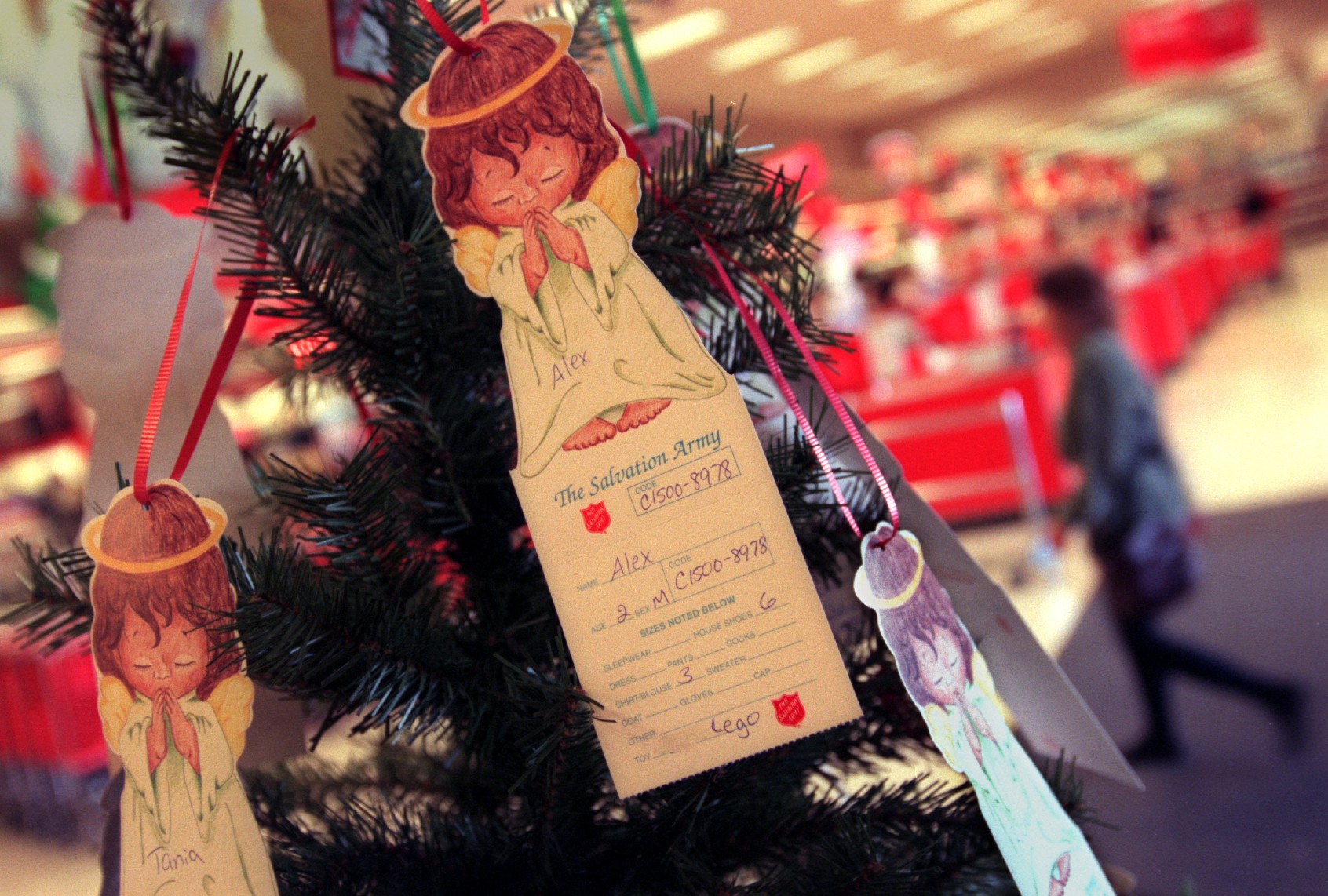

The first time that 41-year-old Janna, a former foster kid and self-described escapee from a “super-churchy small town,” watched a TikTok about Angel Tree shopping, she had what she recalls as an unexpectedly queasy reaction. “It was basically wholesome, just, like, ‘Hey, come shopping with me for the kid whose Christmas list I picked off the Angel Tree at the mall,’” she says, going on to describe the video made by a twentysomething woman picking out gifts for a 12-year-old “angel” who had requested cute socks, glittery shower gel and moisturizer, and a puffer jacket. “And then I had a flashback to my church’s holiday social, where kids like me got gifts from people in the community, and it felt like everyone was watching us to make sure we were grateful in the correct way.”
Janna’s initial encounter with Angel Tree TikTok happened in 2023, the year that the platform was suddenly and unexpectedly inundated with videos of well-meaning young women buying Angel Tree gifts that garnered tens of millions of views and likes. In the two years since, she’s been flummoxed by her own continued fascination with a corner of TikTok increasingly defined by drama, judgment and mess: “On one level I really love that a lot of the people making these videos seem to care about doing right by the child whose tag they chose.” The fact that Angel Tree shoppers are inevitably performing goodness, however, is a discussion Janna wants more people to engage with. “I know a lot of people who think that charity is charity, that as long as people who need help get it, then it doesn’t matter what form [it’s in]. As someone who has been part of the performance, I would maybe challenge that.”
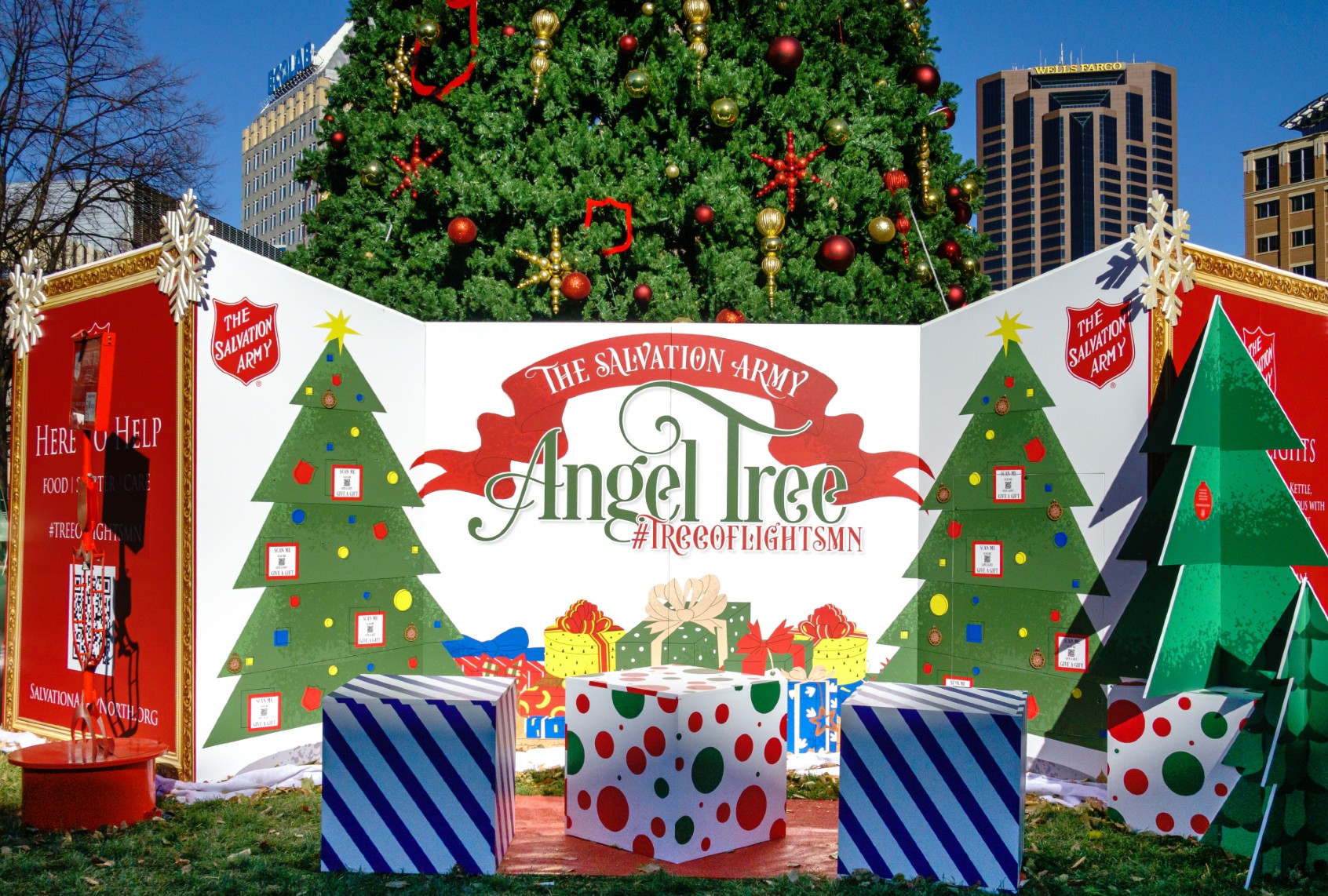
(Wolterk/Getty Images) Salvation Army Angel Tree of Lights in Downtown St. Paul, Minnesota
The Salvation Army has run the Angel Tree program for over 40 years, but its social media boost has come about through a few different flavors of controversy. One category of Angel Tree controversies involves shoppers who are seen to have “gone overboard” — they bought too much, or they bought inappropriately, or they simply seem a bit too pleased with what they bought. A 2024 People article titled “Woman shares gifts she bought for her Angel Tree kid — and her purchases cause uproar on TikTok” reported on a creator whose account of shopping for a 10-year-old girl garnered more than 9 million views and 7 thousand comments, many of which accused her of skimping out on price (for instance, buying a $25 backpack instead of the $150 one requested), buying the “wrong” kind of Stanley cup and, hilariously, letting the child down by purchasing pho when, commenters argued, it was almost certainly a typo that was meant to read “phone.”
Angel Tree’s focus on children often results in a pile-on of judgment about and distrust of parents.
In a mid-November Facebook post, one Angel Tree shopper wrote, “I truly don’t understand when helping Angel Tree children turned into something confrontational,” and went on to list some of the more bizarre responses she’d gotten when she and her daughter documented their shopping trip. (“Why didn’t you buy more?” “Why did you buy THAT much?” “Why did you pick those items?” “Don’t buy extra; another kid might get less.” “You should only stick to the list.”) As if on cue, this year’s Angel Tree villain emerged with an approach to fulfilling the wish list of one of the children she chose to shop for that was both hostile and self-aggrandizing enough to inspire hundreds of stitched reactions, a flurry of mocking satires, and so much vitriol from commenters that the creator ultimately deleted her account.
Confrontations like these reflect a larger, ongoing reckoning with the ethics of fusing philanthropy and performance. Social-media audiences side-eye everything from the contrived fauxlanthropy of YouTube star Mr. Beast to the feel-good public spectacle of “kindness influencers” to the bait-and-switch of billionaire tech overlords who establish charities primarily to ensure that their wealth-hoarding and tax-dodging schemes have a sheen of munificence. The existence of both satirical pop culture like “The Curse” and sincere-but-doomed reality programs like “The Activist” prompts us to confront the ethical dissonance of activism as entertainment.
Has the normalization of performative charity made it more difficult to parse genuine kindness?
Tess, 39, who has participated in Angel Trees through her work in nonprofit public relations, as well as organizing food and toy drives in her neighborhood, feels like it’s important to underline the upsides to performative charity, especially around the holidays. “The amount of need that exists in any given city, in any school district or neighborhood, can feel crushing” when you don’t know how to help, she says; the fact that TikTok has made Angel Trees part of a popular lexicon “makes people see that giving doesn’t have to be a whole complex thing.” On the other hand, she also believes that some forms of charity become less effective as they gain widespread cachet, and worries that “all the hoo-hah” around Angel Trees — the overspending and backbiting and the rigid articulation of the “right” and “wrong” ways of doing good — might ultimately have a chilling effect if the topic remains such a source of social-media friction. “Social-media algorithms prioritize conflict and disagreement,” she says. “And the more people become aware of that, the more they’re going to worry about being called out for having an unorthodox opinion about how best to do good.”
Want more from culture than just the latest trend? The Swell highlights art made to last.
Sign up here
Janna agrees, particularly because Angel Tree’s focus on children often results in a pile-on of judgment about and distrust of parents. “Almost every argument about whether Angel Trees are good or bad or whatever is about parenting: What kind of monster can’t make Christmas happen for their kid? Why didn’t they spend the year planning for Christmas instead of signing their kids up to be Angel Tree recipients? Why don’t they get a second job, or a third job?” Parents of Angel Tree kids not only don’t get the benefit of the doubt, but they are also frequently portrayed as villains with boundless energy for scheming and scamming systems: requesting Playstations and iPads for their 2-year-olds, forcing their kids to return Angel Tree gifts for cash, gaming the system by signing their kids up for multiple gifting programs.
And in turn, she notes, “that obscures what are, to me, important structural problems”— for instance, that the Salvation Army itself once tried to make a deal with President George W. Bush that would have allowed religious charities receiving federal funding to circumvent local enforcement of anti-gay discrimination laws, or that it has a history of undermining its motto of “Doing the Most Good” by prioritizing anti–LGBTQ rhetoric and bigotry.
Has the normalization of performative charity made it more difficult to parse genuine kindness? Probably not, but Angel Tree content on TikTok is currently making a strong case that what lives by the platform also dies by the platform, and in a head-spinningly short span of time. “Becoming aware of the Angel Tree phenomenon has been kind of a wake-up call for me, a reminder of how easy it is to be cynical about other people’s sincerity,” says Tess, a bit sadly. “All the content piling up about whether Angel Trees are good or bad or overindulgent or scammy risks making people suspicious of charity as a concept. Yes, it’s easy to see scams everywhere because scams are everywhere. But that doesn’t mean everything’s a scam. I don’t want to be the person who treats every instance of kindness as performative or exploitative.”
Read more
about philanthropy
