

December is jam-packed — more so every year, it seems—so the idea of squeezing in even a small handful of films from the golden-age Christmas canon can begin to feel like rolling a Sisyphean snowball uphill. (“Miracle on 34th Street.” “It’s a Wonderful Life.” “White Christmas.” Already, you are tired.) But if I could recommend one slightly underrated entry from the black-and-white set — one that rewards a rewatch, or a first watch, with uncommon pleasures — might I gently point you toward “Christmas in Connecticut”?
It has much to recommend it: a spirited Barbara Stanwyck, whose sly chemistry with Dennis Morgan feels equal parts warm and effervescent, like a well-timed hot toddy; the pleasing fact that the film turns 80 this year, which officially ushers it into classicdom.
And, perhaps best of all, the surprise that it is, unmistakably, a food movie.
The film sets this up from the opening credits. Two Navy sailors, Jefferson Jones and his pal, Sink, have been adrift on a raft for 18 days, long enough for hunger to curdle into imagination. Jefferson dreams himself into a restaurant, summoning a waiter—“Garçon, where is the Bordelaise sauce?”— and reaching, blissfully, for another pour of wine, before he is jolted awake. “Doggone you, Sink,” he grouses. “I was just having a wonderful dream.” The dream, of course, is food. As the days drag on, Jefferson’s fantasies of his first post-rescue meal crystallize until he can recite the menu almost like an incantation: a steak, thick and juicy; baked potatoes; asparagus slicked with hollandaise; chocolate cake and ice cream.
Jefferson gets his wish of rescue — but the steak, it turns out, will have to wait. In the hospital, Mary Lee, the sweetly competent nurse tending to him, explains the problem with gentle firmness: “You were out on a raft for 18 without any food. Well, your tummy’s not ready for solid food.” Jefferson is confined to liquids, sentenced to a kind of culinary purgatory. Sink, meanwhile, has already graduated back to solids (the film’s logic being that he starved for slightly less time, having been given the last of their shared K ration) and is suddenly enjoying a parade of gourmet dinners.
He has, he explains, discovered a workaround. “You’ve got to use the old magoo!” Sink tells Jefferson, gesturing toward the nurses. “Don’t they like to do those little extra things,” he asks, “for a guy who’s in love with them?” It is a line tossed off as a joke, but it sets the plot in motion all the same: Jefferson proposes to Mary Lee, and soon enough finds himself on a train headed for Christmas in Connecticut — specifically, the Connecticut home of another woman entirely, Elizabeth Lane.
We encounter Elizabeth Lane first not in the flesh, but on the page.
Jefferson reads her writing from his hospital bed, studying it the way a hungry man studies a menu, lingering on every promise. In her columns for “Smart Housekeeping,” Elizabeth presides over an idyll of New England domesticity. “From my living-room window as I write,” she assures her readers, “I can look out across the broad front lawns of our farm… like a lovely picture postcard of wintry New England.” The film, ever so gently, disagrees. The camera cuts to Elizabeth’s actual surroundings: a New York City apartment, where the radiator clacks and hisses in place of a crackling fire, and the view is brick, not snow-dusted pasture.
Want more great food writing and recipes? Sign up for Salon’s free food newsletter, The Bite.
When Elizabeth writes of stepping into her gleaming kitchen to “test the crumbly brown goodness of the toasted veal cutlets à la Connecticut,” she is not so much lying as world-building. But the fact remains: that Elizabeth Lane, the one America invites into its kitchens every month, is an invention. A carefully tended fantasy.
Whereas this Elizabeth Lane, the one sitting at her typewriter, can’t cook. Not a single dish. The bit lands quickly, but beneath it is a quieter anxiety about how much of a woman’s worth — professional and personal — has been baked into the idea that she can.
And unfortunately for Elizabeth, the fantasy she’s constructed is about to be taken very literally.
Her publisher has heard from Mary Lee, who senses that Jefferson’s enthusiasm for his hospital-room engagement may be waning, and believes the cure is exposure to the real thing: a holiday spent with America’s best housewife. The editor, unaware of the farce and buoyed by wartime cheer, immediately agrees. Why not? Supporting the troops is good for morale—and, not incidentally, good for circulation. There is only one hitch. There is no farmhouse. There is no husband. There is no baby. And the perfect duck Elizabeth has been lovingly seasoning on the page exists only as prose.
Backed into a corner by the threat of a career-ending scandal—one that would not only undo her but also her blithely trusting editor — Elizabeth agrees to make the fantasy corporeal. In quick succession, she arranges a marriage of convenience with her friend John Sloan, who happens to own a farm in Connecticut, and calls in reinforcements: Felix Bassenak, her beloved chef friend and honorary uncle, the quiet architect of her success, who has been supplying her recipes all along.
What follows is 90 minutes of escalating holiday farce: romantic sparks with Jefferson, culinary sleight of hand, and the repeated appearance (and explanation) of a baby whose origins seem to shift depending on who is in the room.
We need your help to stay independent
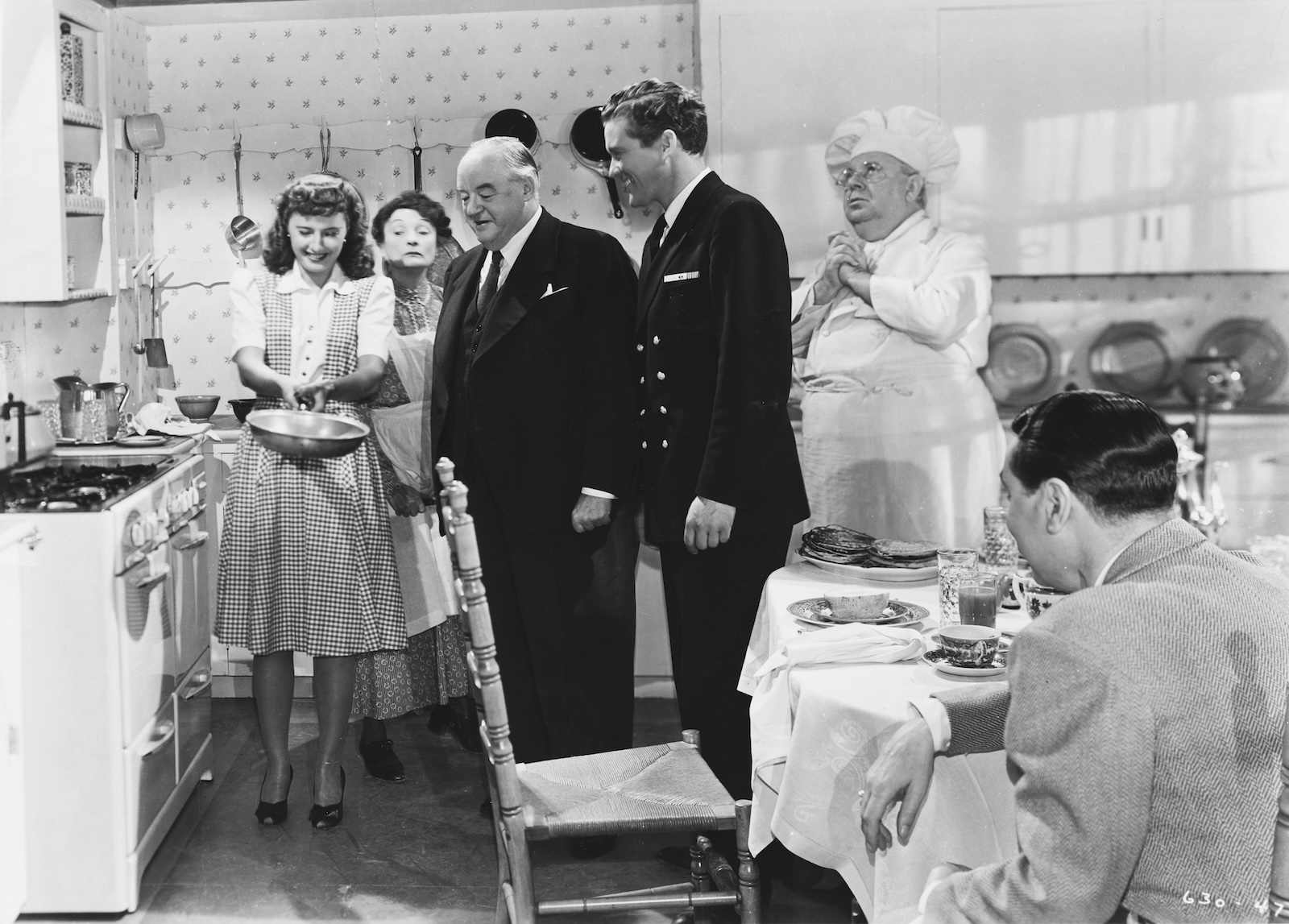
Scratch just beneath the film’s screwball surface and its beating heart as a food movie quickly reveals itself. Elizabeth’s prose, which Jefferson devours with the focus of a man newly returned to solids, is full of lush, almost decadent detail: a salad glossed with blue cheese dressing; “breast of gray dove, sautéed with peaches grenadine.” The food is described not merely to be eaten, but to be imagined. Kitchen scenes abound, too, including an enduringly funny sequence in which Elizabeth—who has confidently written of her domestic prowess—is coaxed into flipping a single flapjack, an act she performs with the concentration of someone defusing a bomb.
And then there is Felix Bassenak. Played with boundless enthusiasm by S. Z. Sakall, Felix is one of the great, undercelebrated chef characters in popular culture: rotund, ebullient, deeply competent, and visibly delighted by his own work. It is through Felix that the film engineers its boldest turns and broadest comedy, but also its most interesting ideas. In an era newly reacquainted with debates about women’s roles in the home and workplace— about who cooks, who performs and who gets the credit — Felix feels quietly, surprisingly progressive.
Felix, after all, is doing all of the recipe development. The arrangement is framed as gratitude, his thank-you to Elizabeth for helping him secure his first restaurant, but its implications ripple outward. Here, it is a man whose labor disappears behind a woman’s byline, a sly inversion of the far more familiar historical pattern.
And crucially, when Elizabeth finally gets her man, it is not because she has mastered the stove through late-night lessons or raided her own archives for answers. She is not redeemed by competence. She is not domesticated by practice. Instead, the film’s closing line lands its punch with breezy assurance: “She can’t cook, but what a wife!”
Which may be why “Christmas in Connecticut” remains such a pleasure to return to, especially in December, when the idea of doing everything perfectly — hosting flawlessly, cooking beautifully, being effortlessly competent — can feel exhausting. The film offers a softer fantasy: that warmth can be improvised, that collaboration counts, that love might arrive even when dinner does not. If you’re looking to add one more black-and-white classic to the rotation this year, you could do far worse than this one.
Best enjoyed, perhaps, with something simple on the table.
Read more
about this topic
