

On a cold winter night, Italian food often appears in its most familiar forms: a steaming bowl of pasta, a bubbling pan of baked ziti, a long-simmered sauce meant to thaw you from the inside out. But the version of Italian cuisine most Americans reach for in winter — heavy on red sauce, overflowing plates, indulgence as comfort — is only a narrow slice of a far deeper, more practical tradition.
Italian cuisine, in reality, is one of the most regionally specific, seasonal, and resource-driven food cultures in the world. Its reputation for coziness isn’t accidental; it’s the result of centuries of people cooking with what they had, where they lived. Out of necessity, they learned how to cook with restraint while still providing warmth; survival, not indulgence. Nowhere is that more evident than in Italy’s central and northern regions, where mountain cooking, preservation, and harsh winter shaped a cuisine far removed from the checkered-tablecloth stereotype.
That depth — and the way it’s been flattened abroad — didn’t happen by accident.
How Italian cuisine became a greatest-hits reel
Food historian Alberto Grandi has spent years unpacking what he calls the “myth” of Italian cuisine: the idea that Italy’s food culture is ancient, fixed and universally shared across regions. In reality, much of what Americans think of as Italian food was shaped by immigration, scarcity, and reinvention — especially in the United States.
“The myth starts very late, basically in the second half of the 20th century,” says Grandi, “And it starts not in kitchens, but in advertising, tourism, and politics.”
Want more great food writing and recipes? Sign up for Salon’s free food newsletter, The Bite.
Italy became a nation in 1861, but Grandi says it became “Italian at the table” only after mass emigration, industrialization, and economic growth. “What we now call ‘Italian cuisine’ is a retrospective construction, projected backwards as if it had always existed,” he says.
When Italians immigrated to the U.S. in the late 19th and early 20th centuries, they encountered a level of abundance that was unfamiliar. Meat, once reserved for special occasions, became more accessible. Portions grew. Dishes were adapted to new ingredients and new expectations. Over time, those adaptations hardened into “tradition,” exported back to the world as a singular Italian cuisine.
“Seasonality collapsed. Tomatoes became eternal, meat became central, portions exploded. Italian food abroad became a cuisine of celebration rather than survival,” says Grandi.
The result was a simplified image: pasta as the center of every meal, tomato sauce as the dominant flavor, excess as comfort. Grandi says that what the “myth” of Italian cuisine obscures the most is hunger.
“Pasta with meatballs is not a peasant memory; it’s an immigrant invention born from abundance,” says Grandi, “For most Italians, for most of history, food was not about pleasure, identity or abundance — it was about survival. Diets were monotonous, seasonal and brutally constrained by income and geography.”
A cuisine shaped by geography, not indulgence
Italy has always been a cultural crossroads, and its food reflects centuries of migration, trade, and regional isolation. Even the physical appearance of Italians tells a story of movement: darker features common in southern regions like Sicily and Sardinia, where North African and Middle Eastern influence runs deep; lighter features more common in northern regions shaped by proximity to Austria, Switzerland, and Central Europe.
The food mirrors that diversity. Southern coastal cuisines lean toward seafood, citrus, olive oil, and lighter preparations even in colder months. But as you move inland and north — into Abruzzo, Emilia-Romagna, Lombardy, Friuli-Venezia Giulia — winter cooking becomes heartier, more restrained, and deeply tied to survival.
This is where Fabio Parasecoli, a professor of food studies and a native Roman, situates Italian comfort food not as indulgence, but as memory and necessity.
He talks about a recent lunch he made: soup with chestnuts. The sweet and soft nut plays a large role in traditional mountain cooking and tradition because in places where you couldn’t grow wheat or barley, there were still chestnut trees.
“People made flour with it, cooked with it, roasted it, or boiled it,” he says.
We need your help to stay independent
For Parasecoli, the foods associated with winter — soups thick with legumes, braised meats stretched across multiple meals, dishes built around grains, potatoes, and preserved ingredients — aren’t about excess. They’re about warmth, continuity, and care.
“I remember growing up, all our sauces started with a little olive oil, but also a lot of pork fat,” he says, “Because olive oil could be found, but was more expensive than the fat people could get from the pigs they raised and they butchered.”
As a child, one of the first things Parasecoli learned how to do in the kitchen was turn a block of pork fat into a paste to use as a sauce starter.
“There is the whole culture of the pig that is quite important. You would make everything with the pig, You wouldn’t throw out anything at all,” says Parasecoli, “You would boil the head and then use the meat that you would take out of it and press it into something that you cut in slices. The blood, you would use it to make desserts or different things.”
He says the culture of “offal,” organ meats, is very important to Italy. In Rome, he grew up eating things like livers, lungs and tripe, and he says these types of dishes are becoming “more fashionable” as younger Italians turn toward the nostalgia of tradition and tourists dive deeper into regional and sub-regional cultures. He says the idea of eating and cooking with leftovers has always been important in Italy because through embargos, war and political turmoil, there wasn’t much to eat, so you had to find ways to re-use.
Mountain cuisine, in particular, reflects a logic born of constraint. Fresh vegetables are limited. Nothing is wasted. Cooking is slow not for romance, but because it has to be. The hearth, where many of these dishes were made, was the one source of heat for many families, especially in the countryside. Parasecoli says this inherently created a culture of “one-pot cooking.”
“A hot pot of soup or stew is not only nourishing, but it also works well, you know, in a cold climate, and gives you a sense of comfort, a sense of family,” he says, “When people moved into cities or into buildings, they brought with them the sense of comfort connected with stews and soups that I think it’s still quite central in Italian cuisine.”
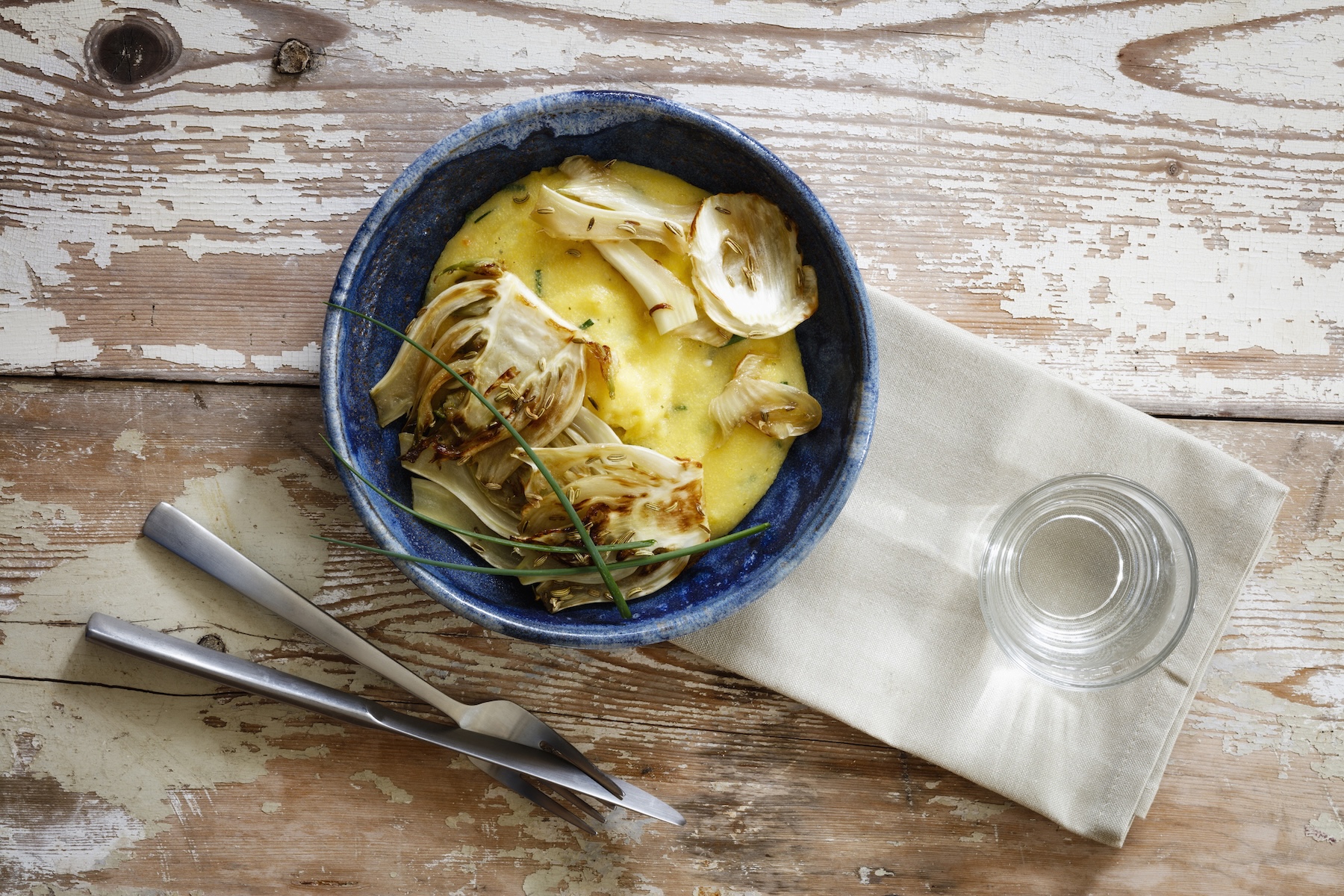
The sweet and nutty aroma of roasted chestnuts, the surprising softness as you take your first bite. Just a few can leave you satiated, just as good as eating a few slices of bread. Hearing the crackle of a small flame — that slightly charred, earthy smell — while a slab of pork fat pops in the cooking kettle, slowly melting down as the base for tonight’s sauce. The rhythmic movement and sore muscles that come from slowly stirring polenta, the way the earthy, nourishing aroma slowly fills the room as the grains start to thicken. This is the version of Italian food that rarely makes it into mainstream imagination: not flashy, not maximalist, but deeply comforting in its restraint.
Why winter food feels so Italian — even when it’s misunderstood
Italian cuisine’s reputation as comfort food isn’t wrong — it’s just incomplete. The coziness comes from structure: meals designed to nourish through cold months, to make use of preserved ingredients, to create warmth without extravagance.
That structure is especially visible in central and northern Italy, where dishes often revolve around meat broths, polenta, beans, chestnuts, and long-cooked cuts meant to feed families over several days. Grandi argues that the logic behind “survival, not indulgence” supersedes any emotional connections tied to the food.
“Taste was shaped by repetition and memory. Comfort didn’t come from variety, but from predictability. Eating the same dish every winter wasn’t boring; it was reassuring,” says Grandi, “Traditionally, Italians didn’t romanticize this connection. They didn’t say ‘comfort food.’ They said ‘this keeps you alive.’ The emotional meaning came later, through memory.”
For Parasecoli, however, that emotional warmth matters as much as the ingredients.
“There is the sense of, you know, sort of reconnecting with one’s origin, even after a migration, but also this physical sense of comfort that comes when you live in a cold place in winter and you need something to nourish you,” he says.
“Taste was shaped by repetition and memory. Comfort didn’t come from variety, but from predictability. Eating the same dish every winter wasn’t boring; it was reassuring.”
And increasingly, he notes, younger Italians are rediscovering that logic. He says the idea of being able to make these traditional dishes from specific areas has become a point of pride for many young people as they search for a sense of identity as well as cultural capital.
“The interesting thing is, very often, their grandparents are not alive any longer to teach them, and so they have to learn from magazines or YouTube,” says Parasecoli, “The transmission of knowledge, it’s somehow been interrupted, but that knowledge is still circulating, of course, interpreted and very often elevated.”
Learning the regions dish by dish
If Parasecoli explains why Italian winter food feels the way it does, Katie Parla shows how it works — region by region, ingredient by ingredient.
Parla, an American who moved to Italy and built a career leading regional food tours, teaching cooking classes, and writing cookbooks, has spent years helping people unlearn the idea of a single Italian cuisine. She says her first trip to Italy was on a school trip when she was 16 years old, and they ate “really terrible food” everywhere they went.
“I was like, I thought Italy was supposed to have good food. Maybe there’s something. There’s a story here. And so I would say, from the jump, my desire to understand Italian gastronomic culture has really been driven by an acknowledgement that the romantic stereotype is false.”
In her work, she strives to focus on the local people who are “truly doing hard farm work, artisan food crafts, biodynamic farming,” which is not the norm in the now-industrialized food country.
Even within northern and mountain cuisines, Parla emphasizes, the variation is enormous — shaped by access to trade routes, neighboring countries, ancient populations, and microclimate (“Some people have to adapt to living in valleys, others in remote peaks”).
In Friuli-Venezia Giulia, for example, Slavic and Austro-Hungarian influences show up in smoked meats, dumplings, and fermented flavors. In Piedmont, dairy-rich cooking leans into butter, cheese, and slow braises. In Emilia-Romagna, egg pasta and meat broths dominate winter tables, while Abruzzo’s mountain villages rely heavily on lamb, legumes, and preserved vegetables.
“Things that are caloric, hefty, but also can be cellared. So I’m thinking like polenta, aged cheeses, things that you can produce in certain times of year and then put in the pantry or in the cellar,” says Parla.
She talks about dishes like frico (made from aged montagio and fortified with breadcrumbs or polenta), dense winter cakes, potato-based dishes (“less pasta than the sort of Italian perception might call for”), preserved pork, lacto-fermented cabbage (“sour of sauerkraut-y type things”), bollito, buckwheat, cornmeal. The list goes on…
What unites these cuisines isn’t a single dish, but a mindset: cooking according to season, stretching resources, and prioritizing sustenance over spectacle.
“Those sort of base ingredients speak to the preservation techniques that predate refrigeration and the shorter growing seasons of mountain areas that require you to really, like, get all your harvest as soon as possible,” says Parla.
For Parla, that practicality is often what Americans miss when they approach Italian food as indulgence. She says that on a recent tour in Friuli, some travelers were asking her when they were going to eat pasta by day two.
“I’m, like, We talked about this, the food’s different,” says Parla, “And so they were really surprised to find, like, pork with kren in a Trieste city context. And then, you know, visit the Friulian Alps and eat these ethereal Alpine cheeses.”
Teaching people to see the full picture
Parla’s work is built around slowing people down. Instead of chasing iconic dishes, she encourages attention to context: why this food exists here, now, in this season.
“As soon as we get a cold snap, the chicories start to come out, and from the Veneto over into Friuli, you just have this, like huge variety of different radicchio species,” she says.”
Parla says that, to an extent, the city of Gorizia has built their economy around the Rosa di Gorizia; a crisp and delicately bitter radicchio variety known for its rose-like appearance and intense cultivation process. It’s season is extremely brief (about two months from December to February). “If you ask for it out of season, people are shocked,” says Parla.
That approach resonates at a moment when food knowledge itself has become a form of cultural fluency. Knowing the difference between northern and southern Italian cooking — or between one mountain region and another — signals curiosity, care and literacy.
That approach resonates at a moment when food knowledge itself has become a form of cultural fluency. Knowing the difference between northern and southern Italian cooking — or between one mountain region and another — signals curiosity, care and literacy.
It’s part of why places like Enoteca Maria, the Staten Island restaurant where grandmothers from around the world cook their regional dishes (including from different parts of Italy), have captured attention. They reflect a growing appetite for specificity — and for the stories behind food.
“People understand what Italy is, it’s a geographic space, it has, in some cases, common history, but in reality, we still live a pretty regional life,” says Parla, “So immersing yourself, let’s say, in the cuisine of Lombardy or Friuli allows you to see how those cultural distinctions play out at the table, even though sometimes borders can seem arbitrary.
She says that, even today, from one valley to the next, food traditions can change depending on which kingdoms ruled there and what spices or resources they had access to.
“That can still be perceived on the table today, and eating, I think, should also be a historical exploration,” she says.
Why this matters now
With Italy once again in global focus — from tourism rebounds to international sporting events like the upcoming Winter Olympics — the country’s regional cultures are being reexamined. But the real relevance of Italian mountain cuisine isn’t about spectacle or nostalgia. It’s about usefulness.
These traditions evolved to answer a simple question: how do you eat well, stay warm, and waste nothing when winter limits your options? Italians mastered how to create a food culture built around comfort and family without being superfluous.
In an era of rising food costs, climate anxiety, and renewed interest in seasonal living, Italian winter cooking offers something rare: comfort without excess, tradition without rigidity, and warmth rooted in care rather than indulgence.
And perhaps that’s the real lesson hidden beneath the pasta stereotype: Italian cuisine isn’t just about pleasure. It’s about knowing where you are, what you have, and how to make it last through the cold.
Read more
about this topic
