


I love a social media moment that involves a screenshot of some unhinged or overblown statement and the sentence “You will never guess what this post is about.” But the other day, scrolling past a dripping-with-disdain comment on Threads — “These ‘Melt ICE hats’ are giving me flashbacks. Have we learned nothing from pussy hats?” — I didn’t need to guess its provenance.
Weeks since the Department of Homeland Security launched Operation Metro Surge, the streets of Minneapolis/St. Paul have been filled with tragedy and fury, flooded with untrained, jumped-up goons intimidating and antagonizing legal observers. The astonishing breadth of local organizing and mutual-aid efforts, much of it done by people who aren’t seasoned protest vets, has risen to meet the chaos. There are countless news dispatches about local residents galvanized by the violence unleashed in their streets, regular reminders of the many ways citizens are disproving the lies of lawless government agencies looking for a reason to continue opening fire. So it wasn’t surprising to see a flurry of stories in the last two weeks about Needle & Skein, a Minneapolis-area yarn shop selling a pattern for a red, knitted “Melt the ICE” cap whose proceeds would be directed to immigrant communities in the area.
The pattern was for an elongated red stocking cap called nisselue, once worn in Norway to protest its Nazi occupation (and eventually banned for that very reason), that was itself inspired by the French revolution-era symbol of liberty known as the Phrygian cap. The “Melt the ICE” pattern had both historical resonance (the majority of America’s Nordic-descended population lives in the upper Midwest) and a simple call to action quickly embraced by crafting communities mobilizing against ICE.
But news of a growing red-hat resistance also poked at a sore spot at the seam of craft and protest, one that stretches back almost a decade. In January 2017, the day after Donald Trump was inaugurated, millions attended the Women’s March, which was originally conceived as a march on Washington but ultimately resulted in hundreds of marches that spanned the globe. Tens of thousands of marchers wore bright-pink, rectangular hats with a top seam that drooped into catlike ears — the so-called pussy hat. Created by three Los Angeles crafters who envisioned the march in D.C. as “a sea of pink hats,” the hat and its simple pattern — accessible for first-time knitters and meant to be worn by anyone attending a Women’s March — quickly went viral.
“The internet isn’t good at nuance,” says Betsy Greer, a writer, editor and longtime craftivism ambassador. “It’s hard to control the narrative once a project is out there on the internet. The project isn’t weird. The internet is.”
Soon after that, it went sideways. The hat’s ubiquity sparked scrutiny and then suspicion. As pussy hats became increasingly visible as a symbol of action, they likewise became synonymous with inaction. The hats were scorned — notably and primarily by other women — as infantilizing and unserious, but also as racist and transphobic. They were performative, empty white feminism incarnate, and eventually pussy hats became a reflexive shorthand for dizzy, insincere protest dilettantes.
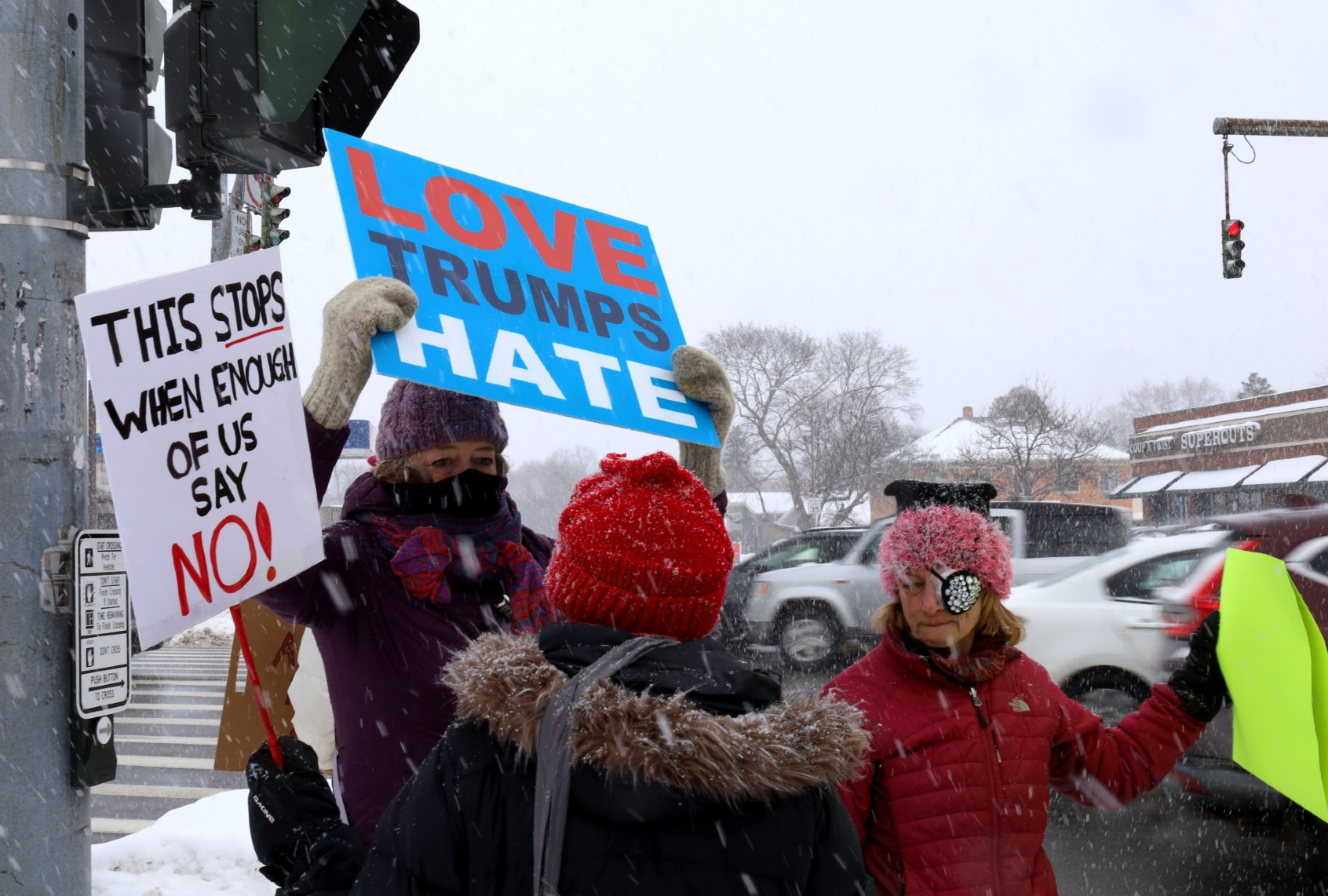
(John Whitney/NurPhoto via Getty Images) Nationwide protest against ICE
The amount of meaning women ascribed to the hats — or rather, the amount of meaning other women were allegedly ascribing to it — overwhelmed the project. By the day of the actual march, the hats had become repositories for assumptions and indictments about protest, representation, erasure and belonging. It was all summed up in the now-iconic photo of Angela Peoples holding a sign that read “Don’t Forget: White Women Voted for Trump” while, in the background, a moment and an indictment was captured: three blond white women in hot-pink hats posing for selfies. By the end of January, the pussy hats were in the rear-view mirror.
The virality of Needle & Skein’s ”Melt the ICE” caps brought that hostility right back, resulting in snarky posts like the one that stopped me short on Threads and zingers that invoked pussy hats both obliquely (“Didn’t we agree that you can’t accessorize your way out of fascism?”) and directly (“Shock of all shocks, those performative pink hats didn’t stop the attack on Roe v. Wade”)
Want more from culture than just the latest trend? The Swell highlights art made to last.
Sign up here
This is true; pussy hats did not stop the attack on Roe v. Wade. That was partly because attacks on abortion began as soon as abortion was legalized; the Dobbs decision was the endgame of a well-funded, decades-long process of chipping away at abortion access. But it’s mostly because they were hats. “The internet isn’t good at nuance,” says Betsy Greer, a writer, editor and longtime craftivism ambassador. “It’s hard to control the narrative once a project is out there on the internet. The project isn’t weird. The internet is.”
And the failures laid at the floppy ears of pussy hats happened long before they existed. They were entrenched, systemic and institutionalized: The racist, misogynist norms that delivered 52% of white women to Trump. The media apparatus already calibrated to undercut Hillary Clinton’s presidential run. The continued existence of an electoral college that weakens the impact of actual voters. The Democratic consultant class that studiously ignored the success of Trump operatives like Steve Bannon, who stoked constant, outsized grievance among young men online and then guided them to voting booths.
We actually did learn something from pussy hats: That a crocheted or knitted rectangle of cotton or wool can be endowed with enough bad faith to ruin protest hats altogether. In a 2019 piece for the cultural anthropology journal Sapiens, Jamie E. Shenton addressed “The Pussy Hat’s identity crisis” by surveying a cross-section of pussy-hat wearers and refusers, “prob[ing] the feelings of both proponents and opponents of the hat.” She arrived at a conclusion familiar to feminists: “Creating a symbol that unifies ‘every resister’. . . might be harder than it looks.”
We need your help to stay independent
Craftivism as a form of protest exists everywhere, past and present. The AIDS memorial quilt is craftivism, as is the textile graffiti form called yarn bombing. The Boston Quakers who founded the Homespun Movement to grow American textile production were craftivists; the Knitting Nannas of Australia are an “international disorganization” of environmental activists whose knit-ins protest fossil-fuel projects. But because craft itself is a medium associated with the domestic and with women, craftivism, despite being a visible, traceable medium, still feels as though it exists in an epistemic limbo.
“Crafts have always been devalued, which I think is kind of a superpower,” Greer says, “because people think, oh, you’re just crafting. But you’re showing that there’s teeth to making, and that making something connects you to the people who came before you who made things” — The Welsh nuclear-disarmament activists who protested at Greenham Common for two decades, Las Madres de Plaza de Mayo, the grieving mothers of dissidents disappeared by Argentina’s military junta who began weekly public protests in the names of their children, starting in 1977, that continue to this day.
Protest via textiles, paper, and garments is a tradition shared across cultures. Pinned to Greer’s Instagram page is a list of at least 60 different terms that describe the practice, from story cloths and guerilla knitting to counternarrative making to social practice. “All these different terms that people use for this kind of work [are] exciting to me because I never meant the term to be prescriptive,” Greer says.
The pussy-hat phenomenon, meanwhile, should never have been a referendum on feminism. And though there’s no way to unring that bell, I think it’s worth keeping good faith in mind — even if you never get within 10 feet of another hat pattern. In any case, red-hat resistance so far appears to be mindful of pitfalls, if the posts in the Antifascist Knitting subreddit are any indication. “Genuine question: [are] the Norwegian red hats performative?” a recent one asked. More than 200 responses consider the question seriously. But the last word belongs to Skein & Thread’s owner: “We have raised over $125,000 so far to be donated. That is far from performative.”
Read more
about crafting with a purpose
