


Recently, I spent too much time trying to figure out if it ever rains on “Shrinking.” The answer is yes, but infrequently. Two episodes into its third season, Jimmy Laird (played by co-creator Jason Segel) and his crew have yet to experience a day of inclement weather in their version of Pasadena. That doesn’t mean they aren’t weathering any storms.
As psychologists, Jimmy and his co-workers Gaby (Jessica Williams) and Paul (Harrison Ford) dedicate themselves to helping their clients manage the weight of the world. As friends, each is a vital component of the other’s emotional scaffolding, a mechanism that wouldn’t exist if not for a tragedy. Jimmy and his daughter Alice (Lukita Maxwell) still grapple with the recent loss of his wife and her mother, Tia. Gaby has embraced the Lairds’ next-door neighbors, Liz (Christa Miller) and Derek (Ted McGinley), as members of her extended family, which never would have happened if Tia hadn’t died.
Inviting us to sit down with a show about mental health professionals mending their spirits is group therapy on a massive scale in a time of diagnosable disorder.
But mourning her best friend’s death, and the end of her marriage, is stalling out Gaby’s new relationship with, yes, another Derrick (Damon Wayans Jr.).
Then we have Paul, a late-career therapist who loves his work and his new wife and former neurologist Julie (Wendie Malick). Paul also has Parkinson’s disease, and his symptoms are worsening. A chance meeting with a fellow Parkinson’s patient, Gerry (Michael J. Fox), and a bout of hallucinations are pushing him toward a series of solemn realizations. Life as he currently knows it cannot go on.
Over the last decade and a half, the critic’s role has evolved from that of an arbiter to a kind of prescriber. This is a consequence of personalized entertainment streams; people care less about whether a professional deems a show to be good than whether they might enjoy it. My peers would say we’ve always served that purpose, but sorting wheat from chaff isn’t the same as steering someone toward shows that are not simply satisfying but palliative. “Breaking Bad” and “The Wire” are among the best of the best TV shows, but I can only imagine sadists watching either for a mood boost.
To this day, I know people who pop “Ted Lasso” episodes like uppers, especially to cope with the assortment of traumas this administration is inflicting on us. (If you count yourself in that number, good news: An updated formula — or in layman’s terms, a fourth season — will be released sometime this summer.) “Shrinking” executive producers and co-creators Bill Lawrence and Brett Goldstein also work together on that surprise curative, which dragged most of us through the pandemic and beyond.

(Apple TV) Jessica Williams in “Shrinking”
But inviting us to sit down with a show about mental health professionals mending their spirits is group therapy on a massive scale in a time of diagnosable disorder. As the administration degrades our system of laws, economic stability, safety and peace of mind, some psychologists have described these assaults as resilience targeting.
The term originated in a paper on climate change and hybrid warfare strategies written by former University of Alaska Anchorage professor Chad Briggs, Ph.D. Within it, Briggs describes concrete strategies that military aggressors employ to destabilize their opponents, but the indirect impacts achieve the same as the direct.
“[A]ctively undercutting resilience of critical systems automatically increases associated vulnerabilities,” Briggs wrote, “whether the ability to withstand outside attacks, maintain social, political, and economic stability, or to recover following a disaster.”
A common recommendation to combat the toll of resilience targeting is connecting to stories we find motivating and hopeful.
This paper was published in 2020, by the way, when pandemic shutdowns separated us physically and ideologically. That same year, another psychological explanation for our lingering malaise and low energy, surge capacity depletion, circulated widely. This is what happens when the adaptive systems we call on for short-term survival are tapped for an indefinite stretch. We become batteries that can’t hold a charge.
If you never quite recovered from pandemic burnout, enduring resilience targeting on top of surge capacity depletion may feel impossible. A common recommendation to combat the toll of resilience targeting is connecting to stories we find motivating and hopeful.
“Shrinking” exists in a bubble entirely divorced from current events, thank goodness, although the production itself is a tribute to persistence. Many of the Altadena and Pasadena locations featured in the first two seasons were impacted by the Eaton fire that broke out in early January 2025. The Altadena home that served as the exterior of Gaby’s house completely burned down.

(Apple TV) Luke Tennie, Rachel Stubington and Isabella Gomez in “Shrinking”
But the way it tethers its bruised healers to the human condition’s laws of gravity is potent medicine for coping. This explains our fixation with “Ted Lasso” when it was new, and “Shrinking” now that it has settled into identity. Its ensemble is still a well-oiled machine powered by the performers’ chemistry and clear affection for each other and their characters’ tangible vulnerability. Casting its relentless sunshine as a background character, coaxing neighbors out of their shells and into verdant parks and yards and onto their manicured streets, is part of that.
When you live in a place like my hometown of Seattle, where the locals call winter The Big Dark, you learn to soak up sunshine whenever and however it appears. It could be courtesy of a rare run of bright, clear days. Or you might get your fix via a warm show about recovering souls.
We need your help to stay independent
This time, The Big Dark also landed with Immigration and Customs Enforcement agents roaming our streets and disappearing our neighbors. Compounding the low-grade anxiety this creates are the reports of the violence that Minnesotans, Chicagoans, the people of Los Angeles and residents in other cities are enduring. Then there are the president’s threats to disrupt the midterm elections. And the president’s threats to invade other countries. And the president’s threats to journalists and free expression, to the economy’s stability, to non-white people, to queer folks, to women, to . . . and . . . ad nauseam.
Our need for solace is acute, and “Shrinking” is meeting it with an exceptional, timely arc about taking shelter in the communities we create.
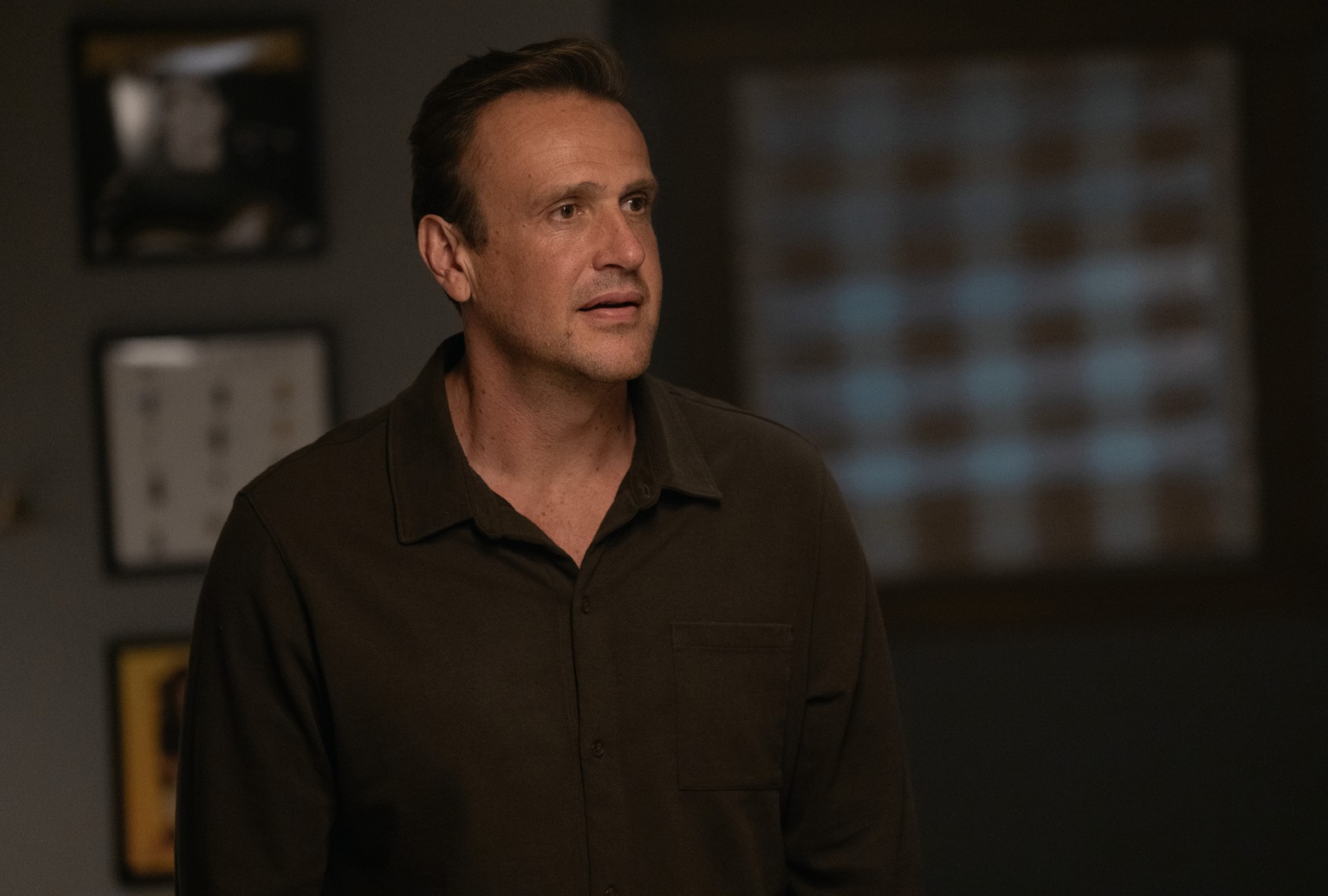
(Apple TV) Jason Segel in “Shrinking”
Lawrence has said he envisioned “Shrinking” as culminating in a three-season arc that begins in grief and steps into forgiveness, before exploring what it means to move forward. (Apple TV has picked it up for a fourth.)
Along with this, the writers are also showing us a version of resilience building achieved through practicing community and, just as importantly, accepting impermanence — that we only have this moment, and can only influence what’s going on in our midst.
Want more from culture than just the latest trend? The Swell highlights art made to last.
Sign up here
Every episode features a framework of caring, with each person taking on a duty to make another’s life easier—Paul’s, primarily, but also Brian’s (Michael Urie), who is about to become a father along with his husband Charlie (Devin Kawaoka).
Mutual support strengthens the shelter Jimmy, Paul and Gaby have created. What could have been one of Jimmy’s worst ideas, his decision to invite his PTSD-stricken patient, Sean (Luke Tennie), to live with him, turns out to be one of the best things to happen to their circle. (His questionable therapy style of being too close to his patients is still ethically unsound, but Sean’s doing great!)
Our need for solace is acute, and “Shrinking” is meeting it with an exceptional, timely arc about taking shelter in the communities we create.
In a similar leap, Jimmy and Alice forgive and befriend Goldstein’s Louis, the man who crashed his car into Tia’s and killed her. Not everyone accepts him, but Jimmy and Alice’s loved ones follow their lead because helping him heal is part of their process of repairing themselves. Now, Louis has moved on — proof of Goldstein’s understanding that the best bits end before the audience tires of them. Meanwhile, Alice and Jimmy are too accustomed to the safety they’ve created in an emotional refuge that was always meant to be temporary: Childhood, in Alice’s case, bachelorhood in Jimmy’s. Accepting impermanence is a tough practice. It’s also our only constant.
“Shrinking” encompasses all this within digestible, easily repeatable therapy sessions. Most of them clock in at around 35 minutes, although the latest season premiere runs just over an hour. It is not a replacement for professional help, of course, or participating in actual community building wherever you live and to whatever extent suits you.
But amid blizzards, subzero winds, outrageous acts of state terror and every other despair lurking in The Big Dark, it’s a readily accessible, harmonious cul-de-sac in an era of rampant tone deafness. Life waxes and wanes between peace and tumult, elation and despair. Nothing good lasts forever. But the sun is always shining somewhere, nevertheless.
New episodes of “Shrinking” stream Wednesdays on Apple TV.
Read more
about “Shrinking”
