
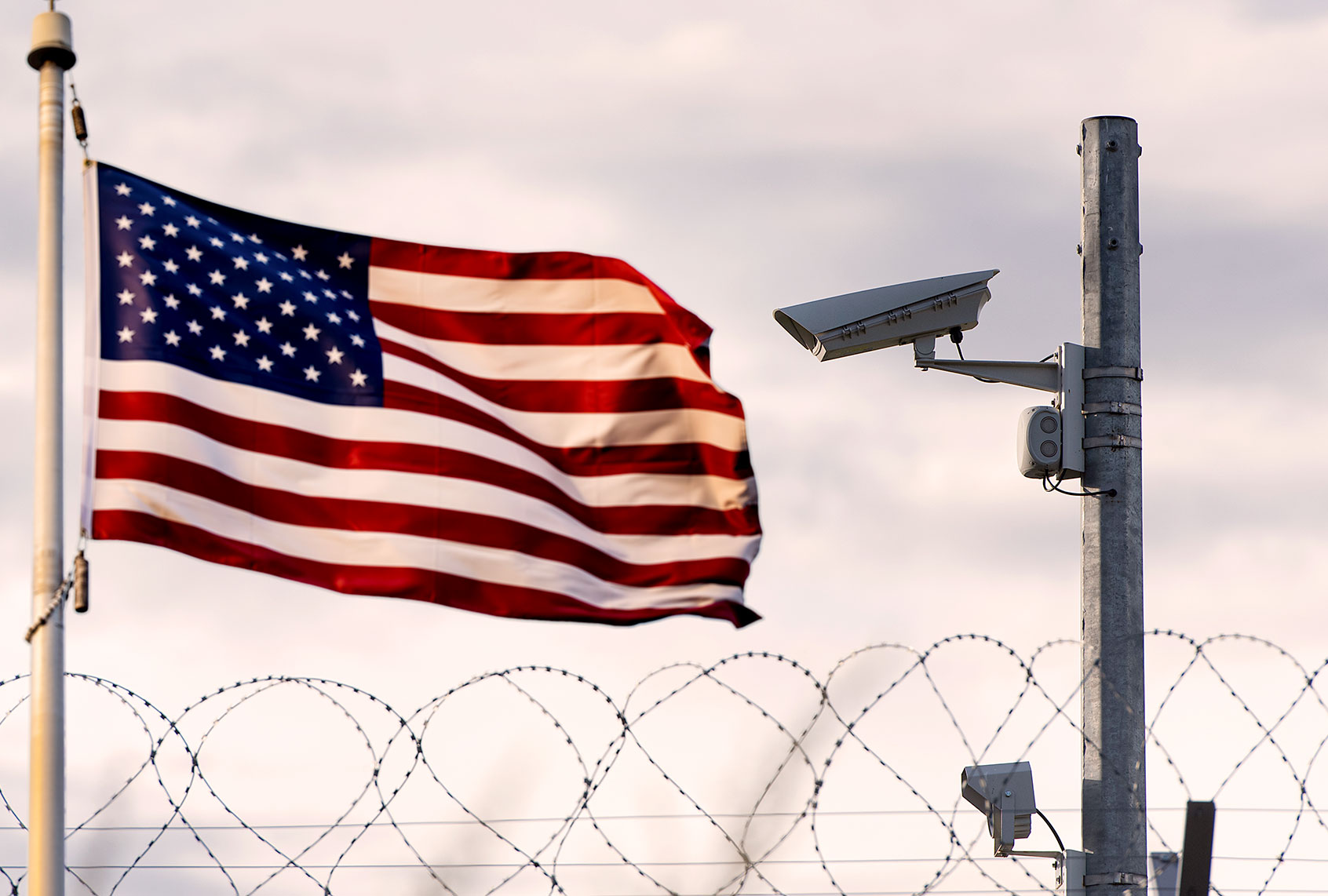

There are a lot fewer neon-drenched skyscrapers and risqué robots than we were promised, but a quarter of the way through the 21st century, we are indeed essentially living inside a cyberpunk dystopia. The evidence is all around us: corporate feudalism driven by monolithic tech companies with larger cashflows than many sovereign nations. Cutting-edge warfare is being waged with drones and lasers, while the generative computer programs being marketed as “artificial intelligence” warp our ability to discern reality. Electronic tchotchkes are ubiquitous but many people have little or no access to nutritious food or health care as our environment is run through a meat grinder and set on fire. This is the “high tech, low life” universe that Philip K. Dick and William Gibson warned us about, only not as glossy. As folks on Reddit like to put it, this is a “boring dystopia.”
The global spike in authoritarianism couldn’t possibly be as efficient, or as widespread, if not for the metastasizing mass surveillance tech apparatus following our every movement, every trip to the bathroom or grocery store, every visit to a website or a TikTok video. It seems that every detail of our face and the fine details of our irises is scanned and profiled and vacuumed up into the All-Seeing Eye of Providence stamped on every dollar bill. But whose providence are we talking here? Even the paranoid, conspiratorial mentality of “Neuromancer” feels justified in light of a global child sex trafficking ring operated by the world’s least savory financiers, spooks and politicians.
Finally, a lot of people seem to be waking up to this “Blade Runner” nightmare, most recently exemplified by a seemingly innocuous Super Bowl ad about a lost dog. The “Search Party” ad was meant to showcase how Amazon’s Ring can help neighbors (presumably all on the same subscription plan with the same cameras attached to their front door) find a missing pet by scanning all that available monitors in the area. Viewers immediately saw through the ruse, recognizing that Ring’s web of surveillance could absolutely be used to watch almost everyone, almost everywhere, whether or not they’ve done something illegal. The ways in which these tools can be rapidly weaponized was not lost on its audience.
The backlash caused Ring to cancel a deal with tech surveillance company Flock Safety, which sells its tools to police and governments under the guise of stopping crime. Ironically, Flock’s business model often involves breaking the law and trampling on the Fourth Amendment, though challenges to this warrantless spying have largely failed. The company’s catalog includes license plate readers, gunshot detectors and automated drones, with plans to expand into even more massive people-tracking software. In a statement regarding the shuttered deal, Flock said it “remains dedicated to supporting law enforcement agencies with tools that are fully configurable to local laws and policies, and we continue to engage directly with public officials and community leaders.”
Cameras and AI programs that scan faces are just tools. They can be used to track down arsonists and mass-shooting suspects. They can also be used to hunt down whomever the state deems as dissidents.
Some of those local law enforcement agencies are already sharing data from Flock cameras at schools with Immigration and Customs Enforcement, to use one example. Leaked emails obtained by 404 Media strongly suggest that Ring’s pet lookup tools would be expanded, with the goal of helping “zero out crime in neighborhoods.”
Of course, in the Trump era “crime” is about as nebulous as the president’s perverted definitions of “peace.” Countless hardcore criminals have gotten a free pass under Trump, from disgraced grifters to Jan. 6 rioters. Meanwhile, in the realm of mass surveillance, “crime” has a broad definition and can apparently include the wrong skin color, the lack of citizenship documents or engaging in public protest against ICE and other arms of the federal secret police.
Flock has a long history of feeding data to police that later filters to federal agencies like the Department of Homeland Security. Its cameras, enhanced with AI features, are found in about 5,000 different communities across the U.S. and were employed by cops to track protesters at the “No Kings” protests last fall. Flock cameras were used by Texas police to track a woman who had self-administered an abortion and was threatened with criminal prosecution. In Washington state, at least eight law enforcement agencies enabled direct sharing of their networks with U.S. Border Patrol, part of a larger pattern across the country. While Flock claims on its website that the company does not partner or share data with ICE or any other wing of DHS, its customers certainly can and do.
Cameras and AI programs that scan faces and ID people are just tools. They can certainly be used to track down arsonists and mass-shooting suspects. They can also be used to hunt down whomever the state deems as dissidents, whether that’s antifascist protesters or migrants looking for work in a Home Depot parking lot. The use of such tools becomes more sinister in light of reports that ICE officers are scanning people’s faces and tracking protesters through a massive digital dragnet, or DHS demanding that tech companies hand over identifying information linked to social media accounts critical of the agency’s actions.
Start your day with essential news from Salon.
Sign up for our free morning newsletter, Crash Course.
It’s almost cute that Ring, Flock and other tech companies pretend to be nothing but innocent bystanders in all this. They are just data brokers doing business, they say, and it’s not their fault if what they gather and sell is used to subdue and surveil people. This was basically the argument made by Jamie Siminoff, the founder and head inventor of Ring, as he went on an apology tour of sorts to try and mitigate the post-Super Bowl damage.
“It’s not just like unfettered mass surveillance,” Siminoff told the New York Times. “That’s not what we have with Ring. You get to choose what you want to do with your individual home.”
Such promises ring hollow (sorry) in light of the high-profile Nancy Guthrie kidnapping case, in which footage from a Google Nest camera was recovered even though Guthrie did not have a subscription to Google’s cloud-based video recording services. That’s a different product from Ring, but the privacy concerns are the same, and the TV ad made people realize that any device able to record video is potentially available to law enforcement. “This is Google tipping their hand for potentially a capability that maybe they’ve never disclosed,” Patrick Jackson, a former NSA data researcher and the chief technology officer for privacy and security company Disconnect, told CBS News.
Typically, the knee-jerk response to all of this is, “So what? Just don’t commit crimes and you have nothing to worry about.” Isn’t tracking down possible kidnappers a good thing? Given the way tech company executives have fawned over Trump, a president hellbent on punishing anyone who dares to criticize his authoritarian agenda, there is absolutely good reason to distrust Google, Amazon, Meta and all the rest.
The killjoys who screamed about draconian laws like the USA PATRIOT Act and warned against uploading our faces to apps that digitally age us were probably right all along.
On the most fundamental level, the demand for privacy is not about paranoia or fear. It’s about control. People browse the internet with VPNs and cookie-blockers and encrypted connections not because they truly believe the government is personally watching them, though that possibility is less remote for some people than for others. They do it because they don’t want to get siphoned up as aggregated data for marketing purposes, and they just want to do whatever they’re doing on the internet with some expectation of privacy. Those are good enough reasons in themselves whether or not we have anything to hide, and that assumption of privacy was embedded in the U.S. Constitution many years before the internet was a gleam in Al Gore’s eye.
Privacy geeks have been warning of this moment for decades, not just in the realms of science fiction, but even on the pages of Salon, back when a digital magazine was a novel idea. The killjoys who screamed about draconian laws like the USA PATRIOT Act and warned against uploading our faces to apps that digitally age us were probably right all along.
If that accounts for the “cyber” aspect of our cyberpunk dystopia, where’s the punk? It’s nice to see more and more of it, from 3D-printed whistles used to keep ICE at bay to backlash against Discord’s announcement that it would introduce age verification. Generations of young people too young to remember the 9/11 terrorist attacks are recognizing Big Tech’s scam for what it is. Poll data from Gallup in 2024 found that only 27% of Americans had high confidence in large tech companies. A survey released by the Tech Oversight Project last month found that “an overwhelming majority of Americans are concerned by President Trump’s cozy relationship with Big Tech companies.”
We need your help to stay independent
So in spite of rising authoritarianism around the world, here’s what gives me hope: More people are awake than ever before. Our economy may be propped up by little more than AI super-projects that could crash with disastrous consequences if the dream doesn’t pan out, but more and more people are rejecting the technology or using it begrudgingly. When the New York Times broke the story about ICE going after social media profiles, many people said that was unnecessary, since they planned to continue exercising their First Amendment rights in public, with their identities out front. If a majority of people in America and around the world want to win this fight, they will need to lean into tactics that show Big Tech isn’t as powerful as it thinks it is.
It’s worth reminding ourselves that none of this dystopia stuff is especially new, even if it’s been hypercharged lately by electronics and algorithms. Police were invented to protect the wealthy and the owners of capital, even back in the days when required keeping people enslaved, literally or metaphorically. They have long used technology to keep people in line. As poet Percy Bysshe Shelley wrote in 1820 essay, “The rich have become richer, and the poor have become poorer; and the vessel of the state is driven between the Scylla and Charybdis of anarchy and despotism. Such are the effects which must ever flow from an unmitigated exercise of the calculating faculty.” I think what he meant was the financial wizards who create nothing but find themselves at the top of the social pyramid — today we call them “tech bros” — are generally happy to enrich themselves by automating away humanity. But the human spirit cannot be condensed and contained as easily as our biometric data can.
Since we’re on the topic of lost dogs, I too know the pain of a missing pet. When I lived in downtown Phoenix, my pit bull Ziggy once escaped through the fence and disappeared, causing my wife to burst into tears. As we drove around the neighborhood calling his name, two different neighbors jumped into their own cars and circled around looking for Ziggy. At the time, I wasn’t entirely sure why they helped us. I had barely interacted with them before, and barely knew their names, but they didn’t hesitate to come out and help. We found Ziggy a few blocks away, thanks to them. Having neighbors who actually care will always be an advantage over any possible device. Turning off the machines and meeting the folks next door could be the key to outlasting or escaping this cyberpunk nightmare.
Read more
about mass surveillance
