

If you were to ask me what I call the process of opening windows and doors of my house to let cross-breezes of fresh air in and stale air out, I’d probably say, “I don’t know. Airing out the house?” What I do know is that, even given unlimited follow-up guesses, there’s no way I would land on the term “house burping,” and I’d imagine the same is true for most Americans. “House burping” might sound like it describes something, but it definitely doesn’t sound like the thing it apparently describes, which is to say, it sounds like a term that was engineered with the hope of kicking off a trend.
It was. And suddenly it’s everywhere. A quick review of Google Trends confirms that searches for “house burping” were a flat line from 2004 until the end of 2025, when searches spiked almost 90 degrees between November 30 and December 31. By mid-January, the headlines had arrived: “What is house burping and why are some people doing it?” “Should we all be ‘house burping’?” “Should you ‘burp’ your house during winter?”, “House burping: a detox trend for your home?” and “House burping sounds absolutely wild, but it really works.”
America’s Puritan origins entwined tidiness with morality, morality with aesthetics, aesthetics with value and value with purpose — in everything but name, house burping hits all the marks.
All of them dangle the possibility that those who click will be rewarded with a jolt of esoteric, game-changing knowledge. The one headline that cut right to the chase, from “Today,” was “What is house burping? Inside the trend of airing out your home,” — the very wording of which points out that this process already has a recognizable name. It just isn’t one that’s likely to go viral on #TikTok: As YouTube creator Feli from Germany explains, lüften is an age-old practice that’s so ingrained within Germany’s public-health measures that not doing it can constitute a lease violation. Much of her video is just marveling that lüften is now a fact of everyday life in one country and hyped like the invention of fire in another. But ultimately, it makes sense. America’s Puritan origins entwined tidiness with morality, morality with aesthetics, aesthetics with value and value with purpose — in everything but name, house burping hits all the marks.
That said, if there’s one thing Americans do well, it’s rebranding. We’ve recast the torture of prisoners as “enhanced interrogation,” upgraded bog-standard reactionary beliefs to “dark enlightenment” and polished up precarious, poverty-wage work as a shiny gig economy. Social media’s co-optation of lüften wasn’t necessarily inevitable, but it fits seamlessly into TikTok’s paradigm of claiming a pre-existing phenomenon as a new discovery, giving it a cutesy name, and adding it to a list of trends, from product overloading (aka bulk buying) to laundry stripping (pre-treating stains) that never fail to aestheticize order, elevate hygiene and exalt productivity.
Cleaning hacks are an internet staple, so when #CleanTok became a thing, I assumed it was a repository of up-to-the-minute hot tips until one friend set me straight: “It’s about watching other people clean, seeing what products and tools they use,” and buying them via handy links. Going from viewing to buying is increasingly frictionless. Multinational hygiene and personal-care behemoth Unilever even joined forces with #CleanTok in 2023 to rebrand the soap opera.
The long, linked history of morality and cleanliness is rife with racism, misogyny and ableism. It’s also not history. The 2006 study “A clean self can render harsh moral judgment” by scientists as the University of Toronto concluded that because those preoccupied with cleanliness “may not only feel dirt-free, but also morally untainted,” leading to an “elevated sense of moral self” that “can in turn license severe moral judgment.” American service media’s house burping hype might be less about trying to match TikTok’s relevance than about never missing an opportunity to reaffirm that cleanliness is next to godliness — and that neither is socially neutral.
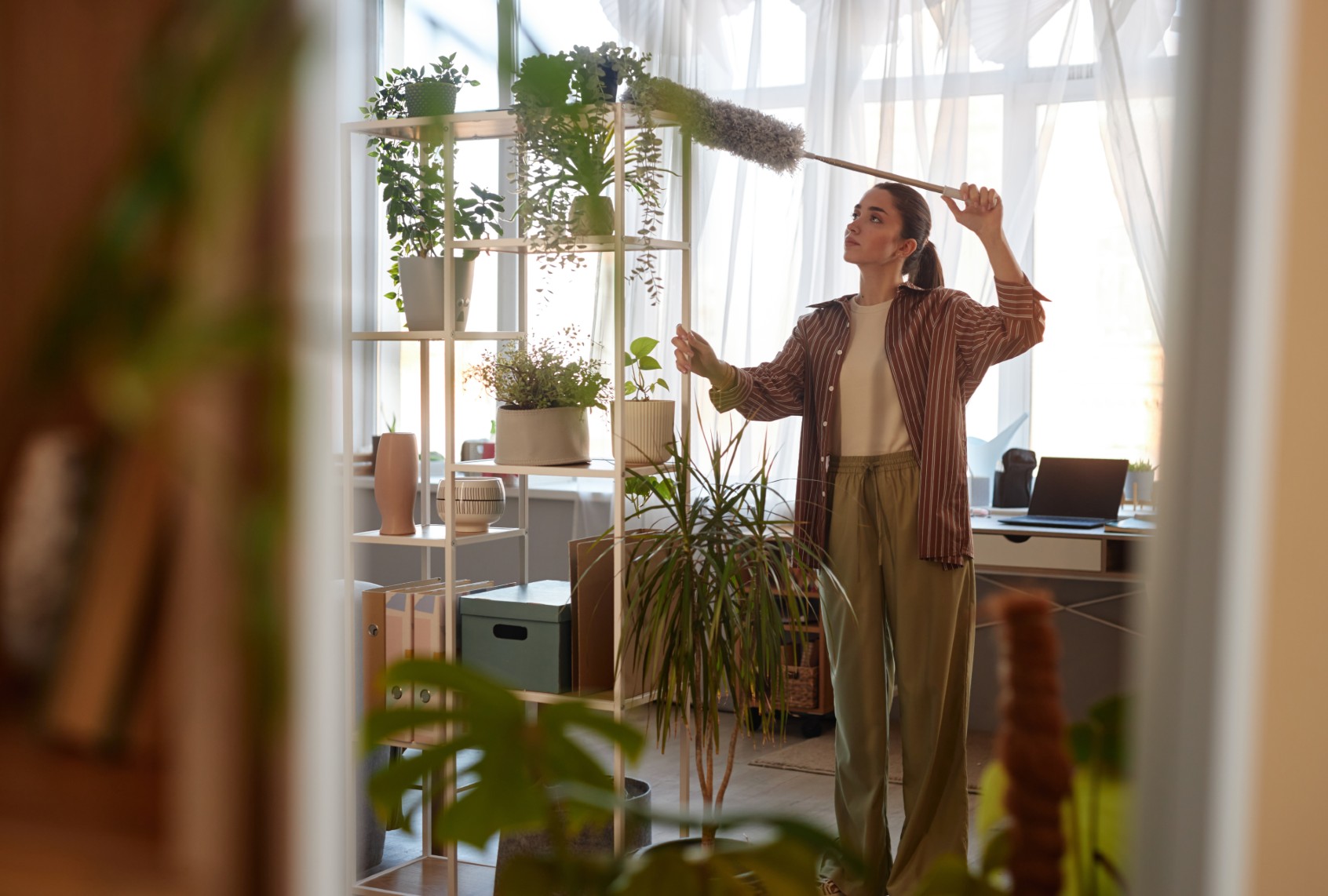
This makes the sheer number of #CleanTok videos (roughly 3.5 million, with an estimated 95 billion views to date) and their prevailing aesthetic (beige-and-white IKEA minimalism) feel unsettling: Scrolling through so many videos that feature the same kind of woman (young, white, athleisure-clad) editing the same kind of cleaning regimens with the same kind of beats and captions that draw the same kinds of comments can feel like trying to escape an uncanny valley of Clean Girls. Isn’t there anyone out there in the wilds of #CleanTok dusting the cobwebbed eaves and re-grouting the bathroom of a dark, ancient, possibly haunted house?
Want more from culture than just the latest trend? The Swell highlights art made to last.
Sign up here
It happens, my friend assures me, but it requires some searching. In her experience, the #CleanTok viewing sessions most likely to result in actual cleaning are ones that reward a kind of interchangeable, mirror-image uniformity. “They’ve got the Scrub Daddy, I’ve got the Scrub Daddy. They’ve got the fridge penguin, I’ve got the fridge penguin.” Until recently, she stood on chairs to dust moldings, high shelves, and the tops of picture frames. #CleanTok reminded her that telescoping dusters exist, and she hasn’t stood on a chair since. “It’s just satisfying,” she concludes.
American service media’s house burping hype might be less about trying to match TikTok’s relevance than about never missing an opportunity to reaffirm that cleanliness is next to godliness — and that neither is socially neutral.
“Satisfying” is a recurring #CleanTok byword deployed in hashtags (like #satisfyingcleans) if not in the videos themselves (like “SATISFYING DOOR CLEAN HEYYYYY”). #CleanTok became one of TikTok’s most popular genres in part thanks to both the escalated hygiene measures and the necessity of dependable zone-out material required during COVID lockdown. But I’d also correlate it with the late-2010s emergence of the “oddly satisfying” genre of short-form social-media content in which close-ups of soap cutting, taffy pulling, pressure washing and more served as both visual nerve tonic and mesmerizing diversion. #CleanTok and #oddlysatisfying converge at the node of aesthetic rightness sometimes called the Goldilocks Effect: Individual tastes vary, but there’s a reason the show “How It’s Made” ran for 32 seasons.
“Satisfying” is also a common hashtag in the #CleanTok subgenre known as #sundayreset,” whose videos of laundry folding, mirror squeegeeing and rug-vacuuming might lead one to think they are just another flavor of cleaning video. Nope: According to a 2025 Good Housekeeping explainer, the Sunday reset is “more than just tackling routine chores: a Sunday reset can benefit you mentally and leave you feeling refreshed for the start of the week.” In other words, it’s more than cleaning. It’s a larger, more complex form of self-actualization that just happens to involve a lot of cleaning. It’s a day of rest rebranded as a productivity ritual with a checklist.
Scrolling through the #sundayreset hashtag is a lot like scrolling through regular #CleanTok: Beige-on-white interiors, decisive clips of vacuuming and dusting, breathy soundtracks (Olivia Dean’s “Baby Steps” appears to be the unofficial #sundayreset anthem) and narration/captions heavy on terms like “mindful,” “soft” and “self-care.” I ask my #CleanTok friend where #sundayreset” falls on the satisfaction continuum. “If everything is in its place, you’re not rushing around trying to find stuff you need.” (She also theorizes that the #sundayreset is itself a rebranding of the aggro, almost militaristic regimens that were once the province of productivity hackers like “The 4-Hour Workweek” author Tim Ferriss and an industry of techbros whose innovations in outsourcing Business Insider described in 2015 as “tech to replace their moms.”)
We need your help to stay independent
The #sundayreset, some of its proponents suggest, is a proactive framework that helps stave off the free-floating anxiety of the Sunday Scaries. But Julio Vincent Gambuto, author of the 2023 manifesto “Please Unsubscribe, Thanks! How to Take Back Our Time, Attention, and Purpose in a World Designed to Bury Us In Bullsh*t” thinks that resets are less about intent than about impact: “It’s important to draw a distinction between resetting that truly allows you to restore your mental, emotional, and physical energy, and resetting that zaps it or that actually winds you up to be more efficient and productive.”
Cheyenne Solis echoes the point in a recent essay, writing that “When social media works with hustle culture, we’re made to feel like we’re chronically behind. Every free moment is a chance to catch up to the pace of everyone else as the prevailing message rings, ‘I can rest when I’m done (or dead).’” An experiment in dedicating her Sundays to rest rather than playing catch-up led Solis to embrace anti-hustle, noting that “By taking a day of rest, whether or not everything on my to-do list is done, I’m engaging in a courageous act of detangling productivity from my self-worth.”
TikTok’s endlessly iterating rebrands distract from hidebound norms and expectations (say, that women are naturally drawn to the domestic realm in which love requires aesthetic perfection). Their vocabulary echoes corporate jargon because treating corporations like people inevitably means that actual people are treated like underperforming assets in perpetual need of optimization.
This hasn’t always been the case. There was a time when, for instance, people made fun of Martha Stewart because she and the media empire she built were so unashamed of suggesting that goodness was achieved by way of relentless tidiness and vigilant domesticity. The triumph of lifestyle branding that’s been normalized via Food Network superstars, celebrity wellness gurus and social-media cleanfluencers is our new normal, and the world is clamoring for the next Martha.
The reaction to Julia Fox’s impromptu 2023 video tour of her cluttered New York City apartment, by contrast, showed how quickly the pendulum swings: Some viewers appreciated the sight of a thoroughly un-zhuzhed celebrity apartment, but the ones who didn’t were quick to call Fox a neglectful mother, mentally ill and “a lowlife.” Did watching the video stress my #CleanTok pal out? “It did. But seeing the way people judge her character was actually worse.” Rebrands are always a compromise: Staking a claim to a new trend means disrespecting the generations-old custom it co-opts; tethering well-being to domestic productivity re-inscribes narrow gendered beliefs.
For Gambuto, the solution seems simple: “True wellness starts when we unsubscribe from the notion of ‘always on.’” A reset that’s more than performative will require that social-media producers aren’t expected to be social-media products. In the meantime, I’ll settle for more details about that fridge penguin.
Read more
about lifestyle branding
