
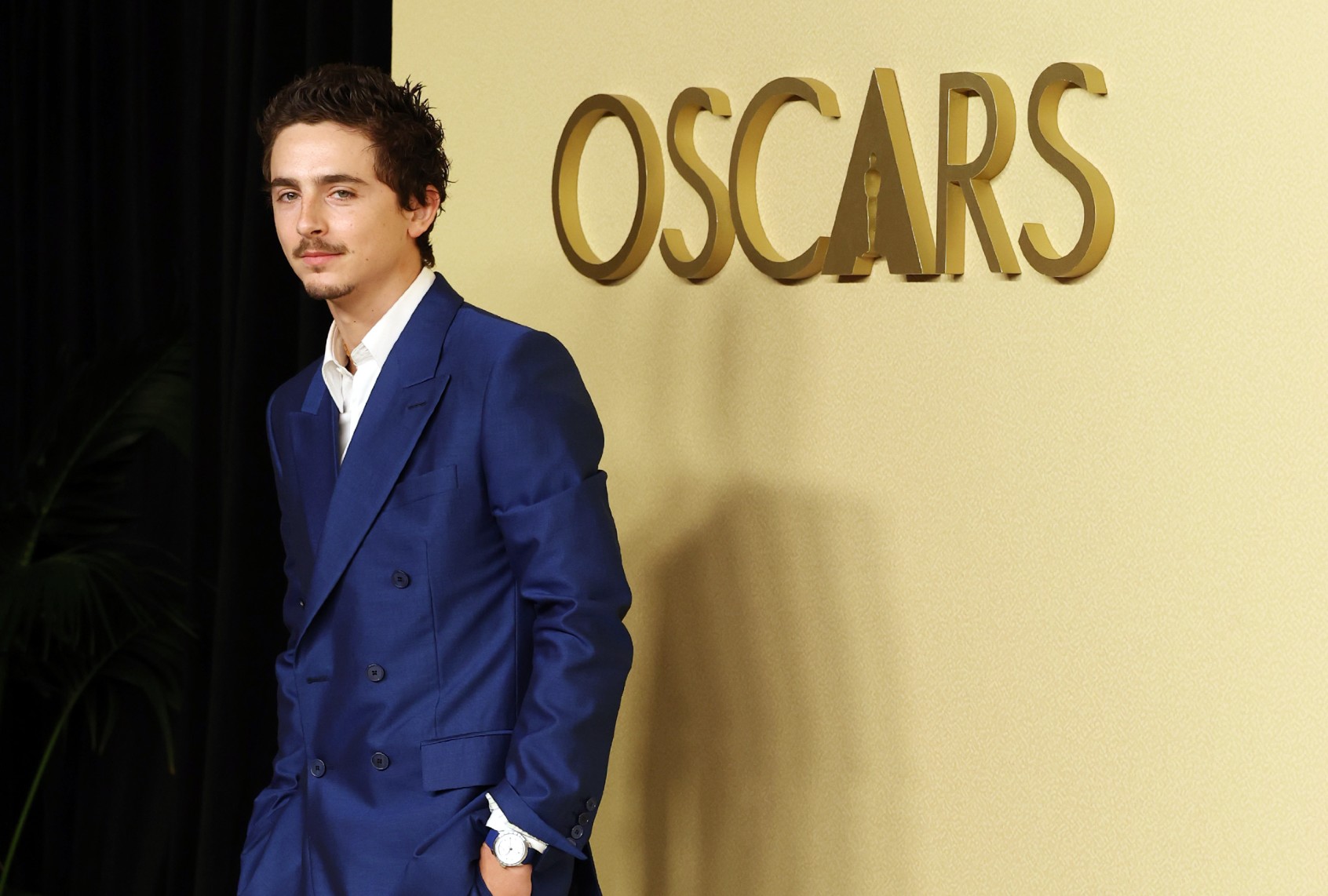

Film is personal. When we watch a movie we love, we want to see it get the respect we feel it deserves. And when that movie is up for an Oscar, the prestige factor augments our hope and anticipation. The Oscars are a celebration of film, but they’re also a competition — an election, really. Studios and artists campaign for votes like politicians. Glitzy Los Angeles luncheons and star-studded parties are as much about hob-nobbing with Academy members as they are keeping films part of the larger conversation in the weeks before and during voting. If you’re Melissa Leo, you might even take out your own for-your-consideration ad to remind voters of your prowess. Or, if you’re Timothée Chalamet, you’ll go the “all press is good press” route, remaining the name on everyone’s lips by talking so much that you don’t realize you’ve been speaking with your foot in your mouth.
Last week, a small section of CNN and Variety’s February town hall interview with Chalamet and Matthew McConaughey broke the internet’s door down and stomped into the public consciousness. In their conversation, Chalamet spoke about viewer impatience and the discrepancy between what moviegoers want these days, with some hoping to be entertained up front, and others content with being more patient to see how a film plays out. “It does take you having to wave the flag of, ‘Hey, this is a serious movie,’ and some want to be entertained, and quickly,” Chalamet began. “I’m really right in the middle. I admire people going on a talk show [talking about keeping movie theaters alive]. And another part of me feels like, if people want to see it . . . they’re gonna go see it.”
“And I don’t want to be working in ballet or opera, or things where it’s like, ‘Hey, keep this thing alive even though no one cares about this anymore,’” Chalamet continued. “All respect to the ballet and opera people out there! I just lost 14 cents in viewership. I just took shots for no reason.”
We live in Trumpworld. As such, so much of our discussions are about who can talk the longest and the loudest. Now, you’re either right or you’re wrong. Even an institution as decisive as the Oscars can have its veracity questioned when the Academy inadvertently aligns itself with our surreal, distinctly Trumpian way of life.
Chalamet’s words were curt, but his opinion was only further muddled by the clip being spread out of context. Chalamet, who has multiple family members who have performed in the New York City Ballet, was attempting to make a point about the accessibility of his art. He wants his work to be seen by the largest number of people possible for the price of a movie ticket, instead of having his efforts hidden behind the barrier of entry that comes with the higher cost of seeing opera or ballet. Those art forms cost more to produce and can’t be widely distributed like films can, which necessitates higher price points. In short, Chalamet doesn’t want to be a performer who depends entirely on a patient audience willing to pay a premium for his art.
But the context didn’t matter. Within 24 hours, the blowback was inescapable. Several esteemed opera houses, ballet companies and artists working within these spaces publicly lambasted Chalamet’s comments. The Seattle Opera offered 14% off with promo code “TIMOTHEE.” TikTokers talked themselves in circles. By Monday, it was a hot topic on “The View.” Yet, few of these responses examined the nuance of Chalamet’s statement or the question he was responding to. However unconsidered Chalamet’s words were, his larger statement had a point. But nuance is the enemy of politics, and because Oscars season now sparks as much ferocious debate and deceit as a general election, Chalamet’s point was overlooked in favor of another opportunity to fight dirty.
But none of this comes as a surprise, only a disappointment. We live in Trumpworld. As such, so much of our discussions are about who can talk the longest and the loudest. It used to be that the truth existed somewhere in the middle, between the disparate narratives. But the gap for subtlety has been forced closed by anger’s oppressive push from both sides. Forget trying to get most people to understand that multiple truths exist at once. Now, you’re either right or you’re wrong. And even an institution as decisive as the Oscars can have its veracity called into question when the Academy inadvertently aligns itself with our surreal, distinctly Trumpian way of life.
Want more from culture than just the latest trend? The Swell highlights art made to last.
Sign up here
Once upon a time, there was a world that made logical sense, one where the word “dystopia” was reserved for disaster films and George Orwell novels. Conflict and cruelty still existed, dealt out by the hands of the country’s most powerful people. But their sting could be numbed by the patriotic facade of American politics. If politicians didn’t have the average American’s best interest in mind, they were at least good at acting as if they cared. Even George W. Bush — the bumbling boardwalk caricature that he is — could deliver a State of the Union address without going off-prompter.
But when Donald Trump was elected president at the end of 2016, the Earth shifted off its axis, sending the planet rotating in different directions depending on the weight of any given argument, happening at any given time. Trump rose to popularity so quickly because he’s erratic and unedited. His crudeness stirred a simmering discontent among the American people, who saw Trump’s racist, misogynistic, vile political rhetoric as an opportunity to use prejudice as a scapegoat for their dissatisfaction. And if his detractors didn’t like that, too bad; even the smallest bit of dissent had the “fake news” label slapped onto it. And as the president’s popularity exploded and his fickle form of governing turned into the new norm, reality became discretionary.
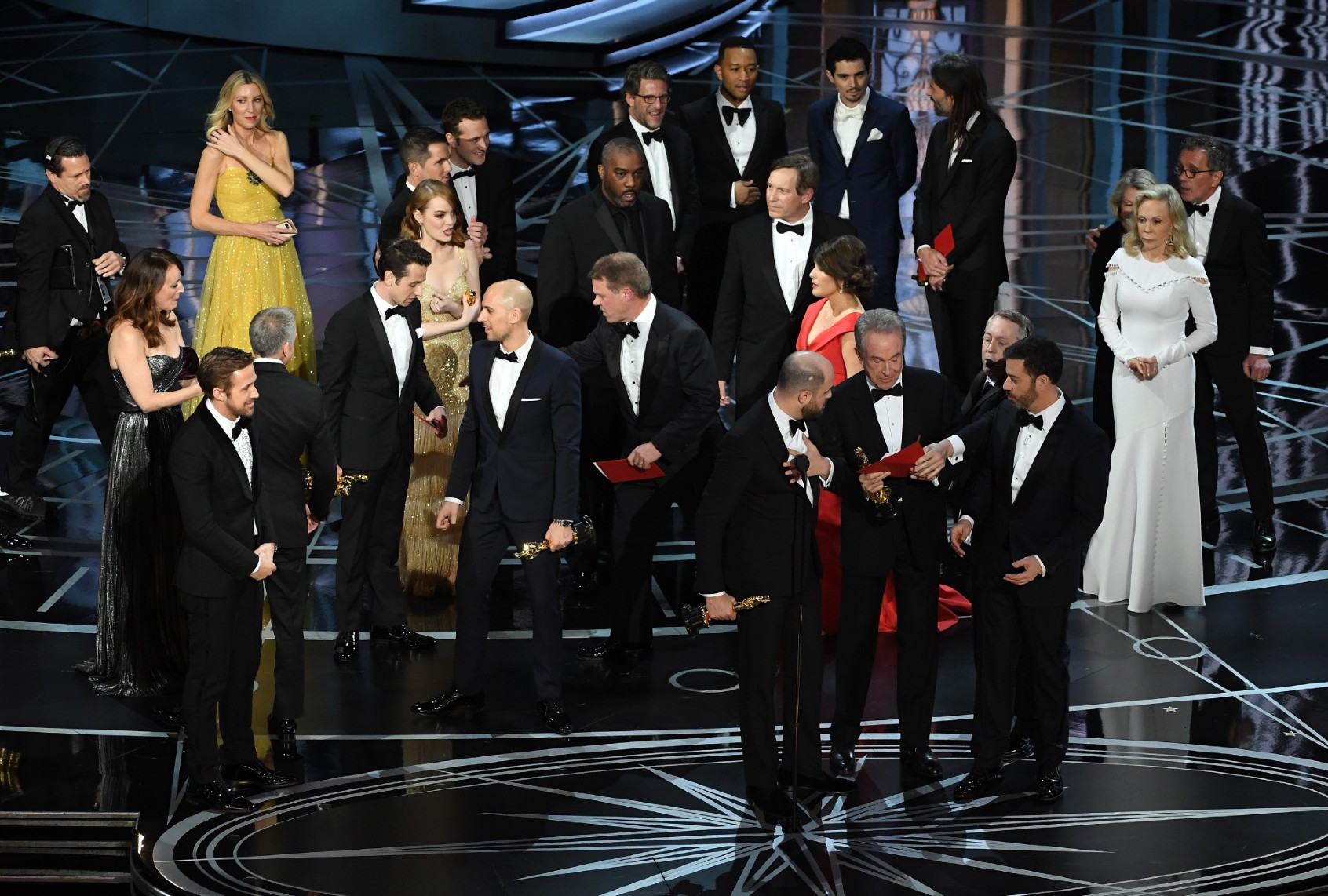
( Kevin Winter/Getty Images) “La La Land” producer Jordan Horowitz holding an Oscar and the winner card before reading the actual Best Picture winner “Moonlight” onstage during the 89th Annual Academy Awards
By the time the 89th Oscars rolled around in February 2017, the MAGA party’s selective belief in the truth had already taken root. Trump had only been in office for a month, but his executive orders and attempts at policymaking dominated the news cycle every day, all day. The immediate scale of his wreckage was unprecedented, but so was the level of resistance from the American public — two sides, fighting like hell to be the louder one.
The “La La Land” and “Moonlight” flub was the first major culture scandal of the Trump presidency, and an unfortunately fitting one: What better way to usher in the Trump era than turning the prestigious, distinguished institution that is the Oscars into a fake news spectacle?
At the same time, a much less dire — though arguably just as significant — debate brewed over which 2016 film deserved to take home best picture at the Oscars: “La La Land” or “Moonlight.” The former was a tribute to the Technicolor musicals of cinema’s heyday and a love letter to jazz, filled with show-stopping musical numbers and a pair of knockout lead performances; the latter, a touching triptych chronicling a man’s search for self-acceptance and love in a cruel world eager to define his Blackness and sexuality for him. On paper, the films are total opposites, but the feelings they evoked among viewers were not. “Moonlight” and “La La Land” reminded audiences of the many ways films are both personal and powerful. A dreamy dance sequence in the Hollywood hills can be as moving as a quiet conversation between a mother and her son. Both of these things can have value.
But in the new, Trumpian world, where everything was up for debate, voicing your love of either film meant you were rooting for the other’s loss. As Los Angeles Times film critic Justin Chang wrote in the days before the Oscars: “The choice between ‘La La Land’ and ‘Moonlight’ has been framed as a choice between various opposites: whiteness and Blackness, fantasy and reality, naivete and wisdom, appropriation and authenticity. But in the spirit of a less hostile, less Trumpian awards season, I’d suggest that these two fine movies, far from being natural adversaries, are in fact worthy companion pieces.”
If only it could have been that simple. Chang’s line of thinking was measured and considerate, a concept that feels so outdated it’s almost nostalgic. But that thoughtful response to the debate flew out the window when the best picture award was presented, and “La La Land” was mistakenly awarded over “Moonlight,” hampering the latter film’s historic, well-earned moment and making the blunder the night’s biggest piece of news. It was the first major culture scandal of the Trump presidency, and an unfortunately fitting one: What better way to usher in the Trump era than turning the prestigious, distinguished institution that is the Oscars into a fake news spectacle?
We need your help to stay independent
The best picture blunder has kept “Moonlight” and “La La Land” under the microscope for nine years now, and made the incident the blueprint for each ensuing Oscar season’s inevitable drama. Expressing affection for a specific film in a public forum is grounds to be drawn and quartered in the social media town square. Platforms like X and TikTok ostensibly exist for users to express personal opinions, but their modern function is to amplify and monetize arguments. In the siloes of social media, all things must be either-or; there is no “and.” If you say you like pancakes, someone else will claim you hate waffles. If you think “Tár” should’ve won best picture, you’re against the new guard of filmmaking represented by “Everything Everywhere All at Once.” If you think Timothée Chalamet was making a marble-mouthed point about moviegoing, you’re devaluing opera and ballet just as much as he is.
The Oscars exist to place multiple different pieces of art in conversation with one another to find the throughline that unifies them as the best of the best across their varying budgets, genres and public responses. There is space for differences even among the individual nominees in a category. Yet, bafflingly, those same points of distinction have been all but lost in the way people discuss the Oscars, as though these awards are the single defining thing that will make a film special, that will make a movie feel as personal to everyone as it does to ourselves. They incite disputes because we live in a world that rewards arguing with undue power. And in the nine years of this Trumpian Oscar era, we’ve yet to figure out how to maintain good-faith discourse when sweeping insincerity is the primary mode of communication. The “and” has been concealed, but it’s not dead. One can enjoy “Sinners” and “One Battle After Another.” One can be a fan of “Marty Supreme” and still think Chalamet’s comments were daft. One can think Amy Madigan’s performance in “Weapons” was great and still dislike the film. (I know I certainly can!) The space for knowledge and intrigue — for the excitement of vast human opinion — exists in the in-between. The devaluation of that nuance is worse than the loss of any award.
Read more
about awards drama
