
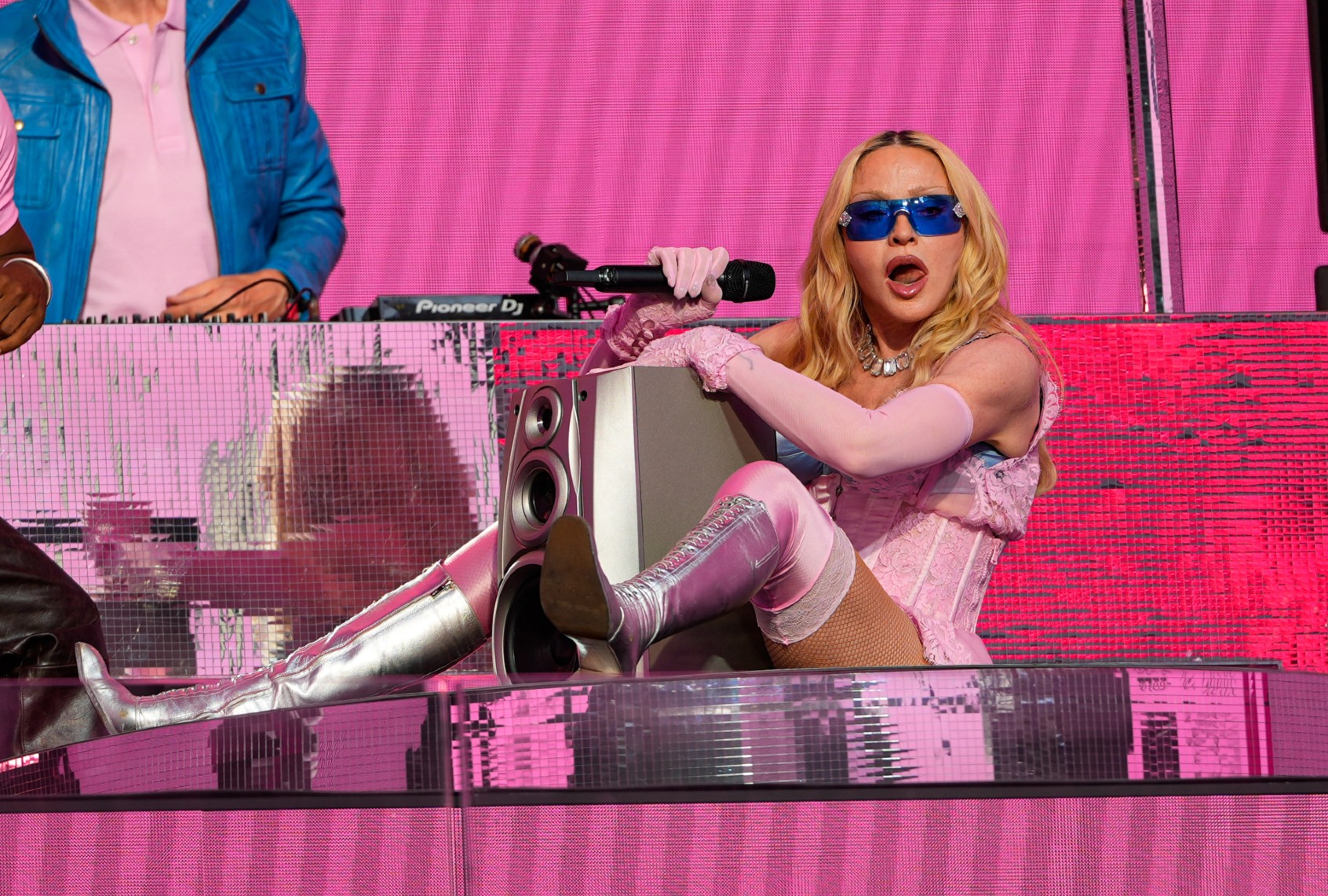

At the outset of her highly anticipated 15th studio album, “Confessions II” — a sonic sequel to her 2005 smash “Confessions on a Dance Floor” — Madonna only has one request: “Don’t be a vibe kill.” Set against a slithering, seductive Chicago house beat, it’s really more of a command, one that the Queen of Pop immediately follows with another decree: “Come on, meet me on the dance floor.” Considered on its own, one might think this first track, “I Feel So Free,” is the album’s thesis, a call for the listener to check their hang-ups at the door before entering what Madonna later calls “a temple of sweat and surrender, where rhythm replaces reason and movement.” The club is no place for the stressors and anxieties of modern life. Once you’re inside, everything outside must fade away.
But strangely enough, it was Madonna who insisted on killing the vibe in the weeks leading up to the album’s July 3 release. In “Confessions II” terms, it was as if she popped out of the club for a quick cigarette, checked her phone and let herself be momentarily consumed by all of life’s ugliness — posting a quick AI edit of herself before stomping out her Marlboro with her boot and going back inside. During the album’s rollout, the pop star’s visage was perfected with the help of some uncanny AI smoothing, while her accompanying “Confessions II” short film featured a team of AI artists in the credits.
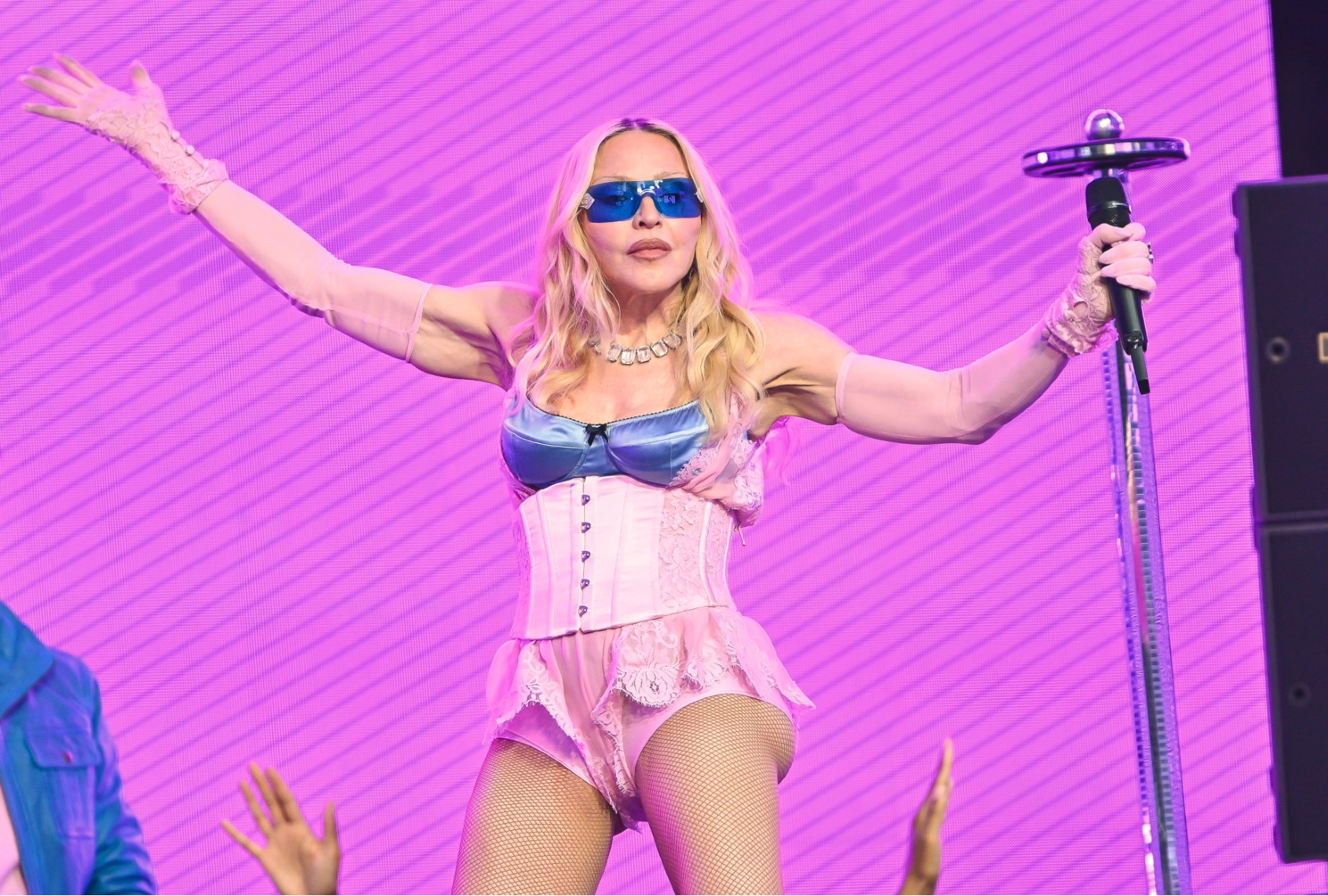
(James Devaney/GC Images/Getty Images) Madonna
As someone who is perennially image-conscious, constantly innovating, and occasionally rash, it’s not surprising that an artist like Madonna would incorporate new technology into her art. What’s disheartening is that she pretends there is no connection, telling Vogue Italia last week, “Algorithms and artificial intelligence are the opposite of taking risks to me, and that is the opposite of making art.” Two days later, Madonna reposted AI fan edits of herself atop the Empire State Building’s spire, waving a “Confessions II” banner. And while an Instagram story might not be her own art — and, granted, is probably being posted by a social media manager — it did place this album’s rollout firmly within this uniquely unnatural era. The carefree, sweat-drenched timelessness of Madonna’s new music couldn’t help but scratch against a very timely problem: Everything’s really bad, and finding space to let yourself forget that is increasingly difficult.
By genuinely confessing on the dance floor, Madonna has made a far more moving and crucial “biopic” than any shiny studio film could afford her. “Confessions II” is better than any film because it’s Madonna’s story exactly the way she’s always told it: through the music.
But that’s also exactly the kind of contradiction Madonna has staked her career on. Her first single, 1982’s “Everybody,” encouraged a similar blind devotion to the dance floor, hitting the booming New York club scene just as the city was recovering from one of its most tumultuous decades. And throughout her reign, Madonna has lived her inconsistencies, vacillating between opinions and social, spiritual and artistic beliefs of all kinds. To fight the industry’s double standards, she created a wealth of her own, making Madonna impossible to pin down and thus endlessly fascinating.
Want more from culture than just the latest trend? The Swell highlights art made to last.
Sign up here
Flattening these nuances into a single feature film would be impossible. And yet, that’s just what Madonna spent the last few years trying to do, writing the treatment for her own biopic at Universal Studios, which she was also slated to direct. But even after the studio won a bidding war for the story, it balked at coughing up the money for a movie worthy of Madonna’s legacy. “We had a falling out, me and Universal, regarding budget because I’ve had an extraordinary life,” Madonna told Interview magazine. “I’ve had a huge life, so I needed a big budget.”
When the project fell apart, Madonna returned to the recording studio with her history on her mind. “Confessions II” features intimate retrospectives of Madonna’s career and personal life — rare, clear-eyed visits to the past from an artist who has always preferred to keep her eyes on the future. These accounts collide with the present era’s eerie uncertainty at every turn, making for an altogether riveting, cyclical listening experience that tells her life’s story without smoothing its contradictions. By genuinely confessing on the dance floor, Madonna has made a far more moving and crucial “biopic” than any shiny studio film could afford her. “Confessions II” is better than any film because it’s Madonna’s story exactly the way she’s always told it: through the music.
The chances of a life as complex and purposefully incongruent as Madonna’s fitting into one feature-length film — even two or three — are slim, and even that’s an understatement. Today’s musician biopics are almost always overly sanitized stories approved by the artist or their estate. Every so often, a wildcard will slip through the cracks, but that’s become increasingly uncommon, especially in an era where fans are militant in their reluctance to let any unsavory portraits slide.
Take this spring’s Michael Jackson biopic, a film that purged Jackson of all of his eccentricities in an attempt to downplay the allegations that clouded his late career. The finished product was more like a compilation of shot-for-shot music video and live performance recreations, stitched together with vignettes depicting a tepid version of Jackson’s real, tumultuous life. A musician’s work becomes significantly less interesting when removed from its context. And though Madonna’s screenplay was undoubtedly more colorful than that of Jackson’s film, trying to shoehorn a lifetime of controversy, defiance, art, religion and love into 160 minutes would’ve left too many critical subtleties on the cutting room floor.
Besides, Madonna’s always been most candid behind the microphone. No exclusive television interview or splashy magazine profile has ever matched the raw personhood of her actual music. As outspoken and sometimes guileless as she is, Madonna tends to choose her words carefully when the cameras are rolling. Even in the midst of her spiritualistic “Ray of Light” era, you won’t find a single interview that matches the open-hearted sincerity of the actual music. And the same goes for “Confessions II.” Even hour-long television specials and magazine cover stories, in which Madonna has been recounting her past, don’t reach the same depth as something like “Danceteria,” where she does the same thing over a beat. Here, Madonna takes the listener through a pivotal moment in her early career, as she dances, performs and hustles at the famous New York club where she eventually broke through. The half-rapped verses owe as much to “Vogue” as they do to Blondie’s “Rapture,” and in the song’s jubilant refrain, she revisits the shared message of “Everybody” and “I Feel so Free,” hollering, “Everybody get up and dance!”
Dancing’s insouciance is reexamined so frequently throughout the album’s first half that one might read its message as hollow, like a desperate attempt to ignore all of the troubles outside the club. Three of the album’s 16 songs, which all appear on this portion of the record, have the word “love” in the title. Madonna pleads with listeners to bring their love to the dance floor (located at the Club of Love), where they will feel the love sensation — a love, she’s careful to specify, is without words. But among the repetitive amorousness, she finds real depth in the joy she’s allowing herself to experience, a type of lightness that can only come from her art failing to meet the public’s expectations for the last 18 years, not to mention a near-death experience.
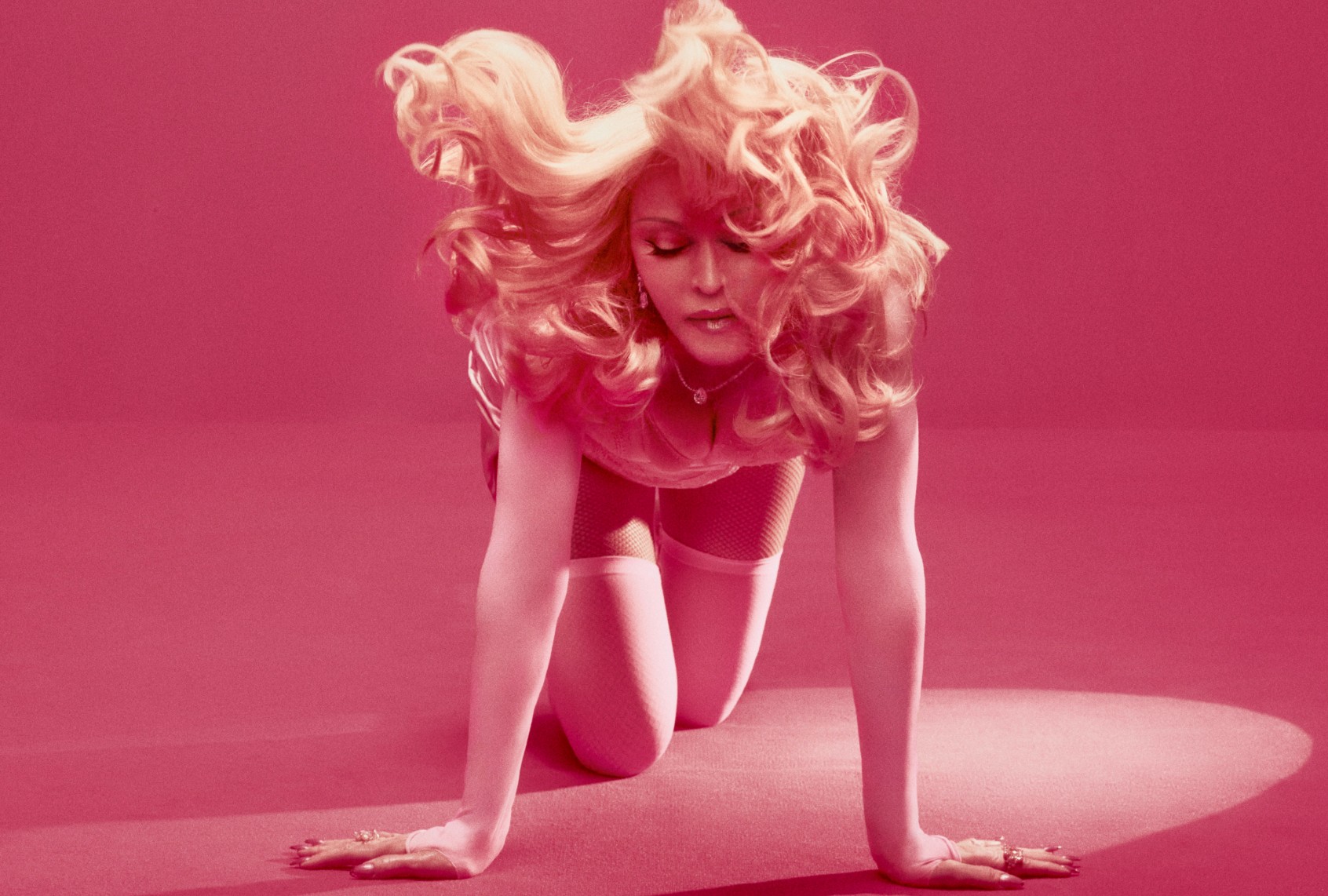
(Rafael Pavarotti) Madonna
But Madonna’s lived too many lives to be naive. She knows that the sun will always rise again, and that when she exits the Club of Love, she’ll have to face the unbearable truths that the light of a new day reveals. “Confessions II” is, by nature, an album of these oppositions. Its first half is filled with the optimistic insistence that dancing and love will save us all, while the second finds Madonna wrestling with bitterness and regret. The stunning midpoint between these two themes, “Fragile,” fuses the hope and lament into one of Madonna’s most personal songs to date, recalling her complicated relationship with her brother, Christopher Ciccone, who died while she was making the album. Just before she slides into a heart-wrenching chorus about who her brother was and all she wishes she could’ve done while he was still here, Madonna admits, “This is the part I hate the most, the words inside my heart.”
That lyric defines the album’s back half — and really, Madonna’s entire career. Her candor has been revered as much as it’s been reviled. Madonna’s reflections on motherhood and spirituality in “Ray of Light” were unanimously praised. But as soon as those ruminations grew darker and her introspection mirrored a world consumed by political strife, just five years later, with “American Life,” critics wrote her off once more. As much as Madonna might love making music, it never gets easier to grapple with the words inside her heart, let alone release them into the public. No biopic could ever capture how terrifying it is to be honest in front of the entire world with such plain, immediate insight as a song like this.
“Confessions II” is Madonna’s message of what it means to be an artist, a mother and a woman — someone whose fallibility makes her human. She did it all, and she still couldn’t do everything right.
That’s partially because, with “Confessions II,” Madonna isn’t playing a character. She might “create a new persona,” as she says on “I Feel So Free,” but even her personae are versions of her true self. There is no wall up, no layer of artifice between the musician and the actor plaguing modern biopics. Here, Madonna is liberated from Universal’s script notes or editing maneuvers, free from tweaking anyone’s performance to feel more like the real thing. Because when it comes to Madonna, nothing can compare to the unvarnished, utterly contradictory artist herself.
This is especially clear in standout moments like “The Test,” a duet with her daughter, Lola Leon, and one of the most important songs of Madonna’s entire career. The track finds mother and daughter writing to each other about their relationship, reconciling the effects Madonna’s fame had on her firstborn child. Calling back to a “Ray of Light” track, Madonna refers to Lola as “little star” and then brilliantly examines the flipside of this affectionate nickname. “You didn’t ask for all the flashing lights,” Madonna says, admitting she didn’t think enough about how being the child of the most famous woman in the world would make her daughter into a celebrity from birth. “My butterfly was always being watched.” Sure, you could try to write this gnarled dynamic into a film. But unless Madonna and Lola played themselves, their reconciliation wouldn’t resonate the way it does as they trade verses, trying to express forgiveness the same way Madonna articulated her rapturous maternal affection in “Little Star,” almost 30 years prior.
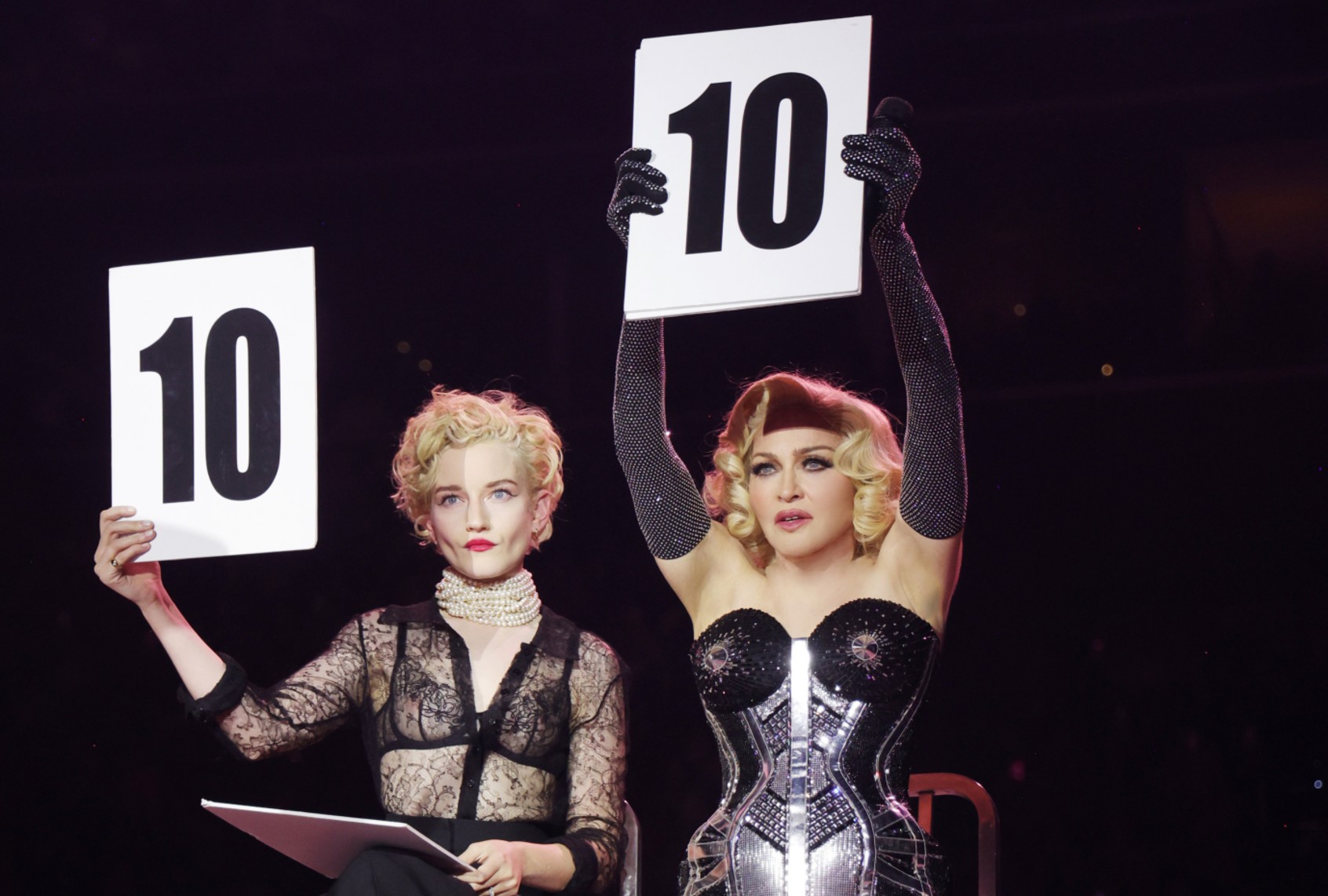
(Kevin Mazur/WireImage for Live Nation/Getty Images) Julia Garner and Madonna during “The Celebration Tour”
Given that the “Confessions II” short film only covers the album’s first six tracks, it seems that even Madonna knows the stories she’s telling here are too big and too intimate for a feature-length movie. It’s as though she’s reminding us that what we see can only ever be some of the story, and that the music is the place where the gaps are filled in.
Notably, the seventh song on the album, “Everything,” tips the record into a more appropriately confessional place, a perspective one couldn’t get with the short film alone. Madonna looks at a world where “no one wants to go outside,” nodding at the ways the COVID-19 pandemic broadly increased our isolation and made people more fearful of reality and each other. In a rage, she announces, “It’s not OK; I don’t f*ck with it!” Much of the album’s narrative is rooted in Madonna’s origins, and here, she channels the rage and confusion of the AIDS crisis that took so many of her friends, personal heroes and collaborators. Is it somewhat surface-level for the distinct complications of the COVID era? Maybe. But the song presents another contradiction worth parsing, reminding us why someone who suffered such enormous losses so early in her life would choose right now to return to the dance floor, where healing always awaited her.
We need your help to stay independent.
Madonna walks back into the past one final time on the album’s closing track, “L.E.S. Girl,” fondly calling her last days before superstardom, where the memory of a long-lost love with dirty hair awaits her. If there’s a song that proves Madonna’s own music is more compelling than any biopic could’ve been, it’s this one — the quietest, most tender cut on the album. With only a handful of lyrics, she revisits a million lifetimes replete with monumental change and insights only an artist of her caliber could convey. As the song closes, she makes one last confession: “Everything fades away, except for you.” While one could read this as a testament to everlasting love, I find it most moving as a bit of well-earned gratification. Madonna considers it her duty to remember that early version of herself and to bring that person with her, no matter where she goes.
I’ve speculated for a while now that Madonna may be preparing for a future without her, where “Confessions II” becomes her last album. God forbid that comes true, but if it does, this record is proof that Madonna is her discrepancies: She is this, and she is also that. Madonna is everything. It’s not that she holds no firm beliefs, but that she is a real person who changes in front of our eyes and ears, a nuance that no feature-length film could allow her. Instead, “Confessions II” is Madonna’s message of what it means to be an artist, a mother and a woman — someone whose fallibility makes her human. She did it all, and she still couldn’t do everything right. She danced and sinned and regretted and atoned, and then contradicted herself by doing it all over again. But if there’s anyone who can make contradiction look like reinvention, it’s Madonna.
Read more
about what led Madonna to “Confessions II”
