
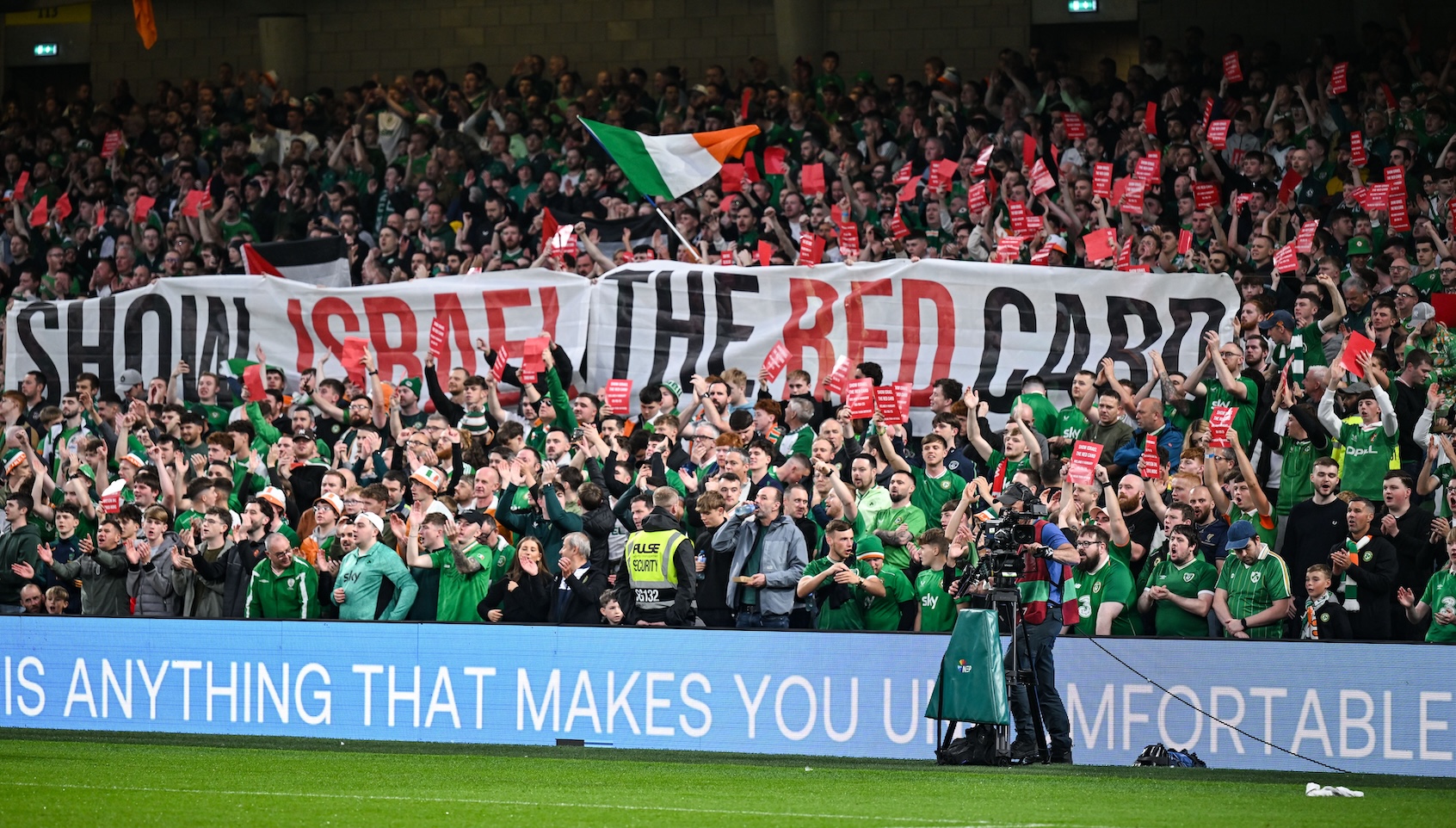

Israel and the Republic of Ireland are engaged in an overheated war of words that has transformed a relatively minor sporting event into an ugly international incident, not to mention a symbol of rising tensions around Israel’s relationship with the rest of the world. Two soccer matches between those countries will apparently take place over the next three weeks, but under increasingly bizarre circumstances. It’s fair to say that most people in both nations wish they weren’t happening at all.
The coach of Ireland’s national soccer team, Heimir Hallgrímsson — who is Icelandic, just to make matters more confusing — has said that none of his players want to participate in the upcoming matches with Israel, which he called “playing against genocide.” The Israel Football Association responded with an angry social media post accusing Hallgrímsson of “stupidity, ignorance and hypocrisy.”
This teapot-level dispute actually reached the United Nations on Tuesday, when Irish Taoiseach (or prime minister) Micheál Martin addressed the General Assembly. In a much shorter speech than the one delivered by Donald Trump, Martin broadly endorsed Secretary General António Guterres’ view that the expansion of Israeli settlements in the occupied West Bank raises “the specter of ethnic cleansing” and endangers a hypothetical two-state solution. But he also found a moment to go local, calling on Israeli authorities to withdraw their “unacceptable remarks” about Hallgrímsson. We may reliably assume that further vituperation will follow.
All of this was predictable, and to some degree avoidable, as soon as Ireland and Israel were drawn to play each other in the opening round of the UEFA Nations League, a European international tournament a few levels below the World Cup. (No, Israel is not a European country. But for international sporting purposes it is considered one on TV, having been expelled from the Asian Football Confederation in the 1970s.)
We need your help to stay independent.
That was never going to end well. Irish public opinion has been strongly pro-Palestinian for decades, partly from a sense of historical identification and deeply ingrained anti-colonial or anti-imperialist attitudes. That sentiment has redoubled since the Gaza war began, leading to increasingly tense diplomatic relations. Ireland was among several smaller European nations to recognize a Palestinian state in 2024, but Israel’s foreign minister singled out the Irish for retribution, closing the Israeli embassy in Dublin and accusing then-Taoiseach Simon Harris of embracing and spreading antisemitic rhetoric. Since then, the tit-for-tat has continued: Various cultural exchange programs have been dumped, and Ireland has become a leading force in the widening anti-Israel boycott of the Eurovision song contest.
From the Irish perspective, a certain historical irony is at work in these allegations of antisemitism. Consider the most famous Irish person of Jewish heritage, who despite being fictional can be said to have changed the world.
No nation anywhere is free of racism or antisemitism, but from the Irish perspective a certain historical irony is at work here. Even in the overwhelmingly Catholic ambiance of 20th-century Ireland (greatly diluted today), the country’s tiny Jewish community never faced outright persecution. In fact, Ireland became the first European nation to guarantee religious freedom to Jewish people in 1937, when the continental current was, shall we say, running in a different direction. Robert Briscoe, who was both a celebrated Irish revolutionary and an Orthodox Jew, became lord mayor of Dublin in the 1950s. Future Israeli president Chaim Herzog was born in Belfast and raised in Dublin. And then there’s the most famous Irish person of Jewish heritage, who despite being a fictional character can be said to have changed the world: Leopold Bloom, the ambiguous protagonist of James Joyce’s “Ulysses.”
Joyce reportedly preferred rugby to soccer, but he might have enjoyed the absurdity of the current Nations League fracas, which will apparently reach its denouement with two matches no one actually cares about happening in virtually empty stadiums. Despite widespread protests by Irish fans and a general consensus that the national team should refuse to play these games, the Football Association of Ireland voted to proceed, but after considerable dithering concluded that hosting a match in Dublin’s cavernous Aviva Stadium under these volatile circumstances was a dreadful idea.
Start your day with essential news from Salon.
Sign up for our free morning newsletter, Crash Course.
So Israel’s “home game” on Sept. 27 will be played in Hungary, and Ireland’s on Oct. 4 will take place behind closed doors in what appears to be the local sports complex of a small town in Serbia. No fans at all will be permitted at the latter event, and only a few hundred Israelis at the former. Ireland’s national broadcaster, RTÉ, is contractually obligated to broadcast the games but will do so in bare-bones fashion, with no commentary, punditry or advertising. (Admittedly, that sounds fascinating.) It doesn’t matter who wins. Everybody has already lost.
Read more
about Israel, Ireland and the world
