Editor: Sarah Hepola
Updated: Today
Topic:

Motherhood

Everybody hates mommy

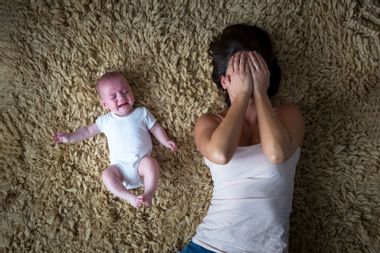
We're "stroller Nazis." We're whiny "breeders." Why is there so much contempt for mothers these days?

Making peace at my ex-husband's Seder

We fought in court over the role of religion in our children's lives. Now, it was time to let it go

This piece originally appeared on Marcelle Soviero's Open Salon blog.

I rang the doorbell of my ex-husband Larry's house, a jar of gefilte fish in one hand, boxed coconut cake in the other. To date I'd been to the house on Thunder Lake only to drop off the kids. But today I was here with my husband, Eric, and two stepchildren, Luke and Jamie, for Seder dinner.

Given the circumstances, this was miraculous; I'd last seen Larry three weeks ago at the trial. Six years after our divorce was final we'd gone back to court over the religious upbringing of our three young children, Sophia, Olivia and Johnny. I'm Catholic; Larry is Jewish.

Eric, Luke, Jamie and I stood on the front steps. I did not want to ring the bell again. "Cool house," Luke, 13, said, looking heavenward to where the white columns we stood between might end.

"We could leave," I said.

"Just breathe, honey," Eric said.

"Tell me again why I'm here?"

"For the children," he said, taking the jar of gefilte fish and squeezing my hand.

Eric had been here for me each odd step of the journey. He'd been at the first meeting with the rabbi more than a year ago, where I sobbed, explaining I was the primary caretaker of my baptized children, and I could not raise my children Jewish.

Sophia, my oldest daughter, just 12, answered the door, welcoming me as a guest in her other home. The divorce agreement said nothing about religion, so Larry and I tried to figure out Sophia's faith in real time. Each decision we made would mark her, and be the precedent for her sister Olivia, 10, and brother Johnny, 6. But looking at Sophia, I knew Larry and I had not damaged her permanently yet. She stood with ease in the foyer. She'd grown into a beautiful girl, her father's dark eyes, my mother's wide-lipped smile, her mane of black hair a gift from some former generation.

Now in a house where my children lived when they were not with me, images of their life with their father came into view, the backpacks on each hook, three jackets hung in the closet, a drawing with the words "I love my Daddy" in a frame on an end table.

I remembered a 5-year-old Sophia in the tub with her little sister just after the divorce. The girls played in the bath bubbles, splashing suds onto their chins Santa-style, and spun the rubber ducks on the surface of the water, like dreidels, singing in Hebrew. That was how I first found out that Larry had been taking the children to Temple on his weekends. He had never taken the children to Temple in the eight years we were married.

I had fallen in love with Larry at a Seder at his house when we were dating. I'd grown up in a cloistered Irish-Italian family, a plaid-uniformed Catholic schoolgirl. I had never been to a Seder and at that one I met a Buddhist and a Muslim. As the conversation developed into a theological discussion, my mind stretched past Sister Marianne McCarthy into the realm of rabbinical texts, the Tipitaka, and the Quran. My world cracked open over a candlelit table with plates of beef brisket and roast turnips. My husband-to-be was worldly, 15 years older than I, and seemed to believe in all religions, subscribing to none.

We walked to the main room. "I come bearing gifts," I blurted, handing Larry the gefilte fish and coconut cake. Several children raced through the house and a few other couples greeted us. I knew one woman from the gym. "It's so nice how you all get along," she said, nodding toward Larry, then Eric. "So nice how you're all here," she added, her words echoing beneath the cathedral ceiling.

All of us getting here was a long story. One that began with a two-sentence e-mail I received 18 months earlier stating Sophia was enrolled in Hebrew school and her bat mitzvah was set for June 12.

My ex-husband's e-mail, in its brevity, seemed a decision to change the course of my children's lives without discussion. It set off a series of sparks that turned into blue-flamed anger, then action; two motions filed within two weeks, followed by a trial.

In court I sat on the bench with my lawyer, waiting for our case to be called. I shuffled papers, my hands shaking, the children's baptismal certificates fluttering to the floor. Larry sat several rows in front of me, with a string of witnesses shoulder-to-shoulder.

Larry's lawyer called me to the stand. I swore to tell the truth and nothing but the truth. I considered another oath I'd made before Larry, to love you in sickness and in health all the days of our lives.

The lawyer fired off questions.

"Do you know how long the children have been attending Temple?" he asked. "Have you ever taken any legal action up until now?"

I hated him, catching me on a hook like that. No, I had not taken legal action, but I had built a case with Larry outside of the court. We'd tried to talk, but the words crisscrossed before ever being heard. The talking turned into pithy e-mail exchanges, what we each thought the other's  intent was for the religion of the children when they were born. I believed we'd agreed the children would be raised Catholic and Jewish. My problem at this juncture really boiled down to a bat mitzvah. A ceremony that would confirm my daughter in the Jewish faith, somehow separating her from me.

"Are the children presently enrolled in any other religious instruction?" the lawyer continued, tension in his voice. I thought back to my enrolling Sophia in CCD when we first moved, and how I pulled her out three weeks later. The change in homes and schools was stress enough for both of us. And I thought the allure of taking three kids to Temple would wear off for Larry.

Larry's lawyer repeated the question. "Are the children enrolled in any other religious instruction?"

I began to explain the three-week enrollment.

"Answer yes or no," the judge said.

"No," I said.

"When was the last time you went to church?" the lawyer asked. "Christmas?"

Objection.

Sophia's Hebrew school teacher came to the stand next. I had never seen this woman before. She addressed me from the stand: "Did I know Sophia already knew her Torah portion?" she asked. I did not know. That was the problem. Somehow this all happened in secret, on the one day a week the children spent with their father. The lawyer finished the show with a former next-door neighbor, who confirmed that, yes, he and his wife had attended Seders in the marital home.

Court was adjourned until a date two weeks from that day. Two more weeks. It would be unbearable.

My lawyer walked me to my car. I locked myself in, tears dripping from my eyes onto the leather seat. My mind reeled back to my childhood, me in that white dress at my First Holy Communion. I had memorized the Our Father and the Hail Mary. I'd taken the Body of Christ for the first time and had gotten stomach sick. Years later I would say my Hail Marys in succession after confession with Father Amato, where I begged forgiveness for my 16-year-old sins.

Though I'd grown up with God, that confession would be my last in a formal setting. Once I went off to college and was away from parents who did not know if I went to church or not, I opted to not. By the time I met Larry after college my faith was packaged into silent prayers at night, the ongoing giving of thanks in a private setting. I married Larry within 12 months of meeting him the first time. We divorced eight years later, to the day.

Larry and I both lost so much in the divorce. But afterward, I found Eric, and I wondered now, for the first time, if Larry found religion. Perhaps Larry was not just pushing his Judaism to control me, but he'd come to believe in it. While I reestablished my roots in an expanding family, with Eric and my children and stepchildren, Larry may have found the roots of his faith. Darkness fell, and all the other parked cars had gone. I tapped out the number of years Larry had been taking the children to Temple and Hebrew school. I tapped seven times on the steering wheel. It had been seven years.

I put the key in the ignition, wondering for the first time if I should let Larry win this one. I told myself that whether or not the children were mitzvah'd, they would choose for themselves one day. Unlike in my house where Christianity had been a given, never questioned, my children would have to think things through as they grew older. Even with a bat mitzvah, Sophia would have to question the two faiths that were rolled up inside of her.

In the morning I called my lawyer. "Settle," I said.

Later that week, after my ex-husband heard of the settlement, I received an e-mail invitation to Seder at his house. "Please bring Eric and Luke and Jamie," he wrote. I thought about the invitation for more than a week and decided it would be best for the children if Larry and I at last appeared to be on the same page.

I took in the scene before me now, Sophia pulling out the Scrabble game, Olivia trying to hide the afikomen while everyone watched. I went to the kitchen to pour a glass of wine and found myself alone with Larry in the kitchen. "It's a nice party," I said.

"I'm glad you're here," he said, taking the Seder plate from the refrigerator, the boiled egg rolling off onto the tile floor.

"Need help?" I asked, picking the shank bone off the counter. 

"Remember that Seder when you tried to bake shehokal?" he said. In a minute I was back in another kitchen, separating 13 egg whites, completely baffled at how to make a dessert without flour.

"I remember," I said, the moment between us tacked to the corkboard, held still for us to observe. We were joined in a singular memory, from a time when we would have done anything for each other.

Our youngest son, Johnny, age 6, came into the kitchen, the moment broken. "Come see my room, Mom," Johnny said, taking my hand. I looked at Larry as if to ask if it was OK for me to go upstairs. He nodded, and Johnny scooted me away taking the steps up to his room two at a time. "Here's my bed," he said, a 6-year-old docent. The room was blue, a framed Derek Jeter jersey hung above the headboard. Autographed baseballs were lined up in individual display cases on the dresser. Johnny hopped on his bed, and I sat next to him.

"Can we have a sleepover tonight, Mom?" he said.

"Not tonight, Champ," I said.

After the tour, Johnny and I went back downstairs for dinner. My children, stepchildren, ex-husband and husband sat down to matzo ball soup in steamy porcelain bowls; matzo ball soup had always been a favorite of mine, the item I craved through each of my pregnancies. I had not had it in years. The smell of broth and parsley sifted through me, the lilies pushed their necks up out from the lips of the vase.

Johnny, the youngest at the table, started the Seder with the first of the four questions.

Ma nishtana ha-laila ha-zeh mi-kol ha-lelot?

"Why is this night different from all other nights?"

The last days of my mother, the control freak

Mom made meticulous plans for everything in life, but when she neared the end, she wasn't sure what they were

The last days of my mother, the control freak
iStockphoto

Two weeks after my mother's final stroke, it occurred to me she might not know she was dying.

The symptoms of her impending death were all there. She was too tired to open her eyes. She was subsisting on ice chips the size of a baby's fingernail. Her extremities were cool, the traffic in her veins so lazy that the hospice nurses couldn't find a pulse. Her breathing would cease for many seconds, then resume with a deep drag -- until the next hiatus. She fiddled with the bedclothes and asked me what that dog was doing in the room. There was no dog.

"Do you know you've had two more strokes?" I asked her.

"No!"

I wasn't surprised by her surprise. All year she'd expressed fresh astonishment each time she was informed of her condition -- the first stroke that robbed her of memory and sight; the second and third that rendered her more demented, and incontinent; the fall that fractured her hip and propelled her further into frailty and confusion. "This is the first time anyone's told me!" she'd declare.

My mother was a woman proud of being in charge. In fact, she could bear hardly a moment of not knowing what was coming next, of intellectual ambiguity or emotional irresolution.

This anxiety had practical outlets. At the various agencies she managed, she'd designed systems that were still in use decades later. Her closets were immaculate; a week's worth of dinners were cooked and frozen each Sunday.

But her allergy to ambivalence also made her impulsive and controlling. Unsure how to live with my father as he descended into Alzheimer's, she'd moved them from Manhattan to an assisted living facility in Ithaca and back three months later, $30,000 poorer. If you visited her summer house, she had every second accounted for and was perpetually pushing you on to the next activity: Finish breakfast so we can go for a hike. Hurry down the mountain so we can get back for lunch. Eat the soup, clear the table for pie ...

Like everything else, dying and death were written into the agenda. She and my father signed living wills in their 50s and periodically renewed them, checking off the boxes to decline extraordinary -- and in some cases ordinary -- measures to prolong their days if there was little promise of a decent quality of life. Every few months she mailed me an updated sheet containing their Social Security numbers, insurance policies, bank account balances, and so on.

Then, six months before her 90th birthday, three blood clots migrated from her heart to her brain, and the woman who had walked two miles and practiced the piano daily, kept the books, distributed leaflets for peace, and organized a social life to rival Marie Antoinette's could no longer make toast or remember her phone number. Her beau, unable to cope with her new needs, asked her to leave the apartment they'd shared for eight years.

Perched on the examining table a few weeks after returning from rehab, my mother wept to her gerontologist. "I have no say anymore," she kept repeating. The crowning proof of her lost autonomy: She possessed neither the courage nor the cognitive ability to commit suicide.

Now, I didn't want my mother to be the last to hear the momentous news -- and I wanted her to have a say. "Mom," I asked, "are you aware that you're dying?"

Her face registered surprise again, then trouble. She shook her head, as if to deny not knowledge of the fact but the fact itself.

Technically, she had a point. My mother was performing every end-of-life act on schedule -- except dying.

According to the death-and-dying websites I pored over while she dozed, today's surge of energy and hunger was another typical end-of-life sign -- or not. A friend's husband had swung his legs over the side of the hospital bed, ordered breakfast, delivered a disquisition on the role of the Menscheviks in the Russian Revolution, and 12 hours later was on his way to that great soviet in the sky.

On the other hand, Mom's nurse Jeff had a patient who'd asked for a pastrami on rye, gotten up, and lived another year.

This morning on the phone, Jeff concurred that Mom probably couldn't down a pastrami sandwich; she coughed on a half-teaspoonful of water. He suggested we try applesauce, but wanted to check her swallowing first.

To tell the truth, I hoped he'd pronounce her unable. Mom and I had discussed the options for checking out. The only one that didn't involve my committing a felony was for her to stop eating and drinking. But I knew she couldn't do it. Food had become Mom's only pleasure.

Now, at last, her body was taking on the job. Her appetite gone and her throat muscles compromised, she was on the way to fatal starvation and dehydration. Then this morning she'd said yes when her caregiver asked if she wanted something to eat.

Was this a habitual response? (In the last months, she never refused a snack.) Or was she actually hungry?

Did she desire just to eat -- or to live?

It seemed the right moment to review the wishes she'd set down in her advanced directive. Feeding tube? No. Intravenous nutrition? No. Her answers were nearly inaudible, but emphatic.

Now came the part between the little boxes on the document -- the part, it turns out, that covers much of dying. "So, OK," I began. "You have a choice. We could keep giving you the ice chips whenever you want them, and keeping your mouth wet, and you would die -- pretty soon." I paused to let her take that in. "Or we could start feeding you again. You'd still die," I said, "but more slowly."

Moments passed. "Do you understand?" I prompted.

She nodded that she did, then turned her head to me: "What's the prognosis?"

I wasn't going to lie to her. "Well, Ma, I gotta say: It ain't good. You're half-paralyzed. You'll never walk again. You're not going to get your mind back, and your sight is only getting worse."

Another long pause. Finally, she sighed: "Oy."

I laughed at this astute summary of the situation.

Mom asked: "What's your recommendation?"

This was turning into the most cogent conversation I'd had with my mother in six months.

"I'm sorry, Mom. But I can't recommend. It's your life."

I felt her drifting. Was she thinking about it, too tired to think about it, unwilling to think about it? Then she spoke slowly, almost soundlessly, but with crystalline clarity: "To tell you the truth, I feel pretty ambivalent about the whole thing."

To appropriate St. Augustine, my mother wanted to be dead, but not yet.

Jeff came an hour later. In the living room with my partner, Paul, and me, he confirmed that food would stall, but not forestall, Mom's demise. Still, if she wanted to eat and could, we should let her eat. "Hospice isn't about hastening anyone's death," he said. Then he excused himself to examine my mother and came back to tell us her throat muscles were too impaired to admit food or even water. The decision was made: keep on with the ice, and wait.

I was relieved, and not just about resolving the dilemma at hand. The last year had overtaken my life, demolished my ability to work, and roiled a fragile détente with my brother. Full-time care was draining my mother's savings. I'd badgered her doctor to discontinue her meds and let nature takes its course. He said the drugs were bettering her quality of life. I countered that they were prolonging her death. I kept telling him she was ready to die -- she kept telling me she was. We all knew I was ready for her to die.

Now that she was "actively dying," however, it seemed she was up for prolonging her death with every ounce of life she had left. And why not? She was in no pain. Her caregivers were swaddling her in meticulous attention.

And she finally had what she'd wanted all my life: me. Her prickly daughter was at her side, doting with inexhaustible patience, anticipating her every need, acknowledging her every feeling -- loving her. Paul and I joked that just to get even, she would live forever. (Or at least until the next thing on her agenda.) My mother had been giving advance directives all her life. The living will was just the ultimate one.

But here's the thing: Plan all you like, you can't know the territory of dying until you arrive. And then there is nothing like the glint off the Grim Reaper's scythe to blind you to the path you thought you'd mapped.

My mother was desperate to get there, then wasn't so sure. She hung on for what to her must have been an interminable period of indecision -- living an entire month on nothing but ice chips.

On day 30, I again asked if she knew she was dying.

This time she nodded her head yes.

"Are you ready? Is it OK, Mom?"

Her face was calm, her voice less than a whisper. Yes, she said. She was ready. 

  • Judith Levine is a journalist and author of four books, most recently "Not Buying It: My Year Without Shopping." More Judith Levine

Why does my son keep coming out to me?

My 16-year-old tells me he's gay. Is it the truth, or a side effect of his recent brain injury?

Why does my son keep coming out to me?
iStockphoto
This piece originally appeared on Drema Dial's Open Salon blog.

"Mom, I have something to tell you."

"What's that?" I barely look up from the dish I am preparing.

"Mom, I'm gay."

I look at him. He stands there with his hands in his pocket. He looks earnest and hesitant.

"I'm glad you've figured it out." I smile.

He looks disappointed; I feel I have not reacted in the way he expected.

"Really? That's all you have to say?"  His mouth twists into a bit of a grimace.

"Well, yes, I guess. I'm glad you figured out something, and I'm also glad you told me."

He sort of nods and walks away.

------

Twenty-six months ago, my son went from a healthy 16-year-old to being in a coma. Hit by a minivan while riding his bike, he flew 60 feet and landed on his head, which caused life-threatening traumatic brain injuries. He was in a medically induced coma for a week, then was "brought back to life."

My son has been out of rehab for three weeks. These are but the early weeks of hell in brain injury recovery. For now, we still have almost complete control over him because he is not yet back in school. He is constantly monitored at home and only leaves the house to attend therapy for speech, occupation and/or physical needs. He hates being so confined. I understand: Who wants to be watched all the time? But we, his adult caretakers, are hyper-vigilant about his whereabouts. We have seen how impulsive he is, how mentally he is closer to an 8-year-old than to the 16-year-old that he is.

His friends come over for an afternoon of fun. He gets very excited because he has not spent much time with his friends. What time he did spend with them either in the hospital or at the rehab facility are ghostly images in his mind with little memory attached.

He decides to take his friends on a tour through the house. This might not be unusual except for two things: One is that most of his friends have been to our house, the second is that he highlights items such as the stove.

"Look!" He turns a knob on the gas stove and points to the electric rings. "See? You turn this knob on and then it gets red, that means it's hot. Then you can cook!" 

He continues the house tour in this manner. My partner, J, and I are unsure what to do. Should we intervene? Or should we just hope his friends don't re-create "Lord of the Flies" and sacrifice him? We hover with uncertainty in the background, turning off the stove as they move on, shutting the door that leads to the sunroom, turning off the light in the bathroom "with a really big tub." Eventually, they settle into his room. Someone puts on music and they have a "rave." They dance wildly to the music and whoop with adolescent joy. J and I smile at one another with a mixture of hope and uncertainty as the boys shout and romp.

At midnight, as their parents begin to arrive, the boys stagger out of his room sweaty, grinning and whooping at one another. High-fives are passed around as they take leave of one another. The scent of musky teen boy lingers in the air.

------

"Mom, I have something to tell you."

"What's that?" I look up from the magazine I am reading.

"Mom, I'm gay."

I look at him. He leans slightly to one side, a result of his brain injury.

"OK."

He looks disappointed again.

"Really? That's all you have to say?" 

"Sweetie, yes, that's it. Do you have something more to tell me?"

"No. I just wanted you to know."

"I appreciate your telling me. I do." We hug.

------

"Mom, I have something to tell you."

"What's that?" I put my knife down, stop chopping vegetables, turn to look at him.

"Mom, I'm gay."

I groan internally. How many times will he come out to me? And is this really "coming out"? He has been asking both my partner and me questions, trying to figure out in his mind what it means to be gay or straight. He lives with me, my same-sex partner and his sister -- three females. He does not have a positive relationship with his father but does have one with us. I suspect he sees in my partner and me a loving relationship; he does not have a good immediate model for a hetero relationship. He does not remember his father and me together (which was not a model relationship anyhow). So, as he comes out to me, I imagine he is trying to fit into the model that fits for him: a loving relationship with someone of the same sex. I wonder if his pronouncement is meant to show that he fits in with us, if he needs approval, or if it seems somehow that he should be gay.

In part, I wonder these things because he was a chick magnet before his accident. In part, I wonder because I am a prime example of the fluidity of sexuality, having been married to a man and then finding myself drawn to women.

Do I care if he is gay or straight? No. I want both of my children to have love, to love and be loved. I have no investment in how that is defined -- gay, straight, bisexual, whatever. Be happy, be loved and love in return.

------

"Mom, I have something to tell you."

"What's that?"

"Mom, I'm gay."

I stare at my son, this good-looking specimen of humanity who is attempting to redefine his place in the world. This little boy who is almost a man but who is also currently lost on this path.

"Sweetie? How about this: How about if you come out to me if you are straight? I know you're gay because you told me, but you don't have to tell me again. Just tell me if you are straight or bisexual. OK? Because I'm going to love you no matter what you are."

He grins and nods. He lifts his hand into the air; we high-five. I guess I got it right that time.

Drema Dial is a psychologist in Austin, TX. She has parented longer than she has been a psychologist but the two frequently overlap.

The strange story of my son's circumcision

I believe cutting a boy's foreskin is mutilation. So why am I standing here at my child's bris?

The strange story of my son's circumcision
iStockphoto

My mother tells me the sweat that's beaded up on my forehead and neck and the wave of nausea and disgust that has come over me is just the result of postpartum hormones, but I know better. As I stand, tottering in heels and fancy dress at 7:45 a.m. in the rabbi's study at my synagogue, a mere eight days following the birth of my son, I know this feeling for the second time: It's not hormones. It's self-loathing.

I have done this before, handed my newborn over to a strange man who makes his business removing foreskins. Three years ago, when my older son was born, I'd had exactly the same feelings. Back then, they were surprising. I hadn't known this would be such a big deal. After all, I grew up in an Orthodox community. Every boy and man I had known had had this done; almost every mother I'd known had handed her child over in a similar fashion. I've been to many of these brises (ritual circumcisions), and there is a formula. The men cringe when they hear the cry. The women crowd around the mother, who is emotional. We shout "Mazel tov!" We eat bagels. But it all seemed like a play. Now I am the mother, and I am seized with desperation: Every morsel of my being, every maternal instinct I've earned in the last three years, says to run. How do women do this? I wonder.

Looking down at my son, not even big enough to open his eyes and object, I am struck by the unfairness of it all. He has not chosen this; he is about to enter a covenant that he does not consent to. The reason we do goes like this: All those years ago, the founding Jew Abraham and his first son, Ishmael, took it upon themselves to do this to themselves. And so now, to commemorate their brises, their covenant with God, we submit our sons to a ritual circumcision. And each time you do it, each time you call the mohel to let him know where to be and when, it is a choice you're making. It is a choice I have made.

Now, before you get excited and skip to the comments section so that you can berate me for my choice to circumcise my son, don't miss the nuance here: To assume that this essay is about whether or not I should circumcise my son is to miss the chance to criticize me for the even uglier dilemma that this essay is actually about. See, there's no doubt I'm going to do this. I'm just trying to figure out why. This essay isn't about the bris; it's about why a woman -- who, like some of you, believes this is mutilation -- would choose to do something so brutal to her newborn son. It's about the fact that as I stand here, I'm still not sure why.

My relationship with religion is complicated. I was raised in a religious family and sent to a yeshiva, where I learned to confuse my hatred for school for a hatred for religion. I swore when I got out of there, there would be no more skirts, no more morning prayers, no more scripture learning, no more blessings before and after food, no more nonsensical rules governing how and when to talk to boys.

I wanted out, and so I got out. As I unpacked in my college dorm, I made a pledge to never get roped into a Shabbat dinner or Yom Kippur fast again. I did whatever I wanted to do on Friday nights, even though the sun was setting and my religious compadres over in Flatbush were lighting candles and settling in for the evening. I did not date one Jewish boy — couldn't risk it. I didn't eat pastrami once. That's the shame of a religious education, isn't it? We get so caught up in the method and persona of who is delivering the message that we forget that it is not they who control the information. It is just they who have first crack in your life at disseminating it. They are not messengers of God. They are merely messengers of your parents' tuition dollar.

But religion can always find you. For some of us, maybe some like me who lack imagination, the fact of religion, the fact of God, is so ingrained in us that by the time we are old enough to question the word of God or even the existence of God, it is too late. Some of us -- not all, surely, but some -- are no longer able to picture a world in which God is not the creator, the author, the determiner. Some of us can't even fathom a world in which God doesn't exist.

Perhaps this is why, no matter what, it was important to me to marry someone Jewish. Though I didn't celebrate my religion, I wasn't ready to sever my ties to it with so much finality as to marry out of it. And so, when I met the man I would eventually marry — a man whose disdain for the hypocrisies of the Catholic Church outshone my mere annoyance with Judaism — I told him I couldn't marry him because he wasn't Jewish. He began thinking about Judaism, and he began learning about it. Eventually, he fell in love with it, maybe even more than he fell in love with me, and became committed to converting. I don't remember the turning point when his conversion went from doing something he was doing for us to something he needed to do for himself, but I do remember a point where he told me that he was going to get a full circumcision (he had never been circumcised).

One Thanksgiving morning, inexplicably in special-occasion wear, we arrived at a mohel's house. I was instructed to sit outside the mohel's study, which doubled as a surgical room for just these occasions. The mohel left a radio on for me, presumably so I wouldn't hear my husband if he cried out in pain. His wife made small talk with me. For the next three weeks, I nursed my husband through an incredible amount of pain. Pain, but never once regret. The regret, and the guilt, they were mine alone. After all, here I was, forcing the first of three men in my life (so far) to undergo a ritual for a religion I was only partially partial to.

Of course, as irony would have it, my husband's love for Judaism only grew stronger after his conversion was complete. Our home is kosher; we attend synagogue. We are even Sabbath observant. My husband wears his yarmulke everywhere. With effort, I have allowed my current experience of Judaism — a rabbi I like, a community that sustains us — to rewrite the bad parts left over from high school, and I find that I'm somewhat relieved that this is how it ended up for me. In fact, I would even say that at some point, not very dramatically, but over a cumulative number of experiences, I chose Judaism right back. But why? To what extent is the acceptance of religion into my life at this point a way to reconcile the fear I face as I give birth to and raise children? To what extent is this acceptance an attempt to cling to something that can help me be brave when I am overwhelmed by the randomness of luck, the accident-proneness of the universe?

And so here I am, holding this child, wondering for the second time if my belief in God is a good enough reason to do this. Now in the sanctuary, I look out into the crowd. My family has flown in from New York. My friends are all here. They have woken up early, delayed an on-time arrival at work or camp, gotten their children here in time to celebrate with us, to meet our son, to learn what we have named him (in Orthodox tradition, a boy's name is not announced until his bris). I should feel warmly toward them. Yet all I can think of is how they seem like the bloodthirsty audience at a gladiator tournament in ancient Rome. First they will watch my son get mutilated, then they will cheer, then they will eat bagels. Though I have invited them here, though I have provided the bagels, I hate each of them for it.

I think of what brought me here. You light some candles on Friday night; eventually you go to synagogue. For your wedding, you find that you've registered for two sets of dishes, one for meat and one for dairy, according to kosher law. All of a sudden, you're standing at your son's bris, not so sure if this is what you meant when you lit those first candles. No, it's not so much the momentum or velocity of religious practice that brought me here. It's more like the inertia of it: My practice of Judaism has tended to stay in motion since no force has slowed it down.

I am surprised to learn, though, that it's not all inertia. Had my husband never converted, had I been destined to live a life with some other man — say, some born Jew as uninterested in religion as I had been — my sons would still have their brises. Why?

Becoming a parent is hard. When you glimpse how every piece of you is invested in your children, it is shocking and overwhelming. When I gave birth to my first son, I was struck by the fact that I had spent nine months worried about how he would come out — whether he'd be healthy, whether he'd survive the trip. As I held him in my arms, I realized that though he was born healthy, there were no guarantees. In fact, now that he was outside my body, he was less safe than before. I realized, suddenly and in a cold sweat, that I wouldn't know if this experiment — parenthood, child-rearing, child loving — would work out till I was on my deathbed and I could be assured my children were outliving me. Sure, there are other things that quantify success as a parent, and I hope to meet those goals, too. But I can't help but think that making sure they live long after I've passed is at the top of that list.

While I do know that I am not in control of certain things in my sons' future — peer pressure, meningitis, drunken drivers, Justin Bieber's effect on tweens, school shootings, cancer — I do know that I am sometimes overwhelmed, nearly driven mad, when I realize how much is out of my control, how much of their safety is not determined by my actions.

In those times, when I am seized with that kind of desperation, I realize why I submit my sons to this ritual. When I do it, I am asking God to share the responsibility with me. To help me parent my children, for no parent would allow something awful to befall his children if he could help it, right? I am so out of control that I resort to a kind of superstition, a kind of magical thinking. I will give you this, God. I will hurt my sons for you, and you, in exchange, will keep us safe. Please give me peace. Give me my sons. Let them live. Let them be healthy. Let their lives be easy. Let me merit the chance to see my children outlive me.

When we begin to have children, we cling to those beliefs; we cling to the hope that the universe is not random so that we can function. For how can we function if we really knew that today could be the last day? Each new child, each new love, is a test of our luck, of the universe's love for us. Each child is like a dare. We are not guaranteed anything.

And so I do it. I hand my son over. After many excruciating minutes, say, five, it is done. The congregation has the gall to call out "Mazel tov!" I feel ugly. I feel relieved. I spend the rest of the day searching my son — Haskel is his name — for signs of forgiveness. He trusted me after this week we'd gotten to know each other, him falling asleep in my arms with the guileless, open face of one who'd never been startled awake by fear. I don't know if his mind is yet sophisticated enough to feel betrayal, but I know I'm testing it. People slap me on the shoulder and tell me that it doesn't hurt the way I imagine it does. Few of them have a relatively recently circumcised husband to dispute that.

Ultimately, though, I am comforted by the feeling that I've secured something. I will do this excruciating and unthinkable thing, and God will, hopefully, protect my children. I'm not even stupid enough to think that I have any kind of guarantee that Haskel's life will be blessed because of this. I don't pretend I am wise enough or enlightened enough to know the ways of God. I even leave room for the idea that religion is a made-up superstition whose goal is to function in exactly the way I'm using it. But I have to do what I can. Whatever our magic is, whatever spells we can cast, whatever wishes we need to make, whatever deals we can broker, we need to do what can. Sometimes, being a parent is just too much to handle without at least some wishing, without just a little magic.

Taffy Brodesser-Akner is a freelance writer living in Los Angeles.

When the "gayby boom" came for me

For years, being a lesbian meant I never had to explain why I didn't want children. Not anymore

Salon/iStockphoto

"Slide further down, right to the edge. Legs apart," prompted Dr. Lee, the OB/GYN I'd seen annually for years. "You're going to feel some pressure," she warned before inserting her gloved fingers. Then, continuing casually, "So, how's Melinda?"

"Six years in August." I smiled.

"You know," she said, peeking around my knees, "I recently helped another lesbian couple have a baby boy. Are you two thinking about kids?"

"Huh?" I propped myself up. I thought we were making small talk. For this, I needed eye contact. "That's not something we want," I said, hoping to leave it at that.

"OK, but know there are options," Dr. Lee probed. "If you and Melinda ever change your minds."

Sure. I laid back, nodding politely through a tight, clamped smile.

-----

I never wanted to be a mother. As a child, I tucked Barbie into bed -- not baby dolls. Cuddling chubby infants didn't interest me nearly as much as perfecting my woman's dream home and sticking giant jewels in that hole in her hand. When Melinda and I got together, we saw our shared lack of interest in motherhood as a major compatibility point -- on par with sexual orientation and religion. We'd both been coaxed by maternal ex-girlfriends to be the "dads," but never -- until Dr. Lee -- had anyone nudged me to be the "mom." Well, except, of course, for my mom.

Mom used to be incessant about wanting grandbabies. Even after my brother had a couple of boys, she didn't miss a beat before starting up again with, "I want your grandbabies!"

"Mom, kids aren't for me," I said through my 20s.

"You'll change your mind when your friends are doing it," Mom insisted. Which was the exact opposite of what she said about peer pressure when I was in high school. Now she used it against me? Fruitlessly. My mind had been made up since 1991 when I baby-sat for the Hill family in Waukesha, Wis. They paid me $4 an hour -- a dollar a kid -- and left me dinner instructions, bedtime requirements (involving nightie lights, binkies and woobies), and laundry ... if I got the chance. Riding home with a $16 check to cash, I knew that'd never be the life for me.

"You'll change your mind when they're yours," Mom promised. "Or meet the right guy." She continued to say this long after I started dating women, but I didn't have the heart to correct her until I knew I was serious. The day I announced I was in love with the one-and-only I wanted to spend the rest of my life with, Mom's face lit up in a full mother-of-the-bride beam. Until I said Melinda's name and it fell sharply as if I had dropped her white-tiered wedding cake.

"But I want you to get married and have babies! I don't want you to be homosexual!" she cried.

"Mom," I reasoned with her, "that wouldn't happen if I was with a man."

"You don't know that! At least there's a chance!" she said.

For what: An accident?

However legal same-sex marriage might become, motherhood would never be an accident. I actually considered that a major perk to lesbian sex. Once we'd both been tested, boiled our dildos, and washed our hands, we could have all the sloppy, lapping, slapping sex we wanted without an Oops! Melinda and I would never find ourselves parents after sharing a six-pack and pizza. It'd be expensive and complicated with other women involved.

I knew our options. Though it was totally progressive of Dr. Lee to offer assistance, I had been kept oh so apprised by ex-girlfriends as well as other lesbians in my life who were busy family planning.

I could be inseminated at the Cryos International Sperm Bank downtown on Maiden Lane -- seriously, 90 Maiden Lane! Its website listed a deep, studly roster of donors, but Melinda's younger brother had already offered us his. He stacked up well: blond, blue eyes, strong jaw, captain of his high school football team -- and bonus, related. Melinda and her brother bore such a strong resemblance to one another that they could've passed for fraternal twins; so I had a feeling that even after I carried it, the baby would look like them. My light brown hair, hazel eyes, soft teeth, and bad skin didn't stand a chance at dominating their Midwestern, farm-stock genes.

At least I hoped. It'd be a relief when strangers cooed, "Who do you look like, mommy or daddy?" that I could answer honestly: Melinda.

Then there was the surrogacy option. If Melinda and I had our hearts set on hiring another woman to carry our child, we'd definitely take a cross-country trip to Growing Generations in Los Angeles. This revolutionary clinic has helped lesbians become moms for over two decades -- with packages starting at $50,000. But here in New York, I knew of another opportunistic (aka illegal) option somewhere between surrogacy and adoption: baby buying. An old colleague of mine wrote a check to her pregnant cleaning lady for her fetus. A year later, she wrote another one for the baby brother.

Of course, one of us could legally adopt a child through a legit agency -- as a single parent. My friend Rachel adopted two kids through Spence-Chapin. On paper Rachel was a lone LGBT mom, even though everyone knew her domestic partner, Amanda, and their story. They'd been together since the '80s, suffered in-vitro failure through the '90s, and joyfully adopted in 2000. In 2003, more New Jersey paperwork officially made them both guardians. Yet, the agency still periodically called Rachel asking if she'd share her experiences with "other single mothers." The institution of adoption, like marriage, still had some evolving to do.

Even with all of these options, I still didn't want to be a mother. Why not? And how could I explain it to Mom?

She had wanted me, badly. Back in the early '70s, endometriosis destroyed most of her reproductive organs, causing doctors to shake their heads and insist on a hysterectomy. After eight years of trying -- everything -- my older brother was born. A little over a year later I came out bawling. My parents often quipped, "Took almost a decade to get the first one, but only one night to get Amy." So I tried a joke of my own.

"Mom," I sighed. "Are you sure you really want to be called the Significant [Grandm]Other?"

I felt her brooding.

I could tell she wanted to yell grown-up versions of what she screamed at me as a kid. Something like, "Go to your room and don't come down until you can say you're pregnant!" But instead she asked, "Was it something I did?"

Wrong. I filled in the last word: Was it something I did wrong?

The truth was, at 31, I was thriving. I had a career and ambitions and a really nice home. My happy, committed partnership was more than enough; it was bliss. Melinda and I went on dates. We read. We regularly traveled to destinations that most only dream of going once -- on their honeymoons. I didn’t want kids, because I had finally become the woman I had always wanted to be.

-----

"OK," Dr. Lee said, snapping me back to the doctor's office by pulling off her rubber gloves. "Your uterus still tilts to the left, but that shouldn't complicate things if, well ... just remember you have options."

She left me, sitting in rumpled paper covers with lube leaking on my thighs. You're going to feel some pressure, I mocked, as I wiped myself off. Normally, I bolted out of her office, but that day I sat on the table, crossing and uncrossing my legs.

My mind was set, right? It had been a while since I'd thought about kids and my aging fertility. Melinda and I didn't talk about it, and Mom had stopped bringing it up. These days, she seemed content to hear about my week instead of suggesting what my next steps should be. I gazed at the wall, until the gestation posters covering it came into sharp focus. My half-second of doubt disappeared. I jumped off the table and into my clothes.

Immediately upon leaving, I called Melinda.

"Dr. Lee just topped me," I said, looking around for any pregnant women within earshot before telling her the whole story of my straight, Asian gyno trying to make a baby in me, while I was flat on my back with my legs up in stirrups.

"That's sick," Melinda said from her office overlooking the Chrysler Building.

"Totally cool of her to offer," I said.

"Totally," Melinda said. "But why would we choose that?"

"I don't know. I mean, I'm not judging," I said. "Some of my best friends are mothers."

Sarah Palin defends Dr. Laura

The "mama grizzly" backs the right-wing radio moralizer who trashed her as a bad mother

On the same day Sarah Palin trashed the "cackle of rads" who "hijacked feminism," she also came to the defense of a staunch anti-feminist, Dr. Laura Schlessinger, on Twitter.

Early Wednesday Palin attempted to declare herself a feminist, to celebrate the 90th anniversary of women's suffrage. She tweeted: "Who hijacked term:"feminist"?A cackle of rads who want 2 crucify other women w/whom they disagree on a singular issue; it's ironic (& passé)"

But about five hours later, she embraced the defiantly anti-feminist Schlessinger, tweeting, "Dr.Laura:don't retreat...reload! (Steps aside bc her 1st Amend.rights ceased 2exist thx 2activists trying 2silence 'isn't American,not fair')" Then she added, "Dr.Laura=even more powerful & effective w/out the shackles, so watch out Constitutional obstructionists. And b thankful 4 her voice,America!"

Digression: It's scary to think we just had a vice presidential nominee who doesn't understand the Constitution, who thinks Schlessinger's First Amendment rights "ceased 2exist" because she was criticized for haranguing a black woman who called for advice, using the word "nigger" 11 times. Again, Gov. Palin, the First Amendment protects us from government infringing on our speech rights; it doesn't take away other Americans' right to criticize.

But it's also funny that Palin goes from pretending she's a feminist to embracing the anti-feminist traditional-values preacher Dr. Laura, who is herself to family values what the four-times-married Rush Limbaugh is. (That's no surprise; the two wealthy entertainers clearly live by the "Do as I say, not as I do" maxim.) I guess when it comes to Palin, right wing politics will trump feminism every time.

But Schlessinger's anti-feminism had a very specific target two years ago: Palin herself. I vaguely remembered Dr. Laura expressing disapproval when Palin was nominated. But I didn't remember how vicious she was. Here's what Schlessinger blogged Sept. 2, 2008:

I am extremely disappointed in the choice of Sarah Palin as the Vice Presidential candidate of the Republican Party. I will still vote for Senator McCain, because I am very concerned about having a fundamental leftist, especially one who is a marvelous orator, as President…

I'm stunned - couldn’t the Republican Party find one competent female with adult children to run for Vice President with McCain? I realize his advisors probably didn’t want a “mature” woman, as the Democrats keep harping on his age. But really, what kind of role model is a woman whose fifth child was recently born with a serious issue, Down Syndrome, and then goes back to the job of Governor within days of the birth?

I am haunted by the family pictures of the Palins during political photo-ops, showing the eldest daughter, now pregnant with her own child, cuddling the family’s newborn.

Now, you can see Palin's Dr. Laura defense as the work of a big-hearted, forgiving mama grizzly. It's also possible she forgot about Schlessinger's diss (but unlikely, because Palin has a talent for holding grudges.) I'd take it as evidence that even among right wingers, sisterhood (as well as victimhood) is powerful. Whatever, they deserve each other.

As a fellow mother, though, I'd suggest Palin keep Bristol, a single mom, away from Dr. Laura. The syndicated bully treats single moms about as viciously as she treated the black woman who phoned in for help dealing with her white in-laws' racism – and does it with far more frequency. I'm not sure why Palin is more outraged by "a cackle of rads who want 2 crucify other women w/whom they disagree on a singular issue" than by Schlessinger's attacks on her and her daughter. Maybe she'll explain on Facebook.

And you're right, "cackle" makes no sense there, but since Palin has already bragged about her Shakespearean way with words, it barely merits mentioning anymore.


Page 1 of 109 in Motherhood Earliest ⇒

Motherhood in the news

Loading...

Currently in Salon

Other News

www.salon.com - sacdcweb01.salon.com