The recession may be easing, but the urgent need to feed New York's hungry is still sharp.
The number of people seeking emergency food assistance in New York City is up 20.9 percent over last year, but agencies were better able to meet that demand despite the shaky economy, according to a report released Monday by the New York City Coalition Against Hunger.
Agencies in New York and around the state have been able to help more people with a boost from federal stimulus money.
The study found that 51 percent of the agencies responding to the survey reported an increase in federal U.S. Department of Agriculture food assistance funding. And money for shelter and food in New York City from a Federal Emergency Management Agency program rose from $4.5 million last year to $7.4 million this year, with $2.3 million from the recovery bill.
About 55 percent of agencies surveyed weren't able to distribute enough food to meet their current demand, down from nearly 69 percent last year.
Despite that, the economic downturn has increased demand enough that many agencies say they're still struggling.
"In our neighborhood, there is an insatiable demand for food," wrote Rev. Paul Block, a pastor who works at the Bronx's Transfiguration Food Pantry. "Food insecurity is a significant problem. Even though we have increased tremendously the amount of people we serve, there continues to be people who are turned away."
The study only covers New York City, but upstate food banks and soup kitchens haven't seen as much of an increase in demand as last year, when the economic downturn was in full swing. And fewer programs are running out of food, said Mark Dunlea, the executive director of the Hunger Action Network of New York State. But demand is still up overall.
"As people lose jobs, it's just flooding into the emergency food programs," Dunlea said.
Hard-hit segments of the population include families with children, senior citizens and immigrants, according to the coalition.
The findings in the coalition's annual hunger survey are based on responses from 287 agencies that run soup kitchens, food pantries and similar programs.
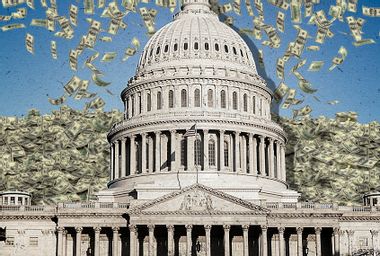
Something quite amazing happened yesterday in Congress: the House Finance Committee -- in a truly bipartisan and even trans-ideological vote -- defied the banking industry, the Federal Reserve, the Democratic leadership, and mainstream Beltway opinion in order to pass an amendment, sponsored by GOP Rep. Ron Paul and Democratic Rep. Alan Grayson, mandating a genuine and probing audit of the Fed. The Huffington Post's Ryan Grim has the best account of what took place, noting:
In an unprecedented defeat for the Federal Reserve, an amendment to audit the multi-trillion dollar institution was approved by the House Finance Committee with an overwhelming and bipartisan 43-26 vote on Thursday afternoon despite harried last-minute lobbying from top Fed officials and the surprise opposition of Chairman Barney Frank (D-Mass.), who had previously been a supporter.
Grim details how key Committee Democrats such as Frank -- who spent the year claiming to support an audit of the Fed in the face of rising anger over its secret and bank-subservient policies -- suddenly introduced their own amendment (sponsored by Democratic Rep. Melvin Watt) that would have essentially gutted the Paul/Grayson provisions. Banking industry and Fed officials, as well as the Democratic leadership, then got behind that alternative provision as a means of pretending to support transparency while protecting the Fed from any genuine examination. Notwithstanding the pressure exerted on Committee Democrats to support that watered-down "audit" bill, Grayson convinced 15 of his colleagues to join with Republicans to provide overwhelming support for the Paul/Grayson amendment. As Grim notes:
[Frank] urged a no vote, yet 15 Democrats bucked him, voting with Paul. Key to winning Democratic support was a letter posted early Thursday from labor leaders and progressive economists. The letter, organized by the liberal blog FireDogLake.com, called for a rejection of the Watt substitute and support for Paul.
Grayson was able to show Democratic colleagues that the liberal base was behind them.
"Today was Waterloo for Fed secrecy," a victorious Grayson said afterwards.
The bill still faces substantial hurdles in becoming law, of course, but yesterday's vote has made that outcome quite possible, and it's worth noting several important points highlighted by what happened here:
(1) Our leading media outlets are capable of understanding political debates only by stuffing them into melodramatic, trite and often distracting "right v. left" storylines. While some debates fit comfortably into that framework, many do not. Anger over the Wall Street bailouts, the control by the banking industry of Congress, and the impenetrable secrecy with which the Fed conducts itself resonates across the political spectrum, as the truly bipartisan and trans-ideological vote yesterday reflects. Populist anger over elite-favoring economic policies has long been brewing on both the Right and Left (and in between), but neither political party can capitalize on it because they're both dependent upon and subservient to the same elite interests which benefit from those policies.
For that reason, many of the most consequential political conflicts are shaped far more by an "insider v. outsider" dichotomy than by a "GOP v. Democrat" or "Left v. Right" split. The pillaging of America's economic security by financial elites, with the eager assistance of the government officials who they own and who serve them, is the prime example of such a conflict. The political system as a whole -- both parties' leadership -- is owned and controlled by a handful of key industry interests, and anger over the fact is found across the political spectrum. Yesterday's vote is a very rare example where the true nature of political power was expressed and the petty distractions and artificial fault lines overcome.
(2) As Grim expertly describes, the effort to defeat the Paul/Grayson amendment came from all of the typical Washington power centers using all of the establishment's typical manipulative tools:
The playbook in Washington often goes like this: When a measure that threatens the establishment builds enough momentum that it must be dealt with, it is labeled as "unserious." The Washington Post editorial board, true to the script, called Paul's measure "an unserious answer to a serious question."
And it particularly rankles the center that a pair of "wingnuts " [Paul and Grayson] are behind a successful effort to challenge the prevailing order.
Step Two is for a "serious" compromise to be offered. In this case, it was Watt's amendment. But by the time the vote was called Thursday afternoon, committee members had seen through his measure, recognizing that it was not a compromise effort to bring real transparency to the Fed but an attempt to further shut the doors.
One can count on one hand the number of times that establishment attacks like this fail, but this time -- at least for now -- it did. And it reveals a winning formula: where there is a strong and principled leader in Congress willing to defy the Party's leadership and the Washington establishment (Grayson), combined with leading experts lending their name to the effort (economists Dean Baker and James Galbraith), organizations standing behind it (labor groups), and a shrewd and driven organizer putting it all together (FDL's Jane Hamsher), even the most powerful forces and opinion-enforcers can be defeated, as they were here. Those progressive advocates' refusal to be distracted by trite partisan considerations, and their reliance on substantial GOP support to pass the bill (as hypocritical as the GOP's position might have been), was particularly crucial -- and smart.
(3) Beyond the specifics, a genuine audit of the Fed would be a major blow to the way Washington typically works. The Fed is one of those permanent power centers in this country that exert great power with very little accountability and almost no transparency (like much of the intelligence and defense community). The power they exert has exploded within the last year as a result of the financial crisis, yet they continue to operate in a completely opaque manner and with virtually no limits. Its officials have been trained to view their unfettered power as an innate entitlement, and they express contempt for any efforts to limit or even monitor what they do.
In other words, the Fed is a typical Washington institution that operates un-democratically and in virtually total secrecy, and a Congressionally-mandated audit that they (and much of the DC establishment) desperately oppose would be a serious step towards changing the dynamic of how things function. At the very least, it would provide an important template for defeating the interests which, in Washington, almost never lose. At least yesterday, those interests did lose -- resoundingly -- and the importance of that should not be overlooked.
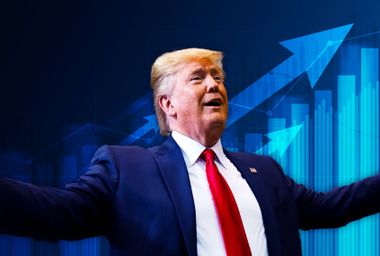
How can the stock market hit new highs at the same time unemployment is hitting new highs? Simple. The market is up because corporate earnings are up. Corporate earnings are up because companies are cutting costs. And the biggest single cost they’re cutting is their payrolls. So they let people go and, presto, their balance sheets look better and their stock prices rise.
In the old-fashioned kind of recession decades ago, big companies laid off people with the expectation of rehiring them when the economy turned up. Then a few recessions back, companies started laying off people for good, never rehiring them even when the economy recovered.
In the Great Recession of 2008-09, companies are going a step further. They’re using this sharp downturn to cut payrolls even below where they were when times were good. Outsourcing abroad, setting up shop in China and elsewhere, contracting out, replacing people with software and automated machines -- they're doing whatever it takes to get payrolls down so earnings bounce up.
Caterpillar earned $404 million in the third quarter, or 64 cents a share. Analysts had expected only 5 cents. Caterpillar’s stock is up 165 percent since March. How did Caterpillar do it? Not by selling more bulldozers. It did it by cutting more than 37,000 jobs.
The result, overall, is an asset-based recovery, not a Main Street recovery. Yes, the economy is growing again, but the surge in productivity is a mirage. Worker output per hour is skyrocketing because companies are generating almost as much output with fewer workers and fewer hours.
The Fed, meanwhile, has become an enabler to all this, making it as cheap as possible for companies to ax their employees. Money costs so little these days it’s easy to substitute capital for labor. It’s also easy to buy up foreign assets with cheap American money. And it’s now blissfully easy for Wall Street to borrow money almost free and buy all sorts of interests in foreign assets, especially commodities. That's why we're seeing the prices of foreign commodities and other assets go through the roof.
At the same time, the Treasury continues to be fixated on keeping banks afloat. The administration's mortgage mitigation efforts are lagging. Small businesses are starved of credit. The White House has announced a "jobs summit," which is better than nothing but not nearly as good as pushing immediately for a larger stimulus, a new jobs tax credit, and a WPA-style jobs program.
The Fed and the Teasury have, in effect, placed a huge bet on a recovery driven by asset prices. That’s a bad bet. The great disconnect between the stock market and jobs is pushing stock prices way out of line with the real economy. This isn't sustainable.
No economy can recover without consumers. Yet American consumers, who constitute 70 percent of the U.S. economy, are facing mounting job losses as well as pay cuts. They’re in no mood to buy and won’t be for some time.
Where is this heading? No place good. Without a major shift in policy -- both at the Fed and in the White House -- the economics point to a big stock-market correction and a double dip. The politics point to substantial losses for Democrats next year.
On Tuesday, White House Chief of Staff Rahm Emanuel said that deficit reduction was "foremost" on the minds of the president and his economic team. On Wednesday, Obama took the new theme one step further; he told Fox News that more government debt could actually cause a double-dip recession.
"It is important, though, to recognize if we keep on adding to the debt, even in the midst of this recovery, that at some point, people could lose confidence in the U.S. economy in a way that could actually lead to a double-dip recession," he said.
People will lose confidence in the U.S. economy? People have no confidence in the current economy, and not because of their concerns about mounting debt. Mounting unemployment and a tsunami of home foreclosures have everyone feeling fragile, and today's disappointing housing start numbers (they fell sharply, by 10 percent compared to the previous month) only serve to reinforce a generalized sense of insecurity.
It is also just as likely that attempting to subtract from the debt right now would precipitate the double-dip recession. Obama is trying to solve a political problem -- successful GOP attacks on government spending -- with rhetoric that signals the direct opposite action of what is necessary to solve a much more fundamental problem: An economy this sick needs more government action, not less.
The usual suspects are sinking into a deeper gloom than ever. Brad DeLong puts the chances of a new Great Depression at five percent, "and it now looks very much as if if such a shock hits the U.S. government will be unable to do a d----- thing about it." Paul Krugman is offering "roughly even odds" on a "Japanese-style lost decade."
Democratic leaders in the House of Representatives are talking up a new jobs bill. Good luck getting the Senate to go along! In the game of chess, the word "zugzwang" describes a situation in which any move made by a player weakens his position. Obama is rapidly nearing that dead-end. If he pushes for more spending, he feeds his political opponents. If he pushes for debt reduction, he runs the risk of disemboweling the recovery. But if he does nothing, we all probably lose.
President Obama says he wants to "rebalance" the economic relationship between China and the U.S. as part of his plan to restart the American jobs machine. "We cannot go back," he said in September, "to an era where the Chinese ... just are selling everything to us, we're taking out a bunch of credit-card debt or home equity loans, but we're not selling anything to them." He hopes that hundreds of millions of Chinese consumers will make up for the inability of American consumers to return to debt-binge spending.
This is wishful thinking. True, the Chinese market is huge and growing fast. By 2009, China was second only to the U.S. in computer sales, with a larger proportion of first-time buyers. It already had more cellphone users. And excluding SUVs, last year Chinese consumers bought as many cars as Americans (as recently as 2006, Americans bought twice as many).
Even as the U.S. government was bailing out General Motors and Chrysler, the two firms' sales in China were soaring; GM's sales there are almost 50 percent higher this year than last. Procter & Gamble is so well-established in China that many Chinese think its products (such as green-tea-flavored Crest toothpaste) are Chinese brands. If the Chinese economy continues to grow at or near its current rate and the benefits of that growth trickle down to 1.3 billion Chinese consumers, the country would become the largest shopping bazaar in the history of the world. They'll be driving over a billion cars and will be the world's biggest purchasers of household electronics, clothing, appliances and almost everything else produced on the planet.
So this will mean millions of American export jobs, right? No.
In fact China is heading in the opposite direction of "rebalancing." Its productive capacity keeps soaring, but Chinese consumers are taking home a shrinking proportion of the total economy. Last year, personal consumption in China amounted to only 35 percent of the Chinese economy; 10 years ago consumption was almost 50 percent. Capital investment, by contrast, rose to 44 percent from 35 percent over the decade.
China's capital spending is on the way to exceeding that of the U.S., but its consumer spending is barely a sixth as large. Chinese companies are plowing their rising profits back into more productive capacity -- additional factories, more equipment, new technologies. China's massive $600 billion stimulus package has been directed at further enlarging China's productive capacity rather than consumption. So where will this productive capacity go if not to Chinese consumers? Net exports to other nations, especially the U.S. and Europe.
Many explanations have been offered for the parsimony of Chinese consumers. Social safety-nets are still inadequate, so Chinese families have to cover the costs of health care, education and retirement. Young Chinese men outnumber young Chinese women by a wide margin, so households with sons have to accumulate and save enough assets to compete in the marriage market. Chinese society is aging quickly because the government has kept a tight lid on population growth for three decades, with the result that households are supporting lots of elderly dependents.
But the larger explanation for Chinese frugality is that the nation is oriented to production, not consumption. China wants to become the world's preeminent producer nation. It also wants to take the lead in the production of advanced technologies. The U.S. would like to retain the lead, but our economy is oriented to consumption rather than production.
Deep down inside the cerebral cortex of our national consciousness we assume that the basic purpose of an economy is to provide more opportunities to consume. We grudgingly support government efforts to rebuild our infrastructure. We want our companies to invest in new equipment and technologies but also want them to pay generous dividends. We approve of government investments in basic research and development, but mainly for the purpose of making the nation more secure through advanced military technologies. (We regard spillovers to the private sector as incidental.)
China's industrial and technological policy is unapologetically direct. It especially wants America's know-how, and the best way to capture know-how is to get it firsthand. So China continues to condition many sales by U.S. and foreign companies on production in China -- often in joint ventures with Chinese companies.
American firms are now helping China build a "smart" infrastructure, tackle pollution with clean technologies, develop a new generation of photovoltaics and wind turbines, find new applications for nanotechnologies, and build commercial jets and jet engines. GM recently announced it was planning to make a new subcompact in China designed and developed primarily by the Pan-Asia Technical Automotive Center, a joint venture between GM and SAIC Motor in Shanghai. General Electric is producing wind turbine components in China. Earlier this month, Massachusetts-based Evergreen Solar announced it will be moving its solar panel production to China.
The Chinese government also wants to create more jobs in China, and it will continue to rely on exports. Each year, tens of millions of poor Chinese pour into large cities from the countryside in pursuit of better-paying work. If they don't find it, China risks riots and other upheaval. Massive disorder is one of the greatest risks facing China's governing elite. That elite would much rather create export jobs, even at the cost of subsidizing foreign buyers, than allow the yuan to rise and thereby risk job shortages at home.
To this extent, China's export policy is really a social policy, designed to maintain order. Despite the Obama administration's entreaties, China will continue to peg the yuan to the dollar -- when the dollar drops, selling yuan in the foreign-exchange market and adding to its pile of foreign assets in order to maintain the yuan's fixed relation to the dollar. This is costly to China, of course, but for the purposes of industrial and social policy, China figures the cost is worth it.
The dirty little secret on both sides of the Pacific is that both America and China are capable of producing far more than their own consumers are capable of buying. In the U.S., the root of the problem is a growing share of total income going to the richest Americans, leaving the middle class with relatively less purchasing power unless they go deep into debt. Inequality is also widening in China, but the problem there is a declining share of the fruits of economic growth going to average Chinese and an increasing share going to capital investment.
Both societies are threatened by the disconnect between production and consumption. In China, the threat is civil unrest. In the U.S., it's a prolonged jobs and earnings recession that, when combined with widening inequality, could create political backlash.