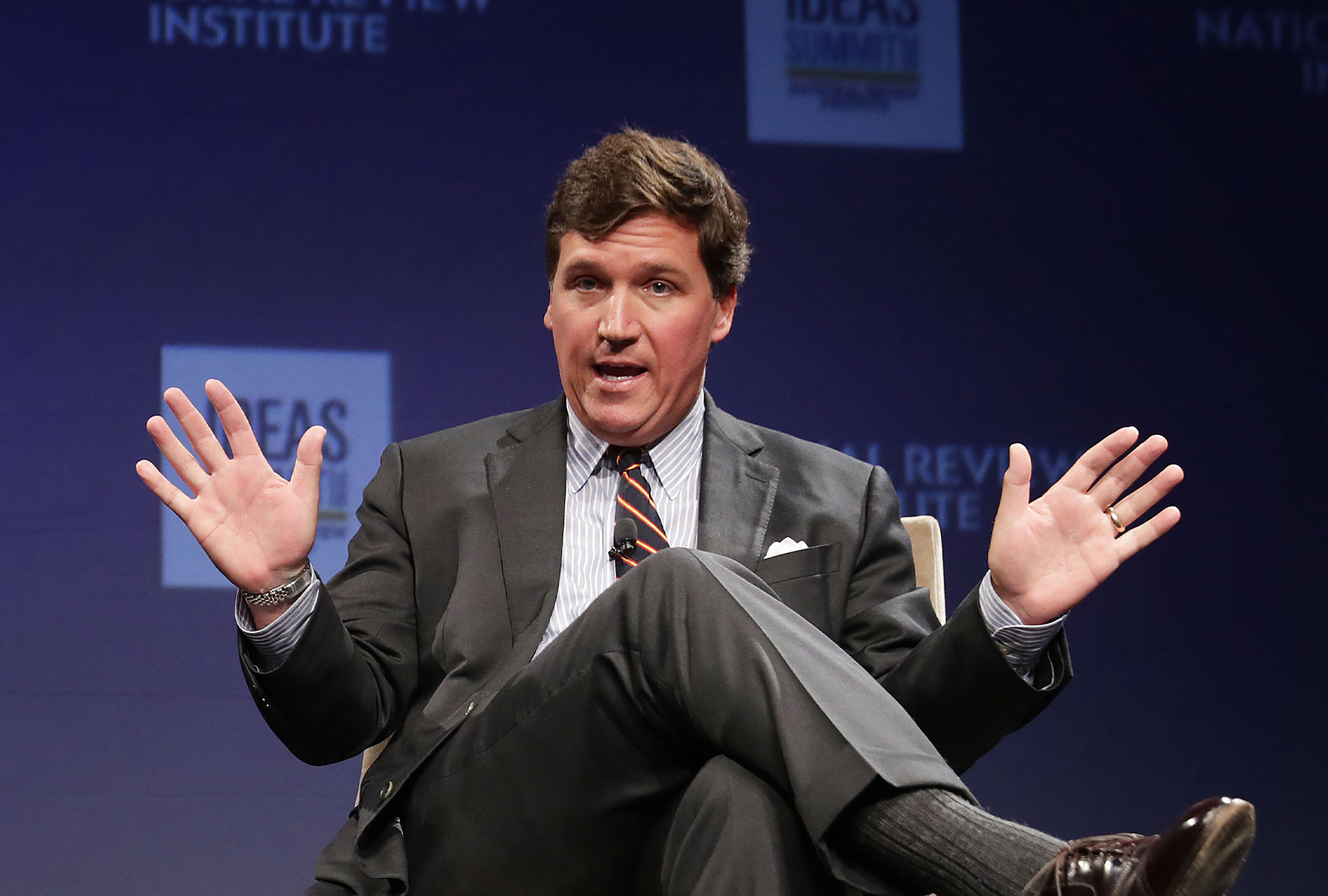
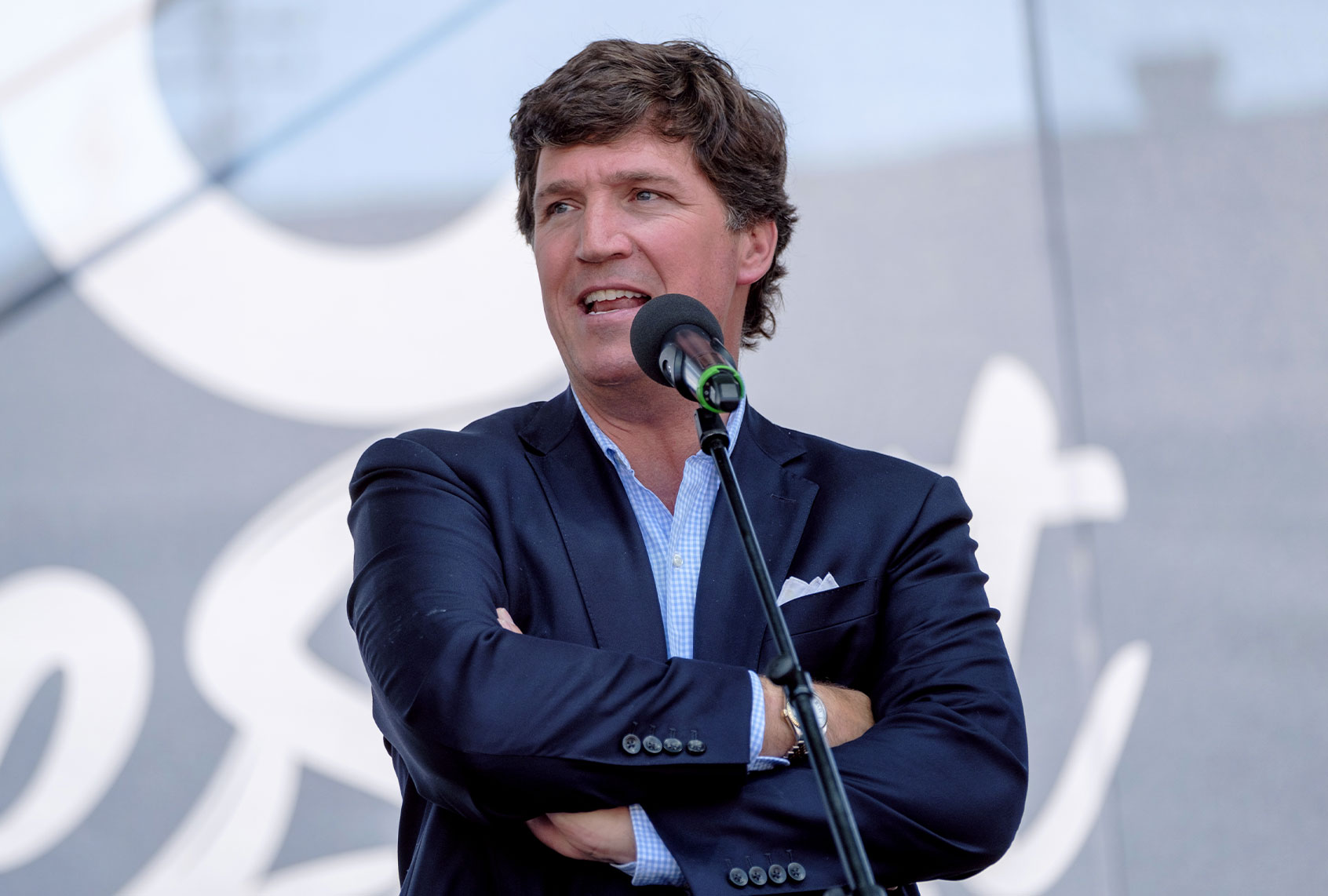
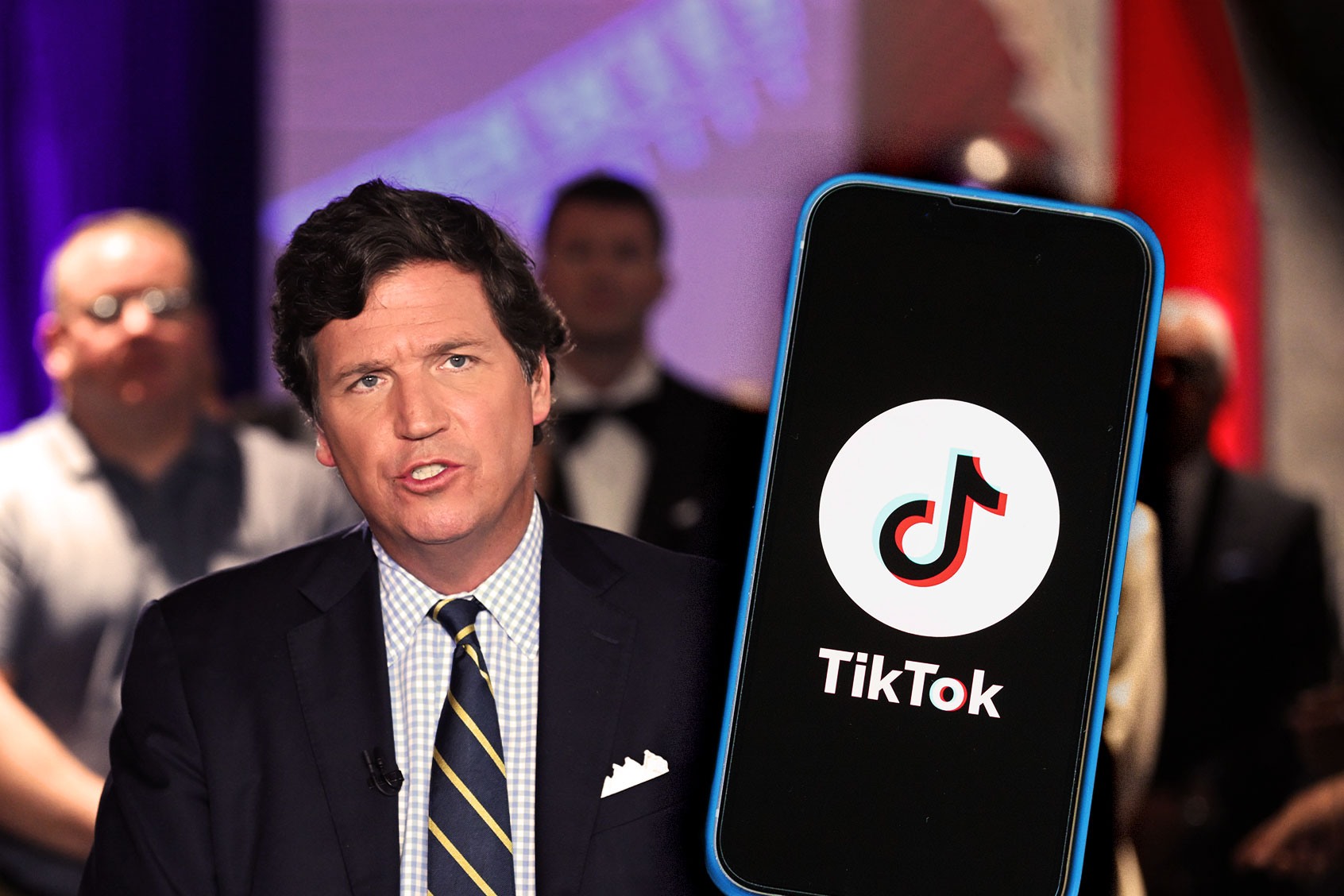
Tucker Carlson
First time for everything
Karen Hughes once said she'd never heard George W. Bush utter a profanity.
By Tim GrieveIn an interview with Salon in 2003 — which is to say, sometime after George W. Bush called Adam Clymer a “major league asshole” and vowed to “fuck Saddam” but before Bush said that Hezbollah needs to “stop doing this shit” — Tucker Carlson said that Karen Hughes once told him that “she’d never heard Bush use a profanity ever.”
Tim Grieve is a senior writer and the author of Salon's War Room blog. More Tim Grieve.
Making PBS as “fair and balanced” as Fox
Critics blast the CPB's unprecedented move to hire competing, "Crossfire"-style ombudsmen, saying the move is intended to make public broadcasting toe a right-wing line.
By Eric Boehlert
Seen as a way to shine light on the news-gathering process and encourage transparency between reporters and news consumers, ombudsmen traditionally help build a sense of trust. But the announcement by the Corporation for Public Broadcasting — the federally funded nonprofit group that oversees public radio and television — that it was creating an ombudsmen’s office seems to have done the opposite, raising questions and suspicions about the group’s true intent.
Specifically, observers wonder why the CPB, which is largely a funding organization, would get involved in critiquing news programs that it does not create, schedule or broadcast. More disconcerting, though, was the CPB’s unique decision to hire two ombudsmen to check PBS for balance. The dueling-ombudsmen format is unprecedented in mainstream journalism.
“It mystifies me,” says Geneva Overholser, a Washington-based University of Missouri journalism professor who served as the Washington Post’s ombudsman from 1995 to 1998. “What in the world does it mean to have two? It makes no sense.” She argues that ombudsman responsibilities are specifically designed to be carried out by just one person as way to demonstrate that a single journalist can be open-minded and listen to all sides of a dispute. By setting up a sort of left-vs.-right, “Crossfire” approach, Overholser says, the CPB model “participates in the ideological charade that journalists can’t be fair. This is a perversion of the ombudsman. I’m surprised Ken Bode would feel comfortable with this.”
Bode, a former NBC and CNN reporter, is one of the CPB’s newly hired ombudsmen. He most recently worked as a columnist for the Indianapolis Star, where readers often wrote angry letters deriding him as a liberal, though he endorsed a Republican last year for governor of Indiana.
When asked last year to write about his worst day as a journalist, Bode detailed the afternoon President Reagan was shot, recalling, “Like many Americans, I never saw President Reagan quite the same again. As someone said at the time, he went into the hospital as Ronald Reagan; he came out as John Wayne.”
The CPB’s other new ombudsman is William Schulz, an avowed conservative and former editor at Reader’s Digest, which the National Review once described as “the quintessential magazine of ‘red-state’ America.” Schulz worked alongside CPB chairman Kenneth Tomlinson, a Republican, for decades at Reader’s Digest.
On Monday, the New York Times reported that during a meeting in February with the head of National Public Radio, Tomlinson outlined the CPB ombudsmen’s responsibilities and specifically noted that the board planned to hire one liberal ombudsman and one conservative one.
Both Bode and Schulz declined to comment for this article.
The two-person, right-vs.-left approach “is antithetical” to the ombudsman position, says Jeffrey Dvorkin, who holds that position for NPR and serves as president of the Organization of News Ombudsmen. “The value of the ombudsman is as an ideological and political independent.”
“Why stop at two ombudsmen? Why not have four or a committee of 12?” quips Carl Stern, a former correspondent for NBC News who teaches journalism ethics at George Washington University and, like Overholser, is a member of PBS’s Editorial Standards Review Committee. “Balancing ombudsmen — when will this end? Are we going to have armies of ombudsmen? This is silliness.”
The CPB’s unorthodox action comes against a backdrop of increasingly heated allegations about liberal bias at PBS’s 349 stations nationwide. Tomlinson has been making several moves to counter what he says is PBS’s lack of “objectivity and balance” or, more specifically, the perception of a lack of balance at PBS.
Last week the Beltway battle escalated further when Reps. David Obey, D-Wis., and John Dingell, D-Mich., asked the CPB’s inspector general to investigate whether Tomlinson overstepped the law by secretly hiring a consultant, at a cost of $10,000, to monitor the weekly PBS news program “Now With Bill Moyers” for liberal bias. The Democrats want a determination of whether Tomlinson violated the Public Broadcasting Act of 1967, which “prohibits interference by Federal officials over the content and distribution of public programming” and the application of political litmus tests in hiring decisions.
On May 12, the inspector general announced he would launch the requested investigation. Then on May 15, in a speech in St. Louis, Moyers blasted Tomlinson, insisting conservatives’ real agenda is to silent journalists who ask tough questions. “The more compelling our journalism, the angrier the radical right of the Republican Party gets,” Moyers said. “That’s because the one thing they loathe more than liberals is the truth. And the quickest way to be damned by them as liberal is to tell the truth.”
Tomlinson declined to comment for this article. As the controversy continues to intensify, he has been sticking exclusively to the friendly confines of conservative media to tell his side of the story. Last week he wrote an on Op-Ed for the Washington Times. And he appeared on Fox News’ “O’Reilly Factor” on May 12 and PBS’s “Unfiltered With Tucker Carlson” on May 13. During the O’Reilly interview, Tomlinson insisted that he has never talked to the White House about PBS. “The point is not to gain support for the Bush administration,” he said. “The point is to gain support for public television.” Yet Tomlinson hired Mary Catherine Andrews to oversee the creation of CPB’s ombudsmen’s office while she was still on the White House payroll.
Tomlinson was among those who greenlighted the creation of PBS’s “Unfiltered” last year to provide an additional conservative platform on public television. Fittingly, the show served a useful purpose for Tomlinson on the May 13 broadcast, where he continued to make the unsubstantiated — and unchallenged — claim that PBS suffers from a liberal bias and that programs like “Now” do “a lot of damage to public television.”
The claim is unsubstantiated because the CPB’s own internal polling — surveys it has refused to release independently — shows that an overwhelming majority of Americans do not think PBS has a liberal bias. As for the “damage” caused by “Now,” the program generated exactly 24 angry e-mails to the CPB during calendar year 2003.
Tomlinson was not challenged much during the O’Reilly and Carlson interviews. At the conclusion of his interview with O’Reilly, Tomlinson said, “We love your show,” and Carlson concluded his “Unfiltered” interview with, “I suspect your liberal critics will always feel threatened by you. And [that's] good, as far as I’m concerned. Ken Tomlinson, I think you’re great.”
One of Tomlinson’s key fairness-and-balance” initiatives — implemented with the help of the White House aide he hired — was to create guidelines for the new CPB ombudsman positions. The newly unveiled charter notes that the position is independent and “will encourage public dialogue aimed at achieving high standards of excellence and balance in public broadcasting.”
An ombudsman typically functions as an advocate for, or representative of, news consumers — a designated person they can contact to complain about a report. As the Organization of News Ombudsmen outlines the position, “A news ombudsman receives and investigates complaints from newspaper readers or listeners or viewers of radio and television stations about accuracy, fairness, balance and good taste in news coverage.”
But the CPB itself has no “readers or listeners or viewers.” That disconnect was evident in the first programming critiques offered by Bode and Schulz, which did not appear to be driven by listener or viewer concerns. Instead, both men simply sampled specific programming and wrote up their thoughts. (They reviewed different reports.)
As the station group that purchases, schedules and airs programming, “PBS is the more appropriate organization for an ombudsman,” notes Christy Carpenter, a former Democratic-appointed member of the CPB board.
National Public Radio already employs an ombudsman, and PBS is exploring hiring its own. And while there had been some public discussion about CPB’s hiring its own ombudsman, the announcement of the hiring of Bode and Schulz caught PBS officials unaware; they were not told that candidates were being interviewed, let alone that the two men would soon start.
But it is CPB’s tapping of two ombudsmen that has most raised eyebrows in journalism circles, particularly the suggestion by Tomlinson that Schulz would serve as a sort of conservative advocate while Bode represented liberal complaints.
“I don’t think ombudsmen should be in the ‘Crossfire’ business,” NPR’s Dvorkin says. “I think it exacerbates conflict rather than resolves it.”
Overholser adds, “The whole two-person approach is rigged. Everything about this smells of adhering to a certain ideology and dressing it up as concern about objectivity and balance.”
Eric Boehlert, a former senior writer for Salon, is the author of "Lapdogs: How the Press Rolled Over for Bush." More Eric Boehlert.
Pushing PBS to the right
Republicans have launched a heavy-handed campaign to correct public broadcasting's "liberal slant." There's just one problem: Most Americans don't think it has one.
By Eric Boehlert
In the early 1970s a civil war erupted inside the fledgling world of public television. Upset with what they saw as its liberal news and public affairs programming, and particularly its tough coverage of the Vietnam War and the Watergate hearings, Nixon administration officials moved to rein in public television by stacking the board at the Corporation for Public Broadcasting, which acts as a governing body for the hundreds of local stations nationwide. The board then sought to control national programming decisions and curtail news programming.
“There were tremendous fights, with the Nixon Administration trying to prevent public television from doing any public affairs programming at all,” former PBS president Lawrence Grossman once recalled to the New York Times. But Nixon’s end run ultimately failed. In 1979, Newsweek quoted a PBS executive who insisted, “The war between CPB and PBS is over.”
Today it’s back on.
Amid a flurry of high-profile personnel changes, suppressed polling data, revised journalism guidelines, new oversight ground rules and deep suspicion, the CPB board — once again under the control of White House-friendly Republicans — and PBS are battling each other over content and allegations of PBS’s liberal bias. The brawl is shaping up to make the Nixon-era dust-up seem tame by comparison: This weekend one PBS station manager dubbed CPB’s crusade for “balance” a “witch hunt.”
“It’s designed to get people’s attention and warn them not to do programming that will be questioned,” says David Fanning, executive producer of “Frontline,” PBS’s award-winning investigative series. “We ask hard questions to people in power. That’s anathema to some people in Washington these days.”
“The situation is very concerning,” says Christy Carpenter, a former Democrat-appointed member of the CPB board. She says that with the 2003 arrival of Republican CPB chairman Kenneth Tomlinson, “the tone of the discussion became increasingly partisan. There was an agenda being pushed to bring in more conservative voices. It’s appropriate to have a wide spectrum, and I have no objection if conservative voices are in the mix. But I had the impression that more was being pursued than just balance.”
Traditionally charged with a dual role as PBS’s personal cheerleader (creating goodwill on Capitol Hill) and bank account (CPB serves as a crucial funding source), the government-run, nonprofit CPB has again, as in the Nixon era, turned its attention to overseeing PBS programming, insisting that the more than 300 PBS affiliates nationwide acknowledge that their programming suffers from a liberal bias.
The effort by Tomlinson and his allies at the CPB — at least one of whom thinks producers should face “penalties” if their programming is deemed unbalanced — echoes the cry of conservatives who for the past three decades have accused PBS of a liberal bias. (During the ’70s it was referred to as an “Eastern elite” bias.) Although PBS, compared with commercial TV news outlets, probably does pose more pressing questions to those in power, its hallmark “NewsHour With Jim Lehrer,” for example, makes sure to include mainstream conservatives, such as New York Times columnist David Brooks, in its regular mix. The truth is that the widespread bias that board members are so eager to fix doesn’t exist.
Tomlinson, a former editor at the staunchly conservative Reader’s Digest who over the years has contributed exclusively to Republican politicians, was not available to comment for this story. But in April he told the Washington Post, “I am concerned about perceptions that not all parts of the political spectrum are reflected on public broadcasting.”
Ernest Wilson, a Democrat-appointed CPB board member, agrees that fairness and balance represent “a genuine political concern” — in part because “people who believe fairness and balance is a problem at PBS include some legislators on the Commerce Committee” (which oversees CPB funding). “But there are a myriad of other issues that are more important than fairness and balance. For instance, most of our PBS viewers are between the ages of 1 and 7 and 47 and 80, and there’s nobody in between. That’s a problem. And that’s not a fairness and balance problem.”
Asked if he thought the increasingly heated debate about objectivity had hijacked the CPB’s larger agenda, Wilson said, “Yes, at the moment.”
A CPB spokesman denies that the corporation has become distracted by the fairness and balance issue. “We’re rolling up our sleeves and focusing on our core mission,” says Eben Peck.
Yet it remains unclear what the evidence is for PBS’s liberal bias. What are the egregious examples of so-called unfairness that are fueling the current controversy? Tomlinson himself rarely singles out any particular programming as being guilty of bias, or of not meeting public broadcasting’s journalism standards. Rather than cite any actual infractions by PBS programs, Tomlinson has said he’s concerned by the mere perception of a bias.
Last week he was quoted in Broadcasting and Cable magazine as saying he wanted to “broaden support for public broadcasting” while “eliminating the perception of political bias.” And in response to a New York Times article last week on the tension between CPB and PBS, Tomlinson released a statement that read, in part, “Eliminating the perception of political bias … is important to maintain continued public support for public broadcasting.”
But the question remains, a perception of political bias by whom — Republican politicians and conservative activists, or PBS viewers? If most PBS viewers and other Americans don’t think the programming is biased — and two internal polls prove they don’t — then why is the CPB unleashing this campaign?
Tomlinson has tipped his hand in the past. In the Nov. 17, 2003, issue of Current magazine, which covers public broadcasting, he argued, “If a significant number of conservatives are saying public TV is not for them, we need to change that” (emphasis added).
So if a significant number of environmentalists, or libertarians or Latinos or Asians, say public TV is not for them, will the CPB be willing to take drastic action to remedy that perception? And what constitutes a “significant number”? According to CPB polling done in 2003, 12 percent of Americans think PBS has a conservative bias. Why isn’t the CPB board addressing that as well?
“They’ve established their own version of political correctness,” says Jeffrey Chester, executive director of the Center for Digital Democracy. “Tomlinson is taking things to the extreme with his ambitious agenda.”
In fact, the CPB’s crusade seems to flip on its head the organization’s mandate, which, following Nixon’s attempt at political interference, has been to act as PBS’s “heat shield,” insulating PBS programming from outside political pressure. Instead, the CPB is demanding programming changes to meet its political concerns.
The CPB was created and funded by Congress to provide about 20 percent of PBS’s programming budget. Under the Public Broadcasting Act, the White House can appoint no more than five of the nine CPB board seats. One of the Democratic seats is unfilled, as it has been for several years, giving Republicans a comfortable decision-making majority.
During an interview for NPR’s “On the Media,” which aired over the weekend, Tomlinson insisted, “I did not choose to bring controversy to public broadcasting over the issue of balance. Others did.” Yet recent events certainly suggest Tomlinson and his Bush-appointed allies on the CPB board have been fixated on the issue of balance.
“People feel like this is a mission for him,” says one public-television source. Adds another veteran, “Everybody’s scared to death.”
What’s especially curious about the current objectivity controversy is that PBS airs hundreds of hours of programming each week, most of which is educational and cultural, and yet CPB’s entire fairness and balance campaign — dismissing its CEO, creating new shows, trying to rewrite PBS’s journalism guidelines, hiring ombudsmen — appears to stem from a single weekly program, Moyers’ “Now.” “All they talk about is the Moyers show,” notes Carpenter. “Where else is the bias or the perceived bias?”
Moyers left the show (which has since been cut back to just 30 minutes) months ago, yet conservative media critics, rather than celebrate his departure, continue to rally against Moyers with a vengeance. In his May 6 attack on PBS posted online, Brent Bozell dedicated nearly half his column to attacking Moyers and detailing his alleged bias (for example, criticizing Condoleezza Rice’s “pattern of ineptness”).
Even when Moyers hosted the show, which routinely aired critical reports about the Bush administration, “Now” wasn’t exactly a lightning rod for viewers’ wrath. According to an attachment to CPB’s annual report to Congress, CPB, eager for public feedback, created “Open to the Public,” an interactive forum in which viewers can express concerns. For calendar year 2003, the most recent year for which statistics are publicly available, the initiative produced 1,139 e-mails from viewers. According to CPB, just 24 of those — or roughly 2 percent — were angry e-mails about “Now.” (Drawing the most comments was “Sit and Be Fit,” an exercise program for seniors; viewers e-mailed asking that it be shown on more local stations.) While individual PBS stations may have logged more complaints about “Now,” CPB’s own feedback mechanism barely registered any concern about the program.
The findings likely come as little surprise to CPB officials, who obviously pored over results from a 2003 survey on liberal bias conducted jointly by a Republican and a Democratic firm. (The firms later hosted focus groups in red states, inviting only people who had complained about a liberal bias at PBS, so they could further detail their complaints.) As the “Research Objectives” portion of the results states, the survey’s top priority was to “re-measure the extent to which people view news and information programming on PBS and NPR as being biased” (emphasis added).
Why “re-measure”? Because, according to public television insiders, the first batch of polling done in 2002 produced unsatisfactory results from the CPB board’s perspective; it showed little viewer concern about bias. “Tomlinson commissioned two polls. The first results were too good, and he didn’t believe them,” says one source. “After the Iraq war, the board commissioned another round of polling, and they thought they’d get worse results.” But the board didn’t. Asked specifically about PBS’s war coverage, only 7 percent of respondents thought it was “slanted.” “They couldn’t use any of it” to bolster any claims of bias, says the source. Overall, just 21 percent of respondents thought PBS was too liberal.
Of course, if Tomlinson and his colleagues were looking for good news about PBS instead of bad, the wider poll results — a healthy 80 percent of Americans have a favorable opinion of public broadcasting — would have been trumpeted as a triumph. (In an NPR interview aired last weekend, Tomlinson suggested that that 80 percent should be higher.) Meanwhile, a strong majority thinks PBS’s news and information programming is more trustworthy, and more in-depth, than that of ABC, CBS, NBC, Fox and CNN. Most viewers think PBS is a “valuable cultural resource,” and a plurality of 48 percent want the government to provide more funding to PBS. (Only 10 percent want it to provide less.) But despite the good news, the CPB board refused to tout these results or even release them independently.
Says Democratic CPB board member Wilson, “It’s very important that the American public see these polls. They were paid for with public money and should be seen.” Asked about any discussion the board had about the polls and releasing them widely to the public, Wilson says, “I’m not going to talk about what happens in the board meetings.”
It should be noted that the polling firms did report “a disparity between Republicans and Democrats with respect to their views towards news and information programming on public broadcasting.” They’re likely referring to the finding that 36 percent of Republicans think PBS has a liberal bias, compared with 21 percent of all respondents.
But Republicans’ complaints about PBS bias are consistent with how they view most mainstream news organizations. According to one of the most comprehensive surveys on public opinion about the media, conducted in 1997 by the Pew Research Center for the People and the Press, Republicans “are more likely to say news organizations favor one side than are Democrats or independents.” In that survey, 77 percent of Republicans thought the press was biased, compared with 58 percent of Democrats. In other words, polls are likely to find about far more Republicans complaining about bias no matter which media outlet is being analyzed.
Despite its own polling showing that bias was not a concern perceived by most Americans, the CPB pressed ahead with its aggressive plans to fix the problem. At her 2003 Senate confirmation hearing, Republican CPB board member (and major GOP fundraiser) Cheryl Halpern not only suggested that producers be penalized for any programming deemed to be biased but also demanded that PBS operate under an “objective, balanced code of journalistic ethics, [which] has got to prevail across the board, and there needs to be accountability.”
The truth is, PBS stations have operated under a strict code of journalistic ethics for decades. But late last year, as part of its contract renewal with PBS, which earmarks $29.5 million for the network in programming funds, CPB for the first time asked for a change in PBS’s journalism guidelines. For the previous 14 years of the multimillion-dollar contract, CPB had relied on PBS to operate under its own well-established journalism standards. According to the Public Broadcasting Act of 1967, which established the CPB, the corporation must meet several goals. One is ensuring a “strict adherence to objectivity and balance in all programs or series of programs of a controversial nature.” The CPB instead moved to introduce statutory language making “objectivity and balance” guidelines an enforceable legal requirement.
PBS balked. Claiming a First Amendment infringement and an unprecedented attempt by the CPB to assert direct control over its broadcasting, the network’s attorneys noted that the U.S. Court of Appeals for the District of Columbia had previously ruled that the “objectivity and balance” provision from the ’67 Act “is not a substantive standard, legally enforceable by agencies or courts.” The CPB relented, but still wants to OK PBS’s journalism standards, which are in the process of being updated by a panel of journalists and academics. If the CPB objects to portions of those standards, that could spark yet another showdown.
“I think the goal is to change the kind of journalism PBS occasionally does,” says Chester at Center for Digital Democracy. “To sort of press for balance within each individual program and neuter PBS’s ability to do serious reporting.”
In his recent “On the Media” interview, Tomlinson insisted he simply wants to create a balance on the PBS schedule, so that for every liberal program there’s a counterbalancing conservative program. But in December 2003, three months after being elected as the CPB’s chairman, Tomlinson wrote a letter to the head of PBS, complaining, “‘Now With Bill Moyers’ does not contain anything approaching the balance the law requires for public broadcasting” (emphasis added), as if suggesting the use of a stopwatch to time how many minutes each side has to tell its story.
But there has never been a standard, or “law,” requiring PBS to adhere to balance within each program. Instead, like the old fairness doctrine that applied to commercial broadcasters before it was rescinded during the Reagan administration, the fairness and balance guideline for PBS is measured by the totality of the network’s schedule of programming.
In Saturday’s Denver Post, James Morgese, president and general manager of the Rocky Mountain PBS station, wrote, “If what is happening in Washington goes unchecked, we will probably have to start counting which shows or even which guests on shows will balance or counter-balance each other, and then start tabulating the amount of minutes, or even seconds, devoted to ideological points of view.” Morgese dubbed the current CPB objectivity campaign a “witch hunt.”
Ironically, if strict new legal guidelines on fairness were applied, among the first shows that would have to be singled out for violating them would be “The Journal Editorial Report.” Like “Tucker Carlson Unfiltered,” which was shepherded to air with seed money from CPB, “The Journal Editorial Report” was tapped as a priority by the CPB to balance out “Now.” But unlike “Now,” which books conservative advocates such as Ralph Reed to debate issues, “The Journal Editorial Report” makes little effort to air opposing viewpoints during its weekly discussion of political events. For instance, during its March 25 segment on the unfolding Terri Schiavo story, every panelist agreed Congress had done the right thing by intervening in the right-to-die case, placing them well out of the American mainstream, which overwhelmingly objected to lawmakers’ intervention in the case, according to several polls.
CPB board member Wilson suggests it’s not just the Journal’s editors who are out of step. “Ask the American people about fairness and balance at PBS and it’s not at the top of their list. But it is at the top of the list for some within a small Beltway loop.”
And for the moment, those people control public television.
Eric Boehlert, a former senior writer for Salon, is the author of "Lapdogs: How the Press Rolled Over for Bush." More Eric Boehlert.
Right Hook
Safire and Novak spin themselves silly over Kerry's Mary Cheney comment; Buchanan equates gays with alcoholics and pedophiles. Plus: Freepers trade blows over Jon Stewart's takedown of Tucker Carlson.
By Mark Follman
Much has been said about John Kerry’s reference to Mary Cheney during the final presidential debate. But with the rights of same-sex couples and gay clergy under attack at the climax of election season, it’s worth looking at just how disingenuous and downright nasty some conservatives have gotten over the issue.
Salon’s Scott Rosenberg has already pointed out the absurdity of New York Times columnist William Safire claiming that “only political junkies knew that a member of the Cheney family serving on the campaign staff was homosexual,” and labeling Kerry’s comment the “lowest blow,” as if Kerry had maliciously outed the proudly and publicly gay Mary Cheney.
In the very same column, Safire himself acknowledged that Cheney’s sexual orientation was “no secret” — even if one wants to believe, as Safire argued, that a uniformly virtuous press had respectfully kept it quiet.
“The vice president, to show it was no secret or anything his family was ashamed of, had referred to it briefly twice this year, but the press — respecting family privacy — had properly not made it a big deal. The percentage of voters aware of Mary Cheney’s sexual orientation was tiny.”
Safire, who decried Kerry’s comment as part of an orchestrated attack by the Dems, might want to check his analysis with fellow columnist Robert Novak, who points out just how widely known the information already was.
“Kerry campaign sources say there was no plan for Kerry to talk about Ms. Cheney last Wednesday, and it never came up in the debate prep,” Novak wrote on Monday. “The senator’s intimates say he was trying to compliment the Cheneys, but there is absolutely nothing complimentary in what he said. Many Republicans see a calculated plot to depress Bush’s social conservative base by revealing the vice president’s daughter as a lesbian. But her sexual orientation is such common knowledge on the right that the alleged Democratic plot would be foolish to undertake.”
Instead, Novak saw an offhand maliciousness on Kerry’s part.
“Kerry’s comments appear to be spontaneous — and unpleasant. Faced with President Bush’s answer in the debate that he did not know whether he believed ‘homosexuality is a choice,’ Kerry blurted out they should go ask Mary Cheney, who ‘would tell you that she’s being who she was, she’s being who she was born as.’ This sounded like an effort to impute hypocrisy on the part of an opponent seeking to ban gay marriage.”
The National Review’s William Buckley was more attuned to the nuances of the issue.
“It is not in question that Mary Cheney’s gayness had already become a part of the cast of characters in the political play. Senator Kerry was in no sense ‘outing’ someone who had hidden her sexual impulses. So that the question narrowed to whether what was said was an expression of magnanimity and inclusiveness, or whether it was a bid for votes from the bigoted.
“This last interpretation of it was taken by an evangelical Christian politician, Gary Bauer, who ran for the presidency four years ago. He reasoned as follows: that traditional-values voters would react to the public reference as to an animadversion against the Bush ticket, and that by saying what he had said, Kerry could reasonably hope ‘to knock l or 2 percent off in some rural areas by causing people to turn on the president.’ This view holds that Kerry was in fact trading on bigotry. That position is of course irreconcilable with the position that Mr. Cheney has profited politically from publicizing his daughter’s gayness — that he has, in effect, said to the gay community: ‘Look, my own beloved daughter is a member of the Cheney family, and a member also of the gay community. You can hardly suspect in the GOP ticket prejudice against gays, when you see that we have one in the family, whom we cherish?’”
And while Robert Novak and others brushed straight past Bush’s “I don’t know” if “homosexuality is a choice,” former Reform Party presidential candidate Pat Buchanan characterized Bush’s non-answer as “honest.” Then he offered his own honest appraisal of the issue.
“To some of us, homosexuality is an affliction, like alcoholism, and hellishly difficult to control. Why some folks can take or leave alcohol — while others can enjoy it in moderation, and others cannot stop drinking without help and must swear off it for life or it will kill them — remains a mystery of nature. Homosexuality seems to be like that.”
Buchanan, apparently able to control his own afflictions, went on to lament men who can’t control theirs. He also added pedophilia to the same list.
“A contemporary of this writer and rising conservative star in the House, with a wonderful family, lost it all when caught trolling D.C.’s tenderloin district for teenage boys. Catholic priests have dishonored the church to which they have dedicated entire lives and disgraced themselves by abusing altar boys. In such cases, the behavior seems almost suicidal. Clearly, there is a compulsion here that is, at times, terribly difficult to resist, a sexual compulsion that seems far more rare among normal men.”
The folly of dirty campaigning
New York Times columnist David Brooks weighed in Tuesday on down-and-dirty campaign rhetoric:
“The truth is that voters are not idiots. They are capable of independent thought. If you attack your opponent wildly, ruthlessly, they will come to their own conclusions.”
His comments came one day after President Bush, in a “major speech” carried live on the Fox News Channel, fired off a litany of flagrant distortions about John Kerry. Bush claimed that Kerry will fight terrorists “only after America is hit,” that Kerry “thinks we need permission from foreign capitals” when “we act to defend ourselves,” and that in a Kerry administration, “America’s overriding goal in Iraq would be to leave, even if the job is not done.”
Oh, wait… Brooks was criticizing the rhetoric of the other presidential candidate in his column, “Kerry off the Leash.”
The crossfire after “Crossfire”
Comedian Jon Stewart’s beat down of the bow-tied Tucker Carlson on CNN’s “Crossfire” last Friday touched off an intriguing mix of reactions among bloggers.
Gerard Van der Leun of American Digest doesn’t think much of the dueling heads of “Crossfire,” or of Stewart.
“I actually caught Jon Stewart’s on-air evisceration of ‘Crossfire’ last week, and I have to admit I enjoyed the discomfort and confusion he brought to the dual tools of that broadcast. At the same time I also noted what a large, self-impressed tool Stewart has become.”
It seems that the heart of the matter for Van der Leun is what he imagines to be Stewart’s privileged lifestyle off the air.
“I don’t know about you but my gorge rises when a TV personality who’s made his bones with long ironic sighs and sideglances starts to speak phrase like ‘We need you to be honest!’ And that was only the center cut from Stewart’s Tripe Store. I was especially taken by Stewart’s reference to himself as one of the guys who is out ‘mowing his lawn’ while ‘Crossfire’ fails to protect the Republic. Hey, I need Stewart to be honest. The closest people like Stewart come to mowing their lawn is telling their personal assistant to drive to some Southern California crossroads and hire an illegal alien to work the Weedwhacker.”
Bill Ardolino of InDC Journal offered a more substantive take on Stewart’s allegations of full-tilt partisan hackdom in the mainstream media. Ardolino has no great love for Stewart, either, labeling much of his Daily Show material “a smirking, incredibly shallow read of the issues surrounding [the Iraq] war every bit as harmful as Michael Moore’s hullabalooed love letter to Leni Riefenstahl.” But Ardolino raises a valid point about Stewart’s own influence and potential responsibility to the political dialogue.
“While Stewart’s recent evisceration of the Crossfire hacks was great fun, it’s also tainted by the fact that he was throwing stones from a glass mansion. Stewart likes to slide out of public responsibility for accuracy by citing the fact that the Daily Show is a comedic farce, but that defense is undermined by the fact that his show has a very large practical influence, his partisanship is overt and pointed, his analysis is frustratingly superficial, and if everything is such a silly joke … he wouldn’t become angry, serious or aggressively condescending during certain political interviews. You can’t have it both ways, Stewart. It’s fine for you to take sides, but you’re drubbing of Begala and Carlson marks you as a hypocrite.”
One wonders what Protein Wisdom’s Jeff Goldstein thinks of the notion of “overt and pointed partisanship,” “frustratingly superficial analysis,” and “everything as such a silly joke.” He aims for barbed political comedy himself and is sometimes quite entertaining, though he doesn’t much like it when his team is on the receiving end. He responded to the crossfire by offering CNN’s hapless bow-tie boy “9 snappy comebacks” to Stewart’s comment, “You know what’s interesting, though? You’re as big a dick on your show as you are on any show.”
“1. It’s genetic, the big dick thing. My father was hung like a horse.
“2. You know who’s funny? That Craig Kilborn. Now he’s funny.
“3. Yeah, I’m a dick, blah blah blah. But tell me — how is Janeane Garofalo in the sack? Wild?
“4. I really like the touch of gray you’ve got going on, by the way. Very Harry Reasoner.
“5. That Craig Kilborn. Christ, I’m still laughing…!
“6. So. Are you going to tell America about the time Bob Dole bitchslapped your shortperson’s ass on the set, or should I?
“7. Incidentally, I spit in your complimentary beverage. Just so you know.
“8. Any truth to the rumor you and Lewis Black like to toss each others’ salads?
“9. Well, it could be worse. I could be Jewish.”
And the Stewart-Carlson dustup sparked a rare but colorful burst of cognitive dissonance inside the right-wing citadel, Free Republic.
clintonh8r: “[The Daily Show] is a big part of the trivialization and bitchiness of American politics that he’s apparently (I’m not near a TV) talking about. I guess he doesn’t really get it…”
glock rocks: “Stewart called Carlson a dick on the way to commercial.”
staytrue: “CNN is probably reading stewart the riot act and threatening legal action as we speak.”
get’email: “Tucker Carlson IS a dick.”
RedBloodedAmerican: “We need people like John where he is. It’s helps to remind us why we fight.”
charles giteau: “If Jon Stewart is the reason we fight, we may need to reevaluate our goals. Stewart is the best talking head on TV. He points out the absurd on both sides. And so what if he’s voting for Kerry? My mother is voting for Kerry, should I take the fight to her too?”
FreddomSurge: “Mom’s gotta go sometime.”
demnomo: “I agree with Stewart — the show is a boring sham. I watched a couple of programs a while ago, thought the talking head hosts were lame, and I have not watched the contrived garbage that they spew since. Of course, I read about what someone said on the show now and then on this forum. That’s about it.”
omniscient: “One Crossfire is worth a thousand Daily Shows. I’m glad Carlson brought up what a suck-up job Stewart did with the Kerry interview.”
navycorpsman: “Stewart’s show is funny when politics is not the subject. Shows like Crossfire, Hannity and Colmes, et al, all suck and offer nothing but bile and useless spin…”
- – - – - – - – - – - -
Read more of “Right Hook,” Salon’s weekly roundup of conservative commentary and analysis here.
Mark Follman is Salon's deputy news editor. Read his other articles here. More Mark Follman.
One minute from abnormal
A Texas reporter explores Karen Hughes' cultlike devotion to George W. Bush.
By James C. Moore
No one saw Karen Hughes’ transcendent moment with George W. Bush. Possibly, she had already crossed over from being his communications consultant to being his confidant. None of us on the outside had any way of knowing until a brief, late-night phone call. While he was governor of Texas, Hughes was the interface between Bush and journalists. But she was already working her relationship with Bush, making every effort to evolve it into something beyond the daily grind with reporters.
Early in the presidential campaign, Bush and his entourage were in New York for a speech and bus tour. A reporter for a major daily newspaper, who arrived late because of airline delays, was without a schedule and logistical information for the subsequent day’s events.
“I guess I got in about 11 p.m.,” he said. “I called Karen in her room, sort of worried that I might be waking her up. I was very polite. I said, ‘Karen, I was wondering if you could give me the schedule, etc. for reporters for tomorrow.’”
“I don’t do press,” Hughes said.
“And then she hung up on me,” the reporter said. “All I could think was she must be big stuff now. She could have at least been polite. She didn’t even bother to tell me who I was supposed to call.”
Actually, Hughes had become unsettlingly close to her boss long before journalism or outsiders began to take note. In fact, her worst critics have accused the presidential counselor of living almost vicariously through Bush. His goals and political ideology have been so inculcated into Hughes’ consciousness that she may no longer be able discern between her own thinking and the president’s. This undoubtedly is an odd characterization to make of two of the world’s most powerful adults. There is, however, no shortage of evidence to prompt the speculation.
The first time I noticed an indication of a radio frequency bouncing between the brains of Bush and Hughes was during Gov. Bush’s initial State of the State speech in Texas. Still a simple press hack, Hughes did not take to the riser in the Texas House of Representatives, instead standing off to the side, behind the shiny brass railing rimming the chamber’s floor.
“Look at Karen,” I said, nudging a colleague.
“Oh, my God. You’ve got to be kidding me.”
As Gov. Bush read the text of his speech from a teleprompter, his communications director was silently mouthing the words along with him. The synchronized delivery suggested a parent sitting in the audience of an elementary school pageant while mouthing forgotten lines as her child stood dumbstruck onstage.
“Do you suppose she has any idea how odd that looks?” my friend asked.
“If she does, I don’t think she cares. She seems to just want her guy to do well.”
In the ensuing years of Bush’s political development, Hughes was spotted many times as she pursed her lips and moved her jaws to each word her employer was stammering in the front of the room. After a while, those of us in the traveling press corps became so accustomed to her mannerisms that we were no longer amazed.
Hughes, of course, was more than just the candidate’s remote-control device. Her portfolio included creating the messages and sound bites — turning the phrases Bush was later very likely to overturn when he tried to articulate them in public. Hughes’ great skill as a political advisor is that she is both intuitive and analytical. While her relentlessness with message delivery is all over the airwaves and in the newspapers, people often overlook Hughes’ talents in message development. In the South Carolina primary campaign against presidential candidate Sen. John McCain, as Bush strategist Karl Rove deployed what Sen. Max Cleland called a “slime and defend” strategy, it was Hughes who gave the Bush team an effective communications template.
“McCain clearly kicked our butts in New Hampshire,” a Bush campaign source told me. “His message of reform immediately took off. And then Karen said, ‘Hey, we’re the reformers here. We’re reformers with results.’ That’s what we ended up having on all of the signs all over South Carolina: ‘A Reformer With Results.’ We just stole McCain’s message, refined it, and it worked. That was all Karen.”
I have worked around Hughes from the time she was an energetic reporter at KXAS-TV in Dallas/Fort Worth, and even if I had been watching her with nothing more than peripheral vision, I cannot avoid concluding that there is something almost pathological about her almost born-again devotion to Bush. She was a solid TV political correspondent with serviceable prose and production skills. But as a counselor and communicator for the president, she is driven in a manner that never manifested itself in her journalism. Whatever reality she, Rove and Bush choose to manufacture, Hughes believes in it more than the reality of any and all contradictory external information. And God help any journalist or analyst whose interpretation or reportage of facts varies with her version of events.
Bush’s only courageous political act of his career provides a case study of Hughes and message discipline. During his first year as governor of Texas, Bush elected to deal with a property-tax crisis for homeowners by spreading the tax burden across the broader business community. His idea, which Rove did not like, was to ask the business community to pay more to fund public education. Bush tried to raise taxes on aviation fuel, lawyers, architects and countless other professional endeavors. Predictably, corporate lobbyists and CEOs handed the neophyte governor his political head over the proposal.
“I’ll never try anything like that again unless people are standing on the Capitol lawn by the thousands,” Bush told me at the time.
Rove had a better idea, and Hughes knew she could sell it to voters and lobbyists. The governor pushed a piece of legislation to increase the homestead exemption for Texas homeowners, reducing the taxable assessed valuation for every homeowner who filed for the exemption. This was a political shell game, a foreshadowing of how the Bush administration would run the federal government. Hughes and Rove knew that the funds lost from the $3 billion tax cut resulting from the increased exemption had to be replaced by local school districts. Public education could not live without the money, and Texas school districts had to raise taxes to make up for the loss. But Bush, conveniently, did not get the blame.
In Nashua, N.H., this artful dodge almost fell to pieces. As reporters on Bush’s presidential campaign were gathering for a news conference, Steve Forbes’ supporters were handing out pamphlets listing all of the businesses Bush had tried to increase taxes on before he settled on the homestead exemption as a political accomplishment. Frank Bruni of the New York Times approached me with the list.
“Is this true?” he asked.
I scanned the proposed taxes. “Yeah, looks accurate to me.”
Bruni’s eyes swept the room searching for Hughes and found her leaning against a rear wall as Bush spoke. I drifted over close enough to hear their conversation.
“Karen,” Bruni asked, “did the governor really try to raise taxes on all of these businesses?”
Hughes looked at the Forbes materials.
“Frank, Governor Bush is responsible for the largest single tax cut in Texas history at 3 billion dollars.”
“I know,” Bruni said. “I’ve heard that a lot. But did he try to increase taxes on these companies before he cut them with the homestead exemption?”
“As I said, Frank, Governor Bush made history with the largest tax cut ever recorded in Texas.”
Bruni, frustrated, looked in my direction briefly.
“OK, I’ll ask you again: Did Governor Bush try to raise taxes on the companies listed on this document?”
Unflagging, Hughes stuck with her message, almost verbatim, and Bruni shrugged his shoulders and walked off. He had been worn out by the message discipline of the High Prophet, the nickname Bush had given her as a derivative of her married name of Karen Parfitt Hughes.
She was as capable at preemptive political attacks on opponents and journalists as she was with tactical defense. I found this out in 1994 as a panelist on a debate broadcast statewide between Bush and his gubernatorial opponent, Ann Richards. Having come of age during the Vietnam War, I thought I would ask Bush how he managed to get into the Texas Air National Guard when most waiting lists were years long. Only seconds after the red tally lights had gone out on the cameras, Hughes was looming in front of me, acting as if I owed her an explanation for my question.
“What was that all about, Jim? I don’t see what that has to do with being governor. That was just an absurd question. Why’d you ask such a thing?”
“His behavior during that time is relevant, Karen. It’s about character. You know that.”
“No, I don’t. He’s not asking to run the federal government. He wants to be governor of Texas. He’s not going to declare war on Mexico.”
Initially, I thought she was trying to playfully badger me. But her face was dark and her mouth and eyes had hardened at the edges.
“Look, Karen, I lost friends in Vietnam. I had a right and an obligation to ask him about what he did back then.”
When I turned and left the stage, she followed me, insistently repeating her assertions. Political reporters told me the next day that Hughes had spent some time at the hotel bar that night ridiculing my choice of questions to Bush. Nothing has changed since then about Hughes and her devotion to the president — except for the degree of her obsessive connection to him.
No one in Austin had any illusion that Hughes might grow more independent with her much-publicized return home two years ago. In fact, that decision is often viewed cynically by Democrats, some of whom accuse her of making a marketing rather than a personal decision. By walking away from an office in the White House, Hughes became an “Oprah” topic: Possibly History’s Most Powerful Female Not Married to a President Abandons Post for Sake of Family. She didn’t really walk away, though. Her husband and son changed their mailing addresses by returning to Austin, but Hughes has been incessantly in Washington or on the road promoting her expansive love note to her president, “Ten Minutes From Normal.” Bush reportedly speaks with her every day, at least once, no matter where Hughes is traveling. In Texas, one lobbyist who had worked closely with the governor and his “governess” suggested that Bush appears to need Hughes’ approval. That represents a meaningless endorsement, since she clearly thinks he can do no wrong.
Inevitably, either discomfort or romance arises from this kind of codependency. While Bush was running for president and the miles and days clicked off on the campaign trail, the candidate and his word worker were inseparable. Hughes appeared in almost every photo of the candidate. On each flight to the next venue, she sat next to him, leaning in to talk, confide and counsel. This kind of intimacy might lead lesser adults into precarious territory. Bush and Hughes, however, were oblivious to the growing perception among the traveling press entourage that they were more than just friends and political confederates. When someone finally advised them of how their kinship might be misinterpreted, the campaign responded with an odd maneuver. Hughes brought her son onto the campaign jet and home-schooled him out on the hustings.
“It’s a once-in-a-lifetime experience for him,” she told reporters. “He wants to go everywhere I go.”
The press corps suspected, though, that Hughes’ son’s arrival on the plane was a direct message to us and the wider world that there was no hanky-panky between her and the boss man. The fact that this development coincided with an increased profile in the campaign by Laura Bush was probably a part of the same communications strategy.
Despite her former career as a journalist, Hughes has cultivated an absurd, counterintuitive notion that she can either control or strongly influence what is reported. Of course, she ought to know better, but this does not preclude her from persistently trying to write stories for reporters. She relaxed — momentarily — when conservative writer and commentator Tucker Carlson came to Austin to interview Bush. The piece Carlson filed for the now defunct Talk magazine was not what she had anticipated from someone whose politics were expected to be like Bush’s.
Carlson, a floppy-haired antagonist of progressives, wasn’t supposed to be hard on Karen’s man. In fact, in an interview with Salon last year, the CNN host said his wife was worried that his story might appear to be “sucking up.” Bush, knowing Carlson’s political predisposition, lifted the shades hiding his true beliefs and offered a clearer view of himself to the reporter. Carlson’s story described how Bush swore freely and mocked condemned death-row inmate Karla Faye Tucker. He told Salon that he was astonished by how Hughes responded to his article in Talk.
“It was very, very hostile,” Carlson said. “The reaction was: You betrayed us. Well, I was never there as a partisan to begin with. Then I heard that [on the campaign bus], Karen Hughes accused me of lying. And so I called Karen and asked her why she was saying this, and she had this almost Orwellian rap that she laid on me about how things she’d heard — that I watched her hear — she in fact had never heard, and she’d never heard Bush use profanity ever. It was insane. I’ve obviously been lied to a lot by campaign operatives, but the striking thing about the way she lied was she knew I knew she was lying, and she did it anyway. There is no word in English that captures that. It almost crosses over from bravado into mental illness.”
When cornered, Hughes dissembles. But she is rarely cornered. Nonetheless, she seems to have lost her ability to distinguish between the real world and the red, white and blue movie playing on a loop in her head; it’s a drama where “W” is the hero and crowds are cheering him as a savior while the national anthem plays as the soundtrack. This is considerably more than a political skill. It’s more of a serious psychological tic. Even when confronted with a videotape or a transcript contradicting her recall, Hughes still finds denial a viable political tool.
During an interview with Wolf Blitzer on CNN, Hughes appeared to compare pro-choice supporters to terrorists, then later denied precisely what she had said.
“And President Bush has worked to say, let’s be reasonable, let’s work to value life, let’s try to reduce the number of abortions, let’s increase adoptions,” she told Blitzer. “And I think those are the kind of policies that the American people can support, particularly at a time when we’re facing an enemy, and really the fundamental difference between us and the terror network we fight is that we value every life. It’s the founding conviction of our country, that we’re endowed by our creator with certain inalienable rights, the right to life and liberty and the pursuit of happiness. Unfortunately our enemies in the terror network, as we’re seeing repeatedly in the headlines these days, don’t value any life, not even the innocent and not even their own.”
Rarely good with a follow-up, Blitzer let this rank assertion slip past unchallenged. The Washington Post, however, held Hughes’ nose to her own words. Regardless, she still was unable to see how she had used the war on terrorism in an analogy that practically put pro-choice supporters in an al-Qaida training camp saying evening prayers with Osama bin Laden.
“That is a gross distortion and I would never make such a comparison,” Hughes told the Post.
She did, however — and tens of thousands of people have signed an online petition demanding that she issue an apology. Unfortunately, she is no more forthcoming with requests for forgiveness than the president is.
It is a difficult judgment to make, calling someone a liar when they truly believe what they are saying. Hughes, though, has often said things that are not true. Turning a series of Bush’s stump speeches into a book, Hughes wrote in Bush’s “A Charge to Keep: My Journey to the White House” that he “continued flying with his National Guard unit for many years.” Bush and Hughes both knew that was not true, and documents the White House released in March proved the opposite. Bush probably privately acknowledges this distortion, but Hughes likely believes the version she fabricated is unfailingly accurate. Although the former Texas governor was known to launch an occasional F-bomb around male reporters, not surprisingly, her romanticized version of Bush is a man who doesn’t even curse.
As the war on terrorism has spiraled into chaos, Hughes has begun testifying about her religion in public forums, such as in a recent speech in Austin. It’s impossible to tell if she is seeking solace in her faith or trying to convince Americans that God is on our side. Unfortunately, the U.S. soldiers who are theoretically being guided by the Bush administration’s Christian God are no less dead than the Iraqi insurgents and al-Qaida terrorists who believe Allah is directing them to destroy the American infidels. Neither Jesus nor Muhammad ever spoke to the concept of killing to achieve political ends, though. One assumes, in her private moments, that Hughes and the president seek forgiveness from their Creator. But they inhabit a remote, unexplored location.
In the carefully rendered world where Hughes lives, the weapons of mass destruction are not missing; they have only to be discovered. Terrorists hate freedom and liberty and equality, instead of hating Americans. A man who won a Silver Star for shedding blood for his country needs to explain himself, while a young lieutenant who skipped out on an officer’s commission and a coveted pilot’s slot has “served honorably.” On Planet Hughes, life is returning to normal in Iraq, the horrors are diminishing and the casualties of Americans and Iraqis are not that significant. It’s a happy place where presidents never make mistakes and there is never anything to be sorry about. One can almost see her in the back of the room, her mouth rounded with expression and secretly moving in unison with the president as he speaks the words “Donald Rumsfeld is a superb secretary of defense.”
After all of the troops have come home, a powerful cleric is ruling Iraq with a theocratic government and Bush has been retired to his ranch by an angry electorate, the president’s closest friend will be undaunted. Years from now, when historians begin to insist that Iraq was the greatest geopolitical mistake ever made by an American president, she will be there disputing their interpretations.
Karen Hughes will always believe.
Right-wing crank yankers
Texas bug-man Tom DeLay and the New York Post's Bob McManus are harassing MoveOn.org with silly phone tricks.
By Michelle GoldbergThe progressive Internet organizing group MoveOn.org has reduced two pillars of the right-wing establishment to pulling petulant phone pranks. On Tuesday, the office of House Majority Leader Tom DeLay, angry that MoveOn members were wasting the staff’s time with complaints about DeLay’s handling of a House resolution on FCC regulation, started forwarding its phone calls to MoveOn organizer Eli Pariser’s cellphone. The day before, Bob McManus, the New York Post’s opinion-page editor, published MoveOn’s Noah Winer’s phone number in the headline of his Monday column and urged readers to “swarm” him.
McManus refers to MoveOn as “cyberbullies” and writes that Winer — whose name he spells “Weiner” — “oozes annoying self-righteousness.” So he, like DeLay’s office, tried to show MoveOn that, when it comes to annoying bullying, the right doesn’t like competition.
MoveOn’s phone wars began with two e-mails the group sent to its members. The first was about the conservative columnist Robert Novak, who, working from a White House leak, outed undercover CIA agent Valerie Plame. Plame, of course, is the wife of former Ambassador Joseph Wilson, who investigated Iraq’s purported uranium deal with Niger, found it to be false, and revealed his findings in the New York Times, undermining part of Bush’s case for war.
Winer sent an e-mail to MoveOn members, urging them to call Novak’s bosses at the Chicago Sun-Times, the New York Post and CNN and demand that the conservative columnist be fired for endangering national security — and “to remain polite and professional” while doing so.
“What Novak did is a threat to national security without good cause,” the e-mail said. “Moreover, he cooperated fully with the Bush administration’s efforts to intimidate those who speak out about the administration’s deceptions.”
The second MoveOn message, sent on Tuesday morning, was about DeLay’s efforts to block a vote on a resolution that would roll back the Federal Communications Commission vote to loosen media ownership rules. A similar resolution passed the Senate by 55-40, but DeLay is working with the White House to preserve the FCC’s attempt at deregulation. Thus he and House Speaker Dennis Hastert, R-Ill., are refusing to bring the resolution to the House floor. MoveOn e-mailed its members urging them to contact DeLay and Hastert and ask them to allow a vote.
Neither of these efforts are novel. Advocacy groups constantly ask members to contact their government representatives, and organizations on both the right and left frequently mount campaigns to pressure the media to reflect their views. In the past, both government and the media have usually resisted the temptation to harass their critics in return.
But that was before right-wing partisans took over the government and Rupert Murdoch, owner of both Fox News and the New York Post, came to dominate the news business.
Murdoch’s empire has made a habit of blustering attacks on its enemies. This summer, outraged by Al Franken’s denigration of Fox News in his book “Lies and the Lying Liars Who Tell Them: A Fair and Balanced Look at the Right,” Murdoch’s network filed a bizarrely ad hominem trademark infringement lawsuit against the comedian, who Fox’s lawyers called a “C-level political commentator” who “appears to be shrill and unstable.”
A week ago, CNN talking head Tucker Carlson, a conservative but also a Fox critic, was defending telemarketers on “Crossfire.” Asked for his home phone number, he gave out that of Fox’s Washington bureau instead. In retaliation, Fox posted Carlson’s unlisted home number on its Web site, resulting in a deluge of obscene calls to Carlson’s wife.
Now, Murdoch employee McManus has directed his audience and his animus toward MoveOn. In his column Monday, McManus complained that, because of Winer’s e-mail, he had received hundreds of calls to his office at the Post. “Cumulatively, they resided somewhere between a substantial annoyance and actionable harassment; a we-know-where-you-live threat of sorts; a whiff of virtual fascism hanging in the air, clearly not by accident,” he wrote. Then, he offered Winer’s number, writing: “What the hell. He asked for it. Swarm him.”
Pariser told Salon that no swarm ever materialized — more like a few gnats. “McManus obviously had a bone to pick with MoveOn,” he says. “Does it have anything to do with the ads we ran against Murdoch? I don’t know. I don’t even think it’s illegitimate to contact us when people disagree with us, but this tactic of, ‘They’re calling us so let’s get calls to them,’ without looking at the substance of the issue, it does strike me as unprofessional. I’m inclined just to write it off. The New York Post is a far-right newspaper. Of course they’re going to publish attacks on the left. Who would expect anything else?” McManus didn’t return Salon’s phone calls.
Pariser is more surprised by DeLay’s stunt, not because he expects better from the former Texas bug-killer, but because, as he says, “This is the guy who’s the majority leader. He has a responsibility not just to members of Congress, but to the whole country.”
DeLay’s office doesn’t see it that way. As a MoveOn member wrote in an e-mail to Pariser, “I was also able to reach Rep. DeLay’s office. There, I was interrupted in the middle of my first sentence, asked if this was about the FCC, and placed on hold. After a few seconds someone else answered and I learned that Rep. DeLay’s office had forwarded my call to MoveOn.org. Evidently, they have no interest in the opinions of a citizen.” Pariser has since changed the message on his cellphone, urging callers to try DeLay again.
According to DeLay spokesman Stuart Roy, MoveOn is getting what it deserves. “They like to generate the phone calls but they don’t like to receive them,” he says. “It seems to me that public debate is a two-way street.” He dismissed the notion that, as citizens, MoveOn’s members deserve to have their opinions heard by their government, noting that none of the calls came from constituents in DeLay’s home district.
But since DeLay holds one of the most powerful positions in the United States government, doesn’t he have an obligation to all Americans? Roy’s response was a non sequitur. “Do you have an obligation to all Americans at Salon.com?” he asked.
The answer to Roy’s question, clearly, is no, since Salon is an online magazine with a responsibility to its readers, and not a high-ranking official in a representative democracy. But the question of whether DeLay has any responsibility to hear the views of dissenting citizens rather than play tricks on them remains open.
If you want to ask him yourself, his office number is (202)225-4000.
Michelle Goldberg is a frequent contributor to Salon and the author of "Kingdom Coming: The Rise of Christian Nationalism" (WW Norton). More Michelle Goldberg.
Page 7 of 8 in Tucker Carlson
Recommendations
-
The Tea Party’s Mad Hatters are back
Jimmy Zuma -
The White Moose: Sarah Palin In Alaska
Robert Brenner -
Breitbart fiddles while the MSM refuses to burn him
Scott Rosenberg