Avi Asher-Schapiro

The GOP Brotherhood of Egypt

Demonized in the U.S. as radical terrorists, Egypt's Islamists are actually led by free-market businessmen

  • more
    • All Share Services

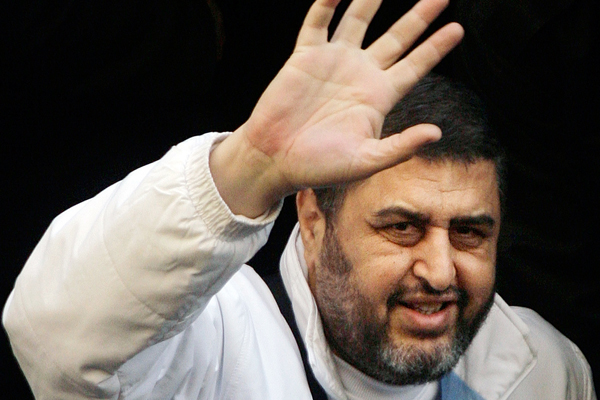
The GOP Brotherhood of EgyptKhairat Al-Shater, Muslim Brother and free marketeer (Credit: AP/Amr Nabil)

While Western alarmists often depict Egypt’s Muslim Brotherhood as a shadowy organization with terrorist ties, the Brotherhood’s ideology actually has more in common with America’s Republican Party than with al-Qaida. Few Americans know it but the Brotherhood is a free-market party led by wealthy businessmen whose economic agenda embraces privatization and foreign investment while spurning labor unions and the redistribution of wealth. Like the Republicans in the U.S., the financial interests of the party’s leadership of businessmen and professionals diverge sharply from those of its poor, socially conservative followers.

The Brotherhood, which did not initially support the revolution that began a year ago, reaped its benefits, capturing nearly half the seats in the new parliament, which was seated this week, and vaulting its top leaders into positions of power.

Arguably the most powerful man in the Muslim Brotherhood is Khairat Al-Shater, a multimillionaire tycoon whose financial interests extend into electronics, manufacturing and retail. A strong advocate of privatization, Al-Shater is one of a cadre of Muslim Brotherhood businessmen who helped finance the Brotherhood’s Freedom and Justice Party’s impressive electoral victory this winter and is now crafting the FJP’s economic agenda.

At Al-Shater’s luxury furniture outlet Istakbal, a new couch costs about 6,000 Egyptian pounds, about $1,000 in U.S. currency. In a country where 40 percent of the population lives on less than $2 a day, Istakbal’s clientele is largely limited to Egypt’s upper classes.

Although the Brothers do draw significant support from Egypt’s poor and working class, “the Brotherhood is a firmly upper-middle-class organization in its leadership,” says Shadi Hamid, a leading Muslim Brotherhood expert at the Brookings Institution in Washington.

Not surprisingly, these well-to-do Egyptians are eager to safeguard their economic position in the post-Mubarak Egypt.  Despite rising economic inequality and poverty, the Brotherhood does not back radical changes in Egypt’s economy.

The FJP’s  economic platform is a tame document, rife with promises to root out corruption and tweak Egypt’s tax and subsidies systems, with occasional allusions to an unspecific commitment to “social justice.” The platform praises the mechanisms of the free market and promises that the party will work for “balanced, sustainable and comprehensive economic development.” It is a program that any European conservative party could get behind.

Over the last few months the Brothers have been publicizing their economic conservatism to international investors and financial institutions.

“The Brothers see this as a major source of its appeal among Western audiences,” Hamid explains. “Most people think the Brothers would be aligned with a leftist interventionist approach to the economy. But after taking a second look, most investors find themselves pleasantly surprised when they find out otherwise.”

Speaking to Reuters in November, Hassan Malek, a textile mogul and Brotherhood financier, emphasized that the Brothers “want to attract as much foreign investment as possible … and this needs a big role for the private sector.” Just last week, Malek was tapped by the Brotherhood to head up the newly formed “Egyptian Business and Investment Association,” a coalition of leading Brotherhood businessmen working to promote private investment.

For his part, Al-Shater has been personally courting select investors and reassuring them in private that the Brothers have no radical plans for the economy.

Over the last few months the Egyptian investment bank EFG-Hermes organized sit-downs between Al-Shater and 14 major investment managers from Europe, the United States and Africa. Al-Shater used the opportunity to reassure investors that the new government shares their goals.

“I believe the meeting dismissed some investors’ concerns about an extreme economic policy,” said Wael Ziada, an official with EFG.

The Brotherhood wants continuity. Al-Shater’s relationship with EFG-Hermes has raised some eyebrows, since the investment bank was partially owned by deposed President Hosni Mubarak’s son Gamal.  But the businessmen in the Brotherhood do not seem concerned by this connection, and they are not at all hasty to jettison the Mubaraks’ economic legacy.

Malek has even gone so far as to praise the economic policies of the Mubarak regime. “We can benefit from previous economic decisions. There have been correct ones in the past … Rachid Mohamed Rachid [Mubarak’s minister of trade] understood very well how to attract foreign investment.”

What Malek failed to mention is that Rachid fled to Dubai after the ouster of Mubarak and has since been convicted in absentia of squandering public funds and embezzlement.

Rachid worked to privatize Egyptian industries, reduce taxes and subsidies, and defang unions. This economic model, adopted at the urging of the IMF and international financial institutions, delivered strong economic growth — nearly 6 percent a year from 2004 to 2009 — but also generated inequality. The gains were concentrated in the hands of Egypt’s economic elite, while millions of working-class Egyptians saw their wages stagnate, as rising food prices pushed many to the brink.

This pressure inaugurated a wave of strikes, which were a key component in the uprising that toppled the Mubarak regime last spring.  Since Mubarak’s ouster, however, the Brotherhood has taken a hostile line against trade unions. When a wave of strikes rocked Egypt last September, the Brothers sided with business interests and the ruling military junta against the unions.

“The Brothers have been against wildcat strikes and all significant labor actions,” says Zeinab Abdul-Magd, an Egyptian academic and leftists activist. “The Brothers just don’t relate to workers.”

The Brothers do run a number of impressive charity organizations for Egypt’s poor, and during holidays the Brotherhood offers subsidized meat to the poor. The Brotherhood’s candidates won big in last month’s parliamentary elections preaching social justice and promising relief to Egypt’s increasingly impoverished population.

But when it comes to specific policy proposals that could help Egypt’s millions of families who struggle to afford food, the Brothers employ what Shadi Hamid at Brookings calls “strategic ambiguity.”

“Their approach is to be everything to everyone all at once,” but in reality, Hamid says the leaders of the Brotherhood are “not in touch with the shockingly high levels of poverty on the grass-roots level.”

With Egypt facing a looming financial crisis — with rising unemployment and diminishing currency reserves — the real priorities of the Brotherhood will be tested.  Despite Islam’s prohibition on interest, the leaders of the FJP have already met with representatives of the IMF who are offering over  $3 billion in loans to ease Egypt’s financial burden.

It will be weeks before the new parliament takes any concrete steps to reform Egypt’s economy. But George Ishak, the co-founder of the Free Egyptian Party, a moderate liberal party that only managed to win one seat in the parliament, expressed skepticism that the Muslim Brotherhood would break with the past. “There’s a danger they will continue with the Mubarak policies.”

When asked what he would do differently Ishak responded, “I think we need to focus not just on growth, but instead think about the quality of growth … we need to think about redistribution.”

But that’s not what the Muslim Brotherhood is thinking about.

Why the Muslim Brotherhood wins

Party denies plans for an "Islamist" government after gaining in first round of elections.

  • more
    • All Share Services

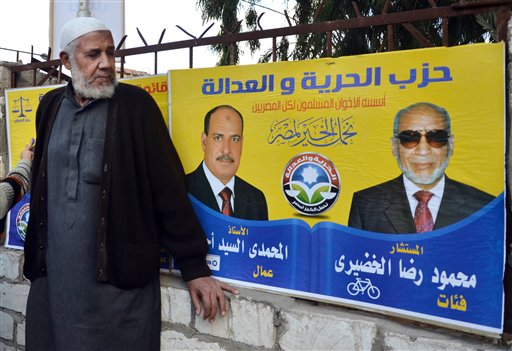
Why the Muslim Brotherhood winsCampaign banner in Arabic for The Freedom and Justice party. (Credit: AP/Tarek Fawzy)

The Freedom and Justice Party (FJP), the political arm of Egypt’s Muslim Brotherhood is exceeding already high expectations in the first of Egypt’s three-round parliamentary elections.  Although opinion polls had predicated the MB support at 20-30 percent, initial returns indicate that the FJP and its allies may win over 40 percent of seats, depending on the outcome of runoffs.

Many attribute this bump to the Brotherhood’s impressive ground-game.  “Each Muslim Brotherhood member signs on to a rigorous educational curriculum and is part of something called an usra, or family, which meets weekly,”  explains Shadi Hamid  Director of Research at the Brookings Doha Center, “If a Brother chooses to stay home on election day, other Brothers will know.”

But the FJP’s initial success cannot be explained by logistics alone.  The 90-year old organization has deep roots in Egyptian society and its vaguely centrist ideology–a mix of free-market liberalism and moderate social conservatism–appeals to a wide swath of the Egyptian public.  In an election where many party lists include former members of Mubarak regime, the FJP boasts strong anti-regime bona fides. Many of its leaders have spent significant time in prison and are widely respected across the Egyptian political spectrum.

Although there has been an explosion of new political parties since the fall of Mubarak last spring, elections returns suggest these new parties still lag far behind the FJP in name recognition and organizational strength.

With results still coming in, I asked Dr. Amr Derrag, who sits on the FJP’s Supreme Committee, if he were pleased with his party’s performance: “We don’t pay attention to how many seats we score, as much as we pay attention to the success of the process itself,” he replied coyly.  “We need to wait till the final round, to make any assessment.”

But when pressed, he admitted that the strong performance might motivate the FJP to seek a parliamentary majority in the next round of elections. For now, the Secretary General of the FJP, Mohamed Saad El-Katatn,  has pledged that it will only seek a plurality of seats in Egypt’s first post-Mubarak legislature.

Confounding High Expectations

Despite, Derrag’s blasé attitude, the FJP is doing so well that they appear competitive in some places secular-liberal parties had counted on winning. In Cairo’s 6th district, which includes the liberal upper-class island of Zamalek and much of the heart of downtown, the FJP’s candidates are making a strong showing.  The district hosted one of the most watched races in town between the well known former television reporter and activist Gameela Ismail, Amr Khaled of the FJP and Mohamed Abu-Hamed of the Egyptian Bloc, a centrist coalition of secular liberal parties.

Despite widespread name recognition, and an unparalleled advertising campaign, Ismail was knocked out of the race.  Khaled will face Abu-Hamed in a runoff in the coming weeks.

On Nubar St., near the edge of the 6th district, the neighborhood is abuzz with election talk, and many of the locals are surprised at the Brothers’ strong showing in their neighborhood.

“I voted for the Egyptian Block,” Ahmed, a 20-year-old university student tells me.   “I would vote for Ismail as well, but I don’t approve of how the Brothers mix religion and politics, ” he adds.

The majority of this week’s voters, however, do not share Ahmed’s aversion to political Islam. The Salafi Nour Party, a fundamentalist Islamic party, is coming in a strong second to the FJP.   The Nour Party has done especially well outside of Cairo and quite a few of its candidates are headed towards runoff elections.

Between the Nour and the FJP, Islamic parties won a clear majority of seats in Egypt’s first round of elections.  Based on this trend up to 65 percent of  Egypt’s incoming parliament could be controlled by Islamists, according to  Diaa Rashwan, the head of the Ahram Centre for Political and Strategic Studies here in Cairo.

But the Brotherhood has made it clear that it will not enter into a religiously based alliance. “We will be part of a democratic coalition including all currents,” Dr. Derrag explained to me.

Saad El Katatny,the  FJP’s Secretary General,  reiterated this point in a statement released Thursday, which denies rumors that  the Brothers were considering an alliance with the Nour Party to form an “Islamist government.”

From Opposition Group to Political Party

 As elections continue over the coming months, it is unclear how smoothly the Brotherhood can transition from an opposition movement to a political party with a (growing) popular mandate. This dilemma is only exacerbated by Egypt’s uncertain political climate and the continued political dominance of the ruling military junta, the Supreme Council of the Armed Forces (SCAF).

During the election season, the Muslim Brotherhood had struck a conciliatory posture in dealing with the SCAF. Though FJP and Brotherhood leaders criticized the military’s authoritarian ruling style, they refused to join protests last week calling for the immediate removal of the military government.

Over the last months, the Brothers have criticized the proliferation of military trials, condemned police brutality, and publically demonstrated against the SCAF’s attempts to influence the constitutional drafting process.  But they have not adopted the rhetoric of those activists occupying Tahrir Square who declare the military completely illegitimate.

As the Brother’s build momentum, they may be headed on a collision course with the increasingly authoritarian SCAF.  In the few days following the election, the Brothers are already struggling to balance their popular mandate with the political realities of military rule.

On Thursday, the FJP rescinded a statement made by party leader Mohammad Morsi that the party had earned the right to form a new government and interim cabinet. Party leaders later called the announcement, “premature.” The SCAF currently claims the right to name and dismiss the civilian cabinet. The Generals have signaled their intent to retain this power even after the new parliament is seated. Unless the FJP is prepared to serve as the SCAF’s rubber stamp, a showdown is inevitable.

For now, though, FJP officials are focusing on elections.

“Lets not get ahead of ourselves, we have two more rounds of elections to compete in, ” Dr. Derrag tols me.  He refused to comment on potential friction with the military, but he did promise that the FJP would guarantee that the democratic process unfolds properly:   “What we can assure everyone, at the end of the process the will of the people must be respected.”


Continue Reading Close

Amid street fighting, Egypt’s cabinet resigns

Demonstrators flooding Tahrir Square demand military relent to civilian rule

  • more
    • All Share Services

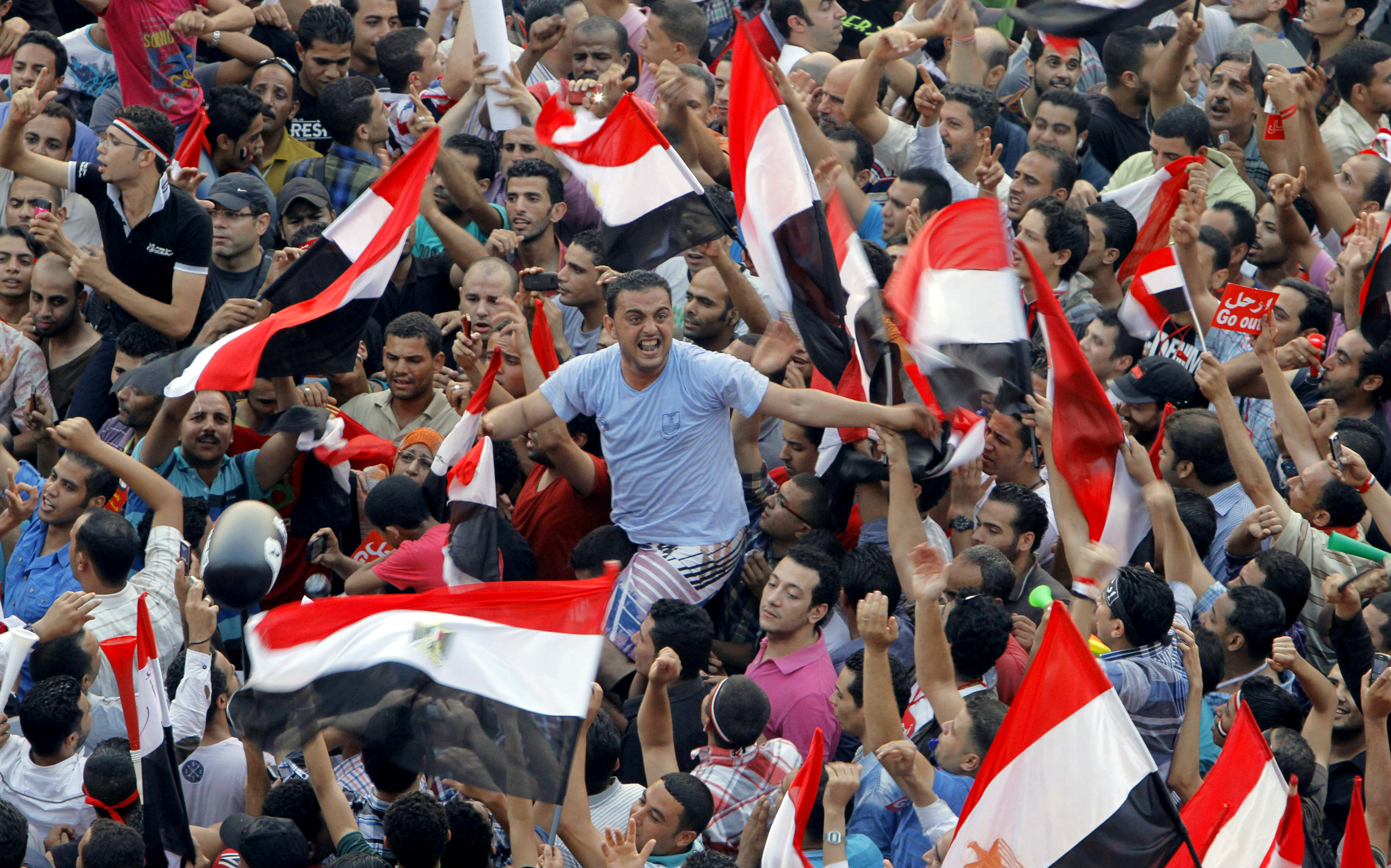
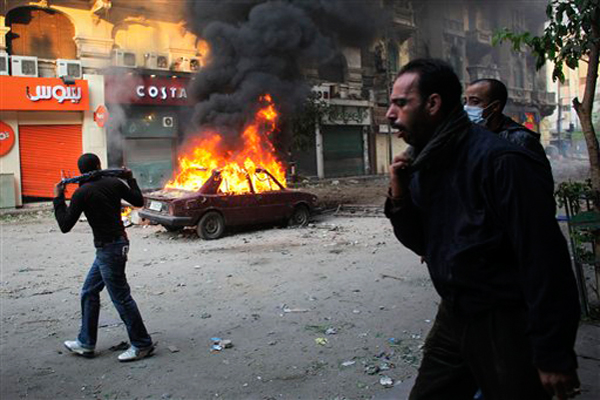
Amid street fighting, Egypt's cabinet resignsProtesters move away from tear gas fired by Egyptian riot police during clashes near Tahrir Square in Cairo on Monday. (Credit: AP/Tara Todras-Whitehill)

CAIRO — The military-appointed cabinet of the Egyptian government submitted letters of resignation late Monday night after three days of demonstrations rocked downtown Cairo and claimed nearly 40 lives. Just a week before Egypt’s planned parliamentary elections, the real political battle is being fought on the streets of Cairo while the military government and nascent political parties play catch-up.

The tumult began last Friday when thousands of peaceful protesters marched in Tahrir Square to condemn a constitutional proposal which would place the Supreme Council of the Armed Forces (SCAF) beyond civilian control.  On Saturday afternoon, military police then cleared the square of demonstrators using tear gas but the crowds soon returned, forcing the security personnel out.  Ever since, protesters and police have been playing an ever-escalating game of cat-and-mouse through the downtown streets.

Late Monday night in Tahrir, exuberant crowds chanted,  “The people want the downfall of the Field Marshall” (Field Marshal Mohamed Tantawi has been the nominal head of state for the last  nine months). A diverse collection of demonstrators, including children and families, gathered in the square while young men battled riot police on side streets.

As I watched these pitched battles rage,  young activists gathered around me,  eager to explain their reasons for taking to the streets. “We have had enough of the military,” 18-year-old Hady told me. Walid, 23, said this is the first time he’s felt optimistic since “we kicked out Mubarak.”

The last three days have seen a revival of the grass-roots street protest movement that swiftly toppled the 30-year dictatorship of Hosni Mubarak last spring.  The demonstrations come after months of haggling between the military government and the political parties about the details of the transition to democracy.

Although the military has feigned interest in sharing power with civilians, it refuses to budge on key issues, including the persistence of Emergency Laws and the proliferation of military trials for civilians. As a result, many in Tahrir have lost faith in the political class’s ability to negotiate effectively with the military.

“We have come here to complete the revolution,“  said Ahmad Salah a left-wing activist who has been in Tahrir since Saturday afternoon.

“Where are all the leaders? Where are the political celebrities? Where are the political parties?” he asked me. “We don’t need them. This is how a revolution should be, a people’s revolution.”

Of course, the political parties, seeking to compete in next week’s election, are following events closely and are doing their best to not alienate anyone.

Dr. Amr Derrag, a leader of the Muslim Brotherhood’s political wing in the metropolitan neighborhood of Giza, told me that protesters “may be considered justified in the face of  police brutality,” but stopped short  of endorsing the protests or calling for the military’s immediate removal.

In their official statements, the Brotherhood both condemned the violence and called for stability.  Brotherhood leaders are still insisting that elections proceed as scheduled.  Though individual Brotherhood members  are present in Tahrir Square, the organization has promised to not participate in any  demonstrations that “lead to confrontations.”

The resignation of the cabinet was viewed by many in the crowd as a cosmetic concession.  It is well known the cabinet has little real power and that, since the removal of Hosni Mubarak last spring, the SCAF has been calling the shots.

“It is not enough, ” Shahir Ishak, one of the co-founders of the Freedom Egypt Party and himself a candidate for parliament, told me in Tahrir Square.  “The protesters expect more than just the cabinet submitting their resignation. People cannot leave the square without a clear statement for a proper transition.”

It is unclear what an acceptable transition would look like, but Ishak still has faith in next week’s elections. “We have to have elections immediately,” he told me. Without elections, there will be no viable alternative to the SCAF.

By midnight in Cairo, a wary calm had settled in Tahrir Square. There are rumors that the SCAF is trying to negotiate with a coalition of political parties, and some are saying that Nobel laureate Mohamed ElBaradei is trying to form a national “salvation government. ” For now, though, most are focusing on holding the square for another day.

Continue Reading Close

Egypt uses U.S. teargas on pro-democracy crowds

600 injured as military clashes with demonstrators demanding return to civilian rule

  • more
    • All Share Services

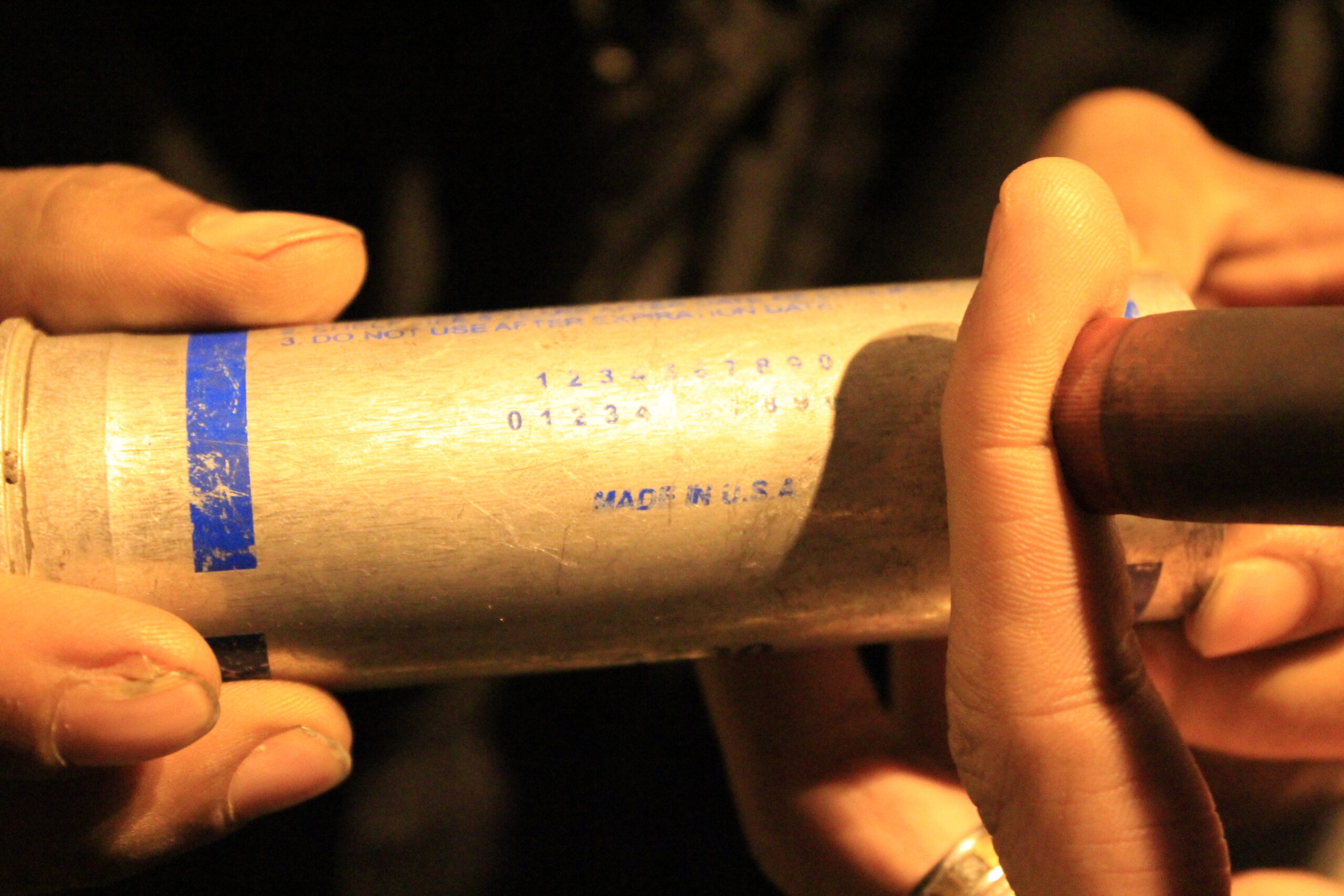
Egypt uses U.S. teargas on pro-democracy crowds "Made in USA" teargas cannister

CAIRO–Late Saturday evening the air here was heavy with suffocating smoke as Egyptian security personnel battled street protesters for control of Tahrir Square.  A protester, who told me his name was Karim,  held up a used teargas canister and pointed to the label: “Made in USA.”

“People need to know where this comes from,” he told me as the crowd chanted:  “The people demand an end to military rule.”

The serial number and blue markings on the  tear gas canister indicate that it was manufactured by Combined Systems Incorporated (CSI), a weapons manufacturer based in Jamestown, Pennsylvania.

This is not the first time CSI ‘s products have been used against Egyptian citizens.  During Egypt’s January revolution,  CSI tear gas was employed by the Mubarak regime against demonstrators in Tahrir Square.

Nearly nine months later, these same canisters have been raining down on demonstrators for the past  eight hours as Egyptian security forces clash with protesters throughout downtown Cairo. The  violence on Saturday came  a day after peaceful protesters occupied Tahrir Square on Friday demanding the ruling Supreme Council of the Armed Forces (SCAF) accelerate the transition to civilian rule.

The use of U.S-made tear gas against the protesters  in Cairo is the result of  the U.S. military aid policy.  In exchange for nearly $1.3 billion in aid, the United States requires that Egypt buy its hardware from U.S. manufacturers.

CSI’s website announces that the firms sell an“ innovative line of less-lethal munitions, tactical munitions and crowd control products . . . to a wide range of international military and law enforcement customers.” CSI will not confirm or deny whether they sell arms to Egypt, but their distinct labels are evidence enough.

According to the State Department web site, the United States gave Egypt $1.2 million in 2009 for tear gas, riot control agents, and associated equipment.

Clashes in Tahrir Square

During Friday’s protests, a diverse group of political parties and activists joined together for a rowdy but peaceful denunciation of military rule.  A small group of demonstrators stayed the night, vowing to occupy the Square until the military steps aside.

Beginning in the early afternoon on Saturday, security forces moved to clear the square of the remaining demonstrators, but the protesters stood their ground.   By late Saturday night,  after nearly eight hours of violent street clashes,  protesters had secured the periphery of Tahrir Square and were checking ID’s at makeshift barricades.

Chaos still reigned outside the Square as security personal faced down groups of rock-throwing youths.

On the corner of Mohammad Mahoud Street,  across from Tahrir Square, young men with their faces covered in surgical masks rushed forward to grab a smoking canister and fling it back at a line of riot-police.

A block away,  on Tahrir Street,  a resident hurled  Molotov cocktails at the advancing riot police  and dropped water bottles to exhausted protestors.  At the end of the street, protesters lit piles of trash on fire to obstruct the oncoming policemen.

The wounded were treated at a makeshift hospital set up outside a Kentucky Fried Chicken at the edge of Tahrir Square.  A man, who identified himself as a doctor, tolds me that hundred of protesters have been wounded and several have died.

A spokesperson for the Healthy Ministry, Mohammed Sherbini, confirmed that more 600 protesters have been wounded in the clashes. The Ministry of Interior claims that 40 police officers have been wounded as well.

State TV Spreads Military Propaganda

Reports on military-controlled State TV blamed the violence on the protesters. But thousands ignored the propaganda and streamed into Tahrir Square to express their dissatisfaction with the military and to take part in the clashes.

Rami Sizar, a native of the working class neighborhood of Imbaba,  told me he came straight to the Square as soon as he heard the police were clashing with protesters.  “I didn’t believe the State TV,” he explained.  “Everyone has the right to protest in the Square,” his friend Amr added.

In the middle of Tahrir Square,  protesters held up teargas canisters and bullet shells and ask journalists to take pictures.  One man gestured at a canister and asks me why the United States was helping the SCAF “attack” the Egyptian people.

As of midnight in Cairo, there was no indication that the protesters would leave Tahrir Square.  A group of men have hoisted a banner which reads “the people want a civil ruling council.”    The violent crackdown seems to have only strengthened the resolve of protesters.  “The revolution continues,” tweeted activist Hossam el-Homalawy, as protesters braced themselves for further attacks.


Continue Reading Close

Crackdown in Cairo, excuses in Washington

As Egyptians return to Tahrir Square, the Obama administration sides with the military

  • more
    • All Share Services

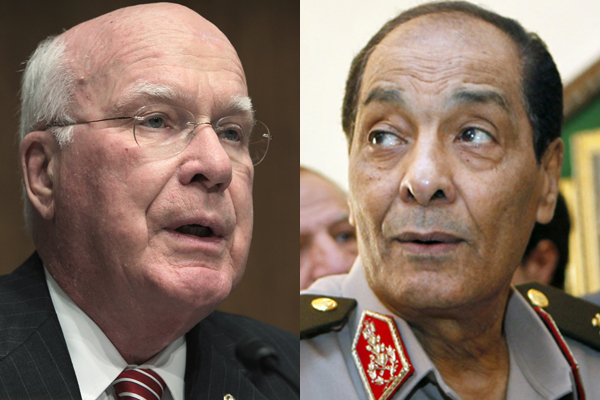
Crackdown in Cairo, excuses in WashingtonSen. Patrick Leahy, left, and Field Marshal Mohamed Hussein Tantawi, head of Egyptian armed forces (Credit: AP/Reuters)

CAIRO — Sitting across from me in a downtown cafe, disgruntled democracy activist Ismail Wahby looks defeated. “Everything is failing,” he says.

In many ways, Wahby personifies the Western stereotypes about the mislabeled “Facebook Revolution”: He is an upper-middle-class 20-something who blogs in English, French and Arabic. After the ouster of Hosni Mubarak, he worked as community organizer with the Union of Progressive Youth, one of the many revolutionary coalitions formed after the dictator’s fall. But as Egypt’s ruling Supreme Council of the Armed Forces (SCAF) became more oppressive in the months that followed, Wahby grew discouraged and withdrew from political activism. “I didn’t do a revolution for this shit,” he explains.

Wahby has a long list of grievances about the aftermath of Egypt’s largely peaceful revolution last January, including the persistence of the State of Emergency — which was supposed to have expired months ago — and the failure of the opposition to present a unified front.  But mostly Wahby is concerned with the dominance of the military in post-Mubarak Egypt.

Wahby’s pessimism is widespread.  Since taking power last February, the military has perpetrated major human rights abuses and seems more interested in consolidating its own power than ensuring a democratic transition. Protesters have begun to set up tents in Tahrir Square in preparation for massive anti-SCAF demonstrations this Friday. A broad coalition of political parties and activists have threatened a prolonged sit-in protesting the military’s increasingly authoritarian ruling style and its unwillingness to share power with civilians. “The SCAF must step aside and respect the will of the people,” 45-year-old electronic engineer Mohammad Sayyid tells me from inside a tent he shares with half a dozen other men.  Sayyid has been sleeping in the tent for over a week and promises that he will not leave the square until the military steps aside.

The showdown in Egypt coincides with a showdown in Washington, where Vermont Sena. Patrick Leahy is seeking to link U.S. foreign aid to the conditions of Egyptian democracy, a move that is opposed by the Obama administration. The proposal, contained within the Department of State and Foreign Appropriations Bill, passed out of committee last week with bipartisan support, and is expected to come to a floor vote soon.

After months of denial about the true nature of Egypt’s “democratic transition,” the Obama administration shows signs of concern.

After Tahrir Square

In the nine months since Hosni Mubarak stepped aside, the Egyptian military has monopolized political decision-making. The SCAF has broken its promise to lift or modify the Emergency Laws, which have been in place since 1981 and give the state sweeping powers to detain citizens and restrict free speech, even though repeal of the laws was a central demand of the revolutionaries in Tahrir Square.

Since assuming power in February, the military has broken up protests, suppressed trade unionists, and imprisoned dissidents, journalists and bloggers.  Human Rights Watch has accused the SCAF of subjecting between 7,000 and 10,000 civilians to military trials in the five months following the revolution.  The recent imprisonment of  blogger Alaa Abdel-Fattah drew the attention of the U.N. High Commission for Human Rights, which expressed concern about “what appears to be a diminishing public space for freedom of expression and association in Egypt.”

One of the more egregious incidents was the death of 27 Coptic Christian demonstrators at the hands of what many suspect to be military personnel on Oct. 9 at the Maspiro State Television building in downtown Cairo. The military blames the demonstrators themselves for the violence.

“Instead of identifying which members of the military were driving the military vehicles that crushed Coptic protesters, the military prosecutor is going after the activists who organized the march,” reported Sarah Whitson, the Middle East North Africa director of Human Rights Watch.

The U.S. government shrugs off these abuses, attributing them to the SCAF’s inexperience. At a Nov. 3 press conference in Washington, U.S.  Ambassador for Middle East Transition William Taylor asserted that military abuse can be attributed to the fact that the military is unaccustomed to governing and may be overwhelmed. “[Governing] is not what the Egyptian military is trained to do,” explained Taylor.

Nadeem Mansour, the executive director of the Egyptian Association for Economic and Social Rights, a Cairo-based NGO, called Taylor’s assertion baseless.  “You don’t need to torture civilians because you are overwhelmed. They [the SCAF] are a repressive force by nature and they require an authoritarian environment. After all, they were all appointed by Mubarak, served him well, and still represent this mind-set,” he told Salon.

“The days of blank checks are over”

Leahy’s bill would require the secretary of state to certify Egypt has held free elections and is promoting human rights and freedom of the press in order to transfer the $ 1.3 billion in aid. The liberal Democrat insists that establishing fundamental conditions for the aid is necessary to ensure the openness of the parliamentary elections and the long-term viability of Egypt’s democratic transition.

The unconditional approach has been tried. Over the last three decades, the United States has supplied over $60 billion in unconditional aid to the Egyptian military, even as the Mubarak regime rigged elections and trampled on human rights.

“Going forward, the days of blank checks are over, and it is in the mutual interest of the Egyptian people and the United States to reinforce these rights as conditions for our aid,” Leahy’s spokesman David Carle told Salon.

The State Department disagrees.  A week after Leahy’s bill moved out of committee in late September, Secretary Clinton cautioned against altering the current aid scheme at a press conference here in Cairo:  “We are against conditionality … we will be working very hard with the Congress to convince [them] that that is not the best approach to take.”

As it became clear that the bill would make it to the floor, Assistant Secretary of State Andrew Shapiro (no relation to this reporter) ratcheted up the rhetoric. In a policy address earlier this month Shapiro warned that “conditioning assistance risks putting our relations with Egypt in a contentious place at the worst possible moment.”

The Obama administration’s case against conditioning aid is straightforward: In order to ensure U.S. influence in a post-Mubarak Egypt, the U.S. must pay to play. Placing conditions on aid would alienate the SCAF. Since February, the administration has preferred to rely upon behind-the-scenes pressure and gentle public prodding to cajole the SCAF into transferring power to a civilian government.

So far, this approach has failed spectacularly.

Egyptians head to the polls on Nov. 28, for the first round of a three-stage, four-month process of rolling votes across the country, which is slated to end in March.  Meanwhile, the SCAF is maneuvering to ensure its supremacy over the incoming civilian government, which will be responsible for selecting a constitutional committee to draft a new Egyptian constitution.

On Nov. 1 , the SCAF-appointed Deputy Prime Minister Ali al-Selmi issued a set of principles designed to influence the constitutional drafting process before it even begins.  The principles would insulate the Egyptian military from civilian oversight and could seriously undermine the incoming civilian parliament’s authority.

For example, Articles 9 and 10 of the constitutional principles declare the military the “protector of constitutional legitimacy” and mandate that the military budget be placed outside of civilian control.

These declarations drew widespread condemnation from across the political spectrum. The Muslim Brotherhood, whose Freedom and Justice Party stands to do quite well in parliamentary elections, has been especially critical of the move. Party president Mohammad Morsy threatened a “second revolution” if the principles are not withdrawn.

Outrage over the SCAF’s constitutional principles is a primary motivation for Friday’s protests and the Brotherhood is encouraging its vast constituency of supporters to voice their dissatisfaction in Tahrir Square.

Dr. Amr Derrag, the recently elected regional head of the Muslim Brotherhood party in the major metropolitan area of Giza, told Salon that he hopes the SCAF withdraws the principles before things get out of hand. Derrag said that the SCAF must resist the temptation to intervene in the civilian governing process. The “Turkish model,” in which the army reserves the right to overrule civilian governments, will not work in Egypt, he says.  “If the constitution allows the army to intervene at any time this will be a disaster.”

Since the SCAF has little interest in sharing power, its leaders seem to hope that this month’s elections will yield a divided and illegitimate parliament too weak to challenge its authority.  It may very well get its wish. The elections will feature nearly 55 political parties, arranged in a dizzying and constantly changing constellation of alliances.  There is little hope for transparency, since the SCAF has banned international election monitors (the Carter Center has been granted “witness” status) and many of the patronage systems that dominated Mubarak-era politics remain intact.

Local analysts are not optimistic. “What happens if, after the first round, the results and/or the tensions prompt a panicking military to cancel the poll?” writes Issandr El Amrani, a longtime Cairo-based journalist. “An already turbulent Egypt is entering a period of increased turbulence: Fasten your seat belts.”

Administration officials continue to praise the SCAF as a moderating force committed to democracy and there is a blanket refusal to even consider conditions on aid. But even some longtime supporters are rethinking that position.

Michele Dunne, a former State Department official, current director of the Rafik Hariri Center for the Middle East, and one-time opponent of conditional aid, has penned a policy brief calling for just that.

“Egypt is at a critical moment right now,” Dunne said in an interview, “and the United States should use all the leverage that it has … if the [Egyptian] military undermines the political transition and the U.S. continues to supply military assistance, then we are complicit.”

Continue Reading Close