Baz Dreisinger

A pop princess, unspoiled

Alicia Keys beats the odds, avoiding a Lauryn Hill flameout (or a Britney travesty) with the simple and joyous retro-soul of her new album.

  • more
    • All Share Services

A pop princess, unspoiled

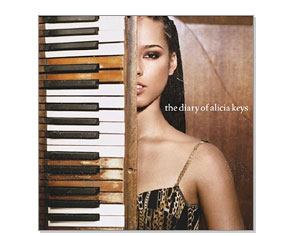
Once upon a time and several years ago, a very beautiful young woman with a very beautiful voice recorded a very beautiful album. A very, very beautiful album — the sort of achingly soulful, thoughtfully written, impeccably composed album for which critics lust and fans get down on their knees to say hallelujah.

This PYT was rewarded with universal acclaim — which, in real-world terms, means five Grammy awards. Glimmering statuettes in hand, she posed gorgeously for the press; then, with the music world at her feet, she disappeared into that land where artists go (the studio) eager to do what artists do (record a sophomore album). Fans salivated, anxiously awaiting their musical treat.

The album came; it was no treat. What, everyone asked, had spoiled such a good thing? The creative autonomy that came with fame, which allowed her to overindulge herself? Or perhaps the opposite: She had buckled under the onerous, restraining load of excess celebrity. Greedy fans, cheated of a precious follow-up, lamented their loss. Critics, meanwhile, dismantled the very pedestal they’d erected.

This is not the story of Alicia Keys; it’s actually that of Lauryn Hill, ex-Fugees rap/R&B sensation. But if not for “The Diary of Alicia Keys” — a joy of a second album — it certainly could have been Keys’ story. Both women, after all, recorded stunning debuts that earned them five Grammys, including awards for best new artist. Both were deemed heirs to the legacy of classic soul; both sold millions of records; and both had the industry wrapped around fine-looking fingers.

Perhaps because Hill’s letdown of a follow-up (“MTV Unplugged No. 2.0″) revealed the pressures inherent in instant greatness, Keys’ anticipated return made folks nervous. Ironically, the fact that she was so good made marketing Alicia Keys harder than one might expect: If you nearly achieve perfection with your debut, where do you go from there?

Music marketing, after all, has a one-word mantra: Growth. Artists and their various representatives live by the claim that so-and-so’s latest release exhibits artistic evolution. New releases are touted via an artist’s literal growth, too: Christina Aguilera’s upper region magically grew in time for “Stripped”; every post-debut Britney Spears album has been marketed as the one on which the pop princess — no longer a girl and not yet a woman (or, wait, is she one by now?) — has finally grown up. But Alicia Keys, at 22, is already more grown than Britney and Christina put together. We haven’t gorged on tabloid photos of her either, nor have we been forced to watch her making out with Madonna and calling it maturity. What sort of growth could Alicia Keys possibly boast of?

Thankfully, none. “The Diary of Alicia Keys” is a superb album because Keys and her camp remembered that if it ain’t broke, you don’t have to fix it. The initial sign that all was as it should be — in other words, as it was in 2001, when “Songs in A Minor” was released — is Keys’ current single, “You Don’t Know My Name.” Hearing its retro-sounding first notes — Keys murmuring “baby, baby, baby” in dreamy tones, evoking ’60s soul — I exhaled. No seismic shift had occurred! This was the same Alicia we knew and loved. The song’s sultry video was — glory be! — more of the same: Alicia, still in braids, still stunning, still sitting at the piano, still the chic-est thugette in New York. The video’s only indication that Alicia has been moving on up is its cameo from A-list rapper/actor Mos Def. But hey, even thug princesses have to network.

“The Diary of Alicia Keys” is proof that it doesn’t take a newer, raunchier look — or a gimmicky all-grown-up-now persona — to stage an artist’s return. Much as I hate to be yet another critic clocking in at the Alicia Keys altar, I can’t deny that sheer talent speaks for itself.

Three things make “The Diary of Alicia Keys” an album that will last. The first is — what else? — piano. Yes, it’s rather irritating that piano playing has been turned into Keys’ shtick. The album has its share of gratuitous keyboard moments, and photos of the damn thing are plastered all over her promotional material. But gimmicks aside, Keys can work those keys. A quality producer in her own right, she also does an impressive job of incorporating them into songs like “Karma,” on which her hard vocals are reminiscent of Mary J. Blige’s, or “If I Ain’t Got You,” a simple, soft ballad that’s classic Keys.

Simplicity is the album’s second successful ingredient. Keys is no extraordinary writer; her lyrics are neither profound nor eminently spiritual. Hallelujah! The music world needs fewer attempts at profundity and more plain, honest beauty. Keys lets her singing voice say it all; it’s a voice that can soar, whisper, moan and belt. On paper, a song like “When You Really Love Someone” seems trite, indeed: “I’m a woman, Lord knows it’s hard/ I need a real man to give me what I need,” she begins. Or take “Dragon Days,” on which Keys declares herself a “damsel in distress” and moans, “like a desert needs water, I need you a lot.”

But “You make me feel like a natural woman” isn’t exactly Yeats, either. Its art lies in its delivery. Keys, like Aretha Franklin, could sing the yellow pages and make them sound profound. Instead, she sings little songs about desire and heartache and a lover who leaves (“Samsonite Man,” she calls him, on one touching track) — but transforms them, via a voice that has integrity and passion, into big, beautiful tracks that seem classic already. Unlike such R&B divas as Monica or the latter-day Mary J. — whose songs are complaints about ne’er-do-well suitors put to music — Keys forgoes whining in favor of stoic complacency and sincere empathy.

As if playing humble, Keys persistently complements her voice with subtle background vocals — the third secret ingredient on “Diary.” Well-timed backup — especially on the Timbaland-produced “Heartburn,” which sounds straight outta “Shaft,” or any other movie that Isaac Hayes wrote the score for — lends the album its much-touted retro feel. Keys clearly has the right musical mentors, past and present, and possesses a musical sense well beyond her years, as well as an innate understanding of the word “classic.” But listening to “The Diary of Alicia Keys,” and silently giving thanks that this media darling hasn’t gone off the creative deep end, you’re not likely to think of what came before. All you hear is that voice, the one that not even critical acclaim could damage.

“Passing” and the American dream

These days we're supposed to think race doesn't matter. But as "The Human Stain" and a raft of recent writing makes clear, we're just as fascinated by its slippery boundaries as ever.

  • more
    • All Share Services

Every now and then, cultural and social critics fashion an axiom that’s flippant, succinct and thus darling enough to render its truth value irrelevant. Such is the case with a phrase coined by culture-mongers in the 1960s that’s finding new currency today: “Passing is passé.”

“Passing” is shorthand for “racial passing,” and “racial passing” means people of one race (generally African-American) passing for another (usually white). Anybody who’s surprised that there’s a shorthand terminology for what might seem a pretty unlikely scenario will be more surprised that the phenomenon, with its lengthy history in American culture, isn’t all that unusual. Some of the earliest stories about passing reach back to the 19th century, when slaves — like Ellen Craft, who penned a mesmerizing slave narrative — used their light skin to escape, and novelists from Mark Twain to Charles Chesnutt mined the subject for their oeuvre.

Passing was a much-hyped subject during the Harlem Renaissance, which produced a plethora of rich fiction about it: Nella Larsen’s “Passing,” Jessie Fauset’s “Plum Bun,” Walter White’s “Flight.” The subject had its Hollywood heyday; melodramatic passing flicks from the ’30s, ’40s and ’50s include “Pinky,” “Lost Boundaries” and two big-screen versions of “Imitation of Life” (the latter version, directed by Douglas Sirk, probably still delights the Kleenex industry).

But along came the ’60s. And with it, Black Power and other ideologies that made the saga of passing — and the act of passing itself — soppy, weak-kneed and thus unhip. Passing was passé, critics said, because racial pride was where it’s at. Whether prophecy or prescription, their words proved accurate, for a while, at least: The subject never vanished from public or private sectors, but it did step aside for a hot minute or two.

That hot minute is over. Passing, these days, is anything but passé. This week Anthony Hopkins, neither a black man nor a Jew, saunters onto the big screen to play a black man passing as a Jew in the long-awaited screen version of Philip Roth’s “The Human Stain.” Last month, journalist Brooke Kroeger’s collection of case studies, “Passing: When People Can’t Be Who They Are,” earned solid reviews and prompted a National Public Radio program on passing. Brent Staples recently penned a series of New York Times editorials on the subject.

All this is the crescendo of a passing wave that’s been approaching for several years now: In the late ’90s, two highly touted novels — Danzy Senna’s “Caucasia” and Colson Whitehead’s “The Intuitionist” — featured passing plots, and as race-based memoirs became practically the only memoirs worth publishing, real-life passing narratives (like poet Clarence Major’s “Come by Here: My Mother’s Life”) resurfaced on shelves.

This passing renaissance — no pun intended — represented something rare: A trend that germinated in the ivory tower was trickling down to the masses (not, as is usually the case, vice versa). It began in the mid-’90s, with cultural-studies academics who gave renewed attention to passing narratives, got them reissued in snazzy Penguin editions, and wrote occasionally readable, theoretical books about them. The best of these was a 1996 Duke University Press anthology, “Passing and the Fictions of Identity,” which Kroeger — who’s clearly done her academic homework — cites.

Kroeger cites it because this anthology, like her book and “The Human Stain,” embodies racial passing, new-millennium style: Among other things, it isn’t limited to black-as-white. “Passing puts us in touch with the wondrous ability each person has to create and recreate the self,” Kroeger writes. Her book includes blacks passing as white, yes, but also a gay man passing as straight, a white woman passing as black, and a Jewish Latina (her richest subject, because it encompasses the theoretical trinity of race, class and gender).

There’s passing that Kroeger aptly deems “good-guy adventuring,” which is really just disguise: Frank Abagnale in “Catch Me If You Can,” or Joshua Clover, a poet whose writing persona was Jane Dark — Village Voice music critic, feminist and high-lowbrow aficionado. Kroeger offers a sketch of passing’s progressive arc: “from inadvertent passing to passing for fun to passing part time or full time to passing all the way or breaking the cycle at any point.”

Kroeger’s broad definition of passing is really too broad, however, so broad as to render the term almost meaningless. Refusing to allow for historical differences between forms of passing, her definition also isn’t precise enough: Though Jane Dark’s public “outing” may have ruffled few feathers, the public fuss over the young “Latino” writer Danny Santiago’s 1983 memoir “Famous All Over Town” (Santiago was really a white man named Dan James), or Binjamin Wilkomirski’s 1994 Holocaust memoir “Fragments” (Wilkomirski was neither a Jew nor a survivor), proves that even in the literary world, not all passing is equal. We have long guarded the gates into some identities more closely than others.

But even without its necessary distinctions — between passing that’s based on physical traits (black-white) and passing that isn’t (gay-straight), between the slippery categories called “ethnicity,” “race” and “nationality” — Kroeger’s definition gestures toward an America that’s finally giving due attention to racial binaries other than black/white. It’s in line with the sort of passing narratives making rounds nowadays: gender passing in “Boys Don’t Cry” and “The Crying Game,” Jewish-Gentile passing in the 1990 film “Europa, Europa” and books like Stephen Dubner’s “Turbulent Souls,” Susan Jacoby’s “Half Jew” or the 2000 anthology “Suddenly Jewish.” Name the category — Latina? Italian? Senior citizen? — and odds are someone’s written about passing for it.

So what to make of this passing fad? Here’s the simplest explanation: It goes hand-in-hand with new-and-improved notions about race and identity. Passing “upends all our tidy little methods of recognizing and categorizing human beings,” writes Kroeger, and “makes us wonder what exactly makes an identity authentic, or if and how authenticity matters.”

Bingo: In the context of race, “authenticity” and “identity” have truly begun to unravel. This began when biologists, finding more variations than commonalities among so-called races, debunked race altogether. First for the highbrow and then for the masses — increasingly informed that multiracialism is our destiny, glimpsing the “new face of America” on the cover of Time — race became the emperor’s new clothes. The public imagination slowly began coming to grips with an idea voiced half a century ago by Walter White, the blond-haired, blue-eyed “black” man who once ran the NAACP: “We do not see color. We think it.”

Nothing embodies this notion — race is an idea, not a physical truth — like passing. If color is thought and not reality, why, after all, can’t a blue-blooded Welshman named Hopkins play Coleman Silk, American black-cum-Jew? And why can’t Wentworth Miller, an actor of mixed heritage, play the young Silk? More broadly, why should someone whose father is black and mother is Jewish, who looks “white as snow” (as Coleman’s mother describes him), be bound to any single race?

He shouldn’t. And that — insist Kroeger’s book, Benton’s film and most other contemporary passing narratives — is precisely what separates new-school passing stories from old-school ones. Back in the Jim Crow days, Nella Larsen or Douglas Sirk delivered punishment — usually death — to passers, whom we were meant to believe had overstepped “natural” boundaries. Sure, passers offered a revolutionary moment or two, a scene in which they radically questioned rigid racial lines. But in the end, melodramas like “Showboat” and “Pinky” upheld such categories. Passers were deemed to be essentially black, via the slavery-era “one-drop rule,” and the scene in which they owned up to this one drop was their moment of undoing and the narrative’s climax.

According to Kroeger, the contemporary passer’s unmasking doesn’t produce this sort of tear-jerking drama. “It usually provokes some surprise, no doubt some gossip,” she writes, “but then what ordinarily follows is a big ‘So what?’” Savvy postmodern minds — critical of race as a category and thus too sophisticated for its unyielding distinctions — empathize with and often champion passers, Kroeger argues. We don’t chastise them for committing the great sin of denying some true, essential self; what’s a “true self,” anyway?

Kroeger’s point — her “so what?” — is at the heart of “The Human Stain,” which — like Roth’s novel, first conceived during the ’50s but set in the ’40s and the ’90s — is really two stories sewn together. One is a traditional passing narrative of the American 1940s, when a young Coleman Silk breaks his mother’s heart by electing to pass for white and date Steena Paulson, the very embodiment of white womanhood (Danish and Icelandic — do they come any whiter?). Upon discovering that she’s fallen in love with a “black” man who only looks white, a shocked Steena tearfully exits the film and Coleman’s life.

The unraveling of this love story is set in deliberate contrast to that of the other film embedded in “The Human Stain.” Set in the contemporary moment and thus pervaded by our modern-day dysfunctions (race-, class- and gender-related), this film is a May-December romance between Coleman and Faunia Farley, played by a Nicole Kidman who looks more emaciated than ever (representing her frailty, perhaps? Her un-bootylicious whiteness?). Though viewers never witness Faunia’s reaction to Coleman’s confession about his past and his race, the film’s opening scene — Faunia resting peacefully on Coleman’s shoulder — establishes her reaction as indeed somewhere along the lines of “so what?” The point is obvious, but Coleman’s sister spells it out for us: “Nowadays it’s hard to imagine that anyone would do what Coleman felt he had to do.”

Via different mediums and different tones — “Passing” has moments of uplift while “The Human Stain” is all tragedy — Kroeger and director Benton are really making the same point: Passing is passé not as a topic, but as an activity. At a time when we’ve supposedly reconsidered race and outgrown Jim Crow-era racism, there’s no reason to pass anymore. The impetus for producing movies and books about passing is thus to insist on a paradox: We ought to talk about passing again in order to assert that it’s a dead issue. Passing, the thinking goes, isn’t passé as a subject — precisely because it is passé as a course of action.

But there’s the rub. Can we really suggest that passing has passed, a casualty of older-and-wiser theories about race?

Tell that to the woman who, empathizing with one of Staples’ New York Times editorials, described growing up in “a ‘passing’ family” and had her letter published under the heading “Black, White and in Pain.” Tell it to some of my blunt college students, who deem the benefits of passing alluring as ever (“Hell, I would if I could,” one of them sighed after class, speaking with more than a measure of envy about a passing co-worker). To say that passing is passé is to say that racism, which produces passing, is passé. And that’s one of the Great American Fantasies.

As long as there’s white privilege, as long as there’s racism of the “but would you let your daughter marry one?” variety, passing will exist and “so what?” won’t be the most frequent reaction to it. Offensive racial ideologies are like roaches: Just when you think you’ve eradicated them, they crop up again and your apartment looks just the way it did a week ago. Until we come up with a magical race-equalizing version of Raid, black-to-white passing won’t, practically speaking, have its last stand.

Neither will it vanish, theoretically speaking. Here’s where things get slippery: Though it seems to undermine essential racial categories — when someone who looks white isn’t white, then who is? — passing ultimately reinforces them, because talking about passing from one race to another assumes that there are distinct races to pass in and out of. Despite her well-meaning claims about the elusive qualities of identity, Kroeger serves up a title as essentialist as they come: “When People Can’t Be Who They Are” insinuates that there’s indeed a true self, a certain racial “are” whom passers can’t “be.” Most of her subjects, usually in the process of finding a racially appropriate mate, ultimately locate this “are” and thus settle into a “true” self, much as old-school passing figures did.

Kroeger, hip to passing paradoxes, tries to find an out by tinkering with the definition of “passing,” which produces another mess: If passing is race-based, and race, as progressive minds know, doesn’t actually exist, then no one can be a passer; if passing is about identity-shifting more generally, then everyone is a passer. So Kroeger distinguishes passing from everyday identity-shifting by claiming that only a passer doesn’t “recognize the persona she assumes as her own.” But this isn’t fully convincing, and neither is the lip service she pays to the artificiality of race.

Any truly anti-essentialist framework must embrace a technical truth: Despite the legacy of the “one-drop rule,” someone who’s both black and white is passing for black as much as he’s passing for white. “The Human Stain” sidesteps this issue because Coleman’s parents are both defined as black, but Coleman’s white ancestry is written all over his face — so why can’t he claim it?

“The Human Stain,” like “Passing,” ultimately can’t buck the essentialist conventions of the passing story. Not only does it begin with tragic death for the passer — his punishment? — but the film is described by Benton as modern-day Greek tragedy. And what is Greek tragedy if not didactic, eager to render retribution to those who hubristically overstep natural boundaries? The film employs almost every stock element in the classic passing-narrative book, most notably a long-suffering black mother who — standing in for the African-American race — endures the sting of her son’s rejection.

So essentialism wins out in the end. It does in my classroom, too: With their proclivity for statements about being “essentially” black or “really” white, my students — wise and insightful in so many respects — remind me that claims about how racially progressive we’ve become are overstated and optimistic. So does another recent letter to the Times, which asserts — in terms to make racial theorists cringe — that “being black is not something you can teach or mimic … it’s simply who you are.”

We like our solid selves. How, after all, does one actually live in a racial free-for-all, a world in which all identity is (to quote Samira Kawash’s study of passing) “not what we are but what we are passing for”? Even Harvard race guru Randall Kennedy, whose “Interracial Intimacies” argues for a choose-your-own-race approach (he calls it “free and easy entry into and exit from racial categories”), admits that such a world could produce “some racial fraud, or even a considerable amount of it.” Such a world also runs contrary to our passion for security, for the type of identity comfort zone that even Kroeger’s shifting subjects stake out in the end.

More than anything else, today’s passing fad is about the gulf between theory and practice. Yes, race is dead and passing passed with it — but no, they’re not. Academic jive about race as a “disproved” concept is, well, jive; good old Race, rigid and old-hat, lives on in our hearts and minds. Slay something — blackness, whiteness, Latino-ness — in concept and you haven’t slain it in the flesh.

So where does the solution lie? For “The Human Stain,” in language. The film is structured on the struggle of blocked writer Nathan Zuckerman (Roth’s alter ego, played with understated pathos by Gary Sinise). Nathan finds his story in Coleman; he finds it, then, in passing. To clean the human stain of racism — to out that damned spot — is to make narrative about it. Talking is the cure.

Thing is, that produces yet another paradox: The more we talk about the end of race (or of passing), the more it thrives in our discourse and thus in our consciousness. The article you’re reading, which objects to our fixation on race, ironically perpetuates this same fixation. Does this mean we — I — ought to shut up? That’s a tall order, considering that the subject is as eternally hot (if not quite as steamy) as Ben and J.Lo.

It’s also a tall order because we hold dearly to at least one Freudian tenet: In knowledge lies healing, and analysis extricates us from quagmires, racial and otherwise. It’s hard to dispute that — but as contemporary chatter about race and passing makes clear, it’s also easy to overstate it. The wisest move is the most obvious one: Take talk with more than a few grains of salt. Keep theorizing about the passing of passing — as Kroeger, Roth and others do — and hope that time will make theory and practice, the real and the ideal, better bedfellows.

Continue Reading Close

Hip-hop’s odd couple gets odder

OutKast's new double album is a critic's dream -- a self-indulgent but thrilling mixture of Southern funk, indie rock and art music.

  • more
    • All Share Services

Dynamic duos delight us by virtue of contrast: One might be staid and the other brash; one large, the other lean; one high-pitched, the other baritone. Think Batman and Robin, Abbott and Costello, Bert and Ernie.

That’s also the winning formula behind famous rap pairings, from Chuck D and Flava Flav (of Public Enemy) to N.W.A.’s Ice Cube and Eazy-E. In style and intonation, one is a little more out there than the other. One might wear the pants, so to speak, while the other wears, well, a skirt — or a psychedelic top, neon green smock and daisies.

OK, so this last description applies to only one rap duo: OutKast’s Andre 3000 and Big Boi (né Andre Benjamin and Antwan Patton). Two albums into their career, Andre launched his own sartorial revolution, adding a numerical value to his name and sporting outfits that — especially on his lanky, lean frame — might alternately be deemed eccentric or extraterrestrial. Big Boi remained content with Phat Farm sweat suits.

Andre’s gimmick was superfluous; OutKast’s music was enough to attract attention. Hailing from down south — East Point in Atlanta, to be exact — the pair met in high school. But unlike many big-name Southern hip-hop acts, from Master P to Lil’ John to Baby, OutKast, which released its debut “Southernplayalisticadillacmuzik” in 1994, made more than booty-shaking anthems that “crunk it up” (as they say down there). OutKast were a slightly more highbrow South. Sampling jazz or funk and experimenting with rhyme and flow, they had that rare ability to take chicken and grits — which they weren’t above referencing — to a whole new level. They made music that was smart, funky and original — yet eminently danceable. A track like “Rosa Parks,” from their breakthrough 1998 album “Aquemini,” may feature a chorus like “everybody move to the back of the bus,” but it’s still a club favorite.

Their new release, “The Love Below/Speakerboxxx,” is likely to make music critics salivate. First, it’s a double CD (and therefore provides plenty of critical fodder). Second, it’s a post-Grammy effort, which intensifies both audience and artist expectations (OutKast earned two Grammys in 2002 for the album “Stankonia,” and one in 2003 for their single “The Whole World”). Third, it’s a product of something that generally proves either heaven- or hell-sent: artistic evolution. After four albums and a greatest-hits compilation, Andre and Big Boi found themselves growing apart musically and working at different paces. Instead of splitting up, they elected — with the full blessing of Arista Records CEO Antonio “LA” Reid, who has long given them creative carte blanche — to record individual efforts and release the results on one OutKast album. The album has been touted as a genre-bending, über-original endeavor, yet another reason it’s a reviewer’s dream: Name the critic who doesn’t delight in penning descriptions like, “rock-hip-hop-funk fusion with a jazzy feel.”

Such a description applies to many tracks on “The Love Below/Speakerboxxx” — even to tracks on the more traditional OutKast-esque half of the album, Big Boi’s “Speakerboxxx.” Its first single, “The Way You Move,” brilliantly merges blaring horns and harmonies with Big Boi’s rapid-yet-smooth signature flow (the speed of Busta Rhymes meets the laid-back drawl of Snoop Dogg). “Ghetto Musick” has something of a Dr. Dre feel to it (a touch of ’80s synth does the trick), and “Flip Flop Rock” is an energized pairing of three rappers with vastly different styles: Big Boi, newcomer Killer Mike and Jay-Z (who hits a lyrical low on this one; his contribution is merely to say that he’s great and he likes Outkast). “Last Call,” featuring Lil’ John and the Eastside Boys, proves that Outkast can do the dirty Southern thang when they so choose.

Andre, however, isn’t doing that. In fact, he’s not doing much rapping at all. “The Love Below” puts him at the forefront of two hip-hop trends: rap figures who dabble in falsetto, retro-soul singing (think Pharell and even Snoop, on a track for his latest album), and rappers who say they’re done with rapping (DMX and Jay-Z, for instance, are soon to release “retirement” albums). Andre — who is currently acting in both an HBO production and a film by Albert and Allen Hughes about Jimi Hendrix — goes out on a musical limb here, playing guitar and keyboard and recording what are often soft-spoken chants. The result is not mere song but musical composition: “Dracula’s Wedding,” which nicely approximates a Gothic sound and is reminiscent of a Broadway number, or “Pink & Blue,” which would make a compelling film score.

There are some enormously creative moments on “The Love Below”: a drum ‘n’ bass version of “My Favorite Things,” or indie-rock guitar on “Hey Ya!” Andre’s musical tactic is summed up by the stylized photos of him in the album sleeve, which evoke Doris Day/Rock Hudson flicks. As with watching recent ’50s-nostalgia films (“Down With Love” and “Far From Heaven”), listening to “The Love Below” leaves us a tad confused about the line between tongue-in-cheek and sincere. Whenever Andre gets too musically highbrow, too artsy for a pop audience, he seems to interject a silly sigh or a goofy lyric (i.e., “she don’t even have to have a big old ass/ just something well proportioned to her body”) — thus reminding us about those grains of salt we ought to take him with.

Andre is right to temper the high art here, because if “Speakerboxxx” is solid but ultimately decent, “The Love Below” often bears the mark of an artist who’s been trapped in the studio too long. Like an ivory-tower academic, Andre occasionally forgets that an audience hopes to understand what he’s getting at. OutKast gets an A for creative effort, but there’s a tad too much self-indulgence behind such Andre renditions as “Roses,” “Vibrate” and “She’s Alive.” Even the first single, “She Lives in My Lap” — which has actress Rosario Dawson intoning a few lines (I’m not sure this justifies the label “featuring Rosario Dawson,” as the album puts it) — becomes mildly irritating in the context of the many other album tracks in a similar vein.

As Lauryn Hill’s sophomore bomb made tragically clear, musical growth sometimes works best when it’s reined in. The ideal sound for a newly evolved Andre might be “Take Off Your Cool,” in which he’s paired with Norah Jones and acoustic guitar. The song is short, sweet and delightfully original. It leaves us with a taste of something new and nice, not an overcooked, filled-to-the-brim tub of it.

Continue Reading Close

Will the real Feminem please stand up

Is Sarai the music industry's eagerly awaited lady Slim Shady?

  • more
    • All Share Services

Will the real Feminem please stand up

For the past few years, the music industry has been on a quest for something that sounds vaguely like a feminine hygiene product — something it hopes it found this summer: Feminem. That’s as in “female Eminem.” As in a miniskirted version of the bleached-blond, hot-tongued rapper who delved deep into the hearts and pockets of America, making hip-hop fans of suburban teens and baby boomers alike.

It seemed a natural progression. First, Col. Tom Parker found Elvis, a Mississippi white boy who belted out rhythm ‘n’ blues with enough sneer and swagger to make ladies swoon. Then über-producer Dr. Dre found Eminem, a Detroit white boy who spits rhymes with enough skill and surliness to make critics swoon. The pop industry’s next idea for a Great White Hope is tantalizing: a white girl, from anywhere in America, who could serve up hip-hop with enough feminist posturing to excite teenage girls and enough cleavage to excite their boyfriends.

Candidates were rounded up. First was Princess Superstar, a Jewish-Italian diva with X-rated rhymes who released an indie album in 1995 but made her way, several years ago, into Rolling Stone. Blond as she was, the princess proved too raw — and, no doubt, too zaftig — to be a pop powerhouse. Then there was Northern State, a trio of Long Island femmes more Beastie Boys than Vanilla Ice. Their highbrow lyrical lines — what rhymes with “Chekhov”? — earned them critical nods and a hipster fan base, but alas, no Eminem-like explosion seems in store for these liberal-arts poster children (though they did sign, earlier this year, with Columbia).

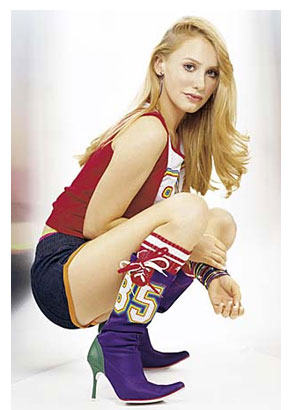
But now, courtesy of Epic Records, comes Sarai. Straight outta Kingston (Kingston, N.Y., that is, a middle-size town on the Hudson River). If the name — a bit too conservative, a bit too biblical — seems an ill fit for a rapper, feast your eyes on Sarai herself. She’s Britney Spears meets, well, just Britney Spears.

Once word leaked that a major label had signed a 20-year-old strawberry blonde as its hottest new rapper, the magic word “Feminem” began to be whispered in industry camps and music mags. With decent reviews in Rolling Stone and a full-page spread in the New York Post, Sarai indeed seemed Eminem-esque enough. Raised, like Slim Shady, by a relatively downtrodden single mother, she dabbled in lyricism and was discovered by small-name hip-hop producers at an Atlanta gas station. She soon found her way into the beats of Scott Storch, founding member of rap ensemble the Roots and producer for, among others, Christina Aguilera and Eminem himself. Storch told CNN.com that the first time he heard Sarai, he heard “something different.” She was “sort of hip-hop with a white female, and actually bringing it off like a real sister.”

A real sister. The word alone is enough to make a blue-eyed soul diva quiver with pride. It’s the compliment of all compliments, the stamp of authenticity for white artists venturing into so-called nonwhite musical domain. It’s long been bestowed on men who could claim “soul,” from Elvis to Justin Timberlake. But female crossover artists have their legacy, too. Think Sophie Tucker, a 1920s Broadway Yiddishe mama (sort of a female counterpart to Al Jolson) whom many, sight unseen, took for black. Think Janis Joplin. Think Rick James’ protégé, Teena Marie, deemed the “honorary soul sister” of the ’80s by Vibe magazine, or ’70s singer Laura Nyro, about whom Patti LaBelle said, rehashing what’s now a cliché, “She is a black woman in a white girl’s body.” More recently, think Nikka Costa, whose critically acclaimed album and its Aretha-esque single “Like a Feather” inspired one magazine to label her “some unholy amalgam of Janis Joplin and Teena Marie” (in other words, an honorary honorary soul sister).

Historically speaking, then, though more male white artists have built careers on the claim that their supposedly soulless pigment belied a soulful soul, there’s been a fair share (no pun intended) of female ones who’ve done the same. For every Eminem, there’s a Feminem. Right?

Not quite. The problem with this theory is, 1) Sarai is no Feminem, and 2) there will most likely never be one. That’s because our current notions about men and women and crossover don’t really allow for a white woman who’s as “authentically” hip-hop as Eminem proved himself to be — as authentically hip-hop, really, as the cultural guardians of all that is “true” hip-hop require him to be.

Let’s start with Sarai. Her album is titled “The Original,” and rightly so; it takes a real original to make hip-hop sound this bad. There’s an irritating reading of hip-hop — a remnant of the days when highbrow critics muttered things like “rap is crap” — in which the entire genre is dismissed as mere talking and beats. It’s an absurdly unfair claim, but Sarai is fodder for it. She has none of what’s known in rap as flow: vocal cadence that makes speech musical without turning it to song.

For most of the album — the this-is-me-and-here-I-am track “I Know,” the female empowerment jam “Ladies,” the potential single “Pack Ya Bags” — Sarai is content to talk her way through decent beats, garnish them with a “yo” or two, and top off with a sing-song chorus. It’s easy to pull a race card and call Sarai’s album musical affirmative action; it’s even easier to dismiss her as yet another novelty-as-selling-point act. But there’s no need to do either; the sheer staleness of Sarai’s music speaks for itself.

Yes, “The Original” bears the occasional tolerable track. On “Swear,” featuring small-name rapper Beau Dozier, Sarai manages to sound a tad like bold, buxom rapper Foxy Brown. “L.I.F.E” has a haunting chorus sung by underrated soul singer Jaguar (annoyingly, though, we never learn the meaning of the acronym). And “Ladies” is a true waste of a hot beat, fueled by a bouncing horns section. But while the genius of Eminem — and of countless other rappers, male and female — lies in their verbal dexterity, Sarai makes you wish she hadn’t included lyrics in her album sleeve. Here, for instance, is the lyrical gem that kicks off “The Original”: “I’m about to shock the world/ bring it to ya now/ jaws drop when you see this girl/ Big like whoa gotcha shook like I ain’t know.”

Whoa, indeed. Sarai’s lyrics boil down to four declarations. 1) I’m such a good rapper. 2) I shake my booty and you should too. 3) I’ve seen pain, thanks to bad men and bad ‘hoods. And 4) This one’s the kicker — I am all of the above despite being white.

Call it the Eminem strategy: Reference your own whiteness before critics do it for you. Reference it enough to render it benign. Remember the line that ushered Eminem into the world, the first line off one of his first big hits? “Y’all act like you’ve never seen a white person before,” he rhymed, sometime around the time he performed the song “White America” on the 2002 MTV Awards.

On and off record, Eminem had to address his whiteness. He had to produce a license to blackness, so to speak, and this meant sporting “white trash” like some badge of pride that substitutes class for race. It’s a delightful paradox, this white trash routine: Em, along with fellow white crossover acts Kid Rock and Bubba Sparxxx, imply that they’re so poor and so white they might as well be black.

Eminem (and, less so, the others) had to prove their “right” to tread on what’s been deemed nonwhite musical ground because a hostile public — its memory seared by the complex, vexed legacy of white appropriations of African-American musical forms — required them to. If Eminem won’t stop talking and rhyming about the 8 miles of his tough upbringing, it’s partly because a public that associates “authentic” rap with “black” and “ghetto” won’t let him. Uttered softly at first, anti-Eminem rhetoric (none-too-flattering comparisons to grand poseur Vanilla Ice, simplistic parallels with Elvis) was soon brashly overstated by hip-hop’s Bible, the Source magazine, which called him “part of a dangerous, corruptive cycle that promotes the blatant theft of a culture from the community that created it.”

But here’s where the Sarai-Eminem parallel really falls apart. Yes, Sarai’s songs offer a nod to the troubles she’s seen in “Kingston upstate New York/ Lil’ place up North where the style is raw” (population: 77 percent white; median income: $31,594). Yes, her hip-hop schmaltz tracks, “Mary Anne” and “It’s Not a Fairytale,” unleash TV movie- style sagas of teen pregnancy.

But unlike Eminem’s, Sarai’s persona is not built on being ultra-”real”, hyperhard or hip-hop to the bone; and she’s therefore unlikely to suffer the excoriation that Eminem did. “I’m a straight MTV baby,” she admits on her Web site, adding that she “didn’t start to fully experience hip-hop until the era of Biggie, Tupac, Nas and Jay-Z” (for the laymen, that’s the early ’90s and thus pretty late in the game).

Sarai doesn’t, as CNN.com put it, “pepper her talk with street slang” or assert that she’s a tried-and-true child of rap culture. She doesn’t look the part, either: Her blond tresses are no pseudo-Afro, and her publicity shots find her bereft of bling-bling. Sarai isn’t posturing herself as hip-hop’s authentic white incarnation, nor, unlike Eminem, is she being criticized for doing so.

She’s not alone in this. Unlike white men, white women crossing race-inflected musical boundaries nowadays are generally excused when it comes to proving street cred. When a white girl with plenty of attitude called herself Pink and delivered an album of straight-up R&B (sample lyric: “I don’t want no man with the bling-bling”), few suggested she wasn’t “real” enough for the genre, or that she was engaged in cultural theft. When Christina Aguilera decided to go Latin for a quick minute, learning Spanish and recording “Mi Refleja,” she didn’t have to produce some sort of Boricua pass; when she teamed up with rappers Li’l Kim or Redman and recorded hip-hop tracks, she didn’t have to prove she was “down” enough to do that, either.

These crossover white women pull off the near impossible: They’re musical chameleons, crossing generic boundaries in a way that makes them — gasp! — difficult to classify. Back in 1990, N.W.A. rapper Eazy-E unleashed a white protégé named Tairrie B., who was deemed the Madonna of rap; in the blink of an eye, she turned to heavy-metal goddess. Princess Superstar is now part hip-hop, part dance-raver; Northern State are femme punk with a dash of hip-hop. Pink morphed from R&B diva to punk-rock skate chick, collaborating with hardcore outfit Rancid and sharing venues with rock act Linkin Park.

On her latest album, Beautiful, Aguilera alternately displays the crooning of an alterna-chick (“Beautiful”), the prowess of a punk rocker (“Fighter,” with guitar by Dave Navarro) and the tough sneer of a hip-hop diva, complete with booty shaking, rap-star collaborations and such (“Dirrty”). “I got a chance to show off all those colors and textures of my love of music and of my vocal range,” X-Tina gushed to MTV.

For an album, then, or even a track (Blondie’s Debbie Harry, No Doubt’s Gwen Stefani and Sonic Youth’s Kim Gordon have all dabbled in rap) white women are permitted to feature hip-hop; men, on the other hand, are expected to live it. For white women, hip-hop can be a style; for white men, it must be a lifestyle.

To some extent, this is a case of gender trumping genre and race: Women of any sort have a hard time transcending sex-toy status, convincing the world that their musical skill is more than some fashion or style they slip in and out of for pop America’s viewing pleasure. It’s hard to imagine even a black female rapper being marketed as, say, the female 50 Cent, sporting a nine-bullet halo and declaring herself harder than an algebra equation. A woman — especially a black woman — who is that “real” is also far too emasculating to please any male audience: black, white or other.

But the truth is, on a smaller scale and via a different set of rules, even black women rappers-cum-sex symbols like Trina, Da Brat or Eve are expected to hold it down for the streets, to maintain “hard” personas and gritty “realness.” Those like Missy Elliott and Lauryn Hill, for instance, who have eluded such expectations and proved genre-defying (and, in the process, enormously creative), seem the exception, not the rule.

Authenticity, hardness, street supremacy: This is masculinity’s trinity, yet to a lesser extent, it’s also a standard for black women in the rap game. But white women? They’re especially unlikely to get away with being so utterly unsoft, which means they’ll never quite embody hip-hop the way their male counterparts do.

And that’s why “Feminem,” alas, is a pipe dream. Musically speaking, women have been too chameleon-like to embody “authentic” rap music, to represent it in the way the real Slim Shady does. No one expects them to, which is most likely why Sarai’s background isn’t scrutinized the way Eminem’s or even Vanilla Ice’s was — and why hardly anyone’s going to raise a fuss about some white female rapper stealing from black music and black culture.

Sarai (and others like her) are likely to merit a condescending smile and a pat on the head instead of a high-profile protest. There can be no Feminem because tomorrow Feminem might wake up and be Metallica or John Mayer. And hardly anybody would feel surprised, upset or betrayed by the transformation.

In the case of Sarai, I’m actually gunning for such an evolution, because it might produce something more tolerable than what’s there now. I’m hoping it happens before a Sarai single finds itself in heavy radio rotation. Especially if that single is “Black and White,” a song that embodies the only inherently offensive trend in white rap. “More than you see, more than skin and bones/ more than blood more than flesh I’m soul/ Yeah it gets rough being the minority’s tough,” rhymes Sarai, lamenting because her race makes “me and my roommate stand out in the complex” and thereby indulging in what can only be described as a white victim complex.

Spare us, Sarai. The only thing more tiresome than persistent reference to whiteness is persistent hallucination about whiteness as liability. Take your cue from the blue-eyed soul acts that came before you and use this so-called liability to your advantage. No one expects you to be the real deal. So make like Pink or Christina and evolve.

Continue Reading Close

Top Dogg

Inside Snoop Dogg's growing empire, where the hip-hop mogul enjoys his wine, women and bong. But can he outrun his gangsta past?

  • more
    • All Share Services

Top Dogg

Snoop Dogg is backstage at “Late Night With Conan O’Brien,” and he’s cradling a little blond boy in his arms. The boy is comedian Andy Richter’s son, and Richter’s wife wants a photo of him with the world-famous hip-hop star, the man synonymous with the term “gangsta rap.” Snoop — who’s making talk-show rounds to promote his latest album, “Paid Tha Cost to Be Da Bo$$,” and his MTV comedy sketch show, “Doggy Fizzle Televizzle, ” which wraps its first season this month — scoops up little Richter. It’s a shot for the family album: Snoop, in Converse sneakers and baggy Snoop Dogg Clothing sweats, with a little white boy in a wide-eyed grin.

Later, Snoop poses for another camera. Slumped in Conan’s hot seat, he details the burgeoning conglomerate that is Calvin Broadus, aka Snoop Dogg: his clothing line; his DoggyStyle Record label; his soul-inflected recent album and his first love song, the hit single “Beautiful.” There’s Doggyland theme park, soon to open in Mississippi, and the special-order Snoop DeVille, a mink-seated Cadillac low-rider (which he deems “fit for a pimp”). There’s “Doggy Fizzle Televizzle,” in which Snoop mesmerizes a first-grade class with Iceberg Slim as if it’s Doctor Seuss. When Conan whips out a Vital Toys Snoop doll, the rapper interjects. “Not a doll. An action figure,” he declares, adding that his boys like to pit him against Batman and Robin.

Next, Conan jokes about a certain sweet scent that, back in the day, emanated from Snoop’s dressing room, but the rapper is deadpan. Quitting his “thousand-dollar-a-day” marijuana habit in order to be a better coach to his son’s football team and a role model to his fans is, he insists, no publicity stunt. Snoop first told me he quit because one of his musical idols and close friends, Johnny Wilson of the GAP Band, told him to; days later he added, “It’s hard to have a clear head, to put in that quality family time, if you’re always high.”

The mantra coined by Snoop’s omnipresent publicist, Richie Abbott, goes like this: “Snoop’s for the kids.” I hear it often during our trip from L.A. to Las Vegas with Snoop, who’ll be ad-libbing prank phone calls as a guest on Comedy Central’s “Crank Yankers.” The tour bus is outfitted with strobe lights, black leather seats and bottles of Hennessy, but Snoop could care less. He’s holed up in the back of the bus with fast food, a Kung Fu video and PlayStation.

In the “Crank Yankers” studio, Snoop enjoys the wholesome mischief of prank calling, keeping us in stitches, after the job is done, with calls to friends like Dennis Rodman. He’s almost too soft-spoken to pull off a prank: When words like “bitch” (or, in his slightly Southern twang, “bee-atch”) slip sweetly from his lips, Snoop might as well be murmuring “baby.”

But as the show’s team scribbles prompts on poster board, holding them up as guides for Snoop while he makes his calls, I wonder if they’ve been informed that Snoop is now “for the kids.” For one skit, Snoop is instructed to phone a high school principal and tell her he’d like to lecture students about drugs. Following the principal’s stunned initial response — “You want to come here? To our little town?” — staff scribbling begins. “Ask about the weed she likes,” reads one poster board. “Can she let you hand out rolling papers?” “Gin and juice?” “School gangs?” “How’s her butt?”

After two hours in this sea of gangster clichés, Snoop is transported from the studio in a swarm of bodyguards who can never leave his side — especially at the local mall, where Snoop decides he wants to meet the saleswoman he’d prank called. The shopping spree becomes a quasi-riot when word spreads that Snoop is in the vicinity, and the shop owner closes his gates as Snoop models Roca Wear jackets. Crowds gawk through the iron gates as if ogling the top attraction in a zoo.

Hoping to make Snoop’s son’s afternoon football game, we finally file into a homeward-bound bus. Snoop tries to wander off.

“Where do you think you’re going?” one bodyguard calls after him. Snoop keeps walking. “Over there,” he says with a frustrated sigh, pointing at the McDonald’s across the road.

“Not alone, you’re not!” comes the reply, as it seems to have come many times before. Faster than you can say “Big Mac,” Snoop’s security team are on his tail. They’re always on his tail. They were on his tail in April, when — for the third time in his career — Snoop found himself in the line of fire, the target of a loaded gun.

As Snoop’s long, lean figure disappears in the dawn, a timeless question springs to mind: Can an old Dogg learn new tricks? Once upon a time, Snoop was gangsta rap’s golden-tongued child. His mesmerizing delivery, so tranquil it could rival Mr. Rogers’, belied its subject matter: juice-and-ginning, Crip walking, the bitch in his bed last night. His brand of hip-hop — its images of young black men in low-riders, sporting gang colors and proclaiming “fuck the police” — first put South Central Los Angeles on the musical map in the late ’80s, then rode the wave of ’90s culture wars by prompting FBI warnings, nationwide boycotts, and courtroom dramas. A decade after gangsta rap’s heyday — after Snoop’s “Doggystyle” sold 802,000 copies in its first week and was the first debut album to ever enter Billboard at No. 1 — the 31-year-old Snoop, declaring himself a family man, tries out a public rebirth. But with five albums, a gangsta-hungry fan base, and a real-life gangster history, can a gangsta rapper really move on?

—————————–

There’s a knock at the door of Snoop’s dressing room at “The Jimmy Kimmel Show,” where Snoop is co-hosting for a week. No one wants to answer because everyone knows who it is: theater security, requesting yet again if, please, could Snoop’s people put out the blunts, please? The smoke has drifted down the hall.

There’s smoke for every inhaler in Snoop’s sizable, wide-ranging entourage: old friends from his hometown, Long Beach, Calif., many of whom work in one form or another for DoggyStyle Records; a coterie of middle-aged, silk-shirt-wearing avuncular types with names like Uncle Charlie Wilson and June Bugg (who’s actually Snoop’s uncle); at least a handful of bodyguards, some of whom have been with Snoop almost a decade. Midriff-baring ladies keep all the men in rollicking moods.

In the corner of the room, oblivious to the hubbub surrounding him yet somehow defined by it, is Snoop. He’s having his hair braided by a woman who materializes every time Snoop needs a new look, which is often: The rapper travels with an inexhaustible supply of sweat suits and Converse sneakers. One eye on me, the other on his PlayStation, Snoop answers questions efficiently, as if he’s been well trained by publicists over the years. He sums up his evolution neatly: “In 1993 I was restless. I had no cares, no kids, and I was enjoying the limelight. 2003 is about my kids, my wife, my bettering myself, and trying to be more of a role model.”

His friends are excited about this evolution. They say he’s the same-old Snoop, just older and wiser. “Quitting weed? That ain’t no image change. That’s positive change for his health,” says a singer called Lil’ Half Dead, who’s known Snoop since childhood. Rapper Kam, also a longtime friend of Snoop’s, nods. “He’s an institution now, not an individual. Whether we want it or not, we’re role models.” His wife Shante — who began dating him after he walked up to her at a high school football game and told her she was pretty (“Because there was just something funny about him”) — says football helped turn around Snoop. “Ever since he started coaching our son’s team, he’s just more devoted.”

After the Kimmel taping, Snoop, a little less pre-packaged, holds a blunt in his long fingers. And yes, he’s inhaling: Though he first quit cold turkey, Snoop now smokes on special occasions (and plenty an occasion seems special enough). When I tell him he makes a good talk-show host, he’s all ears. “You think so?” Snoop asks, almost breathless. I suggest it’s because he’s a tolerant guy who can calmly take in varied personalities — even ones like Tammy Faye Baker, Kimmel’s guest tonight. He stares at me for a moment, in rapt attention. “I like her,” Snoop nods. He also likes Bill Clinton (“I miss you, Bill. Let’s make a record together,” he says), and insists the world needs more role models. “Who?” I ask. Snoop stares again. “Me,” he replies softly, as if the question were rhetorical. “I’ve seen a lot. I can be a leader.” But what, I continue — he’s glowering at me now — about headlining L.A.’s annual pro-pot concert last November, or being named High Times’ “Stoner of the Year”? What about lyrics that still find him, “gin and juice in hand,” Crip-walking up a storm?

Snoop is suddenly that L.A. archetype, a reformed gangster. “You gotta understand that people can relate to it because I actually lived that lifestyle, so it’s not a preach-and-teach routine. I can make people say, ‘Well, I don’t have to do it because Snoop did it for me — and I see the results of him doing it but also the results of him doing better.’”

America — a country built by Puritans who were fixated on reform — has long loved converted sinners. It adores, too, bad boys with soft spots — which is probably why a rapper’s most fashionable accessory these days is a child. Eminem’s high-profile daughter Hailie represents our rebel’s ultimate goodness, his potential for reform.

Snoop’s favorite song on “Paid tha Cost to be Da Boss” is “I Miss That Bitch” — in which said “bitch” is marijuana — because “when I wrote that song, I was really missing weed bad. But I knew I could quit.” Asked to describe himself in a word, he offers three: “standup kinda guy.”

Only “Jim Henson’s Muppet Christmas Special,” which Bill O’Reilly’s fuss got him edited out of last year, seems to hit a chord. “I can’t believe [O'Reilly] did that, and he let millions of kids down,” he says quietly. “They love me.”

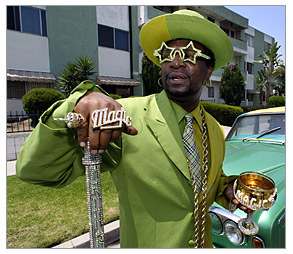
Snoop turns away in disgust, passing the blunt to his “spiritual advisor,” Archbishop Don “Magic” Juan. Juan, sipping from a bejeweled goblet and wearing a white suit with a dollar-bill pattern, is a former pimp who earned ordination. Decked out as Dolemite, he’s the rapper’s unofficial mascot.

“Snoop is calmer now, baby,” Juan shouts at me above the din, waving smoke from my eyes with a gold-encrusted hand. “Millions have seen it. They saw it at the Playboy mansion, when we visited there together. His family life has improved, and he’s reaching a spiritual level that he couldn’t reach before because his brain was clogged up with weed and alcohol. That’s why his career is taking off the way it is, why he’s touring with those — what’s their name? — Hot Chili Peppers, and with 50 Cent.”

Juan helped Snoop prepare for his role as Huggy Bear in the upcoming remake of “Starsky and Hutch,” starring Owen Wilson and Ben Stiller. Says Snoop, “The music side is so natural for me — it’s creative in the natural sense. But the movie thing pushes me. It drives me to become another character, to do things I might not do.” Snoop has already flexed his gangsta muscles in John Singleton’s “Baby Boy” and smoked chronic alongside Dr. Dre in “The Wash.” The latter is an over-the-top comedy about South Central L.A. that, like Ice Cube’s recent “The Friday After Next,” is starkly different from what critics called “new black realist cinema,” which pervaded Snoop’s early days in rap: “Boyz n the ‘Hood,” “Menace II Society,” and “Poetic Justice.” At the film premiere party for “The Friday After Next,” food was served by jovial waiters sporting gang-style bandannas.

Between inhales, Juan is still talking. “Everybody’s always pullin’ at Snoop Dogg, but I try to do for him. I go get him things, like a fish fillet — I know he like that. Orange Crush — he like that, too. And because of my association with Snoop, I’m taking myself to new heights. Like — and you print this — I’m the first pimp William Morris ever signed!”

In videos and songs with titles like “P.I.M.P” and “Pimp Juice,” in a VSOP liquor commercial, Snoop and Juan have lately been inseparable. Describing himself on one album track as “Snoop Hefner mixed with a little bit of Dogg Flynt,” Snoop also does ubiquitous solos in college-as-bacchanalia cinema — “Girls Gone Wild: Doggystyle,” a DVD advertised on the E! channel, as well as “The Real Cancun,” reality television’s big-screen debut. He sports lavish furs and a pimp’s cup, hamming it up in Rabelaisian glory.

In person, he’s sometimes in blaxploitation mode: Big Snoop Dogg, whose verbal ticks include lines like “you got’s to do it!” and “the game is calling me, baby!” and who uses the suffix “izzle” to produce a lexicon of slang (as in, “for shizzle, my nizzle,” loosely translated as “for sure, my man”). During my first encounter with him, Snoop drove up in a blue Porsche, wearing the sort of incognito getup — a colorful headscarf and enormous sunglasses — that hides little, especially on a 6’4″ celebrity. Unfurling himself from the car, Snoop gave me the once-over, licked his lips, and sweetly purred, “Where are you from, baby girl?”

“Personally, I don’t care too much for that side of him, but hey, if it floats his boat, it’s fine,” Shante says of her husband’s Superfly routine. “I just don’t get it — all the weird clothes and bright colors. I’m tolerant, though. Snoop tells me that every day.”

Shante may be married to Calvin Broadus but she’s also married to Snoop Dogg — who has both enemies and permanently affixed bodyguards. Snoop’s security team won’t say how his three L.A.-area homes are protected, only that they are protected. “Sometimes I think, Can’t we just take a trip to Disneyland, just the five of us, and not have all the security? But that’s just the lifestyle we live. Even the kids are used to it now,” sighs Shante.

Security is something other gangsta rappers know well. “A person like me with a past like mine — I live in a weird state of paranoia,” says Ice-T, one of the first gangsta rappers and a former pimp. Speaking with professorial gravitas about “the science of the gangster,” Ice-T — now 43 — sits in his Manhattan high-rise, nostalgic for his Crip-walking days, compulsively miming the gang dance that Snoop’s rhymes made famous. “I guess I’m what you would call hyper-sensitive, like a cat or predator in the jungle. I see everything. My instinct is the only thing that’s gonna keep me alive. I have a nice street level of fear that I turn into awareness. I call it being on point. I don’t get high, because I always want to be alert. You’ve got to be ready for whatever.”

Late last year — when Snoop first started talking reform, when it hit home that Ice-T had gone from peddling drugs in Compton to peddling “Posse Pops” ice cream — many heralded the triumph of time and money over something America once shunned: gangsta rap. A genre of hip-hop born in the late ’80s, gangsta rap — which some prefer to call “reality rap” — sprouted first on the East Coast with artists like KRS-One, then blossomed on the West Coast, where two acts took it national: Ice-T and NWA, or Niggaz With Attitude. Their 1988 album “Straight Outta Compton” — too controversial for MTV or radio — went triple platinum, established the theme and funk-backed sounds of the genre, and sent five teenagers from Compton to stardom: Andre Young (Dr. Dre), O’Shea Jackson (Ice Cube), Lorenzo Patterson (MC Ren), Eric Wright (Eazy-E), and Antoine Carraby (DJ Yella).

At its best, gangsta rap sustained the tradition, reaching back to ’70s political poets like the Watts Prophets, of voicing the young, poor, and black in L.A. At its worst, it devolved into tawdry trappings of gangsterism — misogynistic, violent posturing whose redeeming value was its putative realism — or meta-rap, which didn’t say something profound, political, or controversial but kept asserting that it could do so.

In 1992, a former bodyguard from Compton, Marion “Suge” Knight, secured backing from Interscope Records to establish Death Row Records, which immediately signed Dr. Dre and his protégé, a young rapper from Long Beach named Snoop Doggy Dogg (he’s since dropped the “Doggy”). Like his favorite rapper, Slick Rick, Snoop wrote rhymes that were often comic; his moniker evoked a cartoon, not a cartel. But though Knight liked to think of Death Row as the Motown of the ’90s, squeaky-clean Motown made black performers presentable to white audiences while Knight and Death Row generated over $100 million a year doing the opposite: Knight supposedly encouraged his legendary trio — Dre, Snoop and Tupac Shakur — to play up their gangsterism in every verbal and visual way possible.

This stoked the ire of Bob Dole, William Bennett, and C. Delores Tucker, of the National Congress of Black Women. In 1993, Tucker feasted her eyes on lyrics from “Doggystyle” and launched a crusade against Snoop and gangsta rap. Her 1994 statement in Sen. Carol Moseley-Braun’s Senate hearings deemed Snoop’s music “pornographic smut”; in 1995, her hullabaloo — and hefty chunk of company stock — succeeded in getting Time Warner to dump its share of Interscope, Death Row’s distributor. Snoop was, as Tucker put it in a recent phone chat, “committing genocide on our children, and I had to stop him.” Snoop is now Tucker’s victory medal. “They’re stopping all that gangster business now. Rappers are turning gospel,” she asserts.

Gospel? Not quite, but Tucker has a point. Dr. Dre, mastermind of “The Chronic,” an album that is to gangsta rap what “Ulysses” is to modernism, has long denounced any association with the genre; he’s now the legendary producer behind today’s top two rap acts, Eminem and 50 Cent. Ice Cube, who voiced the ire of Rodney King’s L.A., who once added a verse to rap group Public Enemy’s “Burn, Hollywood, Burn,” is — thanks to the hit movie “Barbershop,” which grossed more than $80 million, and his Cube Vision Films — Hollywood royalty. Ice-T has gone from singing about a “Cop Killer” to playing a cop on “Law and Order: SVU.” Only Snoop still calls himself a gangsta rapper.

At a taping of MTV2′s roving “$2 Bill tour” in Louisville, Ky., fans have lined up to see this gangsta rapper. The diverse crowd is the sort that MTV manufactures: old and young, black and white, industry and non-industry. Snoop takes the stage in a red football jersey and gray sweats, backed by a live band and backup singers who exhibit the more mature, soulful side of his new album. Snoop never sweats. In his signature style, he calmly ambles to and fro, enunciating rhymes as if conversing with his audience. Then Snoop begins a sentence with, “Now that I’ve quite drinking and smoking.” The audience boos; Snoop sighs. He revises his statement: “OK, OK — I still drink and smoke.” The crowd roars. Among them is a blond girl in a Kangol hat and low-cut sweater, who joins Snoop in a merry chant of “Fuck the police.”

At the Snoop Dogg Clothing Co. warehouse in Manhattan’s fashion district, head designer Guka Evans showcases the spring line. He lays out several oversized plaid shirts, matching khakis and two basketball-style jerseys. “These are the two Snoop personalities: the West-Coast casual aesthetic, and the more aggressive, athletic feel. During our first season, the retro-West-Coast look was the biggest seller,” Evans explains. There’s a tank top with “pimp” across the chest and a “Snoop All Stars” top that reads “Hoopdog.” Among the rejects is a shirt with “1-8-7″ printed on it; it’s inspired by Snoop’s duet with Dr. Dre, “Deep Cover,” about putting “1-8-7 on an undercover cop” (the municipal code for homicide). Designers had the shirt reprinted with “2-1-3,” instead, which is the Long Beach area code and the name of Snoop’s first rap group. “We didn’t think Macy’s would be too happy with that one,” says CEO Michael Cohen, pointing at the reject with a nervous laugh.

No one was laughing on April 10, when Snoop was driving his brown custom Cadillac (“brown sugar,” he calls it) south on Fairfax Avenue in L.A. and a northbound sedan fired nearly a dozen shots in his direction. They missed Snoop, but a bullet grazed one of eight bodyguards trailing him in five surrounding vehicles. An anti-gang LAPD unit heard shots and arrived on the scene; after questioning, Snoop was carted off safely in an armored vehicle. Either because it was utterly in line with the same-old Snoop — or puzzlingly out of line with the new-and-improved one — the incident remained relatively low profile, and no arrests were made.

According to Juan, whom Snoop had been visiting that night, the shooting was a product of young boys who tried to approach Snoop and were brushed aside by security. Rumor mills produced a juicier suspect: Suge Knight, gangsta rap’s longtime scapegoat. Knight and Snoop have been publicly feuding ever since Snoop left Death Row in 1998, while Knight served a five-year jail sentence for various parole violations. Snoop insults Suge on “Pimp Slapp’d,” a track from “Paid tha Cost” that includes cameos by an L.A. gang leader who has since filed a lawsuit against Snoop for sampling his voice.

“I have no hate for Bloods, just one particular fake-ass Blood,” says Snoop, referring to Knight. He claims Knight egged him on, plastering his face on the cover of an album titled “Dead Man Walking,” even promising a car to the man who’d cut Snoop’s hair. After the April shooting, a Web site for Death Row, now called Tha Row Records, featured Snoop, the sound of gunshots, and a whimpering dog.

“Snoop don’t threaten me or nobody on my label,” Knight told me at a charity Mother’s Day brunch he throws annually in Beverly Hills. “I mean, we never see the guy. He don’t come out, and if he do come out, the people don’t feel him. They don’t respect the simple fact of who he is, because every time he come out he gets shot at. And if he do go out, it’s like a million police, or, for him to go to the restroom, 20 people gotta walk with him. That’s not living.”

At a magazine shoot in New York, Snoop insists on featuring a “Fuck Simon” T-shirt (Simon is a nickname for Suge). Uncle June Bugg, busy trying to chat up any woman at close range, doesn’t seem to notice; Abbott fires off frantic two-ways; Snoop’s bodyguards, slumped in chairs like exasperated parents, can only roll their eyes — just as they did when Snoop blasted “Pimp Slapp’d” in his Vegas hotel room.

“Artists shouldn’t get into feuds if they’re just doing it for sales, because they should be able to deal with the repercussions,” Knight declares, wiping a bead of sweat from his brow. “They shouldn’t listen to the executives because while executives are at home, watching TV or playing golf somewhere, these guys are trying to hang out in clubs, and that’s when the feud starts, and it’s real life.”

Knight puffs on his cigar. “So I think they should be careful what they say, or if they say it, they should mean it and deal with it — and when you have to deal with it, stop calling the police. If you have a problem, be able to roll by yourself. You shouldn’t have to be saying ‘we, we, we’ all the time. If you cut out all the extra fat, most people would stop talking their mouth so much.”

At the magazine shoot, an onlooker attempts to explain the Suge-Snoop enmity. “Snoop’s a Crip,” she says, pronouncing the word with awe. It’s the routine performed for a gangsta-curious public: Is he or isn’t he?

“Snoop was a rapper. He wasn’t into gangbanging — it was nothing like that,” says Snoop’s first bodyguard, McKinley “Malik” Lee. “He sold weed, he went to jail a few times, but he wasn’t some big gangster. Snoop was a character. He was comical, a ladies man, a player. He wasn’t anything like the music. Matter of fact, I couldn’t understand why he chose to take his music that way.”

Growing up on 21st Street in Long Beach, Snoop sang in the church choir and listened to music he still loves: Al Green, the Dramatics, Curtis Mayfield. At Long Beach Polytechnic high school, recalls longtime friend Nate Dogg, “I’d beat on the desk and Snoop would freestyle.” Snoop, Nate, and Warren G formed the rap group 213 and eventually got successful producer (and Warren’s older stepbrother) Dr. Dre to give their demo a listen.

“Snoop was funny and he made me laugh, but the guys he hung out with — I didn’t like them at all. So I told him I wouldn’t go out with him at first,” Shante recalls. A month later, she says, Snoop was back at her door a changed man, no longer hanging around the Rolling 20 Crips. His music, though, was awash in Crip talk, which was enough to turn debut video shoots into anti-Snoop mini-riots, especially — as was once reportedly the case — when they were filmed in Blood neighborhoods and Snoop wore Crip-style blue.

“The people he grew up with knew the reality — that he wasn’t Cripping like that — but others didn’t,” says Lee. “You reap what you sow. You speak it into existence.” After Snoop’s debut on “The Chronic” made him famous, Death Row installed him and Lee in small apartments that Knight owned in the working-class Palms district of L.A. It was an attempt to keep Snoop from harm’s way — and it failed. Here’s the popular account of what happened in August 1993 at a park near that apartment: Gangsta rapper Snoop Dogg showed authentic Crip colors when he and his bodyguard feuded with a 20-year-old rival named Philip Woldemariam, who was killed. Snoop landed on the cover of major music magazines. Death Row happily surrendered to the marketing frenzy, recording a video for the eerily appropriate Snoop single “Murder was the Case.” “Doggystyle” flew from record stores.

The account given by Paul Palladino, the private investigator who got Snoop and Lee acquitted, is far less glamorous. “It wasn’t a gang dispute — the case was much more complicated than that,” he explains. While Snoop and Lee were inside Snoop’s apartment, which was known to house the rap star, Woldemariam and friends — drug dealers with a paranoid theory that Snoop would usurp their business — threw gang signs at a coterie of Snoop’s friends who were loitering in front of Snoop’s building. Later that day, when Snoop was driving his SUV to the studio with Lee beside him, Woldemariam and crew flagged the car down, approached its passenger side, and pulled a gun; in self-defense, Lee fired and Woldemariam was killed. Ironically, Snoop’s lyrics, which had created his gangsta identity, were cited at hearings as proof of this very identity.

“Everybody on the streets was saying it was gangster this and gangster that, but it had nothing to do with gangs,” says Lee. “If that trial wouldn’t have happened, though, Snoop’s album wouldn’t have dropped the way it did. ‘Murder was the Case’ was recorded two years before the shooting ever happened.”

Lee claims that the April shooting was prompted by Snoop’s presence in the very neighborhood of “the deceased,” where Snoop still has enemies. “Of course there’s still beef! A life was taken, and to people in the streets, Snoop Dogg did it. If there was peace made, it’s one thing, but there was never any closure — it was never spoken on righteously. Snoop needs to call a meeting, a press conference, and say that that murder wasn’t about gangs, say to the family, ‘Hey, we didn’t even know who your son was.’”

But in Snoop’s vision of the universe, he’s moved passively along by a larger-than-life force. “I’m a child of God and I walk in the right way, so I’m not worried. If something is gonna happen, God’s gonna make it happen,” says Snoop, asked if he felt afraid in 1995, when he and his bodyguards fled from gunshots at a video shoot in New York — or if he feels afraid now.

“When the [April] shooting happened,” says Shante, “I got kinda down — like ‘How come we have to live like this?’ It’s like, he had a dream and he wanted to fulfill it and it’s fulfilled — so what do you do now? I just pray.” She remembers the day after the shooting, when Corde came home from private school upset. “He said, ‘Mom, why does everyone keep asking me if Dad’s OK?’”

We’re waiting on Snoop at a small house in the Valley, where he’ll shoot a segment for one of his final Jimmy Kimmel appearances. Crew members are discussing last night’s show, which featured Snoop and the rapper he toured with this summer, the enormously successful performer credited with the recent East-Coast rebirth of gangsta rap: 50 Cent. “Is Snoop a real gangster?” one staffer asks me. Before I can respond, another staffer interjects. “You know who’s a real gangster? That 50 Cent.” All nod in reverent silence.

Several bodyguards arrive at the house; others arrive later with Snoop, who’s running on what Abbott calls “Snoop time.” One bodyguard regales me with stories of his trip to Brazil, where Snoop was shooting the video for “Beautiful.” The video has a different aesthetic from Snoop’s previous video, which served up gangsta delights: blue bandannas, low-riders, and an abusive LAPD officer. The bandanna, however, was worn by a Snoop doll; the low-rider was an outrageous Snoop DeVille; and the officer a comic dwarf. If 50 Cent’s aesthetic is “real,” used as an un-ironic epithet even in a post-postmodern era (“50 is real, so he does real things,” reads his Web site), Snoop’s is so deliberately artificial it’s camp.

Lil’ Half Dead arrives with Snoop. He’s fresh out of jail and says he sometimes has to drive around the block before entering his own home, because he’ll always have enemies.

“No one, including Snoop, wants to live the kind of life it would take to truly be safe. He’d have to never bring old homies around, because it’s usually the friends who end up starting all the drama,” Palladino had told me, recalling a scenario early in Snoop’s career when Snoop, arrested for firing road-rage shots at a police officer who took down his license plate number, was released upon discovery that Snoop’s friend — driving Snoop’s car — was the one who’d fired the shots. “I told Snoop, ‘With friends like that, you don’t need enemies.’”

Later that day, when I ask Snoop what he’d change about the music industry, he turns melancholy. “The untimely deaths,” he says, stone-faced. One such death is that of Snoop’s friend Tupac Shakur, a gangsta rapper who was one-part political poet and one-part gangsta posturing. This latter part earned him the enemies who were his tragic undoing. Unidentified gunmen murdered Tupac in Las Vegas in 1996, but he still sells records, containing songs recorded before his death; he still appears, saintly as ever, in nostalgia-ridden music videos. He’s the embodiment of Robert Warshow’s famous essay about the gangster archetype in American culture, which claims that because the genre must culminate in a fatal climax, one can only be a true gangster in art or in death.

“If you want to leave it all behind, you have to sever ties with the past, really,” says Palladino. “Suge couldn’t do it, and he still won’t. How can you do that when you’re under enormous pressure to stay true to the streets?”

Russell Simmons, chairman of Def Jam Records and one of hip-hop’s most high-profile spokesmen, says it can be done. Recalling a recent vacation he took to St. Bart’s with platinum rapper Jay-Z, Simmons is wistful. “Here’s a kid from the projects on my boat, loving life. He doesn’t want to be involved in shoot-ups. He’s grown past that.” Simmons claims that even today’s most successful live gangster, 50 Cent, can also grow past it, and still maintain his fan base. “Hip-hop is defined by change,” he insists.

Back in the Valley, Snoop is ready to be filmed. With his Long Beach buddies milling about, Snoop shoots a short skit in which he’s having a garage sale, peddling bongs, hash brownies, and other such stoner paraphernalia. Actual neighbors line up to buy them. Then they watch in awe as Snoop, lost in a whirl of bodyguards, zips back to Hollywood.

Continue Reading Close

Page 2 of 2 in Baz Dreisinger