Con Chapman

Frustrated writers save New England from flood

Who needs sandbags when you've got unpublished manuscripts to sop up the water?

  • more
    • All Share Services

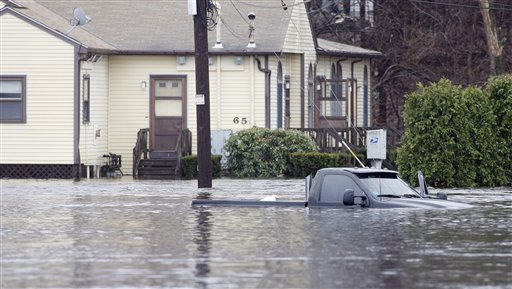
Frustrated writers save New England from floodAn abandoned truck sits in flood water on Industrial Lane in West Warwick, R.I.,Tuesday, March 30, 2010. The Pawtuxet River is predicted to hit a record stage of 17.5 feet, eight feet above floor stage. (AP Photo/Stew Milne)(Credit: AP)

SEEKONK, Mass. When Armand St. Stephen, a recent graduate of Tulane University, heard that New England had been inundated with unprecedented spring rains, the New Orleans native who survived Hurricane Katrina decided to do something about it. “It’s not enough to do a heckuva job,” he says, recalling former President Bush’s premature praise of FEMA Director Michael D. Brown. “You’ve got to do a helluva heckuva job.”

Brown:  “We can appease the weather gods if we give them Baton Rouge.”

So St. Stephen, who earned his degree in creative writing, called up the Army Corps of Engineers and suggested a new and unlikely source of raw material: unpublished manuscripts by writers across America.

“When you mix a 400-page coming-of-age novel with a little flour, water and glue, you get a substance that makes a pretty darn good flood prevention device,” said Chief Engineer Warren Lamont. “Of course, it looks like an elementary school science project, such as ‘How a Volcano Works’ or ‘When Dinosaurs Walked the Earth’, but we’re not in the landscape gardening business here.”

Federal Writers Project workers pretending to work

The idea of linking unpublished writers with reconstruction efforts has a Keynesian “multiplier” effect, according to David Simon, an economist at the University of Massachusetts-Seekonk. “If we can get underemployed writers — and believe me, they’re all underemployed — to crank out a short story collection at prevailing wages, then use it to fuel a waste-to-energy plant, we will ease unemployment and cut our dependence on foreign oil.”

Faulkner:  “Thanks to my Nobel Prize winnings, I can afford to maintain my savage tan.”

St. Stephen is currently working on a three-volume family saga in the manner of William Faulkner’s Yoknapatawpha County novels. “It’s a stream of consciousness novel told through the voice of Darrell Suggins, the feeble-minded product of inbreeding between the offspring of a morganatic marriage between a scion of the old Southern dynasty and a syphilitic prostitute,” he says. St. Stephens provided this reporter with a sample dependent clause from a sentence of his work-in-progress:

Yoo-Hoo Chocolate Soda Family Pack

. . . and it was not the knowingness or the beingness between the two who were the issue or the effluvium of their polar opposite forebears who yet shared the sameness and the oneness of the South yes the South with its crape myrtle and Yoo-Hoo Chocolate Soda and lightning bugs even though the drinking fountain yes the drinking fountain at Sonny Tufts Park in Atlanta had been shared yes shared by them illicitly and implictly even though serially and even though one was white and one black.

St. Stephen has been unable to find a publisher for the tome, and will ship his manuscript in three semi-trailer trucks to a processing plant in Shirley, Mass., where it will be mixed with uneaten fish sticks from the cafeteria at Bernie Carbo Junior High School to give it more substance.

Bernie Carbo

Other writers with specialized literary talents are excited about the program, and eager to participate. Dorothy Danville, an author of romantic novels disparagingly referred to as “bodice rippers” in the industry, has donated a 500-page draft of “Love’s Conquering Climax” to the cause, after trying for several years to sell it to Harlequin Books. “Ms. Danville’s works are very viscous, if I may use a 50-cent word,” said Dick Martin, Director of Public Works for New Bedford, Mass. “People are using them for caulking, tuckpointing brick structures and roof tar.”

Con Chapman, a Midwestern transplant to Boston, donated an unsold humor collection to Portland, Maine, which rejected the shipment when it failed to pass inspection. “Up here we like our humor dry,” said City Manager Floyd Oehrke. “Bounty, the Quicker Picker-upper, is more absorbent and frankly funnier than what this guy puts out.” 

On their way!

Chapman was undeterred, and said he would send a container-load of material from the Massport Marine Terminal in South Boston as soon as a ship large enough to carry it arrived in port. “And that,” he noted proudly, “will be just my rejection letters.”

RadioShack’s ZIP code hypocrisy kills merger

The company that demands your ZIP code for the mere purchase of a battery won't disclose its own to potential buyer

  • more
    • All Share Services

RadioShack's ZIP code hypocrisy kills merger

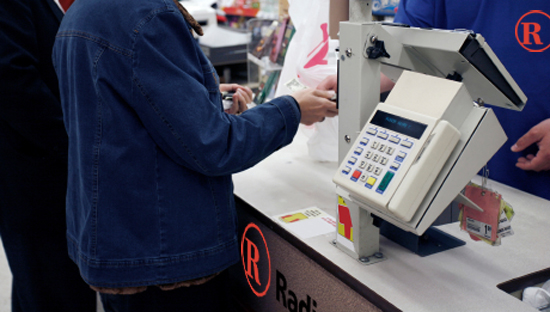
FORT WORTH, Texas. A rumored acquisition of RadioShack Corporation (RSHL:NYSE) sent the company’s stock higher on Friday, but the suitor walked away from the deal over the weekend when the consumer electronics company refused to disclose its ZIP code.

“Can I interest you in a remote-controlled drag racer with toothbrush?”

“Radio Shack can’t have it both ways,” said Judith Crowley of Cowen, Phillips, an investment bank that was prepared to finance the transaction. “If you buy a D battery from them, they have to know your ZIP code; if you want to use the ladies’ room, they ask your ZIP code.”

“You don’t have to be a geek to work here, but it helps.”

Radio Shack officials defended their reticence. “If we give out our ZIP code to every Tom, Dick and Harry, pretty soon people will start coming in all the time,” said COO Malcolm Natanel. “That’s going to cut into our employees’ ability to goof around with our remote-controlled drag racers, a benefit we offer because it’s cheaper than health insurance.”

RadioShack is, according to the company’s Web site, one of the nation’s most trusted consumer electronics specialty retailers, and it uses that trust to persuade millions of cash-paying customers at the company’s 1,300 dealer outlets to give up their ZIP code as a condition to buying its products. “For years there’s been speculation that the company’s sales associates use it as a way to find women, but that’s an urban myth, like albino alligators in sewers,” said industry analyst Tony Sopson of Mercer Securities in Atlanta. “Has anyone ever seen a Radio Shack employee leaving work with a woman?”

“It comes with a built-in lava lamp, but batteries aren’t included.”

Company officials would not rule out a possible sale in the best interests of shareholders. “Radio Shack will continue to explore strategic options,” said Niles Davis, a spokesperson. “What we won’t put up with is somebody asking a bunch of nosy questions.” 

Continue Reading Close

“College coach” canned after bummer SATs

Parents in an affluent Boston suburb are furious as rejections from top-notch universities roll in

  • more
    • All Share Services

WELLESLEY FALLS, Mass. In this wealthy suburb of Boston, parents will go to great lengths to ensure that their children get into a good college, even paying top dollar to “college coaches” who counsel the kids on their essays, SAT preparation, community service choices and overall application strategy.

“You’ve got to completely fill in the little oval with your #2 lead pencil!”

“It means so much,” says Marci Hallinan, whose daughter Courtney’s first choice was Mount Holyoke College. “Get into the right school and someday you’ll be able to buy a $1.3 million starter home,” says the perky blonde who supplements her husband Rick’s income by working as a real estate broker. “If you don’t, you may end up pushing a grocery cart through the streets picking up deposit cans.”

“If only I’d gone to Tufts!”

If Marci’s smile seems a little forced today, it’s because Courtney was not accepted from the “early decision” applicants to the prestigious women’s college and wasn’t granted “deferred” status to be considered as part of the regular applicant pool, either. “Flat-out rejected,” says Marci bitterly, and this reporter hears the sound of sobbing floating down from an upstairs bedroom.

“Just leave me to my broken dreams, okay?”

The scene was repeated across town as clients of college coach Ron Dilworth received the bad news from Stanford, Harvard, Emory, Washington University in St. Louis and Northwestern, among others.  “He got the big goose-egg,” says angry father Todd Dremke, whose son Miles applied early decision to the University of Chicago.  “O for 8.”

” . . . bare ruined choirs where late the dweeb nerds sang.”

At a cost of six to eight thousand dollars a child, a college coach can do quite well, but “the only thing that counts is your record,” says Norton Zeligman, who “ran the table” this year, getting his clients into Yale, Oberlin, Vanderbilt and Georgetown. “I feel sorry for Ron, but that’s the nature of the business.”

“Your essay should show you’re not just a grade grubber, you’re a well-rounded grade grubber.”

So Dilworth got the bad news this morning. He’s been sacked, asked to clean out his flash cards, and told that his services won’t be needed for the stretch run through the “early action” and general application deadlines. “I don’t think I was given the chance I needed to turn this season around,” he said at a sparsely-attended press conference at the high school guidance office. “I wish these kids the best of luck. Given their scores in AP Biology, they’re going to need it.”

“I’m looking forward to spending more time my family, and less with yours.”

Dilworth has no job offers at present, but hopes to catch on as a junior college coach in a less-affluent community. “Some of those schools will take a kid if he fogs a mirror held under his nose and the parents’ check doesn’t bounce,” he noted in his farewell speech. “Those are my kind of standards.”

Anti-bully law stalls as toughs pummel lawmaker

"I was a bully, and I want my kid to be a bully too"

  • more
    • All Share Services

Anti-bully law stalls as toughs pummel lawmaker

JEFFERSON CITY, Mo. — When state Sen. Bob Reisdorph, D-Pettis County, was a teenager, he was teased unmercifully by a boy whose name and face are etched in his memory. “Jimmy Dale Embree would wait for me to come out of Garst’s,” a ’50s-style drive-in restaurant in Sedalia. “Then he and his gang would throw ketchup packs at me,” staining Reisdorph’s clothes and, more importantly, his self-esteem.

Garst’s: Scene of the crime.

Four decades later, Reisdorph is fighting back the only way he knows how: by filing legislation to create penalties for bullying, and making “aggravated” bullying punishable by jail, with no ability to avoid prison by paying a fine. “We as a society have got to stand up collectively to bullies, since there are so many who are unable to do so individually.”

Bully’s weapon of choice.

The bill is the sort of feel-good legislation that ought to pass both houses of the Legislature in a breeze, as has been the case with similar laws in 27 other states. There’s just one problem: “Jimmy Dale Embree Jr.,” Reisdorph says, as he looks warily over his shoulder before dashing to his car, which is parked in a reserved space outside the state Capitol.

Reisdorph as a teenage bully magnet.

As the state legislator hits his stride, a reporter hears cries go up from a gang of young boys who have been hiding under the portico that runs along the front of the building. “There he is,” shouts one. “Get him!” yells another. They give chase, and as Reisdorph struggles to open his car door, they bombard him with water balloons before a member of the state police arrives, causing the boys to scatter.

Jimmy Dale Jr.: “Why do I do it? ‘Cause it’s fun!”

Reisdorph is the victim of what political analysts have dubbed “bully-lobbying” — grass-roots efforts to forestall, water down or even kill anti-bullying bills before they become law. “I was a bully, and I want my kid to be a bully too,” says Jimmy Dale Embree Sr., who is now a 55-year-old long-haul truck driver with a front yard filled with his prize-winning collection of rusted-out junk cars. “If we are going to prepare our kids to compete in a global economy, we need to teach them to be tough and resilient,” Jimmy Dale Sr. says as he spits snuff juice into a topless 7-Up can.

“If you file that bill today, your ass is grass and I’m a lawnmower.”

Child development specialists are unanimous in their support of anti-bullying measures, but former bullies have recently begun to challenge their methodology. “A lot of them don’t use statistically valid samples, and the guys who write them are — I don’t know how to put this any other way — dinks,” says Earl “Duck’s Ass” Bennett, who dropped out of Joliet, Ill., Central High School in 1959 and is now a loading dock supervisor for Central States Tool and Die Co. “When I confront them at academic conferences and express my concerns, they inevitably back away from their conclusions.”

“I can’t believe she called me a nimmy-not!”

All of which is fine with Reisdorph, who says he welcomes a robust debate on the subject when his bill comes up for its first hearing later this spring. “I want to hear all points of view,” he says with a nervous look on his face as pulls out of the parking lot, leaving Jimmy Dale Jr. and his gang in a cloud of gravel dust. “Just please — don’t let them stuff me under the Senate podium again!”

Continue Reading Close

Bin Laden blames U.S. for Salinger’s death

Suddenly, the al-Qaida leader has an opinion about everything!

  • more
    • All Share Services

Bin Laden blames U.S. for Salinger's death

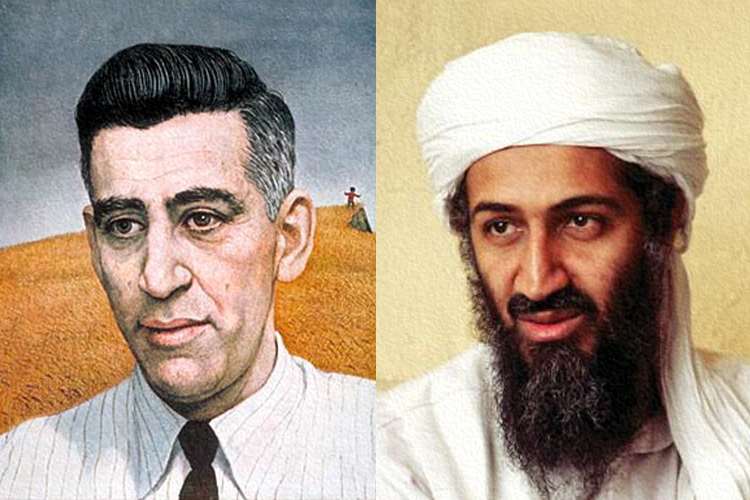
CAIRO — Al-Qaida recluse Osama bin Laden today called for a worldwide boycott of American bookstores, saying the United States was responsible for the death of J.D. Salinger, New Hampshire recluse and author of “The Catcher in the Rye.”

Ask yourself — did you ever see them in the same room together?

“If you really want to hear about it,” bin Laden says in an audiotape released today, “you’ll want to hear all the David Copperfield crap about my lousy childhood and how I was abandoned by my father Muhammed Awad bin Laden because I was the only son of his tenth wife, but I don’t feel like going into it.”

Bin Laden sought seclusion in the mountains of Afghanistan following the disastrous attacks on Sept. 11, 2001.  Salinger sought seclusion in the mountains of New Hampshire following the disastrous reviews of the film version of his story “Uncle Wiggily in Connecticut.”  The two men were never seen together, and mysteriously canceled a scheduled appearance on “The Hollywood Squares” when they learned that Wally Cox would not be a member of the show’s nine-celebrity “tic-tac-toe” box.

Wally Cox and Joyce Maynard:  No connection, but the lack of any parallels is rather eerie.

Both Salinger and bin Laden became increasingly eccentric in their later years, with Salinger drinking his own urine according to his lover Joyce Maynard, a woman half Salinger’s age who, like him, scored an early literary success.  Her world-weary adolescent memoir “An Eighteen Year Old Looks Back on Life” caught the attention of Salinger, who sent her a letter complimenting her style “because you obviously copied it from mine.”

Continue Reading Close