Gavin McNett
To bee or not to bee
Why did three new books just come out about bees? Is the publishing world taking secret orders from the Discovery Channel? And should writers who refer to "my recommended daily allowance of magic and wonder" be stung to death?
First, we need to get this out of the way: There are three books on bees coming out at pretty much the same time. (A fourth, “Sweetness and Light: The Mysterious History of the Honeybee,” by Hattie Ellis, made itself known later.) “Ha ha!” I said to myself and later to everyone else I knew. “Ha ha! I see there are three books on bees coming out at about the same time. Why,” I said, “one might even say that there’s a ‘buzz’!” Rimshot, orchestral vamp, goofy xylophone music as the credits roll. (– Gavin McNett writes on books and culture for a variety of publications.)
Indeed, you don’t get them handed to you like that every day. (A “buzz”!) The last time was a year or two ago when my friend Doug and I were working in the garden, scooping soil from a wheelbarrow with an old mug. “Is there any coffee left?” Doug asked. “Here,” I said, handing him the mug full of dirt. “It’s fresh ground.” He made a perfect “boing!” face like a cartoon character. You treasure each moment like that because in old age, those memories become your consolation for the fool you still are.
In any event, these three new books on bees give an encompassing, if not overwhelming, treatment of a creature that’s so everyday-familiar to most of us that it’s easy to forget how strange and unlikely, even wondrous, they are. If there were no such thing as bees, and if one were to invent an imaginary animal — an insect — that builds nests with identically hexagonal, waxen cells and upholds a rigid caste system of queens, drones and workers; that communicates with waggling dances; that collects flower nectar and concentrates it into a thick, ambrosial-sweet essence (and converts pollen into cakes of “bread”), laying up stores against the chill of winter; et cetera; people would think you were attempting some kind of broad, H.G. Wells-style metaphor for industrial civilization or socialism, or at least speaking in Aesopian parable about human thrift and duty. It certainly wouldn’t seem like a plausibly real creature. And yet, this (and more) is the familiar honeybee — and the closer you look at bees, the odder and more puzzling they can seem.
Which is also true with books, often enough. And here we have three different, even archetypical kinds of book, all mustered around the same topic as though for a controlled experiment — which is interesting just in itself, give or take the infernal joy of “it’s a buzz” and even worse temptations (“Now here’s a honey of a book!”) that would certainly be easy to wallow in if one were a fiend (or writing for Slate). In any case, it’s a mystery why four books on bees would come out in such close succession — although that seems to happen in publishing with a funny regularity. Some years back, for instance, seven books on masculinity, maleness and boys hit the stores in rapid fire for no apparent reason, while in ’03 a book on the X chromosome dropped like a pair of shoes with a book on the Y chromosome. My own pet theory has been that there’s some attractive guy out there, a gifted cocktail-party orator, who keeps going to publishing events and rhapsodizing about the latest fascinating thing he saw on the Discovery Channel — and the next day a number of book editors go to their offices all charged up about the idea they had while talking to that cute guy at the party, and start ransacking the manuscript piles. His aria on bees must have been an especially fine one. (He also seems to watch a lot of those Hitler-in-the-bunker shows on the History Channel.)
“Letters From the Hive,” by Stephen Buchmann, is a slenderish volume by a professor of entomology (at the University of Arizona at Tucson) who’s spent his adult life studying bees. It’s a pleasantly wonkish book, with writing shaped and colored in by co-author Banning Repplier, that features firsthand accounts of a traditional raid on a Malaysian bee tree, a search in Yucatán for keepers of the native (and increasingly scarce) stingless bee, and other such tales. It has a rootedness in what we usually, perhaps awkwardly, call biodiversity and traditional cultures, but for which a better term might be, simply, “the vanishing world.” It’s a bit of a shame to reduce “Letters From the Hive” to a type, but it represents a sort of elegant book, modest and evenly paced, that’s dense-packed with information, but such a pleasure to read that you hardly notice how much you’re assimilating, page by page. (Another of these is the X chromosome book, David Bainbridge’s “The X of Sex.”) Buchmann covers the world history of beekeeping and honey, culture by culture; the natural history of bees (an appendix features entries on such diverse entities as polyester bees, mining bees and honey-making wasps); makes frequent sharp turns into arcana such as Australian Aboriginal hive-robbing techniques; and throws in a section on honey recipes merely to — if we were making all those bad, obvious jokes — sweeten the pot.
This passage on “swarming,” the behavior bees exhibit when abandoning a nest for a new one, or when one colony splits into two, gives a sense of the book’s pleasant wonkishness:
“I’ve been lucky enough in my career as a bee researcher and part-time bee keeper to witness the swarming spectacle dozens of times. I’ve even experienced the adrenaline rush of running inside several swarms as they traveled to their new lodgings. It’s called swarm running and I do it just for fun. The bees are gentle, their stomachs full of honey packed for the trip, and they are not in the mood to sting. As I run, bees swirl about me in all directions, but somehow the mass stays coherent, changing shape but not dispersing.”
In the available photos, Buchmann appears as a cheerful, beardlessly professorial man with thick glasses. One imagines him running with the bees in khaki shorts and a short-sleeved dress shirt, all knees and elbows. It’s impossible not to admire a man like that, knowledgeable yet childlike in his enthusiasm.
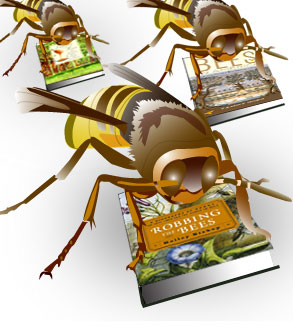
Holley Bishop’s “Robbing the Bees” is another ball of wax altogether. It represents a venerable New York dilettante tradition, in which a privileged or well-connected New Yorker will become a casual expert on a subject, reading through the literature and taking a few field trips, then reporting his or her findings in book form.
Some of these dilettante books are very good: The estimable John McPhee, one of America’s all-time research fiends and prose stylists, began as one of these writers, as did Michael Pollan (of “Botany of Desire”). The less-estimable ones tend to be hedged as personal memoirs, in the “my journey through the fascinating world of…” category, and err strangely toward the obvious (or even the no-duh), such that you can imagine the authors going through life protected by giant, Plexiglas New York Bubbles like the balls that hamsters walk around in.
Bishop, a graduate of Brown University and the Columbia School of Journalism who works in book publishing, bought a house in rural Connecticut and got a couple of beehives. Someone must have said, perhaps at one of those same parties where the Discovery Channel guy hangs out, that she should write a book about being a person who has a couple of beehives, so, as Bishop says, she studied the literature on bees and took some trips to visit Donald Smiley, a professional beekeeper in Florida, and produced just such a book. The difference between her book and Buchmann’s is striking. Both have loads of great information and detail, covering much of the same territory. And good, or simply honest, writing can make almost any topic interesting. But “Robbing the Bees” is written in a familiar, semi-precious style that’s full of facts from other sources, pat descriptions and stock phrases, and where the entire solar system seems to orbit the author. For instance, to describe my evening: My taste buds enjoyed a Jolly Rancher with gusto, and I perused a dusty old tome while guzzling a glass of the finest beer. I am now excitedly walking toward my fish tank, where I will get my recommended daily allowance of magic and wonder.
If anyone’s dying out there, I’m sorry — it’s really that bad when Bishop shifts from expository, fact-based prose, which is merely stuck together at slightly odd angles, into a more expressive, personal style. Here’s one place where you can see such a shift:
“[Honeybees] live for only several weeks and heroically die after delivering their dreaded, venomous sting. Bees shape the very landscape in which we all live by cross-pollinating and changing the plants that nourish them. After decades of living in honeyless ignorance I added these divine insects and their delicious produce to my recommended daily allowance of magic and wonder.”
This bandage on my head is from when I set the book on fire and beat myself silly with it (it’s a thick book), thinking that some people can write like that with relaxed certainty, like a bowling ball rolling downhill, whereas I could barely finish anything for years, classically blocked and in mortal dread of publishing an imperfect sentence (as you can see, I’ve largely gotten over any silly concerns with quality. And yet, there are things like a puzzling chapter of Bishop’s in which she’s hanging around her New York apartment naked during the ’03 blackout, that make “relaxed certainty” seem a more perilous mindframe than ever).
We’re on a bit of a tangent here, and we’ll be back to the bees (and Bishop’s book) in just a paragraph or two, but perhaps the best example of the contemporary dilettante book is Daniel Pinchbeck’s “Trust-fund Shaman: My Psychedelic Journey Through the Fascinating World of a Bunch of Old Carlos Castaneda Paperbacks” (published under the title “Breaking Open the Head: A Psychedelic Journey Into the Heart of Contemporary Shamanism”). According to Pinchbeck, a good-natured and well-meaning son of a wealthy literary family, he remembered that psychedelic drugs are widely said to have religious significance, and went around reading books about drugs while also taking a lot of them, often in far-flung locales. Achoo!, he sneezed, and a book deal was in the Kleenex. It’s an interesting topic, to be sure, although in classic low-dilettante style, Pinchbeck describes things in over-limpid, imprecise terms, as though (this is a crucial characteristic, and also the thing about “Robbing the Bees” that best explains Bishop’s writing style) a book were like a paper to be turned in for a grade: As if someone who comes from the right place socially need only demonstrate that he did the relevant reading, and write correct prose with no serious logical or factual errors, to be able to expect comments like “Great work!” or “A revealing treatment of the subject matter!” and be rewarded with an authorial career. To imitate Pinchbeck’s signature 50 yards of narrative distance (and this is a made-up passage, tuned for concision, that’s actually quite close to how the book reads): The drug, Yage, can radically dissolve consciousness. The experience can be highly individual, but I found myself experiencing beatific visions that transcended time and space.
As an expository style, that barely rates a C+ (although Pinchbeck is a nice guy and there’s no joy in poking at him). And consummately, the big noise that you didn’t hear when the book came out included literally millions of ’70s hippies, ’80s Robert Anton Wilson fans and recent Burning Man weirdos — the book’s natural constituency — not yelling, “Great work! A revealing treatment of the subject matter!” (Aldous Huxley, likewise, did not spin in his casket.) I mentioned my own period of dread-haunted blockage earlier because the signal difference between, on one hand, myself and (I think) most writers, and the dilettante tradition that reaches to McPhee and encompasses Bishop and Pinchbeck, is that most writers type under an eternal, hanging neon sign that blinks, “So what? Who cares!” — and that sign has to be argued with and answered every day, sometimes line by line or word by word. “Robbing the Bees,” like most dilettante books, reads like it was composed under a neon sign that gamely blinks, “How nice! Do tell!”
In any case, the whole “psychedelic drug” thing will be cleared up with my upcoming book, “The Slamdancing Wu-Li Masters: A Wake ‘n’ Bake, Tao-of-Fuck-You Rampage Through the Heart of String Theory, Chaos Theory, and Quantum Physics.” It will be finished as soon as these pumpkins stop chasing me.
But there’s still a third book on bees that’s yet a different kind altogether from Buchmann’s and Bishop’s. Tammy Horn’s “Bees in America” is an academic romp of the young-professor variety — meaning it was composed under a furiously blinking sign that says, “Research more! Cite more sources!”
Covering (again) much of the same territory as the other books, Horn goes further and builds a social history of the bee in America, beginning with the earliest colonists (honeybees aren’t native to North America) and ending with hyper-contemporary electronic hives and the Bee Genome Project, making a dizzying journey along the way through the bee’s appearance in advertising, popular music (the Gospel group Sweet Honey in the Rock gets two mentions; early blues artists get many more), Mormon wood carvings (the hive is an important Mormon symbol), popular film, and anything else one is likely to think of. It’s a heroic book in its scope, but like many popular-academic books, the structure starts to fly apart in the middle and the references begin to come faster and faster, becoming choppy and eventually turning into a sort of fact blizzard in which you have no idea where you are or what’s happening.
At around the three-quarter mark, it begins to seem as though paragraphs could be shuffled randomly, each with its own small topic (one short stretch, by no means unrepresentative, bounds directly from parasitic mites and the 1922 Honey Bee Restriction Act to Tom Petty’s song “Honey Bee,” to Gloria Gaynor, and Southern writer Lee Smith). Horn seems to finish the book in a state of exhaustion, notebooks empty, sources wrung dry, nothing left to do but turn off the blinking neon sign and slip deservedly into bed for the after-deadline sleep of the blessed. It’s a book that exhausts the reader as well, but one that’s worth coming back to — not just for the cram-jammed facts and references, but for the aesthetic thrill of being caught in a typhoon of data and interconnections that, one knows, one could never in decades of work have whipped up oneself. Horn learned beekeeping from her grandfather, and “Bees in America” has the glow of a book that only a serious, lifelong enthusiast could have written — not an expert such as Stephen Buchmann, but a thrillingly mad one, intoxicated with her subject.
The Discovery Channel guy is even now stirring up a new flurry of random, same-subject books, and it’s anybody’s guess as to what they might be about. It would be interesting if he were to go really deep and expound a temporary passion for light bulbs or doorknobs, or Polish army helmets. One would like to see the limits of his powers; and while bees are indeed a strange topic to produce a buzz, perhaps the next topic to swarm the shelves will really give people hives (or carry a sting), or at least lead to an equally good array of groan-worthy one-liners. Fish are a rich topic for those, if you’re out there, sir.
Getting to the bottom of the bulge
Does the Bush-is-wired story make sense? A variety of experts weigh in.
The first time Joseph Cannon watched the Sept. 30 presidential debate between George W. Bush and John Kerry, he was too “nervous” to notice anything strange about the president’s mannerisms, let alone his clothing. It was only on a second viewing with his girlfriend that Cannon, a graphic designer and prolific, Bush-bashing blogger in Los Angeles, saw what the world has now come to call the Bush Bulge.
“Bush seemed to have a wire, or an odd protrusion of some sort, running down his back,” Cannon wrote on Oct. 2. Naturally, he searched around the Web for clues as to what the bulge could be, and, as often happens online, the evidence he found seemed to converge upon a conspiratorial, yet not-implausible hypothesis — in this case, an old suspicion that the president receives help during speaking engagements by using an in-ear prompting device, a direct wire to advisors concealed behind the Oz curtain.
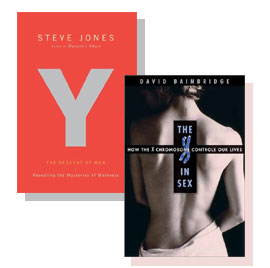
Continue Reading CloseY are men necessary?
Two new books on genetics explore how the Y-chromosome divides males from females -- and ask whether male humans are headed for the biological dustbin.
You walk into the bookstore and there’s a book on display called “Dust: A Universal History.” It’s really interesting. It follows the history of dust from the big bang to the rise of human civilization in the dusty regions of the Middle East to the invention of commercial dusting sprays and chemical-impregnated dust cloths. And then a chapter, “Dust to Dust,” describing the slow work of wind and water, and (finally) of entropy itself, returning all that’s solid in the universe into dusty particulate matter. And there you have it all, pretty much. Dust — who knew?
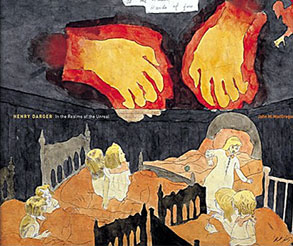
Continue Reading Close“Henry Darger: In the Realms of the Unreal” by John M. MacGregor
The late Henry Darger is a darling of the outsider art world, a dishwasher who created a vast epic tale of naked little girls. But was he also something more sinister?
Henry Darger is doubtless the world’s most celebrated lifelong menial laborer, having worked diligently not only as a janitor, but also in later life as a dishwasher and (finally) a winder of gauze bandages. Darger was truly a man of several careers, and John MacGregor’s “In the Realms of the Unreal” represents a definitive, 10-year, 720-page critical study of his life and work. MacGregor’s first chapter is gamely called “On the Autobiography of a Dishwasher,” a nod to the fact that nobody in the Chicago hospitals in which Darger worked, nor perhaps in his entire life, would ever have believed he would be remembered, let alone lionized, now, 30 years after his death. Darger was a fireplug of a man, mentally ill in the unspecifiable way of the self-muttering recluse, and his fame comes from what was discovered during the cleaning out of the room he inhabited for 40 years, once he finally left its solitude, at 81, for a charity-ward deathbed.
Continue Reading Close“Why Smart People Can Be So Stupid,” by Robert J. Sternberg
Scholars finally tackle the question that has plagued humanity since time immemorial.
Only a few questions can be called basic to the human condition — such as “What can we eat?” or “Who created us?” — and lots of very smart people have been working on them for millennia. The “eating” thing, for instance, has been minutely parsed by agriculture, economics and the culinary arts (among other fields), while the question of origins has given us religion and several branches of the hard sciences. But there’s at least one question — as basic as any other in its topical relevance and its grounding in the ancient — that human inquiry has only recently begun seriously to address. It was asked in caves, by people clad in mastodon-hide shifts, and chances are it crossed your mind this very day. “How,” it goes, “can people be so stupid?” And who knows the answer, really? I don’t — do you?
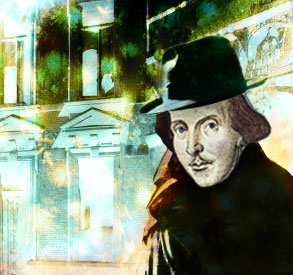
Continue Reading CloseMystery man
A new documentary revives an old controversy: Was actor and landowner William Shakespeare merely a front man for Christopher Marlowe, the flamboyant gay genius and shadowy Elizabethan spy?
If you look hard enough, it’s possible to find a group of ardent souls, somewhere, who still believe almost any weird idea that might ever have held currency. The Flat Earth Society, for instance, is still very much in business, with headquarters both in America and what they’d hesitate to call the Southern Hemisphere, in Australia. There are groups of people, after all this time, who still think Japanese anime is edgy and avant-garde, and others still devoted to proving that Shakespeare didn’t write Shakespeare. Perhaps you know some of these people, or are one of them. For my part, I believe the Shakespeare-authorship thing. I think Christopher Marlowe might’ve written all the Bard’s works instead, and it was Michael Rubbo’s new video documentary, “Much Ado About Something,” which just completed a two-week run at Film Forum in New York and should appear somewhere near you soon, that smashed my paradigm.
Continue Reading ClosePage 1 of 12 in Gavin McNett