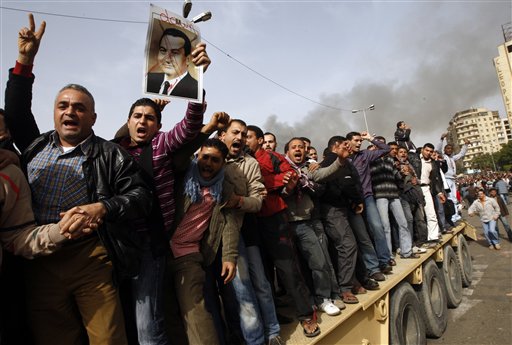
CAIRO (AP) — Hosni Mubarak’s former vice president and spy chief says he will not attempt to “reinvent” the regime of his longtime mentor if he becomes president.
Omar Suleiman is running in presidential elections scheduled for May 23-24. He said in an interview published Monday in the state-owned newspaper Al-Akhbar that restoring security would be his top priority as president.
He also sought to distance himself from the Mubarak regime and said the uprising that forced Mubarak to step down nearly 14 months ago has created a “new reality that cannot be reversed.”
The 75-year-old Suleiman said he has received death threats from “elements” of the Muslim Brotherhood and other Islamist groups since he announced his candidacy on Friday.
THIS IS A BREAKING NEWS UPDATE. Check back soon for further information. AP’s earlier story is below.
CAIRO (AP) — Hosni Mubarak’s former vice president and spy chief Omar Suleiman will have the behind-the-scenes backing of Egypt’s ruling generals and the state media’s powerful propaganda machine in his bid to succeed his longtime mentor for the nation’s highest office, according to officials with firsthand knowledge.
Suleiman, 75, will set out as a formidable presidential challenger to stop the Islamists from taking over the country and may also try to sell himself as a safe pair of hands for those increasingly frustrated over tenuous security and a worsening economy.
His surprise candidacy speaks to the seismic changes Egypt has gone through since millions of people took to the streets last year united by a desire to topple Mubarak’s regime and the dream of a free, democratic and more just Egypt.
The notion of a Suleiman presidency would have been ludicrous then. But not any more.
Many Egyptians have since lost faith with the young revolutionaries who engineered Mubarak’s stunning overthrow. The euphoria over his ouster soon gave way to frustration as Egyptians struggled to cope with a surge in violent crime, the fallout from a faltering economy and seemingly endless strikes, street protests and sit-ins that disrupted their daily life.
“There is a real constituency that now yearns for law and order and stability after the tumultuous period following the fall of the Mubarak regime,” said Michael Hanna, an Egypt expert from the Century Foundation in New York. “Many among this sector will view him as a force for such stability in the face of rising chaos and economic uncertainty. But his inextricably tight connection to the former regime and some its most repressive practices will also limit his support.”
On Friday, Suleiman reversed a decision not to run and on Sunday he presented his candidacy papers to the election commission just minutes before the deadline expired.
His supporters boasted that he collected more than 100,000 signatures, nearly four times the number of endorsements required for independent politicians to be able to run in the May 23-24 presidential election. The presidential vote will be the first since Mubarak’s ouster in a popular uprising 14 months ago.
The election commission later announced that 23 candidates have presented their papers, but that a final list would be announced later this week after vetting.
The names did not include Buthaina Kamel, the only female hopeful who announced on Sunday that she was not able to collect the required minimum of 30,000 signatures.
“I can say with certainty that the (ruling) military council pushed Omar Suleiman to run,” declared moderate Islamist candidate Abdel-Moneim Abolfotoh. “I can’t imagine the Egyptian people will elect a figure from the old regime.”
A career army officer, Suleiman served as Mubarak’s intelligence chief for 18 years. Mubarak named him vice president days before an 18-day uprising forced him to step down and he has since disappeared from the public eye.
In the meantime, two dominant forces emerged from the revolution — the ruling military and the Islamists.
Many looked to Islamists, who dominated in parliamentary elections several months ago, for actions that would ease their woes. When that did not happen, they began to look to the next president.
Suleiman’s candidacy could provide the revolutionaries with the spark to reconnect with the streets as they did during the revolution, using it as evidence to support their claim that the ruling generals were an extension of the Mubarak regime and a Suleiman presidency would amount to turning the clock back on the 2011 revolution.
“Omar Suleiman is in fact Mubarak No. 2,” said Khaled Ali, a presidential candidate representing liberal and leftist groups.
Suleiman is not the only Mubarak-era figure running for president. The ousted leader’s last prime minister and fellow air force officer Ahmed Shafiq is one, and so is Amr Moussa, who was Mubarak’s foreign minister for 10 years. The two are front-runners along with Abolfotoh and ultraconservative lawyer Hazem Abu Ismail.
In Suleiman, the ruling generals will have a sympathetic military man happy to shield them from any attempt to prosecute them for alleged crimes during their rule, protect them from civilian oversight and keep their vast economic empire away from the tax collectors.
“He is the candidate of the ruling military council without a doubt,” said one official with firsthand knowledge who spoke on conditional of anonymity because he was not authorized to speak to the media.
Already, the state media, which have sided with the ruling military council against the pro-democracy groups calling for it to step down, is promoting Suleiman, presenting him as the politician with the expertise needed to spare Egypt more upheavals.
Faced with the prospect of a Suleiman presidency, the Muslim Brotherhood as the dominant Islamist party in parliament is trying to project itself again as a revolutionary force. The Brotherhood said Suleiman’s entry into the race was a throwback to the days of Mubarak, who cracked down on the group for most of his 29 years in office. The Brotherhood’s official website posted on Sunday a picture of Suleiman crossed out in red with the word “no” over it.
Mahmoud Ghozlan, the spokesman for the Muslim Brotherhood, said if the elections are free and fair, Suleiman is bound to lose.
“The Egyptian people hate him, they know his scandals and his animosity to the public,” Ghozlan said. “He will either take a big fall or he will re-ignite the revolution again.”
The Brotherhood won just under half of the seats in parliament. Combined with the ultraconservative Salafis, the two Islamist groups control 70 per cent of the chamber. The two joined forces again to ensure that Islamists are the majority on a 100-member panel tasked to draft the country’s next constitution.
In the eyes of some critics, the Islamists’ political gains have only made them hungrier for power, a charge that earned credence when the Brotherhood fielded a candidate in the presidential race, reversing an earlier decision not to do so.
Like his mentor Mubarak, Suleiman was a keen adversary of the Brotherhood. But he also ended a ban of nearly six decades on the long outlawed group and opened a dialogue with them during the uprising.
His candidacy could appeal to the significant sector of moderate Egyptians who fear that an Islamist from the Brotherhood or the Salafis would turn Egypt into an Iranian-style theocracy.
“People are frightened,” said Negad Borai, a rights lawyer and activist. “Suleiman cashes in on this fear and becomes the candidate suitable for everyone.”
BAGHDAD (AP) — Iran is promoting a conservative cleric close to its supreme leader as a possible successor for the aging spiritual leader of Iraq’s Shiites, a move that would give Tehran a powerful platform to influence its neighbor, according to figures close to Iraq’s religious leadership.
The 81-year-old spiritual leader, Grand Ayatollah Ali al-Sistani, is one of the most influential figures in Iraq, revered by its Shiite majority as well as by Shiites around the world. In the years after the 2003 U.S.-led invasion and fall of Saddam Hussein, he was strong enough to shape the new Iraq, forcing American leaders and Iraqi politicians to revise parts of their transition plans he objected to.
The man Iran is maneuvering in hopes of eventually replacing him is Grand Ayatollah Mahmoud Hashemi Shahroudi, a prominent insider in the clerical hierarchy that rules Iran. He was the head of Iran’s judiciary for 10 years until 2009, playing a major role in suppressing the country’s reform movement, and sits on one of Iran’s main ruling councils.
Shahroudi has started to build a presence in Najaf, the Iraqi holy city of dozens of seminaries that is the center of Shiism’s religious leadership, to which many of the world’s 200 million Shiites turn for spiritual and political guidance. Posters bearing his portrait have sprung up in the Baghdad district of Sadr City, a bastion of Shiite activism and home to some 2.5 million Shiites.
Iran’s growing influence in Iraq — through the economy and ties with Shiite politicians in Baghdad — is already a source of alarm to the United States and its Gulf Arab allies who see Shiite-majority Iran as a rival.
It would boost Tehran’s voice in Iraq even more if Shahroudi ever succeeds al-Sistani as “al-marjaa al-akbar,” or “the greatest object of emulation.”
The 63-year-old Shahroudi would likely take an even more assertive political role than al-Sistani has. Al-Sistani adheres to a “quietist” school of Shiism that rejects formal rule by clerics, in contrast to Iran’s school in which clerics hold ultimate power.
Also, al-Sistani has lived in seclusion for years — he is thought not to have left his Najaf house since 2004 — and some feel he has grown out of sync with Iraq’s new generation of young and empowered Shiites. Disillusioned over unemployment and erratic services, many young Shiites are looking for a more dynamic religious leadership to counter what they see as the rising power of Sunni fundamentalists in the Arab world.
“Iraq’s Shiites are deeply politicized and they have had enough of traditional marjaiyah (religious authorities) like al-Sistani’s,” said one insider in Najaf, who is in daily contact with the city’s top clerics. “Iran is taking advantage of this by working energetically to replace him with one of its own.”
The insider is one of six who are well connected to the Shiites’ secretive religious establishment in Najaf and in Baghdad. They said Shahroudi appears to be angling for the post. They spoke to The Associated Press on condition of anonymity because of the sensitivity of the subject.
Al-Sistani, who was treated in London for heart problems in 2004, remains healthy and alert, according to visitors who saw him recently. But his advanced age has fueled speculation about his succession in Najaf.
But the succession does not necessarily have to wait until al-Sistani’s death. It could effectively take place if al-Sistani is deemed too old to guide his followers.
The position of al-marjaa al-akbar is considered the highest in Shia Islam’s spiritual hierarchy, more elevated than the several dozen clerics with “marjaa” — or “object of emulation” — status in the Shiite world. Pious Shiites generally choose a marjaa to follow. Al-Sistani has been al-marjaa al-akbar since the 1990s.
Filling the post is done by an informal process of consensus among senior and middle-ranking clerics, aimed at choosing the learned and respected figure. “Campaigning” for it means showing religious clout among Shiites in general and in Najaf specifically.
Ibrahim al-Baghdadi, Shahroudi’s top aide in Najaf, would not say if Shahroudi has ambitions for the position. Morteza Monajjem, a spokesman for Shahroudi’s office in the holy city of Qom, Iran’s religious capital, said the cleric “has no plan to stand next to other marjaas” and “has not officially defined himself as a marjaa.”
Still, Shahroudi is laying the necessary groundwork.
He opened a representative office in Najaf in October and plans to visit the city soon, according to al-Baghdadi.
He has begun paying monthly stipends to poor seminary students, organizing “study circles” and collecting the “khoms” from followers — a tithe of a fifth of one’s income. He has sent cleric-deputies to Shiite provinces in Iraq, al-Baghdadi said. He has also increased his issuing of fatwas, or religious edicts, in response to questions sent to his website.
Any ayatollah with aspirations of becoming a marjaa must write a religious textbook known as a “Tawdih al-Masail,” or “Clarification of Issues,” laying out rules for daily religious practice. Shahroudi published his just over a year ago.
Shahroudi is already known to be the spiritual leader of powerful Iraqi factions, including followers of the Badr Organization as well as most members of the Iranian-backed Shiite Hezbollah Brigades militia active in southern Iraq, and Asaib Ahl al-Haq, a hardline faction.
Among his students in Qom were Hassan Nasrallah, leader of Lebanon’s Hezbollah movement, and Humam Hamoudi, a prominent Iraqi politician.
Shahroudi is also believed to have replaced a grand ayatollah who died in 2010 as the spiritual mentor of the Dawa Party, Iraq’s oldest and most powerful Shiite political group. Iraqi Prime Minister Nouri al-Maliki, the Dawa leader, visited Shahroudi during a recent visit to Iran.
Shahroudi was born in Najaf to Iranian parents in a family of clerics that claims descent from the Prophet Muhammad. He studied under Grand Ayatollah Mohammed Baqir al-Sadr, a prominent scholar credited with modernizing Shiite doctrine before he was executed by Saddam in 1980. Shahroudi fled a 1979 crackdown against Shiites and took refuge in Iran.
There, he became the first leader of the Supreme Council of the Islamic Revolution in Iraq, a major opposition group of Iraqi Shiite exiles. The group became a major political player in post-Saddam Iraq and its successor party is in al-Maliki’s ruling coalition.
Shahroudi also rose in Iran’s clerical leadership. He is so close to supreme leader Ayatollah Ali Khamenei that he has been cited by many observers as his possible successor.
Still, the Najaf insiders caution there are challenges in his path to succeed al-Sistani.
Muqtada al-Sadr, the young anti-American cleric whose followers have 40 of parliament’s 325 seats, has been in Iran studying to become a marjaa. But he is believed to need several more years before he can reach the rank of ayatollah, a status below marjaa, according to one of his aides in Iraq.
One of Shahroudi’s former students in Qom — now an Iraqi politician — said Shahroudi is strongly positioned.
“He is relatively young, he is familiar with modern day issues and has impeccable family pedigree,” he said. “The Shiite street wants a dynamic marjaa who can compensate it for the failure of the government.”
Continue Reading
Close
BAGHDAD (AP) — Qatar’s prime minister said late Wednesday that his nation was sending Baghdad a “message” with its low-level representation at an Arab summit in the Iraqi capital, criticizing what he said was the marginalization by the country’s Shiite-led government of its Sunni Arab minority.
The emir of Kuwait is the only Gulf Arab leader attending the summit, which Iraq had hoped would serve as its debut into the Arab mainstream after two decades of isolation. This reflects increased Sunni-Shia tensions across the region in the aftermath of last year’s Arab Spring uprisings, particularly the one against a regime dominated by a Shiite offshoot sect in Sunni-majority Syria and another by majority Shiites in Sunni-ruled Bahrain, also a Gulf Arab nation.
Qatar’s Prime Minister Sheikh Hamad Bin Jassem Bin Jabr Al Thani, who is also the country’s foreign minister, told Al-Jazeera that Syrians have a right to defend themselves against the crackdown by President Bashar Assad’s regime, suggesting that his energy-rich nation approves of arming rebels there, or is arming them already.
Sheikh Hamad is one of six Sunni-led Gulf Arab nations whose relations with Iraq have been fraught with tension because of Baghdad’s close ties with Shiite Iran and its ambivalence on Syria, where the United Nations says at least 9,000 people have died since an anti-Assad uprising began a year ago.
Majority Shiites have dominated Iraq since the 2003 ouster of Saddam Hussein, a Sunni. The nation’s once powerful Sunnis complain that the Shiite-led government of Prime Minister Nouri al-Maliki is concentrating power in the hands of the Shiites. There is a growing desire by Sunni-majority provinces to win autonomy as a way to escape Shiite domination.
Tens of thousands of Iraqis died in the sectarian violence that began shortly after Saddam’s ouster but peaked in 2006 and 2007. Tension continues to simmers to this day, with occasional attacks by Sunni militants against Shiites and crackdowns on Sunni areas by the Shiite-led security forces.
Sheikh Hamad told al-Jazeera his energy-rich nation, a key regional player, disapproved of the marginalization in Iraq of “some segments, including the Sunnis,” and that this policy was not in the interest of Iraq or the Arab world.
“Qatar wants the Iraqi government to resolve this in a way that unites the Iraqi people and gives everyone their rights through a dialogue involving all parties,” he said.
Iraq is hosting the annual Arab summit for the first time since 1990, keen to show it has emerged from years of turmoil and U.S. occupation. But the Syria issue has clouded its attempts to win acceptance by other Arab nations, which are deeply suspicious of its ties with Iran.
In a snub to Baghdad, all but one of the rulers of the six, U.S.-allied Gulf Arab nations were staying away from the summit, sending lower-level figures instead. League officials said the level of representation was aimed at showing their frustration over the lack of more assertive action on Syria.
Instead of its king, Saudi Arabia was sending its ambassador to the Arab League — a worse slap because the post is even lower than the foreign minister level. The League officials said Saudi Arabia and Qatar had wanted Iraq to invite representatives of the Syrian opposition to the summit. Baghdad declined, much to their dismay, the officials said, speaking on condition of anonymity because of the sensitivity of the subject.
The one Gulf ruler who is attending, Kuwaiti emir Sheikh Sabah Al Ahmed Al Sabah, was received by Iraqi Prime Minister Nouri al-Malik at Baghdad’s international airport and the two leaders held hands as they walked to the facility’s VIP lounge.
Saddam Hussein invaded Kuwait in 1990, but his army was driven out of the oil-rich nation the following year at the hands of a U.S.-led coalition. Relations between the two neighbors remained tense even after Saddam’s 2003 overthrow, but they partially thawed recently. Al-Maliki visited Kuwait earlier this month.
Relations between Iraq and the Gulf Arab nations have also been tense over criticism by Shiite Iraqi politicians and clerics of Bahrain’s crackdown on Shiite protesters. The demonstrators seek more economic opportunity and an end to what they see as discrimination by the Sunni ruling family.
Al-Maliki on Wednesday met with Bahrain’s foreign minister on the sidelines of the Arab summit and Iraqi Foreign Minister Hoshyar Zebari later told reporters that Bahrain would not be on the summit’s agenda, a decision that appeared to be a concession by the hosts.
Offering a glimpse of Qatar’s thinking on the Syrian crisis, Sheikh Hamad said it would be a “disgrace to all of us if the sacrifices of the Syrian people go to waste.”
“We are faced with a difficult choice — either we stand by the Syrian people or stand by him (Assad),” he said. “It is not to be expected from the Syrians to idly stand by while the regime continues to kill its own people this way.”
The Gulf nations, particularly Saudi Arabia and Qatar, have been pushing behind the scenes for more assertive action to end the conflict. Privately, they see little benefit in the Arab League’s efforts to reach a peaceful settlement and prefer instead to see a small core of nations banding together to act on their own.
Among the options they are considering are arming the Syrian rebels and creating a safe haven for the opposition along the Turkish-Syrian border to serve as a humanitarian sphere or staging ground for anti-regime forces. Such a step would require help from Turkey — the country best positioned to defend such a safe haven — but so far Ankara has seemed reluctant.
For Gulf nations, removing Assad would almost certainly break Syria’s alliance with Iran, disrupting the sphere of Tehran’s influence that now extends from Iraq and across Syria to the shores of the Mediterranean. Syria’s Sunni majority makes up the bulk of the uprising. Assad’s regime is dominated by his own Alawite sect, a minority offshoot of Shiite Islam.
Continue Reading
Close
CAIRO (AP) — Egypt’s powerful Islamists on Monday faced a backlash on two fronts as they try to solidify their hold on the country’s politics, as liberal politicians quit a panel tasked with drafting a new constitution to protest its domination by Islamists.
More ominously, the ruling military issued a veiled threat of a crackdown on the Muslim Brotherhood if the group persisted in demands to form a new government.
The warning pointed to a growing possibility of confrontation between the Brotherhood and the military, which emerged as Egypt’s two most powerful institutions since the fall of longtime authoritarian ruler Hosni Mubarak a year ago. For months, they have moved between cooperating and jostling for position.
But the Brotherhood appears to be growing in confidence over its position. The group holds nearly half the seats in parliament, making it the largest bloc — and its strength grows even more on some issues in which it is backed by the second-largest bloc, the ultraconservative Islamic Salafis.
Together they have been demanding the ouster of the military-appointed prime minister so they can form their own government. The military has staunchly refused. They have also used their strength in parliament to create a constitutional panel with an Islamist majority, giving them the strongest hand in writing the new charter.
In response to the tensions with the military, the Brotherhood’s leader, Mohammed Badie, said in comments posted on the group’s website Monday that it was “quite possible” for the Brotherhood to reverse an earlier decision not to field its own candidate in presidential elections due in May.
If the military-Brotherhood quarrel escalates, the transfer of power from the military to a civilian president — scheduled for before July 1 — could be in jeopardy. Their dispute could also hand the liberal and secular groups that engineered the 18-day uprising that toppled Mubarak an opportunity to move back to center stage after months on the side.
The independent Al-Shorouq daily said on Monday that several members of the ruling military council have expressed their disapproval of the makeup of the panel in a meeting with Brotherhood leaders. Brotherhood officials could not be reached for comment, but the report was the latest in a series published in the independent media suggesting that relations between the two sides have become so strained that a rapprochement may not be possible any time soon.
Two prominent liberal Egyptian politicians — independent lawmaker Amr Hamzawy and Christian activist Mona Makram Obeid — were the first to announce they were pulling out of the 100-member constitutional panel on Monday.
Lawmaker Emad Gad said 11 other liberal politicians have also decided to pull out and were due to formally announce their decision on Tuesday, a day before the body is scheduled to hold its inaugural session. The group include eight members of the panel and three “reserve” members, who would serve if a member bows out for any reason. Gad is one of the three reserve members pulling out.
“The entire process is a show to conceal the intention to draft a constitution for a religious state,” said Gad, a Christian. “It’s a disgrace to the constitution,” Sherif Samir, a spokesman for the secular Free Egyptians Party, said of the religious slant of the panel.
The controversy surrounding the panel’s makeup drew a guarded reaction from the United States, which has over 30 years regarded Egypt as a key partner in the fight against Muslim militancy.
“We want to see a new constitution for Egypt that upholds democratic values and universal human rights in all of their aspects and provides protections and assurances for the participation and the rights of all Egyptians,” U.S. State Department spokeswoman Victoria Nuland told reporters in Washington on Monday.
She said the panel has an “obligation to uphold and defend and protect the democratic rights that brought them to power in the first place, including the universal rights of all groups.”
Selected over the weekend, the panel includes nearly 60 Islamists and only six women and six Christians. The members were chosen by parliament’s two chambers, where Islamists have a comfortable majority of more than 70 percent.
“I polled those who elected me and the majority of them said they preferred for me to stay on the constituent assembly,” Hamzawy wrote. “I gave the matter a great deal of thought and studied the makeup of the assembly. My conscience told me to pull out.”
Obeid, a former lawmaker and a prominent women’s rights activist, said, “the religious nature and the absence of women are behind my withdrawal from the constituent assembly.”
The new constitution will determine whether Egypt, a mainly Muslim nation of some 85 million people, will become further Islamized. The charter also will determine whether the decades-old system of a powerful president will be maintained, or instead, an empowered parliament under Islamist domination will set the tone.
The Brotherhood’s spat with the military has its roots in the Islamists’ resolve to fire the military-backed government of Prime Minister Kamal el-Ganzouri, a Mubarak-era politician who is nearly 80.
“The (ruling) military council bears full responsibility for attempts to hinder the process of democratic transition and … exporting crises to future governments,” said a statement by the Freedom and Justice Party, the Brotherhood’s political wing. The party also charged that the military might try to rig the presidential election to install a favorable candidate.
The military hit back with a strongly worded statement on Sunday saying it was unacceptable to question its commitment to turning over power to a civilian government and to a fair presidential election.
It also made a thinly veiled threat of a crackdown against the group by alluding to the mid-1950s, when the Brotherhood was outlawed and its members detained after the group challenged the rule of the military.
“We ask everyone to learn from the lessons of history so we avoid the mistakes of a past we don’t wish to return to,” the military statement said.
But the Brotherhood appeared to dismiss the warnings. One senior Brotherhood figure, Essam Yassin, suggested times had changed and that the group had no fear of the military.
“The hands of the clock never go back,” he wrote on his Facebook page. “Believers are never stung twice from the same snake pit.”
___
AP correspondent Matthew Lee in Washington contributed to this report.
Continue Reading
Close
CAIRO (AP) — Tearful and wearing mourning black, tens of thousands of Egyptian Coptic Christians joined Tuesday a funeral mass for their patriarch, Pope Shenouda III, led by senior clerics at the main cathedral in Cairo.
St. Mark’s Cathedral was packed full with clerics, visiting clergymen and dignitaries as deacons chanted somber hymns and bearded, black-clad priests and monks recited prayers and dispensed incense smoke from censers. Shenouda’s body lay in a white casket in the elaborate regalia he traditionally wore to oversee services, complete with an ornate golden crown.
Many in the congregation broke down in tears, while others frantically waved goodbye as the mass came to a close.
Clerics, deacons and laypeople gathered around the casket, kissing it, standing in silence or bowing in respect.
Tens of thousands more who could not get in followed the mass outside the cathedral.
“After God, he was our only protector,” lamented a young woman in the crowd.
Shenouda died on Saturday at age 88 after spending 40 years at the helm of the Coptic Orthodox Church, one of the world’s most ancient Christian denominations. Most of Egypt’s estimated 10 million Christians are Orthodox Copts.
Shenouda’s body will be flown later on Tuesday by helicopter for burial in the desert St. Bishoy monastery northwest of Cairo. The monastery, which dates back to the 4th century, has been a favorite of Shenouda’s.
Egypt’s military ruler, Field Marshal Hussein Tantawi, declared a nationwide state of mourning on Tuesday.
A successor to Pope Shenouda has yet to be found and it could take months before the complex process is completed.
Egypt’s Coptic Christians have long complained of discrimination by the nation’s Muslim majority. The political ascent of Islamists since the ouster of longtime leader Hosni Mubarak a year ago has added to their worries.
“Words, my beloved, can never do Pope Shenouda justice. He left us an example of leadership that we should all follow,” a senior cleric said in an address to the congregation. “It is because of him that we have national unity with our Muslim brothers.”
During his 40 years as patriarch, Shenouda strove to ensure his place among the main players in this mainly Muslim nation, pressing demands behind the scenes while keeping Christians’ anger over violence and discrimination in check. It was a delicate balancing act.
Shenouda maintained a high media profile, giving interviews, speaking on key domestic and regional developments and never allowing himself to show anger at times of crisis.
Egyptian authorities deny any discrimination, but Christians say it happens in numerous and subtle ways. Christians, for example, rarely assume leadership jobs on the police force, particularly the security agencies. The Islamist-dominated parliament only has a handful of Christians, and there are never more than one or two Christians among 30-plus Cabinet ministers.
As Egypt grew more religiously conservative over the past 40 years, the discrimination became more manifest in everyday life, particularly when Christians came into direct contact with government departments or enrolled their children at state schools, where Islamists often dominate teaching staff.
The pope, accustomed to the monastic traditions of Egypt’s unforgiving desert, had on occasion protested what he perceived to be gross injustices to his flock by living in seclusion for days or even weeks in remote monasteries. Although he had publicly acknowledged that Christians were discriminated against, he never accepted that they be referred to as a minority, insisting that Copts were an integral part of the nation’s fabric.
“When he got upset and angry, he left the world behind and returned to his cave where he spoke to no one for days except his secretaries,” said Father Wissa, a monk at St. Bishoy monastery. “No one can replace him. God brought us this person at a time we were in need for someone like him. Now at these difficult times, we need his wisdom the most.”
The ceiling of the burial chamber where Shenouda will be laid to rest is covered with a mosaic depicting Jesus Christ, the Virgin Mary and saints. The chamber has a large dome surrounded by smaller ones symbolizing open skies. The chamber has several small windows, big enough to let in a faint light.
The chamber was originally a small museum housing a collection of antiquities belonging to the monastery such as clay pots, the garments of the monastery’s early fathers as well as musical instruments. The collection was moved elsewhere after Shenouda expressed two months ago a desire to be buried in the monastery, Father Wissa said.
___
Michael reported from St. Bishoy monastery in Wadi Natroun, Egypt.
Continue Reading
Close
CAIRO (AP) — A lineup of Islamists, retired generals, old regime figures and political newcomers are campaigning to become Egypt’s first president since Hosni Mubarak’s fall, but none of them may have the stature to tackle this nation’s enormous problems or stand up to the powerful military.
The May 23-24 elections are supposed to mark the final stage of the post-uprising transition to civilian rule and in the end, the Islamists will probably have the last word. They dominated parliamentary elections a few months ago and their newfound political power makes them the country’s kingmakers.
“The Islamists boast the nation’s best capabilities to mobilize the masses, but that has been somewhat weakened,” said prominent analyst Ammar Ali Hassan. “There is potential for a wide open race, but only if everyone plays by the rules.”
Whoever is chosen and the extent of transparency in the election will determine whether this country, where power has long been concentrated in the hands of the executive, can discard a legacy of authoritarian rule and become truly democratic or will continue to have a facade of democracy that thinly conceals an autocratic regime.
There is also a hope, especially among the liberal and secular youth who spearheaded last year’s democracy uprising, that the right candidate for the nation’s highest office could temper the two biggest centers of power in Egypt today — the military and the Islamists.
But those in the running so far have come under criticism for a lack of charisma, lack of a clear vision for the future of Egypt, being too beholden to the military or too closely associated with the old Mubarak regime.
The field was significantly depleted when Nobel Peace Laureate and pro-democracy leader Mohamed ElBaradei quit the race in January. He said at the time a fair election would be impossible under the rule of the military, which took power after Mubarak fell in February of last year.
Amr Moussa, who served Mubarak as foreign minister for 10 years before becoming the Arab League chief, is in his late 70s and does not appear to be in synch with the revolutionary mood gripping the nation over the past year. But he is popular among middle-class Egyptians. Moussa is a secular-minded seasoned diplomat who is well known internationally — hardly the pedigree that the Islamist parties are looking for in a president.
Also at the forefront of the hopefuls is Abdel Moneim Aboul-Fotouh, a moderate Islamist who defied the nation’s largest political group — the Muslim Brotherhood — by quitting to run for president as an independent.
He is a doctor by profession and his chances depend on whether he can muster support that transcends political and ideological boundaries because he cannot rely on the Brotherhood for votes.
The list of real contenders also includes ultraconservative cleric Hazem Abu Ismail; Mubarak’s last prime minister and former air force general Ahmed Shafiq; leftist politician Hamdeen Sabahy; Islamic scholar Mohammed Salim El Awa and a youthful rights lawyer and newcomer Khaled Ali. The list of likely also-rans includes lawmakers, judges, journalists and senior army officers.
“We don’t know what to do. We either have candidates from the old regime or we have people who don’t share our principles,” said Mohamed Abou el-Ghar, co-founder of the liberal Egyptian Social Democratic Party. “I don’t think the public mood is entirely Islamic. People want to have a respectable personality, trustworthy and pious, but not necessarily an Islamist.”
After decades of authoritarian rule, the office of the president has acquired almost absolute powers, eclipsing those of the prime minister, the legislature and judiciary combined.
Such extensive powers have given past presidents, such as Mubarak, license to impose their own personal will and convictions on the nation’s political and economic policies.
But Islamists are determined to curtail the president’s powers in the next constitution, giving more say in the running of the country to the legislature they now dominate. The parliament is supposed to choose an assembly to draft the new charter.
Another problem is the new constitution is not likely to be drafted before the presidential elections, something that deterred at least one candidate, Elbaradei, from running. He was troubled by the idea of running for an office without knowing what the powers of that office will be.
Egypt has been ruled by presidents with a military background since a 1952 coup by army officers seized power, toppling the monarchy and ending a liberal political experiment that endured for 30 years under British occupation. Mubarak, 83 and now on trial, ruled Egypt for 29 years during which he won five terms in heavily fraudulent votes.
Though his ouster raised high hopes that Egypt could finally be democratically ruled, the policies adopted by the ruling generals over the past year have cast heavy doubts.
The military’s reputation has been tarnished by charges that they bungled the transition to democracy, killed protesters, tortured detainees and operated in secrecy. Most recently, their standing was dented by their handling of a case that accused Americans and others working for nonprofit, pro-democracy groups of fomenting unrest.
Late last year, Egypt held what was hailed then as the nation’s freest election in living memory. There were few signs of the ballot-stuffing and vote-rigging rampant during the Mubarak years. But there were nationwide and consistent violations that gave rise to credible claims of unfairness in the parliamentary vote.
The violations have mostly been blamed on the Islamists, who went on to dominate both houses of parliament. There is only a handful of women and a tiny number of minority Christians, who account for 10 percent of Egypt’s 85 million people, who sit in parliament’s two chambers, a fact that is used to back up claims that the elections were skewed.
The Muslim Brotherhood, the country’s largest political group, captured just under half of all seats in the lower house and more than a third of in the upper house. The Brotherhood, which spent most of the 84 years since its inception as an illegal group, has said it would not field its own candidate for president and that it did not plan to support an Islamist president either. But it now insists that the president must have an “Islamic background.”
The fundamentalist group, however, has yet to say which one on the steadily growing list of presidential hopefuls it will throw its considerable weight behind.
The ultraconservative Salafis of the Islamist al-Nour party, who won 25 percent of the seats in the lower house, are coordinating with the Muslim Brotherhood over the presidential election.
They too said they are waiting to see which candidate they will tell their supporters to vote for. But they already know the qualities they are looking for: The Salafis want to see Islamic law strictly imposed in Egypt.
“He must be a believer in Islamic laws, but he doesn’t have to be an Islamist,” said Al-Nour party spokesman Yousseri Hamad.
Continue Reading
Close