Hooman Majd

How Iran played the hostage “crisis”

The captured British sailors ate decent meals and were set free in business suits -- as Tehran used them to score political points on the Arab street.

  • more
    • All Share Services

How Iran played the hostage

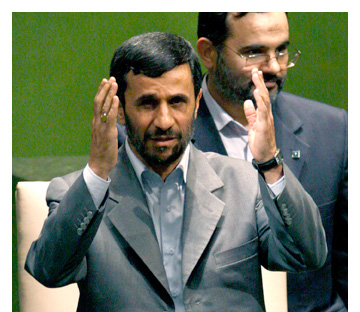
The so-called crisis over the Iranian capture of 15 British sailors and Marines in the Persian Gulf ended rather quickly, perhaps to the dismay of some who may have been looking for a prolonged standoff to provide a casus belli for armed intervention. The way the crisis started and why will be the subject of numerous analyses for days to come. But the way it ended — as a “gift to the British people,” in the formulation of Iranian President Mahmoud Ahmadinejad — was Persian grandiosity at its finest, and a political victory for the beleaguered leader.

Most Iranians, including many in government, were on holiday when the British sailors from the HMS Cornwall were captured by a naval unit of the Revolutionary Guards on March 23. The Iranian new year, which begins with the official ushering in of spring and runs until its 13th day (coincidence, perhaps, that the British captives were freed exactly 13 days after the capture?), is a time when even the newspapers cease to publish. Tehran, one of the most crowded cities in the world, becomes a comparative ghost town. (Think Paris in August.) Some have suggested that Iran’s seizing the British sailors was a premeditated move to rally popular support around the government, or to distract the population from other, namely nuclear, issues. But those notions were clearly preposterous to any Iranian observer; the fact that there was little coverage of the “crisis” inside Iran, at least early on, made that abundantly clear.

Though the Iranian government insisted from the start that the British sailors were caught in Iranian waters, curiously, President Ahmadinejad, never one to shy away from speaking on behalf of his nation, or even to make an issue his personal crusade, was conspicuously silent. That a week of the “crisis” went by before he made his first comments (and mild comments at that) showed who was really in charge: Supreme Leader Ayatollah Ali Khamenei. The Revolutionary Guards report directly to him, and whether or not Khamenei knew in advance of the military gambit, he was definitely calling the shots on this one and wanted no interference from presidential quarters.

And Khamenei is a master at the kind of game the British seemed to want to play, at least in the beginning: tough words, and an insistence on the veracity of their version of the events. The British maintained echoes of a colonial attitude, at least in the eyes of the Iranians, about their presence in the Persian Gulf, which the state-owned BBC referred to as the “Arabian Gulf” in its broadcasts — an insult of the highest order to any Iranian, Islamic or not. When the British government went public with GPS coordinates of the captured boat and began discussions at the U.N. Security Council to condemn Iran’s action, Iran’s response was to put the British sailors on television.

It was an act that seemed provocative and self-destructive to many people in the West — but was in fact quite brilliant in its execution. The Iranians showed the British captives on Iran’s Arabic language satellite station, a station that hardly anyone inside Iran actually watches (very few Iranians speak Arabic). But its broadcasts are beamed to Arab countries across the region, where Iran has much support and sympathy among ordinary people.

And the message was clear enough: Iran was treating the British, hated though they are, very well — unlike the way the British and Americans treat Arab prisoners, whether in Basra, Abu Ghraib or Guantánamo. No hooded or shackled prisoners here, certainly no humiliating human pyramids. In Iranian custody, the captives played chess and ate well. Upon receiving their freedom, they were attired in civilized-looking, albeit Tehran-made, suits.

The British sailors appeared to admit their trespass into Iranian territory on television without any visible signs of coercion. Many in the West may feel certain that the sailors’ “confessions” were made under duress, but it should be remembered that even were the Arab street to believe that, their conclusion might well be that the British naval personnel were extremely weak, given that they were seen enjoying hearty meals and were not terribly nervous.

Either way, the Iranians were winning where it mattered. The Arab street was being reminded that the British, once hated as colonial masters in the region and now hated as servants of the U.S., were meddling in both Iraq and in Iran’s territorial waters. And if the Arab governments were too timid to do anything about it, well, the Iranians weren’t. Any downside to a reaction of disgust by Westerners at the display of the confessions was tempered by the knowledge that Iranian power and British weakness, even humiliation, was on display for the whole world to see.

And inside Iran, for those Iranians less preoccupied with vacation, the sense from the very beginning was that the British — along with their bullying big brother — are up to no good in the Gulf and more than deserved to be called out on it.

Iran also quickly saw an advantage to be gained, at a time of mounting threats by the U.S., Britain and Israel against its nuclear program, in showing that it is not toothless in the face of mightier and technologically superior forces in the Gulf. The relative ease with which the Revolutionary Guards made off with their captives — amid a host of U.S. and British naval vessels almost bumping into each other in the shallow waters off the Iranian coast — was doubtless a cause for celebration in Tehran. It also surely caused some worry among other Gulf states, those that depend on the U.S.-British alliance for their protection.

Within the corridors of power in Tehran there was undoubtedly much discussion on how to proceed with the “crisis.” Ayatollah Khamenei’s style, ruling by consensus, showed in the seemingly schizophrenic pronouncements coming from various government sources, both hard-line and pragmatic. But Khamenei’s success lies in that very style; he will allow various competing parties a certain amount of freedom of opinion and action, and when he feels the time is right, he will quickly make a decision and have it acted on immediately, before anyone has a chance to object too strenuously.

It is hard to know exactly where Ahmadinejad stood on the issue up until his announcement that the sailors had been pardoned (pointedly not by him, but by “Iran”). But wherever Ahmadinejad stood earlier, he clearly wanted, in his vainglorious style, to be the person who delivered the good news of their release. The 13th day of the Persian New Year, Norouz, was on Monday, a day Iranians know as seezdah-bedar, traditionally a day to spend outdoors. That day, Ahmadinejad announced a press conference for Tuesday, the first real working day of the Persian year, a sign that there might be some news on the British captives as well as on Iran’s nuclear program. The press conference was quickly postponed to Wednesday, indicating that either Ahmadinejad didn’t have the Supreme Leader’s approval to hold one yet, or that there was still some maneuvering to be done by him to ensure that he could be the one to make the announcement.

It is quite likely the decision to “pardon” the British captives had already been made on Monday; what remained to be worked out was how to extract maximum advantage for Tehran. Ahmadinejad, more often the angry, indignant or sometimes offensive public face of the Islamic Republic, was going to be allowed a heroic moment — a moment he desperately needed at a time when even his conservative supporters are questioning his leadership.

Stories are told in the Middle East of the Prophet Mohammad’s good deeds and his compassion, even for his enemies, and Ahmadinejad was going to be, Saladin-like, compassionate. The Iranians had made their point, and in a gesture of Shia Muslim magnanimity, after only 13 days of captivity, the sailors were going home in time for their very own Christian holiday of Easter.

The view from Tehran

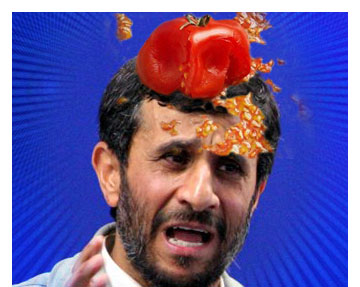
Iranians are fed up with the high price of tomatoes and their provocative president. But it would be dangerous for Bush and the West to overlook their national pride.

  • more
    • All Share Services

The view from Tehran

At the local greengrocer on the corner of Hedayat and Safi Alishah, in the decidedly unchic downtown section of Tehran where I’m staying, the fruits and vegetables are stacked high in perfectly formed pyramids. A dilapidated pickup truck parked in front and loaded with fruit stacked in boxes serves as a billboard for passing motorists as well as extra square footage for the store. Oranges are most visible, a plentiful and cheap winter fruit, but tomatoes, a virtual staple in Persian cooking, are practically out of sight. Tomatoes, it seems, have become a valuable commodity in Iran these days, much to the dismay of everyone, including those in the corridors of power, for whom a kebab, salad or stew without tomatoes is an affront to the palate.

I was born in Tehran and speak fluent Farsi, though I largely grew up in Europe and the United States. I have been traveling to Iran over the past three years, returning again in mid-January for six weeks to continue researching a book I’m writing on Iran and Iranians.

Much has been made in the media of growing discontent inside Iran with President Mahmoud Ahmadinejad, and in Tehran sentiments are indeed openly expressed against him and his administration in many quarters, including some of his own. It may be tempting, therefore, to imagine that the “Iranian people,” those to whom President Bush often refers as aspiring to the very same thing we do, i.e., “freedom,” are becoming as dissatisfied with their political system as they are with their president. However, it would be dangerous — and all the more so if the imagining is done by the White House — to make such a presumption.

Iran’s rather unique notion of democracy may not jibe with Western notions, but there are remarkable similarities that are often overlooked by analysts sitting at their desks a few thousand miles away. Iranians, like Americans, vote for their president and fully expect him, perhaps as naively as we do, to deliver on his campaign promises. As Bill Clinton’s campaign slogan once went — “It’s the economy, stupid” — so it goes in Iran. Foreign policy — what we are most concerned with when it comes to Iran and its unusual leader — is relevant to the Iranian masses only inasmuch as it affects their pocketbooks and, of course, their broader sense of security.

And in Iran the economy is reeling. Bread and dairy prices are fixed by the government, but fruit prices are not, and as inflation has been particularly bad recently, Iranians have focused on tomatoes, found in practically every Iranian dish. Food price increases and astronomical home prices are making it difficult for the already squeezed working classes — who were promised a share of Iranian oil wealth by Ahmadinejad — to make a living. The unemployment rate, officially put at around 12 percent, is in reality 20 percent, or even higher, according to experts.

Every day when I try to hail a cab on Tehran’s streets, private cars stop and offer me and others standing nearby a cheap ride. The drivers do not fit the profile of gypsy cab operators in cities such as New York; they are in many cases college graduates for whom there simply is no other work. Recently, I asked one licensed cabbie if he resented the competition, and he merely shrugged. “Why should I?” he asked. “Everybody’s suffering, and if they could find better work they wouldn’t be doing this.” The blame for the economic woes of ordinary Iranians is laid squarely at the feet of the government — and to Iranians that government is President Ahmadinejad.

As for security, the massive buildup of U.S. naval forces in the Gulf has not gone unnoticed by the Iranian masses, who need only pause by a newsstand for a few moments a day and read the headlines of some 40 dailies neatly laid out on the sidewalk. Ahmadinejad’s promises (both prior to and during his presidency) to alleviate Iran’s economic woes have fallen short, and the style (but not necessarily the substance) of his foreign policy is widely viewed as having exacerbated the economic crunch and contributed to the sense of insecurity.

The United Nations Security Council resolution of December 2006 imposing sanctions on Iran for its refusal to suspend uranium enrichment is viewed here as an Iranian foreign policy failure. This is not because Iranians disagree with Ahmadinejad’s sometimes belligerent and always defiant insistence that Iran will not give up its rights under the Nuclear Nonproliferation Treaty — but because the result of that resolution is that tomatoes have, since the passage of the resolution, become unaffordable to the Iranian masses. The Holocaust conference in Tehran that preceded the U.N. vote is not derided so much because of its preposterous premise but because of the perception that it unfavorably swayed the U.N. vote, which has in turn resulted in tomatoes becoming unaffordable.

The current Iranian administration’s goading of President Bush and the U.S. government — whether on Iraq, Lebanon, the Palestinian question or basic issues of Iranian and American power — is not viewed as illegitimate. But it is seen as having resulted in unilateral U.S. economic sanctions (and undue U.S. pressure on European and Asian allies), which mean foreign letters of credit are essentially now unavailable to Iranian businesses. This will cause them to downsize, especially if sanctions continue or even expand, and will exacerbate Iran’s already unenviable unemployment rate.

Bush’s speech on Jan. 10 was keenly watched and read in Iran, and its emphasis on aggressive confrontation with Iran, along with the subsequent raid on Iran’s “consulate” in Irbil, Iraq, is viewed partly as a reaction to Ahmadinejad’s foreign policy (and also, fatalistically, as evidence of unending U.S. hostility toward Iran). The muted European response to the seizure of Iranian “diplomats” in Iraq, however, is viewed as evidence of Ahmadinejad’s unpopularity abroad, an unpopularity that has resulted in European banks agreeing to American demands that they curtail their dealings with Iran. (This is emphasized more than the threat to European banks’ U.S. operations if they don’t cooperate with U.S. policy.)

Iranians here are neither shy nor fearful in expressing their dissatisfaction with their president. And as much as the White House wills it to be, Iran is neither a police state nor does it resemble a dictatorship along the lines of Saddam Hussein’s Iraq or Kim Jong Il’s North Korea, despite periodic crackdowns on journalistic freedom and free speech. Few people here feel the kind of oppressive air often heard about in the West. It’s remarkable how freely people speak out, and drink liquor and smoke dope and have unmarried sex, without fear of a secret police. Depending on where one is in the country, Iran can feel like a modern southern European state or a peaceful and modernizing third-world country.

And in terms of public opinion, a sense of President Ahmadinejad’s stature in Iran is not unlike the sense of President Bush’s stature one might now find in New York, or even in the Midwest. Since Ahmadinejad’s popularity started falling precipitously at the end of 2006, the newspapers have been filled with extremely harsh criticisms of him and his government. If Ahmadinejad’s honeymoon with both Iranian voters and the Iranian media has been even shorter-lived than Bush’s (which was extended by the events of 9/11, as it was), it does not mean that he is politically doomed, nor does it even mean that he cannot regain his popularity. In the minds of Iranians, foreign policy is in some sense inextricably linked to the price of tomatoes. But it is by no means certain that Iranians, who seem to prefer that their president project a more benign image abroad, are willing to forgo what they believe to be nuclear independence in order to buy cheaper tomatoes.

The most common political view expressed in Iran is one of justice and a nation’s rights. For many decades Iranians have felt that their leaders have sold those rights away for a pittance, and foreign concepts of justice simply mean foreign hegemony and exploitation. The nuclear issue clearly fits into Iranians’ worldview, and even those among the Westernized and highly educated population in Tehran — which openly worries about war and believes President Ahmadinejad to be incompetent at best — admitted to me in discussion about the nuclear standoff that Ahmadinejad is right in saying that the Americans “harf-e zoor meezanan,” literally “speak in the words of force,” but meaning that the Americans want to impose their views regardless of what is right or fair.

However, the Iranian government has to carefully balance its foreign policy goals with economic programs. Iranian obsession with the price of tomatoes is evident in the airtime the subject still receives on national television and in Ahmadinejad’s remark, widely ridiculed here, that people should shop in his neighborhood because the price of tomatoes at his corner bodega hasn’t increased. Ahmadinejad actually was not too far off the mark with his quip, which was intended as much as a dig against the nation’s elite as a defense of his economy. Still, his populist tone isn’t putting tomatoes on the tables of the working classes.

On a weekday afternoon at the Behjatabad bazaar, however, Tehran’s chicest and most expensive outdoor food emporium, tomatoes of every variety are piled high in front of the vegetable stalls, and hawkers beckon the well-dressed shoppers to sample their wares. The exquisitely red tomatoes, out of reach for most south Tehrani residents, are bought by the kilo by men and women who pull up in their $120,000 Mercedeses and $60,000 BMWs, in a city otherwise filled with $8,000 Iranian-made cars. Many of them will go on to discuss the price they paid at dinner parties with the same seriousness they reserve for discussing the Dow Jones average or foreign-exchange rates.

The open dissatisfaction with the Ahmadinejad government should be viewed as being not unlike the dissatisfaction European and Asian voters often express with their presidents and prime ministers, and not as a prelude to the fall of an entire political system, in this case the Islamic Republic. Other than the minority of elite and secular Tehranis who would like nothing better than some version of a Western democracy — albeit only if their class can wield power — it is hard to find anyone here who feels that an ideal Islamic democracy is an unachievable goal under the concept of “velayat-e faqih,” or rule of the jurisprudent. “The people of Iran” to whom President Bush beckons do indeed desire freedom, and they consistently express themselves in what are reasonably fair elections (certainly if one includes the Florida and Ohio standards of 2000 and 2004). But it is a monumental mistake to presume that the freedoms they seek are precisely the same ones Americans do.

One need only witness the massive participation in Shiite mourning ceremonies marking Tasua and Ashura at the end of January and beginning of February in Iran to grasp the fact that Iranians are by and large not only deeply religious but reasonably comfortable with the concept of velayat-e faqih, which is the fundamental philosophy of the Islamic Republic. Iran today is still very much a Shiite country and a source of inspiration to Shiites everywhere. In Yazd, for example, self-flagellation ceremonies at the Hazireh Mosque included large organized groups of Afghans and Iraqis, who beat themselves with chains with as much vigor as, if not more than, the locals.

It may be serendipitous for Ahmadinejad that his low point in popularity came both during Muharram, the most holy of Shiite months, and during the celebrations for the anniversary of the birth of the Islamic Republic. It is during these times that Iranians are most united — particularly if faced by threats from abroad. From the anniversary of the day of Ayatollah Khomeini’s arrival in Iran in 1979 (Feb. 1) until the anniversary of the victory of the Islamic revolution on Feb. 11, Iranian television broadcasts back-to-back documentaries on the revolution, Imam Khomeini (who is still very much viewed as a saint by a large part of the population), and foreign plots and intrigue against the Iranian people. Friday-prayer leaders and top officials across the country remind their bigger-than-usual crowds of the importance of unity in the face of outside threats, namely the U.S. and Israel. Even Hashemi Rafsanjani, the former hojatoleslam who is now ayatollah — and Ahmadinejad’s political nemesis — has felt the need to toe the government line on Iran’s nuclear policy, which rejects any preconditions for negotiations.

On Feb. 2 in Yazd, the current Friday-prayer leader, the mild-mannered, moderate and very charming Hojatoleslam Sadoughi, leaned on an automatic rifle as he stood at the lectern. Sadoughi, who as prayer leader is also the supreme leader’s representative in the region, subtly reminded his audience that the revolution is at all times ready to defend itself.

However, Iranians by and large do not believe that the United States will attack Iran, mostly because they cannot envision that the White House could be so very stupid. Perhaps, as I have suggested to some, they put too much faith in the wisdom of George W. Bush. One former Revolutionary Guard told me, with absolutely no animosity, that Americans could not be so foolish as to attack a country where 10-year-olds have been willing to strap grenades to their waists and run under enemy tanks (referring to the Iran-Iraq war). Iranians generally agree, albeit nervously, with their government that U.S. aggressiveness and recent military moves are part of a psychological war to frighten Iran. Whether or not that it is the case, the Bush administration would do well to remember that a prideful Shiite Iran will choose martyrdom over humiliation any day of the week.

Yet Iranians are perhaps now more than ever willing to seek a rapprochement with the U.S., for both political and economic reasons. The attitude of the Iranian “street” is nowhere close to that of the Arab “street” today, and the sense of strength, even real power, that Iranians feel their nation wields means that they no longer see any downside to, nor feel threatened by, having relations with the United States.

Sadly, all indications are that another milestone opportunity is about to be squandered in favor of confrontation. President Ahmadinejad, who is not the decision maker on Iran’s nuclear policy nor even on Iran’s foreign policy goals, will in all probability survive politically. But his long-term survival will be better ensured if his government tones down the rhetoric on the nation’s nuclear prowess, so that any unreasonableness is viewed as coming only from Bush and the West. Equally important is Ahmadinejad’s government getting a handle on the price of tomatoes.

Continue Reading Close

Page 2 of 2 in Hooman Majd