Jeanne Carstensen

Voyage to the top of the trees

Just as Jacques Cousteau opened up the oceans, amazing tree-climbers are discovering a new frontier in redwood canopies 35 stories above the forest floor.

  • more
    • All Share Services

Voyage to the top of the trees

Flying around the planet via Google Earth, it’s easy to despair that there is nothing left for humans to discover. Having mapped every inch of the planet with satellites, we can type in London or Darfur or Redwoods National Park and see pigeons circling above Trafalgar Square, a tent city spreading out across the desert, or the green expanse of the forest canopy. This ability to instantly possess images of almost any place on any continent, to zoom in on a certain tree or building (hello, Dick Cheney!), then zoom out as if piloting a plane, can make the world feel like an entirely known quantity, bereft of mystery.

Then comes Richard Preston’s thrilling, wondrous book “The Wild Trees.” Trees — the most familiar and beloved of all plants — turn out to be as unexplored by science as Tibet was by the West before Alexandra David-Néel dressed as a man and sneaked over the Himalayas into the forbidden kingdom. The tree of life may be the archetypal symbol of the human experience, but we don’t know as much as we thought about the life of the tree — especially that of the redwood, the tallest species of tree on the planet. Higher than the W Hotel in downtown San Francisco, redwoods can grow to be 370 feet tall, and until very recently nobody thought, or dared, to climb them.

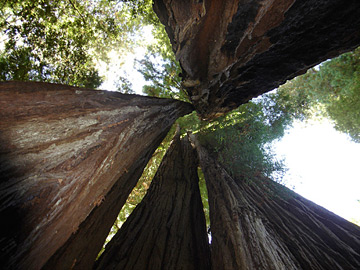
But a new breed of tree-loving eccentrics — some of them are scientists, others have an almost mystical attraction to the species — has discovered a world above the forest floor, an aerial forest 250 feet aboveground teeming with biodiversity that is largely “undescribed” by science. “The forest canopy is the earth’s secret ocean,” Preston explains, “and it is inhabited by many living things that don’t have names, and are vanishing before they have even been seen by human eyes.” Possessing amazing regenerative powers, redwoods react to ravages of nature such as fire, drought or lightning by sprouting new trunks, as many as 200, from the old main trunk high in the air. The granddaddy trees can live between 2,000 and 3,000 years, approximating the age of the Parthenon.

The patches of virgin coastal redwood forest that dot the map in Northern California in Mendocino and Humboldt counties were protected from logging operations by conservationists in various stages from the 1900s through the ’60s. Comprising 170,000 acres, this remaining redwood country represents only 4 percent of the virgin rain forest that once blanketed the coast from Big Sur to the Oregon border. The light in these forests has an enchanted, golden quality as it filters down through the dense canopy above, which is often licked by fog rolling in from the Pacific Ocean. Coastal redwoods, or Sequoia sempervirens, thrive in the damp, temperate climate just out of reach of the salt air. Preston, who in the course of writing this book became an elite tree climber and one of only several dozen people to have entered the deep redwood canopy, compares the remaining shards of forest to “a few fragments of stained glass from a rose window in a cathedral after the rest of the window has been smashed and swept away.”

A science writer for the New Yorker known for his “dark biology” series of books about biological warfare and killer viruses, Richard Preston has written extensively about the fearful power of nature, especially when unleashed by human ignorance, arrogance and greed. “The Wild Trees,” which began as a story in the magazine, is also a cautionary tale, about the destruction of the forests, and especially forest canopies, where half of all species on earth are thought to exist. But really it’s a love story — about love of nature and discovery, of tree climbing, and of botanists for each other. It’s so beautifully written that I found myself reading it out loud.

Back in the 1980s, Steve Sillett, the man who would become a world-renowned forest canopy botanist, took a trip to redwood country in a beat-up old Honda with his brother, who was visiting from Arizona, and a fellow student from Reed College in Portland, Ore. Just 19 at the time, Sillett “had flaring shoulders, and his eyes were dark brown and watchful, and were set deep in a square face.” Sillett had already started climbing Douglas firs in Oregon, but he wanted to see the even bigger redwoods in Northern California. Without a clear plan, the three young men plunged into Prairie Creek Redwood State Park and started bushwhacking through the dense forest until Sillett suddenly tossed off his pack, stared up at a 300-foot redwood and declared, “I’m lusting for this tree.”

While Sillett’s brother watched in horror below, fearing that Steve had lost his mind, Sillett and his friend Steve Marwood threw themselves into a small tree next to the giant and climbed branch by branch to its top, which is called a “leader.” Seventy feet aboveground, the leader swayed under his weight as he stared across the gap between himself and the lower fragile branches of the immense redwood trunk. Struggling to control his fear of heights, he threw his body into space and grabbed the branch like a trapeze, landing safely in the tree. Sillett and Marwood climbed the crown of the immense tree they called “Nameless,” entering a dense labyrinth of branches more than 200 feet high holding beds of soil where masses of ferns, lichens and ripe huckleberries grew.

“The top of Nameless had been sheared away in a storm that occurred many centuries earlier, and the tree had reacted by driving a radiance of branches spreading horizontally in all directions away from the broken trunk, like spokes coming from the hub of a wagon wheel. Those branches had sprouted vertical trunks, like spikes on a crown. A forest of small redwoods had sprung out of the top of Nameless — Nameless Wood.” As far as anyone knows, Sillett was the first person ever to visit the upper redwood canopy. It was one of “the last unseen realms on the planet.” He has dedicated his life to canopy science, going on to make the first 3-D map of the upper reaches of a virgin redwood grove, where new species, such as earthworms and lichen, are still being found. He also became a master tree climber; never again would he climb a giant without the proper equipment — it’s a miracle he didn’t die that day.

The redwood defines “superlative,” not only in terms of big, but in terms of complicated. It is “the largest and tallest individual living organism that has appeared in nature since the beginning of life on the planet.” The fern gardens in old redwood crowns are second only to Olympic Peninsula rain forests in their density, and scientists estimate the crowns hold so much water they function as airborne aquifers, supporting species such as salamanders and copepod crustaceans, the most abundant animals in oceans. The oldest titans, such as Ilúvatar, in Prairie Creek Redwood State Park, contain some 37,000 cubic feet of wood and are so dense you could “put on a pair of snowshoes and walk around on top and play Frisbee there.” Many of the trees, Preston explains, reiterate themselves numerous times in the crown, repeating their own shape in smaller scales of size in the form of a fractal. Ilúvatar has done so six times, creating “Ilúvatars within Ilúvatars, ” and is considered one of the most complex living structures ever discovered.

In 1963, National Geographic writer Paul Zahl found the tallest known tree on earth — a 367.8-foot behemoth that would become the centerpiece of Redwood National Park. The magazine dubbed it “the Mt. Everest of trees.” The record stood for almost three decades, until a college dropout and door-to-door Cutco knife salesman named Michael Taylor eyeballed the beast and immediately sensed that the celebrated tall tree was tall but not a record-breaker. Indeed, its top had died and fallen off. Thus began the career of an amateur tree lover who used handmade instruments (he later graduated to more state-of-the-art equipment) to measure trees in the dense backcountry of Humboldt County’s redwood parks. His obsession, which he shared with Ron Hildebrant, a post office employee who worked the night shift, led him into unmapped rain forest choked with fallen logs and vegetation for days on end, causing his lonely girlfriend back in Arcata to refer to herself as a “tree widow.” Dismissed at first as a “woo woo” tree-hugger by park rangers, Taylor went on to discover many groves of giants that had not been mapped by the park service or anyone else. Much of “one of the most important ecosystems in North America” had, until Taylor came along, been “unexplored at the most basic level, the level of a map.”

After three months of exploring around Prairie Creek Redwoods State Park, Taylor found an immense redwood that he named “Atlas,” part of a grove of titans that many botanists consider to be the “Sistine Chapel of the world’s forests.” Other world-class redwoods over 350 feet tall that Taylor, Hildebrant and Sillett discovered and named include Kronos, Rhea and Zeus in the Atlas Grove, Illúvatar, Earendil, Elwing, Adventure, Sir Isaac Newton, Graywacke, Thunderbolt, Paradox, Harriet Weaver and Bamboozle. In the tradition of botany, the exact location of most of these trees, considered to be rare plants, is known only by a handful of scientists and their collaborators. In his stubbornness and curiosity, Taylor resembles past explorers who struck out for unknown lands. Preston writes, “He was a man who could find beauty in the small, hidden places that still existed on earth, the lost places that nobody had ever noticed.”

Although Sillett free-climbed up Nameless at 19, he had a lot to learn about technical tree-climbing. Canopy science began to explode in the 1990s and pockets of tree-climbing fanatics in Australia, Costa Rica and the Northwest developed new methods and technologies for reaching the upper canopy. A French scientist had invented a sort of airship raft for studying the rain forest in French Guyana, and various aerial trams had been built to suspend scientists in the midst of the upper branches, but tree-climbing techniques adapted from arborists’ methods, using soft ropes and boots so as not to damage the tree, were the most effective.

To imagine how intimidating it must be to climb a redwood titan, look at the 25th floor of a skyscraper: That’s about where the first solid branches appear off the main trunk. To ascend such a tree, Sillett uses a crossbow to shoot a line up over a sound branch and then pulls on the line to drag the main 600-foot-long climbing rope over it and back down to the ground. He then attaches ascenders to his climbing saddle and “jugs” himself up the long dangling rope. From the photos on Preston’s Web site — the book has beautiful line drawings only — the scale of the tiny climber hanging out in space next to the enormous trunk is similar to that of a mountaineer dwarfed by a mountain. Once in the crown, he detaches himself from the main rope and moves about, often horizontally as a monkey would travel, using a specially manufactured V-shaped spider rope. Among the many hazards of redwood climbing are “widow-makers,” chunks of dead wood, “sometimes bigger than Chevrolet Suburbans,” that can break loose and crush the climber.

Part of what makes “The Wild Trees” such a pleasure to read is that Preston himself drinks the Kool-Aid. Hardly a detached observer, he studies tree climbing at a school outside of Atlanta, takes to the woods behind his house in New Jersey, learns advanced techniques, and earns the respect of Sillett and the other scientist-climbers that leads to his climbing redwood titans side by side with his subjects. So when he writes about what it feels like to be 300 feet about the ground in a redwood, he’s not guessing: “There is something unnerving about leaving the main rope behind and going into motion in the crown of a redwood. The main rope is a lifeline that connects a climber to the ground, an escape route out of the tree. Once you disconnect from the main rope, you’re on your own,” he writes about his ascent of Adventure with Sillett and his botanist wife, Marie Antoine. His enthusiasm for tree climbing is so great that his three children also get the bug. For a family vacation, the Prestons travel to remote Glen Affric in Scotland to climb into the 400-year-old Caledonian pine canopy, the first climbers ever to do so. Preston also travels with Sillett and Antoine to Australia to climb the Southern Hemisphere’s tallest trees — the mountain ash, or Eucalyptus regnans, and gets covered with leeches in the process.

Somewhat surprisingly for a science writer, Preston is as passionate about people as he is about trees, giving the human characters starring roles alongside the redwoods, which is a diva species if there ever was one. Much of the early part of the book chronicles Sillett, Taylor and Antoine’s childhoods, all of which are notable for their ordinariness. But Preston finds in their stories the events that shaped their overwhelming love of nature. Marie Antoine, who grew up on a remote island in Ontario, Canada, and lost her mother to cancer when she was a girl, used to lie awake on winter nights listening to the ice cracking on the nearby lake: “The night was growing colder, and the ice was making ringing sounds, like church bells peeling. And then, mysteriously, frighteningly, all the sounds of the ice stopped, and there was complete silence. Marie felt almost overwhelmed by the stillness within the lake, a silence so profound that she could feel it inside her body.” Steve Sillett and his brother Scott, who is now an ornithologist at the Smithsonian, had a gruff, chain-smoking grandmother named Poe who taught them about the birds and plants in the woods near their home in Philadelphia. We follow Sillett’s heart throughout the book, as it breaks over the loss of his first love (who didn’t share his tree obsession) and then is united with Antoine, whom he marries — of course — while suspended midair between two redwood giants.

In the summer of 2006, Taylor and his friend Chris Atkins discovered what really may be the Mount Everest of trees. Bushwhacking into a canyon in a remote area of Redwood National Park that is almost impossible to enter on foot, they found Helios — which measured a whopping 375 feet. The next day they set their lasers on yet another giant, Hyperion, which turned out to be even taller, 379.1 feet — currently the tallest known tree. Later, when Sillett climbed Hyperion, a “wild tree” (meaning it had never been climbed before), he radioed down to Marie Antoine that he’d seen some brown ants. “That may be a new species,” Sillett said. Just as Jacques Cousteau opened up the oceans, Sillett, Taylor, Antoine and the other amazing tree geeks in Preston’s tale have found a new frontier in the earth’s forest canopies. Thanks to their passion, we can finally see the forest for the trees.

Snuggling with anacondas

Jesus Rivas talks about wrestling the biggest serpents on earth and how he came to travel with two pillowcases full of snakes on a plane.

  • more
    • All Share Services

Snuggling with anacondas

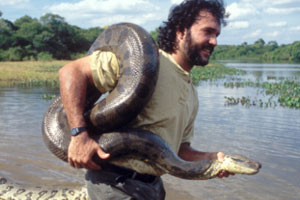
Jesus Rivas loves the green anaconda. The object of his affection is the biggest snake on earth, which regularly dines on 7-foot caimans (Spanish alligators). Rivas loves them so much that he walks barefoot through the swamps of Venezuela, his native country, until his toes touch one of the serpents lounging in the mud, at which point he wrestles them into submission. Perhaps for obvious reasons, field studies of the anaconda were virtually nonexistent before Rivas began pursuing his herpetological passion in the late ’80s. Since then, he has captured more than 900 anacondas in the wild and carefully studied their life cycle — including the previously undocumented “breeding aggregations,” the balls of small male snakes that struggle to impregnate a giant female. Rivas has made several TV documentaries about his charismatic study animal, including “The Land of the Anacondas” with National Geographic. He’s now an assistant professor at Somerset Community College in Kentucky.

Salon spoke to Rivas by phone about how it feels to snuggle with an anaconda, what to do when a large female tries to wrap you in an “evil loop,” and the challenges of actually taking snakes on a plane.

What does it feel like to be close to anacondas. Are they cuddly?

They’re not cuddly. [Laughs.] But they’re not slimy, either. They’re very muscular. When you grab them, you feel you’re grabbing something hugely muscular underneath. The skin is smooth. It’s nice to the touch. When you squeeze it, you know you’re touching an extremely strong animal. You feel the layers of muscle under your hand. She normally grabs you back and holds you around your arm or leg. When I catch them in the wild they are upset, of course, and we have to wrestle.

You have to wrestle?

Yes, she grabs at you and you wrestle her back — normally with several people. After about 15 minutes, I will be panting and tired, but the snake will be just as tired because her metabolism is slower and she doesn’t recover as quickly. So after 15 minutes of struggle, the snake will just give up.

So is the snake trying to wrap herself around you and squish you in the “evil loop” the anaconda is famous for?

[Laughs.] I don’t let her do that, but that’s what she tries to do. It’s about knowing how the animal is going to turn to avoid being caught by the loop.

You mean you’ve never been strangled or bitten?

Normally I’m the one going after the snake. If the snake came after me, it would be a different story. Normally when they attack prey, they grab with the mouth and then wrap it in a loop. The really dangerous, powerful thing about the anaconda isn’t the bite but the squeeze. I have been bitten a few times, but they don’t bite to hurt. They bite to hold.

How do you find these large snakes in the swamps of Venezuela?

I know the kind of places where they live — usually in shallow waters with a lot of vegetation. I go shuffling through the water, feeling with my feet for them and poking with poles in the mud. Normally I find them by stepping on them.

You’re kidding. You step on it and then you reach into the water to grab it?

Yes, that’s when the fun begins. You know, when you step on something it could be anything. Could be a turtle, in which case there’s nothing to do — you’re going to feel the shell. You feel something hard, but you need to reach with your hand to really define what it is. Sometimes you can reach and feel something hard but scaly, in which case it could be a caiman, which is a smaller cousin of the alligator. When I say smaller, it’s 7 to 20 feet and with a very big mouth.

Why don’t you wear boots?

The boots really slow me down and I get stuck in the mud. Plus I have less capacity for feeling. You see, nothing will stop the jaws of a caiman. They will go right through the boot anyway. Even more dangerous is the freshwater sting ray. Its sting is reported to be the most painful thing in the world. But it would go right through the boot, too.

But being barefoot I can feel thoroughly and detect what it might be and pull out my foot sooner, which is better than putting on a clumsy boot and eventually getting hurt.

Also, I stopped wearing boots because of fungus. I developed a nasty fungal infection all the way up my ankles. It was horrendous. Without boots, my feet would dry more quickly and the fungus went away.

Can a mature anaconda actually eat a caiman?

Absolutely, yes. I have photos of that.

Could a mature anaconda eat somebody the size of Samuel Jackson?

How big is he?

He’s a big man. I’m guessing he’s over 6 feet tall.

How many pounds?

I’m not sure, but let’s say 200.

Absolutely. Snakes are known to eat things that size or even bigger. There are records of snakes eating prey that weigh 160 percent of their body weight. So a 200-pound anaconda could eat something that weighs 300 pounds — no problem.

So I’ve read that anacondas can get as big as 32 feet and weight 1,200 pounds.

That’s been reported, but the biggest one I’ve ever captured was 18 feet and about 220 pounds. I’ve noticed something I call the coefficient of amazement — the more amazement, the bigger the snake! Where I work in the Venezuelan Llanos there’s a long dry season. It could be that anacondas live longer in the Amazon, where it’s wetter, and therefore get bigger. But I don’t believe anything that I haven’t measured myself.

You travel the world studying anacondas. Have you ever traveled with snakes on a plane?

You know, I always try to avoid traveling with animals. But once I was doing a study in husbandry to see how well anacondas would do in captivity. The problem is, it’s hard to get babies in the wild because they have a very low survival rate. I had caught a few but there was a zoo in Barquisimeto, a small city west of Caracas, which had a big female who had given birth to a lot of babies — 29 baby anacondas. It was perfect. They agreed to give me the babies for my research, so I flew from Caracas to go pick them up. After spending a day there, I went to the airport with the babies in a pillowcase to take them back home.

A pillowcase?

The best cage, as any snake biologist knows, is a pillow case — there’s nothing else. If you’re a snake biologist, you won’t find any better device or cage.

You had 29 anacondas in a pillowcase?

Actually I had them in two. They weighed a little under a pound each and were about one-half to 3 feet long but they cram together really good. They were fine — they travel well. It was just a short half-hour flight back to Caracas.

It that legal?

Well, I had permits, but I still had trouble. This was a small-town airport and they didn’t have much security, no X-ray machines or anything — everything was hand-checked. So when it was my turn I decided I better tell the security guy that I have some snakes here because I didn’t want him to just open my bag of baby anacondas. He jumped and said, “You can’t travel with snakes on this plane, man! If those snakes get loose at 30,000 feet there could be a panic in the cabin. We can’t risk that.”

I told him not to worry. “They’re not venomous. And they’re nicely contained in a brand-new pillow case. There’s no reason they’re going to escape. If you want, I could double-bag them.”

Did you have extra pillowcases with you?

He wanted me to put them in a proper cage but I explained that there isn’t such a thing. You put snakes in a cage, they’ll slither right out of it. You can use a cage with a screen but what the snakes do is rub their noses against it and they wound themselves. So the best is a pillowcase.

The guy wouldn’t listen to reason. Next he tried to get the National Guard to confiscate the snakes because they’re wild animals. But I worked for Fish and Wildlife at the time and had all the paperwork.

Finally, the security guy said that he had to ask permission from the pilot. I’m standing out on the tarmac with my baby anacondas and everyone is walking past me to board the plane and overhearing the discussion. I thought I’d never get on but very soon the pilot comes out and waves me in.

But what were the snakes doing? Were they wiggling around?

No, the snakes are very calm animals. They do great in bags. They try and move and realize there’s no escape so they just chill out and cool down. With the air conditioning they tend to be colder than they like so they don’t squirm or move around. I hoped people would think I was carrying bags of cheese or something like that.

What happened when you got on the plane?

But by the time I boarded the rumor had spread. I had to go to the last seat and as I walked down the aisle everyone knew I was carrying snakes. Since the movie “Anaconda,” everyone is absolutely terrified of these animals, but the person who had the most extreme phobia was the security guy.

When you sat down, where did you put the two bags of snakes?

One in the overhead compartment and one underneath my seat.

How did they act at high altitudes?

I don’t know for sure, but the snakes under my legs didn’t move much. I don’t think they noticed. They were probably too cold for their liking.

What if those snakes had escaped?

I don’t think anything would have happened because the overhead compartment was locked.

But you did have some under your seat.

Well, yes. The first thing that could have happened is some of the passengers would have stepped on them. But they wouldn’t have attacked anybody. They were too cold. Anacondas like it from 85 to 90 degrees and above. The plane is set to 70 or 72 degrees. That’s a temperature at which they live fine but are not very active. Snakes depend on temperature in order to be happy.

So were the passengers happy?

I don’t know, but at the end of the flight the pilot wanted to see them. So I opened the bag and he said, “Oh, cool.” We were already back on the ground in Caracas.

Once I took some mature female anacondas to the gynecologist.

To where?

To the gynecologist — the OB-GYN. I didn’t have enough financing to afford the expensive field equipment I needed so I found a doctor who was willing to let me use his equipment to do an ultrasound. I offered to bring the snakes in on the weekend — they were several adult females between 9 and 17 feet long — but he told me to come in at 7 a.m. before his patients arrived. I got there with my snakes in a metal drum, got one out, wrestled it and put it on the table. The doctor was very excited because he could see the small baby snakes coiled up inside the mother, just like human babies.

Unfortunately, his patients started arriving before we were through. Four or five women saw me with the large anacondas and turned absolutely white.

Are there any other scientists in the world who go barefoot in the swamps looking for large snakes?

No. None that I know of.

Continue Reading Close

Page 2 of 2 in Jeanne Carstensen