Justin Sullivan
The unhealthy life of drawing
A South Korea-born illustrator talks about why she enjoys printmaking and art as autobiography
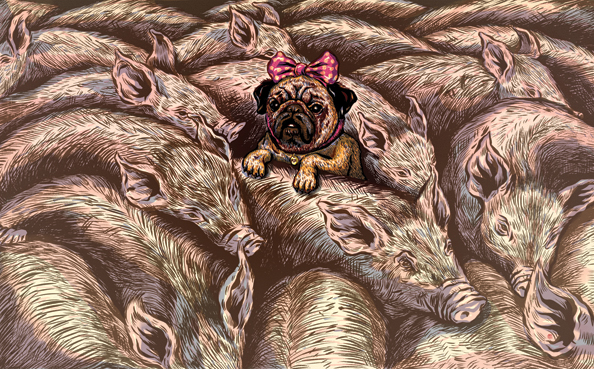
Illustration for The New York Times Book Review (art director: Nicholas Blechman) (Credit: Jungyeon Roh)
Soon after Jungyeon Roh began working as an illustrator, she had an unpleasant revelation. “I realized that we are just sitting and drawing all the time,” she says. “It’s really not healthy at all!” Movement is essential to Roh. Born in South Korea, she lived in Seoul for 23 years until a study-abroad program in her junior year of college led her to visit nine European countries in a month. Having caught the travel bug, she studied in Chicago before making her way to New York in 2006 to study at SVA.
Age: 29
Illustrator
From: Seoul, South Korea
Lives in: New York City
Website: jungyeonroh.com
Her interest in physicality and health eventually led her to printmaking, which requires a constant pushing, pulling and lifting. Roh had found a way out of the illustrator’s chair. That visceral engagement with life is evident in her work too, where Roh often shares embarrassing memories with a tragicomic intimacy. Pieces like “My Second Ex-Boyfriend”―featured in Print’s 2011 Hand Drawn competition―reveal shades of darkness amid manic scenes of junior-high romance. To illustrate a familiar tale of a crush gone awry, she uses a Crumb-esque style that makes commonplace scenes seem almost grotesque.
“There’s a certain sense of intensity to her work that feels surprising,” says the illustrator Josh Cochran, Roh’s thesis advisor at SVA. “I think she gives off a different persona in person, but she is definitely not afraid to get down and up close with a lot of her subjects.”
That is especially apparent in Miss Eggplant’s American Boys, which earned Roh a Gold Award from the Art Directors Club. Set to the lyrics of an Estelle song, the book tells the tale of a free-spirited woman in a giant eggplant costume on her journey to America. It’s weird and fantastical, but also clearly semiautobiographical. Such intimacy doesn’t come easily. “I’m from a conservative culture, so it can feel really embarrassing, but I just keep doing it anyway,” she says. “Drawing pictures is my autobiography.”

Miss Eggplant’s American Boys book for School of Visual Arts (art directors: Marshall Arisman, Carl Titolo), 2010
See the other 2012 New Visual Artists:
- Sang Mun
- Erin Schell
- Berton Hasebe
- Drea Zlanabitnig
- Casper Heijkenskjöld
- Kelsey Dake
- Jerome Corgier
- Tracy Ma
- Olimpia Zagnoli
- Ryan Thacker
- John Passafiume
- Lisa Hedge
- Jungyeon Roh
- Dafi Kühne
- Jing Wei
- Caleb Bennett
- Naz Sahin
- Serifcan Ozcan
- Brendan Griffiths
- George Michael Brower
Copyright F+W Media Inc. 2012.
Salon is proud to feature content from Imprint, the fastest-growing design community on the web. Brought to you by Print magazine, America’s oldest and most trusted design voice, Imprint features some of the biggest names in the industry covering visual culture from every angle. Imprint advances and expands the design conversation, providing fresh daily content to the community (and now to salon.com!), sparking conversation, competition, criticism, and passion among its members.
The philosophy of aesthetics
An exciting new designer uses graphics as a means for critical inquiry
(Credit: Erin Schell)
By all accounts, Erin Schell was doing well. She had a good job designing book jackets for a large company. But there was one minor issue: “I found working for a corporation and having a comfortable job sort of soul crushing and meaningless,” she says. “But that’s just me.”
How words shape design
An up-and-coming artist describes himself as a problem solver whose work is driven by an interest in language
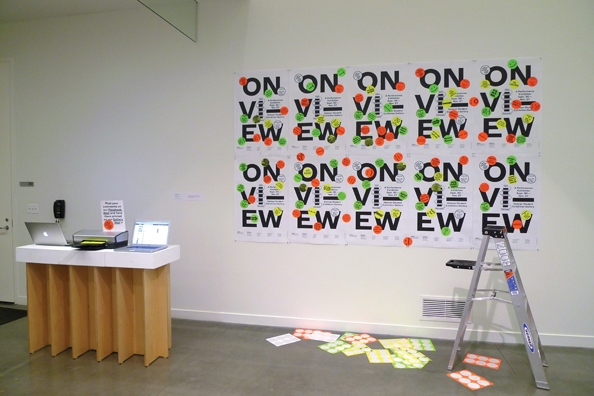
Sang Mun's "On View," black-and-white laser print with stickers, 2011
To be clear, Sang Mun is not a graphic designer. Speaking from his home in Providence, where he’s an undergraduate at the Rhode Island School of Design, he says, “I feel like a problem solver. I try not to restrict myself to the term ‘graphic design.’”
Age: 25
“More than a graphic designer”
From: Seoul, South Korea
Lives in: Providence, Rhode Island
Website: sang-mun.com/
America’s real school-safety problem
In the wake of Columbine, many educators have instituted zero-tolerance discipline. What is it teaching our kids?
Detail from the cover of Homeroom Security Last fall, a Delaware student was suspended from school after bringing a knife into his classroom. Because of his school’s zero-tolerance weapons policy, he was suspended for 45 days and forced to attend an alternative school. Swift justice? Perhaps — except that the student, Zachary Christie, was a first grader at the time and the “weapon” was his Cub Scout-issued fork-spoon-knife tool. When his case received national attention, his punishment and the school’s policy were swiftly revised — part of the growing groundswell of opposition to zero tolerance.
Continue Reading Close“The Last Gasp”: Can you take the pain out of executions?
What's the future of capital punishment? The author of a new book explains how suffering is shaping the debate
The gas chamber at the Mississippi State Penitentiary in Parchman, Miss. When the state of Utah executed Ronnie Lee Gardner this June, his death became the latest salvo in the ongoing national debate about capital punishment. Gardner’s decision to die by the seemingly archaic firing squad — opting out of the default method of lethal injection — gave a boost to those who have long argued that the latter is far from a “humane” form of execution. Over the last decade, there has been a growing debate over what constitutes the least painful way to kill a prisoner, with anti-death penalty advocates using the 8th Amendment ban on “cruel and unusual punishment” as the centerpiece of their campaign. It’s a strategy that has had winning results in the past. In 1994, when support for capital punishment peaked at a whopping 80 percent, the use of the gas chamber was deemed “cruel and unusual” in court and effectively discontinued as a means of execution. The last execution using poison gas in the United States took place in 1999.
Continue Reading CloseReclaiming Phil Spector’s troubled genius
While the legendary producer sits behind bars for murder, a new documentary examines his talent and charm
Music producer Phil Spector listens as the prosecution present their opening statements in Spector's murder trial at Los Angeles Superior Court in Los Angeles April 25, 2007. The trial of the pioneering record producer comes more than four years after actress Lana Clarkson was found shot to death at Spector's home. REUTERS/Gabriel Bouys/Pool (UNITED STATES)(Credit: © Pool New / Reuters) For many people, the name Phil Spector is now more synonymous with murder than with a long and illustrious music career. Famously labeled “the first tycoon of teen” by Tom Wolfe, his recording methods and innovations produced the type of songs that shaped the way we understand music: “Be My Baby,” by the Ronettes, “Then He Kissed Me,” by the Crystals, and “You’ve Lost That Loving Feeling” by the Righteous Brothers. From his role in creating “Wall of Sound,” the dense and layered music production technique that characterized an era, to salvaging the Beatles’ “Let It Be” and producing John Lennon and George Harrison’s solo records, no history of pop music can be written without him.
Continue Reading ClosePage 1 of 2 in Justin Sullivan