Lance Gould

He don't love you

It's the talk of the T.O.W.N.! Tony Orlando and Wayne Newton square off in the Show-Me (the money) State.

  • more
    • All Share Services

He don't love you

Last month, Wayne Newton signed the “most lucrative” contract of his quixotic career, a 10-year, 40-week-per-annum mega-deal with the Stardust Casino in Las Vegas. He won’t discuss the terms of his contract, but about 1,000 miles east of Vegas, Newton is thick in the middle of another potentially lucrative blockbuster to which the financial terms are public information.

Newton filed a $20 million lawsuit against fellow croonmeister Tony Orlando. Actually, Newton’s June 21 suit was a return volley — Orlando fired the first salvo in this real-life Celebrity Death Match, having launched his $15 million lawsuit against Newton two months earlier, on April 28. Their feud centers around the theater that — up until December –
Newton and Orlando shared in Branson, Mo.

Branson is, without question, the preeminent Ozark Mountain vacation spot. Replete with more than three dozen musical revues, paddle-wheel riverboat cruises and a 19th century theme park, it’s also home to a boatload of once-famous entertainers — from Andy Williams to Yakov Smirnoff — whose careers have gotten a third wind in this show-biz anomaly in the southwest corner of the “Show-Me State.”

But venture just a little bit outside of town — say 10 minutes south down Highway 65 — and suddenly you’re not in the “Las Vegas of the Midwest” anymore. There, in rural Arkansas, sandwiched between the Omaha Church of Christ and what’s left of the dilapidated Dinosaur Dumplin’ Palace, you’ll find Bax’s Guns of the Ozarks, a scary bumpkin bazaar whose sign advertises an “AMMO SALE 62 3.75 BOX,” whatever that means.

There’s just no escaping the fact that Branson, which wags have dubbed “the Redneck Riviera,” lies perilously close to genuine Hatfield and McCoy country, where feudin’ fever is as common as ‘possom pie. How else to explain why two performing pals — who had been friends for more than 30 years — would now be embroiled in a particularly ugly celebrity squabble?

Yellow ribbons and red roses

In case you snoozed through the ’70s, here’s a little refresher course to help you tell one cheesy entertainer from the other. With his band Dawn, Orlando recorded three No. 1 tunes: “Tie A Yellow Ribbon Round the Ole Oak Tree,” “Knock Three Times” and “He Don’t Love You (Like I Love You).” The trio even enjoyed a television variety show on CBS for two years in the 1970s.

Newton never reached No. 1 on the pop charts, though his repertoire, which includes “Danke Schoen” and “Red Roses for a Blue Lady,” may be familiar. Still, by maintaining a maniacal appearance schedule — mostly in Las Vegas — Newton is said to have become the highest-paid nightclub performer in history.

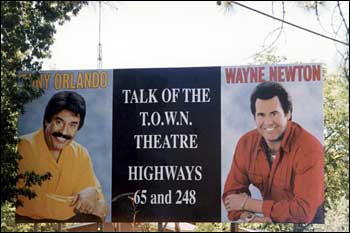
Though they took slightly different paths to fame, Orlando and Newton mined the same sort of fun, schmaltzy material, and the two former friends shared so much more. They both dropped their first names — Carson Wayne Newton had a professional “Carson”-echtomy, while Michael Anthony Orlando Cassavitis disposed of both his first and last names. In 1997, Orlando invited Newton to share the stage with him at Tony’s Yellow Ribbon Theatre in Branson. And in April 1998, they even leased a theater together, which they christened “The Talk of the T.O.W.N. Theatre,” an acronym for “Tony Orlando Wayne Newton.” Sadly, all they share today is their April 3 birthday. Oh, and a mutual hatred for each other.

That’s because their theater on Highway 65 at the junction of Highway 248, though still very much the talk of the town, has changed its name to the “Wayne Newton Theatre.” And it was here that, almost a year ago, Newton and his wife locked Orlando out in the December cold.

What could possibly have transpired to put good friends at odds with each other? To engage in a juicy “He said, He said” war of words in which accusations of illegal wiretapping, conspiracy, planting of evidence and the kidnapping of a young girl’s Christmas toys have played a part? To stage a battle royale in a Springfield, Mo., federal court where even the “Omnibus Crime and Safe Streets Act” has made a cameo?

Tony’s tale

In Orlando’s version of events, Tony heard that Wayne was considering leaving Branson because, according to Rob Wilcox, Orlando’s publicist, Newton had been involved in disputes with two other theater owners. Tony took Wayne under his Branson wing and got him a gig at the venue where he himself was performing, the Yellow Ribbon Theatre. When Tony’s lease at the Yellow Ribbon was up, he
fielded numerous offers from suitor venues, including the Glen Campbell Theatre. But Tony heroically made it clear that he would only come on board if his buddy Wayne was included in the deal. The Campbell people went for it, and the theater was renamed the Talk of the T.O.W.N.

According to court documents, it was agreed that White Eagle Inc., a theater management group and holding company whose sole shareholder is Kathleen McCrone Newton (Wayne’s lawyer
wife), would be the contractual lessee and run the business side of things.

But it seems as if Kathleen Newton was the Yoko Ono in this supergroup: She denied Tony access to expense accounts, raised the costs of his contributions to the joint “kitty” account and bullied him in attempts to get him to renegotiate the contract.

Things were starting to get ugly when Newton scheduled a powwow. On Dec. 9, 1998, Newton’s people met with Orlando and his people in
Newton’s dressing room — Wayne himself had left the theater hours earlier. Orlando alleges in
his suit that he got wind that something was amiss and went on to discover that Newton was secretly taping the meeting. A search of Newton’s dressing room, Orlando claims, revealed a tape recorder in a house plant.

Days later, the Newtons locked Orlando out of the theater and canceled his 11 remaining Christmas shows. In April 1999, one year after the curtains went up in the Talk of the T.O.W.N. Theatre, Orlando slapped Newton with a $15 million, 11-count lawsuit. While citing the Newtons’ “evil motive,” the suit’s counts included “a violation of the anti-wire-tap statute” in the Omnibus Crime Control and Safe Streets Act and a “civil conspiracy” to surreptitiously tape record Orlando and lock him out of the theater, “so that Wayne Newton would be able to rename the theater as the Wayne Newton Theater … and to enable Wayne Newton to have the theater to himself.”

How “Macbeth” is that? Tony “Duncan” Orlando rewards Wayne “Macbeth” Newton with a nice gig as the thane of Branson, when suddenly Kathleen “Lady Macbeth” Newton gets into the act, shouts, “Out, damned spotlight,” and encourages her husband to completely usurp Orlando’s power, claiming the kingdom as his own.

Intermission

(Featuring the music of Chuck Mangione.)

And now back to the story.

Wayne’s way

Newton’s side of the story is no less entertaining. In this account, Tony “Wimpy” Orlando will gladly pay White Eagle Tuesday for a share of the theater today. But many Tuesdays come and go and Orlando never does live up to his financial end of the bargain. First Newton says that Orlando’s “failure to pay his pro rata share of the expenses of White Eagle, Inc., generated from his shows and his share of the overhead in accordance with the Agreement was seriously straining the business relationship.”

Even worse, according to Newton’s suit, Tony was not exactly a stellar attraction. White Eagle was having trouble making ends meet due, “in substantial part, to Tony Orlando’s inability to draw even 50 percent of the 750 person per show attendance figure he had represented he would draw.” White Eagle also claimed that Orlando had suckered them into the agreement with false information as to his drawing power.

(Ron Stenger, the former owner of the Yellow Ribbon Theatre, confirmed that, when Orlando was headlining the Yellow Ribbon, “the draw was less than satisfactory” and that for the length of its four-year run, the theater was a “money-losing operation.”)

Oh, and as for Tony’s version of how he and Wayne got together in the first place? Wrong. In Newton’s account, it was he who was approached by the Glen Campbell people. The “principals wanted Wayne Newton as their headline performer, but if Wayne Newton agreed to certain provisions and other agreements could be reached, they would consider having Tony Orlando also perform at the theater.”

As for the taping scandal, Newton claims that it was Orlando who was playing Tricky Dick, not him. For some reason, Newton’s suit claims, the meeting that took place in his dressing room between Orlando and Newton’s agents was picked up by sound equipment onstage at Tony’s monitor board. Orlando instructed one of his henchmen to start recording the proceedings, unbeknownst to the other participants. At the intermission of Orlando’s show (the show must go on!), Orlando returned to Newton’s dressing room and told Newton’s rep that there was a wireless microphone in the room. A search of Newton’s dressing room ensued and — voil`! — a bug was found hidden in a house plant.

Ah, but there is an explanation for that, you see. That wireless mike had been placed in Newton’s dressing room “routinely … in an effort to determine the person or persons responsible for numerous thefts and vandalisms which had occurred in Wayne Newton’s dressing room involving professional and personal property of the Newton family.”

In his $20 million countersuit, Newton characterized Orlando’s actions as “willful, wanton, and malicious.” Such charges stem in part from claims that Orlando and his publicist knowingly disseminated false statements to the media, including the gem that “Newton refused to allow Tony Orlando to remove personal and professional items [from the theater], including holding his daughter’s Christmas toys hostage.”

Darn the torpedoes

So what do poor Bransonites do when these big-time show-biz movers and shakers come to town and start litigating? “No one really understands what happened,” Dori Allen, public relations manager of the Branson/Lakes Area Chamber of Commerce and Convention Visitors Bureau, said. “We all just went, ‘Darn.’ We knew there was some kind of tiff. This is something that would not happen in our everyday lives, but it would be great if they
could work this out.”

Listening to their respective corners, that doesn’t seem likely too soon. “Tony had a very difficult time realizing that someone he thought was a friend didn’t have the same good intentions that Tony had in his heart,” Wilcox said. “But now he’s doing incredibly well. For the millennium, he will be headlining the Taj Mahal in Atlantic City. All of the spinning that the Newton side has been trying to do isn’t going to hold water.”

Newton’s lawyers sent me a formal “Response to Tony Orlando’s Publicist’s Remarks”:

With Tony Orlando’s obsessive desire for publicity on this story, or lack thereof, it has become apparent that Tony Orlando has chosen to ignore the distinction between what is truth and what is fiction. He is a poster boy for the old adage “if one tells a falsehood long enough and to enough people, that alone makes it true.” Tony’s one-sided story is just that, a story, a fictional story. Mr. Newton has no problem sleeping at night and spends his entire day not thinking about Tony Orlando or his attempt at writing fiction.

The last week in October, Newton inked the deal with the Stardust Resort and Casino. Forty weeks of every year he will headline the hotel’s newly named performance space, called — wait for it — the Wayne Newton Theatre. His lawyers say he will also honor his Branson contract, which runs through 2001.

“Mr. Newton still does have obligations in Branson,” said a
spokesperson, “which he will absolutely fulfill because he is a man of his word.”

I asked one of Newton’s lawyers if this new deal would patch things up between the boys and bring Orlando back into the Wayne Newton Theatre.

“Turning it back over to Tony implies that Tony had it in the first place,” said a Newton lawyer. “Tony playing again at that theater is not an option that I know of at all. I have not heard that one discussed.”

So, for us everyday citizens, we can only hope that Tony hears a knock, three times, on his ceiling. Perhaps then, he’ll know that Wayne wants him.

But he shouldn’t hold his breath.

Give me an “oy!”

Jewish athletes are on the rise -- mazel tov!

  • more
    • All Share Services

Mendy’s, the real-life Murray Hill restaurant made famous on “Seinfeld,”
is about as authentic a kosher deli as you can get. It’s got
excellent matzoh ball soup and it’s closed on Friday nights for
Sabbath. Satisfied? So when a Semitic superstar is indoctrinated onto
Mendy’s “Jewish Athletes Wall of Fame,” you know he has received the
rubber stamp of an authority almost as high as the Big Guy himself.

Only problem is, there are very few fellas on the wall. Sure, you’ve got
your baseball heroes of old — Hank Greenberg and Sandy Koufax — and
All-American poster boy Mark Spitz. But the rest of the mural space is
taken up by significantly lesser figures; indeed almost a third of the
names belong not to athletes but to coaches and local sportscasters,
like Len Berman and Bill Mazer. (There’s also a hilariously defaced Marv
Albert, whose name has been scratched out.)

We Jews are not exactly renowned for our athletic prowess — we’re
usually better at the management side of things. The four major
professional sports leagues in North America know from what I’m talking
about, as three of them have Jewish commissioners (Major League
Baseball’s Bud Selig, the NBA’s David Stern and the NHL’s Gary
Bettman).

But recent developments in the sports landscape indicate that Jews are
through wandering the athletic desert: Suddenly, bar-mitzvah boys are
kicking ass on the diamond, the hardwood and the ice and in the ring. Soon,
Mendy’s might have to commission a new muralist.

Consider:

  • There are currently nine Jews on Major League Baseball rosters –
    almost enough for a minyan. Detroit outfielder Gabe Kapler enjoyed a
    much-heralded rookie season and three other chosen people — Toronto
    outfielder Shawn Green and catchers Mike Lieberthal of Philadelphia and
    Brad Ausmus of Detroit — were chosen for their respective leagues’
    All-Star teams, a religious record of some sort.

  • Green is considered one of baseball’s future superstars, and rumors
    have circulated in Gotham City that George Steinbrenner is eying Blue
    Jay Green in Yankee pinstripes, hoping to put Jewish fannies in his
    seats.

  • Baseball will unveil its All-Century team next week during the World
    Series, and three Jews are on the ballot. Pitcher Sandy Koufax is a
    lock to make the squad, and this summer Koufax was a Sports Illustrated
    cover boy as the magazine’s all-time favorite athlete.

  • This summer, amusingly named Lenny Krayzelburg, a Ukrainian-born
    American, won the 100-meter backstroke at the Pan-Pacific Championships
    in Australia. He broke the world record and has his sites set on gold in
    Sydney 2000.

  • Much has also been made of the up-and-coming young Orthodox basketball
    phenom in Baltimore, Tamir Goodman. Dubbed “the Jewish Jordan” by the
    national press, he was offered a basketball scholarship to the highly
    competitive University of Maryland Terrapins basketball program in his
    junior year of high school. Just last month Goodman rejected the
    offer, as he said the Maryland coaching staff frowned upon his refusal
    to play on the Sabbath. (Interestingly enough, the high school senior
    just transferred from his Talmudic yeshiva to Takoma Academy, which
    plays a tougher hoops schedule. It’s also a Seventh Day Adventist high
    school.)

Jews also seem to be making gains in sports that would never meet with a
rabbi’s approval, let alone a mother’s:

  • In the inexplicably popular world of wrestling, the WCW’s No. 1-ranked grappler is Bill Goldberg, whose nom de ring is, remarkably,
    just Goldberg. He sports a startling physique and a gaudy record of
    161-0 — impressive even for a faux sport.

  • Also dominant in the ring are two-time champion male boxer “Dangerous”
    Dana Rosenblatt and two-time champion female sweet-science sensation
    Jill Matthews. Rosenblatt fights with a Star of David on his trunks
    while Matthews, a rabbi’s daughter-in-law, goes by the nickname the
    “Zion Lion.”

  • Hockey star Mathieu Schneider, a defenseman on the NHL’s New York
    Rangers, was a key member of hockey Team USA when it captured the
    inaugural World Cup in 1996, and was captain of the New York Islanders
    in 1995-96.

  • Just last week, tennis superstar Pete Sampras, following in the
    footsteps of Madeleine Albright, Hillary Clinton, Tom Stoppard and
    Harrison Ford, came out of the Jewish closet.

  • Then just last Sunday, two things transpired to evoke shouts of “Mazel
    tov!” from Jewish sports fans. Aaron Feinberg captured the 1999
    Aggressive Skaters Association Pro Tour World Championship (an X-Games
    style daredevil skating competition) and, for the first time ever, the
    Israeli men’s soccer team advanced to the European Cup championship
    round of 16. And they’re not even in Europe!

Why is this year unlike all other years? Is there a special prayer to
say over the Gatorade?

“Becoming a professional — a doctor or lawyer, not athlete — was novel
for Jews a generation or two ago because of the discrimination they
faced,” said a Jewish communal service professional who asked not to be
identified. “That’s why today you have so many Jews as professionals –
a totally disproportionate number, in fact. And now that things have
normalized for American Jewry — there are very few people who believe
there is still career discrimination against Jews in America — we have
become like most other ethnic groups. So it is only natural that those
who can or want to focus on sports will now do so. We’re certainly not
overrepresented in sports, but things do seem to be changing. And I can
almost guarantee you that the parents of most of these modern Jewish
athletes are professionals of one sort or another.”

While that is difficult to confirm, it is true that Goldberg’s father,
Jed, is a retired gynecologist. Anyone parsing bitter-herb leaves in this
phenomenon will learn one thing: Near-full assimilation of the Jewish
community has clearly arrived. Though it’s not nearly as alarming as Jewish
intermarriage statistics, I imagine the Orthodox community would claim
that there is a downside to the story, which is that tradition
(observing holidays and the Sabbath, putting education before athletic achievement, not eschewing yeshivas for Seventh-Day Adventist high schools) is
losing out to homogeneity. But how truly remarkable it is, in this
age of high-profile hate crimes, to see wrestling fans in the heartland
bearing placards of support for Goldberg, adorned with Stars of David. A
generation ago, the Jewish idea of sports was memorizing stats.

Still curious about why things have evolved this way, I called — who
else? — my Jewish grandmother, Alice, an 87-year-old macher born and bred in
Brooklyn.

- – - – - – - – - – - -

Grandma, have you ever heard of Michael Jordan?

The name is familiar — I see it in the newspaper. I
think he plays basketball.

That’s right. How about the Jewish Jordan?

What, the country?

Never mind. Anyway, Grandma, why are there so many more Jewish
athletes now than at any other time?

Jews were a nomadic group — we never had time to settle
down and play other people’s games. We never had time to absorb the
culture and games of a particular area. We were always on the run so
that they should not persecute us. We became a sporadic nation. We were
glad that we were not being kidnapped and held for ransom.

And now this proliferation of Jews in sports?

(Something really off topic about Polish Cossacks and
then something about how whales communicate.)

Grandma, the sports thing?

Jews started going away to college, and instead of being
in their own shtetl, they were meeting different cultures, like the guy
from Idaho who does the sports thing. They intertwined education with
advancing themselves in practically everything. The taste of education
led to higher realms and they went out of town and experienced other
infrastructures.

You had me, then you lost me.

You meet different people and look how many years are
involved in going to law school or medical school. You think, “I can
make money right away in sports. If I’m going to college, should I put
another four years into medical school, plus an internship and a
residency?” The bottom line — you need money. This is a shortcut.

Oh, I see. Do you like sports?

Not particularly. I can watch them, but I can turn them
off easily. I don’t need to see Moshe Pipik [Michael Jordan], or whatever
his name is, trying to make a basket.

Any sport in particular you do like?

I like handball.

And why is that?

It was always a poor man’s sport — all you needed was a
ball and a wall.

- – - – - – - – - – - -

When that Mendy’s muralist remodels his wall to fit in the superstars of
the next “millennium,” maybe he can leave room for the unsung handball
players from Brooklyn.

Continue Reading Close

Afoot in the South African bush

A New Yorker ventures on a walking safari into the wild world of wildebeest, Cape buffalo and dung beetles.

  • more
    • All Share Services

“Do you know why I smoke in the bush?” asks Leslie Brett, a South African safari guide, as he takes a lethal drag on his harsh Lexington cigarette.

“To scare dangerous animals away?” guesses Jane, one of the students in his outdoor classroom.

“Nope,” he says, fiddling with the rifle strapped across his back.

“To see which way the wind is blowing the smoke?” I offer.

“No,” he says, exhaling a substantial cloud and pausing in this Socratic dialogue. “The reason I smoke is because I’m scared shitless every time I come out here.” He breaks into a naughty schoolboy’s giggle.

His students laugh, too, savoring a light moment in an otherwise terrifying nature walk. Just an instant later, our guard is back up — we’re about to sneak past an active hyena lair as the nocturnal creatures sleep. The collective heart of our single-file line skips a beat as Les sharply rebukes us, “Be quiet!” Creepy whitebacked vultures circle high above us. Fresh lion tracks on the trail hint at what may lurk beneath the waist-high reeds. Even ticks, sensing our exuded carbon dioxide, leap onto our socks.

So this is what it’s like traipsing through the African veld — unequivocally frightening! It’s our fourth day in the bush, but our most forbidding so far, as the lion spoor is our first sure sign of the king of the jungle’s presence. It’s not like I’m unprepared for a chance encounter with a lion — I do have a notebook. Oh yes, and a blue Bic pen. It’s just that, well, lions and other members of the cat family have yet to familiarize themselves with the intimidating potency of small, hand-held writing instruments.

The loud crack of a rifle — that they know. And yet even though Les has a gun, somehow I can’t help but think that hiking through the South African bush with only a pen and paper for a sword and shield has to be one of the most insanely scary things I’ve ever done. And it’s only going to get worse: Tonight we are scheduled to sleep under the stars — sans tents.

Oddly, we are not prisoners banished to this sub-Saharan Siberia — we’ve paid to be students in this wilderness course, “Secrets of the Game Ranger.” Our group of seven consists of bush guide Les, his deputy Kevin, and five students: me, a 33-year-old writer from New York; Stephen, a middle-aged architect from Kent, England; Alastair, 20, a windshield manufacturer from Liverpool; Jane, a thirty-something actress from London; and Pietro, 53, a nasty little South African white supremacist who thinks his country would benefit from a reinstitutionalizing of apartheid. We are all attempting to earn our game ranger certificates, and to do so, we have to pass Les’ exam at the end of the course. Hence our studious note-taking.

We first caught up with our hosts in the Johannesburg airport. It was hard to miss them. Among the many international vacationers and domestic business travelers, Les and Kevin were the only ones wearing khaki safari shirts with matching shorts. Their ensemble also included important-looking black business briefcases — they described themselves jokingly as “bush executives.” With their trim haircuts, clipped mustaches, mirrored shades, muscular builds, brown uniforms and no-nonsense expressions, they looked more like L.A. cops on vacation.

For three days, we acclimated to the ways of the wild — sleeping in the bush; eating ostrich steaks and impala stew; learning faunal factoids such as the fact that herbivorous giraffes will chew on bones to get calcium. Now we’re ready for a more intense wilderness experience. It’s our fourth day, and we’re trekking in the Timbavati, a private game reserve in South Africa’s Mpumalanga safari area, through thorny acacia scrub that tears at our clothes. We come to a dry riverbed, nervously spinning as we walk to preempt a blindside attack. The air is rife with the putrid smell of a rhino calf’s remains. Nothing is left of him but a few bones and the remnants of his hooves — our friends the hyenas and vultures have disposed of the rest. Any sane trekkers would vacate the premises immediately, but we’ve paid $1,500 to have such terrifying encounters. We press on.

We are learning those intangible facts that separate experts from neophytes, men from boys. The data to which we are suddenly privy are the trade secrets of safari-meisters: the fact that termite mounds always lean to the northwest (useful if you lose your sense of direction), or that, in a pinch, the leaves of the African wattle tree can be used as toilet paper. But I’ll let you in on the biggest game-ranging secret of all: The master key to the closely guarded mysteries of the wild is dung.

Bathroom habits of the indigenous fauna are an integral part of our course. Yes, modern-day Doctor Doolittles don’t bother to talk to the animals — it’s the other end that fascinates them. Rhinos, for example, will always defecate in their own personal lavatories, called middens. Ostriches, like other birds, will drop a double-dynamite combination by always defecating and urinating at the same time. This information is invaluable when tracking these creatures, or just for keeping tabs on which ones are lurking in your immediate vicinity. Dung is really quite a revealing byproduct.

But it is the animals themselves, of course, that are the main
attraction of any nature walk, and the most prized sightings are, in the
vernacular of the safari business, the Big 5. The so-called Big 5 — lion, leopard, buffalo, rhino and elephant — are so
named because they are the five most dangerous animals to encounter on
foot. On our second night, when we first arrived in the Timbavati, we
had our first Big 5 sighting in an open-air jeep — a herd of about 400
Cape buffalo. We would learn later just how dangerous these can be: A
lone male buffalo is also known as a “dagga” bull, dagga also being
South African slang for a potent home-grown marijuana. If a dagga bull
sees you on foot, we are told, he will chase you and kill you. But on
our second night, still rookies and more interested in big cats,
elephants and rhinos, we didn’t appreciate the rarity of the moment.
Besides which, the buffalo is by far the least cool of the Big 5. It’s
like getting excited to see a member of the Rat Pack in concert and
then getting Joey Bishop.

The next morning, our first on-foot animal sighting gives us students a
short scare: The dagga bull we think we see skirting back and forth
across the plain, trumpeting a warning sign to his companions, turns out to be a wildebeest. As the wildebeest scampers away and we breathe a
sigh of relief, Les gives us instructions on what to do in case we
actually do encounter any of the Big 5 on foot. “If you see a lion,”
Les instructs us, “lock arms with each other and hold perfectly still —
don’t crouch, and certainly don’t run.” Running, we are told, will only
trigger the lion’s predatory instincts, and get us killed.

“If, however,
we see an elephant, rhino or buffalo,” Les goes on, “and they should
charge us, then run like hell and climb up a tree.” In my neurotic New
York mind-set, I ask, with Oliver Stone-like skepticism, “What if you
start running from the rhino or elephant, and then a lion sees you and
starts chasing you?” Dismissing the possibility that the animals could
be in any kind of Big 5 conspiracy plot with a snort and a roll of his
eyes, Les repeats his emergency contingency plans. Of course, when the
contingency plan involves running and climbing, I wish I was back in the
friendly confines of, say, the South Bronx.

Moving forward after the wildebeest incident, Alastair spots a black
object just up ahead of us on the trail. It turns out to be a half-eaten
black and white Converse trainer. Les explains that the shoe almost
certainly belonged to a Mozambican refugee, eaten by a lion. Mozambique,
just now recovering from a ruinous two-decade civil war, borders South
Africa to the east. Thus, Les explains, it is not uncommon for refugees
from Mozambique to avoid customs and attempt to cross into South Africa
through Kruger National Park and the Timbavati. There are no statistics
kept on this, but Les estimates that seven Mozambicans are killed by
lions every month.

As we approach a small watering hole, the overcast skies open up and we
take shelter under a jackalberry tree. Large golden orb spiders
patiently await their next insect meal on webs that are 17 times as
strong as steel. Already thoroughly soaked, we decide not to wait out
the rain any longer and we push ahead. The trail turns muddy as our walk
takes us remarkably close to seven jackals, some zebras, wildebeests
and giraffes. The rain finally lets up as we pause on Jackal Plain for a
brief lunch of cheese, crackers and apples. We are careful not to let
fall any apple seeds, which could introduce an exotic tree to the area
and wreak havoc with the present ecosystem. Even though it’s winter in
Africa, the sun is still strong enough to quickly dry the wet clothes on
our backs.

We start our return journey back to camp. Les stops suddenly and
pulls his rifle off his shoulders. “We’ve got a problem,” he says.
About 150 yards in front of us is a lone Cape buffalo — a dagga bull.
“If he sees us,” Les says gravely, “Kevin will lead you out the way we
just came. And you’ll run. I’ll stay here and try to distract him.”

Fortunately, Mr. Dagga is too engrossed in grazing to bother with a
bunch of tourists, but his presence forces us to take a different route
back to camp. We proceed without any further incidents. Home in the
dining hall, with fruit bats sleeping upside down above us and a family
of dwarf mongooses darting about our feet, the property manager, Happy,
serves us a leftover lunch of impala roast.

Happy is a character too clichéd even for central casting. A lithe, loopy
soul with a quick laugh and a Zen spirit, the guy never speaks unless he
is asked a question directly, and even then he is likely to answer back
in the form of a question. Happy has no TV or radio and doesn’t get any
newspapers, and he’s been managing the camp for nine years. Where “camp”
ends and the bush begins is actually a debatable point — animals
certainly act as if they didn’t get the memo, as they wander through the
camp with impunity. Last night at dinner, Stephen and Alastair reported
excitedly that a giraffe came thrillingly close to their cabin’s terrace.
The bungalows are built on stilts, making them more difficult for
predators to access — still, each terrace is adorned with a giraffe
femur, useful to smack a hyena on the noggin if he gets uppity.

Our cabins are situated along a riverbed, one that flows full in the wet
season and becomes an animal highway in the dry season. There is no
plumbing in the camp; the adjacent shower operates on a
rope-pulley-bucket system. We are each rationed a bucket of hot
water in the morning; we lower the shower bucket and fill it with hot
water, then hoist it back up. Farther down the road is the loo, which,
like an experimental drama, has broken down the fourth wall, allowing
one to sightsee wildlife while one takes care of other business. But
going to the bathroom suddenly takes on a Clint Eastwood quality: Do you
feel lucky, punk? Each trip to the loo has to be weighed against a
potential predator encounter, one in which you could be fatally caught
with your pants down.

By our fourth evening, we are ready for the biggest challenge of our
course — the overnight camp-out. Our safaris have been relatively
fruitful up to this point: We have seen impala, hippos, warthogs,
waterbucks, duikers, bush babies, genet cats, chameleons and scores of
bird and insect species. But aside from the two separate Cape buffalo
sightings, the closest we have come to Big 5 has been the spoor of a
lion and the dung of elephants and rhinos. Tonight we are going to see
if our dangerous animal hosts are as elusive at night as they are from 9
to 5.

We head for a spot that we had scouted yesterday, where plenty of
zebras, giraffes and vervet monkeys had congregated. Les likes to
establish a civilized ambience in his wilderness outposts: He brings
lawn chairs, silverware and dishes, little buffet tables for our dinner
and even a washbasin on a small night stand. And, of course, tons of
booze.

We set up our sleeping bags on a filthy blue tarp as Les and Kevin —
whom we have dubbed “the Khaki Brothers” — prepare a gargantuan feast:
scores of impala kebabs, lamb chops and boerewors (sausage),
accompanied by pap (a lumpy but tasty potato mass), baked potatoes
and a huge salad. A South African cookout is called a braai, and
clearly this is a braai of epic proportions. We take turns scooping
burning embers from the bottom of the fire pit and putting them on a bed
of sand, on top of which the meat sizzles on grills.

Everyone in our party, with the exception of Pietro, has bonded
extremely well up to this point. Pietro is a complete nuisance, like a
little Napoleon school prefect. Though he is by far the oldest of our
group, he is constantly kissing up to Les. The question he asks before
we go on every field trip is, “Les, should we bring our notebooks, Les?”
Another favorite pastime of his is “Wanker One-upmanship.” When Michael
Jackson’s name comes up in casual conversation, for example, Pietro
notes how Jacko had expressed interest in purchasing Pietro’s Cape Town
manse. Same with Princess Di. And when Margaret Thatcher is mentioned,
Pietro notes how the Iron Lady had been subject to the same weapons
search as all his other guests at a party in, what else, his Cape Town
home.

The Brits, on the other hand, in spite of the cliché, are politeness
personified. Steven is a proper English gentleman — so proper, in fact,
that earlier he had prefaced a mild rebuke of Ronald Reagan by first
obtaining my permission to make a possibly offensive remark about a
former American president. Alastair is a thoughtful young lad who enjoys
wildlife and photography. Jane is perceptive and insightful, and brave
enough to spend 10 days in the wilderness with six men.

When done eating their lamb chops, Les, Kevin and Pietro — the native
South Africans — chuck the bones cavalierly over their shoulders. If I
am concerned that the refuse will attract predators, I am flat-out
petrified by what transpires next. Les, clearly sloshed out of his mind
at this point and having some good fun at the city folks’ expense,
stands up, grabs his own throat and delivers his impression of the
wildebeest distress call, which to humans sounds like rapper Biz Markie
on helium getting a wedgie — but which
predators hear as a Pavlovian dinner bell. We all sit frozen in terror,
mouths agape, as Les bleats his wild, inebriated message to our
free-ranging animal audience. Seconds after he finishes, hyenas howl
their approving response. I stand up slowly from my lawn chair and try
to position myself between the chairs and the fire, wheeling around in
full circles with my flashlight.

I momentarily regain my calm center by staring up at the gorgeous full
moon and the constellations — Orion, Scorpio, Southern Cross — that
are not easily visible in, say, Manhattan. But when it comes time for
bed, my apprehensions sit in my stomach like a lump of pap. Les
divides the night into shifts of half an hour each, from midnight until
6. Needless to say, there are only seven of us, so when Les is awakened
at 4 in the morning, he falls victim to his own mathematical miscalculation. My
shift is from 2 until 2:30, but when I go to bed at 11:30, all I
can think of is that either a hyena is going to bite my face off or a
crocodile is going to bite my entire head off. I place my shoes between
my head and any approaching intruder — yeah, that ought to stop him.

The next thing I see is Alastair’s face, waking me for my shift. He
stokes the fire while I get my shoes on. And then it is just me and the
wild. I’m so scared that I can’t even move from my chair for the first
three minutes, but somehow, after those three minutes are up, soothed by
the crackling of the fire and the enormity of the southern sky, I relax
and roam the camp a little. I munch on some leftover food sitting on the
buffet table. I stoke the fire. I shine my flashlight. There are
absolutely no animals to be seen. It is a tremendous relief, and yet
also a bitter disappointment. And before I know it, my shift is over. I
am enjoying it so much, and my adrenaline is pumping so thoroughly, that
I momentarily consider not waking Stephen, but at 2:35, drowsiness kicks
in. I wake the architect and drift off to my hyena dreams.

The next morning we awake to find we are still alive. We pack up as Les
tells us to leave nothing behind but our footprints — those and the
17,000 cigarette butts that he has tossed into the fire pit. So we leave
the Timbavati having seen only one of the Big 5. It is disappointing,
but Les tells us that is the nature of this kind of tour. There are
private parks, he explains, that tag leopards with radio collars, so
that when guests arrive, the rangers can pinpoint the leopard’s
location, and then all the park’s jeeps will converge on the surprised
cat. Les’ tours are much more authentic, a genuine “what you see is
what you get” experience. Plus, the element of surprise is always with
us — we never know what we are going to see.

To make ourselves feel better, we congratulate ourselves on having seen
the Little 5, our own designation consisting of four wildebeests and a
dung beetle. We have learned in our course work that the dung beetle
plays a critical role in the ecosystem, not only in removing dung, but
also in returning it to the earth, thus giving the soil invaluable
nutrients. About 30 seconds after we enter the property of our next
camp, Moholoholo, I see a dung beetle on the side of the road rolling a
ball of dung — the stage just before it plants its eggs in the dung and
buries the ball in the ground. It is a quintessential Little 5 sighting
and, believe it or not, for an urban boy from the wilds of New York City
more familiar with cockroaches and large rats, it is genuinely exciting.

In addition to being a private game park, Moholoholo is also home to an
animal rehabilitation center, one that nurses injured or abandoned
animals back to health. Here we actually do bag some Big 5 sightings —
lions and a leopard — as well as a variety of raptors, such as the
dangerous martial eagle. But seeing a lion or a leopard in a zoo-like
rehab center as opposed to in the wild is kind of like seeing Iggy Pop
in concert in 1996 as opposed to 1976 — equal parts exciting and
pathetic.

There is also a bizarre interactive element to the rehab center. Our
party is encouraged to enter the vulture cage with 12 birds, and we take
turns lifting them up with a falconer’s glove. For some reason, four of
the vultures take a keen interest in relentlessly pecking at Pietro’s
socks, much to everyone else’s amusement. We are then invited to stand
inside one end of the martial eagle cage while the bird is perched on
the opposite end. The property manager, Brian Jones, stands between us
as the bird flies onto his glove, allowing us to take photographs of her
in flight. Our next stop takes us into the lion cage, where a young
female cub called Sara can be stroked by careful visitors.

Later that night, I have a few beers with some of the staffers, and I
ask what the likelihood is that, one day, Sara will get confused over
who is a guest and who is a meal. One of the staffers takes a deep
breath and says, quietly, that that day is now. Sara can easily kill a
man. Same with the martial eagle and the vultures. The martial eagle is
familiar with only one human — Brian Jones. When one of Jones’
assistants performed the mid-flight photo trick, the eagle became
confused and, after landing on this poor kid’s arm, put her talons in
his face — one each in his lip, ear, skull, and eye. And this
unfortunate mishap occurred only two weeks before we arrived! I meet
this fellow, Greg, that night at dinner, and his scars are still fresh.
He notes candidly that his mother implored him not to work in the
martial eagle cage anymore — and he doesn’t have the heart to tell her that
he’s working half the day in the lion cage now.

Also at dinner, we get a taste of just how far South Africa has to go in
racial relations. A 21-year-old white girl joyfully tells a tale in which
a “little pickaninny” is almost poisoned to death by a deadly snake,
much to the delight of the dinner table’s other white diners. In fact, I
have been in Africa for about a week by this point, and have yet to have one
significant interaction with a black person. And not only have I been shocked
by Pietro’s boorish behavior, but I’ve also been blown away by the manner in
which our white bush guides, normally very good blokes, change
behaviorally when interacting with South African blacks. In one incident, I was unsure whether it was
proper to take a photograph of a black parking lot attendant. I asked
Kevin if he thought it was within the realm of politesse, and he assured
me it was OK. “Besides,” he said, “if he gives you any shit, we’ll
just shoot ‘im.” Clearly, political correctness is not yet even a
twinkle in some white South Africans’ eyes.

After a few more days in the bush, firing guns, identifying bird calls
and drinking many more beers, we are ready for our final exams. Alastair
wins the student Rumble in the Jungle, scoring an impressive 90 on his
test. I earn the second-worst tally — a 78 — but at least I have an
excuse. It’s difficult to keep notes while walking, especially when your
eyes are looking up every few seconds to see if a leopard is about to
maul you into next week. Trying to decipher his notes one evening,
all Steven could make of one passage was “bent parrot pie.” Still, I
receive my game-ranger certificate from a generous Les.

He may have
created a monster. Now, patrolling the concrete jungles of Manhattan, I
tell any and all Gothamites who will listen about how lichen always
grows on the east; how plants can warn each other about approaching
herbivores by releasing tannin, a bitter hormone picked up by the wind;
and the wonderful world of dung. And believe me, there is no shortage of
that in New York.

Continue Reading Close

Rogue Ambassador

Lance Gould reviews 'Rogue Ambassador' by Smith Hempstone

  • more
    • All Share Services

Earlier this year, when President Clinton visited Africa — the first U.S. president to do so since 1978 — Kenya was conspicuously absent from his itinerary. Once an obligatory destination for any high-ranking American official in the East African neighborhood, Kenya is now on America’s unofficial “pariah” list. Blame the rule of its despotic president, Daniel arap Moi.

Moi’s “face appears on every coin minted and on bills of every denomination,” writes journalist and diplomat Smith Hempstone in his new memoir, “Rogue Ambassador.” “The shopowner who does not display Moi’s photograph on the wall of his store is at considerable personal risk … The courts rule as he wishes, and he jails opposition legislators and newspaper editors with impunity.” As the U.S. ambassador to Kenya from 1989 to 1993, Hempstone courageously stood up to Moi, applying pressures diplomatic, economic and otherwise every time the dictator-cum-magician made a dissident disappear.

As the former editor in chief of the Washington Times, Hempstone would seem to be an ideal conduit of behind-the-scenes information concerning Kenya, first world/third world relations and the workings of American diplomatic machinery. Indeed, he proudly wears his journalism credentials on his sleeves. Unfortunately, Hempstone seems to have left his shirt in Nairobi. His ruminations careen so wildly from factually incorrect to politically incorrect to simply ludicrous that they seriously dim the virtue of his bravery.

In fact, were not this collection of recollections attributed to an actual person, one might reasonably confuse them with the memoirs of fictional Queens bartender Archibald Bunker. Hempstone, who presumably lived in a cave before George Bush appointed him to be our man in Kenya, makes such startlingly derogatory references to women, Jews, Catholics and — most disturbingly for an ambassador to an African nation — blacks, as to merit a Senate investigation into what planet he lives on.

For starters, Hempstone describes a papal office in Rome that he visits as, “like most Vatican offices … reeking of disinfectant and the sour smell of celibacy.” One fellow he encounters is described as “a dumpy little Bronx Jew.” A member of his own staff is ingloriously remembered for the way he looks in his chapeau, “a large African-American — in his wide-brimmed straw hat he looked like Smokey the Bear.”

Women do not seem to figure highly in Hempstone’s universe, either. He expresses pleasure that no Kenyan women worked at the American embassy, because “inevitably they led to trouble in the compound as the male servants vied for their favors.” He describes two female ambassadorial colleagues — Raynell Andreychuk of Canada and Cristina Funes-Noppen of Belgium — as “two adornments to the diplomatic corps, both unencumbered with husbands.” An Austrian national named Joy is described as “blond but not particularly pretty … She was sexually promiscuous, even omnivorous.”

Even men of less than average height evoke Hempstone’s Spinal Tap diplomacy: When choosing between two equally qualified candidates for a senior diplomatic administrative post, Hempstone chooses the taller individual, reasoning that “I had had only two bad run-ins in my life, and both had been with very short men, some of whom compensate for their lack of altitude with an aggressive and combative style of interaction. This I didn’t need or want.”

Hempstone is as oblivious to facts as he is to political sensitivity: He writes of meeting with “former Senator Paul Laxalt of Arizona.” Laxalt was, of course, actually a senator from Nevada. He also reveals a remarkable naiveti when he becomes incensed about a rumor that American intelligence could possibly have been involved in the murder of a Kenyan diplomat. “All branches of the U.S. government were forbidden by law from participating in ‘wet’ operations (assassinations), in contrast to some other countries’ intelligence services.” Yeah, and the good folks at the CIA also obeyed all traffic laws and flossed after every meal.

As the title suggests, Hempstone is anything but diplomatic. But though Ambassador Hempstone seems to revel in his role as “rogue,” clearly the line between “rogue” and “ass” is a thin one.

Continue Reading Close

Page 2 of 2 in Lance Gould