Larry Derfner
Israel’s latest overreaction
A brutal new video reveals how out-of-touch the country's leaders are with the security reality
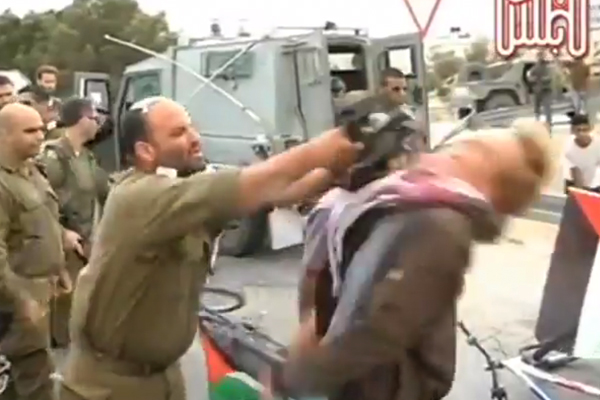
Israeli army Lieutenant-Colonel Shalom Eisner uses his M-16 rifle to strike Danish pro-Palestinian protester Andreas Las during a protest near Jericho on April 14. BEN GURION INTERNATIONAL AIRPORT – The ironic thing is that Israel has never had it so easy ruling the Palestinians, yet never has it come so unhinged in the face of nonviolent protest. Life in this country now is as safe as it is in America; Palestinian troops work with the army and Shin Bet every day to stop terror; the Obama administration has gone mum. Yet the government and most of the public inflate every impolite moral challenge from the Palestinians or their supporters into a national security threat.
The Netanyahu government, more so than its predecessors, confuses sovereignty over Israeli territory with sovereignty over the West Bank and Gaza Strip – which is what inevitably sets off the protests, causing Israel to freak out and sooner or later commit some act or acts that most of the world finds appalling. It’s a vicious circle; no matter how much security Israel’s military, political and economic power provide, the occupation does not let this country rest. The events of Sunday were a great example.
“Israel will prevent hostile elements from entering,” vowed the minister of public security, Yitzhak Aharonovitch, during a security drill at the airport before a planned “fly-in” by 1,500 pro-Palestinian activists, mainly Europeans, who were hoping to land and bus straight away into the West Bank. They wouldn’t have had to go through Ben Gurion, of course, if the Palestinians in the West Bank – or Gaza – were allowed to do what free nations do, such as build their own airport. This was the implied point of the “Welcome to Palestine” fly-in.
Nothing doing, said Israel’s powers-that-be.
As they did when they headed off a similar protest last summer, Israeli authorities gave foreign airlines the names of the majority of activists who’d bought tickets to Ben Gurion for Sunday, warning that upon landing they would be deported ASAP and the airlines that flew them in would be billed. In response, Air France, Lufthansa, Britain’s Jet2 and other carriers canceled most of the activists’ tickets, while the few dozen who did manage to get on flights were scooped up by Israeli security as soon as they touched down, and detained for deportation.
In the arrivals hall at Ben Gurion, camera crews and cops waited for something to happen, but the only action was provided by two Israeli leftists who held up “Welcome to Palestine” placards before being hustled off by police. A small group of right-wing counter-protesters unfurled a big Israeli flag and gave interviews to bored reporters.
“The pictures speak for themselves – all is quiet, the operation was a great success, the security forces prevented an attempt to undermine Israel’s sovereignty,” Benzi Sao, the police officer in charge, told Channel 2 news. Prime Minister Benjamin Netanyahu’s bureau wrote up a sarcastic letter to hand to the activists awaiting deportation: “We … suggest that you first solve the real problems of the region, and then come back and share with us your experience. Have a nice flight.”
Mission accomplished, as far as official Israel was concerned. Then it all went to hell.
The fly-in was only the second story on Channel 2 news, having been pushed down by a shocking video taken that afternoon in the West Bank by pro-Palestinian activists. It showed one of them, a young, blond, unarmed Dane, getting abruptly smashed in the face by an M-16 rifle wielded by a senior Israeli army officer. The video, posted on YouTube, went viral. A still photo showed the officer, Lt. Col. Shalom Eisner, rearing back with his rifle, about to bash another protester in the back.
About 250 Palestinians and Western sympathizers had been on a protest bike ride when Eisner and his men tried to break it up. He said the protesters had attacked them with sticks, and was photographed later with his hand bandaged, saying a protester had broken a couple of his fingers. The protesters, though, said they’d done nothing but ride their bikes when the soldiers went after them.
Whatever the truth, the YouTube looked terrible for Israel, and nothing could justify Eisner’s act. He apologized, the army called it a “grave” incident and suspended him. Netanyahu said: “This kind of behavior does not represent Israeli soldiers or officers, and it is not acceptable in the Israeli army or the State of Israel.”
Well-l-l-l-l… The talkbacks and Facebook seemed considerably more pro-Eisner than anti-, with endless variations of “The only purpose in these scumbags’ lives is to instigate, and create mayhem. If the soldier hit this bum, he deserved it.” (From “tough jew” on The Jerusalem Post’s talkbacks.) One of Israel’s 120 Knesset members, Michael Ben-Ari, who is banned from entering the U.S. because of his affiliation with the outlawed, violently anti-Arab Kach party, actually said: “Well done. … Radical leftists must be handled with a heavy hand.”
Israeli soldiers and policemen trying to run the West Bank, playing Goliath to the Palestinian side’s David – this story is as old as the occupation, which will be 45 years old in June. On the surface, things are under control, except for the odd incidents that keep driving this country crazy. On the surface, it could be evidence of a guilty conscience.
How Netanyahu tries to bully American presidents
The Israeli prime minister offends Washington -- again. Will Bibi's hubris slow the rush to war with Iran?
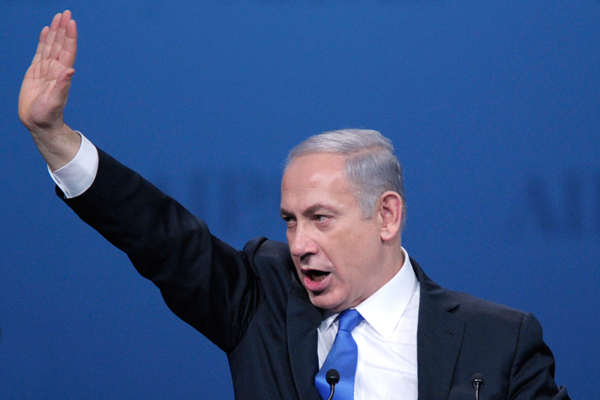
Benjamin Netanyahu (Credit: AP/Cliff Owen) JERUSALEM – Israeli Prime Minister Benjamin Netanyahu has done it again: He’s managed to outrage a Democratic administration in Washington, setting it against him and his Mideast policy. Whether this is going to screw up Netanyahu’s plans to either bomb Iran or let America do it remains to be seen. The feeling here is the same as in the U.S. and elsewhere – that after President Obama insisted that sanctions and diplomacy be given a chance, Israel won’t defy him in the short term, say, before summer. Afterward is anyone’s guess.
Continue Reading CloseAs Netanyahu pushes for war, Israel starts to balk
The prime minister has cowed Washington on Iran but he hasn't convinced his own people
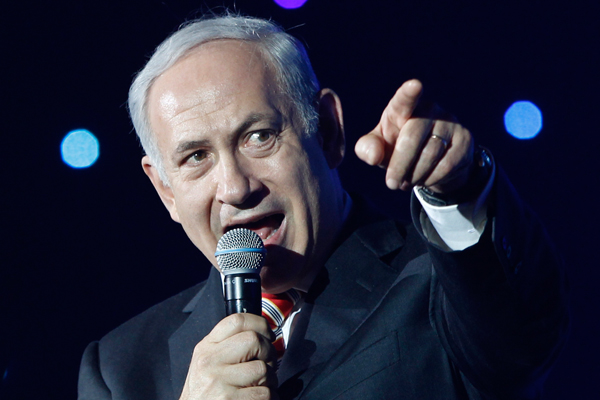
Benjamin Netanyahu (Credit: AP/Ronen Zvulun) JERUSALEM – To Americans, Israeli Prime Minister Binyamin Netanyahu must look like some invading giant. Backed by an army of AIPAC lobbyists and Republican presidential candidates, he came to Washington this week and put President Barack Obama on the defensive, using threats of imminent war on Iran to coerce his host into threatening his own war on the Islamic republic, albeit further down the road than Netanyahu would like.
At home, however, Netanyahu is not so strong, not as a prospective wartime prime minister, at any rate. Having no formidable rival, he is secure in office, but his public image, more and more, is that of an indecisive, deceitful, endlessly suspicious leader who’s under the sway of his wife, Sara. In a series of scandals in the prime minister’s office, the last one surfacing just before he left for Washington, he comes off like a weaker version of Richard Nixon.
Continue Reading CloseBibi or Barak: Who will plunge us into Mideast war?
As U.S. officials seek to head off an Israeli attack on Iran, the character of two old soldiers will be decisive
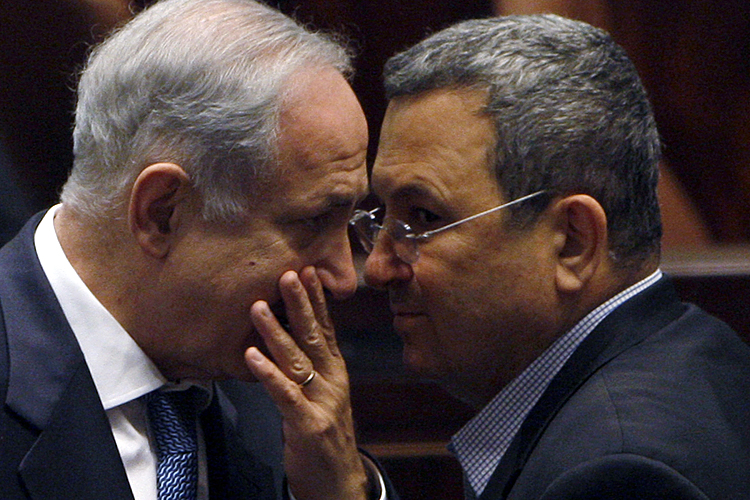
Israeli Prime Minister Benjamin Netanyahu speaks with Defense Minister Ehud Barak (Credit: Ronen Zvulun / Reuters) In their joint management of what appears, at least, to be the run-up to an Israeli attack on Iran, who is pushing harder for war, Prime Minister Benjamin Netanyahu or Defense Minister Ehud Barak?
A casual observer would probably say Netanyahu. He’s the Likud hard-liner, the settlement-builder, the one who’s always comparing Iran to the Nazis; Barak is the peacemaker from Camp David, the good friend of Bill and Hillary. Barak is an honorary Democrat; Netanyahu is the Republicans’ fantasy pick for president.
Continue Reading CloseIsraelis prepare for war with Iran
Even ex-Mossad chief who opposes an attack on Iran seems to have given up
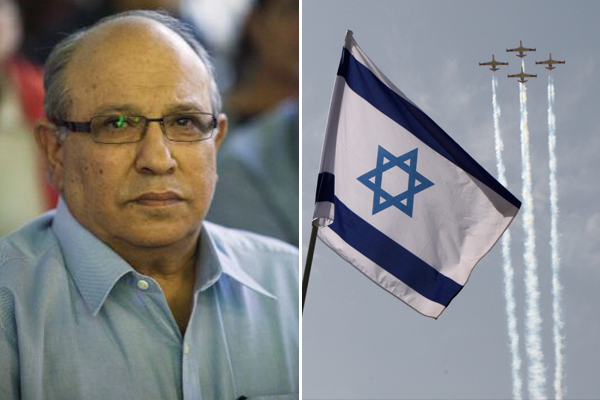
Ex-Mossad chief Meir Dagan no longer warns against attacking Iran (Credit: AP/Dan Balilty/Reuters/Baz Ratner) JERUSALEM — After bombs went off near Israeli embassies in New Delhi and Tbilisi, and a man with an Iranian passport accidentally blew himself up in Bangkok, Israeli Prime Minister Binyamin Netanyahu couldn’t let the opportunity pass. Yediot Aharonot, the country’s most widely read newspaper, reported Wednesday:
Continue Reading CloseAn updated list of talking points distributed by the national advocacy desk in the Prime Minister’s Office sought to connect the wave of terror with the international community’s efforts at tightening sanctions on Iran, and also to prepare the ground for a military option to stop Iran’s nuclear program.
Barak recommits Israel to Middle East peace
After meeting with Egyptian President Hosni Mubarak, new Israeli Prime Minister Ehud Barak puts the peace process back on track.
Fulfilling a campaign promise to reignite the Middle East peace process, Israeli
Prime Minister Ehud Barak met with Egyptian President Hosni Mubarak in Egypt
Friday, and was planning to meet with King Abdullah II and President Clinton early next week.
Barak, the 57-year-old career warrior against Israel’s Arab neighbors, has tilted in the direction
of peace, despite some concerns that he was “Bibi-compatible” — reciting
moderate rhetoric but in fact sharing Netanyahu’s hard-line stance on the peace process.