Laurie Essig

Fine diving

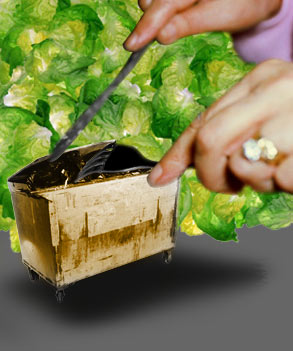
Young anarchists with guts of steel raid dumpsters for edible "trash." The idea? Divert waste to end wastefulness.

  • more
    • All Share Services

Fine diving

Normally I am a fun date. I like good restaurants that serve ridiculously vertical entrees and dry martinis. It doesn’t hurt if the lighting is good and the servers are attractive. Cooking at home, I am a diva of fresh and perfect produce. I love slicing kumquats wafer thin into salads of freshly picked greens and concocting ever more exotic dressings. But lately I’ve been thinking a lot about the politics of food and, as we all know, thinking about fun always ruins it.

I’m not just speaking about the very scary genetically engineered potato on my plate, or the even scarier idea that we’ll all die of mad cow disease in a few years, but the very premise of fine dining: conspicuous consumption and the waste that is central to its enjoyment. When I buy unblemished produce or eat at a restaurant, I am not just supporting a market that charges far too much money; I am part of an economy of excess and luxury that leaves far too much in the trash. Which brings me, albeit in an abrupt manner, to the topic at hand: dumpster diving.

Dumpster diving itself is not new; those without have been diving into the trash bins of those with since the beginning of time. But dumpster diving is not just about need. It is often about a political impulse to liberate the excesses of the rich for the poor. It is part of a larger ideology of radical nonconsumption. Thirty years ago, the Diggers liberated the waste of capitalism for those in need. Long before the Diggers, Franciscan monks liberated the waste of feudalism. What is new about today’s waste liberation movement, sometimes known as “Do It Yourselfers” (DIY) or just plain old anarchists, is that it is part of the larger movement against global capitalism, a movement made most visible when they gather en masse at G7 meetings and other iconic events of the global economy.

The dumpster divers are the most logical subset of the anti-globalization activists because they live in a way that does not create any demand for goods and therefore their lives do nothing to propagate the very system they are protesting. It is difficult to know how many anarchists occupy this wing, especially since most of them are not particularly thrilled about talking to the “liberal media.” (When I first started this article, many of the anarchists refused to speak to me because they felt I represented the “liberal media” and would therefore distort their views or, worse, expose them to police intervention). It is fair to say that the Do It Yourselfers have a national, if not international, presence that is evident on many of the anarchist Web sites and in much of the anarchist media (especially ‘zines).

Do It Yourselfers are not just living off the grid, but off of the excess that the grid produces. In an incredibly idealistic act of faith, they believe that by redirecting consumer capitalism’s “waste stream” to those in need, they are actually dismantling the master’s house with the master’s tools. Although I am far too cynical to believe that global capitalism will be affected by the redistribution of waste, I am impressed by the strict ethical code that gets this food to people in need. Through both informal and formal channels, such as Vermont’s Food for Folks program that only distributes reclaimed foodstuffs to the needy, Do It Yourselfers are doing something that seems both useful and incredibly ethical.

I was so impressed by the strict ethical code of the dumpster divers that I began following them around Burlington, Vt., where I live. Because this is a small city, and dumpster diving is illegal, all of the people I spoke to asked me not to identify them. They also asked me not to identify the dumpsters since some owners might feel compelled to stop the “theft” of their trash by getting compactors and locks. Suffice it to say that the people I spoke to, all of whom were in their mid to late 20s, are able to get day-old bagels, food from grocery stores that would normally be thrown out because it has passed its expiration date or is overripe, and pizzas and other fast food that has sat under warming lights long enough that it cannot be sold, and even candy that is either imperfect or past its prime. In other words, a relative healthy meal and dessert too.

The media, complain Do It Yourselfers, often get dumpster divers wrong, believing that they are not just using what’s left over, but stealing from large corporations as a way to put a wrench in the capitalist machinery. This has been particularly true since the publication of “Evasion,” a picaresque memoir of a young Do It Yourselfer that also is a how-to manual in shoplifting.

The fact is, however, that most of the people trying to live outside consumption oppose theft. As Chubba explains it, “Theft still falls under the category of ‘creating a demand’ … When something is taken off the shelf of a lot of corporate grocery stores, there isn’t a difference between the space created by stealing it or the space created by purchasing the product … there is just a space. A space dictating a call for more of the very same product.”

Doing-it-yourself doctrine relies on a critique of capitalism as an immoral distribution of wealth, and on an anarchist-inspired call to action. According to Andy, a 28-year-old political puppeteer, dumpster diving and anti-consumerism more generally come out of a “wish not to participate in a ‘work economy’ or to participate in an economy that is causing a lot of misery.” Instead, the waste of the miserable system is diverted to the miserable — or whoever happens to be around when the bounty arrives.

“Last time I went to Burlington,” says Andy, “I picked up three hitchhikers on the way home and sent them off with three boxes of food, all from dumpsters.”

Dumpster divers also are siphoning off the one thing consumer capitalism cannot live without: waste. Without waste, consumer capitalism cannot charge for the luxury of the flawless tomato or the freshly baked bagel. According to Adam, there is “so much tied up in what I call the ‘perfect capitalist vegetable.’ If there’s a blemish it’s thrown out.” Similarly, everything baked is tossed at the end of a day so that fresh things can be baked in the morning. In other words, without waste, conspicuous consumption becomes far less conspicuous.

Like most of those involved in diverting the waste stream to those in need, neither Adam nor Chubba grew up without food. Adam is from a fairly privileged family in Connecticut and went to college to study literature. Chubba was able to “travel and goof around” for years after high school and even go to art school for a while. But, as Chubba explains it, the more education he got, the more he didn’t believe in the capitalist system as “a viable model for humanity to practice.” Besides, he says, the process of diverting the waste stream is a politically ethical stand that also happens to be fun.

“The excess is not just a pear here and a case of tomato sauce there,” he explains. “It is more food than you and your 20 friends know what to do with. I have had to solve such problems as: What do we do with seven cases of wrapped chocolate? Is there a recipe that calls for 100 red bell peppers? How many ice cream sandwiches does it take to give you a stomach ache or how many grilled cheese sandwiches will 15 loaves of bread, 30 tomatoes and 40 pounds of extra sharp Grafton cheese make?”

The idealism, if not the actual food and criminal activities, of such a movement is enough to turn some peoples’ stomachs. It is difficult for even the most optimistic among us to believe that eating trash will actually have an impact on global capitalism, but it does have a cultural one. To eat “trash” is to go against our cultural consciousness, which imagines that food can be “tossed” from the realm of what can be safely seen and discussed into an abject state of invisibility and taboo. To consume the abject trash is to risk contamination and status as a fully civil human.

Eating trash turns my stomach, not just because I’m squeamish, but because I’m socialized into a culture that separates food from trash and humans into “deserving” and “revolting.” Yet I find myself more attracted than repulsed by those who live off of and redistribute waste. It’s not that I would actually eat out of the trash (I tried, I can’t), but I know — we all know — that landfills should not be full of perfectly edible foodstuffs, and no one should ever go hungry. That there are some who structure their lives around this knowledge is inspiring and I am grateful. So grateful that I am tempted to join them. And probably will. Just not for dinner.

Heteroflexibility

The latest semantic ploy to keep sexual options open really pisses me off.

  • more
    • All Share Services

Heteroflexibility

There is nothing like teaching college students to make a person feel hopelessly out-of-date. This fact first hit me at the tender age of 30. I was teaching what I thought was the hippest version of sociology imaginable. As part of my haute hipness, I had included readings on Elvis Presley. None of the students, however, had the faintest idea who Elvis Presley was. One thought that he might have been an actor. Another said she thought he had invented a diet because he had always been fat.

The generation gap between the students and me was bad enough, but then my teaching assistant, a nice man who was neither as young as they nor as old as I, decided to help me communicate more effectively the King’s cultural significance. “Elvis Presley,” he explained to the students, “was someone our parents used to listen to. He sang this stuff called rock ‘n’ roll. It came before rap music.”

The students nodded their heads, as if they had just remembered that rap music did not always exist. I shook mine, having realized for the first time that Elvis really was dead. And in Elvis’ death, I felt my own mortality.

Faced with the eternal youth of college students, my own aging can only become more obvious with each passing semester. I vowed to accept this fact gracefully and never again try to wow them with my knowledge of popular culture.

But now it’s not just popular culture that divides us. It’s sexuality as well. Oh I don’t mean straight, gay or bi. I don’t even mean queer. What I’m talking about here is “heteroflexibility.”

If you don’t know what that is, it’s time to admit that you’re as out of it as I am. Heteroflexibility is the newest permutation of sexual identity. According to my students, a person uses heteroflexibility in the first person, as in “I’m heteroflexible.” This means that the person has or intends to have a primarily heterosexual lifestyle, with a primary sexual and emotional attachment to someone of the opposite sex. But that person remains open to sexual encounters and even relationships with persons of the same sex. It is a rejection of bisexuality since the inevitable question that comes up in bisexuality is one of preference, and the preference of the heteroflexible is quite clear.

Heteroflexible, I am told, is a lighthearted attempt to stick with heterosexual identification while still “getting in on the fun of homosexual pleasures.” One student, Lisa, explained it like this: “Heteroflexibility is Ally McBeal kissing Ling.” I pretended I knew what she was talking about, but of course I didn’t (and not just because I don’t watch television).

My reaction was predictable. I was ashamed of my own inability to stay current, and I was also deeply pissed. How could these kids go and invent yet another identity when “we” solved that problem for them in the 1980s and ’90s? The word they were looking for was “queer” or even “bisexual,” damnit. I was angry that they would throw out the politics and the struggles of naming that had come before them. And what did they throw it out for? A monstrosity of a word, a mix of sexology and yoga practices.

My anger wasn’t just the anger of the middle-aged toward disrespectful youth (even if it was primarily that). I resented the fact that they would root their marginal sexual practices in the safety of heterosexuality. I resented that they would be so committed to not having primary relationships with someone of the same sex that they would preclude such possibilities with that abominable prefix. I resented that feminism had died so that women now felt free to name their primary commitment to men while proclaiming their sexual availability to other women.

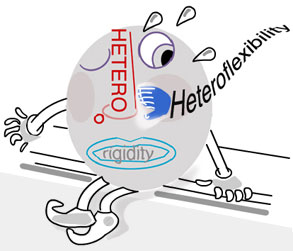
And then my middle-aged rage mellowed enough to see the true genius behind this new term. Heteroflexibility — not homosexuality or bisexuality — would bring about an end to the hegemony of heterosexuality. Think about it. The opposite of heteroflexible is heterorigid. Imagine saying to anyone that you’re heterorigid. Sounds awful, right? Like some very stiff politician in a suit and tie who is so busy being heterorigid that he can’t relax his sphincter muscles enough to look natural. Heterorigidity has none of the promises of pleasure that heterosexuality has. There is no sexual potential in an identity rooted in denial of possibility.

Of course, it’s not just heterosexuality that will wither away with the advent of heteroflexibility, but homosexuality as well. Being homorigid doesn’t sound as appealing as homoflexible. Homorigidity brings to mind the lesbian who won’t even have penetrative sex because she’s afraid it might be too much like heterosexuality, a person so bent on identity that her sexual desires get bent into knots.

I can imagine a world where rigidity of any variety becomes as taboo as homosexuality used to be. In the post-rigid age, we will all identify as flexible (even if we’re not). And sexual identity will become much less mired in the unimaginative binary of hetero and homo. The world will in fact start to look a lot more like that queer nation “we” envisioned when we were in school — just like the queer nation we envisioned turns out to be not that different from the one envisioned by the gay liberationists before us, and the homophiles before them and so on and so forth.

And so my students will replace me and others like me with new imaginings of sexual desires. And I will become increasingly entrenched in my own generation’s way of seeing the world and sexual desires and ourselves until one day it will not be my sexual rigidity that makes me old and them young, but my generational rigidity. Or more accurately, it is my generation’s superiority that will make me old and them young, since anyone born before 1970 surely knows a lot more about sex than these heteroflexible punks ever will.

Continue Reading Close

Lesbian fingers

Discrimination against us is underlined in the indelible ink of science.

  • more
    • All Share Services

Lesbian fingers

I am enjoying the feeling of warmth and unaccountable optimism that can only come on a Indian summer afternoon. My daughters are happily picking the few confused daffodils that came out early in our Brooklyn garden. And then I open the newspaper.

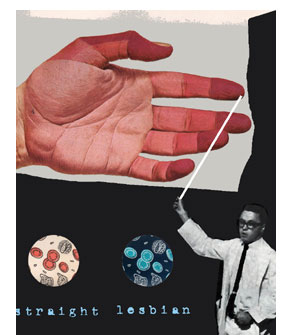
“Heterosexual Women Have Index and Middle Fingers of the Same Length, Lesbians Deviate From the Norm” is the first headline I see. I quickly glance at my fingers and feel a rush of relief. I have not been living a lie. My fingers conform to and confirm my true self. Then my relief turns to anger as I think about how one more shard of mean-spirited science has entered American culture as objective truth. And the truth of lesbian fingers is as sordid and as painful as any attempt to confine the imagination and creativity of human desire into a rigid and painful one-size-fits-all model.

The science of lesbian fingers is mean-spririted science for many reasons. First, this sort of study uses the existence of a statistical correlation to argue causation. Certain sorts of hands may be more likely to appear on the bodies of women who identify as lesbians, but isn’t that a correlation as opposed to a cause? People with green eyes might be more likely to be accountants, but it is highly unlikely that there is a causal relationship between the two.

Second, the supposed cause of lesbian finger deviance is a “fetal androgen wash.” In other words, lesbians undergo a wash of “male” hormones in the womb that gives them a “masculine” brain in a female body. In other words, the study wants me to assume that gender — identified as masculine or feminine — resides in the brain, even though there is no evidence of such a claim (or of an in-utero hormone bath, for that matter). In other words, I am supposed to believe that lesbians really are mannish and this is scientifically true.

Finally, the study believes that lesbians’ mannish brains will naturally desire their opposite, which is to say, female bodies. Clearly a mannish brain could not be attracted to a mannish body any more than a girlish brain could be attracted to a girlish body because such attraction would be, oh lordy, same-sex attraction.

As I read the newspaper account of the “truth” of lesbianism, the balmy day begins to disappear behind dark, foreboding clouds. At first, I don’t even notice the large raindrops as they fall silently onto the pages in front of me. All I can see are the words “lesbian fingers” and “science” blurring together into a single line. The sexuality line.

For over a century, Americans have been trying to establish the color line, to mark everyone as either black or white. These days the color line is supplemented by other lines, other worlds of either/or. We must be either male or female, straight or gay too. We cannot be both or neither or more than that.

At least with race we can now check more than one box, but of course we still have to check a box and ultimately it is still about being “white” or “not white” or “other.” It does not seem coincidental that for every step we take toward erasing the color line and the gender line and the sexuality line in our private lives, there is a redoubled effort to draw these lines in the indelible ink of science.

Science — racial science, gender science, sexual science — has been the source of Truth not only for the modern age, but for our postmodern era as well. The only difference is that now we feed our science into our culture, into our newspapers and television shows and Web sites, at such high speeds that there’s less and less time to think about its implications. There is no more public debate on the morality of drawing the sexuality line than there is on cloning or genetic engineering.

And in our hurry to draw the sexuality line, we have lost the truth of human bodies and desires. Humans are messy and our passions are even messier. Forcing our bodies to toe the line of binary ideologies only deadens us to the multiple possibilities that present themselves every time a child is born or an orgasm is had.

But I digress. It is raining. I have to rush my daughters inside. As we run, laughing and shouting, into our kitchen, they thrust the daffodils and dandelions they have plucked into my hands. For a moment the three of us are all holding hands, rain dripping down our faces, all talking at once about how beautiful the flowers are. Then I slip. I find myself checking the fingers of their right hands. At first I do this surreptitiously, but eventually I ask them to hold up their hands. I am relieved to see that their hands are, not surprisingly, like mine. I am also ashamed.

Why would I want something as rich and full as desire to be predetermined by their fingers? Whatever trajectories their desires take should be a surprise to me and to them. I want them to know desire as the accumulation of a lifetime of experiences, not the predetermined and rather boring creation of scientific sexism and heterosexism. I kiss both of my girls and tell them that I love the dandelions best. I figure it’s never too early to introduce the wild and uncultivated nature of beauty to them. After all, finger size may not affect their future loves, but I will.

Continue Reading Close

Hillary’s a dyke!

My favorite rumor gets no respect.

  • more
    • All Share Services

Hillary's a dyke!

I am not always a good example for my children. I have tattoos, I drink a bit too much and, perhaps worst of all, I love to spread rumors. Oh, not so much about my friends. After all, there’s little fun in taking delight in the downfall of mere mortals. Spreading the word that friends are breaking up or having affairs provides me with very little pleasure.

No, the rumors I like to spread are about famous people, especially politicians. There is something so luscious about hearing that some self-righteous politician who just came out for the “Defense of Marriage Act” was caught with his pants down in a whorehouse. And when the rumor moves from the tabloids to the mainstream press — without actually gaining any more credibility — I am filled with a devilish glee.

So when rumors about Hillary Rodham Clinton moved from the peripheral Post to the middle of the Times, I should have been dancing on air. After all, here was word that Hillary, that paragon of political sensitivity, had uttered an anti-Semitic remark. Here was a rumor, pure and simple, dancing through the most respectable of papers.

But it just wasn’t making me happy. Instead, I was deeply disappointed by the silence about the other rumor that appeared in the same book as the one about the anti-Semitic remark. You know the one, the one that dares not speak its name, the one that keeps popping up all over the place but that the press refuses to publish.

Apparently it’s OK to say that someone said that Hillary said a certain remark about a certain ethnic-religious group, but whatever you do, don’t mention the L word, and I don’t mean “liberal.”

The lesbian rumor has been around for years. I myself have collected various versions of the “Hillary is a lesbian” rumor and mongered them to my heart’s content. They are, after all, only rumors; but they’re fun and naughty and maybe even true.

I first heard about Hillary’s supposed Sapphic tendencies from someone who claims to have been her law school roommate. Then there was the editor from a very respectable publication who swore up and down at dinner parties that everyone knew Hillary had a girlfriend and that she met regularly with this girlfriend in New York (not unlike another first lady and her girlfriend, but that’s a different story). Then there was the one about how said girlfriend was actually an actress who was on “Night Court,” which may or may not have come from a former Secret Service agent, or maybe it was my hairdresser who told me that one.

Admittedly these rumors were often told to me by people who had evidence of flying saucers, but that didn’t diminish their power as good dirt. These rumors are good because they’re about secrets and sex, sex, sex. And sex and secrets are the narrative grounding of all good rumors.

A couple of years ago, during the Monica Lewinsky scandal, I was very nearly satisfied when the lesbian rumor popped into the media, but it only lasted for a microsecond. One of President Clinton’s closest allies suggested that Hillary didn’t like regular sex with men (thus forcing Bill to go elsewhere). But the rumor never really took off and I was left feeling stimulated, but not satisfied.

And then the “true” story of Hillary and Bill’s marriage came out this month and the press — the mainstream press — began trading in rumors. I waited and waited for the stories about Hillary’s “many” lesbian affairs to come to the surface. I’m still waiting. Oh sure, the National Enquirer ran a front-page story about “Hillary’s Gay Affairs” (with a very tough and almost bull-dykey picture of the first lady on the front, I might add), but it has done that before. In fact, the National Enquirer even printed the “Night Court” rumor a while back. But this isn’t really enough for me. I’m a serious rumor addict. I need more. I want the juicy stuff.

When I say this in front of my liberal Democrat friends, their faces turn purple and they point their fingers my way and talk about how the lesbian rumor would “cost Hillary the election.” Many of these liberal Democrat friends write for the mainstream media, so maybe that’s why they don’t write about this. Apparently it’s OK to be married to someone who has sex with 20-year-olds, but it’s not OK to have a female lover.

I may be a bad example for my children, but I’m not that bad. I don’t want them to have to face a world where it’s so shameful for a woman to love a woman that even the prurient press is silenced. That, far more than rumor mongering, is just wrong.

In fact, faced with the ridiculous and homophobic silence of the mainstream media, spreading this particular rumor seems downright ethical. After all, I don’t want my children to grow up in a world where presidential blow jobs and “dirty Jew” comments are “news that’s fit to print,” but lesbian relationships can only be spoken about in the shadowy realm of rumor and tabloids.

Continue Reading Close

Same-sex marriage

I don't care if it is legal, I still think it's wrong -- and I'm a lesbian.

  • more
    • All Share Services

Same-sex marriage

Lately straight relatives and friends have been calling to talk about Vermont and the fact that same-sex “unions” are now legal in that state. They can barely contain their excitement as they ask: “Aren’t you just thrilled? You and Liza will go and get married, won’t you?”

I hate to disappoint them. They so desperately want us to be just like they are, to aspire to nothing more nor less than legal recognition till death do us part. I couch my rejection in subjunctives: “It would be nice if we could be recognized as a family. If we were married, we would save thousands of dollars in insurance bills alone.”

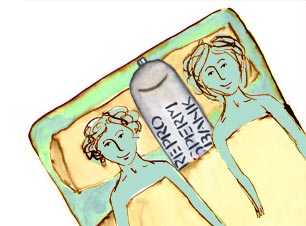
But the reality is that I don’t want to marry Liza (nor she me). In fact, I’m against same-sex marriage for the same reasons I’m against all marriage.

Although we like to pretend that marriage is natural and universal, it is an institution founded in historical, material and cultural conditions that ensured women’s oppression — and everyone’s disappointment. Monogamous, heterosexual marriages were an invention of the Industrial Revolution’s emerging middle class. The Victorians created the domestic sphere in which middle-class women’s labor could be confined and unpaid. At the same time, by infusing the patriarchal family with the romance of monogamy for both parties, the Victorians reduced sexual pleasure to sexual reproduction. All other forms of sex — homosexuality, masturbation, nonreproductive sex — were strictly forbidden.

But in the American culture of the ’00s, we like to be paid for our labor and we insist on indulging in our pleasures. That’s why a truly monogamous and lifelong marriage today is as rare as a Jane Austen book that hasn’t been made into a movie.

Now don’t go getting your wedding dresses in a twist. I don’t care if you’re married, had a huge wedding, spent $15,000 on a useless dress and let your father “give you away.” I really don’t care what personal perversions people partake of in their quest for pleasure.

What annoys me is that no one, not even queers, can imagine anything other than marriage as a model for organizing our desires. In the past, we queers have had to beg, cheat, steal and lie in order to create our families. But it’s exactly this lack of state and societal recognition that gave us the freedom to organize our lives according to desire rather than convention.

Lesbians and gay men have created alliances and households and children together. Lesbians have bought sperm and used it to devious ends, gay men have explored sex as a public spectacle that is democratically available to all — and we have done this while forming intimate, lifelong allegiances with one another. And yes, many gays and lesbians, including me, have mimicked heterosexual marriage as best we could.

But why should those of us who have organized our lives in a way that looks a lot like heterosexual marriage be afforded special recognition by the government because of that? What about people who organize their lives in threes, or fours, or ones? What about my friend who is professionally promiscuous, who for ideological and psychological and sexual reasons has refused to ever be paired with anyone? What about my sister who is straight but has never in her 40-odd years seen a reason to participate in marriage? Which group will gain state recognition next? The polygamous? The lifelong celibate?

My point is not that we should do away with marriage but that we should do away with favoring some relationships over others with state recognition and privilege. Religions, not the state, should determine what is morally right and desirable in our personal lives. We can choose to be followers of those religions or thumb our noses at them. But the state has no place in my bedroom or family room, or in yours, either.

“Ah,” but you say, “the state must recognize monogamous couples as more conducive to stable families and therefore better for children.” Hello? Have you noticed that a huge number of marriages end in divorce? Even the supposedly “happy” ones aren’t necessarily cheery little islands of serenity. What were your parents like?

There is absolutely no evidence that monogamous, state-sanctioned couplings are more stable than other sorts of arrangements. Even if there were such evidence, couples should be recognized by the state only when they decide to become parents. Why should anyone get societal privileges, let alone gifts, when he or she marries for the fourth time at age 68 with no intention of ever becoming a parent?

Still, as much as I hate to admit it, I am liberal at heart. If gays and lesbians want to get married, then I don’t want to stop them. I just want to lay a couple of ground rules:

First, do not expect me to be happy. The legalization of gay marriage does not make me feel liberated as much as it makes me feel depressed. It’s sort of like getting excited about gays in the military — until I remember that I don’t really care about the military as an institution.

Second, under absolutely no circumstances should you expect me to give you a gift for such a decision. If you’re insane enough to waste money on tacky clothes and bad cake, I’m not going to underwrite your actions with a toaster oven.

Continue Reading Close

The detachable phallus

There is a cure for sexism in academe. All you need are a sock and passing knowledge of French gender theory.

  • more
    • All Share Services

The detachable phallus

I am sitting with two friends in a crowded cafe on a cold winter afternoon. We are all three academics. We are all three feminists. We are all three mothers. And we are all three laughing uproariously. Heads begin to turn. The other diners, mostly professors from the nearby university, do not see what could possibly be so amusing. If only they knew that the source of our mirth is so appropriately academic.

We have been discussing the rather dense theories of gender that have come out of France in the past couple of decades. (In the rarefied world of academe, examining theoretical models often passes for companionable dinner conversation.) My friend Genie is sputtering the phrase “detachable phallus” through bursts of laughter while Emily is repeating the seemingly incomprehensible phrase “It must be a dress sock” and emphasizing her pronouncement’s truth by jabbing the air with her finger.

The three of us have just had a dramatic theoretical and personal breakthrough. We have long known that to be a woman in the university is to face a brick ceiling, a ceiling lowered by the advent of children. But we have just figured out a theoretical intervention that might just chip away at that ceiling. And the discovery has brought us to the point of hilarity and perhaps, ironically, hysteria.

We feel frustrated that, as women in academe, our chances of getting tenure are about 1/50th of a man’s. But what frustrates us even more, what pushes our laughter to the edge of hysteria, is that for many years we avoided those institutional barriers by being “one of the boys.” There was a time when our intelligence, coupled with our short hair and sensible shoes, was interpreted by the white men who rule our futures as making us just like everyone else, which is to say, like Them.

These ruling professors award privilege to young men who look and act and think like Them (and thereby ensure survival of the breed). The men who are the most like them are mostly white, mostly straight and mostly upper-middle class. But occasionally, if class and race signals are in place, they will favor certain young women.

Like the three of us — until we got pregnant and were betrayed by our female bodies.

Faced with our protruding abdomens, the men in charge had to admit that we were, in fact, women. And in that moment of being visibly female, we lost our invaluable status as protigis. You see, in the Ivory Tower, as in the Real World, most jobs are awarded not just on merit, but on network. Mr. Big calls up Mr. Bigger and says, “I’ve got a student here. She’s applying for the job and you really need to take a look at her. She’s brilliant, serious, has lots of publications, etc.”

But when you’re pregnant you are no longer serious; you are a woman, and worse, a mother. And everyone knows that mothers cannot be relied upon to be serious about work.

That’s why at a recent job interview the hiring committee asked me several illegal questions about my children and my priorities. That’s why I was told by other women to disguise or lie about the fact that I’d taken some time off to be with my children. That’s why the female professors I know go to ridiculous lengths to hide their pregnancies.

One woman I know hid both her pregnancies until the eighth month by wearing loose clothes and then conspicuously displaying doughnuts in her office to explain her weight gain. Another woman couldn’t face her advisors with the horrible news that she was having a baby. She waited as long as possible and then sent them an e-mail. More than one female professor has planned pregnancy around summer break in order to minimize time off and limit the number of people who know about the baby.

But now my friends and I had come up with a solution. The problem is that the men in charge of our lives are not up on many of the most important theories of gender. These theories argue that it is not the penis that is the site of social power, but the phallus, the metaphorical embodiment of masculine privilege. Phalluses are detachable; penises, for the most part, are not.

Unfortuately, the men who rule in our professional domain cling to the Freudian model of the literal penis as the static locus of power. They can’t imagine passing power onto someone who does not have “the goods.” My friends and I, adherents to the phallus theory, don’t actually envy the penises of these men. It’s their phalluses we want. We want all of the power and privilege of being white men in academia without actually being them.

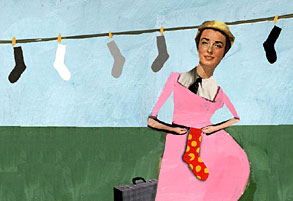
And so we have just developed sockiology. According to sockiological theory, the only way to accrue a phallus and obtain male privilege in a penis-focused society is to signify a penis. In other words, if we shove a sock in our pants, the men in charge are far more likely to consider us one of them. Even mothers, even those of us who insist on making our bodies visibly female, might be allowed to be “one of the boys” if we act in strategic and sockiological ways. With the right equipment, a sockiologist who is a mother might get support, advice, encouragement and a tenured job.

That’s why tomorrow we’re all going to wear an extra sock to work. We simply must decide whether the sock should be dress or sports, black or white, subtle or obvious. Once we work out this last kink in sockiology, power (preferably in the form of tenure) will be ours.

And then, having achieved our goal, will we be prepared to remove the sock from our underwear? Perhaps. Or maybe we will be so attached, so deeply sockological by then, that detachment will be impossible.

Continue Reading Close

Page 1 of 2 in Laurie Essig