Max Garrone

Are we victorious yet?

With the al-Qaida network shattered but Osama bin Laden still at large, "Black Hawk Down" author Mark Bowden and other national security experts discuss when the U.S. will be able to declare victory over terrorism.

  • more
    • All Share Services

When will the war be over? Does the U.S. have to capture or kill Osama bin Laden and Mullah Omar before we can declare victory? Or must we also eliminate terrorists in other dangerous corners of the world before the parades can begin? Salon recently put these questions to three terrorism and national security experts: Jessica Stern, a lecturer at the John F. Kennedy School of Government; Mark Bowden,, author of “Black Hawk Down” and “Killing Pablo”; and Michele Zanini, former graduate fellow at the RAND Corporation now with a major consulting firm.

Do you think terminating bin Laden is essential for a U.S. victory in Afghanistan, or is his organization, al-Qaida, more important?

Jessica Stern

I think the organization is more important than he is. This is a really dispersed network of people and I think we have to think of it as a network of networks that includes not only al-Qaida and the Egyptian Islamic Jihad but all the groups that have been funded and inspired by bin Laden. In Indonesia there’s Laskar Jihad; clearly Abu Sayaff [in the Philippines] is high on the U.S. radar screen at the moment; there are groups in Somalia, there are groups in Pakistan and those are only the groups that come immediately to mind. It’s really a worldwide movement.

Certainly we were the laughingstock for the Europeans because of the prominence that we gave bin Laden, especially after the U.S. embassy bombings in East Africa in 1998 with that most wanted poster. Now it turns out that our fears were more than justified. We perhaps increased his importance and popularity by focusing on him so much, but it turned out that he was preparing a more horrific attack than any of us really understood. So the people in Washington who focused so heavily on him and turned him into an evil bogeyman turned out to be correct and the Europeans making fun of us clearly were wrong.

How effective is it now to focus on bin Laden? Is he or his organization more important? Well, I think his organization is more important. And it’s not just his organization, but the movement that he and others have inspired — and that’s what is going to require the long-term slog through intelligence and law enforcement.

Mark Bowden

I think it was probably a mistake to place so much emphasis on getting bin Laden personally, because I do believe that our success in Afghanistan has strongly diminished the ability of al-Qaida to function. I’m one of those who believe that if they were capable of doing anything further — anything on a large scale — they would have by this point. I do think it’s likely that from here on out there will be isolated acts of atrocity committed against Americans.

But [by destroying the bin Laden organization and the Taliban in Afghanistan], we’ve probably scared any state with an ounce of sense away from being a sponsor of terrorist groups. That’s a major coup that limits their capability in a major way. I think we’ve seen the worst from al-Qaida.

So yes, bin Laden was an important symbol for the terrorist movement. But it’s more important to focus on the extraordinary successes in the last five months in rounding up terrorist cells across Europe in addition to what’s happened in Afghanistan. Placing such a great emphasis on bringing Osama bin Laden to heel might have been wrong, because doing that in and of itself wouldn’t necessarily have been as crippling a blow as what in fact has happened. Probably it was an unavoidable public relations mistake given the circumstances, but it was unfortunate.

He was a major symbol of terrorism and we needed one at the time but meanwhile we were quietly rounding up these terrorist cells in Paris, Spain, Bosnia, Algeria, Indonesia and Malaysia, among other places. They caught these people and put them out of action before they had a chance to move. To me that is a much more telling and significant achievement than if they had caught Osama bin Laden.

Michele Zanini

I think that bin Laden always had much more symbolic importance than a direct command and control role. Therefore whether he’s dead or alive, it doesn’t matter; his persona will always shine in the eyes of militants or people dear to his cause. I think in practical terms whether he’s dead or alive doesn’t matter that much to the movement.

It has been mentioned that he has quite a bit of money that he uses to support his movement. That may be true, but estimates of how much money he actually had after the embassy bombings [in 1998] when the U.S. started to seriously freeze his accounts were actually fairly low. So I don’t know how much al-Qaida would have to depend on him financially. It’s not the money, and it’s not his military or his organizational skills –which are attributed to other people in the movement.

Locating him would be great; it would maybe allow people to reach closure on this, and it would give us a movie ending where the bad guy dies and people might feel good about that. But this is not a movement that is based on a great leader.

It’s not like the PLO, which was based on Arafat — if you took him away from the PLO, the movement would have imploded in the past and now there would definitely be factional infighting. But in the case of this new terrorism, we’re looking at loose collections of organizations and individuals that play different roles. Because of the network structure, bin Laden’s node is certainly an important one, but I would not think from an organizational standpoint that it would be decisive to get him or take him out.

So if finding bin Laden is not decisive, can the U.S. declare victory? Where are we in this war?

Jessica Stern

Unfortunately, I think that we’re still at the very beginning. I think the first stage of the war on terrorism, knocking out the Taliban, was the easiest part and that the more difficult stage is now beginning — which is the really long, hard slog of intelligence and law enforcement cooperation to root out the cells internationally and their sources of funding.

Mark Bowden

Based on my conversations with people in the military, I always thought the Afghanistan part of this war was going to be, I don’t want to say simple, I want to emphasize that it would be the simplest part, but the simplest part of what will be a very long and difficult war. I thought it would be the simplest part because it had a much more identifiable and achievable aim, which was to topple the Taliban. Before we started bombing, many people worried that we would get bogged down like the Soviets. But these people failed to realize that the aims of the United States were fairly direct and much simpler than the aims of the Soviet Union when they went into Afghanistan.

Where we are today is at the beginning of the real war against terrorism, which is a prolonged and tedious process of building an espionage network and intelligence systems throughout the world, particularly more effective types of human intelligence. Working with and developing relationships with other countries, with their police forces and their military, developing the kind of international security system you need to grab these people before they get far enough along with their plans to kill people.

And also targeting individual cells or individuals when and if we discover them wherever they are in the world. I think that’s a process that’s going to take place probably over the next five to 10 years or more.

The recently announced U.S. support role in the Philippines is an example of this. There we have a group of terrorists who have kidnapped a group of American citizens. Who have links to al-Qaida, maybe somewhat tenuous, but whom we clearly have every right to go after since they’ve kidnapped American hostages.

At his press conference this week, Defense Secretary Rumsfeld was asked if in that particular case the American forces would be more “forward-leaning” because there were American hostages being held. And Rumsfeld’s response was that America is forward-leaning, period. Which means to me that we’re in a period where our military force will be much more proactive.

I mean, the special forces people have been urging this for years and are thrilled that they have an opportunity to demonstrate what they can do. It remains to be seen whether their tactics and what they can accomplish will succeed. But they’re at least being given an opportunity to do it. I think so long as that kind of military action is intelligent and carefully targeted, it’s probably the only way that we can fight back at these groups. And by the use of special forces I mean nothing on the scale of what’s happened in Afghanistan. I think what we’re talking about are when and if intelligence locates an active cell laying their plans or doing whatever they do, small teams of American soldiers conducting hits or raids.

It will probably be a replay of what happened in Colombia, going after the drug lord Pablo Escobar, which I wrote about in my last book. This is a very good model of what I think this is going to look like. They will work as much as possible with indigenous forces so that our special forces are not looking to take credit, they’re just looking for results. They just want to accomplish their mission. It doesn’t matter to them who killed Pablo Escobar, it just matters that Pablo Escobar is dead.

Michele Zanini

The U.S. is in an interesting situation now in Afghanistan and elsewhere because there’s a tendency and desire by the Bush administration to pull out as soon as possible. But that would create a vacuum that would be filled by Afghan warlords, al-Qaida remnants and other organizations that would provide fertile ground for terrorism to grow again.

If the U.S. forces pulled out too soon, they might undermine the Afghan government that will still be weak. So I think that this idea of quick withdrawal is fantasy. The U.S. will be there for some time and Afghanistan will be out of control for some time. Like Afghanistan, there are so many dysfunctional countries and that list grows every year. As long as there are anarchic countries they will all potentially provide breeding grounds for terrorists.

People always talk about Somalia, Indonesia and the Philippines, but there are a lot of other countries, especially in Africa, that are bankrupt, failed states. Terrorists might find fertile ground in these states, and the U.S. might find it very difficult to operate there because there’s no control there. It’s becoming a very murky world and that’s why I think this idea of war is ultimately misleading because war is traditionally understood as waged between fairly well-defined opponents like states, or between a state and a guerrilla movement, in a particular geographic area or a particular time. This war is different; it’s really an array of shades of gray.

Balthus’ provocative poses

One of modern art's lions shows us that sexual moments and nudity aren't necessarily erotic.

  • more
    • All Share Services

Balthus' provocative poses

Surrounded as we are by blatant and pervasive sex, looking back at the work of Balthus can give us respite — and a more nuanced, playful vision of eroticism.

All the great modernist painters of the 20th century — Picasso, Dali, Matisse — drew frequently from the female nude and erotic themes for their art. Balthazar Klossowski, aka Balthus, presented a new vision that blended explicitly erotic and high art. His paintings are full of women and girls with their bodies on display, but they meander between the erotic and a direct confrontation of his audience. One of his hallmarks is a testy, teasing, relationship with his audience as he pulls them between considerations of the sexual and exquisite compositions in the same moment.

A new book is out from Rizzoli to accompany the largest exhibit of his work (now at the Palazzo Grassi in Venice through Jan. 6, 2002) and to commemorate his death in February, 2001.

Balthus’ most notorious and compelling painting, “The Guitar Lesson,” is a perfect example of his vision. It presents a woman with a girl draped over her lap. The girl’s skirt has ridden up to her belly as the woman pulls her hair and has her hand poised over the girl’s vagina. The girl’s hand is raised to pinch the woman’s erect nipple.

In a letter as he was preparing the painting Balthus described it as “a rather ferocious one.” “It’s an erotic scene. But you have to understand, it is not in the least quirky, none of the usual little naughtiness you show around under cover with winks and nudges. No, I want to proclaim in broad daylight, with sincerity and feeling, all the throbbing tragedy of a drama of the flesh, proclaim vociferously, the deep-rooted laws of instinct. Thus to return to the passionate content of art. Down with the hypocrites!”

The son of a highly cultivated family and a pupil and friend of renowned German poet Rainer Maria Rilke, Balthus arrived on the scene a young 26 at a fevered moment in the history of art. He had been a painter since he was 16, encouraged by a mother who also painted. He was also surrounded by many major cultural figures such as Rilke, who helped publish his first ink drawings in 1921, and painter Pierre Bonard, who further nurtured his talent.

As he gained his first successes as a painter in 1934, modernist art movements captivated Europe. The Bauhaus and expressionist movements had swept Germany, futurists were ardently followed by the cultural elite and future dictator Benito Mussolini in Italy, while France played host to a grand collection of artists and intellectuals like Man Ray, Picasso and Matisse. Most major artistic and creative movements in Europe were focused on defining the new and breaking from the old, classical orders that dominated 19th century culture.

While nearly all of these artists and groups were drawn to the erotic in one way or the other, Balthus made it his priority to present it as high art. His was a constant campaign to bring two potentially disparate camps together; for him they probably coexisted naturally. He called the erotic the “passionate content of art” and he gave it a passionate form. “The Guitar Lesson” is a rigorously classical composition, one borrowed from the pietá in the Western tradition, dressed with references to Dutch still life paintings and thoroughly informed by classical perspective. By combining his own sense of eroticism with formal elegance, Balthus got to have his cake and eat it too.

Balthus also played with nudes, confronting the viewer with the implied question: what is more erotic, nudity or suggestion? “Alice in the Mirror” confronts you with a seminude woman, her naked pubes at the exact center of the painting and a breast staring back at you. But her eyes are a dirty, cloudy blue that almost obscures the pupils entirely and suggests either an ethereal calm or complete removal.

The centrality of the nudity in this painting puts sex front and center, but there’s also the setting of the painting: Alice stands with one foot on a chair in a bare corner brushing out her hair. For a contemporary viewer it might elicit ruminations about how women’s identities are tied to their bodies or how we use nudity as a symbol for sex, but the original buyer, Pierre Jean Jouve, thought otherwise and described the painting as “having such an intense carnality, that I considered ‘Alice’ as being my companion.”

But Balthus plays a two-front game. He’s not merely concerned with carnality but with an exquisite form or vehicle for that eroticism. Despite his comments about “The Guitar Lesson” he also made other, more accommodating remarks that demonstrate his keen sense that his paintings’ subject matter might obscure the grace of their execution. In a letter about “Alice in the Mirror” he wrote, “I don’t believe it is obscene and I think the grave, severe atmosphere it is steeped in is such that even a young girl can look at it without blushing.”

It’s the clothed women in Balthus’ paintings that appear most erotically charged. In “Therese” a young girl stares languidly out of the canvas as her skirt slides up her thigh. A companion painting of the same model shows her sitting with eyes closed and legs open so that you can see her underwear as a cat laps milk from a bowl in the foreground.

Still other paintings of the same model like “Therese on a Bench-seat” feature her alone and oblivious to the viewer, apparently in a moment of quiet contemplation or lazy repose while her skirt inches up her thigh. Your eye moves instantly to the point where the skirt stands ready to reveal more — both because that’s the land of erotic potential, but also because Balthus has used composition, drawn it seems from early Dutch portraiture, that draws a viewer’s eyes where he wants them.

Balthus was forever borrowing and twisting the past into his version of an incredibly erotically charged present. You sense a man in full charge of his obsessions who gains even more power and release from playing his fantasies out on canvas and having viewers, buyers and connoisseurs share in his game and pleasure. Indeed, he painted erotic subjects right up to his death in February. His last, unfinished painting depicts a nude woman asleep on a couch, a mandolin about to fall from her hand.

That’s what’s so extraordinary for a contemporary viewer. Today we can easily find pornography to fulfill carnal urges. And artists today used nudity for political purposes as well as titillation. But it’s rare to find an artist both skilled and daring enough to breathe a vivid life into his erotic fantasies with formal elegance.

Continue Reading Close

After the fall

The Taliban is on the run. What happens now? Who should govern Afghanistan? And how hard will it be to win the war of the caves?

  • more
    • All Share Services

After Taliban forces retreated Tuesday from Kabul, Afghanistan’s capital, the U.S.-supported Northern Alliance took control of the city. The White House said that President Bush was “very pleased” with the advance. The Taliban’s unexpectedly sudden withdrawal — on the heels of defeats in Herat and Mazar-e-Sharif — represented an important military triumph for the U.S. (On Tuesday, it was reported that Northern Alliance troops had pushed on from Kabul to the Taliban’s stronghold, Kandahar.) But the Taliban’s unexpectedly sudden withdrawal also gave new urgency to major issues — Afghanistan’s political future, the trustworthiness of the Northern Alliance, the next step in the military campaign, the status of humanitarian aid and the relationship between the U.S. and Pakistan.

Several experts on the region spoke with Salon about what the future holds for Afghanistan and the region and what the United States should do next.

Joel Charny, Asia expert from Refugees International

The Northern Alliance progress means that 70 to 80 percent of the Afghans in need of assistance are now in Northern Alliance territory. This is critical. We need the Northern Alliance to provide enough stability and security so we can provide humanitarian aid.

If it can do this, we’ll be able to save a lot of lives. This is potentially a huge victory for humanitarian efforts, but it can only happen if Mazar-e-Sharif becomes a normal city where the international community can set up a base of operations. We need to make this clear to the Northern Alliance. We need to tell them that any future role they might have in the Afghan government is dependent on their ability to create a stable place for assistance. The Afghan people desperately needs someone to govern this country, if only to make a way for the international community to help.

This is also important for the coalition. They can’t attack terrorism and bomb the Afghan people and then pull out when it comes to human aid. I think the international community is aware of this, but here’s our chance. We need to become proactive. If people die unnecessarily, that will be a blow to the Northern Alliance and to the coalition. We can’t underscore this enough.

The Northern Alliance’s past record is dismal. They’ve been unable to work together among themselves. There have been a lot of betrayals among them over the past 10 years. Furthermore, they have a very poor human rights record. So the question now is whether cooler heads will prevail, whether they know what’s at stake and whether they’ll comply.

There’s also been talk of creating a multinational police force under U.N. auspices. But because there is no standing force like this already in place, it takes a while to organize. And yet, Kofi Annan has said that the U.N. has to act as swiftly as possible, so it might happen sooner than expected. But surely, one way to potentially control the situation on the ground is to have a multinational police force — preferably with people from Muslim countries.

The difficulty is going to be in implementing that. It’s clear that putting U.S. special forces in charge of anything in Afghanistan is a non-starter. [Lakhdar] Brahimi, the U.S. special envoy, went out of his way to make that point when he started working on Afghanistan again in September. You can’t look to the U.S. because no American force will be accepted there. So you’re stuck with exerting U.S. force on the Northern Alliance or creating and asserting influence on an international force.

Robert Legvold, political science professor at Columbia University specializing in former Soviet states

There’s more nuance to [the falling of Kabul]. My reading of the news is that commanders have restrained troops from sweeping in. Instead they’ve sent in limited numbers in order to go from house to house to make sure that the Taliban have left. Abdullah Abdullah [the Northern Alliance's foreign minister] has said that it’s very much in the interest of the Northern Alliance to respect the wishes of the international community, for them not to seize Kabul, and they seem to be complying.

The question is whether there is a spontaneous movement on the part of some of the forces under warlords that can’t be controlled by the central leadership. It’s a matter of how much control the Northern Alliance has over itself.

The second question is whether the international community can get their act together in time. Secretary of State Colin Powell has agreements from Muslim countries, but not Arab countries, and I think that’s the key. There needs to be an Arab presence that then creates a constabulary force, an international monitoring force to oversee what the Northern Alliance does. This should be in place until the larger question of the shape of interim government can be answered.

So you have two kinds of institutions that are needed: one, a quick monitoring force that ought not to be Western powers; and second, a solution to this longer-term problem of trying to find some kind of broad government. Both of those things should fall under the mediation of the international community, preferably the U.N.

But we’re having a lot of trouble getting that off the ground. The main problem with the first institution is time urgency. They need to do this as soon as possible.

So the real issue for now is whether and where the Taliban will make their stand. Presumably they’ll build up their military power around Kandahar. The further south they move from Kandahar, or the closer [north] to Iran, the weaker they are in terms of tribal support. So my guess is that the war will intensify south of Kabul and east to Pakistan.

I’ve also heard that the Taliban has been fractured, that they don’t have communications with each other. If that’s true, then it may be that regardless of their will or strength, they won’t be able to pull themselves together militarily and will be much weaker. But I wouldn’t count on that until we see it happen.

Harvey Sapolsky, defense expert and professor of political science at MIT

It looks good. I don’t know what’s going to come next; who knows what’s really gong on with Afghan politics. But it shouldn’t matter to us. The goal was to destroy the Taliban and get al-Qaida, and while we don’t have al-Qaida, we have the Taliban on the run. It’s a victory.

There should be more on the way. Everybody who wants to fight the U.S.-assisted Northern Alliance will be at a disadvantage. Our air power makes a big difference. The Northern Alliance had 10 percent of the country; now they have, say, half of it. This couldn’t have happened without our help. And going south, they’ll still have this borrowed strength. It will only get better because we’re now setting up bases in Tajikistan.

It’s true, we haven’t got much control over the Northern Alliance. We should tell them not to commit atrocities. But unless we want a lot of American ground troops to take their place, we don’t have much choice but to accept what they do. I’m of the opinion that whatever we have there will be better than the Taliban. Whether it has a Pashtun mix, or more Tajiks doesn’t matter. We shouldn’t encourage the world’s paranoia. People already think we run the world and they blame us for everything. We shouldn’t feed the anger with a strong American presence. We shouldn’t create the government there. We should want a more stable government, we should give them aid, but it’s not our business to see who runs Afghanistan. We should only make sure the government doesn’t harbor people who want to destroy American buildings and commit terrorist acts. And if we’ve done that, then we should get out.

John Voll, Islamic history professor at Georgetown University

A lot will depend upon the behavior of the Alliance troops as they take control of newly conquered areas. If there are many revenge killings and looting and disorder, then most people in the Muslim world will blame the U.S. for aiding violence and will argue that the U.S. is being hypocritical — bombing the Taliban for being supporters of terrorism but rewarding the Alliance even when it engages in acts that are like terrorism. I do not think Muslim peacekeeping troops will make much difference, because the forces would simply be seen as military forces acting under orders. Sending Turkish troops would do nothing to improve such sentiment, since the Turkish military has a reputation in much of the Muslim world as acting to suppress Islamic movements.

I would hope that the Northern Alliance victories would allow for a suspension of bombing during Ramadan, but my guess is that military planners would not want to lose the momentum from the string of victories and would probably not suspend bombing until after some major victories in the south.

Retired Col. Dan Smith, chief of research for the Center for Defense Information

The fall of Kabul must be considered a victory. The U.S. did not expect Kabul to be so precipitously abandoned. Next comes more effort in tracking down the al-Qaida leadership and bin Laden. This has been a separate but parallel track with the Northern Alliance effort against the Taliban. The two are now intersecting more, but it can complicate the search because there will be more small groups the Special Forces will want to avoid or will have to fight if encountered as they search for al-Qaida.

Could the retreat be a trap? It seems too disorganized and fragmented to involve one. If the Taliban leadership can reestablish some control of hard-line fighters, they could begin some kind of guerrilla activity after a few weeks. The south is their ethnic stronghold, so they may find some assistance from Pashtuns living in the south or even from across the international border.

As for Northern Alliance atrocities, not all reprisals can be stopped no matter how big an international force may go in. What must be done is to internationalize control of the cities with Afghan assistance and begin the process of rebuilding civil society — government, police, courts, the whole justice system.

Thomas Barfield is professor and chairman of anthropology at Boston University.

Given their dismal track record during the civil war, can we trust the Northern Alliance?

One of the problems is that the Afghan civil war is extremely complicated. When Borhanuddin Rabbani took over in 1992 [from the communists] there was no violence, all the communist and mujahedin factions joined together to form a new government. There was no bloodbath.

But because the outside world walked away, there was no international attention to getting the country back on its feet and the factions started fighting amongst themselves for power because each thought that they could get more out of the deal.

After 10 years of civil war now they know that they can’t. When the Northern Alliance says it wants a broad-based government, they’re honest. Everyone knows that they all had a chance and failed — even the Pashtuns who ruled as the Taliban have learned that. Now they’re much more amenable to creating a broad based government

How difficult will it be to create a new, multi-ethnic government in Afghanistan?

In the east, the Pashtuns have already revolted against the Taliban in some places like Ghazni, which is halfway down the road to Kandahar from Kabul, and there’s been some unrest in Kandahar itself. You have to realize that the Taliban exploded out of Kandahar and took over 90 percent of the country really quickly. They never really won a battle because Afghans really want to be on the winning side. During the rise of the Taliban only one Afghan faction was able to retreat successfully with its forces intact, that was [former Northern Alliance Leader Ahmed Shah] Massoud. When most other Afghan factions retreat, their followers make a calculation about who’s going to win and decide to ally themselves with successful invaders. Throughout history the country has turned to one side or another with remarkable rapidity without decisive battles because people calculate who’s going to win and jump ship. Afghans are very pragmatic.

We’re seeing that people have decided that the Taliban is on the way out. In the north they fell because it wasn’t their territory. However, in the south a good chunk of their forces are composed of the so-called Afghan Arabs, who will fight it out for ideological reasons. But most Afghans have a much finer grained sense of self and don’t readily ally themselves with a larger group. This isn’t like Yugoslavia, where you saw people allying themselves with their ethnic groups. In Afghanistan the sense of ethnicity is very fluid, with a few exceptions like the Hazaras. Traditionally there’s lots of intermarriage. Politics is not based on ideology or ethnicity. If the Pashtuns want to come over to the Northern Alliance then they’ll be accepted.

One of the problems is that everyone brings their own lens to this. For most people, the first time they’d heard about Afghanistan and its ethnic groups was six weeks ago. Suddenly people learn really quickly and focus on these ethnic groups, and the most recent thing we’ve read about ethnic groups was in the Balkans, where every time you create a nation for an ethnic group you get new revolts. The Afghans are not like that. There is not a single party in Afghanistan that has threatened to join a foreign country like the Kosovars in Macedonia. The amazing thing about Afghans is that they have co-ethnics along all their borders, and despite that not a single group has said “if we don’t win we’re going to form our own country or join with a foreign country.” These guys are like poker players — they argue about the division of the pot, not the table.

Afghanistan is the size of France and Afghans understand that you need a country of a certain size in order to survive. If you’re five different countries then each one becomes an appendage to a neighboring country and everyone gets screwed. Central Asian ethnicity is very different from Eastern European ethnicity. They’ve always lived in multi-ethnic societies and have never suffered the ethnic problems of Eastern Europe.

One of the things that surprised me is how quickly the Pashtun areas seem to be unraveling. Until recently it had been thought that the country could be divided between the North and South along ethnic lines, but Pashtuns seemingly want to have no part of this.

Why should we think that a new government can work in Afghanistan?

The entire country has undergone considerable change. After the communist government fell in 1992, there was a real government to seize. But since the Taliban rose there hasn’t been a government there. There’s no army, no institutions, it’s just a symbolic shell. That’s one of the reasons they can agree to accommodate one another.

In the past it was a Pashtun-dominated government but all power came out of Kabul. The Pashtuns dominated because they controlled the monarchy and the military while the Tajiks controlled most of the bureaucracy. The Hazaras were discriminated against and got the short end of the stick. Then in the war against the Soviets they all learned that they could all fight. Previously the Pashtuns said “we’re the best fighters.” In that war the Tajiks proved to be among the best fighters under Massoud. The Hazaras also proved considerably tough warriors and pushed the Pashtuns out of some areas. So what has happened is that all ethnic groups have a certain amount of respect for one another. The Pashtuns know that there’s no way of recreating the ethnic balance that existed before 1978 and everyone else is much more secure in their regional identities than before. Everyone is now talking about a central government, but it’s not clear that will be very strong. They’ll need a central government, at a minimum, to cash foreign aid checks and divide it up.

So you don’t expect the new government to be effective?

Afghanistan has collapsed before, in 1929. The central government was restored but it took many years for it to become effective. The deal that the communists broke was that the Afghan central government leaves everyone alone as long as you’re peaceful. No one collects taxes in Afghanistan, the government relied on taxing trade and smuggling for its revenue. That means that Afghan national governments rarely interfere in local affairs. The communists interfered by insisting on local land reforms and other policies. We’ll probably go back to an era in which the central government allows local areas to administer themselves. Kabul used to appoint regional leaders; now local areas have appointed their own.

Will a weak central government hamper international aid efforts?

You don’t even need a central government to do this sort of reconstruction. Every major city is close to another country: Mazar-e-Sharif is something like 60 miles from Uzbekistan, Kabul and Kandahar are right across the border from Pakistan and Herat is just 80 miles from Iran. If you want to set up reconstruction projects or policies based in each neighboring region then you can run all of that from outside. So let them spend next six-eight months arguing about the form of a central government while the international community actually does the rebuilding.

What reconstruction needs to be done?

There’s relatively little that needs to be done because there wasn’t much there before. They need roads and agriculture and little else. The first thing they need is a large amount of grain because Afghanistan has suffered three years of drought. USAID is planning to ship in tons of grain in order to bring the price down across the country. They only have one main road, the circuit road around the country, that needs to be rebuilt. It’s a relatively simple job to do but needs to be done. Actually all these returning refugees from Iran have been doing road work in Iran for the past 10-20 years, so put them to work.

The northern part of country is the agricultural center, so they need to get their roads up in order to feed the south and then run transit from Pakistan to Central Asia which represents lots of revenue for the country. Afghanistan’s not a cul-de-sac — all its neighbors would like to have its infrastructure together too because they all want to get their trading routes back up and running.

Does the Taliban pose a lasting threat in Afghanistan?

Mullah Omar says his forces will retreat to the hills and start a guerilla war. The West says “oh my god,” but they forget that guerillas need to be resupplied. The mujahedin won against the Soviet Union because we resupplied them and they could retreat into Pakistan. If Omar goes into the hills he can buy supplies from smugglers but he will have to pay cash and can’t retreat to another country; he will be stuck in the hills and caves. It will be especially difficult for him to hide if the country becomes more developed because his hiding places will rapidly disappear.

The United States’ demand is that Afghanistan turn over all foreigners. It’s relatively easy for the Afghans to turn over foreigners. The interesting thing is that you don’t see one Afghan in one of these terrorist groups. They’re very parochial. Even the Taliban were intent only on putting the Islamic revolution in place in Afghanistan, while Osama wanted to spread it to the world. It was a symbiotic relationship, but the Afghans haven’t had any interest in going off to kill anyone outside their territory. They even had to bring in Arabs to kill Massoud because they probably couldn’t get Afghans to do it.

Second, Afghans of whatever ideology really don’t want to sacrifice themselves outside of their own country. If you get the economy going they won’t even attend madrasas because they’ll have better things to do. It’s an easier problem to take care of rather than many of the other difficulties we’ve been dealing with. In some ways we’ve invented some bogeymen. The collapse of the Taliban has taken many people by surprise, but if you look at their rise it’s exactly what happens in Afghanistan’s political history.

You hear military experts on TV saying that the flip side could be that the Northern Alliance is moving so fast that it could be counter-attacked, but the guys who were Taliban yesterday are part of the Northern Alliance today. And they won’t change back, because they will go with their own interests which are now firmly aligned with the Northern Alliance. And given the power and resources Afghanistan might actually stabilize. Twenty-five years of fighting has taught the warlords that there are better things to do.

Sanjoy Banerjee is a professor in the international relations department at San Francisco State University.

What happens now?

The Northern Alliance forces have now entered Kabul and control the city. After that there are a range of options. They have named [Borhanuddin] Rabbani president, who was president before the Taliban took over. [Rabbani is still recognized by the U.N.] They’re clearly moving politically to create a government, but so far they have been silent on the role of Mohammad Zahir-Shah [the deposed king of Afghanistan]. So we can imagine a government more dominated by the Northern Alliance or they can try to bring in Zahir Shah and then move towards a more inclusive government. I think that they want to reestablish the pre-Taliban government as much as they can and then they can try to be more inclusive of Pashtuns, at least those free of taint of the Taliban.

Other discussions have been going on about bringing in various foreign Muslim armies under U.N. auspices like Turkey, Indonesia, and Bangladesh. The United States is talking about that. Pakistan has volunteered but they’re unpopular with the Northern Alliance because they supported the Taliban against Rabbani and previous groups.

Under these circumstances we can see quite a bit of Northern Alliance consolidation in the north amidst a very fluid situation. We’ll have to see if the Taliban can consolidate in the south. If they can then Afghanistan will be de facto partitioned. If that happens then American goals will be unachieved; al-Qaida will still be ensconced in the south.

Why does the south represent such a potentially difficult battle?

First, there is this big ethnic divide. You would have the Taliban guerillas able to rely on villages that they could not in the north for more enthusiastic and active resistance. They could allow any penetrating army to move as they wish initially and then stage hit-and-run attacks, whereas before they were trying to block access to Kabul. They can rely on the Pashtun population to assist them and also utilize the extensive networks of caves and tunnels. The terrain and the predominant ethnicity tend to favor the Taliban more in the south.

Politically the Taliban is much stronger in the south. We’ve seen, in spite of two months of bombing and offers of inducements to Pashtun leaders to defect, very little success. The few interested parties were killed. That could change now that the tide of battle has really turned. But we cannot underestimate the significance of the Taliban’s strength.

How stable is the Northern Alliance politically?

The odds of their factions fighting against one another before the threat of the Taliban and Pakistan is resolved aren’t high. Many have switched sides many times but history has moved on. Possible coalitions have congealed and changed so there aren’t really a lot of options for leaders to switch sides. Other groups haven’t really fought against one another. I think the Pashtun against non-Pashtun is the big conflict. There are other dangers, though, like a lack of discipline, which may have prompted the reported massacres after the fall of Mazar-e-Sharif.

How strong is the Northern Alliance administratively?

They haven’t demonstrated any great administrative capacity in the past. But it also was not a valid test because there was always outside interference. When they first established a government in the early ’90s, Pakistan intervened. Now they probably have better options. They’ll certainly have access to much greater resources in terms of material and expertise from the U.N. and the West. They have friends in Russia and India. They’re not even dependent exclusively on the West and the U.N., though that is likely to be their first and main target for support because that’s where the money is.

How do you see a future Afghan government? Will it be a strong state?

A lot of the suggestions that were made as of 48 hours ago suggested that Afghanistan would emerge as a semi-sovereign state with a lot of foreign supervision. That prospect may be receding as the Northern Alliance moves in, especially with President Bush expressing support even though he was saying something completely different 24 hours earlier. It’s not even that Bush is doing a big flip-flop — this just wasn’t the scenario he was envisioning. He though that there would be a civil war within Kabul, but when the Taliban pulled out the local population welcomed the Northern Alliance.

Under those circumstances, even with the human rights violations against prisoners, the Northern Alliance capture of Kabul is more legitimate than anticipated. They were consistently popular in the north because of a shared ethnicity with the local population. But even in Kabul, which is less northern in ethnicity, they’ve shown some popularity. Maybe it’s only the co-ethnics in Kabul who are celebrating, but at least they’re not out fighting and protesting.

So the Northern Alliance took the initiative even amidst interest and pressure from global forces. That’s what’s interesting as an observer. Here you have a minuscule force driving history and the U.S. having to change its line over six hours.

What role does Pakistan play in Afghanistan’s future?

That is the great issue of the future. Now, to talk about that I think you have to accurately describe the interaction between the United States and Pakistan after Sept. 11. Both in terms of government rhetoric and the United States media coverage it has been said that Pakistan is a crucial ally in the war against terrorism. That’s true up to a point: Pakistan has permitted American overflights of its territory and some limited non-combat operations from its territory, although Uzbekistan and Tajikistan have done quite a bit more for the American war effort in Afghanistan. Moreover in Pakistan you have these fairly large holy warrior outfits who are the ones now being massacred after they’ve been captured. They’ve been moving into Afghanistan without being constrained by the Pakistani government.

The actual attitude of the United States towards all this isn’t that easy to fathom. If you listen to Bush’s speech to the U.N. a few days ago it contains a few passages whose meaning isn’t self-evident. There were sharp passages directed against terrorists, but they don’t seem to be directed towards Syria and Iraq — which has led some to think that it’s a veiled threat against Pakistan that it needs to deal with the holy warrior outfits on its territory.

So maybe we’ll have a Pashtun buffer zone between the Northern Alliance and Pakistani zone. But that wouldn’t really be acceptable to the U.S. because the U.S. would really like to see radical terrorist outfits excluded in some reliable way from the Pashtun area in the south of Afghanistan.

The United States has quite a tricky problem to solve. Most of it involves Pakistan’s holy warrior outfits and their relationship to the government. From Sept. 11 onwards the U.S. has talked about Phase 1 as getting rid of the Taliban and al-Qaida; phase two was getting rid of the rest of terror networks. The second phase has sometimes been considered Iraq-centric, but the way it has evolved I think it has a lot to do with Pakistan — using economic and other pressures on Pakistan to gradually quiet down the holy warrior outfits and stop fresh production of extremist madrasas and other types of training that go on in and around Pakistan.

If we think of the struggle against terrorism, then that is in many ways the main action because it’s through that holy warrior nexus that the Taliban emerged and al-Qaida and Osama were able to find a sanctuary that Pakistan diplomatically protected for three years. So I think that that’s the next problem that Bush is going to have to deal with.

The short-term challenge is establishing a non-Taliban, non-al-Qaida government in Afghanistan — even, optimistically, in the south. The long-term challenge is to protect that political structure from subversion from Pakistan, which is what happened in early ’90s.

What can Pakistan do in this situation?

It depends on what they’re ready to sacrifice. The Pakistani army is pretty good in terms of training and confidence, plus they have national guard militias which brings the total number of forces under Musharraf to about 1 million. If he decides to move these forces against the holy warriors, which might number 200,000, he could do it, but it would cost him something. He’s using the holy warriors to fight in Kashmir.

If the military and fundamentalists fall out it also opens the way for democratic forces like Benazir Bhutto and Nawaz Shariff [former Pakistani prime ministers] who are national democrats as well as the ethnic parties, the majority of which are still not fundamentalists. Musharraf wishes to continue his military dictatorship; he recently announced that wants to remain in power after elections in 2002. The danger is that to some extent Pakistan’s commitment to fighting in Kashmir is connected to preserving the military’s political power in Pakistan itself.

If Musharraf does substantially crack down on holy warriors and the U.S. believes that he’s doing that, then I believe that a lot of money will flow. My hunch is that the aid that has been promised to Pakistan is contingent on that. It’s the U.S. strategy — you play ball with us and we’ll help you out.

Turning Pakistan around is a big part of the challenge. It seems to be something that the Bush administration recognizes but cannot openly say. Bush praises Musharraf but presses him in more elliptical terms.

How likely do you think it is that a centralized government will emerge in Afghanistan?

It’s hard to envision a highly centralized successful government in Afghanistan at this time. Historically, multiethnic states can federalize or move towards tight centralization. But to follow the tight centralization strategy you need a historical opening to allow it to happen like a Tito in Yugoslavia.

The reality is that a lot of Yugoslavs did collaborate with Nazis and that’s what allowed Tito his opening, because many sympathizers were ashamed of their actions during the Second World War. In Afghanistan it would take a temporary period where those that resisted centralization would then be ashamed. The government would have to create something that worked. But Afghanistan doesn’t really have its Tito, the Northern Alliance is not really Tito-like in leadership. So it’s not easy to see a very centralized structure coming up soon, but we could be in for surprises.

Charles Santos is a former U.N. mediator in Afghanistan and former executive at Delta Oil, where he was negotiating the right-of-way for a pipeline that would carry Central Asian oil through Afghanistan.

The Northern Alliance has moved into Kabul and announced that they’re going to return former President Rabbani to power from his exile. Can this be considered a victory for the U.S., given that the Bush administration asked the alliance not to enter Kabul yet? Could this complicate international efforts to build a transition government?

The U.S. position was reasonable. But what we have to do is take a step back. Instead of talking about personalities, which everybody wants to do, and trying to determine who’s a bad guy and who isn’t, we should try to understand the nature of the country and the structure of the government. The problem isn’t a person. It’s more important to focus on what kind of state we want to see in Afghanistan and to understand what drove the conflict during the ’90s. What were the things that turned Kabul into the place where most of the fighting was going on?

The reason was that Kabul is perceived in the Afghan context as the seat of power. Whoever controls Kabul controls everything. But that paradigm doesn’t work for Afghanistan because the people who aren’t a part of the power structure begin to feel very insecure — they don’t have a presence there and aren’t able to assert themselves. That ultimately leads to conflict. A power struggle invariably ensures. The return of Rabbani to Kabul is less important than the notion of the city being perceived as the center of everything. What we need to do is look at how we can encourage a system that decentralizes power in Afghanistan and de-emphasizes the importance of Kabul. A diverse country requires that it reflect the decentralized nature of the communities and devolve power from the center to those regions. That’s the thing that will prevent Kabul from turning into another nightmare.

If you got rid of the Taliban and put in a whole bunch of new people, even representing the different communities, but you still left the central state in Kabul as it is, then you still set up the pressure for further conflicts.

The U.N. and President Bush are calling for a “broad-based” and “multi-ethnic” post-Taliban government, which sounds very centralized. Can that type of government work in Afghanistan after 20 years of civil war?

We should be empiricists and look at what happened in the ’90s. Every U.N. resolution, every U.N. mediation effort, went with that as its core set of principles — that you have to set up a broad-based, multi-ethnic government. But we were not able in a centralized way to establish that. Every effort looked at: How do you create a broad-based government in Kabul? How do you create a broad-based government in Afghanistan so people would feel confident that their interests were being represented in that central authority? That did not work. The very notion of a centralized power in Kabul provokes instability in the region because people never feel secure.

What we’ve got to do is look first at how you encourage confidence among different ethnic communities in Afghanistan; how you encourage goodwill among these different communities. Let’s be honest: A lot of that goodwill has been evaporated over the last 10 years of fighting, driven in part over this desire to determine power for their own groups. We can say the Pashtuns, because they were the largest of the ethnic groups (though still a minority) have held out the longest. But Massoud and Rabbani were also trying to control and hold Kabul as the central authority that controls everything and everyone. That just doesn’t work.

What would this decentralized system of governance look like? You’ve said it could resemble the United Kingdom, where there are powerful regional governments with legislative bodies in Wales, Scotland and Northern Ireland.

Or like Switzerland. I see it as something like a canton system, where a lot of the functions of the central government are devolved out to the regions, where they have much closer connections to the grassroots communities they’re serving. It would be a regional structure that would give a kind of autonomy — economic and cultural — to these regions. There would still be a central government, but it wouldn’t be the kind of central government that controls everything. That’s been the problem in the past.

Maybe in 15 or 20 years a more centralized government will be chosen by the Afghans as the way to go, but in this context we found that it doesn’t work. We need to think of Afghanistan not in terms of what works for us, but in terms of what works for them. What tends to happen is that the United Nations and national governments tend to like central power because it’s easier — you know who to talk to, it’s simple, it’s the way you see the world. But that doesn’t work in Afghanistan. Instead, we need to develop a system that reflects the decentralized nature of the place.

If you had a decentralized system of governance, would it be delineated along ethnic lines?

There are a lot of areas that are mixed ethnically, so you would want to structure this more regionally. Those regions would somewhat reflect an ethnic composition, but it wouldn’t be total.

Could you foresee the Taliban ruling the areas dominated by ethnic Pashtuns?

There are a number of people who may have initially been in the Taliban movement who left it who could play some role. But I think many Pashtun communities are going to be very upset with the road the Taliban leaders led them down, which has been disastrous. I’m less worried about present Taliban leaders playing a significant role — they’ve already been discredited, and not only internationally. Now, with the loss of the north, west and center of country, the very notion they were playing on — one of Pashtun ethnic dominance — has been cracked. These communities are much more now interested in their preservation, not their ability to dominate. Most Afghan Pashtuns would rather find a way in which they can live peacefully within their own communities and be protected. That’s where a decentralized system will play an important role: It will give confidence also to the Pashtuns that their future will be secure. That’s what we’re looking to figure out — how we create a sense of security among these various communities. The centralized power structure in the past has created insecurity. It’s the thing that’s driven the ethnic identification in a significant way. A hundred years ago, people weren’t as ethnically identified in Afghanistan, but today they are. That’s a problem.

Who could be the best mediator for a new system of governance in Afghanistan? Could it be the U.N., given its failure to do so in the past? Could it be the U.S. , which has bombarded Kabul?

The U.N. clearly has a role in this, but I would like to see the U.S. play a leading role. Contrary to what some people think, among the Afghans, it has an enormous amount of respect. Afghans also understand that the U.S. is really the main player in all of this. As a country taking a leading role, that would be helpful. There might even be a place for an international conference that would help to establish such a system.

Pakistan has been a longtime ally of the Taliban. How will their relationship with Afghanistan evolve once the Taliban is out?

What the Pakistanis did by supporting the Taliban created more instability in their own country than stability. It helped further radicalize the Islamicist elements within Pakistan, it put them in jeopardy of being isolated by the world. If you can create a stable political system in Afghanistan, it will spill over into Pakistan. For Pakistan, it’s a recognition that the Pashtuns will have a role to play — and that’s not really anything they can complain about if it happens.

Do you think the Northern Alliance is being fairly portrayed in the Western media? Reports depict Northern Alliance leaders as warriors and barbarians.

I’m amazed. What’s the difference between an Afghan leader and an Afghan warlord? We see this written up in the press all the time. This guy is a warlord, that guy is a leader. Can you explain the difference? Both have armies, both represent communities. Why this kind of reporting?

We also have to understand that this country has been at war for years. Everybody has been involved in the fighting, everybody has taken a side and played a role. To say that because they’ve defended their communities — which is how they would see it — that that somehow makes them bad and unable to play any role is crazy. There’s nobody in Afghanistan right now who hasn’t been involved in something or other that we might not like. The question is whether they have the capacity to administer a government. Has the situation evolved enough, with enough stability, that their communities feel secure enough that such things won’t happen again? We have to understand that there’s a basis for their actions in the past: a very insecure political system.

Rashid Dostum, for example, is being referred to as an “ethnic Uzbek warlord.” I’m amazed that they don’t put the ethnicity in front of Rabbani and say he’s an “ethnic Tajik warlord president” or something like that. I don’t quite understand it. Dostum was a major part of the resistance during the Soviet times and a major figure in the war. I don’t quite understand how those determinations are made. I find that a lot of the reporting seems to be coming out of Pakistan with Pakistani ISI sources, and I just wonder if people are really understanding that they may be being played a bit in all of this. This has always been one of the problems. The Pakistani and Pashtun perspective has always been the one that gets reported because Pakistan seems to be the gateway for reporting about Afghanistan. It’s a disservice because then you only get a piece of the story — it’s not the only perspective. You should want to get a more comprehensive perspective of what Afghanistan is.

Dostum, Ismael Khan and Karim Khalili are all serious leaders who are connected and rooted in their communities. Dostum, who was in charge of Mazar-e-Sharif at the time, was in my mind, was very helpful when a U.N. human rights team came in to investigate atrocities in 1997. One of the amazing things that’s never been reported is that not only did he want to help — he also personally went with them. He was incredibly supportive and said he wanted them to see the mass graves. He went with them and brought his men in order to guarantee their security. He directed the investigators to bodies of civilians murdered by General Pahlawan Malik. Then he’s attacked as being a warlord with no interest in human rights. I’m always amazed that the press always misses those pieces.

These three men have all run decent administrations in the area. Dostum and Khan opened schools, Dostum had a university, girls were allowed to attend school, there was no dress code the way there has been under the Taliban. If you wanted to wear a burqa you could. Women were working — they were working in hospitals, they were working in various aid organizations. There were restrictions, but it was a much more open place in an Afghan context. Of course, you can’t apply Afghanistan to New York City, but in the Afghan context it was one of the most open places you could work and live, and it was quite peaceful during most of his reign. The fighting came after the Taliban’s arrival, and you can’t blame him for that. The same is true with Khan — they both ran multiethnic administrations, they didn’t just dominate with their own ethnic group. It’s extraordinary to me that these guys are being tagged as some kind of wild maniacs — it’s nonsense and it’s not the way it was. Most of the fighting was going on in Kabul.

In his book “Taliban,” Ahmed Rashid writes that U.N. mediators didn’t trust you because you were too aligned with the U.S. and had a “personal agenda.”

Rashid has had a long personal disagreement with me and I’m sad that he needs to carry this out in his book. He’s attacked me a number of times, but what I’ve found is that he’s taken sides himself in all of this. His criticism about my being close to the U.S.? I was close to many different governments because I was trying to encourage them to get interested in Afghanistan because none of them were paying attention to it. The personal agenda he’s talking about is that I was committed to trying to solve this problem. You can see that from my long history of involvement in Afghanistan. But that doesn’t always go over well in a U.N. bureaucracy or any kind of bureaucracy that tends to like to see a more bureaucratic approach to addressing these kinds of problems.

I’m very open — I stepped on a lot of toes in places where I could have probably been more careful, but I thought it was worth it because it meant trying to get issues in front of people. He makes these comments about U.N. officials complaining about me, but there were also high-level U.N. officials who were very supportive of my career who he doesn’t quote who have written quite highly of me in their books. He decided to listen to those two and not others. That’s reflective of his style of journalism — he has an agenda himself and he decides what he thinks is true and what he thinks is not. Unfortunately, people have accepted his position as the gospel truth. But the reality is that he’s a guy with a perspective that’s sometimes a little off the wall. But he’s entitled to his own opinions.

Continue Reading Close

The sorrow of war

With every heartbreaking picture of innocent victims, more of the world turns against the U.S. bombing. But the American military has taken more care to minimize civilian casualties than any other armed force in the world.

  • more
    • All Share Services

The sorrow of war

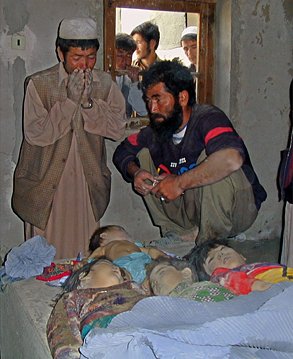
The AP photos that appeared in the New York Times on Monday were heartbreaking: Afghan men, including a father, weeping over the lifeless bodies of four small children, killed by errant American bombs. Coming on top of last week’s reports that American planes had accidentally bombed a Red Cross facility in Kabul for the second time in as many weeks, the images forced the world to confront one of the most painful issues connected with any war — and an extraordinarily sensitive one in this war — civilian casualties.

To date, human rights groups have confirmed that American bombs dropped on Afghanistan have resulted in at least 48 civilian deaths. America’s enemy, the Taliban, has claimed hundreds if not thousands have been killed — figures the United States asserts are vastly exaggerated for propaganda purposes. But for much of the Islamic world, already deeply suspicious of America’s motives and rectitude, any civilian casualties are evidence that the U.S. campaign is not against terrorism but against Islam itself. Key Islamic supporters of the campaign, like Pakistan, are nervous about how news of civilian casualties will resonate with their citizens and are calling for the air war to be quick and decisive.

Nor is it just the Islamic world that is sensitive to civilian casualties. European nations, both allies and neutrals, are also paying close attention to the issue. A Swedish policeman guarding a mosque in Stockholm told Salon last week, “I think the Swedish people are very worried about civilian casualties. They know this is a very difficult war, but many do not support it and they do not want to see innocent people killed.” The European press, including the widely-watched BBC World News television program, has given prominent coverage to civilian casualties.

In fact, thanks to American policy, planning and execution, the number of civilian casualties so far has been exceptionally low, experts say. In a larger sense, the U.S. has come closer than any other nation to warring within the confines of the Geneva Conventions. But these experts also say that the United States has done a poor job of communicating to the world just how much importance it places on avoiding civilian deaths; has failed to explain in detail exactly what went wrong when mistakes have occurred; and has aroused unrealistic expectations by touting its super-precise weapons.

In a war as controversial, narrowly defined, morally complex and precariously supported as this one, and in a high-tech media age when shattering images of innocent children killed can instantly be beamed around the world, undercutting uplifting official pronouncements, any civilian casualties would have a potent effect on world opinion. But the United States has not helped its cause by the way it has told its story.

Continuing in the tradition of the Gulf War, the most press-managed conflict in history, government officials have attempted to control information through spin control, with tightlipped briefings, vague official statements and praise for “highly accurate” and “precision-guided” weapons that still occasionally miss. Instead of preparing the public for the inevitability of civilian casualties by explaining how American soldiers are trained to avoid them and describing what went wrong when they occur, the Bush administration and the Pentagon have instead created expectations that can’t be met. Disappointment, if not anger, is the inevitable result.

The United States entered this war with narrow goals: find Osama bin Laden and destroy the al-Qaida network. A corollary goal was destroying or removing the Taliban. The war, officials repeated, was not against the Afghan people, or Afghanistan itself. But as the war has intensified, the distinction between attacking the Taliban and attacking Afghanistan has inevitably blurred — with civilian casualties marking the boundary. John Voll, an Islamic history and international affairs professor at Georgetown University, says, “Civilian casualties are the red flag saying the U.S. is no longer just dropping bombs on removed terrorist camps, but also in urban areas. They broaden the scope of the war as the world sees it.”

Government officials have at times been astonishingly insensitive. One unnamed administration official told the New York Times, “The lesson we’re learning is that you can bomb the wrong place in Afghanistan and not take much heat for it, but don’t mess up at the post office.”

Neither the Bush administration nor the military has realized that military policy must be fused to an equally energetic effort on the public relations front. They have acknowledged that civilian casualties are an unfortunate consequence of war, but have yet to go much further.

“This is a worldwide war for public sentiment, and particularly sentiment in Islamic countries,” says Richard Kohn, a military history professor at the University of North Carolina. “It’s a propaganda battle. Every civilian casualty will be used by the other side to try to make the U.S. look brutal or savage and to try to smear the U.S. for making a war against Islam. These claims need to be answered. And yet, I see no evidence that the U.S. even knows it’s in a propaganda war. They have no idea how important this is.”

One of the problems, according to Col. Dan Smith, a former West Point professor who is now chief of research for the Center for Defense Information, a Washington think tank, lies with the inflated expectations produced by the military’s focus on technological precision. They’ve oversold American military capability, says Smith. “The dilemma of bombing is one of the Pentagon’s own making,” he says. “For years they have touted the accuracy of precision guided munitions, but they obviously are not quite as precise as the military boasted they were.” Smith says that the military brass should long ago have stopped stressing accuracy in the abstract and instead used concrete examples from past conflicts.

The fact stressed by Kohn and others is that the United States, more than any other country in history, has attempted to avoid civilian casualties. American bombing strategy has become progressively more focused not just on destroying the enemy but also on avoiding so-called “collateral damage.”

World War II pilots worked with very different strategic goals. Unlike the current war against terrorism, in which military action — itself severely hemmed in by diplomatic and political concerns — is only one part of a multiprong strategy, World War II was a total war. American bombers aimed for military targets first, but it was considered acceptable to bomb entire cities such as Berlin in order to weaken the Third Reich. Pilots were also ordered to drop their bombs even if they couldn’t find their targets, a situation dramatized in Joseph Heller’s bitterly ironic anti-war novel “Catch-22.” In the waning days of World War II, deliberate American firebombing of wooden Japanese cities, which had little military strategic value, killed hundreds of thousands of civilians.

In Vietnam the Pentagon outlined “free fire zones” in which “anything that moved was enemy,” says Smith, a Vietnam veteran. Vietnam also saw horrendous civilian massacres as in Mai Lai and indiscriminate bombing like the 1968 raids that leveled the entire city of Hue (which prompted General Westmoreland’s infamous line “we had to destroy the city in order to save it.”)

While those and many other high-profile incidents (such as the recent revelation that former Sen. Bob Kerrey and his troops knowingly killed civilians) highlight the American military’s indiscriminate targeting of civilians in Vietnam, U.S. forces also made strenuous, if ineffective, efforts to separate civilians from military actions. Resettlement programs specifically aimed to move civilians out of strategic areas before bombings occurred or away from known military forces. These initiatives ultimately failed because Vietnamese society was so agrarian that being removed from their land left them without any economic tools for survival, but the plans still broke from previous military tradition.

The American military’s desire to fight clean wars was given a huge boost by technological advances in the 1980s, when the F-117 was first used, says Smith. The Lockheed Martin fighter, made of radar-absorbing materials, allowed bombs to be dropped from about 10,000 feet, far closer than other bombers like the B-52. “[This] gave pilots the opportunity to come in lower to drop their weaponry,” Smith explains.

In fact, however, there was still a built-in conflict between maximizing pilot safety and minimizing civilian casualties — a tension that will never be overcome. “The Gulf War was the first widespread use (and trumpeting) of what is called precision munitions,” Smith says. “And it is here that the problem of civilian casualties clashed with claims of precision. Just as expectations were raised that U.S. casualties would be low because pilots would not have to swoop in low to make sure they hit targets, so too were expectations raised that civilian casualties would be low.”

Studies conducted after the war proved the expectations to be far-fetched. Human Rights Watch, the most trusted source for civilian casualty data, found that the number of civilian deaths in the Gulf War was “historically low” — but more that 3,000 civilians were still killed.

“Considering the extent of the campaigns, these numbers are very low,” Kohn says. But because the Pentagon led people to believe that there would be virtually no civilian casualties — showing only pictures of successful targets hit at briefings — the numbers seemed disturbingly high, he adds.

While the Pentagon pursued a tight-lipped P.R. strategy that largely ignored civilian casualties and highlighted precision-targeted cruise missiles, Iraqi President Saddam Hussein was playing his propaganda cards for all they were worth. Highlighting alleged civilian deaths, he claimed that the U.S. was targeting Muslims rather than the Iraqi military machine. No doubt much of the Arab world was disposed against the U.S.-led war to begin with, but Saddam’s cunning added fuel to the fire: Arabs rioted in the streets and denounced the U.S. The idea that the U.S. is targeting Muslims rather than its declared enemies (first Saddam, now bin Laden) still holds sway in much of the Arab world today.

Euphoric after a victory that took only 43 days, the Pentagon failed to realize that touting precision weapons could backfire. The bombing campaign in Kosovo continued the pattern. During 78 days of NATO bombing, about 500 civilians died. This was a historic low for a war in which 26,000 bombs were dropped and a staggering 37,465 sorties flown, but the videos of a civilian train being hit by a missile and graphic accounts collected by the Yugoslavian government, Human Rights Watch and other organizations posed stark challenges to American and allied support for the war. As in the Gulf War, the resident dictator, Slobodan Milosevic, made hay out of claiming that the NATO air war was indiscriminately killing civilians.

Midway through the war President Clinton issued an executive order banning the use of cluster bombs because their use in the northern Serbian town of Nis had killed 14 civilians and provoked a disastrous public relations backlash. Joost Hiltermann, executive director of the arms division of Human Rights Watch, notes that “Clinton needed to keep the coalition together and couldn’t afford to rock the boat. And one thing that will rock the boat is killing a lot of civilians, because the home publics of many governments will stand up and scream and say ‘What are we doing in this coalition?’.”

Joost also notes that the U.S. military works to integrate the laws concerning the treatment of noncombatants into all its troops. “There’s a fairly strong integration of these concerns: Military manuals reflect U.S. obligations; officers and soldiers are instructed in rules of war.” Joost also noted that “lawyers are involved who go over target lists and look at new weapon systems that are being developed in order to ensure that there are no violations in principle of the U.S. obligations under international humanitarian law. To that extent, the U.S., like other Western governments, has done quite a bit to integrate these concerns into its military.”

Joost notes that legal analysis of targets can result in differences of opinion, as in the targeting of electricity facilities. “You could argue, legitimately in some cases, that the military is completely dependent on electricity grid — but civilians are also completely dependent on that grid. It becomes a proportionality argument. You need to determine whether by hitting an electric plant that you’ve done more damage to the military and less to the civilian population.

“It’s a difficult balancing act. The U.S. has developed new technologies between the Iraq and Yugoslavia wars that, instead of destroying facilities, limit their use. In Yugoslavia the U.S. used graphite bombs which cause shorts and some damage to the electricity grid but that damage is eminently repairable.”

In his book “Virtual War: Kosovo and Beyond,” Michael Ignatieff detailed the extent to which American forces under NATO leadership went to avoid civilian casualties. Each target had to be vetted by a chain of lawyers, who examined its military uses and potential for causing civilian casualties. A variation of that protocol is still standard operating procedure for the Air Force.

“There are very strict rules about engagement,” says Jean Bethke Elshtain, a professor of political ethics at the University of Chicago and author of “But Was it Just?,” a book of essays on the morality of the Gulf War. “If a military target is obscured, if an unforetold situation arises where you would knowingly be increasing the chance of hitting civilians, pilots are supposed to return with their coordinates intact. This is a complete reversal from World War II where if you couldn’t find the target, you just bombed something else.”

From an historical perspective, the present war in Afghanistan looks relatively tame. “Any civilian casualties are to be lamented, but if people’s points of comparison went back further, if people asked would you rather be in Baghdad during the Gulf War or Berlin in 1944, they might realize that our strategy in Afghanistan is not as bad as it looks,” she says. “We’ve become far more morally sensitive about this issue.”

Bill Arkin, a military analyst for NBC and adjunct professor at the School of Advanced Air Power Studies at the U.S. Air Force Air War College, agrees. He points to a constant improvement in the precision of U.S. air wars. “The reality is this: Nine percent of the air weapons used in the Gulf War were precision weapons, partially because only a certain number of planes could utilize them. In Kosovo about 30 percent of the air weapons used were precision-guided. By 1999 all planes could carry precision-guided weapons. And the cost of those weapons has gone down, which has led to a greater willingness to use them.”

The protocols, while contributing to a significant decline in civilian casualties, have not eliminated unforeseen trouble. Joost notes that unintended deaths have occurred because of “intelligence mistakes with target selection, problems with precisely hitting targets, coordination errors, and using the wrong munitions.”

“If you’re hitting a military target in a civilian area, you’d better make sure that you use a smart weapon,” he says. “But the truth is that maybe two decades ago it wouldn’t have been possible to hit a military target in a civilian area and not cause civilian casualties. Now it’s possible if everything goes right.” But he adds, “There is always human and technical error; there is no such thing as a war that has no casualties. We have to continue to weigh whether combatants break the laws of war.”

While U.S. military actions over the past 12 years have demonstrated dramatic improvements in keeping noncombatants from harm, other major wars have shown just the opposite. Russia’s 1994-1996 war in Chechnya was excoriated by human rights organizations, the State Department and other governments. Russian armed forces made few attempts to focus exclusively on military targets, using scorched-earth tactics harking back to Vietnam and the Second World War. They completely leveled Grozny, the capital of Chechnya, killing, according to Rachel Denbar of Human Rights Watch, “conservatively 15,000 to 20,000 civilians.”

Denbar points to numerous incidents in the first Chechnyan war like the “bombing of the market in Grozny in the middle of the day in 1999 that killed 50 to 100 people.” Denbar says that the “Russians claimed that it was an arms bazaar. Maybe arms were being sold there, but it looked like it was occupied predominantly by civilians and there was no investigation of who was actually there.”

Other nations that have waged war over the past two decades, in particular less developed ones, have shown almost no regard for civilian casualties. Indeed, civilians have frequently been the major targets in appallingly violent civil wars like those that convulsed Yugoslavia throughout the 1990s, the Rwandan genocide of 1994, Congo’s continuing struggle and many others.

In those bloodbaths, civilian casualties were unquestioned. But in wars involving more delicate political considerations, civilian casualties can be critical factors. The NATO-led intervention in Yugoslavia in 1999 faced constant pressure from within and without over high-profile civilian casualties, as did the U.S. in the Gulf War.

Just how badly a single horrific episode of civilian casualties can hurt a controversial, narrowly defined military action became evident in 1996, when during its “Operation Grapes of Wrath” invasion of Lebanon Israel accidentally shelled a U.N. refugee center at Qana, killing 102 civilians. International outrage and U.S. pressure led Israel to pull out of Lebanon.

What should the American government and military do to better communicate their position on civilian casualties? Kohn favors the creation of a department of war information, similar to what the U.S. maintained during World War II. Elshtain says that “a briefing about the rules of engagement that the pilots are under would be a very good thing.” But the military and government still appear reluctant to take up these suggestions — or even to directly confront the inevitability of civilian casualties in internal reports and training.

According to Arkin, there’s a critical lack of information about the results of air wars on civilian populations. “The Air Force did a four-volume study on the air war over Yugoslavia that the secretary of defense, William Cohen, suppressed,” he says. “The study wasn’t even distributed to the Air Force until last year when Cohen left the government. There has been no methodical study of an air campaign’s effects. Very few people have experience of what happens on the ground in air wars, and those that do have doctrinal blinders that often stand in the way of doing what’s best.”

If the military can conduct its own investigations on civilian casualties and realistically assess that information, then its tactics could be further refined to avoid such casualties. The admission of mistakes, honest contrition and efforts at amelioration might actually increase trust and result in a more transparent and effective force — though there’s no way of knowing if this more open approach would work.

Voll and other Middle East experts argue that the present level of support for the war will be hard to maintain, regardless of improved P.R.

“When we were attacking Kosovo, we were attacking a country,” Voll says. “This time, we have never said we’re in it to destroy Afghanistan, but we are de facto attacking a country when the war aim was to attack a terrorist network. This is harder for our Muslim allies to support. Our coalition partners didn’t sign on to destroy a country.”

But even if improving America’s story didn’t shore up wavering allies, some experts maintain that it would still have a generally positive effect.

“The propaganda on the other side has to be answered and countered and they’re just not doing it,” Kohn says. “These people are hiding themselves and their equipment in mosques, just like the Iraqis did. They’re playing on our commitment to follow international law. The fact that the hypocrisy of the other side is so glaring indicates to me that this is not being handled as aggressively as it should be. Here are these great jihad warriors hiding behind their women and children. That’s the message the world should be hearing.”

Additional reporting by Gary Kamiya.

Continue Reading Close

Everything you were afraid to ask about “Mulholland Drive”

Revised and updated: The scary cowboy! The mysterious box! All that sex! We answer all your questions about David Lynch's latest outrage -- the weirdest movie of the year.

  • more
    • All Share Services

Everything you were afraid to ask about

“Mulholland Drive,” the latest feature from director David Lynch, is exhilarating — two hours and 25 minutes of macabre thrills, highly charged erotica and indelible images. But it’s also confusing. Bits and pieces of plot dribble out; characters appear and disappear; the film takes an incomprehensible turn two-thirds of the way through; and there seem to be three or four disparate story lines that have virtually nothing to do with one another.

In this way, the film is similar to Lynch’s “Lost Highway,” his cinematic scud missile of 1997. In that film, the 40-something Bill Pullman languishes in a locked prison cell. He then, without explanation, turns into the 20-something Balthazar Getty and is released from prison, and the movie goes off on a new story tangent. That was just one puzzling development in a film whose plot was regularly described as a Möbius strip by reviewers.

“Mulholland Drive” is a movie along those lines, though its filmic palette is broader, its setting (Hollywood and the film industry) more portentous, and its themes plainer. Beyond that, the narrative is intricate and playfully surreal rather than opaque and frustrating.

Indeed, it may be the most conventional and coherent of Lynch’s “hard” movies (“Eraserhead,” “Blue Velvet,” “Twin Peaks,” “Fire Walk With Me,” “Wild at Heart,” “Lost Highway”). All the themes that cycle through his work — strange figures pulling the strings behind the scenes, random acts of extreme violence, bizarre character fixations and the feeling that the surreal is an active part of our everyday life — are present here, but he’s tied them to a narrative structure that, in the end, resolves itself. For aficionados, there are red herrings that will maintain many a debate, but others will suspect that Lynch is finally coming out and telling us what he’s all about.

Still, of recent American movies, only “Memento” is remotely as challenging, and it’s still almost impenetrable on first viewing. What follows includes a synopsis of the plot and then questions and answers about what in the world is going on in “Mulholland Drive’s” strange universe. So stop reading now if you haven’t yet seen the film.

- – - – - – - – - – - -

Here’s the basic plot: The film opens with garish, distorted footage of people jitterbugging; it’s a hellish version of a Gap ad. Then we see washed-out superimposed footage of a young woman with a sort of beatific homecoming queen smile on her face.

Then there’s a few seconds of a red blanket; breathing sounds pulse on the soundtrack.

Then the movie proper starts, with a few parallel stories: In one, a gorgeous woman is in the back of a limo, climbing the winding curves of Mulholland Drive above Los Angeles. The driver stops unexpectedly and points a pistol at her. But before he can fire the limo is rammed by one of a pair of drag-racing cars. The voluptuous woman gets out in a daze and stumbles down the hills into Hollywood and ends up sleeping in an apartment whose owner is away on vacation.

Then we see a diner, with an odd, nervous, nerdy-looking young guy talking to a more composed middle-aged man. The younger one says he’s had a dream about the diner and a monster outside. They go outside and see the monster! The young guy collapses.

Someone is after the woman who wandered off from the car wreck. We see a strange man pick up a phone and hear that they haven’t found her yet. He calls a number and passes along the message; we see a dirty yellow wall phone picked up and accept the message. Then we see that phone hung up, picked up and dialed. A phone rings on a coffee table next to an ashtray, but no one answers.

We are introduced to another character, Betty, as she gets off a plane, chatting gaily with an elderly couple she met on the flight. Betty is a bushy-tailed, almost painfully chipper young woman just arrived in Los Angeles to make her fortune as an actress. The older couple effusively wish her luck.

In yet another narrative stream, a young director, Adam, is being forced by some evil Hollywood studio types to cast a certain ingénue in his film — a blond named Camilla. Arrogantly, he refuses; a strange man in a spooky room orders that the film be shut down. Adam leaves for home in despair and finds his wife in bed with the pool man, who beats him up.

Meanwhile, a scruffy blond-haired guy is talking to a long-haired guy in a shabby office, who mentions something about an accident. The blond guy pulls out a gun and shoots the other, apparently to get a mysterious black book that has some sort of connection to the attempted killing of Rita. But a shot goes awry and hits a woman in the next office. The hit guy tries to strangle her, then shoots her. Then he shoots a janitor who wanders by. Then he shoots the janitor’s vacuum cleaner and starts a fire, which sets off alarms and sprinklers.

Betty is staying in the vacant apartment of her aunt, in a building run by an older woman who calls herself Coco. Betty stumbles on the bruised woman hiding out in the shower! She’s under the impression, at first, that she’s a friend of her aunt’s; but it eventually is revealed that the strange guest is suffering from amnesia. She christens herself Rita, after seeing Rita Hayworth’s name on a movie poster; the pair find $50,000 and a mysterious blue key in Rita’s pocketbook. This suits the Nancy Drew-like inclinations of the out-of-towner perfectly, and they set out to figure out the secret of Rita’s life.

The director is thoroughly menaced by some dark forces, including a very scary guy in a cowboy hat in a deserted corral at the top of Beachwood Canyon, high above Hollywood.

The cowboy, calm but dangerous, tells the director again to hire Camilla, the ingénue. “If you do what you’re told, you’ll see me one more time,” the cowboy says calmly. “If you don’t do what you’re told, you’ll see me two more times.”

Betty, meanwhile, is preparing for her first audition. She and Rita practice her lines; she’s clumsy and conventional. But at the actual audition she turns into a sensual bombshell — and blows away the producer and everyone watching!

Then a casting agent walks Betty over to the director’s movie set. It seems to be some sort of ’50s period piece. We see a woman sing Connie Stevens’ “16 Reasons.” Then Camilla, the ingénue the bad guys are shoving down Adam’s throat, sings Linda Scott’s “I’ve Told Every Little Star.” “This is the girl,” Adam says.

Betty and Adam’s eyes meet. But she runs home to Rita.

The two women follow clues to the apartment of another young woman, Diane. They speak to Diane’s neighbor, then break into her apartment and find her dead and decayed in her bed!

Shaken, the two return home and dress Rita in a blond wig as a disguise. Betty invites Rita to share her bed that night. Rita makes a pass and the pair find comfort in each other’s arms.

“Have you even done this before?” coos Betty.

“I don’t know,” replies Rita, “– have you?”

Betty says, “I want to, with you. I’m in love with you.”

Rita has a dream about a stage show in a nightclub. She drags them to the club, which is called Silencio. There, musicians and singers pretend to perform, but the music is all canned. Says the emcee: “This is all a tape recording. It is an illusion.”

Up in the balcony, the pair begin crying. Betty shakes and weeps in some hyperemotional response to the music. Without explanation, she finds a glistening blue box in her purse.

They go home. Rita turns to the closet. When she turns around, Betty has disappeared. Rita uses the key to open the box. She’s apparently sucked into it; we zoom into it, presumably from her point of view, and it drops to the floor.

The movie suddenly changes. We’re back at the dead Diane’s apartment. We hear knocks at her door; we even see the mysterious cowboy again! “Hey, pretty girl, time to wake up,” he says.

Her neighbor, whom we met before, finally wakes her up. Diane is a haggard, dirty-blond with a nervous twitch and a beaten-down look. She notices a blue key on her coffee table.

She’s involved with a taunting but cold brunet — the amnesia victim, Rita! The brunet’s real name, we learn, is Camilla — which is the same name as the ingénue the studio bad guys are pushing. But that woman was blond and much shorter — an entirely different woman.

The two women have sex on the couch, but Camilla suddenly goes cold. Camilla says, “We shouldn’t do this any more.”

Diane, horrified, says, “Don’t say that,” and tries to force her way with her.

This Camilla is suddenly the object of the charms of the young film director, now happily separated from his wife. We see him putting the moves on her on his movie set. Camilla makes sure that Diane can watch, which she does, glowering.

Later we see Diane masturbating in an unhappy frenzy.

The phone rings; the phone she picks up is the one that isn’t answered at the beginning of the movie. Diane is taken in a limo to the party — the same limo, it seems, we saw Rita in at the beginning of the film. It’s on the same ominous trip up Mulholland Drive, too.

But she’s not about to be shot. Instead, she’s greeted at a party by Rita, who is now Camilla. The host is the director, and the weird Coco is now the director’s mother! She questions Diane with a look of disapproval on her face. We learn that Diane was a teen jitterbugging champion in Canada who came to Hollywood after her aunt died and left her some money. Diane says she’s acted a bit, and met Camilla at an audition for a big part in a movie called “The Sylvia North Story,” directed by Paul Bruckner. But she lost the part to Camilla.

Diane, humiliatingly, is forced to watch first as the blond Camilla from the first half of the movie comes over and kisses her Camilla, deeply on the lips. And then Camilla and Adam make out in front of her at the table. They seem to be about to announce their engagement.

This scene abruptly cuts to one in which we see a distraught Diane sitting again in the diner, paying the shaggy hit man $50,000 to kill her girlfriend. He’s holding a black book. She’ll find a blue key on her coffee table when the deed is done, he says.

The camera pans out into the back lot of the diner, where we see the monster again. It’s a homeless man, it turns out, his face filthy and his hair matted. He’s turning the mysterious deep blue box over in his hands.

We suddenly are reintroduced to the cheerful elderly couple who accompanied Betty off the plane — incredibly tiny, and crawling out of the mysterious box. Now they are shrieking and horrific. They chase Diane around her apartment in a phalanx of terror. She flees to her bedroom and shoots herself in the head.

The couple laugh maniacally.

We see the ominous L.A. cityscape at night. Spectral washed out images float over it, just like at the beginning of the movie. This time we can see Betty and Camilla’s faces.

Then there’s a shot of an odd, heavily made-up actress from the club the women went to.

“Silencio,” she says.

- – - – - – - – - – - -

This all leaves a number of questions. Let’s take them in order. (Feel free to send us suggestions, quarrels or further thoughts on the film.)

What the fuck is going on in this movie?

Well, it seems that Diane had her girlfriend murdered. Then, in a masturbatory fantasy cum fever dream in the moments before she commits suicide, she reimagines her ruined career and failed relationship with the woman she loves.

The dream begins with Camilla/Rita miraculously escaping the hit Diane had taken out on her. From there, Diane, a product of Hollywood, imagines the story in cinematic fashion: She sees herself as the naive wannabe starlet Betty, who succeeds on sheer talent and solves whatever problems are thrown her way. She even gets the girl!

Thematically, Lynch seems to be working out a number of things: the enticing but empty imagery of the movie screen; the accompanying imagery that is used as stardust to cover up the unpleasantries of the movie-making process; the imagery that the ambitious use to reimagine and remake themselves; and the imagery and imagination actors put to work to create their characters.

Wait, go back to the Diane and Rita stuff. Where does Betty fit in?

Diane and Betty are the same person.

Get out!

Some viewers see that it’s the same person right away; others are flummoxed because they just seem different. If you look closely, you see they’re the same actress. The actress, Naomi Watts, delivers a technically dazzling performance. It’s difficult to believe that chipper Betty and the ground-down Diane are the same woman, but they are.

As a reader points out in a letter to the editor, Lynch even slips in a wry joke. “It’s weird to be calling myself,” Rita says as the pair call Diane. “Hi, it’s me,” Diane says immediately afterward, on her answering machine.

Fine: “So it was all just a dream.” Is that the cliché you’re contending Lynch is giving us?

Well, it’s a little more complex than that. It certainly does explain the exaggerated gestures, heightened emotions and odd plot turns in the first part of the movie. Seen as dream motions, Betty’s hokey “I’m goink to be a stah, darlink” schtick makes more sense.

Diane’s fantasy is a number of things. It’s obviously a dream of a world in which her relationship with Camilla was different — a place where Camilla loves her and is dependent on her. But it’s also a requiem for her lost career, and arguably an elegy to a lost Hollywood as well. But Lynch seems rather ambivalent about the lost Hollywood, which by analogy undermines Diane’s dream vision, too.

Lynch may be telling us that this is the dream we all share when we watch Hollywood movies, and reminding us at the same time that it is a dream — that it is wishful, and says a lot about the dreamer. The movie’s most problematic conceit is Diane’s hallucination of the mad powers behind the scenes in Hollywood. Are those imaginings the incoherent ones of a cockeyed youngster turned sour by failure? Or the unvarnished truth of someone who’d seen it happen, up close and personal?

Indeed, Diane herself is someone who deals with personal rejection by hiring an assassin. Lynch does a great job intertwining the dicier sides of Diane’s character with a wider critique of Hollywood as a business and the complex relationship between Hollywood as dream factory and its audience. It’s possible Lynch sees consumers of popular Hollywood fare as unable to work out their grievances in their real lives, so they resort to fantasies of revenge.

What’s the time period of the movie?

It’s apparently the present, but the dream part of the film is an eras-spanning romanticized netherworld of ivied Hollywood apartment buildings, aging stars and picture-perfect period re-creations on busy sound stages. (In “Blue Velvet,” too, Lynch pulled off the trick of creating a modern setting that seemed somehow to have previous decades still hanging heavily in the air.) The women ride around in cabs a lot, an anachronistic touch. But the thuggish hit men and crack-addled hookers wandering around are up to the minute. Overall it’s typical of the fine line Lynch walks between the fantastic and the real, all set against a malevolently filmed skyline, harsh parking lots and the endless expanse of light that is L.A. from the hills at night.

Speaking of which, despite a few night scenes, this is one of those odd noirs in which terror lives in broad daylight.

OK, so what about the box?

We don’t know about the box.

What about the monster?

The monster, who hides behind the diner where Diane contracted the killing, seems to be the demon Diane metaphorically begins dealing with when she decides to have her girlfriend knocked off. In the end we see he’s just a homeless man, a reminder of the grimy Hollywood Diane came to know after her jitterbug-queen optimism got beaten out of her. And, OK — he’s also the keeper of the box, the symbol of Camilla’s death and perhaps reality contained (sort of like a movie). Once it’s unlocked, Diane has to return to the physical world and accept that she’s done an inhuman thing.

Readers see a lot more in the box: Several found an amusing — and hard to argue with — sexual connotation. (Maybe that’s why the hitman laughs when Diane asks what the key opens.) Others make a case that it’s a television. The multiplicity of meanings fits in well with the film’s texture.

The blue key is supposed to mean Camilla’s dead; but we see her alive after that.

After the fairly straightforward narrative of the film’s first two-thirds, the last part of the movie is a staccato sequence of flashbacks. Diane sees the key, and understands that the deed is done. (She probably understands that she’s going to pay a price for it, too; her neighbor even tells her that “Those detectives were here again.”) She starts reflecting on how she came to be in this position, from Camilla’s coolness to her flirtations with Adam to the unforgivable humiliations at the party. Diane sees that she’s been reduced to an object of pity and contempt by even someone like Coco. That takes her into the downward spiral that produces the hallucinogenic first part of the movie and then her decision to shoot herself.

Let’s talk about the 50 grand. Diane gives it to the hit man; why is Rita carrying it?

This is a good example of Lynch’s dream logic. Diane fetishizes it, and it turns up in an odd place in the dream. Same with the mysterious blue key. The hit man says he’ll leave a normal blue key in her apartment when the deed is done. This transmogrifies in her fantasy into that futuristic one. Both are also necessary to Diane’s dream mélange of film clichés, particularly noir film clichés (and the director’s deconstruction of the genre as well: “A dame appears out of nowhere with 50 grand in her purse and a mysterious key.”)

Watch the movie carefully and you see that many characters and props in the last third of the film are picked up in Diane’s mind and repurposed for the dream: The hit man’s black book; her grouchy neighbor; the waitress at the diner; the director’s mom; the director who didn’t give her the movie part; the woman Camilla kisses at the party; the cowboy; even her aunt.

What mélange of film clichés?

Diane seems to have imbued herself with the worlds of film, TV, even pop-culture camp, in her time in L.A. Much of what she and Rita attempt are procedures right out of a Sam Spade noir handbook by way of Nancy Drew — peeking into windows, talking to neighbors, making anonymous phone calls and so forth. When the two are in their bed together, there’s a double-profile shot that’s an homage to Bergman’s “Persona.” Betty helps Rita turn herself into a blond, a rough doppelganger of Betty, à la “Vertigo.” The sequences in which the director is bullied into using Camilla in his film have a tangential similarity to the conversations leading up to the infamous horse’s head scene in “The Godfather.” Readers note that “The Wizard of Oz” is in there too, as well as a strange pattern of parallels to “Pulp Fiction.”

There are also vague echoes of TV soap operas, pornography and a lot of other things, not to mention the presence of Chad Everett (the guy Diane does the audition with), ’40s hoofer Ann Miller (Coco), Lee Grant (the aunt’s weird neighbor), Billy Ray Cyrus (the pool guy), Robert Forster (a cop), and others.

The references all seem to be what the theorists call “blank,” just memories ricocheting around in poor Diane’s head at a really bad time.

Fine, fine. Isn’t the cowboy just sort of a twist on the menacing Robert Blake character in “Lost Highway,” the reindeer man in “Wild at Heart” etc., etc.?

It certainly seems like it. The goofy Roy Rogers getup is also another echo of a prelapsarian Hollywood when the studio system ruled and studio heads of virtually limitless power really did pull the strings.

The director did what he was told. Why did we see the cowboy twice?

Well, the cowboy appears once to Diane as a transition from her dream back to reality, apparently part of her fantasies before she kills herself. In the “real” last third of the film, we see the cowboy passing out of the party at the director’s house. To us, caught up in the backward dream logic of Diane’s fantasy, this would have been the one last time the director would see him, since he agreed to put Camilla in the movie. But in reality he was just someone she once saw out of the corner of her eye who was then incorporated into the paranoid fantasy of her dream.

What about that hooker the hit man questions and then ushers into his van? And what about those diner waitresses?

They seem to be Lynch’s nods to the milieu he’s filming in and the diverse women Hollywood chews up in various ways. Diane imagines herself as Betty in the dream after seeing a waitress named Betty when she’s talking to the hit man. In the dream, Betty meets a waitress named Diane.

Betty loses a part in “The Sylvia North Story” to Camilla. Who’s Sylvia North?

Beats us. But note that the director of that movie is Paul Bruckner — the milquetoasty guy at her audition.

That weird old couple?

They appear in the opening jitterbug sequence as well. They may be the judges of the contest she won, or her parents. In the end, they seem to be signs of her innocent past come back to terrorize her.

The film’s dedicated to Jennifer Syme. Who’s that?

Syme was an actress who appeared in “Lost Highway.” She died in a car accident. The tragic death was noted in the tabloids because she used to date Keanu Reeves.

What about the Silencio Club?

In the dream logic of Diane’s imaginings, it’s part of the glamour of Hollywood, and the out-of-body existence of many actors, and perhaps the ultimate emptiness of the reality that films purport to give us. The unexpected focus on sound, as opposed to image, which is what the rest of the film seems to be about, is typical for Lynch as well: His soundscapes, here as in his other difficult films, are extraordinary, and he regularly conflates sound and image. Remember that in “Blue Velvet,” which also dealt with the reality beneath the surface image, young Jeffrey, the Kyle MacLachlan character, is introduced to that netherworld via a severed ear.

Lynch’s longtime composer, Angelo Badalamenti, plays the espresso-drinking movie exec at the beginning of the film, incidentally.

Also, speaking of “Blue Velvet,” Dorothy Vallens lived in the Deep River apartments. Betty is from Deep River, Ontario.

What is the point of that scene with Chad Everett, Diane’s audition?

This strikes us as possibly the heart of the movie. It’s the linchpin of Diane’s idealized image of herself. Yet beyond that, the care with which the sequence is set up and the scene’s immense punch seems to suggest that Lynch believes, perhaps passionately, that there is such a thing as acting, even great acting. It may be his tribute specifically to the miracle of character imaginings like Diane’s and, by extension, to the creation of self in our subconscious and the many selves we don’t know. Actors make it up out of nothing more than sheer imagination and persuade the audience to believe it. Lynch has been doing the same thing explicitly over his entire career.

Again, Naomi Watts, the actress, should be given credit for balancing the many levels of control needed to convincingly act the part of a ground-down starlet imagining herself as a chipper and idealistic young thing who then can convincingly deliver a unexpectedly searing audition performance — and then have the levels of the conceptions make emotional sense to viewers at the end of the film. Brava!

The hit man thing is confusing. Who is the long-haired guy he murders? And what about the prostitute he ushers into the van? Is that Diane, too?

The guy he shot so perfunctorily made some remark about a car accident. The implication seems to be that he was in one of the joyriding cars that hit the limo, and that he ended up with some sort of black book that the guys who were about to kill Rita possessed. In the logic of Diane’s dream, the hit man needed that as a lead to where she was. We know that it’s not going to help him find Rita, but he doesn’t know that.

The scene is also another movie nod, this time to the absurdist modern black noir; here it allows Lynch, at his bleakest, to film a senseless carnage that out-Tarantinos Tarantino. It’s also part of the confusing background noise Lynch likes to put into his movies. It is a deeply felt contention of his that not everything makes sense. Less charitably, you can say it’s a loose end from the TV series that never got made.

What TV series?

“Mulholland Drive” was supposed to be the pilot for an ABC TV series that was going to both make ABC the network of the moment and put Lynch back into a “Twin Peaks”-like limelight. Fat chance. The network approved the script, but balked when execs saw the two-hour-plus result. Lynch apparently tried to slice off the last 40 minutes, but the network didn’t like that either. He eventually found a French film company, Studio Canal, to put up some money. He reassembled the cast, filmed some more and created the feature version out now.

So what is Lynch trying to say about Hollywood?

You can’t help noticing that no one comes off very well in this fetid world. In interviews Lynch has been putting the screws to ABC. While he points out that the network had approved the script before he filmed it, it’s hard to believe any sane person would expect broadcast television to air a movie anything remotely like this. And we’re somewhat suspicious when a director like Lynch — who’s been given tens of millions of dollars to make extraordinarily dark, sometimes positively inhuman (“Wild at Heart,” for example) movies for more than 20 years — whines about Hollywood. He’s been nominated for a best director Oscar twice. What does he have to complain about?

All that said, the movie is certainly no polemic. Lynch seems pretty detached from this. The character of Adam the director seems a mocking version of himself. Lynch’s nuances and implicit respect for the magic of the art make the film a complex portrait of the industry.

And the artistic rationale for the extended sequences of lesbian sex would be …

He’s playing explicitly with how Hollywood uses women predominantly as sex objects — except he’s turning the formula on its head, making the women’s world a closed one, at least in Diane’s fantasy of it. But of course, in the end she’s doing the same thing a Hollywood movie normally does to a Camilla — imagining that she’s an empty object that she can possess.

In the end, “Mulholland Drive” is Lynch’s most sympathetic film, particularly to women. Even if Betty’s dream is an extended apologia for a terrible crime, the density of her character, the expansiveness of her dreams and desires, and the catch-all giddiness of her imagination all make her something close the one the thing she always wanted to be: the ultimate movie heroine.

And she’s just part of the film’s dense milieu. The network of aging actresses and incoming starlets ineffably captures the implacable Hollywood mill. Lynch seems to accept the manifold processes by which women come in to self-invent themselves: by sheer talent, the way Betty does; desperately, as Diane does; by hook or by crook, as Rita does, plucking a new identity off a movie poster; or sexually, the way Camilla does. All, he seems at pains to point out, are ultimately in the business of dream fulfillment, which is why we as consumers go to the films as well. Right?

- – - – - – - – - – - -

If you liked this feature, please take a minute to click here to read a note from the Arts & Entertainment staff about Salon Premium.

Continue Reading Close

Fundamental problems

Religious writer Karen Armstrong explains why Muslim nations have difficulty with democracy and the qualities that all forms of fundamentalism share.

  • more
    • All Share Services

Fundamental problems

Americans are scrambling to learn about Islam in record numbers, and when they do, chances are they’re turning to the works of Karen Armstrong, a British theologian, former Roman Catholic nun and the author of “Islam” and “The Battle for God,” as well as “Buddha” and several other books about the world’s religions. The breadth and liberality of Armstrong’s views on faith in all its myriad varieties makes her the ideal interpreter for those who are frightened and baffled by the dramatic clash between Islam and the West. Salon spoke with her recently by phone.

Where’s the line in the Islamic world between fundamentalists and extreme actions like terrorism?

In many Muslim countries there’s a strong dislike of American foreign policy and that makes it difficult for them to dissociate many fundamentalist leaders. Many of the middle and professional classes have a degree of sympathy for fundamentalist actions while they deplore things like Sept. 11. That atmosphere can encourage radicalism.

How did Islamic fundamentalism develop?

Education has a lot to do with it. There’s not much leadership among the ulema, or religious scholars, who, in many ways, have become separate from the populace. One or two have popular appeal but not many of them. In the 19th century, they tended to retreat in front of the secular forces of the state. There was an ideological vacuum.

In our secular countries we’ve pushed religion to the side. In fundamentalist movements worldwide people are dragging religion back from the sidelines and onto the center stage. In a country like Egypt, modernization has proceeded so quickly, unlike in the West. They’ve done it so fast that only an elite has any understanding of the norms and institutions of secular society while the vast majority of society was left floundering. Many fundamentalist groups have great support among the masses because they can present modernity in a light that people can understand. For example, the Muslim Brotherhood in Egypt brought clinics, education and labor law into an Islamic context.

Before the Iranian revolution people never had representational government. They tried to get it in the early 20th century and actually got a constitution but it was never put into practice. The British wouldn’t let it happen because oil was discovered and they didn’t want to risk losing the oil to the local government. Under the regime in Iran, they are trying to develop a Shiite democracy, which makes democracy more intelligible to the people. In the last days of Khomeini’s life, he was trying to pass power from conservative clerics to parliament. [Iranian president Mohammed] Khatami is trying to carry that on.

Why do democratic institutions seem to be so hard to set up in Muslim nations?

Democracy is something that we developed in the modern world as a result of our modernization — not because we wanted to suddenly give power to the people. It’s part of the transformation that comes with a capitalist economy. Once more and more people at humble levels had to be involved in the productivity of the country as factory workers, clerks, etc., they had to receive a modicum of education; more education demanded a greater share in the decision-making processes of the country. In order to use all human resources available to them, governments realized that they had to bring everyone into the franchise.

The Muslim world hasn’t had time to develop a home-grown democracy. They still don’t have the same kind of capital market economies, and in many countries democracy got a bad name because it was associated with bad regimes that the United States supported, despots like the Shahs in Iran. In Egypt between 1922 and 1948 or so there were 17 elections all won by the populist party, but it was only allowed to rule five times because each time the British or the palace wouldn’t let them rule because the populists wanted to kick the British out. That sort of thing left a bad taste.

What about the division between church and state in Islam? I understand that the Quran doesn’t have a “render unto Caesar the things which are Caesar’s/God what is God’s” division and that Khatami’s insistence on the rule of law in Iran has created quite a stir.

Everything has changed under the process of modernization. In fact, even though ideologically [in Islam] there can be no separation between church and state, both Sunnis and Shiites developed a separation very early on. In the Sunni world, the separation was de facto; Islamic law developed as kind of a counterculture to the aristocratic courts. In the Shiite world, there was a separation of church and state on principle. It was held that since every state was corrupt, clerics should take no part in them, that the religious should withdraw until the messiah came and established a proper Muslim state.

The Ayatollah Khomeini’s insistence that a cleric could lead a state was revolutionary.

Do you mean to say that religion hasn’t been a big part of the state in Islamic society?

Fundamentalist movements have tried to drag religion back into the center of public concern and policy across the world. The United States did this first in the early 20th century, really during World War I. Islam was the last of the three monotheistic religions to produce a fundamentalist religion in the late 1960s after the shock of the Six Day War. Religious fundamentalism took hold on both sides of the war. In Egypt, the feeling that [President] Nasser’s secular policy was bankrupt made many Egyptians feel that they wanted to get back to their roots. The same thing happened in Israel with orthodox sects.

Has fundamentalism grown rapidly across the Islamic world since the 1970s or has it been isolated in countries like Iran and Egypt?

Don’t imagine that the entire Muslim world is fundamentalist. And our perception is that only the United States and United Kingdom have happy fundamentalists, but that’s not entirely true. It’s the same in the Muslim world. Not all fundamentalist movements are violent, for example, most American movements and most ultraorthodox Jewish organizations in New York and Israel aren’t violent.

Some of the Egyptian student movements confined themselves to providing assistance to students, and the Muslim Brotherhood was largely occupied with providing social services to the general population until it got quashed and incarcerated by Nasser. Until then their main concern was to open clinics and teach people factory laws. Many student bodies were trying to get better conditions for students because universities in Egypt are extremely overcrowded and offer very little space for quiet study. Islamic student organizations will provide quiet study time in mosques and study handouts where books are lacking. There’s also an enormous concern for women in overcrowded classes because they’re frequently harassed. The vast majority of fundamentalists don’t take part in terror. They’re just trying to take part in a religious world that also exists in their material lives.

What changes fundamentalist movements like the Muslim Brotherhood and Hamas from social services organizations into terrorist organizations?

If the country is at war. The United States has been fortunate because it hasn’t been at war for a long time. But in the Middle East, political tension and warfare have been almost a constant for the past 30 years. Every fundamentalist movement is rooted in fear. Fundamentalists believe that on some level modern liberal secular society wants to wipe out religion. Even American fundamentalists have that fear. Some people in small-town America feel colonized by the alien ethos of Washington, Yale and so on.

In Middle Eastern countries the secularization process has often been so accelerated that it’s felt as an assault. In Turkey, Ataturk closed all madrassas [religious schools], forced the Sufis underground and forced men and women to wear Western dress. In Iran, Shah Reza Pahlavi gave orders to shoot at hundreds of demonstrators protesting compulsory Western dress. In that environment, you can see how secularization is experienced as an assault.

You have people who feel under fire, rageful and vengeful and feel that they’re fighting for survival. In that condition, anyone can lash out. People in the United Kingdom are so disinterested in religion, so there’s no problem, but we do have football hooliganism where the experiences normally present in religion manifest themselves: You can pour your soul into a movement, experience a collective defeat and lash out at a common enemy. It’s the same mix that fuels a lot of these fundamentalist movements.

Why do you tie the growth of Islamic fundamentalism to the aftermath of the Six Day War?

They felt that adopting the Western method didn’t work, that it was bankrupt, and they withdrew to a religion that they knew.

At the same time, Khomeini was studying in Qum and started protesting against the Shah. He was deported in the 1960s, then there was a lull and a sudden upsurge in the late 1970s. The Moral Majority appeared in the United States, the Iranian revolution exploded and you also see the emergence of religious Zionism in Israel with the new power of ultraorthodox parties there. In the Middle East, you have more and more people inspired by the example of the Iranian revolution turning to their own ideologues like Said Qutb in Egypt who was executed by Nasser in 1966.

Then Afghanistan blew up, then Lebanon. The Moral Majority’s political prominence receded in the United States after the sex scandals, but they’re still in America and are getting more extreme. It hasn’t gone away; these movements don’t go away, they just change.

Similarly in Israel you have more and more fundamentalist parties in the 1980s having an effect on government that they’d never had before. Israel was a defiantly secular state, but now no politician can form a government without support from fundamentalist Jews. At the same time fundamentalism has seen a quiet and steady growth in Islam. Islam is now as popular as Nasser’s socialist and nationalist policies were in the 1950s and 1960s.

There was a yawning vacuum, especially in the Middle East where society became divided and split between an elite intelligentsia who have a Western education and understand what’s going on and the vast rank and file who are essentially left to rot in a pre-modern ethos. They didn’t understand the changes: everything from a new type of town planning, to new political institutions. How can they vote creatively when they don’t understand secular politics? The West did it gradually so that it could filter down to the people. In the Islamic world modernization split countries right down the middle.

It’s worth noting that at the turn of the 20th century every Muslim intellectual was pro-Western because they saw it as a beacon of progress and justice. They thought that progress and justice would filter down to the people. They said, “These Westerners are better Muslims,” because Islam puts great weight on social justice, and it looked like social justice was filtering down to the masses in the West.

What happens now that fundamentalists have such a great deal of support in the Islamic world and many appear to tacitly support terrorist action?

These are all bad religions. In a hostile world, they play down the compassionate ethos of religion and accelerate the more bellicose elements of religion. When you have bad religion, like bad art or bad sex, it can easily tip over into nihilism and tip into things like what happened on Sept. 11.

Once they get into power they moderate, but they still say, “We don’t want to be like Westerners.” It’s a po-mo ethic that says you don’t have to be like the West to be progressive or modern. Rafsanjani [president of Iran from 1989 to 1997] said this will be a Shiite democracy, we’re doing it our way. But at the end of the day they find that any modern government has to be democratic. The governments in Eastern Europe learned the same lesson after they tried to hog all the benefits of modernity and fell behind.

You have to remember that in every society culture is contested. There’s always a struggle over which ideology should prevail. That conflict is going on in the United States where there are people who don’t identify with democracy and have a dim view of it and are convinced that the federal government will fall and that God will take care of it. Similarly, in other countries you’re seeing a struggle over which ideology will come out on top.

What about President Bush’s declaration of war and subsequent use of the term “crusade” to describe it; does that demonstrate a very basic problem of understanding how to approach winning the hearts and minds of fundamentalists?

It was very stupid of him to say “crusade” when trying to appeal to Muslim counties. Americans don’t understand enough about the Muslim world in order to mount a good P.R. campaign. That applies to the Western world in general, but in America there’s a particularly acute ignorance.

In my travels around the states, I’m astonished about the lack of interest in the rest of the world. If you’re staying in Denver the local paper seems totally local; there’s lots of commentary and very little news. That’s all got to change because this attack has shown that if you ignore the world, the world will come to you.

Just before this tragedy, in the United Kingdom, the big scandal was asylum seekers. Every night a number of people would try to walk through the chunnel. You suddenly had a feeling that the world that we ignore is suddenly pressing in on us. We arm our ports, but truck drivers would open their trucks to find them packed full of asylum seekers.

There seems to be some kind of awful parallel between that and the crazed fury of crashing into the World Trade Center.

Continue Reading Close

Page 2 of 14 in Max Garrone