Nancy Scola

Why Republicans welcome birth control politics

More voters are worried about governmental control than women's health, they say

Demonstrators protest against the healthcare bill outside the Capitol in Washington on Dec. 15, 2009. (Credit: Kevin Lamarque / Reuters)

What the hell are the Republicans thinking? 

That’s the implicit question driving much of the media coverage of the right’s adventures on the contraception front, from an aspirin-between-the-legs “joke” to an all-male revue’s passing as a congressional panel: Are Republicans really willing to raise the specter of their retrograde thinking when, as research has shown, so many American women have counted on contraception at some point in their lives?

It’s a provocative question, but the chatter in Republican circles is that it’s also one that’s beside the point. Sure, the contraception issue might have been foisted upon them by a complicit George Stephanopoulos when he asked about the possibility of states banning contraception during a January New Hampshire GOP presidential debate. (Prompting the classic Romneyism: “George, this is an unusual topic that you’re raising.”) But rather than run away from it as a political loser or liberal ambush, some Republicans are seeing an upside in the raging debate: It’s a chance, they argue, to prove to Americans that Barack Obama truly does want to weasel his way into every aspect of American life. And they’re counting on voters to recognize that fact come fall.

“It’s not really about whether contraception would be included in insurance coverage,” says Tim LeFever, talking about the approach to including birth control in the plans of religious employers that the Obama administration is selling as a compromise with the Catholic Church. LeFever runs the Capitol Resource Institute, a Focus-on-the-Family-type group, and is a California real estate lawyer. Access to contraception is settled law, he points out, some 50 years after the Supreme Court’s landmark decision in Griswold v. Connecticut. “It’s that with our country’s tradition of religious liberty, Obama would step in like he did. Very few people consider the compromise anything more than a wink and a nod. Most of us say, ‘Of course we’re still paying for it. You’re still going to war against our conscience.’ ”

And that, argue Republicans, is what this debate is all about. It’s not birth control. “The argument has been made that 98 percent of Catholic women have used contraception,” says LeFever. “But then the counterargument is that 98 percent of Catholic women have found a way to get contraception.”

What it’s really about is the Obama administrations desire – no, need – to inject itself into aspects of American life that were once beyond the government’s grasp. Starting, of course, with healthcare.

“What we’re seeing with preventive services is the tip of the iceberg as Obamacare goes into its implementation phase,” says Jennifer Marshall, director of domestic policy studies at the DC-based Heritage Foundation. “There are a number of morally fraught questions that in the past we’ve been able to determine the answer to ourselves, but where we’ve not handed the moral compass to regulators.”

Here, it’s the Catholic Church’s stand on contraception. But next it will be the Obama administration’s involvement in parental decisions about their own children’s health needs. Conservatives warn that these choices are going to be standardized from here on out, the inevitable byproduct of a centralized approach to healthcare. That the government is determining which questions of conscience or cost should apply to a healthcare quandary isn’t just a problem for religious institutions, argues Marshall. It’s something that makes small business owners uneasy as they look at what in-the-weeds decisions about the provisioning of services the government will make next.

And in that, Marshall finds support from the pollsters. Ed Goeas runs the Tarrance Group, a Republican polling and strategy firm. “Forcing a church hospital or a church school to move against the ideas of the church is really one step away from doing the same on abortion,” says Goeas. “Abortion is legal in this country, but there’s always been a question about access. What do you do about low-income [women], about the military? That’s a leap forward,” says Goeas. “But slippery slope arguments are persuasive with voters. Infringements on religious freedoms is a persuasive argument with voters.”

That Democrats have been eager to parlay the Republican reaction to Obama’s contraception decision, and the subdebates that have rippled from it, into a “war on women,” to borrow a phrase that has been much in the air over the last few weeks, isn’t necessarily causing a great deal of agitation, either.

“It’s such a fantasy,” says Cindy Graves, president of the Florida Federation of Republican Women. “I’m offended as a woman. It’s part of a ploy to rally women, but I can’t believe that anyone actually believes that hyperbole.” LeFever, who has worked to rally evangelical’s behind Rick Santorum, says he understands that  his candidate’s musings about the dangers or birth control might be coming across as “moralizing or judgmental.” But, he says, “what I don’t get is the fear or hysteria.”

What sort of political legs does the “war on women” slogan have, I asked Goeas. He let out a hearty laugh. “It fits into the category of ‘nice try.’”

Goeas puts some numbers behind that take. “Many of the women that react that way” – as in, who come away from the present debate over contraception with the idea that Republicans are eager to whittle down their right to conceive and bear children as they see fit – “aren’t Republican voters to begin with.” According to a new poll of 1,000 likely voters to be released next week, says Goeas, Republicans and Democrats do equally well on the question of which party best shares their values, tied at 46 percent. There’s only a tiny gender gap. Men lean 48 to 45 percent Republican, while women lean towards Democrats at a rate of 47 to 43 percent.

“If you’re looking at whether in fact Republicans are losing women, you can’t just look at young women, or young single women, or African-American women, or Hispanic women – you have to look at the demographics where Republicans have been strong – white women, for example, or senior women.” Slippage among those groups would be cause to worry, says Goeas. “And I’m seeing no sign of that.”

“In the general [election],” he went on, “I think you’re going to find that this is a trap for the Democrats. They’re not going to score as many points with it as they might think. Even though you’re seeing a slight edge for the president on the generic ballot, with Catholic voters he’s trailing behind a Republican candidate as much as 20 percent.”

About a quarter of the American population is Catholic, points out Goeas. That’s a considerable number of voters who might be persuaded by Obama’s stance on the contraception question. Then there’s a group that Goeas calls a “subtle army,” those religious voters who, beyond just Catholics, might see worrying signs in the newly hammered-out birth control policy. Add to that the swing voters who might be nervous about the federal government’s high-profile involvement in everything from healthcare to, say, the automobile industry. This analysis shows why even vote-counting conservatives aren’t bothered by talking contraception day in and day out.

At the very least, Republicans comfort themselves with the expectation that come November, the nuances of contraception won’t be much on the minds of voters one way or another. Graves, the Florida grassroots leader, admits that the optics of the guys-only House hearing on contraception weren’t all that spectacular. “Anyone who plans things for a living should have had a more diversified panel,” she concedes. “But with the Middle East blowing up and gas prices up to $5 – so you can’t even afford to drive yourself to the hospital to have a baby – I think we’re really off message.”

“Do I think that this is going to turn anyone away from the Republican Party?,” Graves asks herself. “Heck no. Anyone who loves liberty is going to object to the Obama administration continuing to put themselves into people’s lives, into our businesses, into healthcare. Most people are going to turn away from them.”

That’s the hope, at least, among Republicans – that what women will take away from the great contraception debate of 2012 isn’t that Republicans want to roll them back to the days when women were saddled with figuring out how to manage the trickier aspects of their sexual and reproductive lives, and to do it quietly, at their own expense, and without making a fuss of it.  To Republicans, the lesson they’re hoping voters take from this moment is that there’s nothing left in American life that Barack Obama is content to let pass quietly, without making a big fuss.

Protest drags down Europe’s SOPA

Hollywood heads for another defeat as the online world rejects an anti-counterfeiting proposal

Internet activists protest against the international copyright agreement knon as ACTA, (Credit: AP)

“I will not take part in this masquerade,” wrote the European Union’s special rapporteur for the Anti-Counterfeiting Trade Agreement, as he tendered his resignation last month. Since then, opposition to the international pact on so-called intellectual property has swelled. The popular fervor that thwarted the Stop Online Piracy Act in the United States has gone global.

Thousands marched in the streets of Europe last weekend, with protests reported in Budapest, Paris, Prague, Vilnius, Transylvania and beyond. Bulgaria has pulled out of the process of signing ACTA, as the agreement is known. Latvia has called for greater consultation. Poland has suspended its involvement. And Germany is holding off, as are the Czech and Slovak governments.  Hollywood had expected a neat and tidy ending to the years-long negotiation of a new global copyright regime. What it has gotten is something as complex as a Fellini film.

How did we get here? In 2007, the United States, along with Japan, Switzerland, Canada, Australia, New Zealand, Singapore, Korea and the 27 EU member countries began, in near total secret, to work out a policy on piracy and bootlegging that would stand separate from existing international trade bodies. The hope was to synchronize enforcement against counterfeit goods, from knockoff Viagra to black-market electronics to faux Nike sneakers.

But as the world has gotten a peek at ACTA over the years, it’s how the agreement would govern the Internet that has gotten the most attention. The agreement has raised concerns that travelers will have their laptops and MP3 players searched at border crossings for illicit copies of movies or music, or that Internet service providers will be forced to crack down on customers suspected of using their bandwidth to trade files.

“I don’t know where it comes from and how it originated,” said Lithuania’s justice minister, “but I don’t like that this treaty was signed skillfully avoiding discussions in the European Union and Lithuania.”

In real part, where it has come from is Hollywood, as well as the movie industry’s baby brother, the U.S. recording industry. Over the years, those industries have pursued two tactics in their copyright crackdown, one local, one global. Domestically, the Motion Picture Association of America has pushed SOPA and its companion, the Protect IP Act. Globally, there is ACTA. That international agreement could get done on the world stage not only what MPAA has achieved in Washington, but some of what it hasn’t been able to push through in the United States

Both at home and abroad, critics have argued that Hollywood’s vision of an Internet — one where it is empowered to hunt down violators — cares far more about protecting copyright than it does about protecting the public’s ability to freely associate and communicate online. But as unsettling as that might sound to those of us in the United States, it can be downright terrifying in places where fears of totalitarianism and surveillance are fresh and real. Culture doesn’t always translate, on-screen or off. Secretive cross-border agreements hit the ear differently in Vilnius, or Berlin, or Warsaw. Add to that the fact that the Internet is seen as a refuge, a place where the people stand a chance of countering the shadowy ways of government, and the resistance to ACTA we’re seeing in Europe isn’t surprising.

ACTA’s negotiators, for their part, reject the way that the agreement has been framed. Existing trade agreements like the World Trade Organization’s TRIPS agreement pre-date the Internet, they point out. Karel De Gucht, the European Commissioner for Trade, insists that ACTA’s real target is “large-scale illegal activity, often pursued by criminal organizations.”

But, as with SOPA and PIPA, the issue here isn’t just the substance of the policy. It’s who was writing it, and how they were doing it. For a long while, the little that was known about the drafting process came through a WikiLeaks leak. In that vacuum of information, the focus turned to what looked for all the world like Hollywood’s hijacking of what may well be a necessary global conversation about counterfeit goods.

“Unfortunately for these guys,” wrote Public Knowledge’s Harold Feld, “whenever there is an international trade agreement negotiation, Hollywood jumps in, takes over, and starts driving the crazy train off a cliff by demanding all kinds of nonesense [sic] in the name of ‘stopping piracy.’”

If ACTA is SOPA and PIPA writ international (and it is, in spirit if not in enforcement mechanisms), then what is fascinating to notice here is how the catalyzed reaction against ACTA across Europe mirrored that inter-government agreement: It has been a networked response. Surely, there have been major players. The hacker collective Anonymous has played a role. So has the Pirate Party, a tech-minded political party that started in Sweden and has spread across Europe. But there are millions more individuals who have made themselves heard. Anti-ACTA sentiment has spread nearly virally across the continent.

The Internet is beginning to level the political playing field. The Motion Picture Association of America boasts offices in 30 countries around the globe. That has long been to its considerable advantage. But, as with SOPA and PIPA, Hollywood’s political arm is finding that the kids and not-so-young people rallying online and in the streets are proving to be, in the aggregate, at least, formidable foes.

And each of those rallies, each public demonstration — in Budapest or Prague or New York City – over a copyright bill makes it harder to believe Hollywood’s long-told tale: that the only ones who don’t want their copyright regime are hardcore digital pirates driven by a desire to get music and movies for free. It’s getting difficult to ignore the fact that this particular story might be a little more complicated than that. There’s more to the free flow of online information than piracy. That much this winter’s wired political protests have made plain.

Continue Reading Close

Reid bows to online protest

Protest against SOPA derails the Senate bill favored by the majority leader

Foiled by the internet(Credit: Yuri Gripas / Reuters)

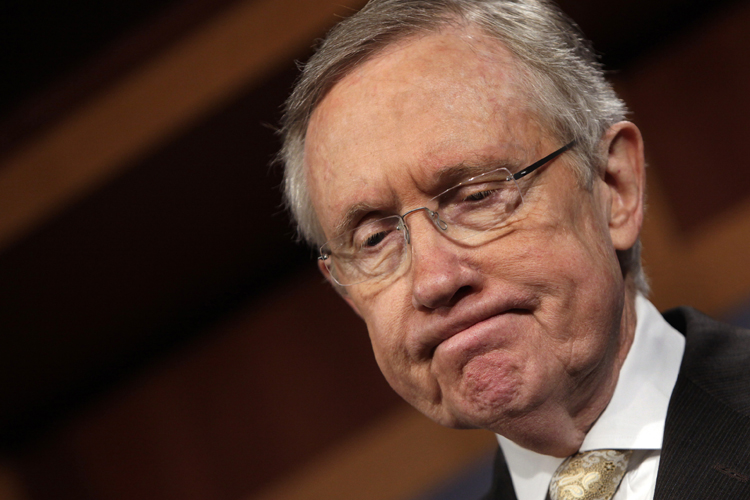
After Wednesday’s one-day  blackout of Wikipedia, Craigslist and scores of other sites to protest the House of Representatives’ Stop Online Piracy Act and its Senate companion, Protect IP Act; after Google’s collection of a reported 7 million petition signatures; after seven co-sponsors of the Senate bill repudiated it and dozens of other rejected it, attention turned to Senate Majority Leader Harry Reid, a supporter of the legislation. What would he do in response to the historic digital outcry?

On Friday morning, Reid settled the matter. “In light of recent events,” read a statement sent out by his office, “I have decided to postpone Tuesday’s vote on the PROTECT I.P. Act.”

The move by Reid to hit pause on the bill, known as PIPA, is a big deal — not least as an acknowledgment that online protest is shaping his agenda.

“To me, it was a day for the history books,” Sen. Ron Wyden said in an interview with Salon on Thursday night. “In terms of communicating with government, America is never going to be the same. This showed that you can literally have millions of people being able to weigh in directly with their legislators when they feel that they haven’t been listened to.”

Wyden has a unique perspective. It was the Oregon Democrat who was holding up the bill that the Senate was scheduled to vote on Tuesday of next week. Backers of PIPA needed 60 votes to advance a motion to proceed and break Wyden’s hold. As recently as Tuesday of this week, the bill’s supporters looked to be in a strong position.

Objections to the bills from the tech community had not swayed the bill’s sponsor, Sen. Patrick Leahy, chairman of the Judiciary Committee, or the majority leader.

“Leahy and Reid don’t care about statements and speeches,” said one Senate aide. “They care about pushing the levers of power. And the Internet stepped up and said, ‘That’s not how you pass legislation anymore.’”

The untold story here is that SOPA, the original target of the online community, had derailed PIPA, a bill with a longer pedigree and, according to online observers, a less aggressive approach. “PIPA is terrible,” says Electronic Frontier Foundation senior staff technologist Peter Eckersley. “SOPA is ghastly.”

After SOPA’s introduction in the House in October, Judiciary Committee Chairman Lamar Smith, Republican of Texas, put on a hearing that was ostensibly intended to give the bill a once-over. The proceedings were comically stacked with Google’s policy counsel, Katherine Oyama, serving less as a technical witness and more of a punching bag for complaints about the search engine giant. That a congressional hearing on a critical piece of legislation could be so vapid infuriated the tech community. In response, technologists rallied around American Censorship Day, and found a champion in Rep. Darrell Issa, chairman of the House Oversight Committee, who suggested an alternative bill. Republicans and Democrats alike condemned the superficial consideration of the bill.

The House meltdown sent PIPA’s backers on the Senate side scrambling to separate themselves from the mess. A two-page fact sheet circulated in the Senate making the case that the House’s bill “differs from the PROTECT IP Act” in several key ways.

  • SOPA applies to sites that merely “facilitate infringement,” for example; PIPA targets those solely dedicated to breaking copyright.
  • SOPA threatens to ensnare sub-domains in website takedowns; PIPA understands that one music blog hosted on Blogger.com does not implicate the whole site.
  • SOPA might violate due process; PIPA requires that any efforts to take down advertising or payment systems of infringing sites be routed through the courts. And so on.

“Much of what has been claimed about the Senate’s Protect IP Act is flatly wrong,” Leahy declared on the eve of the blackouts, “and seems intended more to stoke fear and concern than to shed light or foster workable solutions.”

And if Leahy still felt confident of the bill’s passage at the time, it was probably justified. As of last week, PIPA had attracted 41 co-sponsors.

Wyden attributed that more to effective industry lobbying, than senatorial deliberation.

“It’s the content industry lobbyists who are best known in the Senate,” he said. “They’ve always had their way here. It picked up all these sponsors because the content industry worked so cleverly to tell everybody, ‘This is non-controversial. Nobody is in favor of piracy. This is practically a gimme.’ When people hear that, and that powerful industries are for it, often all the implications don’t get thought through. We heard from senators who said, ‘I had no idea that this would do this kind of damage to the Internet, to cybersecurity, and the like.’”

But if the online protests got all the attention this week, equally noteworthy was the reaction of people who had written the bill. They went back to the drawing board — behind closed doors.

The Motion Picture Association of America made little pretense about the fact that it was instrumental in writing the bill. The OpenCongress blog pointed to a New York Times story in which an MPAA executive declared, “We will come forward with language that will address some of the legitimate concerns” about the bill.

This week, MPAA Chairman Chris Dodd came out and talked about tweaking PIPA as doing “the hard work of legislating,” sounding much like the Democratic senator from Connecticut he until recently was. (Hollywood, for the record, made noises about dropping its traditional support for Democrats, perhaps not noticing that far more Republicans than Democrats withdrew their support from PIPA in the wake of the protests.)

PIPA’s proponents seemed to be misunderstanding the argument that its opponents were making. They don’t reject what’s in the bill. They reject the bill’s very existence. ”

“We’re fundamentally saying, kill PIPA, kill SOPA, nuke the bills,” said David Moore, executive director of the Participatory Politics Foundation and program manager of OpenCongress. “Then we’ll talk.”

Why is  PIPA so irredeemable? For one thing, say its critics, the congressional copyright crackdown assumes facts about digital piracy not yet in evidence. If online piracy is truly so massive a problem for the U.S. economy, doesn’t it require more methodical study in Congress, with input from a wider range of experts?

For another, they’re not willing to concede that the Senate Judiciary Committee, so diligently cultivated by the MPAA over the years, should be the be-all and end-all when it comes to conversations about fostering profitable digital content circa 2012. Or that law enforcement should be the go-to response framework.

Other committees might deserve a crack at developing legislation.

“How do we get our content industries to migrate to business models that get creators paid in the Internet era?” Eckersly asked. “You don’t need to fight a crazy global war against piracy to have a YouTube or an iTunes.”

This tectonic shift of the ground under PIPA has some people searching for ways to reframe the situation in the dynamics Washington knows so well. It’s Hollywood vs. Silicon Valley. It’s MPAA vs. Google. Dodd, for example, breezily explained the reported removal of domain name filtering from PIPA — one of the provisions that technology types found most egregious for its targeting of the Internet’s core infrastructure — as “something the Google crowd didn’t want to have done.”

Via Twitter, media mogul Rupert Murdoch, a PIPA backer, blamed ”Silicon Valley paymasters who threaten all software creators with piracy, plain thievery.”

The revealing assumption: Congress must be taking its marching orders from someone with a ton of money. But that’s revisionist. All signs indicate that Google was ready to accommodate itself to some form of  PIPA. The company’s blacking out of its logo this week was attention-getting, no doubt. But a close watching of how this has all played out over the last two months suggests that Google was jumping in front of a parade that was already well on its way.

“If it was Hollywood vs. the tech companies,” says Art Brodsky of the advocacy group Public Knowledge, “it would have been over a long time ago, because the tech lobby is terminally weak and disorganized.”

The truth is that the bulk of those objecting to the bill were millions of Americans who use Internet utilities such as Google and Wikipedia and Craigslist.

That said, PIPA is still alive. In his statement, Reid praised Leahy for the work that he’s done thus far on the bill.

“I encourage him to continue engaging with all stakeholders to forge a balance between protecting Americans’ intellectual property, and maintaining openness and innovation on the internet,” Reid wrote.

But it does look like PIPA won’t go ahead without fundamental rethinking. Is it naive to see the events this week as evidence that a networked populace might really have the ability to upgrade its country’s politics?

“Everybody retains their constitutional right to be foolish,” says Wyden. “But I hope so.”

Continue Reading Close

Left and right, Congress resists the Stop Online Piracy Act

Fearing Web censorship, Rep. Darrell Issa tries the open-source alternative

Rep. Darrell Issa, Web defender? (Credit: AP/Susan Walsh)

As the debate over the Stop Online Piracy Act (SOPA) rages on in Washington, California Rep. Darrell Issa – perhaps best known in these parts for being a frequent, and spirited, critic of the Obama administration – is agitating for an alternative measure that can win the support of SOPA’s many critics in the online world. In doing so, Issa is engaging in a congressional demonstration of the fact that Marshall McLuhan was right: here, the medium truly is the message.

Issa’s bill is called the OPEN Act, or the Online Protection and Enforcement of Digital Trade Act (the acronym comes from fudging a bit – picking up the first two letters of “enforcement” and ignoring everything that follows). Where SOPA aims to empower the Justice Department to go after websites that allegedly infringe on copyright, and doing it on the Internet’s domain name layer, OPEN goes another route: strictly limiting the bill to foreign sites, setting up the International Trade Commission as the enforcer, and focusing on a “follow the money” approach, as in using digital payment systems as the choke points on targeted sites, a mechanism that has worked to thwart the WikiLeaks movement. On cue, the Motion Picture Association of America, a major SOPA backer, dismissed OPEN as “go[ing] easy on Internet piracy.”

With OPEN, though, Issa isn’t simply focusing on changing what’s in the bill. He’s interested in changing the process by which legislation gets made. When SOPA first started making news in October, it seemed like the legislation dropped from the sky. (More likely, it was dropped from the computer of an entertainment industry lobbyist.)

On OPEN, Issa’s strategy is to show his work. He picked up KeepTheWebOpen.com, a digital gathering point for the bill. In mid-November, after the House’s one and only hearing on SOPA, Issa and his team whipped together what they call “Madison” – a digital legislative platform that lets anyone suggest changes to the draft bill, a Wikipedia of sorts for legislative text. Here, leaving fingerprints is encouraged. All edits and comments are signed, first name, last initial.

And during the Judiciary Committee’s markup of the bill in late December, Keep the Web Open streamed the hearing feed and paired it with a Twitter stream of commentary from folks watching along at home. Issa’s office later reported that, on the first day of markup, there were some 138,000 instances of people watching the proceedings coming from the U.S. alone. “I want to keep the Web open,” says Issa in a video posted on the site, “because the prosperity brought by innovation has spread to the four corners of our planet.” He went on: “We need to be more open, not closed.”

As an open digital platform where anybody can participate, Issa’s site is a particularly appropriate place for opposition to SOPA. That’s because, in many ways, the battle over this bill is about exactly that: open digital platforms where anybody can participate. Think Twitter, Facebook, YouTube and the like. SOPA, say its critics, advances an unreasonable expectation of complicity by those sites for what people post upon them. And that, they say, is bad for the Internet.

That’s why the most passionate, and creative, protests against SOPA have come from the likes of, for example, the document-sharing hub Scribd, which disappeared files last month in dramatic push-back. Or the micro-blogging service Tumblr, whose millions of users recently found its dashboard mock-censored. Or Reddit, whose general manager caused a stir by commenting, on the site, that SOPA “would almost certainly mean the end” of that immensely popular social news platform.

But far more surprising is this: that OPEN, both bill and concept, finds itself meeting a Congress primed to accept it. Members of all stripes and seniorities are recoiling not just at what’s in SOPA, but by a process that has played out incredibly quickly, often in secret, and with little meaningful outside input. The last two months have been, for many, a demonstration of what’s wrong with bills from nowhere.

It’s all making for even stranger bedfellows than usual. Leading the opposition to SOPA in the House Judiciary Committee alongside Issa, who once ran an electronics company, has been Zoe Lofgren, a California Democrat. “We spent years” working on the hugely important Digital Millennium Copyright Act of the ‘90s, said Lofgren during the markup, and yet, “this is being jammed through in two months’ time.” Lofgren represents Silicon Valley, so she’s a given.

But other members are objecting to SOPA as well. Congress has held a single hearing on SOPA, in November, and there, only one witness, Google’s policy counsel, Katherine Oyama, raised doubts about the bill. “None of the six witnesses were able to address” the security implications of the bill, complained 17-term Wisconsin Republican Jim Sensenbrenner. “This bill is not ready for prime time,” he said. Jim Jordan of Ohio, an über-conservative, recommended Congress “take a little extra time” on the legislation.

Two second-term members, Colorado liberal Democrat Jared Polis and Utah conservative Republican Jason Chaffetz, tag-teamed during the markup, with Chaffetz contributing two of the days more memorable lines. “Basically, we are going to do surgery on the Internet,” he said, “and we haven’t had a doctor in the room to tell us how we’re going to change these organs. We are basically going to reconfigure the Internet and how it is going to work without bringing in the nerds.”

Issa is aiming to bring in the nerds, and everyone else.

Keep the Web Open is very much a work in progress. As a legislative collaboration tool, Madison is rudimentary. One possible path for development is to do something like the U.S. Patent Office does with its Peer-to-Patent project, which seeks to tap the wisdom of experts to narrow the universe of information overwhelmed patent reviewers need to contemplate. The goal wouldn’t be for say, me, to parse the nuances of the digital security implications of domain-name filtering. It’s to get people who know the field inside and out to do it, to point Congress toward what it should be considering.

And with its video feed, Keep the Web Open could explore something like the groundbreaking project of former Wonkette blogger Ana Marie Cox, liveblogging the 2009 California Supreme Court hearing on Proposition 8. Bored lawyers joined in to explain to laypeople what they were watching. Why did Judge X ask that question that way? To which case was attorney Y referring? Network engineers could do the same thing during a hearing on the OPEN Act.

Last month’s SOPA markup served as a reminder that openness is coming to Congress, even if glacially. The proceedings came to a screeching halt after Texas Democrat Sheila Jackson Lee discovered a Twitter post from fellow committee member and Iowa Republican Steven King that read, “We are debating the Stop Online Piracy Act and Sheila Jackson has so bored me that I’m killing time by surfing the Internet.” Lee, who called King’s tweeting “so offensive,” was eventually persuaded to strike her words from the record. No matter. The words were already everywhere on Twitter and elsewhere online.

No matter their persuasion, members of Congress don’t like to feel bullied. They hate to feel out of control. It’s one reason many of them have so resisted efforts to open up Congress. But some, at least, are coming to the realization that open-source legislation might be the alternative to having legislation foisted upon them by lobbyists. And that’s creating unusual allies. That Peer-to-Patent initiative that has so much in common with Issa’s Keep the Web Open was, for example, a project of Beth Noveck, the Obama White House’s point person on open government until recently. But the future has a way of doing that.

Continue Reading Close

Twitter takes sides on the Internet’s future

While some tech companies aim to sell surveillance, one aims to thwart it.

(Credit: ps-42 via Shutterstock)

If you’re wondering where Internet and other digital technologies are headed, take note of two news items from this past week.

The first was a piece in the Washington Post profiling the Wiretappers’ Ball, a recent gathering in suburban Maryland for those who make tools for surveilling, monitoring and throttling the Internet — and for the people who buy them. The get-together, according to the Post, featured more than three dozen countries and nearly as many U.S. federal agencies. It’s a showcase event for an industry in which behemoths like Cisco, and smaller players like Blue Coat, help control and track the Internet activities of the government’s enemies in China (Falun Gong) and Syria (revolutionaries).

The second, smaller development, reported by the Wall Street Journal, was that San Francisco-based Twitter Inc. had acquired Whisper Systems, a two-person firm that specializes in securing the Android mobile operating system. The firm’s only employees — the marvelously named Moxie Marlinspike and fellow researcher Stuart Anderson — seek to make it harder for snoops to monitor who and how) you are texting, calling and otherwise connecting with digitally.

These seemingly unrelated events represent alternative visions of the roles technology companies, large and small, will play in the future of the Internet. Will the Internet remain a healthy, flexible, sustainable platform for discourse? Or will it turn  into yet another medium controlled by whoever has the most offline power? The Arab Spring painted a picture of an immensely robust Internet. Twitter, Facebook, cellphones, email and more powered revolution from Tunis to Cairo to Damascus. Yet at the same time, it revealed itself as shaky. Could Hosni Mubarak really turn off the Internet on a whim?

“A lot of this technology is a double-edge sword,” says Tim Karr of Free Press, who drew early attention to the role of U.S. tech companies in equipping the Egyptian regime. “We see it being used by dissidents and activists, but in the wrong hands it can be used to spy on and even crack down on them.”

The Wiretappers’ Ball is, for its part, a carnival of tools that can be used to track and stop what people are doing online.

“On offer were products that allow users to track hundreds of cellphones at once, read emails by the tens of thousands. There was technology that could get a computer to snap a picture of its owner and send the image to police — or anyone else who buys the software,” wrote Post reporters Sari Horwitz, Shyamantha Asokan and Julie Tate. For sale: the very latest in “tracking, monitoring and eavesdropping technology.”

On the day the Post story appeared, Alex Ross, innovation advisor to U.S. Secretary of State Hillary Clinton, tweeted to the tech sector, ”Choose principles over profits. The Wiretappers Ball should not be a morality-free zone.”

Just because a sale is legal,” he went on, “that does not make it responsible.”

But the surveillance industry – a $5 billion a year proposition, according to the Ball’s founder — rolls on, focused on the latest, greatest in tracking and monitoring tech.

Meanwhile, in San Francisco, the 700-employee Twitter is making an investment in Whisper Systems, a firm that makes it harder for people to track and monitor mobile phones built on the Android operating system. (Twitter declined to reveal the terms of the deal, but knowledgeable sources suggest that there were, at least, seven figures involved.) Mobile phones are increasing how much of the world gets online, but because of their architecture, they pose particular challenges. As Berkman Center researcher Ethan Zuckerman has framed the issue, ”Mobiles are both utterly essential devices for activists and ones that are profoundly unsafe for activists to use.” Whisper Systems aims to make the second bit of that equation less true, not only for activists, but for everybody.

Whisper System’s rock-star tool, say those in the industry, is WhisperCore. The tool, writes the company, “integrates with the underlying Android OS to protect everything you keep on your phone, featuring “full disk encryption, network security tools, encrypted backup, selective permissions, and basic platform management tools.” The company claims,  ”WhisperCore presents a simple and unobtrusive interface to users, while providing powerful management capabilities for administrators and enhanced security APIs for developers.”

Then there is TextSecure, a “drop-in replacement for the standard text messaging application, allowing you to send and receive text messages as normal.” Messages sent or received through TextSecure, they say, get encrypted and lodged in a database on your device itself.

Marlinspike, a big name in the computer security world, is considered quite a talent get for Twitter. But Marlinspike and Anderson wouldn’t be the first tech startup founders to get gobbled up, only to see their vision changed and their passions dissipated.

But there are signs that this wasn’t just a case of Twitter filling out its bench — or simply bringing on a pair of security masters to shore up the company’s basic security infrastructure. There was some blowback on Twitter’s pick-up of Whisper Systems this week when Whisper Systems pulled down its RedPhone tool, which provides end-to-end phone call encryption, “securing your conversations so that nobody can listen in.”

In a carefully crafted blog post that went up on Monday, Marlinspike and Anderson’s first day as employees of Twitter, the pair took pains to say that the RedPhone would return. They hinted at the notion that the tool would live on in Twitter, despite the fact that it’s not completely obvious how encrypted voice calls relate to the tweeting experience.

“The Whisper Systems software as our users know it will live on (and we have some surprises in store that we’re excited about), but there is unfortunately a transition period where we will have to temporarily take our products and services offline,” they said. That suggests that the pair were brought on not just for their talent, but for their tools. Perhaps they will be able to incubate hard-core Internet and digital security technology for the masses.

Technology has never been Twitter’s strong suit. The company got slapped on the wrist by the U.S. Federal Trade Commission last March for putting users’ “privacy at risk by failing to safeguard their personal information.” During those breeches, tweeters’ log-in information was exposed and used to blast out bogus tweets.

At the same time, the company has shown good instincts when it comes to questions of whom, exactly, it’s serving – working with customers, for example, during law enforcement crackdowns in the wake of the WikiLeaks situation. Those instincts, and how they act on them, only become more important as Twitter grows. The company is seeking to build out its hugely popular platform to attract not only users’ tweets but also their photos, videos and location data. (One thing to watch for: how well Twitter works with a U.S. government security establishment that doesn’t have an overwhelming fondness for encryption.)

The threat of attracting Washington’s attention may be motivating Twitter as much as good intentions. The capital is starting to pay more attention to what Cisco and other technology firms  are up to around the world, as evidenced by Friday’s Washington Post report. Karr and other advocates argue that Washington has an interest in regulating the sale of routers to Syria, just as it has an interest in the sale of arms.

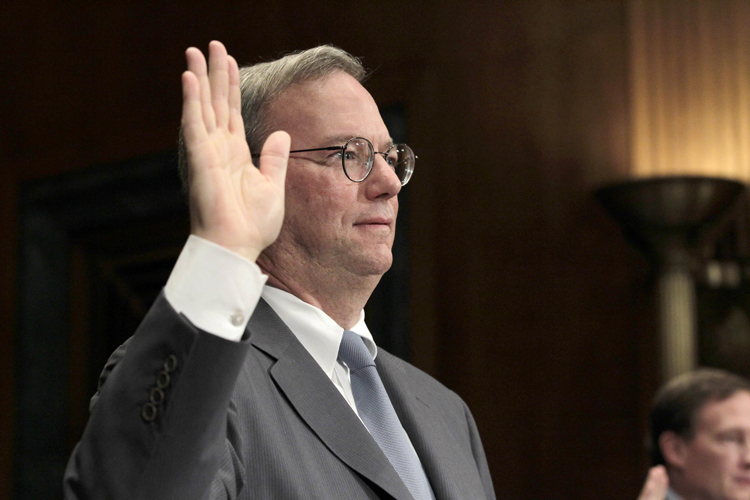
“I don’t think that Twitter wants to be hauled in front of a Senate subcommittee,” says a source in mobile security, citing the appearance of Google’s Eric Schmidt before a Senate Judiciary Committee panel last September. “So they’re battening down the hatches.”

With Whisper Systems embedded inside Twitter, the company now has a built-in user base of tens of millions of people. It puts them in a strong position to secure the digital space. “Changing the Internet is pretty difficult,” said Marlinspike at the 2011 hacker convention DEFCON.

Someone is going to do it. The question is, which company?


Continue Reading Close

Congress seeks to tame the Internet

Fearing Web censorship, the tech world unites against the proposed Stop Online Piracy Act

(Credit: iamanuj.com)

Ever since the days of Napster,  the recording industry and movie industry have treated the Internet as a place on the map marked “Here be dragons.” For the last decade, Hollywood and big music have spent time not innovating, but trying to get the U.S. Congress to help them tame the Internet. Over the years, they’ve floated a variety of legislative mechanisms to do that. The latest is a House bill called the Stop Online Piracy Act. SOPA, as it is known, has Internet advocates boiling — and with good reason.

While the Motion Picture Association of America and its allies rolled out their attorney, First Amendment lawyer Floyd Abrams, to say that the bill would “protect creators of speech, as Congress has done since this nation was founded, by combating its theft,” many in the technology world roared disapproval. At Techdirt, Mike Masnick compared SOPA to the Internet restrictions used by repressive regimes; “Setting up such a system in the US would be an epic mistake,” he wrote. GigaOm’s Mathew Ingram wrote that the bill gives the government and private companies “unprecedented powers to remove websites on the flimsiest of grounds.” The Electronic Frontier Foundation called the bill “a dangerous wish list.” The nonprofit Center for Democracy and Technology in Washington said SOPA would cause “broad collateral damage to freedom of expression and privacy.” 

Leading Internet companies, including AOL, eBay, Facebook, Google, LinkedIn, Mozilla, Twitter, Yahoo and Zynga, teamed up in a Washington-speak letter drily objecting to the bill. Google’s Eric Schmidt was blunter. ”The solutions are draconian,” he said in an appearance at MIT. The bill “would require ISPs to remove URLs from the Web, which is also known as censorship last time I checked.”

When it comes to talking about SOPA, it is important to remember this: You can think that “intellectual property” infringement (not only of movies and music, but knockoff Nikes sold online) is bad for the American economy and still think the legislation is a disaster. Not only would the bill likely do little to address the problem of online content fraud and counterfeiting, but it takes aim at the core features of the Internet that have contributed a great deal to the American economy.

Congress, the political press and lobbyists for the entertainment industries like to frame this fight as one between giants. In one corner, the MPAA, RIAA and others decrying the “lawlessness” of the Internet and in the other, Google, Facebook and other big tech firms defending their business. But SOPA isn’t just about corporate battles. For all the the rhetoric, this isn’t even really about copyright. This is about the Internet — and more to the point, the infrastructure and operations of the Internet that make the Internet the Internet. SOPA targets search engines, Internet service providers, ad networks and payment networks precisely because those components are so central to the functioning of the Internet. Those are digital forces that should be messed with only with the greatest of care.

Here, in a nutshell, is what SOPA does. Under the bill, the U.S. attorney general can, with court approval, require that search engines, ISPs, and advertising networks and payment companies stop dealing with foreign-based websites that are deeply engaged in copyright infringement, including blocking a website’s name from connecting back to the site’s IP address. Google, for example, could be forced to block listings for targeted sites. Other sections of the bill puts copyright holders in a position to demand that ad and payment networks stop doing business with websites based in the United States and abroad when those sites are found to have engaged in prohibited behavior when it comes to copyright.

Critics say that the bill is so broadly written that it incriminates sites that are designed in such a way that make policing copyright difficult, from Facebook to Dropbox to whatever new social network the kids in NYU’s Interactive Telecommunications Program are cooking up. That new vulnerability might scare off not only inventors, but investors.

And, as far as the domain name parts of the bill are concerned, the approach is largely pointless from a technical perspective. The bill targets file-sharing sites like the Pirate Bay that enable users to download movies without paying. Search engines would have to excise the name. But hard-core pirates are simply going to traffic in IP addresses. For example, copy and paste “194.71.107.15″ in your browser. The Pirate Bay should still pop up, and there’s nothing Google can do about it. Still, the damage is done. What was once an international system for getting around the Internet is fractured; SOPA opponents point out that it threatens to undo all the work done to harden the domain name system in federal and private cybersecurity efforts.

SOPA would overturn a long-standing presumption under U.S. law that while Internet players are certainly responsible for complying with the law, they’re not deputies in the copyright battles. During a hearing in the House this week on SOPA, Maria Pallante, the U.S. register of copyrights, testified that SOPA rejects the idea that Internet companies “don’t have an obligation to participate” in enforcing copyright. They don’t — by design. Various U.S. laws — Section 230 of the Communications Decency Act, the so-called safe harbor provisions of the Digital Millenium Copyright Act – grant Internet companies the freedom to operate without being held responsible for knowing the legal pedigree of every piece of content on, or connected to, their sites. And for good reason.

Could Facebook have flourished with the expectation that Mark Zuckerburg and his Harvard dormmates were culpable for every link or video clip someone uploaded to their site? Not likely. So when Pallente testifies that “I believe that search engines should be fully within the reach of the attorney general,” we should hear the legislation for what it is: a revision of the notion that Internet companies have a duty to comply with the law, but not to act as its enforcers.

Washington is sometimes rightfully criticized for harboring some crazy ideas when it comes to the Internet. But the federal government has gotten some basic things very right, from funding the Internet in its early stages to having the wisdom to enshrine Section 230 and the safe harbors. It would be a shame to see Congress trash that legacy with a single bill.

Another concern is what SOPA would do for other countries that seek to shape the Internet as they see fit, China, of course, limits online discussion of democracy, often target the tools, like its homegrown version of Twitter, Sina Weibo, that foster those conversations. With SOPA,  the United States would stand on shaky moral ground when it starts ordering search engines and ISPs to block and black out sites. As Secretary of State Clinton goes around the world promoting her “Internet Freedom Agenda,” she’ll be put in the position of distinguishing between the blocking of bootlegged movies (an infraction that China has shown it doesn’t care much about) and limiting democratic speech online.That’s a distinction very likely to get lost in translation.

And because the U.S. is doing it, there’s even more at stake. We might like to think of the Internet as an organic global medium, but someone has to make the trains run on time. That someone is ICANN, a California-based group that runs the Internet’s naming and numbering systems under a contract with the U.S. Department of Commerce. Not everyone in the world is pleased with the central role of the United States in the Internet’s governance, with several nations and groups wanting ICANN to hand over its authority to the United Nations’ International Telecommunications Union. The U.S. government — and the countless computer scientists, engineers, and Internet policy advocates who live and work here — have been good stewards of the Internet so far.  SOPA would throw that away with, potentially, little in return.

Opponents of SOPA are nervous is that the bill and its counterparts in the Senate have bipartisan support; SOPA’s 24 co-sponsors in the House include 14 Republicans and 10 Democrats. But the sheer extremism of the measure has made for strange bedfellows. In a tweet this week, House Democratic Leader Nancy Pelosi wrote, “Need to find a better solution than #SOPA #DontBreakTheInternet.” Her nemesis, Darrell Issa, Republican from California and chair of the House Oversight Committee, retweeted Pelosi’s note, appending commentary of his own: “If even we can agree … “

So why is Congress bothering? For one thing, Congress is eager to find real solutions for the struggling American economy. And for another, the music and movie industries have spent years and millions of dollars to sell the case that online copyright infringement is an albatross around the economy that the House and Senate can make go away. Right now. Study the test of SOPA for any length of time and with any real knowledge of how the Internet works, and you’ll realize it’s not that simple.

Still, there’s a mini-industry in Washington that consists of selling the idea that it is. Using data from the Center for Responsive Politics, Politico recently reported that the entertainment companies and other SOPA allies spent $280 million over 2010 and 2011 on lobbying. Google, eBay, Facebook and other big tech firms, by comparison, spent $30 million. We shouldn’t underestimate the degree to which SOPA is the natural product of a self-perpetuating system that demands some justification of why the MPAA et al are spending all those millions year after year.

Of course, at some point, even Washington has come to realize that there’s a lot more to the Internet economy than that described by the movie and music industries. Google is no slouch, and no member of Congress wants to be seen as standing in the way of the next Facebook. Andrew McDiarmid, an analyst for the Center for Democracy and Technology, which opposes the bill, said, “We were kind of encouraged by the hearing this week.” There were not public advocacy groups or Internet engineers testifying, and Google represented the sole opposition to the bill. “It was stacked,” he said.

“But at least five members of Congress raised concerns, and they asked more questions than I think we expected,” he said. ” There’s a fair bit of momentum on the bill, but people are really starting to take notice.”


Continue Reading Close

Page 1 of 2 in Nancy Scola

www.salon.com/writer/nancy_scola/index.html