Raphael G. Satter

UK’s Cameron: This Year Will Be Tough

Flag carriers bearing all the flags of the nations to be represented at the London 2012 Olympic Games tak part in the annual London New Years Day parade Sunday, Jan.1, 2012. (AP Photo/Alastair Grant)(Credit: AP)

LONDON (AP) — Britain’s prime minister says the Summer Olympics and the queen’s Diamond Jubilee celebration will raise the country’s profile on the international stage, but that 2012 will be a tough year.

In fact, David Cameron said he sympathizes with citizens “who are worried about what else the year might bring.”

“There are fears about jobs and paying the bills,” Cameron said Monday in a video message meant to mark the new year. “I know how difficult it will be to get through this — but I also know that we will.”

Rising joblessness and the European financial crisis have weighed heavily on Cameron’s government, which came to power in 2010 on the back of promises to control the country’s debt and restore economic growth.

Both goals have been thrown into doubt over the course of 2011.

The Bank of England has forecast little or no growth over the next few months, and rating agency Moody’s recently warned that Britain’s cherished triple A credit rating is at risk, despite determined and controversial efforts to slash the country’s public spending.

And Britain isn’t even one of the hard-pressed users of the euro currency.

Cameron said that 2012 will be the year his government “does everything it takes to get our country up to strength,” promising new but unspecified curbs on what he called the excesses of Britain’s financial industry.

But he said the Olympics, which begin in July, and the Diamond Jubilee in June, marking 60 years of Queen Elizabeth II’s reign, will raise Britain’s profile abroad.

“It gives us an extraordinary incentive to look outward, look onwards and to look our best: To feel pride in who we are and what — even in these trying times — we can achieve.”

___

Online:

http://www.number10.gov.uk/news/2012-new-year-message-from-david-cameron/

UK’s Cameron: This Year Will Be Tough

Flag carriers bearing all the flags of the nations to be represented at the London 2012 Olympic Games tak part in the annual London New Years Day parade Sunday, Jan.1, 2012. (AP Photo/Alastair Grant)(Credit: AP)

LONDON (AP) — Britain’s prime minister says the Summer Olympics and the queen’s Diamond Jubilee celebration will raise the country’s profile on the international stage, but that 2012 will be a tough year.

In fact, David Cameron said he sympathizes with citizens “who are worried about what else the year might bring.”

“There are fears about jobs and paying the bills,” Cameron said Monday in a video message meant to mark the new year. “I know how difficult it will be to get through this — but I also know that we will.”

Rising joblessness and the European financial crisis have weighed heavily on Cameron’s government, which came to power in 2010 on the back of promises to control the country’s debt and restore economic growth.

Both goals have been thrown into doubt over the course of 2011.

The Bank of England has forecast little or no growth over the next few months, and rating agency Moody’s recently warned that Britain’s cherished triple A credit rating is at risk, despite determined and controversial efforts to slash the country’s public spending.

And Britain isn’t even one of the hard-pressed users of the euro currency.

Cameron said that 2012 will be the year his government “does everything it takes to get our country up to strength,” promising new but unspecified curbs on what he called the excesses of Britain’s financial industry.

But he said the Olympics, which begin in July, and the Diamond Jubilee in June, marking 60 years of Queen Elizabeth II’s reign, will raise Britain’s profile abroad.

“It gives us an extraordinary incentive to look outward, look onwards and to look our best: To feel pride in who we are and what — even in these trying times — we can achieve.”

___

Online:

http://www.number10.gov.uk/news/2012-new-year-message-from-david-cameron/

Continue Reading Close

Stephen Hawking Seeks Help To Make Voice Heard

LONDON (AP) — Can you help make Stephen Hawking’s voice heard?

The famed British physicist is seeking an assistant to help develop and maintain the electronic speech system that allows him to communicate his vision of the universe. An informal job ad posted to the famed physicist’s website said the assistant should be computer literate, ready to travel, and able to repair electronic devices “with no instruction manual or technical support.”

Hawking has long struggled against amyotrophic lateral sclerosis, a disease which left him almost completely paralyzed.

He lost his real voice in a tracheotomy in 1985, but a wheelchair-mounted computer helps synthesize speech by interpreting the twitches of his face. The synthesizer’s robotic monotone has become nearly as famous as Hawking himself, but the computer — powered by batteries fastened to the back of Hawking’s wheelchair — isn’t just for speaking.

It can connect to the Internet over cell phone networks and a universal infrared remote enables the physicist to switch on the lights, watch television, or open doors either at home or at the office.

It’s a complicated, tailor-made system, as the ad makes clear. A photograph of the back of Hawking’s wheelchair, loaded with coiled wires and electronic equipment, is pictured under the words: “Could you maintain this?”

“If your answer is ‘yes,’ we’d like to hear from you!” the website says.

Hawking’s website says that the job’s salary is expected to be about 25,000 pounds ($38,500) a year.

___

Online:

http://www.hawking.org.uk/

Continue Reading Close

Former executives challenge Murdochs’ testimony

Further doubt cast on News Corp. chief's July statements to Parliament

FILE - This is a Thursday, Jan. 27, 2011 file photo of a pedestrian he passes signs at the entrance to News International in Wapping, London. Rupert Murdoch's News International said Monday Sept. 5, 2011 it will sell its complex in the east London area of Wapping.The company says it will relocate to another area in east London.The company says in a statement that "current market conditions" led to a decision "not to proceed with remodeling the Wapping site." (AP Photo/Kirsty Wigglesworth, File)(Credit: AP)

Former News International executives on Tuesday challenged testimony given by their bosses — Rupert and James Murdoch — with one saying the media mogul had gotten it wrong when he blamed outside lawyers for improperly investigating the company’s tabloid phone hacking scandal.

Jonathan Chapman, the former director of legal affairs with News International, said Rupert Murdoch wasn’t being accurate when he told Parliament that he blamed the London law firm Harbottle & Lewis for failing to uncover the scope of the hacking scandal back in 2007. News International is the British arm of Murdoch’s global News Corp. media empire.

“I don’t think Mr. Murdoch had his facts right,” Chapman told lawmakers. “He was wrong.”

Chapman was one of four executives fielding questions from Parliament’s media committee about what they knew and when — and all have already cast doubt on key aspects of the testimony given by the Murdoch family earlier this summer.

The hacking scandal has decimated Murdoch’s British newspaper arm, leading to the closure of its top-selling Sunday tabloid, News of the World, and the arrests of more than a dozen journalists.

It’s also rocked the top levels of Britain’s political and police elite. Andy Coulson, a former News of the World editor and until recently one of Prime Minister David Cameron’s top aides, has resigned — as have the two top officers with Scotland Yard. Coulson was one of 15 people arrested.

Media committee chairman John Whittingdale says the latest hearing aims to uncover the truth about a critical piece of evidence, unearthed in 2008, suggesting that voicemail interception at the News of the World was far more widespread than the tabloid claimed at the time.

Questions about who saw the evidence are critical to establishing whether there was an attempt to cover up the scale of illegal behavior at the now-defunct tabloid.

The News of the World stands accused of spying on a host of politicians, celebrities, top athletes, crime victims and even terrorism survivors by systematically intercepting voicemail messages in an effort to get scoops. Allegations of computer hacking and police bribery are also being investigated by Scotland Yard.

The evidence in question was an email carrying the transcript of an illegally intercepted conversation and marked “for Neville” — an apparent reference to the News of the World’s chief reporter, Neville Thurlbeck.

Because it apparently implicates others in the hacking, the email has the potential to undermine News International’s fiercely held contention that one reporter alone, Clive Goodman, had engaged in phone hacking.

If Rupert Murdoch’s son James knew about the email — and was aware of its implication — it would lend weight to the suggestion that he had approved a massive payoff to one employee in an effort to bury the scandal.

James Murdoch has said earlier that he was not aware of the email at the time, but former News International legal adviser Tom Crone and Colin Myler, a former editor at News of the World, contradicted him in Tuesday’s testimony.

“I told him about the document,” Crone insisted, adding there could be no doubt that “this document meant that News of the World had a wider problem and that we had to get out of it.”

Daniel Cloke, News International’s former personnel director, also contradicted James Murdoch’s contention that he and Chapman had approved the massive compensation awarded to Goodman, the disgraced reporter. One lawmaker has alleged that payment was made to buy Goodman’s silence about the scale of phone hacking at the paper.

Cloke and Chapman said it was Murdoch’s right-hand man, Les Hinton, who signed off on the quarter million pound payout.

Hinton, the publisher of The Wall Street Journal, was the most senior Murdoch executive to resign in the hacking scandal.

Continue Reading Close

Police calm London, but riots flare across U.K.

Things calm down in the capital, but unrest spreads out through the country

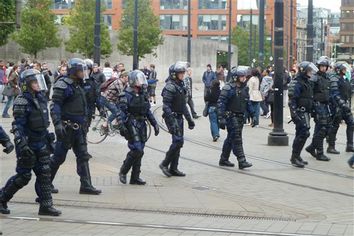
Riot police patrol Manchester city centre after trouble on Market street in Manchester city centre, England, Tuesday Aug. 9, 2011. Britain began flooding London's streets with 16,000 police officers Tuesday, nearly tripling their presence as the nation feared its worst rioting in a generation would stretch into a fourth night. The violence has turned buildings into burnt out carcasses, triggered massive looting and spread to other U.K. cities. (AP Photo / Dave Thompson / PA) UNITED KINGDOM OUT NO SALES NO ARCHIVE(Credit: AP)

Thousands of extra police officers on the streets kept a nervous London quiet Wednesday after three nights of rioting, but looting flared in Manchester and Birmingham, where a murder probe was opened when three men were killed after being hit by a car.

An eerie calm prevailed in the capital, where hundreds of shops were shuttered or boarded up as a precaution, but unrest spread across England on a fourth night of violence by brazen crowds of young people.

Scenes of ransacked stores, torched cars and blackened buildings have frightened and outraged Britons just a year before their country is to host next summer’s Olympic Games, bringing demands for a tougher response from law enforcement. Police across the country have made almost 1,200 arrests since the violence broke out over the weekend.

In London, where armored vehicles and convoys of police vans patrolled the streets, authorities said there were 16,000 officers on duty — almost triple the number present Monday night.

The show of force seems to have worked. There were no reports of major trouble in London, although there were scores of arrests. Almost 800 people have been arrested in London since trouble began Saturday.

“What happened in London last night was, when community leaders and the police came together, there were significant arrests,” said police deputy assistant chief constable Stephen Kavanagh. “We used buses to make sure some looters were taken away before they got into doing anything, but it was that joint action that made the difference.”

Outside the capital, some looting erupted, but not on the scale of the violence that hit several areas of London on Monday.

In the northwestern city of Manchester, hundreds of youths rampaged through the city center, hurling bottles and stones at police and vandalizing stores. A women’s clothing store on the city’s main shopping street was set ablaze, along with a disused library in nearby Salford.

Manchester assistant chief constable Garry Shewan said it was simple lawlessness.

“We want to make it absolutely clear — they have nothing to protest against,” he said. “There is nothing in a sense of injustice and there has been no spark that has led to this.”

Britain’s soccer authorities were talking with police to see whether this weekend’s season-opening matches of the Premier League could still go ahead in London. A Wednesday match between England and the Netherlands at London’s Wembley stadium was canceled to free up police officers for riot duty.

Britain’s riots began Saturday when an initially peaceful protest over a police shooting in London’s Tottenham neighborhood turned violent. That clash has morphed into a general lawlessness in London and several other cities that police have struggled to halt.

While the rioters have run off with goods every teen wants — new sneakers, bikes, electronics and leather goods — they also have torched stores apparently just for the fun of seeing something burn. They were left virtually unchallenged in several neighborhoods, and when police did arrive they often were able to flee quickly and regroup.

With police struggling, some residents stood guard to protect their neighborhoods. Outside a Sikh temple in Southall, west London, residents vowed to defend their place of worship if mobs of young rioters appeared. Another group marched through Enfield, in north London, aiming to deter looters.

One far-right group said about 1,000 of its members were taking to the streets to deter rioters.

“We’re going to stop the riots — police obviously can’t handle it,” Stephen Lennon, leader of the far-right English Defense League, told The Associated Press. He warned that he couldn’t guarantee there wouldn’t be violent clashes with rioting youths.

Anders Behring Breivik, who has confessed to the bombing and massacre that killed 77 people in Norway last month, has cited the EDL as an inspiration.

In the central England city of Nottingham, police said rioters hurled firebombs though the window of a police station, and set fire to a school and a vehicle but there were no reports of injuries. Some 90 people were arrested.

Some 250 people were arrested after two days of violence in Birmingham — where police launched a murder investigation after the deaths of three men hit by a car — some residents said the men had been patrolling their neighborhood to keep it safe from looters.

Police said a man had been arrested on suspicion of murder in the case.

In the northern city of Liverpool, about 200 youths hurled missiles at police and firefighters in a second night of unrest, and 44 arrests were reported.

There also were minor clashes in the central and western England locations of Leicester, Wolverhampton, West Bromwich, Bristol, and Gloucester — where police and firefighters tackled a blaze and disturbance in the city’s Brunswick district.

In London, hundreds of stores, offices, pubs and restaurants had closed early Tuesday amid fears of fresh rioting. Normally busy streets were eerily quiet and the smell of plywood filled the air as business owners rushed to secure their shops before nightfall.

In east London’s Bethnal Green district, convenience store owner Adnan Butt, 28, said the situation was still tense.

“People are all at home — they’re scared,” he said.

Prime Minister David Cameron’s government rejected calls by some lawmakers and citizens for strong-arm riot measures that British police generally avoid, such as tear gas and water cannons.

“The public wanted to see tough action. They wanted to see it sooner and there is a degree of frustration,” said Andrew Silke, head of the criminology department at the University of East London.

Cameron recalled Parliament from its summer recess for an emergency debate on the riots Thursday.

Other politicians visited riot sites Tuesday — but for many residents it was too little, too late. Deputy Prime Minister Nick Clegg was booed by crowds who shouted “Go home!” in Birmingham, while London Mayor Boris Johnson was heckled on a shattered shopping street in Clapham, south London.

Johnson said the riots would not stop London from “welcoming the world to our city” for the 2012 Olympics.

So far 770 people have been arrested in London and 167 charged — including an 11-year-old boy — and the capital’s prison cells were overflowing. Britain’s Crown Prosecution Service said it had teams of lawyers working 24 hours a day to help police decide whether to charge suspects.

A total of 111 officers and 14 members of the public have been hurt.

The violence was triggered by the fatal police shooting of Mark Duggan, a 29-year-old father of four who was gunned down in Tottenham on Thursday under disputed circumstances.

Police said Duggan was shot dead when officers from Operation Trident — the unit that investigates gun crime in the black community — stopped a cab he was riding in. A Saturday protest demanding justice degenerated into a riot, which spread to neighboring parts of London on Sunday and by Monday had spread across the capital.

Duggan’s death resonated because it stirred memories of the 1980s, when many black Londoners felt they were disproportionately stopped and searched by police. Their frustration erupted in violent riots in 1985.

But the rioters who have taken to the streets since Sunday have been extremely diverse — those in central England appeared to be mostly white and working class.

Paisley Dodds, Jill Lawless, Danica Kirka and Meera Selva contributed to this report.

Continue Reading Close

UK issues sprout warning after E. coli fears

British authorities warn consumers against eating the food after links to French outbreak surface

A woman holds bean sprouts with chopsticks in Berlin, Germany, Sunday, June 5, 2011. Health authorities say locally grown beansprouts in northern Germany have been identified as the likely cause of an outbreak of E. coli that has killed at least 22 people and sickened hundreds in Europe. (AP Photo/Gero Breloer)(Credit: AP)

British officials warned consumers Saturday against eating uncooked sprouts after authorities in France linked seeds distributed by an English vendor to an E. coli outbreak near the city of Bordeaux.

France halted the sale of fenugreek, mustard and arugula sprout seeds from British mail order seed and plant company Thompson & Morgan after eight people were hospitalized following an E. coli outbreak. French investigators found that two of them were sickened after consuming sprouts from the three seed types in the southwestern town of Begles, a suburb of Bordeaux.

Some of those affected were infected by the same strain of E. coli that has killed 44 people — all but one in Germany — and sickened more than 3,700 in recent weeks.

In a statement, Thompson & Morgan said the link being made by French officials was unsubstantiated, adding that it believed that “something local in the Bordeaux area, or the way the product has been handled and grown, is responsible for the incident rather than our seeds.”

A spokesman for Britain’s Food Safety Agency said that officials “don’t have definitive evidence that the company is the source of the contamination,” that no food poisoning cases have been reported in the U.K., and that investigations were ongoing. But in what the agency described as a precautionary move, it released a statement warning that “sprouted seeds should only be eaten if they have been cooked thoroughly until steaming hot throughout.”

The official, who spoke on condition of anonymity, in line with department policy, noted that European health authorities have misattributed the source of E. coli outbreaks in the past. Spanish cucumbers, for example, were wrongly blamed for the illnesses in Germany.

Thompson & Morgan said that French officials were still testing the seeds and investigating how they were grown. In the meantime, the company said it had submitted samples of its seeds to British health authorities for investigation.

Jamey Keaten in Paris contributed to this story.

Continue Reading Close

Page 1 of 5 in Raphael G. Satter

www.salon.com/writer/raphael_g_satter/index.html