Stacy Sullivan
View from Guantanamo
Confusion, anger and relief swirl inside the Gitmo courthouse before the the tainted proceedings are halted at Obama's request.
When President Barack Obama took the oath of office Tuesday, one question was foremost in the minds of the judges, prosecutors, defense lawyers, witnesses, journalists and non-governmental trial observers who had traveled to Guantánamo Bay: Would the new president seek to suspend the widely criticized military commissions to try terrorism suspects under way here?
We didn’t have to wait long. Word came Tuesday that an oral order had been issued. The order directed Secretary of Defense Robert Gates to instruct the chief prosecutor to ask for a delay of 120 days in all cases pending before the military commissions, so that “the newly inaugurated president and his administration [can] review the military commissions process, generally, and the cases currently pending before military commissions, specifically.”
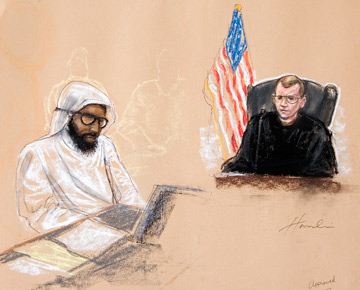
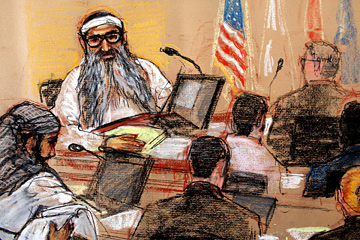
On Wednesday a military judge granted the prosecution’s request to halt proceedings against Khalid Sheikh Mohammed and his four alleged co-conspirators in the Sept. 11 attacks for 120 days.
It wasn’t the order to stop the military commissions permanently and transfer the cases to U.S. federal courts, which we would have liked, but it was the first step to shutting down a process that has been tainted beyond repair.
In the days and weeks leading up to Tuesday’s inauguration, President Obama made it clear that one of his first priorities would be to issue an executive order closing the Guantánamo detention center. It was also assumed that he would stop the military commission proceedings. Such a move seemed all the more urgent because the controversial trial of Omar Khadr — a Canadian who was only 15 when he was accused of terrorist acts — was scheduled to begin on Jan. 26.
The scheduling of proceedings this week was controversial from the start. Despite the expected order seeking to suspend the military commissions, and even though Monday was a national holiday commemorating Martin Luther King Jr., judges scheduled hearings for both Khadr and for Khalid Sheikh Mohammed, the alleged mastermind of the 9/11 attacks, and four alleged co-conspirators.
Both the prosecution and the defense in the 9/11 case had asked that proceedings be halted until after Obama took office, since, in the words of defense counsel for one of the accused, it was “a waste of everyone’s time to come down here.” But the judge, Army Col. Stephen Henley, denied the request and held hearings as scheduled.
The hearings in the 9/11 case began with drama and ended in confusion. Outbursts from several defendants raised tensions in the morning, with Ramzi bin al-Shibh conducting a now-typical verbal attack on his military lawyer; Khalid Sheikh Mohammed launching into a short tirade about Iraq, Afghanistan and U.S. military abuses; and Walid bin Attash speaking so quickly and angrily at one point that little of what he said was translated. Even Mustafa Ahmed al-Hawsawi, usually the mildest of the bunch, seemed tense and upset.
“This is terrorism!” exclaimed Mohammed, without a hint of irony.
Lawyers took over during the second half of the day, debating military commission rules, constitutional and statutory requirements and myriad procedural issues. A relative calm came over the proceedings and defendants and audience members struggled to stay focused. When confusion over a missing motion led the judge to adjourn the proceedings early, most of the audience wasn’t sure what was next on the week’s agenda or when it would occur.
Compounding the uncertainty was the question of whether the new administration would take action. As the judge emphasized, in one of his repeated references to the possibility of interruption: “The next session, should it occur …”
In contrast, during the first day of the proceedings for Khadr, there was no hint that a new commander in chief would take charge. Rather, the defense argued that the trial should be postponed because it had not yet received sufficient access to discovery. The prosecution insisted it had provided all that was necessary.
The judge, Army Col. Patrick Parrish, whom some lawyers call “the rocket” for his expedience in the courtroom, began hearing arguments in a motion the defense had filed to suppress statements Khadr had made to interrogators while in U.S. detention. The court heard testimony from both a military interrogator, who questioned Khadr at Guantánamo, and an FBI agent, who interrogated him at the U.S. detention center at Bagram Air Base in Afghanistan.
Following Monday’s hearings, the Office of the Military Commissions held a press conference with several 9/11 family members, who had reportedly been selected by lottery to travel to the base to attend the hearings. Visibly angry, and holding up large photographs of their relatives who died on 9/11, they appealed to President Obama to keep Guantánamo open.
“Today we were in the presence of true evil,” said Donald Arias, who lost his brother Adam in the attack on the World Trade Center. “Mr. Obama needs to reexamine his decision and keep these tribunals going.”
Joe Holland, who lost his son in the World Trade Center, trembled with rage as he took the podium.
“My name is Joe Holland and I lost my son in 9/11,” he said. “When I said I was coming down here, people asked me what they could do. I said, ‘Write a letter to Obama saying that this place should stay open.’”
When journalists asked Holland about the possibility of trying the 9/11 suspects in federal court, he replied, “No, right here, at Guantánamo,” then excused himself from the podium as he fought back tears.
Shortly after proceedings commenced in the Khadr case Tuesday morning, Judge Parrish acknowledged that the changing of the guard in Washington might have some bearing on the schedule. To the relief of many in the courtroom, he called for a recess at 11 a.m. and promised to resume at 9 a.m. on Wednesday, “unless otherwise ordered by the commission.”
Like many at the base, we were eager to watch the inauguration and headed over to the mess hall, which has several televisions. As we sat down with plates of macaroni and cheese, several of the 9/11 family members took a seat at the table next to us. Tables of soldiers occupied several of the other tables around us.
As the camera panned to President Bush, some of the 9/11 family members clapped. As President Obama was sworn in, others in the galley clapped. A silence fell over the room as the new president began to speak.
Obama referenced terrorism at one point, stating, “For those who seek to advance their aims by inducing terror and slaughtering innocents, we say to you now that our spirit is stronger and cannot be broken; you cannot outlast us, and we will defeat you.” One of 9/11 family members cheered. “I like that! Now the man is talking.”
With the new president now in office, we checked in with the lawyers representing detainees who have hearings this week to find out whether they knew if we would be in court Wednesday morning.
Late Tuesday afternoon, we received an e-mail from Col. Peter R. Masciola, chief defense counsel at the military commissions.
“No news on delay,” he wrote. “Hearings are scheduled tomorrow for 0800 in Khadr; and 0800 (classified) and 1030 (public) in 9/11 cases.”
Several hours later, the state of play had changed again. And while a 120-day delay is not the end, it is a harbinger of what is yet to come.
Goodbye to Guant
With just four weeks till Obama's inauguration, the Bush administration's military commissions are supposed to be history. So why does the government act like they'll continue past January 20?
On Dec. 15, during a pretrial hearing for a Guantánamo detainee named Ahmed al-Darbi, the military judge presiding over the hearing acknowledged the elephant in the room.
“The court is aware that on January 20,” said Army Col. James Pohl, “a new commander-in-chief will take charge, which may or may not impact on this tribunal.”
Although everyone involved in the hearing — the judge, the defense, the prosecution, the spectators, the witnesses — knew that the incoming president might make everything they were seeing and doing moot, nobody had yet said as much aloud. But with the possible irrelevancy of the Bush administration’s military commissions now out in the open, the accused rose to address the issue.
Continue Reading CloseConfessions of a former Guant
The inside story of a military lawyer who discovered stunning injustice at the heart of the Bush administration's military commissions.
When Army Lt. Col. Darrell Vandeveld began his work in May 2007 as a prosecutor at the Guantánamo Bay military commissions, the Iraq war veteran was one of the most enthusiastic and tenacious lawyers working on behalf of the Bush administration. He took on seven cases. In court hearings he dismissed claims of prisoner abuse as “embellishment” and “exaggeration.” Once, when a detainee asked for legal representation only for the purpose of challenging the legitimacy of the military commissions, Vandeveld ridiculed the request as “idiotic.”
Continue Reading CloseGuilty in Guant
Osama bin Laden's driver has been tried and convicted. But what's the verdict for the Bush administration's tactics in the war on terror?
When the verdict in the first U.S. military commission trial since World War II came down Wednesday, no one who had been following the proceedings was surprised to hear that Osama bin Laden’s former driver and bodyguard was found guilty. The six-person jury of military officers from the Army, Navy, Air Force and Marines convicted Salim Ahmed Hamdan of providing material support for terrorism, but acquitted him of charges of conspiracy to support terrorism. They will determine his sentence in separate proceedings later this week.
Continue Reading CloseSabotage in Guant
How the 9/11 suspects are trying to exploit the major flaws in the military commissions implemented by the Bush administration.
When Mustafa Ahmed al-Hawsawi, the 39-year-old Saudi alleged to have been al-Qaida’s financial manager, appeared before the military commissions at Guantánamo Bay last month, his lawyer, Major Jon S. Jackson, intended to defend him on multiple charges. Al-Hawsawi is accused, in a group indictment with four others, of planning the 9/11 attacks. Jackson, a lumbering 6-foot-4 Army lawyer from Memphis, Tenn., had met repeatedly with al-Hawsawi and built a rapport with him.
But when al-Hawsawi met with other alleged al-Qaida brethren in the Guantánamo courtroom — including Khalid Sheikh Mohammed, the alleged 9/11 mastermind — he seemed to have a sudden change of heart. Al-Hawsawi told the court that he didn’t want Maj. Jackson or anyone else to represent him. Like his alleged co-conspirators, he now wanted to represent himself.
Continue Reading CloseThe insanity inside Guant
A new report reveals that a number of prisoners -- even some long ago cleared to leave -- are spiraling into hallucinations, despair and suicide.
“I feel like I’m being buried alive,” said Ahmed Belbacha, a 39-year-old Algerian who has been in Guantánamo since March 2002. He has been cleared to leave the prison camp for over a year, but he can’t.
Algeria isn’t accepting detainees back home, but even it were, Belbacha is so fearful of being tortured there that he has asked the U.S. federal courts to block his return. But there is no other country willing to take him, and he remains stuck in Guantánamo — locked in his windowless cell 22 hours a day, with little more than a Koran and single other book to occupy his time.
Continue Reading ClosePage 1 of 2 in Stacy Sullivan