Vincent Rossmeier

Who dat gonna replace Ray Nagin?

An ecstatic, resurgent New Orleans will pick a new mayor the same weekend as the Saints' first Super Bowl

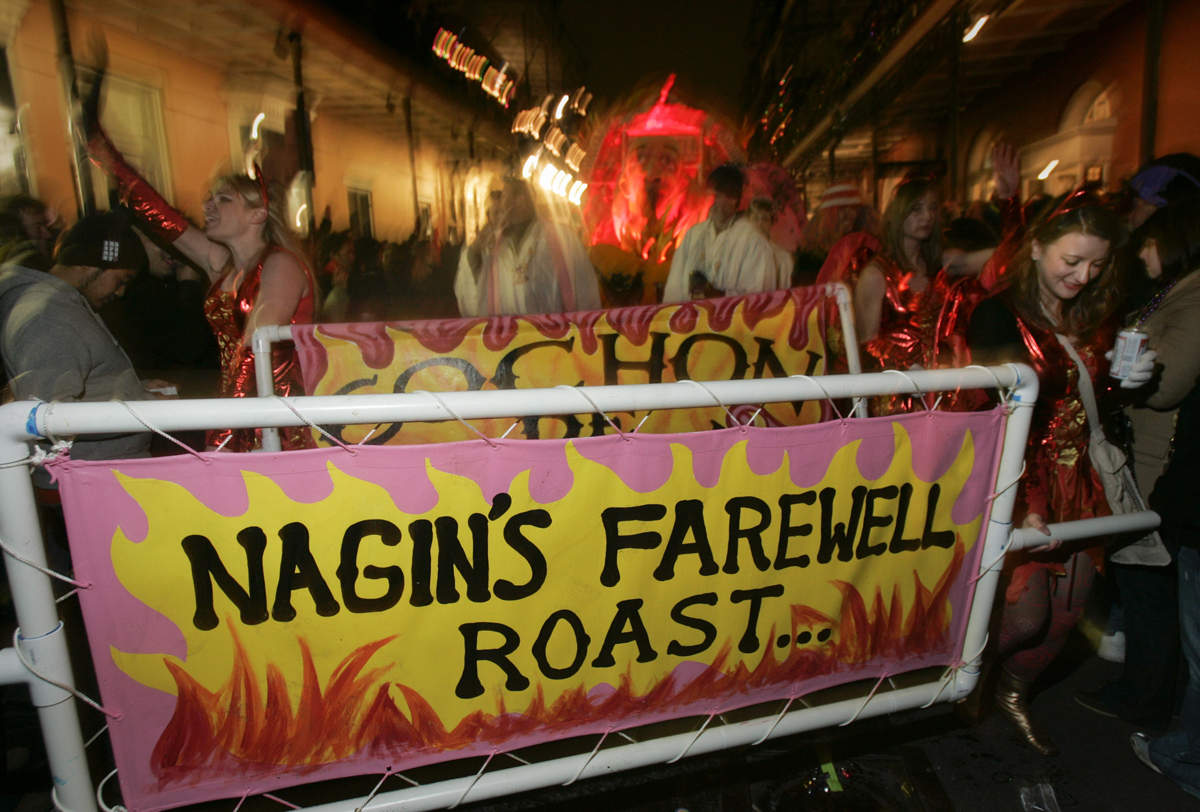
Revelers carry a banner referring to outgoing New Orleans mayor Ray Nagin during the Krewe du Vieux Mardi Gras parade in New Orleans January 30, 2010. The city holds its mayoral primary February 6. REUTERS/Lee Celano (UNITED STATES - Tags: SOCIETY POLITICS)(Credit: © Lee Celano / Reuters)

On the night of Sunday, Jan. 24, after the Saints beat the Minnesota Vikings 31-28 to advance to the first Super Bowl in the team’s 43-year history, New Orleans erupted into a wave of communal euphoria. It was as if someone had slipped Ecstasy into the water supply. Fireworks lit up the sky. Fans took to the streets, car horns honked in ecstatic rhythms, and elated chants of “Who dat?!” — the Saints rallying cry — could be heard across the city. Bourbon Street went from eerie silence to Mardi Gras-style revelry within moments of the game-winning field goal.

After suffering through years of futility, New Orleanians were certainly cheering for the success of their team. But their joy wasn’t confined to football. They were also celebrating themselves. The Saints have become a symbol of civic unity, a sign of how the city’s sense of self has undergone a profound transformation since Hurricane Katrina’s devastation. And this hope is mirrored in the optimism many New Orleanians feel about the end of Ray Nagin’s notoriously incompetent reign as mayor — and the chance that City Hall may finally aid in the city’s recovery.

Andrew O’Brien, an Orleans Parish resident and 26-year-old Latin teacher, summed up the parallel between the Saints and the current mayor’s race with an analogy that resonates with many here. “This year the Saints are a model of competency and effectiveness,” he said. “Now I think New Orleanians are trained to expect the same from their city officials. Our expectations are higher.” O’Brien would not reveal whom he intends to vote for, but added that being an informed citizen goes hand in hand with being a dedicated Saints fan. “I don’t think being a good Saints fan precludes being a good voter, or vice versa,” he said. “Can’t I be just as concerned with Jeremy Shockey’s knee as with charter schools?”

This Saturday, just a day before the Saints battle the Colts in Super Bowl 44, New Orleans residents will go to the polls to vote in citywide elections that include a mayoral primary to elect Nagin’s successor. The civic unity generated by the Saints may have a more significant impact on the mayoral election than any other factor — including, most notably, in this city known for its racial divisions, the race of the candidates.

Mitch Landrieu, Louisiana’s lieutenant governor and the brother of U.S. Sen. Mary Landrieu, is the current front-runner and may win the election outright in the primary. Recent polls have shown him winning more than 45 percent of the vote, with his closest competitors, Troy Henry and John Georges, trailing by almost 30 percentage points. Those same polls show that a high number of voters are undecided, but if Landrieu wins, either now or in a runoff with the primary’s second-place finisher on March 6, he would be the city’s first white mayor since his father, Moon, exited City Hall in 1978. Landrieu has campaigned on his experience in politics and promised to restore competency to the mayor’s office. His ascendancy might provide an indication that the city’s racial divisions, so exacerbated by Nagin, are not insurmountable and that the harmony most apparent on football Sundays has deeper community roots.

Given the wide array of problems facing the city, including the nation’s highest murder rate and astonishingly high levels of blight, residents are desperate for leadership from the mayor’s office. The question now is which of the six leading candidates do New Orleanians think offers the best chance to move the city forward.

After saying repeatedly that he wasn’t going to run this year after to losing to Nagin in 2006, largely due to the Nagin’s overwhelming support among African-Americans, Landrieu entered the race at almost the last possible moment. His campaign was boosted by the withdrawal of Ed Murray, a respected state senator and at the time the leading African-American candidate in the race. Murray said he determined he couldn’t win, but that he also withdrew to avoid dividing the city’s voters along racial lines. Along with winning the endorsement of the Times-Picayune, Landrieu has consistently led in the polls with a strong backing from African-American voters. A recent poll had Landrieu polling ahead of all other candidates, with 40 percent of the city’s African-American voters.

Landrieu’s leading competitors are Democrats Troy Henry, a local businessman and consultant who once worked at Enron; John Georges, a wealthy local businessman who has spent copious amounts of his own money on the campaign but has had to fight a reputation of arrogance; James Perry, the young leader of a fair-housing organization who has won praise from notable national progressives; and Nadine Ramsey, a former Civil District Court judge. There is one Republican in the race, Rob Couhig, a moderate Republican reminiscent of John Lindsay and a reformer who backed Nagin in 2006 but now regrets that endorsement. “[The Nagin administration] didn’t do anything,” Couhig said. “They have no urgency. Everything’s mañana with them.”

Georges appears in second place in many polls, but it seems unlikely that he has a real chance to take the election. He has flip-flopped on his party affiliation, adopting the Democratic label in a move that reeked of politically expediency despite still describing himself as a conservative on the campaign trail. In a devastating profile in the Times-Picayune, he oozed ineptitude and haughtiness about his personal wealth.

The sense of bonhomie felt in the city over the Saints has been on display at the many mayoral forums held during the campaign as well. The candidates have often seemed congenial with one another. Aside from a brash ad from Perry early in the campaign attacking Murray and Georges, the candidates’ ads have mainly avoided negativity. Couhig has been the most vocal critic of Landrieu, blasting the him for what Couhig perceives as viewing the mayoral office as a stepping-stone to higher national office. But these attacks are a far cry from the negativity of the 2006 campaign.

Murray’s withdrawal minimized the racial tensions in the race, although it did not remove them altogether. The city’s African-American community has failed to cohere around a single candidate, with many expressing so-called buyer’s remorse over Nagin. The city’s most prominent African-American publications have endorsed white candidates.

Henry, who is African-American, has played the race card more overtly than any other candidate in the race. He recently grabbed headlines by accusing the local media of preordaining Landrieu the winner, saying, “There’s a move afoot today to ensure that we have a majority white council, an inspector general that’s white, a district attorney that’s white, a U.S. attorney that’s white, a head of education that’s white.” Nagin, who has not officially endorsed any candidate, then went on a local radio show and backed up Henry’s charges, saying black voters had been “hoodwinked” by Landrieu’s reported lead.

Perry, who is also African-American, has rebuked both Henry and Nagin for engaging in what he sees as racially divisive politics. Early in January, after Nagin made some unsubstantiated insinuations about his campaign, Perry responded by issuing a stern rejoinder in which he lumped Henry and Nagin together, calling them a “tag team.” Perry added, “I don’t want to continue down the path that Nagin has set for New Orleans, which is a path as divisive as it is destructive, a path that is sown by racial mistrust and suspicions on both sides … The Nagin-Henry approach takes us backwards, not forward, as a city.”

Speaking to me recently, Perry reiterated this message. “In 2006, we saw an extremely racially divisive election, and that election ended up dividing the city,” he said. “This election season has the potential to go in either direction. It could be a unifying campaign or a racially divisive campaign. I respectfully think that’s a decision voters have to make between me and Mr. Henry. My message has been that people aren’t focused on a black mayor or a white mayor; they’re focused on getting the right mayor.”

Few polls have shown Perry with support outside the single digits, but though he may not make it into a runoff with Landrieu, Perry is indicative of the self-reliance at the base of the city’s rebuilding process. He has no interest in refighting the race wars of the past. A polished public speaker, he is a true reformer and has been a tireless champion for the housing rights of city citizens. Though a Crescent City native, Perry represents the young, idealistic progressives who have flocked to the city since Katrina and helped to reshape the city independent of direct government oversight. Perhaps the most obvious example of this trend is in the city’s school system, one of the most decentralized in the country, which has become a magnet for young education reformers. A higher percentage of New Orleans kids attend charter schools than anywhere else in the nation, and the results produced by these schools are beginning to mean significant improvements for education. Perry, like these education advocates, has found a way to move New Orleans forward despite Nagin’s dithering. He, like the Saints, is a reason for optimism.

To those who don’t call New Orleans home, it may seem hyperbolic to suggest that multiracial unity and exuberance over a football team could influence an election so strongly. Yet, it’s hard to overstate how deeply New Orleans loves its Saints, and the impact they’ve had on civic pride this year. In the past month, as the team has advanced through the playoffs, schools have incorporated the Saints into lessons, and local businesses and churches have become plastered with signs urging on the team. During a recent downtown rally to increase the awareness of issues facing the city’s youth, kids marched down the street wearing gold “Who Dat for Kids?” T-shirts, piggybacking on the Saints unofficial motto. (Full disclosure: I have done some freelance work for one of the organizations involved in the rally, Afterschool Partnership.) When the NFL tried to claim trademark rights over the phrase “Who Dat,” Republican Sen. David Vitter and Democratic Rep. Charlie Melancon finally found something they could agree on and protested the NFL’s assertions. The league backed down. As Jonah Keller, a lifelong Saints fan said to me, “For too long, [New Orleanians] have accepted that we’re a little below average to average at best. With the Saints, now everyone feels a passion for the team and feels they can be a winner.”

Gregory Rusovich, chairman of the Business Council of New Orleans and spokesman for Forward New Orleans, a collaboration of local organizations intent on reforming city governance, said he sees parallels between the city’s optimism over the Saints and the confidence citizens have in an improved future brought on by a new mayor. “There’s been a big sense of hope, pride and unity in the air,” he said. “The Saints and the city move in one heartbeat. The community has come together. There’s some optimism that we’ll get a good city council and an effective mayor, and we’ll be able to grow from that.”

It’s hard to find anyone not linked with the administration who isn’t excited by Nagin’s departure. One local T-shirt shop has printed shirts rejoicing in “Nay-gone” and several floats in this past Saturday’s annual Krewe de Vieux Mardi Gras parade exhibited images of the mayor burning in infamy. As one civically engaged longtime city resident described it to me recently, “Nagin is like Bush was [at the end of his presidency] in that everyone is just waiting for him to get out.”

Yet the proximity of the election to the Super Bowl (not to mention that Saturday is also the commencement of the Mardi Gras season in earnest), has led many in the local press, as well as some political analysts, to express fear that voters’ attention won’t be on the election.

“With the Saints, Carnival and Mardi Gras, people are distracted,” said Brian Brox, an assistant professor of political science at Tulane University. “All these things are hurting the candidates’ ability to get through the clutter.” Brox added that he’s witnessed a nonchalant attitude among some voters because they believe that any mayor will be an improvement over Nagin.

This week, the local television news stations have unquestionably devoted more attention to the goings on in Miami, where the Super Bowl will take place, than to the election. Yet, many of the city’s most prominent civic leaders share Rusovich’s belief that the Saints’ effect on the election has been a largely positive one and that citizens are engaged.

Vera Triplett, the president and co-founder of the Gentilly Civic Improvement Association, bristled at the notion that New Orleanians aren’t giving the election its due. “The Saints’ Super Bowl run doesn’t detract attraction from the mayor’s race,” she said. “That really underestimates New Orleanians because it assumes they can’t focus on more than one thing at a time. We can keep football and the future of the city in perspective.”

Triplett is supported by the swell of early voting that’s taken place over the past two weeks: A record 16,100 residents cast early votes at three locations across the city, surpassing even those cast in the 2008 presidential election. Many may have gone early to ensure they could vote before traveling to Miami for the game.

While Brox worries that the city could split along racial lines if Henry and Landrieu get into a runoff, Triplett, who is African-American, pointed out that the city is no longer as racially divided as it used to be. “The media always reduces everything to black and white, but we have large Vietnamese and Hispanic communities as well,” she said. “That sort of thinking disenfranchises a lot of our population.” Demographically, New Orleans has changed a great deal in the wake of Katrina. In 2008, the most recent census year, the population stood at 336,644, more than 100,000 less than it was in 2005. Around 61 percent of the population is African-American, down from nearly 67 percent in 2000, while the white population has increased from 27 percent to more than 30 percent over the same period. New Orleans also has growing Asian and Latino populations, together comprising more than 7 percent of the population, up from around 5 percent in 2000.

Many residents are hoping that James Perry is right, that all the goodwill felt during the Saints’ run results in a mayoral race that further unifies the city. “The whole city is optimistic,” said Denise Thornton, who heads Beacon of Hope, a nonprofit neighborhood-recovery organization. “We’ve been under a dark cloud for the past four years. Now it’s a new day. The Saints are just a sign of this optimism.”

Right fears secret abortions for 13-year-olds in reform

The latest myth going around: Healthcare reform legislation would lead to abortion clinics in schools

Wednesday night brought the latest installment of everyone’s favorite political drama: “Michele Bachmann tries to warn Americans about a threat that isn’t real.” Speaking on the floor of the House of Representatives, the Minnesota Republican warned parents everywhere that if Democrats’ healthcare reform legislation passes, school clinics will become controlled by Planned Parenthood and turned into sex clinics that promote abortions free of parental consent for 13-year-old girls (video of Bachmann’s comments is below).

Bachmann said:

And written in this bill is a provision whereby Planned Parenthood could become a proprietor for school-based clinics in every school across United States. These have been more accurately called school sex clinics … And as a matter of fact, the bill goes on to say what’s going to go on — comprehensive primary health services, physicals, treatment of minor acute medical conditions, referrals to follow-up for specialty care — is that abortion? Does that mean that someone’s 13 year-old daughter could walk into a sex clinic, have a pregnancy test done, be taken away to the local Planned Parenthood abortion clinic, have their abortion, be back and go home on the school bus that night? Mom and dad are never the wiser.

Bachmann’s argument is entirely untrue and both PolitiFact and Politico’s Glenn Thrush have done a thorough job debunking her claims. But she’s hardly the first conservative to advance this line of thinking. In fact, the specter of Planned Parenthood engaging in abortion bonanzas in America’s schools has been a staple of right-wing opposition to healthcare reform for a while now — though that doesn’t make the assertion any less of a lie.

The falsehood seems to have begun with a blogger named Peter Fleckenstein, writing on his blog Common Sense From a Common Man back in July. Fleckenstein alleged that Page 992 of the House healthcare bill contained language that would lead to the establishment of school clinics that could advise young girls to have abortions without parental input.

Conservative groups like the American Family Association and Liberty Counsel, a conservative group affiliated with Liberty University’s law school, then pushed the abortion clinic myth to wider right-wing audiences. One chain e-mail from the Liberty Counsel told parents, “[your] children will be indoctrinated and your grandchildren may be aborted!”

In actuality, the section of the bill at the root of the controversy states explicitly that the school clinics would have to abide by existing federal, state and local laws regarding parental consent. On top of that, the school clinics in question aren’t a new entity dreamed up by Democratic socialists intent on indoctrinating America’s youth. Rather, as PolitiFact has pointed out, the clinics have been around for 30 years. There are 2,000 such clinics across the country. None provide abortions and they generally serve students who live in areas with limited healthcare options. The healthcare reform legislation would just ensure that these clinics continue to receive funding.

However, as Thrush suggests, the fact that Bachmann’s allegations have no basis in reality might not keep Congress from overreacting.

“[N]one of the three bills in the House explicitly prohibit the use of the school-based clinics to steer kids to abortion clinics — so look out for an amendment, however statutorily superfluous, to be introduced by somebody as a way to wedge conservative Dems from the party’s liberal base,” Thrush writes. “Either that, or we’ll be hearing 30-second ads that say something like, ‘[Candidate X] voted for the Nancy Pelosi government takeover of health care, which will result in your 13-year-old granddaughter getting an abortion on the way home from school …’”

Continue Reading Close

Senate finally taking up cap-and-trade bill

After a long delay, legislation to reduce U.S. greenhouse gas emissions is announced; passing it might not be easy

During the summer of our healthcare discontent, the issue global warming was largely pushed to the backburner in Washington. The House passed cap-and-trade legislation designed to cut greenhouse gas emissions and hopefully slow the process, but that was back in June. Only now, at the end of September, is the Senate finally taking up a similar bill.

At an event on Capitol Hill Wednesday, Sen. Barbara Boxer, D-Calif., and Sen. John Kerry, D-Mass., announced their version of the cap-and-trade legislation.

“We know clean energy is the ticket to strong, sustainable economic growth,” Boxer said. Kerry echoed Boxer’s optimism about the measure. “Ultimately, this bill is about keeping Americans safe,” he said. President Obama lauded the tandem, saying in a prepared statement, ”With the draft legislation they are announcing today, we are one step closer to putting America in control of our energy future and making America more energy independent.”

The Boxer-Kerry bill, which is formally titled the “Clean Energy Jobs and American Power Act,” seeks a 20 percent cut U.S. greenhouse gas emissions by 2020, using the levels of emisssions in 2005 as a benchmark. This is more ambitious than the House plan, which aimed to reduce emissions by 17 percent. Both plans seek an 83 percent reduction by 2050. (Both are also weaker than planned reductions in Europe and Japan, as both of them are using 1990 levels as their baseline.)

Boxer and Kerry aim to meet these targets through a “Pollution Reduction and Investment” program. Essentially, the two Senators have just given a new, less recognizable and hopefully, for them, less controversial name to the idea of cap-and-trade. Essentially, this provision places a fixed limit on carbons emissions, but leaves businesses some wiggle-room in how they will comply. The emissions cap in the Boxer-Kerry bill will only effect the 7,500 largest polluters in the country, or about 2 percent of American businesses.

While the bill seeks to protect the environment, it also touts energy conservation as a way to spark the American economy. Interestingly, the measure also includes a lot of enticements for centrist Democrats and Republicans, with generous funding provisions for nuclear power, natural gas and even coal — though it leaves many of the specifics ambiguous so that details can be decided within the Senate.

The New York Times estimates that the bill currently has 45 supporters in the Senate, with many more members on the fence. Majority Leader Harry Reid, D-Nev. has said Democrats hope to have Congressional approval of climate change legislation passed by the time the U.N. climate summit in Copenhagen, Denmark rolls around in December.

Not surprisingly, many Republicans aren’t fond of the bill and hammered it as a new energy tax on Americans. One of the Senate’s most notorious global warming deniers, Sen. James Inhofe, R-Okla., has already compiled a list of questions for Boxer about the legislation. And in a statement, House Republican Leader John Boehner, R-Ohio, said, “The national energy tax was a terrible idea when it passed the House, and it is an even worse idea now. Middle-class families and small businesses struggling to make ends meet shouldn’t be punished with costly legislation that will increase electricity bills, raise gasoline prices, and ship more American jobs overseas.”

Continue Reading Close

Even people who yell at town halls like Starbucks?

A new Starbucks ad attempts to appeal to everyone -- even town hall protesters

As further proof that Americans can find a way to profit off of anything, a new Starbucks ad attempts to sell coffee by lampooning the contentious healthcare reform town halls that garnered national attention all summer.

The ad (a teaser is below, while the full version can be watched here) is for Starbucks’ new instant coffee Via. It shows a series of groups of people who can’t tell the difference between Starbucks’ regular coffee and the new version. The ad is attempting to say that all sorts of people, from nurses to Civil War reenactors to people with “yellow belts” will find Via as satisfying as regular Starbucks. The ad then concludes with a man standing up at a town hall meeting and yelling, “I can’t taste the difference.”

So is Starbucks attempting to exploit America’s political divisions for its own benefit? Or is the ad a savvy way to portray Starbucks coffee as a product that appeals to everyone? And will conservatives hate Starbucks and all its East Coast, Ivy-League educated, latte-sipping elite customers even more now? (And are they right to do so, since the place burns its coffee, which is overpriced anyway?) Tell us what you think.

Continue Reading Close

Logic in short supply at healthcare hearing

Iowa Republican Sen. Chuck Grassley calls government a "predator" -- so why does he support Medicare?

For today, at least, C-SPAN is must see TV. The Senate Finance Committee is considering two proposed amendments that would add a public, government-run insurance option to the healthcare reform legislation put forward by its chair, Sen. Max Baucus, D-Mont. So far the debate, though lively, hasn’t always involved totally logical arguments.

For instance, this morning, Sen. Charles Grassley, R-Iowa, ripped the public option, saying it would be the first step towards a single-payer healthcare system in which Americans would lose the ability to choose their healthcare providers. This argument clearly got to Sen. Charles Schumer, D-N.Y., who introduced one of the public option amendments.

Schumer asked Grassley how he could support Medicare, yet oppose a public option. Grassley responded, “Medicare is part of the social fabric of America … [but] to say that I support it is not to say that it’s the best program that it can be.” Grassley then went on to lament healthcare’s fate if government becomes more involved.

As Medicare is a popular, government-run insurance plan, Schumer pressed his point. “I just don’t understand the difference,” Schumer said. “If Medicare is good and part of the social fabric, that’s a government run plan. The main knock you’ve made on [our amendment] is it’s government-run. Medicare is government-run, and most people like it very much.”

The conversation only became more circular from there, with Grassley saying that a public option would ruin competition. He then called government a “predator.” Noticing the contradiction in Grassley’s words (not to mention the fact that Grassley is an employee of said “predator” government), Schumer asked, “So you don’t wan’t Medicare?” to which Grassley answered, “I told you that Medicare is part of the social fabric of America.”

This simultaneous defense and criticism of Medicare has been a staple in the Republican attack against the public option throughout the healthcare reform debate. Republicans obviously realize that Medicare is popular among America’s elderly, but want to avoid touting the benefits of having the government involved in healthcare.

Grassley wasn’t the only Senator making tenuous arguments at this morning’s hearing. Sen. Mike Ensign, R-Nev. deserves recognition for the day’s most convoluted opinion. According to Ensign, it’s not fair to compare America’s healthcare system to those in Europe unless we remove all gun and car accidents from our healthcare statistics.

“Are you aware that if you take out gun accidents and auto accidents, that the United States actually is better than those other countries?” Ensign asked. “I mean we’re just a much more mobile society … We drive our cars a lot more, they do public transportation. So you have to compare health care system with health care system.” Ensign added that we shouldn’t count gun deaths because we Americans “like our guns.”

Continue Reading Close

Is Reid ready to give up on the public option?

The Senate majority leader may push forward with healthcare reform that doesn't include a government-run plan

An article in Sunday’s New York Times on Senate Majority Leader Harry Reid, D-Nev., will surely incite angst among progressives for a variety of reasons.

For one thing, the article — entitled “Reid the Quarterback May Call on Obama to Referee” — discusses how Reid, never a favorite of liberals due to his governing style of gentle persuasion and his seeming unwillingness to push back aggressively against Republicans, is now the Senate’s point man on healthcare reform. The majority leader is now working to reconcile two competing healthcare proposals that have emerged from Senate committees so that the body as a whole can vote on a single measure.

This brings us to the second problem for progressives. The article cites unnamed senior Democratic Senate aides who told the Times that a combined bill will not contain a public option for insurance. Liberals see a government-run insurance option as a key to healthcare reform because it would provide competition for private insurers. Reid is apparently interested in dropping the option in order to appeal to centrist Democrats and Sen. Olympia Snowe, R-Maine, the lone Republican who appears even slightly willing to vote in favor of the Democrats’ proposals for overhauling the system.

Now, the public option has already died a thousand deaths during the healthcare reform debate and the Times article is careful to point out that Democratic Senators will likely propose amendments that include it once a final bill has been hammered out. But, as Greg Sargent notes, while the Democratic aides referenced in the piece weren’t necessarily from Reid’s office, the emphasis of the piece suggests that Reid is firmly in charge of the Senate’s dealings on healthcare and he’s ready to concede the public option.

Rodell Mollineau, a spokesman for Reid denied the rumors that Reid has given up on the public option. “It would be wildly speculative of me to say that has been predetermined,” Mollineau said. “It would be wildly speculative of me to say what is going to be in that bill … Right now, we don’t know.”

For what it’s worth, polls show — depending on how you ask the question — that a public option remains popular with Americans. Plus, it would likely drive down insurance costs and Democratic senators like New York’s Charles Schumer and West Virginia’s Jay Rockefeller have voiced their support for the idea recently.

Continue Reading Close

Page 1 of 45 in Vincent Rossmeier

www.salon.com/writer/vincent_rossmeier/index.html