

There’s something we all solemnly acknowledge in November and then immediately forget by January: the side dishes are the real reason to show up. Every year, we gather around a turkey no one is particularly passionate about while lavishing praise on garlic-herb mashed potatoes, honeyed yams crowned with pecans, maple-glazed Brussels sprouts, cornbread stuffing with crisped edges, the zippy apple-cabbage slaw. Entire “Sidesgivings” have sprung up in their honor. Meanwhile, the turkey — often dry, well-meaning, faintly ceremonial — recedes into the background.
The instinct for an all-sides dinner, it turns out, is not seasonal. It’s perennial. It shows up across the echelons of dining, from white tablecloths to vinyl booths. Steakhouse sides, for instance, routinely outshine the steak itself. (If I may suggest a small, attainable luxury: take a seat at the bar, order a martini, and request only the creamed spinach, the lobster mac, the austere wedge salad with its cold crunch. Leave the ribeye to someone else.)
I’ve long adored the old-school deli “salad plate,” a combination platter that arrives like a mosaic: pasta salad, potato salad, three-bean, maybe tuna or chicken, each scoop glossy and self-contained. Even Cracker Barrel understands the assignment. Its “Country Vegetable Plate” — a choose-your-own adventure of classic sides with biscuits or corn muffins — is proof that pleasure need not center a protein.
Across class, region and era, sides have carried the texture, the color, the delight. Perhaps it’s time to remember that when planning dinner this week. Sometimes the best dinner is one without a main dish.
My case for all-sides
You might, at this point, be tempted to give this idea the Miranda Priestly treatment. An all-sides dinner? Groundbreaking. Haven’t vegetarians been doing this quietly for decades? Haven’t we all, at one point or another, assembled a plate of bits and called it a night?
Fair enough. But stay with me.
Because after years of talking to home cooks — fielding emails, listening to grocery-store confessions, hearing the low-grade anxiety threaded through weeknight meal planning — I’ve come to understand that for a lot of us, dinner can sometimes be less about appetite and more about expectation. What and how we feed our people (or just ourselves) is tangled up in a thicket of shoulds.
I should cook more from scratch.
I should vary the menu.
I should spend less.
I should make a “real” dinner — meaning a visible protein anchoring the plate.
It’s a lot to carry into 6 p.m.
Sometimes what’s needed isn’t a new cuisine or a better strategy. It’s permission. Permission to feed everyone in a way that simply gets them fed. An all-sides meal isn’t a cop-out; it’s a template. A generous one.
Want more great food writing and recipes? Sign up for Salon’s free food newsletter, The Bite.
We already know, from the rise of charcuterie boards, snack plates and the much-debated “girl dinner,” that mix-and-match formats are inherently pleasurable. Variety feels abundant. A plate composed of several small, distinct things feels thoughtful even when it’s low-lift.
It also quietly solves problems. If the idea of preparing a protein feels like the final straw, skip it. Creamed spinach and mac and cheese will not stage a revolt. If you’re cooking for picky eaters, let everyone choose at least one thing they love. If vegetables feel like an obligation, tuck them into dense spoon salads, lemony beans and produce-packed pastas that eat like a treat rather than a directive.
Sides, in other words, remove the moral drama from dinner.
How to make it work in your kitchen
I now present three distinct paths to a deeply satisfying Side Night, plus a few gentle formulas to ensure you don’t end up staring down a plate of unrelieved beige. (Unless beige is your love language — which, candidly, it often is mine.)
Path 1: The Make-Ahead Week
For the planners, the batch-cookers, the Sunday-afternoon optimists: make a few big, sturdy sides once and let them earn their keep all week. Choose dishes that improve with a little time and chill — herby potato salad slicked with olive oil and dill, a lemon-bright bean salad, a vegetable-packed pasta salad studded with crunch.
Come dinner, spoon them onto a plate in the grand tradition of the old-school deli “salad plate.” Add good bread with real butter. Maybe some peak fruit. Something pickled. Suddenly, what began as leftovers reads as intentional abundance.
Path 2: The Local Deli Assist
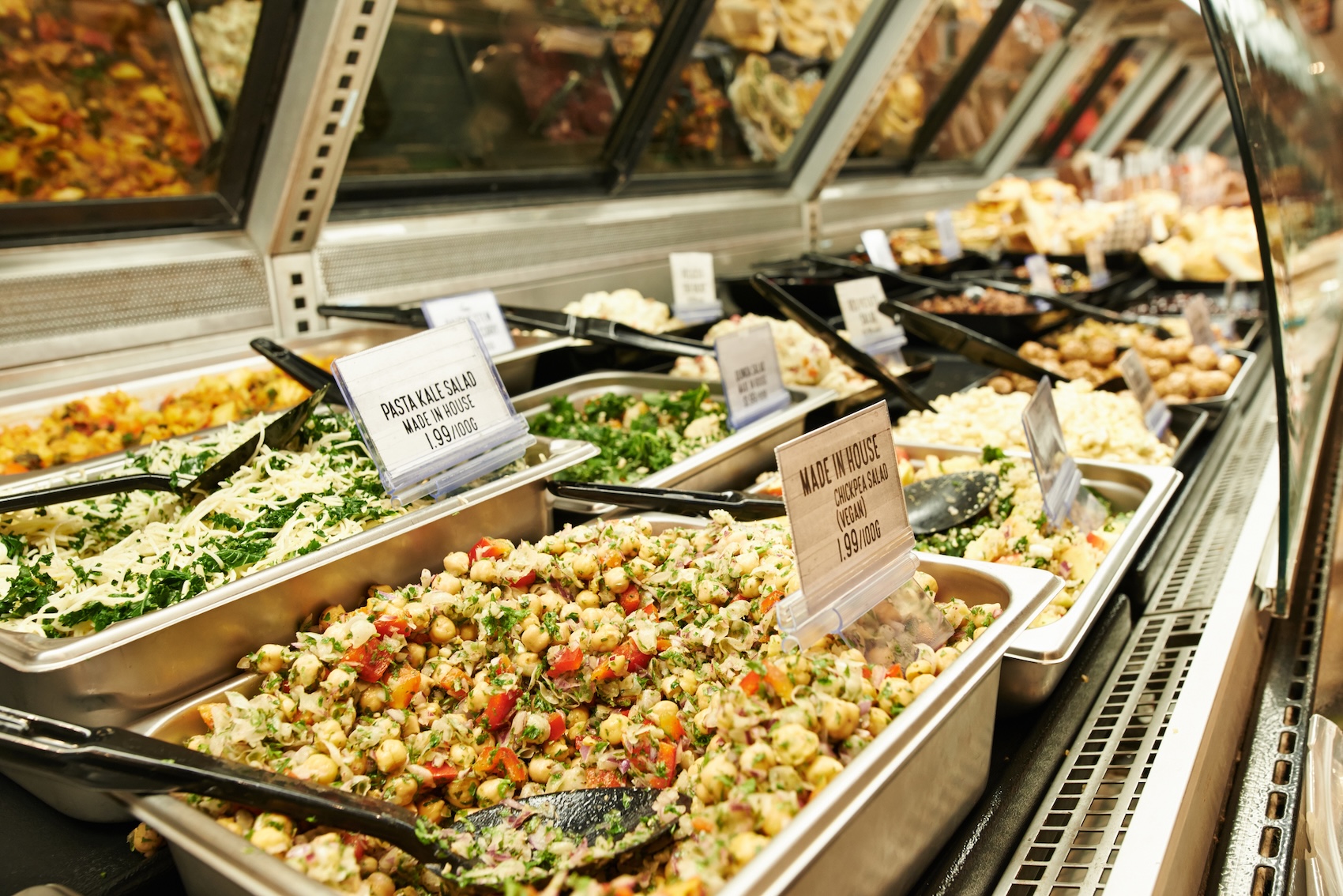
I am helpless before a well-appointed salad case. Italian deli with its vinegary pasta salads tangled with artichokes and sun-dried tomatoes? Yes. German counter with mustard-slicked potatoes and ruby cabbage slaw? Absolutely. Southern spread with pimento cheese glowing like a beacon? Obviously. The fancy shoppy-shop with quinoa and bulgur in matte, tasteful tubs? I’m there.
The trick to turning one deli run into multiple dinners is simple and nearly foolproof: one creamy, one crunchy, one briny or fresh.
Texture does most of the heavy lifting. By night two, you will feel less like someone reheating sides and more like a person who understands composition.
Path 3: The Frozen Aisle Free-for-All
Treat the Trader Joe’s freezer aisle — or your local equivalent — as infrastructure, not a guilty pleasure. Gather your mac and cheese, your spanakopita triangles, your dumplings, your roasted vegetables in tidy bags.
Then, and this is key, add what I privately call a “freshness anchor.” Drift toward the salad kits, the deli-tub greens, the cucumbers and citrus. Slice, scatter, squeeze. The cold crunch of something raw against something molten is what makes the plate feel complete.
Another formula towards which I gravitate: one hot side, one cold, one green, one beige.
Frozen food, in this context, isn’t just a shortcut. It’s smart architecture. It holds up the roof so you don’t have to.
Which is why, in the end, side night is a form of permission. Permission to value pleasure over performance, ease over expectation. Dinner doesn’t need a star; it needs to satisfy. And sometimes the most complete meal is the one that stops trying to prove it deserves the spotlight.
Read more
about this topic
