

If you could open my head like a cookie jar, there’s a good chance that the logline for Amanda Kramer’s stunning new film, “By Design” — “A woman swaps bodies with a chair, and everyone likes her better as the chair” — would pop out like a can of worms. Even before I first saw the film during last year’s Sundance Film Festival, this one-line elevator pitch was taking up all the space in my prefrontal cortex. Like all good jokes, it’s both funny and achingly relatable, with a punchline that sticks to the ribs. But this one-line synopsis also succinctly captures the film’s complexities, humor, darkness and honesty. It’s amazing how much a handful of perfectly chosen words can make us feel, and how much beauty there can be in something as simple as a sentence.
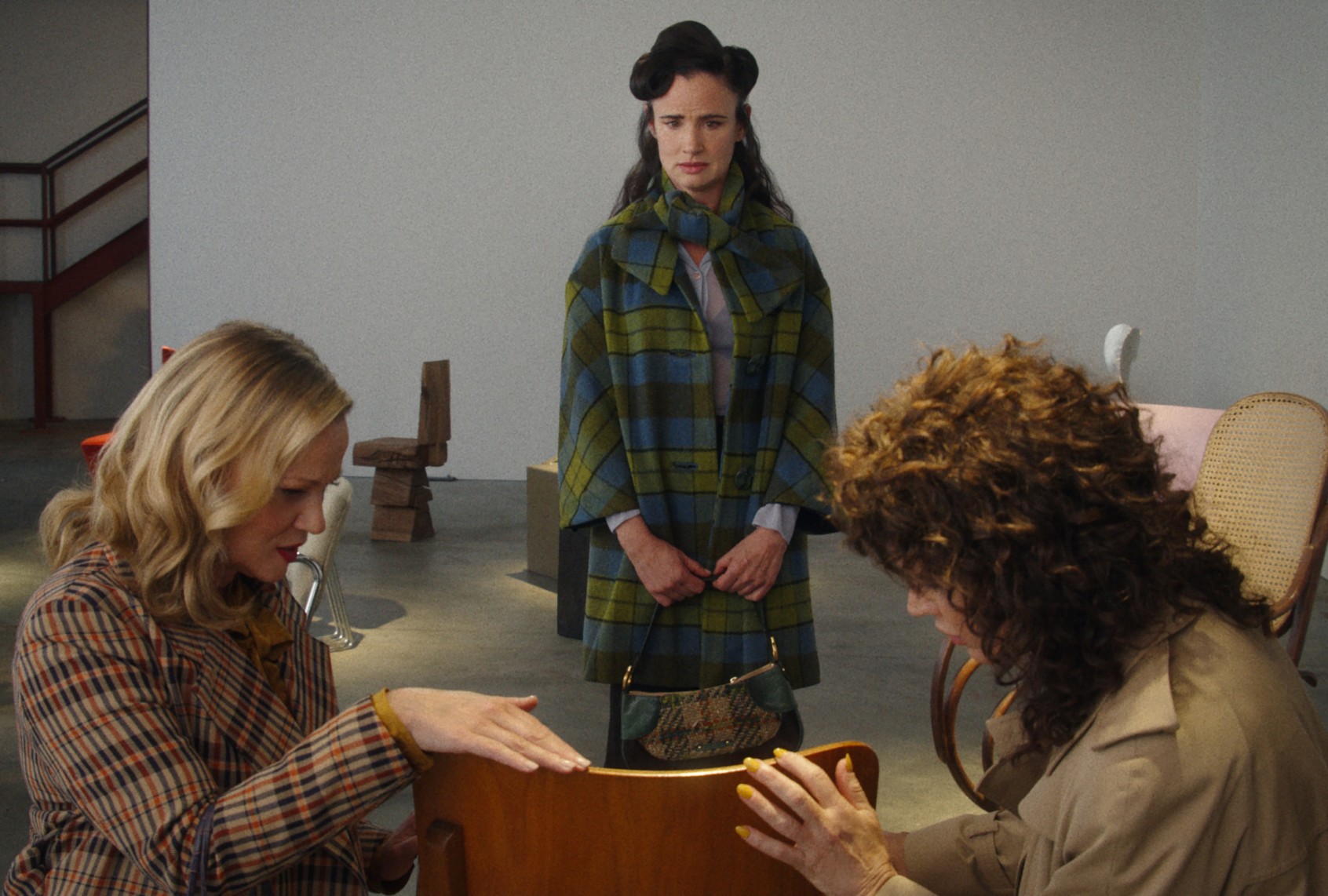
But, then again, “By Design” is all about the little details — and, more specifically, how much those details matter versus how much we obsess over them. In Kramer’s film, Juliette Lewis plays Camille, an absurdly chic yet financially strapped woman preoccupied with keeping up appearances for no reason other than that it’s what’s expected of her. She neglects groceries in favor of spending money on cigarettes and lunch with her two best friends, Irene (Robin Tunney) and Lisa (Samantha Mathis), saving just enough for a small, simple life with no room for additional frivolity. That becomes a problem when, after one of their weekly lunches, the three friends stroll around a furniture store, where Camille is entranced by a gorgeous chair she can’t possibly afford. Instantly, Camille is overcome with desire, as well as a more surprising, complicated feeling: jealousy.
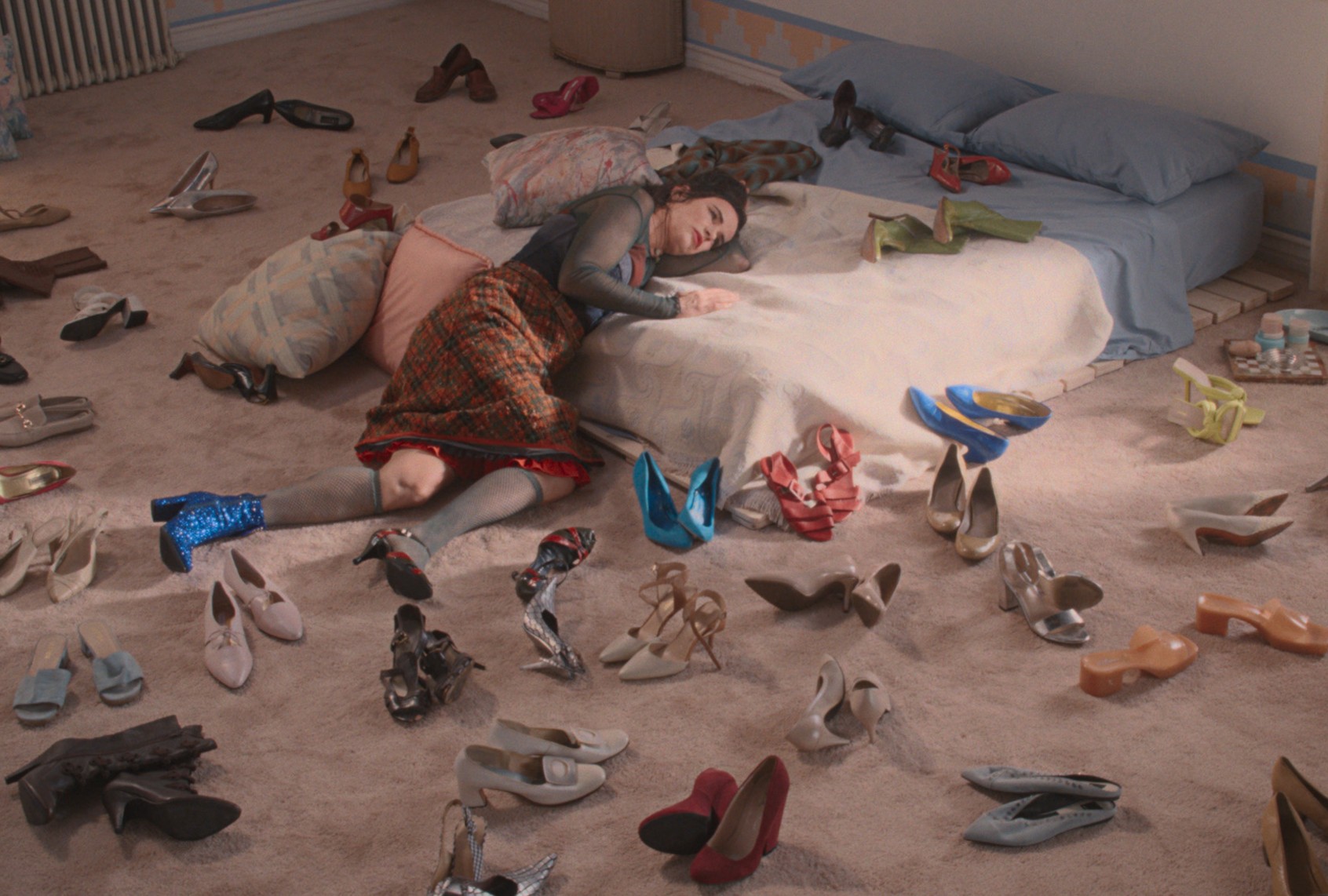
(Music Box Films) Juliette Lewis in “By Design”
With each manicured frame and deceptively poignant observation on the impossibility of living normally in modern life, Kramer concocts an original, wonderfully empathetic study of the desire to play spectator to a world on fire.
“Here is a woman who has never been particularly jealous of any other woman, realizing that she deeply envies this chair,” the film’s narrator, voiced by Melanie Griffith, says. “Its beauty, its usefulness, its deserving of praise . . . She’s never been able to just sit there silently and still be seen, loved. That’s a life she wants instead of the life of always having to perform Camille.”
It sounds like a nice idea, doesn’t it? Being adored without trying, being involved in goings-on without speaking or taking responsibility? In an era when pressure is always mounting and global chaos consistently collides with personal crises, being an active participant in our own lives feels utterly exhausting. There’s always something that we’re trying to keep up with, something that’s falling through the cracks: that person we didn’t text back, that article we meant to read, that bill we haven’t paid. Like Camille and her winsome wooden chair, it’s easy to see something striking and convince ourselves that having it will change our lives and make everything easier. The coveting provides a welcome distraction — even a bit of hope.
That’s why, when Camille promises the chair she’ll be back for it after moving some money around, only to find that another customer has already scooped it up, her loss is devastating. Camille’s heartbreak is so consuming that it turns her into something else entirely, placing her soul in the framework of her sought-after chair and turning her human body into a stiff, agreeable bag of bones. Yet, Camille is happier like this. And with each manicured frame and deceptively poignant observation on the impossibility of living normally in modern life, Kramer concocts an original, wonderfully empathetic study of the desire to play spectator to a world on fire.
If it’s here where you’re thinking, “How interesting could a movie be if the main character turns into an inanimate object within the first 20 minutes of its 90-minute runtime?” you’d be asking a fair question. “By Design” is certainly unconventional — so atypical that a recent ad capitalized on the movie’s eccentric nature by compiling a handful of pullquotes from early reviews, all expressing a sentiment akin to, “This movie isn’t for everyone.” And that’s the truth. You won’t find any of the good-natured platitudes of a body swap comedy like “Freakier Friday” here. But stick around, and you will find that Kramer’s take on the subgenre is far more fascinating and pertinent to life outside the movie theater than most of its peers.
Though her film is singularly witty, Kramer refuses to shy away from tough subjects and perplexing contradictions. “By Design” cleverly drapes its thematic thorns in ornate production design and costuming, making its emotional impact all the more deceptive. This is a film about how the mere structure of something can conjure intense admiration, and Kramer dextrously reflects that idea in every meticulous moment. To make the viewer believe that Camille could be so awestruck by a chair that she ultimately becomes one with it, we must also understand how something can look so beautiful that the mere sight of it could stop us in our tracks. And the world Kramer creates in “By Design” is so elaborately crafted from its opening credits alone that the audience can’t help but understand Camille’s plight, desperate to jump inside this sparse, stylish film and live there forever.
Want more from culture than just the latest trend? The Swell highlights art made to last.
Sign up here
Like Camille, Americans are seeking escape. A 2025 Gallup poll found that Americans’ satisfaction with their personal lives had dipped to its lowest level in a quarter of a century, while their satisfaction with the country as a whole was even lower. It’s no coincidence, then, that we spend more time than ever paying attention to things happening outside of our own lives. It’s far simpler to focus on someone or something else than it is to examine and reorient our own existence toward something more ideal. Chronic disappointment is easy to curb. Our attention is diverted away from ourselves and toward a collective hive mind by social media, advertising and the crushing deluge of current events. But being part of a collective requires engagement. To avoid self-examination and the realization that we may not be able to change our station as quickly as we’d like, one can simply turn themselves into a vessel for useless information — a factory line ready to churn out hollow opinions on demand. Personal discontent is a one-way ticket to intellectual automation.
Camille’s grief should be superficial — this is only a chair, after all. But her sadness is not just about this wooden armchair; it’s about what the chair represents. Camille found something that she truly loved at first sight, an object that had an obvious purpose and function, two things that we’re not always so lucky to understand about ourselves.
On the particular afternoon that Camille is out to lunch with Irene and Lisa, she’s feeling similarly unhappy. “Camille hopes that lunch will be a salon of ideas ranging in topics vast and tremendous, but lunch is devoid of ideas and filled with crisis,” the narrator explains. “She listens with sympathy. She would rather wipe their tears than be home. Home is devoid of ideas.”
Yearning for a kind of abstract stimulation that even she can’t put into words, Camille is transfixed by her beloved chair. It’s the answer to all of her problems, the solution to her chronic dissatisfaction. The chair cuts through the noise. It’s simple and essential. It will change everything, Camille is sure of it.
Then, all of the ideas about what life could’ve been are dashed away in an instant. Lamenting both her loss and the fact that she will have to go back to her routine as it was, Camille tells the furniture store shopkeeper, “I want to be friends with women; it’s important. But there’s so much jealousy. I wish we were each special, but we’re not. I don’t have anything anyone could envy. I could have had this chair.”
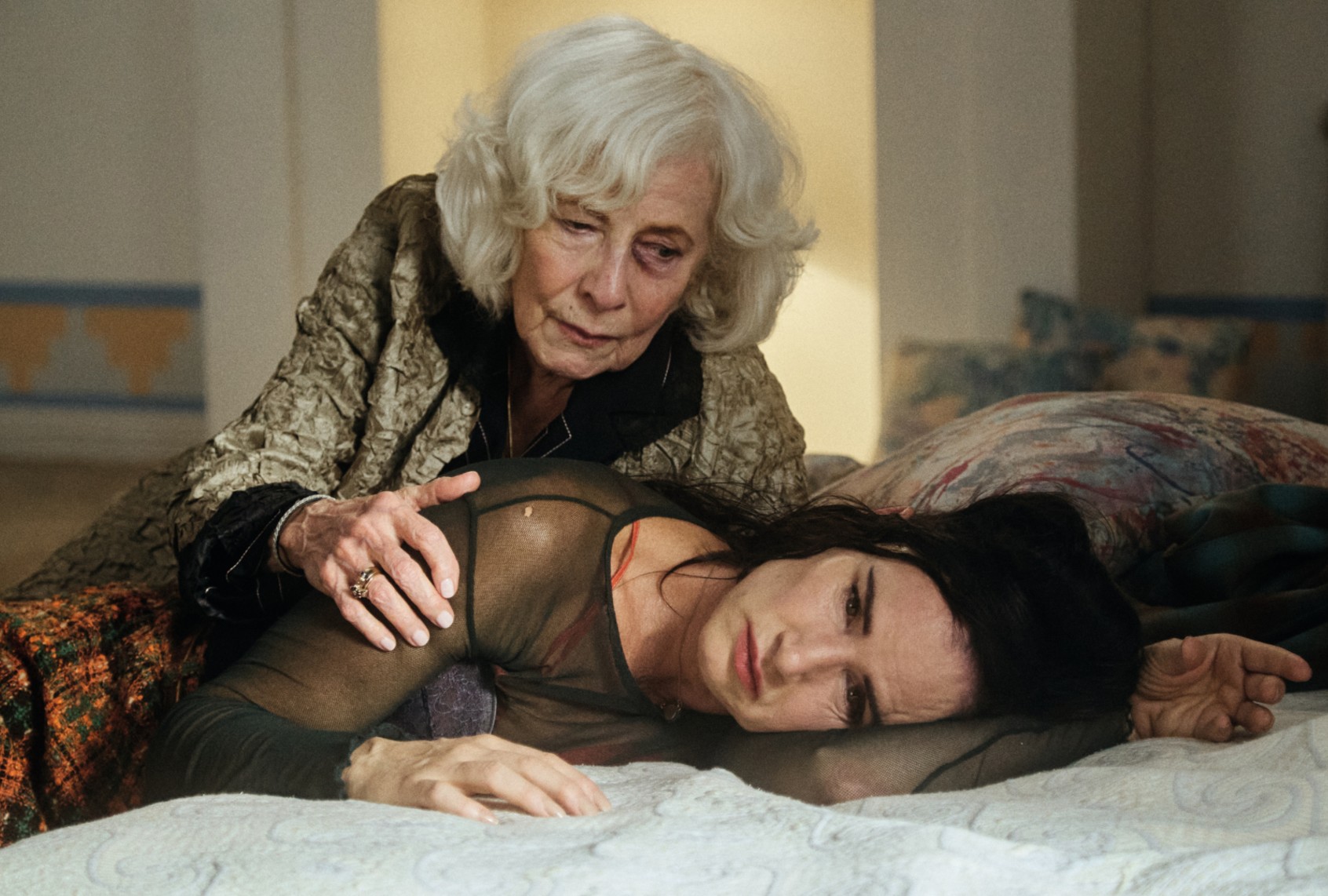
(Music Box Films) Betty Buckley and Juliette Lewis in “By Design”
On paper, the dialogue may seem stiff and silly, but Lewis laces these words with enough sorrow to fill the room. Camille’s grief should be superficial — this is only a chair, after all. But her sadness is not just about this wooden armchair; it’s about what the chair represents. Camille found something that she truly loved at first sight, an object that had an obvious purpose and function, two things that we’re not always so lucky to understand about ourselves. Owning the chair would be a fresh start. It would be a mark of financial solvency and taste. And the chair would be something worthy of as much lunch discussion as any horrific international crisis or ephemeral gossip. The chair would make life’s unavoidable irritants that much more bearable.
When Camille becomes the chair shortly after, she’s allowed the same alleviation. She knows the passive peace that comes with being loved without working for it, and with being beautiful without manufacturing it. How nice, the feeling that you could be an observer in life, instead of feeling like you must always comment or participate. The chair — and by proxy, Camille — ends up in the home of a piano player named Olivier (Mamoudou Athie) and his girlfriend, Marta (Alisa Tores), who bought the chair as a gift. Olivier quickly becomes as obsessed with it as Camille, while Camille enjoys being little more than a beautiful thing for someone else to admire. She’s not asked for her opinions. She’s not in the center of a quarrel. And she’s certainly not worrying about money. For perhaps the first time in her adult life, she’s content.
We need your help to stay independent
Being this unknowable feels good. There’s a thrill of anonymity that comes with walking through an airport far from your home, or stopping at a local coffee shop while driving through a town you’ve never been to. You could be anyone, and no one is expecting anything more from you than a bit of common courtesy. In these circumstances, the deafening buzz of the everyday finally reduces to a faint, pleasant hum.
Human beings were not designed to know as much about the world and each other as we do now, and certainly not made for having opinions and reactions to all of it. We need the lull to keep us sane, and more importantly, give us time to settle within our own bodies and minds. The kind of discontent Camille feels — and the relief she experiences when she breaks free of it — isn’t normal, yet it’s become incredibly relatable. By filtering such a common feeling through a strange and delightfully unsettling narrative lens, “By Design” contends with our modern restlessness in far more memorable fashion than many big-budget, big-idea films of the last year. Kramer’s film lets us off the hook and allows us to breathe, reminding us that sometimes it’s necessary to stick your head in the sand — or your body into a chair — even if the peace won’t last forever.
Read more
about Juliette Lewis’ daring roles
