
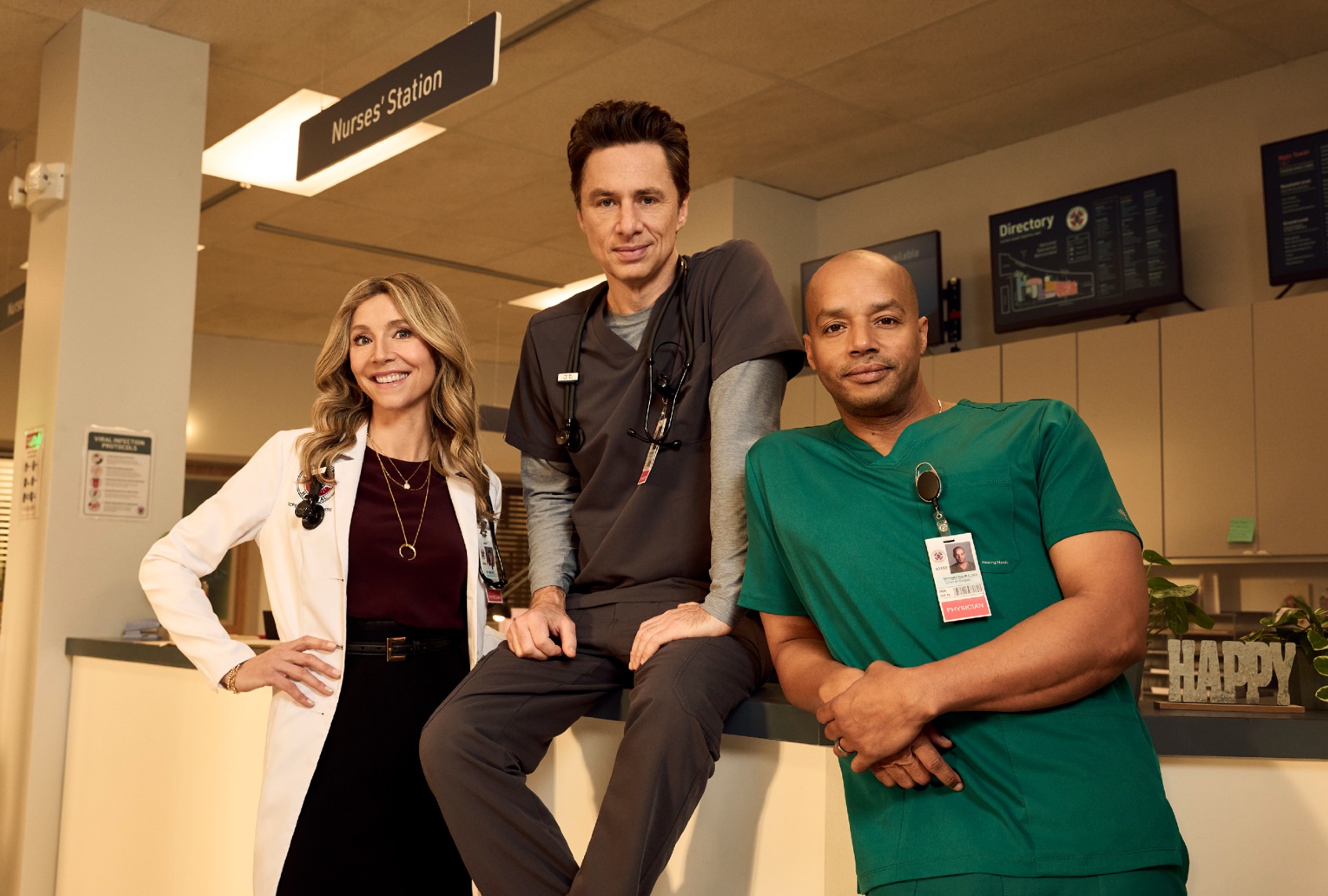

Twenty-five years after “Scrubs” introduced Dr. Christopher Turk (Donald Faison), he returns to our screens a changed man – though not even his best friend, Dr. John “J.D.” Dorian (Zach Braff), notices the difference at first.
When J.D., who has long moved on from Sacred Heart Hospital, surprises Turk with a mid-shift visit to their old stomping grounds, Turk puts on the usual jokey front, crouching so old J-Dizzle can leap on his back for one of their signature “Eagle” flights. Turk’s bad back makes it a brief sortie, but the attempt confirms that their friendship remains fundamentally intact.
Still, when J.D. finds out Turk’s interns secretly refer to him as Dr. Bummer, he realizes his Big Dog may be burying some of his pain.
“God, I wish this guy would die all at once instead of in tiny little pieces,” Turk blurts out while operating on a patient, one of the many small dramatic turns that anchor “Scrubs” in reality. Like many men, Turk is lonely, and like many mid-career doctors, he’s also burned out. No matter how many times Turk advises the man he’s just treated to take better care of himself, he tells J.D., Turk knows he’ll be performing another amputation on him.
“There’s no joy. None,” Turk says, holding back tears.
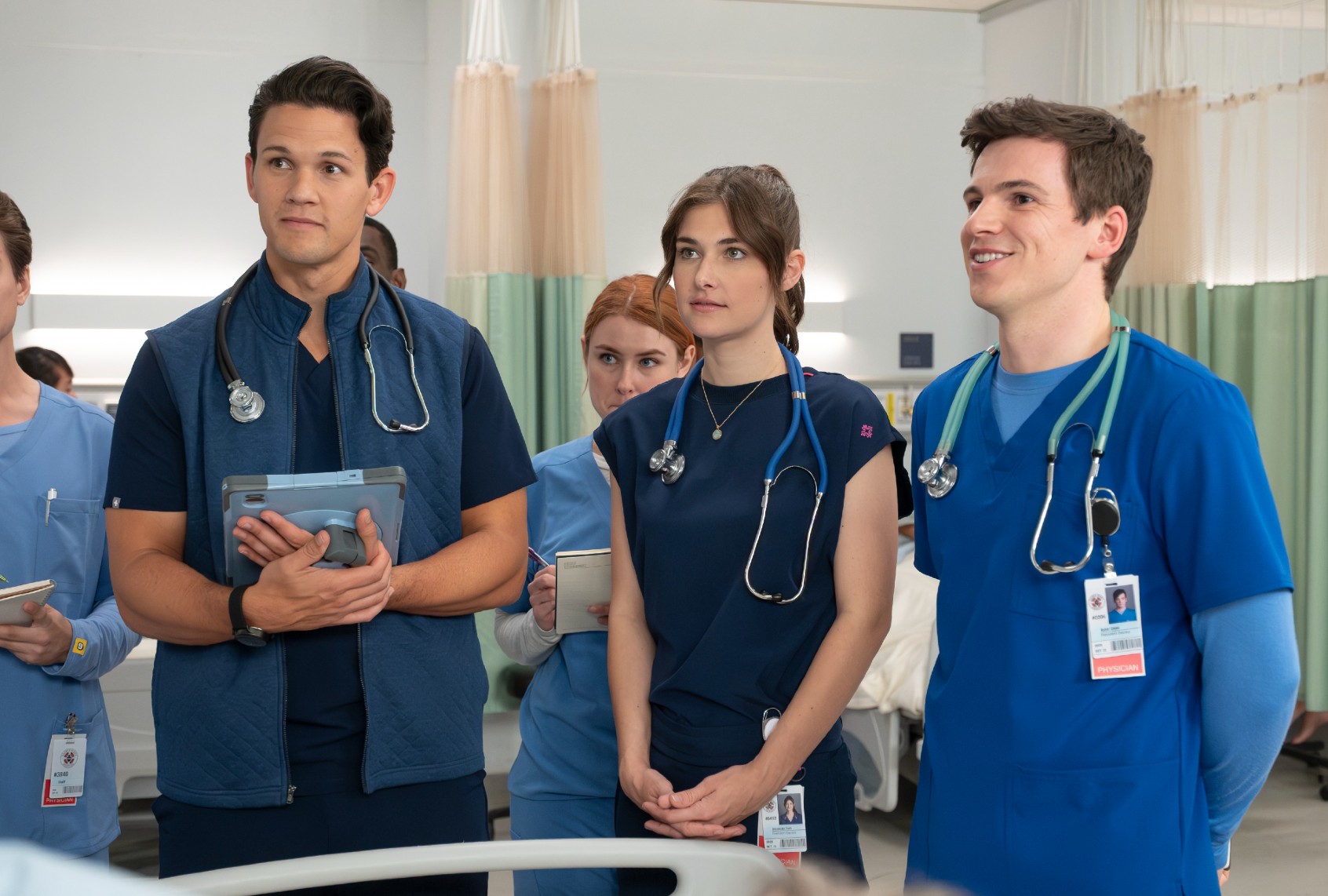
(Disney/Jeff Weddell) David Gridley, Ava Bunn and Jacob Dudman in “Scrubs”
Where “The Pitt” inspires awe at what these doctors achieve with a paucity of resources, time and patience, “Scrubs” lampoons the absurdity of a corporatized medical system steadily grinding down doctor and patient alike.
“Scrubs” being what it is, the joy returns in short order. Realizing that Sacred Heart is where he belongs, J.D. relinquishes his quiet life as a concierge doctor to return to the trenches with Turk, Turk’s wife Carla, the hospital’s head nurse (Judy Reyes), and his ex, Elliot Reed (Sarah Chalke).
However, their wacky little world is no longer what it once was. Anyone who watches “The Pitt” knows that, as do the many who refuse that call – including more than a few medical professionals. When your job requires you to squelch your anxiety while caring for another person’s life and health, the last thing you may want at the end of your shift is to watch a show about a similar workplace enduring one of its most stressful days.
“The Pitt” is a decidedly post-pandemic drama. “Scrubs,” meanwhile, resumes under the spiritual guidance of its creator, Bill Lawrence, the man responsible for two broadly cherished comedies born within and in response to the pandemic: “Ted Lasso” and “Shrinking.”
But Lawrence’s reputation for thoughtfully centering stories about healers and healing in wells of humor began with “Scrubs,” which aired for seven seasons on NBC before moving to ABC for its eight and ninth. Where “The Pitt” inspires awe at what its doctors achieve with a paucity of resources, time and patience, “Scrubs” lampoons the absurdity of a corporatized medical system steadily grinding down doctor and patient alike, zigzagging between J.D.’s mundane narration and the fanciful flights whirling in his brain.
People either love the sitcom’s cartoonish flourishes or despise them. (Or perhaps that was more of a problem when it originally aired and had the poor luck of existing in proximity to shows employing similar conceits, namely “Ally McBeal.”)
For those in the latter camp, there is the standard issue broadcast sitcom goofery of NBC’s “St. Denis Medical.” Even that show doesn’t stray too far from what it’s like to practice medicine in an era when science and certified expertise are vilified, and tempers run short.
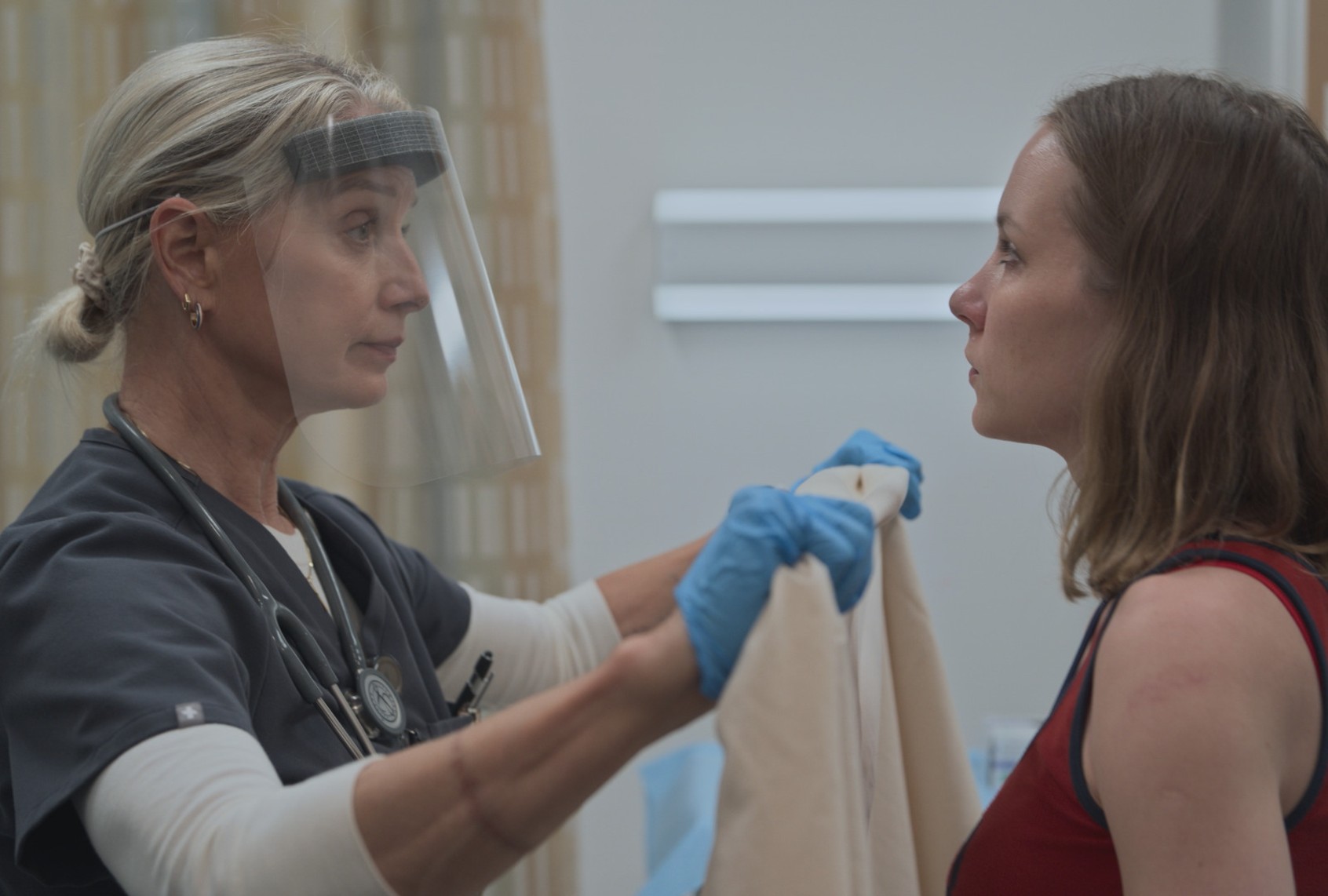
(Warrick Page/HBO Max) Katherine LaNasa and Tina Ivlev in “The Pitt”
In the first season of “The Pitt,” an angry man fed up with waiting for care sucker punches a nurse. But rage spikes in quieter places too, like the Oregon burg where “St. Denis Medical” is set. One episode starts with a doctor bleeding from a gash on his head; he tells his colleagues that he was assaulted on his way into the building.
“Fun fact, healthcare workers are five times more likely to face violence in the workplace,” shares Allison Tolman’s supervising nurse, Alex, in one of the show’s mockumentary-style confessionals. “And there was a state bill to address this, but it failed. On the bright side, they did pass a bill to rename a bridge after Jeff Bridges. So that’s cute.”
Like “The Pitt,” “St. Denis Medical” and “Scrubs” distill the unique relationships between doctors, nurses and patients. It’s just that comedies take sunnier roads to similar destinations.
J.D. and Turk’s interns are green and shallow, but even the social media influencer in their ranks has helpful knowledge to share. The professional rivalries are real, as J.D. finds when his hiring as Sacred Heart’s new chief of medicine gains him a nemesis in Joel Kim Booster’s wonderfully shady Dr. Eric Park. So are the dilemmas created by split-second decisions and the resultant issues rippling outward.
Like “The Pitt,” “St. Denis Medical” and “Scrubs” distill the unique relationships between doctors, nurses and patients. It’s just that comedies take sunnier roads to similar destinations.
Interns must learn how to address their patients carefully and honestly, both out of a sense of empathy and to shield the hospital from legal liability. That’s been true since J.D. and Turk’s first day at Sacred Heart, 25 years ago, when J.D. remarks to himself, somewhat despondently, that the hospital devotes more time to an onboarding seminar on avoiding legal liability than passing along tips on the best patient care.
Perhaps with this in mind, J.D. adopts a more humane approach when he counsels a frustrated charge. “We do the most good we can in a single shift, and then, as hard as it is, we go home,” he says. “That is the job.”
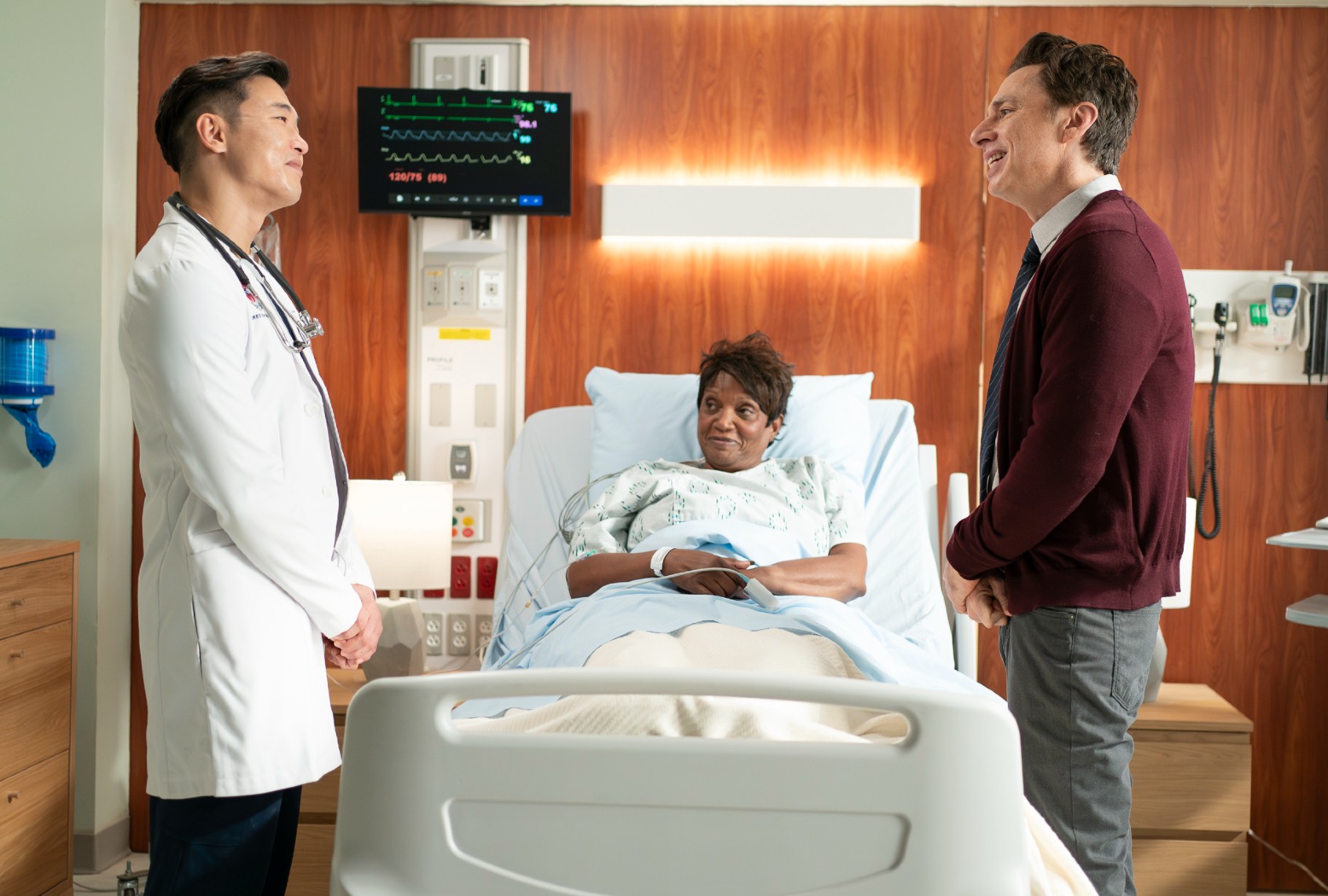
(Disney/Darko Sikman) Joel Kim Booster, Anna Maria Horsford and Zach Braff in “Scrubs”
The personnel we follow in “The Pitt” are archetypes, while J.D., Turk and Elliot are distinct and familiar comedy figures. But that doesn’t necessarily flatten one more than the other.
Every 15-hour shift spent with the Pittsburgh Trauma Medical Hospital’s staff affirms how human these caregivers are. When a recent episode shows its unsinkable charge nurse, Dana (Katherine LaNasa), tending to a sexual assault victim, there’s nothing saccharine about her work. Her apprehensive patient hits a breaking point nevertheless, frantically fleeing the exam room while Dana is procedurally required to remain. And Dana takes that pause to let a sob break through her hard surface. Just for a moment.
We need your help to stay independent
Subplots like this have granted “The Pitt” a kind of cultural essentiality. This week, in fact, New York Times columnist Frank Bruni hailed the second season currently unfolding over a 15-hour shift on Independence Day, calling it a civics lesson.
“Above all, it’s a study of people under intense pressure — as they are when a pulse is fading, or when a nation is fraying — and the importance of muddling through and making things better, no matter the odds, no matter the obstacles,” he writes.
But Bruni easily could have been talking about Sacred Heart Hospital, whose staff vacillates between bridging the compassion gap between medical professionals and patients and managing our expectations. “Scrubs” recognizes that most of a doctor’s hero moments can be tedious, as J.D. observes while languishing on hold with an insurance company. Characters on “The Pitt” and “St. Denis Medical” contend with similar frustrations, demonstrating that needless bureaucracy is bad for everybody’s health.
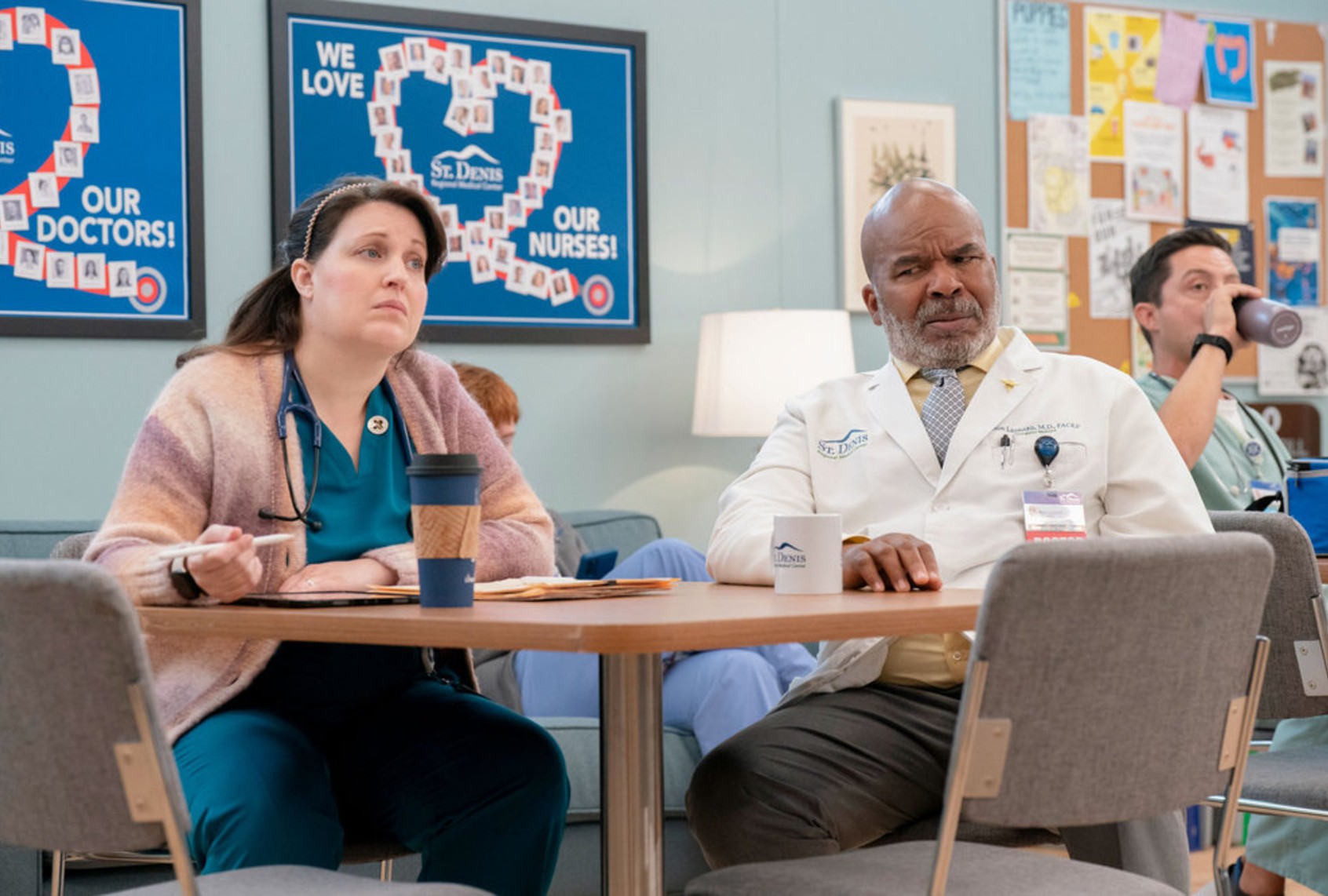
(Justin Lubin/NBC) Allison Tolman as Alex and David Alan Grier as Dr. Ron in “St. Denis Medical”
A quarter of a century ago, J.D. and Turk’s program supervisor, Dr. Kelso (Ken Jenkins), directed them to treat the insured and boot the uninsured. Now that J.D. holds the old man’s job, he faces the fact that insurance carriers struggle to afford the medicine they need, too — and their professional caregivers don’t have time to help them navigate the system. As J.D. explains in one of his signature interior monologues, doctors are required to see five patients every hour to maximize profits. “It can feel a bit . . . mechanical,” he says, lapsing into a frenetic fantasy that pictures his interns as a NASCAR pit crew tending to a gurney-bound patient as if they’re a malfunctioning machine.
Want more from culture than just the latest trend? The Swell highlights art made to last.
Sign up here
This is why “Scrubs” and “The Pitt” have captured the audience – each is, in its own way, a careful examination of how we treat each other. “Scrubs” simply takes more license to find the joy in that as a matter of purpose, since Sacred Heart’s doctors realize they have a duty to fortify the next generation’s outlook, along with that of the audience.
When an intern tells a patient that he believes kindness is the best medicine, J.D. tersely interrupts his blue-sky meliorism with a cold splash of reality. “Actually,” says a straight-faced J.D., “medicine is the best medicine.”
Some also make that claim about laughter, although “Scrubs” proves humor to be more of a coping tool than a cure. But when the American nightmare that is our healthcare system gives us so little to laugh about, that’s enough to see us through.
“Scrubs” airs at 8 p.m. Wednesdays on ABC and streams the next day on Hulu. “St. Denis Medical” airs at 8 p.m. Mondays on NBC and streams the next day on Peacock. New episodes of “The Pitt” stream Thursdays on HBO Max.
CORRECTION: An earlier version of this story gave an incomplete detailing of the series’ network history. The story has been updated.
Read more
about this topic
