
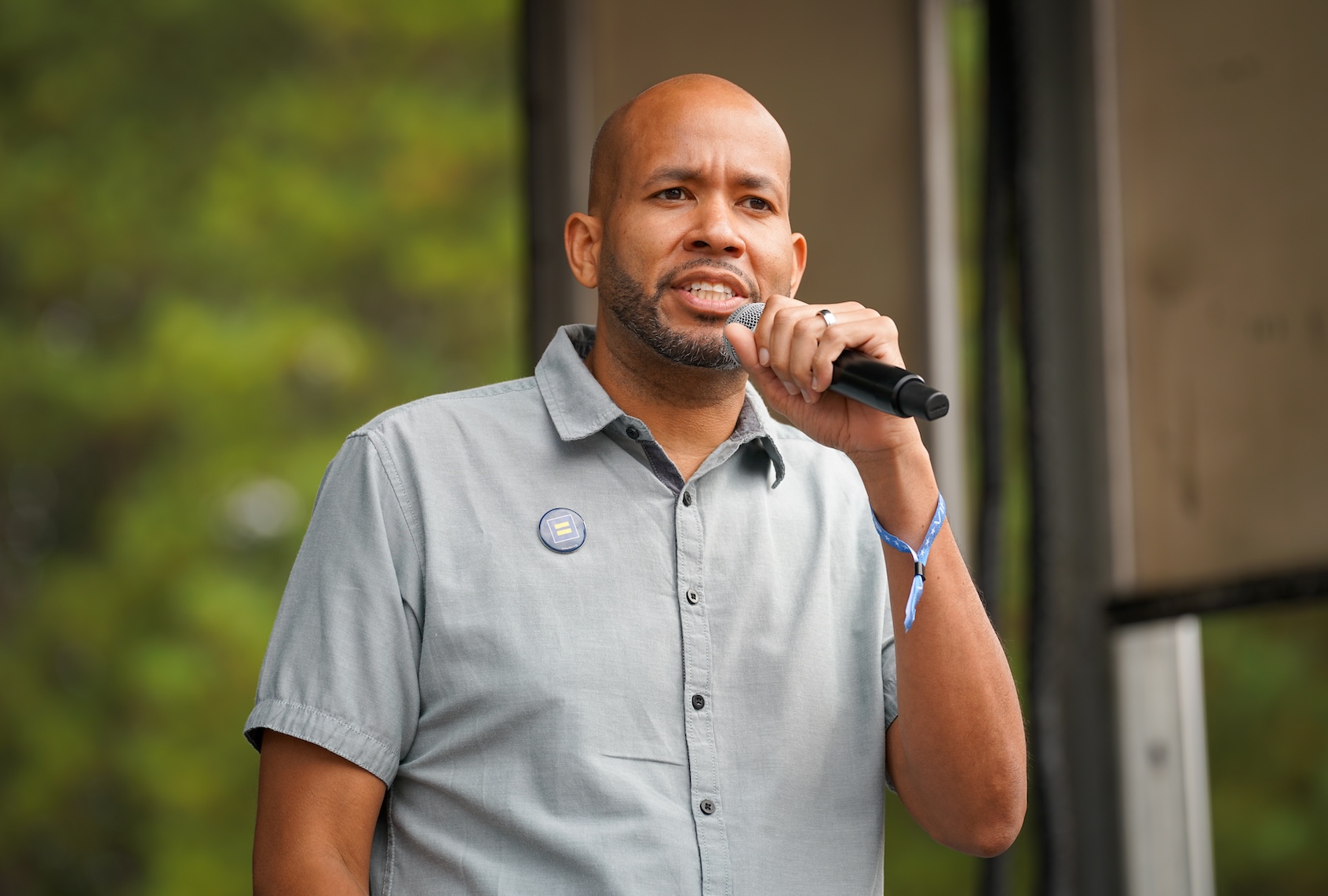

Jason Esteves knows what it’s like to make the most out of very little. The Georgia Democrat watched both his mother and father work two to three jobs at a time to provide for their family throughout his childhood in the ’80s. In adulthood, he climbed his way up through roles as a public school teacher, an Atlanta Public Schools Board of Education member and chair, an attorney and even a state senator, while opening a handful of local businesses with his wife.
Esteves also knows that, these days, many Georgians are struggling to make much of anything as opportunities seem to dwindle; the cost of living on the rise, housing is increasingly unaffordable and healthcare costs mount with no relief in sight. So the Columbus native decided to run for governor to do something about it.
“At the end of the day, I’m running to level the playing field for hard-working people, regardless of who they are, regardless of where they live in the state,” Esteves told Salon. “If you work hard, then you should have the opportunity to thrive.”
In the Peach State’s upcoming Democratic primary on May 19, Esteves also sees himself as something of an underdog, pulling in 14% of voters in a late-March 20/20 Insight poll compared to the just 4% support he netted in an early March Emerson College survey. Still, he remains far behind frontrunner Keisha Lance Bottoms, Atlanta’s former mayor who boasts greater name recognition and 32% of voter support. The ex-state senator is hoping, however, that his grassroots campaign and policy agendas on increased healthcare access, universal childcare, reproductive rights and education will entice the remaining 30% of undecided Georgians to cast their ballot for him.
With the primary expected to result in a runoff election, Esteves is really vying for the chance to face off against Bottoms and ride the party’s nomination into the general election. A Democratic victory in November would mark the first time in more than 20 years that a Republican has not won the governor’s race.
“If you work hard, then you should have the opportunity to thrive.”
Esteves spoke to Salon about his family’s humble beginnings, his slate of plans to improve Georgians’ quality of life, the role he sees the Georgia governorship playing in the future of the Democratic Party and why he’s the candidate best suited to fight for Georgia’s working class.
This interview has been edited for length and clarity.
Let’s start with your campaign slogan and campaign goals: providing health, wealth and opportunity for Georgians. I want to know what that means to you and how that shapes how you have built your run for governor.
What health, wealth and opportunity means to me is the fact that Georgians want us to focus on the issues that matter. At the end of the day, no matter whether you’re Democrat, Republican, Independent or agnostic to politics, what you ultimately care about is that you and your family have access to the healthcare that you need, that you have opportunities to keep and grow the money in your pocket so that you can build your wealth, and ensuring that our children and our grandchildren have more opportunities than what we’ve had.
As I’ve crisscrossed the state, those are the issues that people are focused on: economic issues, healthcare issues, and making sure that we have a brighter future than what we’ve had today. Those are the types of issues that I think that Democrats should be focused on generally because if we give people something in each one of those areas that they can vote for, they’ll get them out to vote, and ultimately, allow us to build the broad-based coalition that we’re going to need to win in a state like Georgia.
I’m glad you brought up the Democratic Party dynamic here, because we’re seeing people look to the party to provide opposition to unfavorable, inflammatory policy and actions coming out of the Trump administration, while also being disillusioned with how the Democratic Party is providing that opposition. If you were to become governor, what role would you see your governorship playing in that dynamic, especially in a state like Georgia, which President Donald Trump flipped in 2024?
People are disillusioned by a politics that is not delivering for them and instead is delivering for billionaires, special interests and large corporations. They think it’s unfair. While we have to fight back against what Trump is doing, at the core, what people actually want is for us to fight for them. They haven’t felt that. They’ve seen billionaires get richer while everyone else is left behind. They’ve seen special interests and big corporations get laws passed to benefit them while, at the same time, we can’t get access to affordable health insurance. What people actually want is a government that is working to solve issues that they have been encountering, not just for years, but for decades. And that’s where Democrats have the opportunity to step in and actually offer solutions, not just give people something to vote against, but give people something to vote for.
Start your day with essential news from Salon.
Sign up for our free morning newsletter, Crash Course.
It’s why I talk about how we can expand access to healthcare beyond expanding access to Medicaid in Georgia, and we can do that by building healthcare hubs throughout the state so that people don’t have to drive more than 45 minutes to get the care that they need. It’s why I talk about the need to expand access to early learning by bringing universal childcare to the state. It’s why I talk about investing in apprenticeship programs and a free technical college system
At the end of the day, what I want people to see is that we can build a better state. We can be bold in a time when people are telling us to make do with less because Georgia ultimately has the resources, and we have the talent. What we’ve been missing for all these years is the leadership that is actually centered in the hardworking people of the state.
What motivates you to advocate so strongly for these working-class Georgians and other underserved voters, in the way that you have? That’s such a huge theme of your campaign, and I want to know if it’s a personal motivation from your experiences, or if it’s from seeing what you have as you’ve been campaigning.
It’s who I am. I’ve been the underdog. I am the underdog in this race, and my parents are working-class Georgians. They didn’t graduate from college. My dad was enlisted in the Army and served for 20 years, and then was an IT administrator after the military. My mom worked a number of service jobs over the course of her life, whether it was as a baker or a florist at a grocery store or working at a customer call center. I grew up watching them work two to three jobs each just to make ends meet, and I’ve seen in a very real way how people work really hard to try to get ahead.
“I’m just not simply focused on Donald Trump. I’m focused on Trump’s impact on our families and in our community, and that’s resonating with people.”
What we’re seeing is that more and more people, who are working hard in this state, are not just failing to get ahead, they’re falling further behind. And it’s because of Trump’s economy. It’s because Republican leaders in this state have put the interests of billionaires and large corporations ahead of the hardworking people of the state. As a result, folks are suffering, and we’re seeing that all across the state and, certainly, all across the country.
It’s also why my campaign is continuing to pick up momentum. I’m just not simply focused on Donald Trump. I’m focused on Trump’s impact on our families and in our community, and that’s resonating with people. The fact that I come from a working-class family and neighborhood, the fact that, even today, as a small business owner, as someone who’s a parent of two young children, I was a caregiver with my wife of a mom with Alzheimer’s — I understand a lot of the challenges that people are facing across the state, and I don’t need a poll or a memo to tell me what those challenges are. I lived them firsthand, which allows me to understand in a real way what the solutions are to those issues. That is what has informed my vision for the future of the state, and that’s why that vision is resonating with people.
I’m sorry for your loss of your mother. I understand that’s a very difficult thing to navigate while also running for governor and expanding your reach in this way.
Thank you for that. It’s a tough loss, but she’s also motivating me because her story is one that other people should not have to go through. I’m working to change circumstances for people like her, who worked hard their entire lives and deserve to grow old with dignity and respect and love and, most importantly, support around her. That was tough because of the crisis that we have with our healthcare system, and the fact that things got even more expensive over time. It made things very tough for her, and certainly made it tough for my wife and me as caregivers. Again, it’s one of those examples of how a lot of the issues that I’m talking about are lived experiences for me.
You say you want to bring a fresh and energetic leadership to the Democratic Party that fights for people like your mom via the policy proposals that you mentioned, but have also talked about overturning Georgia’s abortion ban and ending tax breaks for AI data centers. What does that kind of leadership look like in practice, especially in a moment when people are looking to state and local leaders more in the face of an unyielding federal government?
I think that that administration is one that is laser-focused on delivering, and that means working hard and knocking down barriers that may prevent you from being able to deliver. Whether that’s suing the hell out of the Trump administration to make sure that Georgia is getting the resources that we need, or working with the Trump admin, or anyone in this country who wants to help bring resources to the state of Georgia, I’m going to make sure that I do it. It also means, here in this state, making sure that I’m working with Democrats and Republicans alike to move the ball forward. It’s doing whatever it takes, putting the politics aside and doing the work to actually deliver. That’s what people want to see. They want to see leadership that is actually fulfilling their promises.
Look, Donald Trump is destroying the country. He’s destroyed our economy. But one thing he did teach us well was that when you have a plan, you can actually implement that plan. Project 2025 is something that people are seeing being implemented, and they’re wondering, “If Donald Trump can line the pockets of his family, can line the pockets of billionaires and corporations all across this country, then why can’t we expand Medicaid? Why can’t we have universal childcare? Why can’t I afford to buy a home before I turn 40 years old?”
That’s what people on the streets are saying, which is why we’ve released plans. In addition to being laser-focused on delivering, I also want to encourage accountability. I want to make sure that we are holding ourselves accountable to a plan, and it’s hard for you to tell Georgians where you’re going if you don’t have a plan.
Of those plans, I was particularly interested in your “Black Men’s Agenda.” It seems to reach across so many different parts of your overarching campaign policies: affordability and healthcare, access to education, but also empowering voters, empowering Georgians. What has pushed you to make that such a focus of your campaign?
As a Black man, I understand the fact that Black men felt like they were not being heard in the last election. They’ve felt that way, not just the last election, but for several cycles. They’ve felt ignored, like the stereotype around the Black man was making it so that Democrats were losing sight of what was most important to Black men. I wanted to make it as clear as possible that an agenda that is focused on Black men is an agenda that ensures the prosperity for all of Georgia, and that’s why I thought it was important to lay it out. If you’re anyone in this state that is trying to improve its future, and you read that Black Male Agenda, you’re going to agree with it. Each one of those policy items would ensure that Black men are on track to being able to live to their full potential. At the same time, it’s going to help the broader economy, the broader community, and that means Georgia is going to be a better state.
I should also say that, in the same way that I take inspiration from my mom, I take inspiration from my wife and my kids. As I’m raising a Black boy, I know the statistics for Black boys, and I know the likelihood of being involved with law enforcement. I know the likelihood of not having the same opportunities as everyone else, and I want to make sure there’s a level playing field. At the end of the day, I’m running to level the playing field for hard-working people, regardless of who they are, regardless of where they live in the state. And if you work hard, then you should have the opportunity to thrive. I think that’s what people want, whether they’re Black men or women or anyone else.
You mentioned earlier that as governor, you’d want to sue “the hell out of Donald Trump.” What exactly does that look like, especially given how the criminal trial worked out in Georgia?
I think people’s minds immediately go to the criminal trial, and that’s not where my mind goes. When I say, “sue the hell out of the Trump administration,” I’m talking about filing a lawsuit to stop the ICE detention center from being built in Social Circle, which would triple the population from 5,000 to 15,000 — 10,000 of whom would be detainees. It’s ridiculous, especially because the infrastructure and the water and sewer system in the city wouldn’t be able to handle it.
I’m also talking about suing the Trump administration when they raided the Fulton County elections office and took ballots from 2020. I would have joined Fulton County in suing the Trump administration to get those ballots back and to stop their interference in the 2026 and 2028 elections, which I fully anticipate. So that’s what I’m talking about. I’m specifically laser-focused on making sure that we’re protecting Georgians from interference from an administration that is corrupt and damaging our economy.
You’ve also been a huge proponent of financial and environmental restrictions on data centers, which disproportionately impact working-class southerners, especially in rural areas, because of water and power usage. Why is this such an important issue for you to address as governor?
It goes back to all the issues I’ve been talking about, which ultimately go back to the cost of living and being able to afford to live in a state like Georgia. The data center issue is an affordability issue. In the same way that people are concerned about being able to buy a home, they’re concerned about being able to pay for utilities. They’re concerned about being able to afford to live in communities that are clean and safe — and that’s where the environmental concerns come in.
That concern has come to the forefront across the state. No matter where I’ve traveled in Georgia, rural or urban, people have asked about data centers, and what I hope to do, or what I could do to help make sure that these data centers are held accountable.
We need your help to stay independent.
There will be a plan on my website soon — an agenda for smart data center growth — and it’s going to involve making data centers pay their fair share of utility and infrastructure costs. I’m going to make sure to end taxpayer handouts to these data center companies because they should be built on their own volition. They don’t need the state of Georgia handing out checks that should be going to provide services for people across the state. I want to make sure that we’re protecting our environment and that we’re requiring these data centers to have the latest technology to do so. Then, at the end of the day, I want to make sure that they’re built in communities that want them, which means ensuring that there is local control and that our voices at the local level are being heard during the development of these plants. If all those things are followed, there would be less concern from Georgians across the state.
It’s been a big topic, and certainly one that I’m not shying away from. Not to point out the obvious, but this is one of the things that sets me apart. In addition to the fact that I have the lived experiences that I talked about earlier, the fact that I actually have plans. I’m actually talking to voters about the issues that they care about, and I have plans to address those issues. I want people to see that I actually have a plan to address the issues that they’re most concerned about.
I want to ask you about the path going forward as Georgia gets into the primary and what is likely to be a runoff. Despite being excluded from this recent debate with your opponents — former Mayor Keisha Lance Bottoms, former Lt. Gov. Geoff Duncan, former Labor Commissioner Michael Thurmond — recent polling has placed you as the second most popular among surveyed voters at around 14%. How is this influencing your run for governor now and your appeals to Georgia voters to fall behind you?
We knew that this race was going to go into a runoff because of the number of people that were in the race. We also knew that Georgians were looking for something different. They were looking for a new generation of leadership, one that is laser-focused on delivering results, but also speaking to the issues that people care about. We knew that as long as we focused on those issues and built out a grassroots movement across the state, we would pick up momentum over the course of the campaign, and that’s exactly what we’re seeing. This is not something that’s happened in the last few weeks. This is the result of a year of work, of building out a grassroots organization that is focused on people.
The plan is to make the runoff, and in the runoff, Georgians are going to be looking for the candidate who can win in November, and that’s the candidate that does not have the baggage that my opponents have, and it’s the candidate that is offering Georgians something to vote for, not just something to vote against. I’m confident that in the runoff, I’ll be able to consolidate support amongst Democrats and move on to the general election, where we will be facing one of two out-of-touch billionaires.
Read more
about Democrats
