
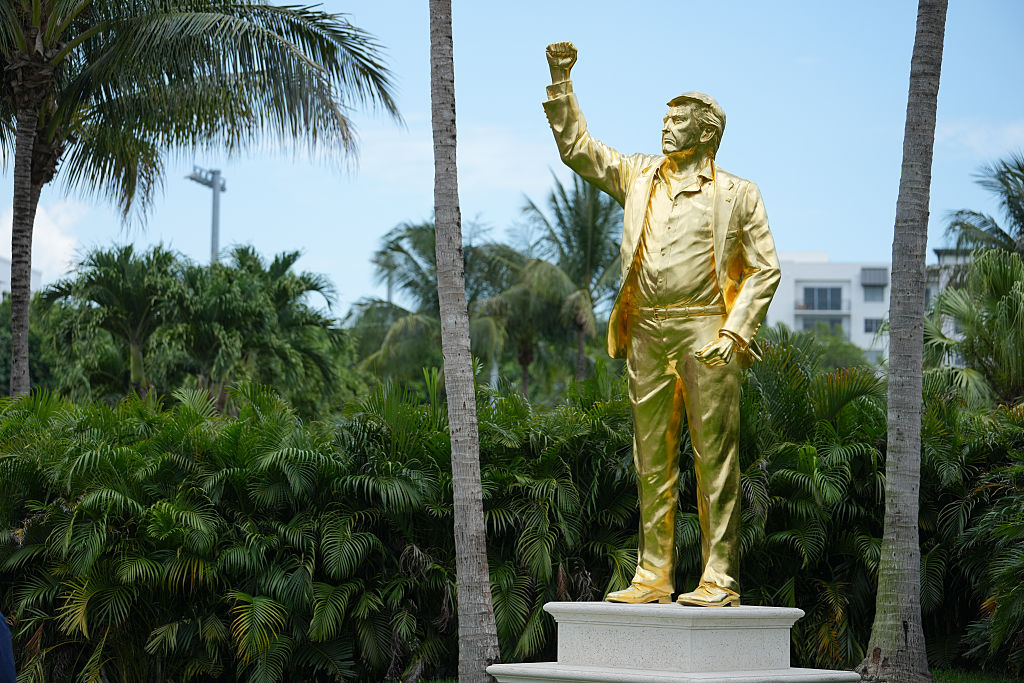

A newly unveiled 22-foot gold-colored statue of Donald Trump at Trump National Doral in Florida is reigniting a familiar debate surrounding the former president: when does political branding begin to resemble religious symbolism?
The statue, which quickly drew online comparisons to the biblical “golden calf,” has sparked criticism from some Christian commentators and religious writers who argue that the imagery surrounding Trump increasingly blurs the line between political loyalty and personal reverence. One report from a Christian news outlet notes that critics questioned whether the display reflected a broader culture of political idolization surrounding the president.
The controversy also revived memories of the now-infamous gold Trump statue displayed at Conservative Political Action Conference in 2021. That sculpture — showing Trump in sandals, shorts and a suit jacket while holding a wand-like object and Constitution — immediately generated “golden idol” comparisons across political and religious media.
What makes the symbolism particularly resonant is that gold has long occupied a central place in Trump’s public image and aesthetic mythology. From the gold-heavy interiors of Trump Tower and Mar-a-Lago to the abundance of gold fixtures, gold décor and lavish redesign ambitions of the White House and proposed ballroom expansions, the visual language surrounding Trump consistently emphasizes wealth, spectacle and grandeur.
For supporters, that imagery often represents success, dominance and aspirational luxury. But for critics, especially within Christian circles, it can evoke something darker: excess, vanity and the visual aesthetics of worship itself.
One of the greatest honors of my life was leading the dedication of President Donald J. Trump’s statue to the world.
What amazes me is how quickly some people have compared this beautiful statue, created and made possible by more than 6,000 patriots, to a golden calf or idol… pic.twitter.com/p8myp46dD5
— Pastor Mark Burns (@pastormarkburns) May 8, 2026
The latest statue controversy also arrives amid a broader wave of digitally amplified Trump iconography online. In recent weeks, AI-generated images depicting Trump in quasi-messianic or heroic roles, including widely shared posts portraying him in savior-like imagery, have circulated heavily across pro-Trump social media spaces, further blurring the line between political branding, internet meme culture and religious symbolism.
Start your day with essential news from Salon.
Sign up for our free morning newsletter, Crash Course.
That tension reflects a broader divide inside American Christianity during the Trump era. While many evangelical leaders remain among Trump’s strongest political allies, others have increasingly warned that elements of Trump-centered political culture risk transforming faith into partisan identity.
Modern political mythmaking now happens collaboratively between politicians, supporters, influencers and AI-generated visual culture. The repeated use of gold imagery only intensifies those concerns because of the symbolism gold carries historically and biblically: kingship, permanence, divinity and power.
Whether viewed as branding, spectacle or political theater, the recurring Trump statues reveal something larger than décor. They reveal how modern political movements increasingly rely not just on policy or ideology, but on mythology, symbolism and carefully constructed visual identity.
