


Lorne Michaels isn’t the funniest person at “Saturday Night Live.” But he’s likely the greatest incubator of comedic talent in TV history. And for more than five decades, his real superpowers – editing, producing, channeling anarchy into 90 minutes of live television, surviving in the same time slot since 1975 – have been on display at 11:30 p.m. most Saturday nights.
Michaels, both controlling and reticent, has never opened up like this, and Morrison has talked to hundreds of “SNL” cast members, writers, hosts and more.
Perhaps no show has launched more never-ending debates: When the show was truly great, when the show stopped being funny, whether there’s anything worth watching after Weekend Update and before the truly weird sketch comes on at 10 of 1. The best cast, of course, tends to be your first. It’s never as good as it was when you needed your parents to stay asleep during the local news so you could watch way too late. Maybe that’s just me. But probably not. The catch phrases lodge in your brain, like it or not. The clips boomerang around the internet and get analyzed and recapped for everyone by Sunday morning. Podcasts, good hangs, and Late Night shows feed a never-ending amount of backstage drama and tales of never-seen sketches.
And from Chevy Chase through Michael Che, it’s been Lorne Michaels at the helm for almost every cultural-defining moment. Susan Morrison’s new biography of the “SNL” creator, “Lorne: The Man Who Invented Saturday Night Live,” places Michaels into the same single-name pantheon as his pals Mick and Paul. It is newly arrived in paperback, and a perfect summer page-turner.
Morrison, a longtime editor at The New Yorker, was a young production assistant on one of Michaels’ few failures: the short-lived “The New Show” back in 1984, during his five-year hiatus from “SNL.” It’s a magnificent book: Michaels, both controlling and reticent, has never opened up like this, and Morrison has talked to hundreds of “SNL” cast members, writers, hosts and more. She also spent a week embedded behind the scenes with the show, tremendous access which not only cracks open the mad quest for 90 minutes of live comedy, but helps anchor the book in the current moment as much as 1975.
The Lorne that emerges is one with many superpowers: Discovering talent, yes, but also surviving the years and the weeks when it doesn’t launch — managing creative egos. But perhaps most fascinating is that this is someone who imagined his own life, and then created it, a young Canadian teen obsessed with how comedy works who pulled himself up to the center of the culture, cultivated the good life with celebrity friends, and built and sustained one of the enduring institutions of American culture.
Morrison and I spoke in a loud bar at the Tucson Book Festival. This interview has been edited and condensed.
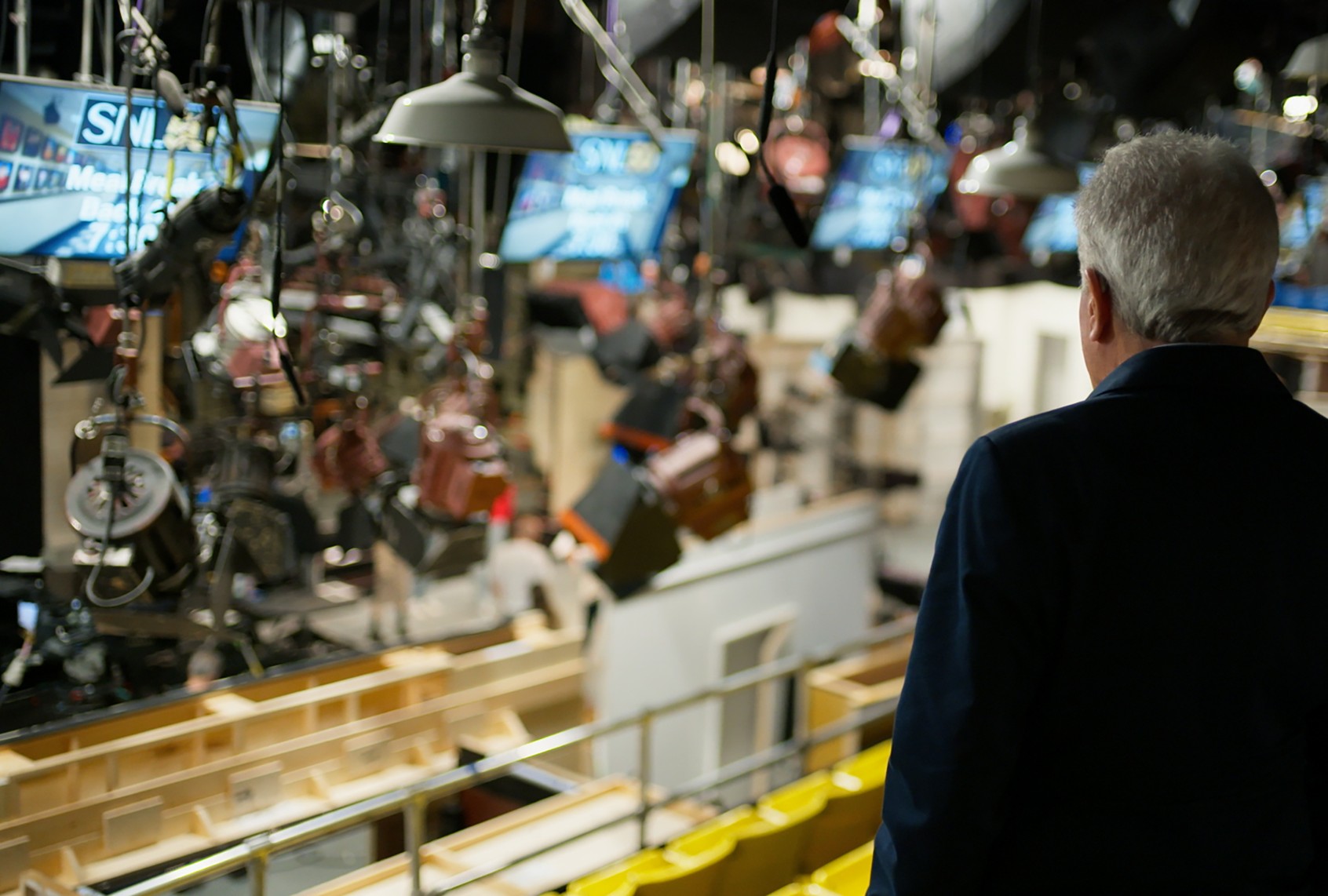
(Focus Features) Lorne Michaels stars in director Morgan Neville’s documentary “Lorne”
Lorne Michaels has spent his career creating comedy that felt anti-establishment and countercultural. He cares about cool. Yet he also became extraordinarily adept at navigating and thriving within giant corporations. When NBC got bought, he could keep the new Comcast CEO waiting outside his office. How does he flourish in both worlds?
A lot of it goes back to his early years at the Canadian Broadcasting Company. The CBC in those days was a bit like a boot camp for television. It was rather small but also egalitarian. If they gave you a show, they also expected you to do everything. You had to worry about budgets, deal with lawyers, manage crews, rent the studio, budget the carpentry hours, handle costumes. You learned every aspect of the business.
It’s similar to what happens with certain writers at “Saturday Night Live.” People think of them as comedy writers, but many of them end up learning how to run things. That’s one reason so many former “SNL” writers become showrunners.
He’s this child of ‘60s culture, with this original superpower of being able to fit into very square rooms and be heard.
Right, he had this kind of preternatural skill at knowing how to talk to the suits, how to seem levelheaded, how to pretend to be cool and calm, even when he was freaking out inside. Early in his career, he would stand on the studio floor clutching a glass of white wine during the show because it projected an image of nonchalance. It wasn’t real. It was almost a performance of composure.
Not to be too Freudian about it, but his father died when Lorne was 14, and for much of the rest of his life he gravitated toward older men who became mentors or father figures. He was comfortable around them. He knew how to listen to them and how to learn from them. By the time he arrived in Hollywood, he could walk into a room full of 50-year-old executives and make them feel comfortable while still getting what he wanted. I do think that facility ended up serving him incredibly well when he found himself dealing with GE and Comcast executives.
Want more from culture than just the latest trend? The Swell highlights art made to last.
Sign up here
It’s not just the CBC: It’s as if every stop he makes along the way contributes to the creation of “SNL” long before the show exists.
That was one of the most enjoyable discoveries of writing the book. I almost felt like this life was like a Victorian novel, and every single thing he did along the way offered an opportunity for him to learn some important lessons. When you look back at all of these seemingly random jobs, every one of them teaches him something that later becomes part of “Saturday Night Live.” A good example is his time working with Phyllis Diller. The producers were struggling with how audiences perceived her. She was a famous comic figure, but they wanted to make her approachable. So they created interview segments where she would sit down with guests and talk to them in a more personal way, these fireside chats.
Lorne paid attention to that. Years later, when “SNL” developed its opening monologue, it served a similar purpose. The monologue isn’t just a comedy segment. It’s a way of humanizing the host, whether it’s Adam Driver or Kevin Costner.
You show how his childhood contained many of the ingredients that would later define his life. His grandparents run an arthouse theater. His high school girlfriend’s father is on the Ed Sullivan Show. He attends lectures at the University of Toronto by Marshall McLuhan.
Absolutely. One of my favorite stories involves his grandparents. They owned a movie theater, and Lorne has vivid memories of sitting around the kitchen table while the adults talked about movies and movie stars. They would discuss people like Humphrey Bogart or Spencer Tracy as if they were familiar figures in their lives. As a child, he almost imagined these people were family friends.
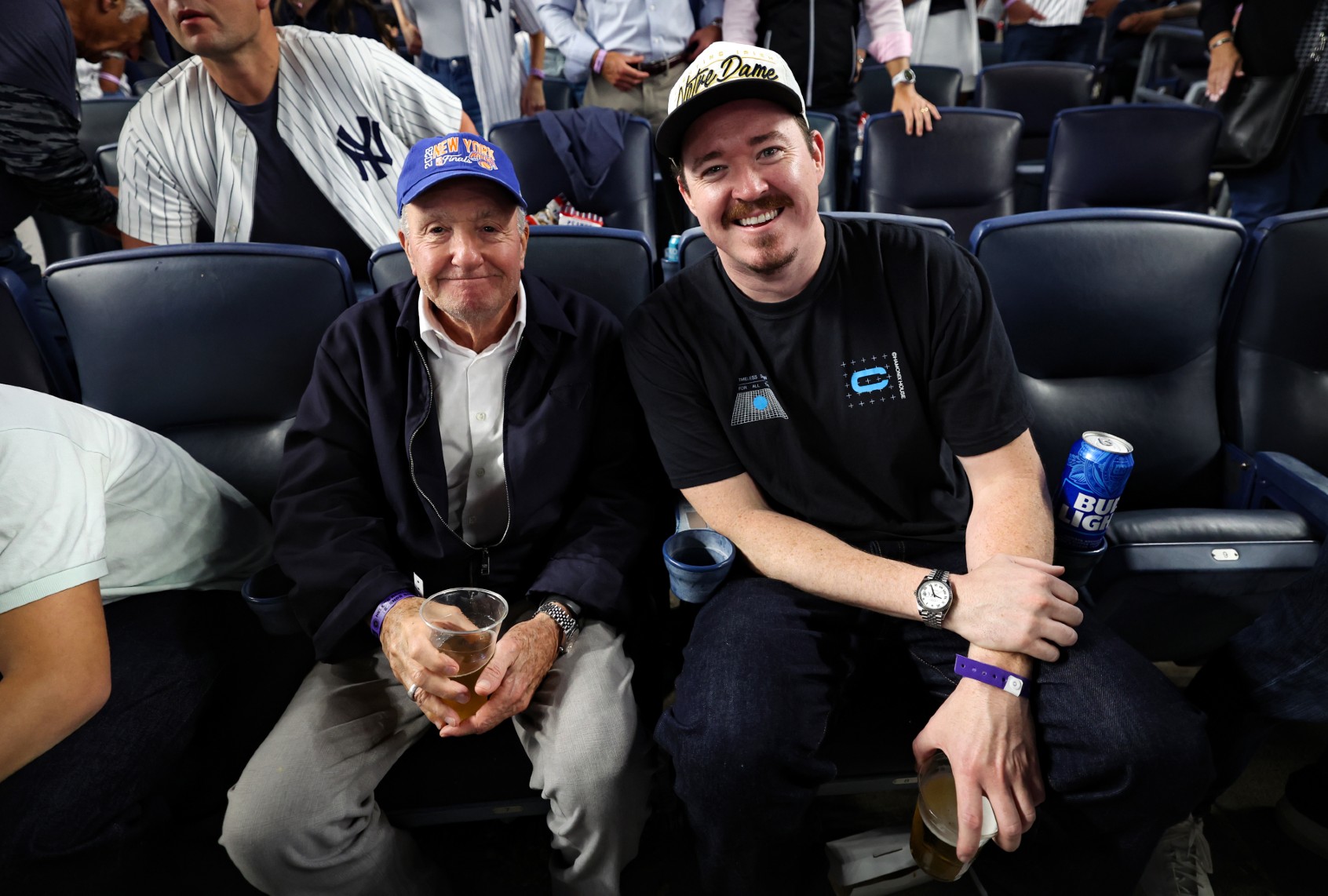
(New York Yankees/Getty Images) Lorne Michaels and Shane Gillis attend the game between the Chicago White Sox and the New York Yankees at Yankee Stadium
McLuhan’s theories about how different forms of media evolve almost help him formulate what would become “Saturday Night Live” many years earlier. He’d take the variety show, this most traditional format, and modernize it.
Yes, he was so wedded to it, this idea that different, new mediums liberate the ones that come before. When he got into television in L.A., rock music is the Stones and The Beatles. The movies are Scorsese and Robert Altman. But television was this weird backwater stuck in the ‘50s, and it was written by guys from radio. He had this faith it could be something else. The line he liked to use is that he wanted to put new wine in old bottles. He wanted to take this ancient format of variety television and bring it up to date with sex and drugs and rock ‘n’ roll. And he pitched this for years, and everyone just looked at him. They had no interest. But again, I think that working at all those different shows that weren’t that good, and certainly were unhappy, each one taught something else.
“The line he liked to use is that he wanted to put new wine in old bottles. He wanted to take this ancient format of variety television and bring it up to date with sex and drugs and rock ‘n’ roll.”
When NBC’s Herbert Schlosser offered him this gig, he almost didn’t take it because he liked L.A., but he was immediately at home in that boardroom of 50-year-old NBC executives. I think a lot of other people who were 30 years old would have probably come in and just either sweated it or been patronizing. He just knew how to play them. Even when they made stupid suggestions.
Bob Hope will host the first episode of this cool new show with musical guest the USC Marching Band.
Right, this is what Tina Fey’s pilot of “30 Rock” was based on: The vice president of television and microwave oven programming. He did shield amazingly creative people from all of this.
The kid from Toronto imagined this entire amazing life and then created it for himself.
Right, he eventually became exactly the adult who would inhabit that world. The idea that this kid around the kitchen table would then grow up to be the person who walks around talking about Jack and Mick and Paul. He became the person who could call celebrities, assemble casts of stars, and create these huge social networks.
There was also another dynamic that I think mattered. His immediate family was comparatively modest. His father was a furrier. His mother was a real Philip Roth Jewish mother. But he had uncles, aunts and cousins who lived in a much fancier part of the city. They were wealthier, more glamorous, more socially polished. They lived in a different part of Toronto and represented a different world.
I suspect that from a very young age he wanted to be part of that world. He did spend a lot of time with them, especially after his father died. When I look at the community he ultimately built around himself – the performers, writers, producers, actors, and friends who became his extended family – it feels like a continuation of that impulse. In many ways, his life has been spent constructing a tribe.
We need your help to stay independent.
The story of his father’s death is particularly heartbreaking. It would be easy not to recover from that. Tell us about this tragedy.
I think it was enormously important. Lorne doesn’t have a huge number of distinct childhood memories, but he did really vividly describe this.
He had broken curfew one night. His mother was furious and goaded his father to discipline him. Lorne and his father had a serious argument. By all accounts, that wasn’t a common occurrence. His father was generally a mild man. That night his father collapsed and was hospitalized. The kids weren’t allowed to visit him. They were told he was getting better. Then, two weeks later, he died. Lorne never saw his father again. That definitely instilled in him this fear of confrontation, fear of any kind of high emotions. He rarely raises his voice. He often delegates difficult conversations to trusted lieutenants. At one point in my notes I wrote, “This is a man who never uses exclamation points.”
“This is a man who never uses exclamation points.”
What’s interesting is that this restraint ended up serving him well. Many people who worked for him describe desperately wanting his approval. Because praise was relatively rare, it carried tremendous weight. That coolness reads as withholding to a young person, and they would work harder. They desperately want to please him. I don’t think that was necessarily calculated. But it became part of how he led people.
He has, of course, become that father figure and mentor to generations within American comedy. But you’d argue that Lorne’s all-stars have succeeded just as much because of these lessons about how to lead and move within these worlds that have allowed them to build mini-empires of their own.
When you talk to former cast members and writers, they certainly talk about learning comedy. They learn how to write sketches, how to pitch ideas, how to survive in a room full of talented people. But it’s not just a comedy education. Amy Poehler and many others described “SNL” almost as a finishing school. You learn how to walk into a room, how to command attention, how to be effective in a meeting and get what you need. You learn how to handle yourself professionally. Not to lose your sh*t.
Judd Apatow once told me how when he was in his 20s, he was a showrunner for “The Ben Stiller Show.” He sat in his office reading “Management for Dummies.” He had no idea what to do. He had a staff to manage! A comedy staff! That’s not easy. Lorne teaches them. That is something that I don’t think anyone is getting in Hollywood from anyone else.
Sometimes the advice is practical. Sometimes it’s old-fashioned. As he became older and richer, the advice evolved, but the principle remained the same. He was always trying to teach people how to build a good life. One of his famous Lorne-isms is, “Buy a more expensive apartment than you think you could afford, because you’ll come home from work and say, ‘I get to live here.’” A lot of them really appreciate it.
But not everyone. There are a lot of quotes from alums in the book where you read between the lines and wonder, “Does this person like him?” I think we’ve all had those difficult bosses, where you go out with colleagues and spend all of lunch talking about them. Is there affection there? Warmth? The relationships seem unusually complicated.
They are. I think there are several categories. There are people who absolutely genuinely love and revere him. He’s always had pets. John Mulaney. Fred Armisen. Tina Fey. Pete Davidson. Jimmy Fallon. These are people who learned from him and remained close to him. It tended to be students of comedy, too, people he can talk to about Jack Benny and Tom Lehrer.
Then there are people who had a much more difficult experience. Working at “SNL” is brutal. You’re sleep-deprived. You’re competing with your friends. They thought Lorne was this as*hole, this old guy. Why is he deciding what’s fun? It’s not surprising that some people leave angry.
What’s interesting is what happens later. Again and again, I heard stories from people who spent years thinking Lorne was impossible. Twenty years later, they’ve grown up; they’re directing a movie or running a production company. Suddenly they understood. Many of them eventually come back and say some version of, “I had no idea how hard your job was, managing all these crazy people.” He gets a lot of those letters and visits, that are like people making amends.
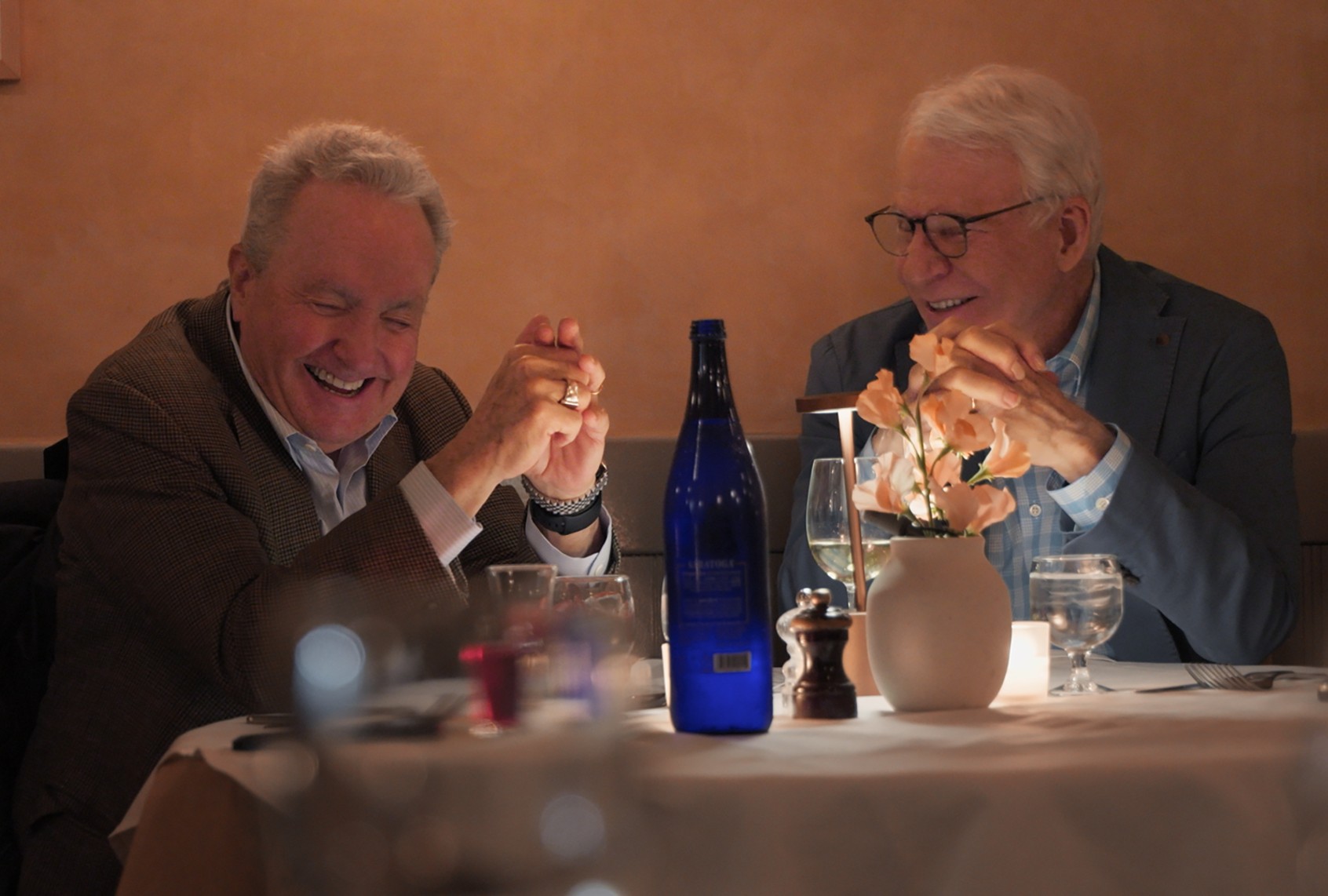
Lorne Michaels and Steve Martin in director Morgan Neville’s documentary “Lorne”
It sounds as if you became almost a celebrity therapist as you were reporting this.
People would often begin interviews by saying, “I don’t really have that many Lorne stories.” Then three hours later they were still talking. In some cases they were crying. I don’t mean one or two people. It happened repeatedly. Part of it was gratitude. Part of it was nostalgia. But I think part of it was that “SNL” is emotionally intense in a way that’s difficult to explain to outsiders. It’s exhausting. It’s exhilarating. It’s terrifying. People often compare it to a family, but it’s also a little like a cult. Everything is organized around one person’s approval. That leaves a mark.
You spent a week inside the show while reporting the book. What did you learn about how the show comes together, and what happens behind closed doors that you couldn’t have learned from interviews alone?
I had heard stories for years, but spending a week there allowed me to feel the pressure physically. Every day the stakes rise. Every day more material gets cut. Every day people become more anxious. It’s “The Hunger Games.” By Saturday, it genuinely feels like a survival competition. One performer described the worst possible outcome: working all week, staying up all night, writing sketches, rehearsing constantly, and then discovering on Saturday night that you don’t even need hair and makeup. You’ve been there through all the long nights, and you’re not on the show. That can happen more now, because the cast is so large.
What else did it show you?
Well, it made me so aware of Lorne’s emotional intelligence. The biggest revelation was just how much of his job is about managing people. Really seeing how engaged he is. I knew he was like that with the network. But to see him moving the levers and pushing buttons was fascinating. Watching him work was like watching someone perform a kind of social Jiu-Jitsu.
“Watching him work was like watching someone perform a kind of social Jiu-Jitsu.”
One thing that surprised me is how democratic the process appears throughout the week. Lorne wants people to talk. He goes around the room soliciting opinions. He encourages younger staff members to speak. He wants writers, performers, producers, everyone, to participate. Partly that’s because he’s curious. But it’s also because participation creates investment.
Yet “SNL” isn’t actually a democracy.
Not at all. And that’s the fascinating part. For most of the week, the process feels collaborative. Then Saturday arrives. After dress rehearsal, everything changes. Lorne gathers all the information. He listens to audience reactions. He hears feedback from producers and writers. He absorbs every opinion. Then he walks upstairs to his office. And suddenly the collaborative phase is over.
The image that stayed with me came from watching “Severance” with my daughter, who works on the show. There’s that elevator where one reality ends and another begins. That’s what it felt like. Lorne goes upstairs and becomes a completely different figure. He’s up there, and it’s all him. No more discussion. No more brainstorming. He barks orders. Now it’s cut three minutes from this sketch. Move that piece later. Lose 32 seconds here. Change the order. She needs a different wig. Boom, boom, boom. Decision after decision after decision. It’s remarkably decisive.
The whole week he has metabolized all these people’s opinions, but then he’s like a general. You really see this change, and yet it doesn’t feel capricious because he has been listening the whole time.
One of the things you suggest is that Lorne’s real genius may be less about comedy than judgment. The show goes on at 11:30, ready or not.
I think that’s exactly right. Jim Downey has a wonderful observation about this. He says that Lorne is someone who always excelled at deadlines. Some people are better at term papers. Some people are better at exams. Lorne is great at exams. He becomes sharper as the deadline approaches. The pressure focuses him. That’s one reason “SNL” works and so many other comedy projects don’t. The deadline is non-negotiable. At 11:30 Saturday night, the show is going on the air.
Something I’ve always wondered: Lorne always thought movies would be his destiny. He wanted to make “The Graduate.” Why didn’t those Hollywood years work? Is it frustrating to him that he didn’t make it in Hollywood, or make a movie that stands above an “SNL” spinoff?
He tried. After the first five years of “SNL”, when he did the hiatus, he basically thought the TV part of his life was over. Now I’m going to do my Mike Nichols thing. And he had to deal with MGM. He was working on an adaptation of “Pride and Prejudice.” He optioned Don DeLillo’s “White Noise.” He wanted to make those kinds of movies. The MGM thing blew up because they were off the rails. What Lorne didn’t realize is what Hollywood wanted from him at that point was a boffo “SNL” movie. They wanted “Animal House,” and he thought he was entering his auteur period.
This is the one period of failure. Hollywood doesn’t happen as he hoped. “The New Show” on NBC doesn’t play to his strengths and costs him millions. And meanwhile, “SNL” lands in an awkward creative moment without him, and NBC essentially says in 1985 that they will cancel it – unless he comes back.
He had this proprietary interest in “SNL” as his baby, but if you think about the mindset of most Hollywood players, it’s always bigger, faster, more. The kind of courage and self-knowledge that it must have taken to sort of go backwards. He told me that he asked two people for advice. He was trying to figure out whether to do back, because something about it smelled wrong to him. He didn’t want to look like he was going back with his tail between his legs. David Geffen said, “No, no, no, you should not go back. Somebody who wants to be you should have that job.”
Lorne has a great response: “But I like being me.”
Then he went to Mo Ostin, a wiser, older guy, very practical, who said, “Look, there aren’t very many big showbiz jobs in New York City. You love New York, you’re good at this job. There’s no reason not to do it.” And it kind of gave him the permission to go back.
It must have been difficult for him, though.
I think it probably was. But then you remember . . .
That first year back was also famously difficult from a talent perspective . . .
A disaster. But another thing about him going back . . . I met Lorne around that time on “The New Show.” I was too young to really have a wide shot on that situation. But he lost tons of his own money. He was a producer. He had to remortgage his apartment. He was getting divorced. He needed a job. And so the idea that he experienced that kind of low ebb at that point in his career, I think, is interesting. That’s another reason that he went back. Also, he just realized, “This is what I’m good at.” And yes, he did have this particular misfire that first year.
What deserted him that season? Everyone says your favorite era of “SNL” is when you were in high school. Well, that was high school for me, after getting on board with the Eddie Murphy era cast, and then the Billy Crystal/Martin Short cast. Those casts had their moments, but wow, even at 15, we knew this first season back was awful and not funny.
Al Franken told me that when he was in the Senate, Marco Rubio would come up to him: “What the fu*k happened that season?” Everyone who loved “SNL” knew. Lorne hired these young actors. They were 17.
Anthony Michael Hall, off the John Hughes films.
Right? They couldn’t do a sketch about the Senate because no one looked old enough to play a senator. NBC was about to cancel the show. And Lorne’s agent said to NBC, “You begged him to come back, you can’t do this to him.” They had to get another chance. But you think of Lorne as so unflappable and powerful. There were these moments when he was really wobbling. Then he did go back and pick one of the great all-time casts with Phil Hartman and Jan Hooks and Dana Carvey, and it was right back again.
Would you say he’s overly dismissive of criticism that the show isn’t funny, or what have you, not edgy enough, simply because he has heard it all before? Even when the criticism is often right?
From the very beginning, he would take the most negative reviews or the silliest things from standards of practice and post them for everyone. I think I say somewhere in the book that he responded to criticism from the network like a driver turning into a skid. He has been through every controversy. He’s been accused of being too liberal, too conservative, too edgy, too cautious, too political, not political enough. If you’re running a live comedy show for 50 years, eventually everybody gets angry at you. The only time it ever really was a problem for him was in the mid ’90s, when for the first and only time, to generalize, the critics and the network executives were in agreement that the show was down.
This is when Don Ohlmeyer, famously a friend of OJ Simpson, comes after Norm Macdonald on Weekend Update, and also for Adam Sandler.
Lorne’s always saying everyone in Hollywood has two jobs: their own job and criticizing “SNL.” But at that time it created a problem because you had these critics and these NBC executives; they were riding high because they had “Seinfeld,” they felt like they were geniuses.
“Lorne’s always saying everyone in Hollywood has two jobs: their own job and criticizing “SNL.'”
They meddled, and they used the press as a weapon. That’s when they made him fire Adam Sandler. And even that is such an interesting lesson in Lorne’s survival. Somebody else might have made a stand, kicked and screamed, said, “If they go, I go. ” He’s always known that if they take you off the air, you’ve got nothing. We were talking earlier about the things he learned as a younger man in Hollywood, but he revered “The Smothers Brothers.” He wished he worked on “The Smothers Brothers” because they were so much cooler than Phyllis Diller.
But they took on a stand on Vietnam, and CBS cancelled them.
They made themselves martyrs. They lost their show. They get to be in the textbooks, but they didn’t get to be on the air. Lorne’s just always known when to keep your head down. Of course, even after that nightmare, less than two years later, Ohlmeyer called him and said he was wrong about Sandler.
And wanted an early screening of “Billy Madison” for his family!
And that ability to just not freak out goes back to his dad and the non-confrontational approach to everything, just waiting it out. There are definitely times when I was working on this book that I thought this could be a Harvard Business School course in how to manage. I learned so much working on this book about management. I hadn’t thought about it so much in the beginning, and this is not remotely to compare myself to him, but our enterprises have a lot of similarities. We’re wrangling a lot of very needy creative egos. We have to say no a hundred times a day and still keep people motivated on weekly deadlines.
Let me back up a little – how does his reaction towards criticism handle how he’s dealt with Donald Trump, both as a host and as a target of jokes? Because I think there were fair criticisms that having him on to host in 2016 helped normalize Trump, some from cast members and alumni, and Lorne basically brushed them aside.
I remember being over there when he had Trump on in 2016; I think I was talking to him in his office a week or two before the show. He was really angry then that people were criticizing and judging a show that hadn’t even aired yet. I’ve never heard him say that he regretted having Trump on. I do know that some of the younger people on the staff felt that having Trump post-normalized Trump by letting him be in on the joke. I mean, it’s hard for me to think that’s anything “SNL” could do after all those years of “The Apprentice.” Trump was already normalized.
I did feel like over those years of the Trump Administration, I saw him bend his own instincts sometimes just because he knew that he needed to let his staff feel that they had ownership and power. And one of the chapters I really enjoyed writing was very complex, but I think really interesting, is about the show right after the election when Kate McKinnon opened the show.
With Leonard Cohen’s “Hallelujah,” as a piano dirge. That garnered mixed reactions.
Yeah. Most of the old timers didn’t like that. They felt like it’s not what we do, but I think Lorne also recognized these are the people who work here. I want them to feel seen and heard and to do what they feel they need to do. He kind of rolled his eyes. He didn’t love it, but they got through it. I know people who just thought that was a genius cold open. I didn’t like it, but a lot of people loved it. I think he allowed it to happen because he understood what his staff needed emotionally that week.
A few more quick things that fascinated me: He met with Woody Allen in the 1960s to try and sell jokes, and there are tape recordings of this meeting!
I wished I could have used that in some audio capacity, right? There’s an hour. I only used a little bit of it. I thought it was so interesting. What’s interesting is you can see that the nascent Lorne personality is there. He’s definitely being deferential to Woody, and yet he’s pushing him.
His moves are possibly the inspiration for the Elaine dance on “Seinfeld.”
Yes! I was interviewing Jerry Seinfeld for The New Yorker when I was working on the book, and I read a couple of the behind-the-scenes books, and talked to some “Seinfeld” writers.
He tried to get rid of something that still makes me cringe: Conan’s nipple dance.
Yes. His note was: “Why are you doing this?” It’s interesting that he gave the note . . .
Is it really the case that “SNL” staffers have therapy on Mondays?
The person who told me said that a whole lot of them do. Because that’s the one free day of the week.
So everybody comes into this insane workweek having just been in therapy, complaining about work.
I love the image; just think about the clouds of psychic energy and all these people all over the city talking about Lorne and the show, trying to figure it out.
Doesn’t anyone say, Hey, this isn’t 1977 anymore? We have kids. We’re not doing cocaine like John Belushi. Can’t we come in at 9 a.m., turn this around, and do a normal day? It seems to work for the late-night shows.
There are people who say, Why do we this? It doesn’t happen because the show just started following Lorne’s schedule. People used to say they could use the down weeks to get sketches in the can, but they don’t do that. They take it off. That’s part of Lorne’s philosophy of leisure. But he has codified these things. He’ll say, “Fatigue is your friend.” That’s an explanation for why they should be working at three in the morning. You’re punchy, you’re loosened up, you’re not being so edited or controlled.
Well, he’s made it last for 51 years. And he’s not going anywhere. Let’s leave it here: How has he made something that has endured across decades and generations? Love it, hate it, no matter how cool or relevant it seems to any particular crowd at any time, “SNL” remains looked to and talked about for a take on the week. It still creates stars. It still helps define our relationship to the culture.
There’s nothing else like it. There’s a quote I love in the book that Mike Myers says: “It’s like he invented NASA or Yale.” It’s the thing that everybody talks about around the water cooler on Monday. And for the past 10 years, the thing that every publication recaps. But it’s more than that. You start to realize that it’s kind of rewired people’s brains. People have these catch phrases deep in their brains. At some point, we reached a moment in our culture where being funny became the kind of lingua franca. Even on the subway, the ads for life insurance. It didn’t used to be like that. Now you have to be able to do that to survive.
Read more
about this topic
