

Throughout July, The Swell is celebrating the lasting cultural inspiration of animator Hayao Miyazaki and the legendary films he created with Studio Ghibli. As part of GKIDS’ annual Studio Ghibli Fest, which kicked off in June, you can enjoy theatrical re-releases of some of his most famous works.
We don’t value peace enough. By “we” I mean Americans, connoisseurs of bareknuckle fight nights and gunplay and blowing things up, just to show the world we’re happy.
But that sweeping generality about serenity’s devaluation could easily apply to any culture, Hayao Miyazaki might say. I’m just guessing this based on what happened when he and producer Toshio Suzuki tried to sell “My Neighbor Totoro” back in 1987. Studio suits rebuffed them. Why? Because who would watch a movie about two little girls who befriend a gentle forest creature and . . . that’s it? No perils or tragedies? No thanks.
So Suzuki struck a deal with Shinchosha Publishing Co. to release “Totoro” in a double feature with a Studio Ghibli adaptation of “Grave of the Fireflies,” which follows struggling survivors of World War II’s fire bombings. What an upbeat lead-in, right?
Suzuki wagered schools would bring history classes to view “Fireflies,” a story where Something Happens, then stay to watch “Totoro” as a kind of palate cleanser. All these decades later, I understand the calculus but remain baffled by that reasoning. Depression triggers are terrible bait regardless of whether there’s candy after the tears. Sure enough, Suzuki said in a DVD feature interview, “My Neighbor Totoro” ended up with the worst box office of all of Studio Ghibli’s films.
 (©1988 Hayao Miyazaki/Studio Ghibli)
Totoro’s real launch into pop culture’s stratosphere came a year later, when NTV brought his namesake movie to a broader audience, exploding its fandom beyond Japan. Even that was remarkable. Although Japanese popular culture had a mainstream presence in the U.S., most of us associated it with, say, Nintendo games or after-school cartoons like “Voltron” and all their associated ruckus.
Miyazaki designed “Totoro” as a contrast to all that. First, he insisted that 10-year-old Satsuki and 4-year-old Mei have loving relationships with the adults in their lives – especially their father, a university professor who brings them to a crumbling house in the countryside to be closer to their hospitalized mother.
As they acclimate to rural life, they’re embraced by a community that takes care of each other and the world around them, including the kind, furry giant who Mei names Totoro.
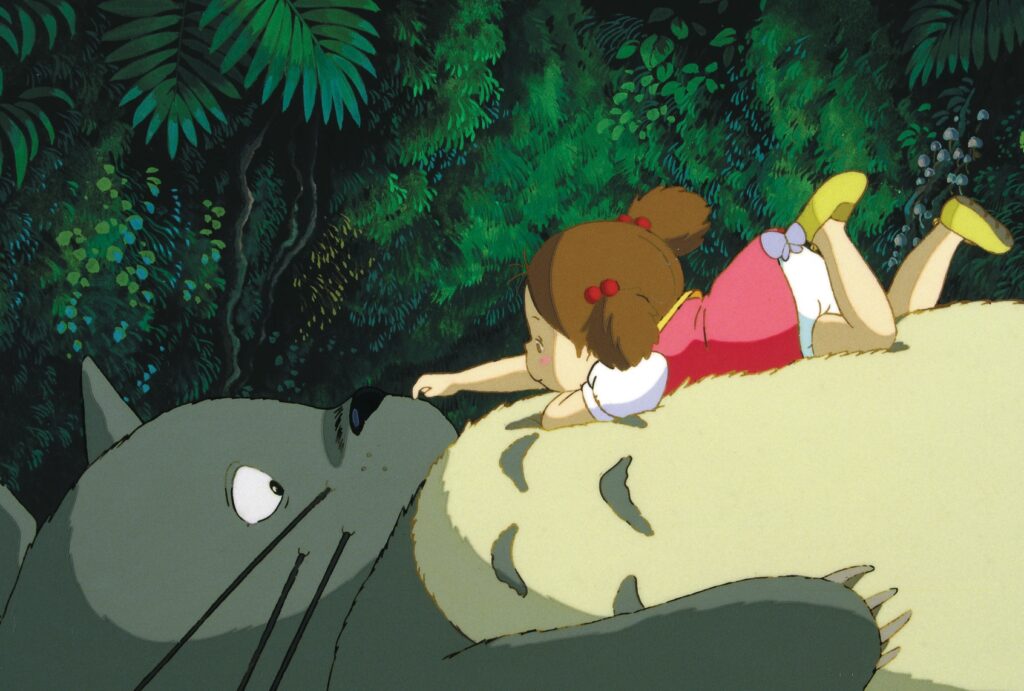
People still marvel at Miyazaki’s handcrafted backgrounds and his painstaking dedication to balancing its feather-light score with the melodies of flowing water or the gentle crunch of a child’s footfalls on grass and gravel. But Mei’s first meet-cute with her giant friend Totoro is what got me: she plops on his round belly as he sleeps, waking him up with her laugh as he yawns with a mouth big enough to swallow her whole. But Totoro would never harm Mei. That would break the spell Miyazaki weaves in every frame leading up to that moment.
“Totoro is where my consciousness begins,” Miyazaki once said. “It explains how my mind works.”
In the late 1980s – and certainly today, much more so – urban living distanced millions of people from their close connection to nature . . . and their parents. America had its latchkey generation and, along with that, a growing sense that the world is a dangerous place, especially its wilder parts.
Among the many culturally specific details that distributors feared would be misconstrued by Americans, the sight of a small child tumbling into a troll’s nest in the woods without any element of threat must have been low on their list.
Yet that’s precisely what made my first viewing of “Totoro” so unforgettable: Mei and Satsuki’s safety was never in doubt. Their father doesn’t dismiss their brush with the forest’s spirits as juvenile fantasy, either. Instead, he tells them that trees and people used to be good friends. By rekindling that relationship, the sisters (who are voiced by Dakota and Elle Fanning in the 2005 English language version) gain a huge and adorable new neighbor.
We need your help to stay independent.
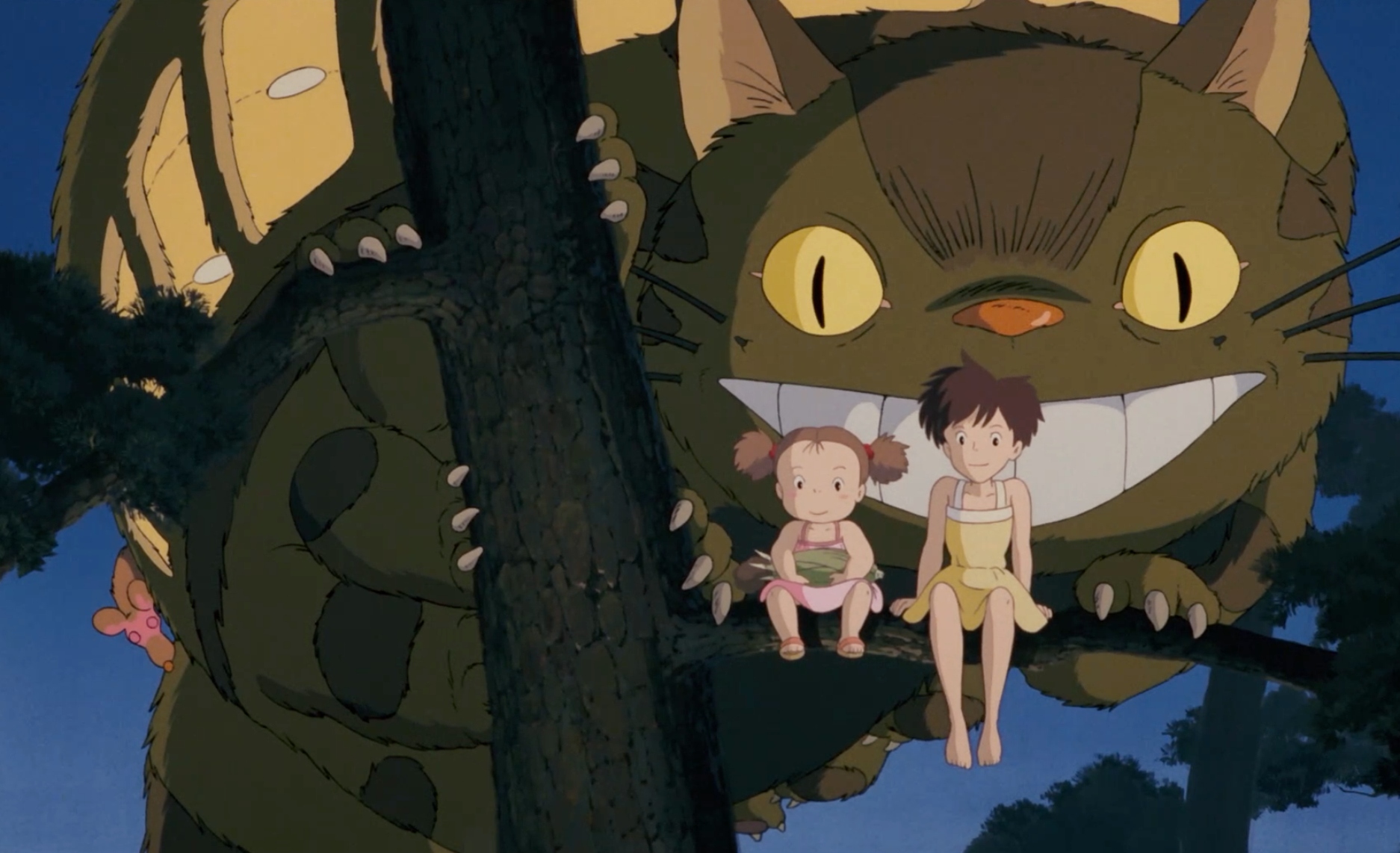
All that said, there were parts of the spirit world that I wasn’t entirely on board with. The Catbus is the movie’s second most popular mascot, but let’s be real — it looks like something out of acid nightmare. The thing’s Cheshire feline grin even made Satsuki a little nervous. Only when it reappeared later to give the girls a ride to the hospital did I drop my guard.
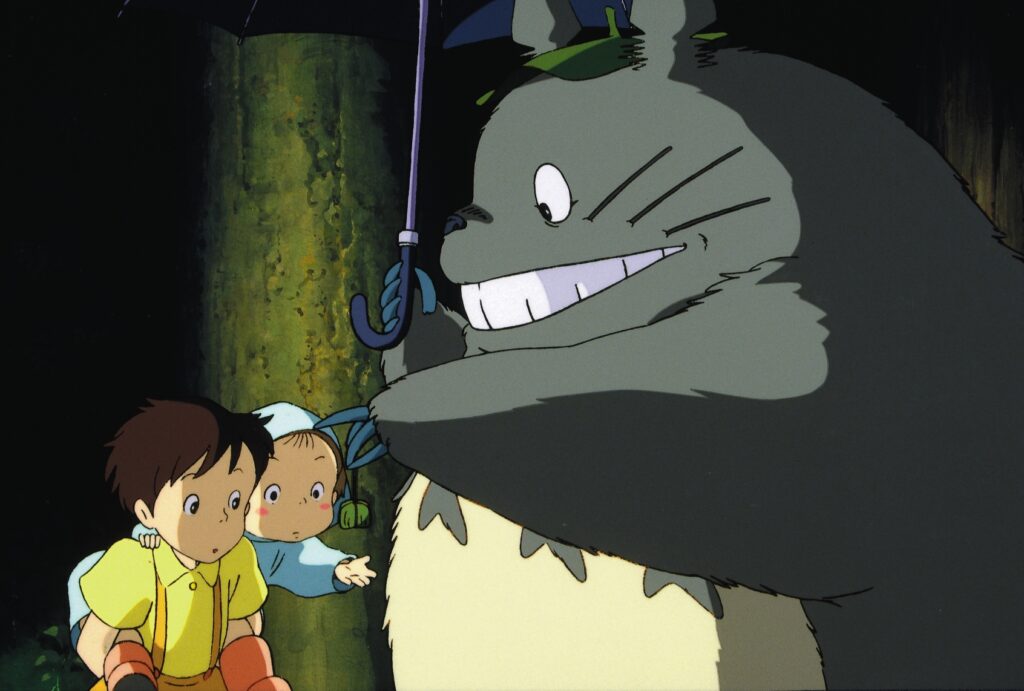
Today we take the hallowed status of “My Neighbor Totoro” for granted. In Japan, he’s a beloved figure on par with any Disney character. Pixar affirms this by incorporating a Totoro cameo into “Toy Story 3.” Sulley from “Monsters, Inc.” is said to have been inspired by Totoro, which Studio Ghibli winked at in 2021 by tweeting a version of the rainy bus stop scene that inserted him and his buddy Mike into the frame.
(©1988 Hayao Miyazaki/Studio Ghibli) Still from “My Neighbor Totoro.” ©1988 Hayao Miyazaki/Studio Ghibli
“Totoro is where my consciousness begins,” Miyazaki once said. “It explains how my mind works.” Deep observers of his catalog also view it as his most biographical feature, citing how closely Satsuki and Mei’s bucolic retreat resembles a chapter in the filmmaker’s childhood when his own mother was gravely ill.
Want more from culture than just the latest trend? The Swell highlights art made to last.
Sign up here
But to me, it’s a calm establishment of Miyazaki’s genius, acknowledged by its ranking on many best film lists, including one compiled by the late Akira Kurosawa — the only animated title he included on a list of 100 movies.
“My Neighbor Totoro” is a gateway into a pastoral ideal that still exists in living memory, reviving parts of our imagination that maturity has stifled into dormancy. And for 86 minutes, it assures us that some of the greatest cinematic treasures are also blissfully conflict-free.
Read more
from Salon’s Culture newsletter, The Swell
